Compound Embedding Features for Semi-supervised Learning
Mo Yu
1, Tiejun Zhao
1, Daxiang Dong
2, Hao Tian
2and Dianhai Yu
2Harbin Institute of Technology, Harbin, China Baidu Inc., Beijing, China
{yumo,tjzhao}@mtlab.hit.edu.cn
{dongdaxiang,tianhao,yudianhai}@baidu.com
Abstract
To solve data sparsity problem, recently there has been a trend in discriminative methods of NLP to use representations of lexical items learned from unlabeled data as features. In this paper, we investigated the usage of word representations learned by neural language models, i.e. word embeddings. The direct us-age has disadvantus-ages such as large amount of computation, inadequacy with dealing word ambiguity and rare-words, and the problem of linear non-separability. To overcome these problems, we instead built compound features from continuous word embeddings based on clustering. Experiments showed that the com-pound features not only improved the perfor-mances on several NLP tasks, but also ran faster, suggesting the potential of embeddings.
1
Introduction
Supervised learning methods have achieved great successes in the field of Natural Language
Pro-cessing (NLP). However, in practice most methods
are usually limited by the problem of data sparsity, since it is impossible to obtain sufficient labeled data for all NLP tasks. In these situations semi-supervised learning can help to make use of both labeled data and easy-to-obtain unlabeled data.
The semi-supervised framework that is widely applied to NLP is to first learn word representa-tions, which are feature vectors of lexical items, from unlabeled data and then plug them into a su-pervised system. These methods are very effective in utilizing large-scale unlabeled data and have successfully improved performances of
state-of-the-art supervised systems on a variety of tasks (Koo et al., 2008; Huang and Yates, 2009; Täck-ström et al., 2012).
With the development of neural language
mod-els (NLM) (Bengio et al., 2003; Mnih and Hinton,
2009), recently researchers become interested in word representations (also called word
embed-dings) learned by these models. Word embeddings
are dense low dimensional real-valued vectors. They are composed of some latent features, which are expected to capture useful syntactic and seman-tic properties. Word embeddings are usually served as the first layer in deep learning systems for NLP (Collobert and Weston, 2008; Socher et al., 2011a, 2011b) and help these systems perform compara-bly with the state-of-the-art models based on hand-crafted features. They also have been directly added as features to the state-of-the-art models of chunking and NER, and have achieved significant improvements (Turian et al. 2010).
Although the direct usage of continuous embed-dings has been proved to be an effective method for enhancing the state-of-the-art supervised mod-els, it has some disadvantages, which made them be out-performed by simpler Brown cluster fea-tures (Turian et al, 2010) and made them computa-tionally complicated. Firstly, embeddings of rare words are insufficiently trained since they are only updated few times and are close to their random initial values. As shown in (Turian et al, 2010), this is the main reason that models with embedding features made more errors than those with Brown cluster features. Secondly, in NLMs, each word has its unique representation, so it is difficult to represent different senses for ambiguous words. Thirdly, word embeddings are unsuitable for linear models in some tasks as will be proved in Section
4.2. This is possibly because in these tasks, either the target labels are correlated with combinations of different dimensions of word embeddings, or discriminative information may be coded in differ-ent intervals in the same dimension. So treating embeddings directly as inputs to a linear model could not fully utilize them. Moreover, since em-beddings are dense vectors, it will introduce large amount of computations when they are directly used as inputs, making the method impractical.
In this paper, we first introduced the idea of clustering embeddings to overcome the last two disadvantages discussed above. The high-dimensional cluster features make samples from different classes better separated by linear models. And models with these features can still run fast because the clusters are sparse and discrete.
Second, we proposed the compound features based on clustering. Compound features, which are conjunctive features of neighboring words, have been widely used in NLP models for improving the performances because they are more discriminative. Compound features of embeddings can also help a model to better predict labels associated with rare-words and ambiguous rare-words, because compound features composed of embeddings of nearby words can help to better describe the property of these words. Compound features are difficult to build on dense embeddings. However they are easy to in-duce from the sparse embedding clusters proposed in this paper.
Experiments on chunking and NER showed that based on the same embeddings, the compound fea-tures managed to achieve better performances. Moreover, we proposed analyses to reveal the rea-sons for the improvements of embedding-clusters and compound features. They suggest that these features can better deal with rare-words and word ambiguity, and are more suitable for linear models. In addition, although Brown clustering was con-sidered better in (Turian et al 2010), our experi-ment results and comparisons showed that our compound features from embedding clustering is at least comparable with those from Brown clustering. Since embeddings can greatly benefit from the im-provement and developing of deep learning in the future, we believe that our proposed method has a large space of performance growth and will benefit more applications in NLP.
In the rest of the paper, Section 2 introduces how compound embedding features were obtained.
Section 3 gives experimental results. In Section 4, we give analysis about the advantages of com-pound features. Section 5 gives the conclusions.
2
Clustering of Word Embeddings
2.1 Learning Word Embeddings
Word embeddings in this paper were trained by NLMs (Bengio et al., 2003). The model predicts the scores of probabilities of words given their context information in the sentences. It first con-verts the current word and its context words (e.g. n-1 words before it as in n-gram models) into em-beddings. Then these embeddings are put together and propagate forward on the network to compute the score of current word. After minimizing the loss on training data, embeddings are learned and can be further used as smoothing representations for words.
2.2 Clustering of embeddings
In order to get compound features of embeddings, we first induce discrete clusters from the embed-dings. Concretely, the k-means clustering algo-rithm is used. Each word is treated as a single sample. A cluster is represented as the mean of the embeddings of words assigned to it. Similarities between words and clusters are measured by Eu-clidean distance. As discussed and experimented later, different numbers of ks contain information of different granularity. So we combine clustering results achieved by different ks as features to better utilize the embeddings.
2.3 Compound features
Based on embedding clusters, more powerful com-pound features can be built. Comcom-pound features are conjunctions between basic features of words and their contexts, which are widely used in NLP. Koo et al. (2008) also observed that compound features of Brown clusters achieved more im-provements on parsing.
are not rare and are fully trained. So we could uti-lize the combination of embeddings before and after the word to predict its tag correctly. We con-ducted analysis to verify our theory in Section4.
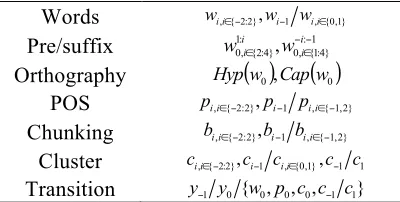
We combined the compound features together with other state-of-the-art human-craft features in supervised models. Examples of the resulted fea-ture templates in chunking and NER are shown in Table 1 & 2. The feature y−1 y0 c−1 c1 in the last
row is an example of compound feature made up of the embedding clusters of words before and af-ter current word. Compound feature extraction can similarly be applied to form compound features of Brown clusters. For example, Brown clusters can replace embedding clusters in 3th row of Table 1.
Words wi,i∈{−2:2},wi−1 wi,i∈{0,1}
POS pi,i∈{−2:2},pi−1 pi,i∈{−1,2}
Cluster ci,i∈{−2:2},ci−1 ci,i∈{0,1},c−1 c1
[image:3.612.83.283.359.460.2]Transition y−1 y0 {w0,p0,c0,c−1 c1}
Table 1: Chunking features. Cluster features are suitable for both Brown clusters and embedding clusters.
Sym-bolyiis the tag predicted on wordwi.
Words wi,i∈{−2:2},wi−1 wi,i∈{0,1}
Pre/suffix :1 } 4 : 1 { , 0 : 1
} 4 : 2 { ,
0∈ , −∈−
i i i
i w
w
Orthography Hyp
( )
w0,Cap( )
w0POS pi,i∈{−2:2},pi−1 pi,i∈{−1,2}
Chunking bi,i∈{−2:2},bi−1 bi,i∈{−1,2}
Cluster ci,i∈{−2:2},ci−1 ci,i∈{0,1},c−1 c1
Transition y−1 y0 {w0,p0,c0,c−1 c1} Table 2: NER features. Hyp indicates if word contains
hyphen and Cap indicates if first letter is capitalized.
3
Experiments
3.1 Experimental settings
We tested our compound features on the same chunking (CoNLL2000) and NER (CoNLL2003) tasks in (Turian et al., 2010). The Brown cluster features were used for comparison, which shared the same feature template used by clusters of em-beddings. To compare with the work of (Turian et al, 2010), which aimed to solve the same problem but using embedding directly, we used the same word embeddings (CW 50) and Brown clusters (1000 clusters) they provided. The embeddings in (Turian et al, 2010) are trained on RCV corpus, while the CoNLL2000 data is a part of the WSJ corpus. Since we believe that word representations
trained on similar domain may better help to im-prove the results, we also used embeddings and Brown clusters trained on unlabeled WSJ data from (Nivre et al, 2007) for comparison.
Moreover, we wish to find out whether our method extends well to languages other than Eng-lish. So we conducted experiments on Chinese NER, where large amount of training data exists, which makes improving accuracies more difficult. We used data from People’s Daily (Jan.-Jun. 1998) and converted them following the style of Penn CTB (Xue et al, 2005). Data from April was cho-sen as test set (1,309,616 words in 55,177 cho- sentenc-es), others for training (6,119,063 words in 255,951 sentences). The Chinese word representa-tions were trained on Chinese Wikipedia until March 2011. The features used in Chinese NER are similar to those in English, except for the or-thography, pre/suffixes, and chunking features.
We did little pre-processing work for the train-ing of word representations on WSJ data. The da-tasets were tokenized and capital words were kept. For training of Chinese Wikipedia, we retained the bodies of all articles and replaced words with fre-quencies lower than 10 as an “UK_WORD” token. On each dataset, we induced embeddings with 64 dimensions based on 7-gram models and 1000 Brown clusters. The method in (Schwenk, 2007) was used to accelerate the training processes of NLMs. All the NLMs were trained for 5 epochs.
For clustering of embeddings we choose k=500 and 2500 since such combination performed best on development set as shown in the next section. We chose the Sofia-ml toolkit (Sculley 2010) for clustering of embeddings in order to save time.
In the experiments CRF models were used and were optimized by ASGD (implemented by Léon Bottou). For comparison we re-implemented the direct usage of embeddings in (Turian et al, 2010) with CRFsuite (Okazaki, 2007) since their features contain continuous values.
3.2 Performances
Table 3 shows the chunking results. The results reported in (Turian et al. 2010) were denoted as
“direct”. Based on the same word representations,
show-ing that word representations from similar domains can better help the supervised tasks.
System Direct Compound
Baseline 93.75 +Embedding (RCV) 94.10 94.19 +Brown (RCV) 94.11 94.24 +Brown&Emb (RCV) 94.35 94.42
[image:4.612.323.533.71.142.2]+Embedding (WSJ) 94.20 94.37 +Brown (WSJ) 94.25 94.36 +Brown&Emb (WSJ) 94.43 94.58
Table 3: F1-scores of chunking
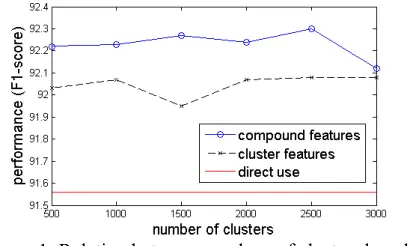
[image:4.612.76.298.97.211.2]In the experiments of NER, first we evaluated how the numbers of clusters k will affect the per-formances on development set (Figure 1). The re-sults showed that both the cluster features (excluding all compound embedding features) and compound features could achieve better results than direct usage of the same embeddings. It also showed that the performances did not vary much when k was between 500 and 3000. When k=2500, the result was a little higher than others. We finally chose combination of k=500 and 2500, which achieved best results on development set.
Figure 1: Relation between numbers of clusters k and performances on development set.
The performances of NER on test set are shown in Table 4. Our baseline is slightly lower than that in (Turian et al, 2010), because the first-order CRF cannot utilize context information of NE tags. Despite of this, same conclusions with chunking held.
System Direct Compound
[image:4.612.320.532.314.372.2]Baseline 83.78 +Embedding 87.38 88.46 +Brown 88.14 88.23 +Brown&Embedding 88.85 89.06
Table 4: F1-scores of English NER on test data
Performances on Chinese NER are shown in Table 5. Similar results were observed as in Eng-lish NER, showing that our method extends to oth-er languages as well.
System Direct Compound
Baseline 88.24 +Embedding 89.98 90.37 +Brown 90.24 90.55 +Brown&Embedding 90.66 90.96
Table 5: F1-scores of Chinese NER on test data
Above results gave evidences that although clus-tering embeddings may lose some information, the derived compound features did have better perfor-mances. The compound features can also improve the performances of Brown clusters, but not as much as they did on embeddings. And the combi-nation of embedding-clusters and Brown-clusters could further improve the performances, since they made use of different type of context information.
The compound features also reduced the time cost of using embedding features. For example, the time for tagging one sentence in English NER was reduced from 5.6 ms to 1.6 ms, shown in Table 6.
Embedding Time (ms)
Baseline 1.2
Embeddings (direct) 5.6 Embeddings (compound) 1.6
Table 6: Running time of different features
4
Analysis
Our compound embedding features greatly out-performed the direct usage of same embeddings on English NER. In this section we conducted anal-yses to show the reasons for the improvements.
4.1 Rare-words and ambiguous words
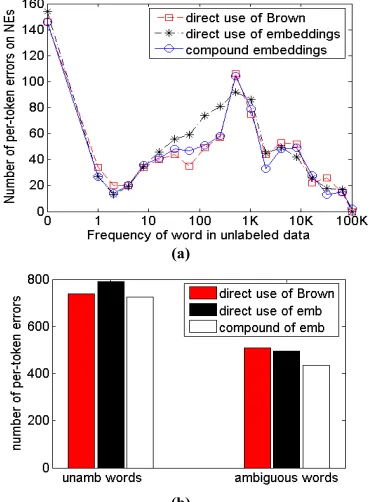
To show the compound features have stronger abil-ities to handle rare words, we counted the numbers of errors made on words with different frequencies on unlabeled data. Here the word frequencies are from the results of Brown clustering provided by (Turian et al. 2010). We compared our compound embedding features with direct usage of embed-dings as well as Brown clusters, which is believed to work better on rare words. Figure 2(a) shows that the compound features indeed resulted in few-er few-errors than the two baseline methods in most cases. Errors of embeddings occurred on words with frequencies lower than 2K and those in the range of 16 to 256 were reduced by 10.55% and 24.44%, respectively.
[image:4.612.88.292.370.493.2] [image:4.612.78.292.588.658.2]2(b), where the numbers of senses for a word are measured by the numbers of different POS tags it has in Penn Treebank. 12.1% of the errors on am-biguous words were reduced, comparing to 8.4% of the errors on unambiguous ones.
(a)
[image:5.612.95.282.143.394.2](b)
Figure 2: Errors incurred on words with different fre-quencies (a) and ambiguous words (b) in NER.
4.2 Linear separability of embeddings
Another reason for the good performances of com-pound features on NER is that they made linear models better separate named entities (NEs) and
non-NEs, which are more difficult to be linearly
separated when embeddings are directly used as features. Here we designed an experiment to prove this. Based on training data of CoNLL2003, a clas-sification task was built to tell whether a word be-longs to NE or not. Linear SVM and a non-linear model Multilayer Perceptron (MLP) were used to build the classifiers. As shown in Table 7, when embeddings were directly used as features, MLP performed much better than linear SVM. And the linear model was under-fitting on this task since it had similar accuracies on both training set and de-velopment set. Above observations showed that linear models could not separate NEs and non-NEs well in the space of embeddings.
When clusters of embeddings were used as fea-tures, the accuracies of linear models increased even when there were only one or two non-zero
features for each sample. At the same time the per-formances of MLP decreased because of the loss of information during clustering. The gaps between accuracies of linear models and non-linear ones decreased in the spaces of clusters, showing that cluster features are more suitable for linear models. At last, the compound features made the linear model out-perform all non-linear ones, since extra context information could be utilized.
Embeddings Models Accuracy
direct linear 94.38 direct MLP 96.87 cluster 1000 linear 95.31 cluster 1000 MLP 95.32 cluster 500+2500 linear 96.10 cluster 500+2500 MLP 96.02 compound linear 97.30
Table 7: Performances of linear and non-linear models on development set with different embedding features.
5
Conclusion and perspectives
In this paper, we first introduced the idea of clus-tering embeddings and then proposed the com-pound features based on clustering, in order to overcome the disadvantages of the direct usage of continuous embeddings. Experiments showed that the compound features built on the same original word representation features (either embeddings or Brown clusters) achieve better performances on the same tasks. Further analyses showed that the com-pound features reduced errors on rare-words and ambiguous words and could be better utilized by linear models.
The usage of word embeddings also has some limitations, e.g. they are weak in capturing struc-tural information of languages, which is necessary in NLP. In the future, we will research on task-specific representations for sub-structures, such as phrases and sub-trees based on word embeddings and documents representations (Xu et al., 2012).
Acknowledgments
[image:5.612.321.530.186.289.2]References
Bengio, Y., Ducharme, R., Vincent, P., and Jauvin, C. (2003). A neural probabilistic language models. The
Journal of Machine Learning Research, 3:1137– 1155.
Collobert, R. and Weston, J. (2008). A unified architecture for natural language processing: Deep neural networks with multitask learning. In
Proceedings of the 25th international conference on Machine learning, pages 160–167. ACM.
Finkel, J., Grenager, T., and Manning, C. (2005). Incorporating non-local information into information extraction systems by gibbs sampling. In
Proceedings of the 43rd Annual Meeting on Association for Computational Linguistics, pages 363–370. Association for Computational Linguistics. Huang, F. and Yates, A. (2009). Distributional
representations for handling sparsity in supervised sequence labeling. In Proceedings of the Joint Conference of the 47th Annual Meeting of the ACL and the 4th International Joint Conference on Natural Language Processing of the AFNLP: Volume 1-Volume 1, pages 495–503. Association for Computational Linguistics.
Koo, T., Carreras, X., and Collins, M. (2008). Simple semi-supervised dependency parsing. In Proceed-ings of Association for Computational Linguistics,
pages 595–603. Association for Computational Linguistics.
Mnih, A. and Hinton, G. E. (2009). A scalable hierarchical distributed language model. Advances in neural information processing systems, 21:1081– 1088.
Nivre, J., Hall, J., Kübler, S., McDonald, R., Nilsson, J., Riedel, S., and Yuret, D. (2007). The CoNLL 2007 shared task on dependency parsing. In Proceedings of the CoNLL Shared Task Session of EMNLP-CoNLL, pages 915–932.
Okazaki, N. (2007). Crfsuite: a fast implementation of conditional random fields (crfs). URL http://www.chokkan.org/software/crfsuite.
Schwenk, H. (2007). Continuous space language models.
Computer Speech & Language, 21(3):492–518. Sculley, D. (2010). Web-scale k-means clustering. In
Proceedings of the 19th international conference on World Wide Web, pages 1177–1178. ACM.
Socher, R., Huang, E., Pennington, J., Ng, A., and Manning, C. (2011a). Dynamic pooling and unfolding recursive auto-encoders for paraphrase
detection. Advances in Neural Information Processing Systems, 24:801–809.
Socher, R., Pennington, J., Huang, E., Ng, A., and Manning, C. (2011b). Semi-supervised recursive auto-encoders for predicting sentiment distributions. In Proceedings of the Conference on Empirical Methods in Natural Language Processing, pages 151–161. Association for Computational Linguistics. Täckström, O., McDonald, R., and Uszkoreit, J. (2012).
Cross-lingual word clusters for direct transfer of linguistic structure. In Proceedings of the North American Chapter of the Association for Computational Linguistics: Human Language Technologies, pages 477–487, Montréal, Canada, June 3-8, 2012.
Turian, J., Ratinov, L., and Bengio, Y. (2010). Word representations: a simple and general method for semi-supervised learning. In Annual Meeting-Association For Computational Linguistics. Urbana, 51:61801.
Xu, Z., Chen, M., Weinberger, K., and Sha, F. An alternative text representation to TF-IDF and Bag-of-Words. In Proceedings of 21st ACM Conf. of Information and Knowledge Management (CIKM), Hawaii, 2012.