Thread Popularity Prediction and Tracking with
a Permutation-invariant Model
Hou Pong Chan1,2 and Irwin King1,2 1Department of Computer Science and Engineering,
The Chinese University of Hong Kong, Shatin, N.T., Hong Kong
2Shenzhen Key Laboratory of Rich Media Big Data Analytics and Application,
Shenzhen Research Institute, The Chinese University of Hong Kong, Shenzhen, China
{hpchan, king}@cse.cuhk.edu.hk
Abstract
The task of thread popularity prediction and tracking aims to recommend a few popular comments to subscribed users when a batch of new comments arrive in a discussion thread. This task has been formulated as a reinforce-ment learning problem, in which the reward of the agent is the sum of positive responses received by the recommended comments. In this work, we propose a novel approach to tackle this problem. First, we propose a deep neural network architecture to model the ex-pected cumulative reward (Q-value) of a rec-ommendation (action). Unlike the state-of-the-art approach, which treats an action as a sequence, our model uses an attention mech-anism to integrate information from a set of comments. Thus, the prediction of Q-value is invariant to the permutation of the comments, which leads to a more consistent agent behav-ior. Second, we employ a greedy procedure to approximate the action that maximizes the predicted Q-value from a combinatorial action space. Different from the state-of-the-art ap-proach, this procedure does not require an ad-ditional pre-trained model to generate candi-date actions. Experiments on five real-world datasets show that our approach outperforms the state-of-the-art.
1 Introduction
Online discussion forums allow people to join in-depth conversations about different topics in form of threads. Each thread corresponds to one con-versation, which is initiated by a post and users respond to it with comments. In addition, a com-ment can be further replied by another comcom-ment, forming a discussion tree. Users who are inter-ested in a particular thread will subscribe to it. Af-ter the subscription, users will receive a notifica-tion when a new comment arrives in that thread. However, the speed of content generation in a
well-known discussion forum is breakneck. For instance, in Reddit1, there were more than 900 million comments posted in 2017 (Reddit,2017). Hence, merely pushing every new comment to the subscribers leads to a poor user experience. Mo-tivated by this issue, He et al.(2016c) proposed the task of threadpopularity predictionand track-ing. WhenN new comments arrive in a thread, the system performs one step of recommendation by pushing K comments to the subscribers. We want to maximize the sum of popularities of the recommended comments over all recommendation steps. The popularity of a comment is measured by the number of positive reactions it received, e.g., the rating. With the assumption that a user needs to know the prior context in order to under-stand a comment, the system can only recommend new comments that are in the subtrees of previ-ously recommended comments. Thus, the selec-tion of comments at the current recommendaselec-tion step will affect the comments that we can choose in the future recommendation steps.
To incorporate the long-term consequences of recommendations, the task of thread popularity prediction and tracking has been formulated as a reinforcement learning problem, in which an agent selects an action (a set ofKcomments) according to its current state (previous recommended com-ments), with the goal of maximizing the cumula-tive reward (total popularities of the recommended comments over all recommendation steps). The optimal action of the agent at each step is the action that maximizes the Q-function, Q(s, a), which denotes the long-term reward of choosing action ain state s. In practice, we learn this Q-function using a parametric Q-function, Q(s, a;θ), whereθis the model parameter vector. Thus, the predicted optimal action of the agent is the action
that maximizesQ(s, a;θ).
This reinforcement learning problem has two main challenges. First, we need to develop a para-metric model, Q(s, a;θ), to approximate the Q-function. Second, finding the action that maxi-mizesQ(s, a;θ)requires the prediction of all NK possible actions, which is intractable. Thus, we need a procedure to approximate the predicted op-timal action from a combinatorial action space.
To address the first challenge, He et al.
(2016c) proposed a neural network model, DRRN-BiLSTM, to approximate the Q-function. In this model, a bi-directional long short-term memory (LSTM) (Graves and Schmidhuber,2005) is used to encode the set of K comments in an action. To address the second challenge, they proposed the two-stage Q-learning procedure to approxi-mate the predicted optimal action (He et al.,2017). In this procedure, the agent uses a pre-trained and less-sophisticated model to rank all possible ac-tions, then it uses the DRRN-BiLSTM to re-rank the top-M actions and selects the best one. How-ever, this approach has two limitations. First of all, bi-directional LSTM is a sequence model, which treats the set of K comments in an action as a sequence. Although they tried to fix this prob-lem by feeding randomly-permuted comments to the model, a different permutation of the same set of comments leads to a different Q-value predic-tion. Thus, the agent may not consistently select the predicted optimal action. Secondly, the two-stage Q-learning procedure requires an additional pre-trained model to generate candidate actions.
Our work addresses these two limitations as follows. We propose a novel neural network model, DRRN-Attention, to approximate the Q-function. In our model, we use an attention mech-anism (Bahdanau et al., 2014) to integrate the information from a set of comment into an ac-tion embedding vector. In a nutshell, the atten-tion mechanism outputs a weighted sum of the comment representations, where the weights are learned by a subnetwork to indicate the impor-tance of each comment. Thus, the action embed-ding is invariant to the permutation of the com-ments, which leads to a permutation invariant Q-value prediction. Next, we employ a greedy pro-cedure to approximate the action that maximizes Q(s, a;θ). This procedure only requires the pre-diction ofO(N K) actions, which is significantly lower than KN
. Moreover, it does not require an
additional pre-trained model to generate candidate actions.
In our experiments, we evaluate the perfor-mance of our DRRN-Attention model and the greedy approximation procedure against the base-lines on five real-world datasets. Experimental re-sults demonstrate that our approach beats the base-lines on four of the datasets and achieves a com-petitive performance on one of the datasets. Fur-thermore, we analyze the performance of our ap-proach across four action sizes (K = 2,3,4,5). Our approach consistently achieves a higher cu-mulative reward than the baselines across all these action sizes.
We summarize our contributions as follow: (1) a new neural network architecture to model the Q-value of the agent which is invariant to the per-mutation of sub-actions; (2) a greedy procedure for the agent to select an action from the com-binatorial action space without an additional pre-trained model; and (3) the new state-of-the-art per-formances on five real-world datasets.
2 Related Work
2.1 Reinforcement Learning in Text-based Tasks
Reinforcement learning has been widely applied in various text-based tasks. There are several ar-ticles in literature studying the tasks of mapping instruction manuals to a sequence of commands, such as game commands (Branavan et al.,2011), software commands (Branavan et al., 2010), and navigation directions (Vogel and Jurafsky,2010). In the task of text-based game, an agent selects a textual command from a set of feasible com-mands at every time step. Narasimhan et al.
(2016) considered a special case that all the tex-tual commands have a fixed structure, while He et al.(2016b) and Chen et al. (2017) considered another case that all commands are free text.
In the task of thread popularity prediction and tracking, the agent selects a set of K comments from N available comments at every time step, where each comment is a free text. He et al.
ac-tion. To due with the combinatorial action space, the agent uses uniform sampling to generate a set ofM candidate actions. To improve this random sampling scheme, they proposed the two-stage Q-learning procedure in their later work (He et al.,
2017), which used a pre-trained model to gener-ate M candidate actions. Their experimental re-sults showed that using DRRN-BiLSTM with two-stage Q-learning procedure outperforms all other existing methods. The difference between our model and DRRN-BiLSTM is that we use atten-tion to encode a set of comments rather than using a bi-directional LSTM. Besides, the greedy pro-cedure in our approach does not require any extra pre-trained model. He et al. (2017) also consid-ered a special case that the agent can access an ex-ternal knowledge source to augment the state rep-resentation. This setting is orthogonal to this work since we focus on the action encoding and the ap-proximation of predicted optimal action.
One line of research focused on the in-tegration of sequence-to-sequence (SEQ2SEQ) model (Sutskever et al.,2014) and reinforcement learning framework, examples including dialogue generation (Dhingra et al., 2017;Li et al., 2016;
Su et al.,2016), question answering system (Buck et al., 2017), and machine translation (He et al.,
2016a). In these tasks, the agent selects an action by generating a free text using a SEQ2SEQ model.
2.2 Deep Learning on Sets
Most of the deep learning models on sets em-ployed attention to integrate information from a set of input. This idea was first introduced in the read-process-and-write network (Vinyals et al.,
2016), which uses a process module to perform multiple steps of attention over a set of vectors to obtain a permutation-invariant embedding. Our work adapts this idea to aggregate a set of com-ment embedding vectors. In the domain of graph learning, several models (Sukhbaatar et al.,2015;
Zhang et al.,2017) learn an embedding of a node by attending over its neighboring nodes. All of the above models can be interpreted as a special case of memory network (Weston et al., 2015;
Sukhbaatar et al.,2015;Zhang et al.,2017), if we view the set of feature vectors as external mem-ory. Max-pooling is another promising technique for the problem of learning on sets.Qi et al.(2017) used max-pooling to aggregate the feature vectors of a set of 3D geometry points. Recently,Zaheer
et al. (2017) derived the necessary and sufficient conditions for a neural network layer to be permu-tation invariant.
2.3 Popularity Prediction
Another related line of research is popularity prediction problem in a supervised learning set-ting. Yano and Smith(2010) used the LDA topic model (Blei et al., 2003) to predict the number of comments of a blog post in a political blog. There are also several studies focused on the task of predicting the number of reshares on Face-book (Cheng et al., 2014) and the number of retweets in tweeter based on the text content (Tan et al.,2014;Hong et al.,2011). Recently, Cheng et al.(2017) proposed a neural network model to learn comment embeddings for the task of com-munity endorsement prediction in a supervised learning setting.
3 Preliminary
3.1 Discussion Tree
A discussion thread in an online forum can be rep-resented as a tree. Each node in the tree stores a free text. The root node represents the post of the thread and each non-root node represents a com-ment of the thread. There is a directed edge from nodeuto nodevif and only if a comment (or post) uis replied by commentv. This tree keeps grow-ing as new comments are submitted to the thread.
3.2 Problem Definition
The task of thread popularity prediction and track-ing is formally defined as a reinforcement learntrack-ing problem. We use Mt to denote the set of
com-ments that are being tracked at time t. Given a discussion thread, we start an episode as follows. First, we initializeM1 to be the post of a thread.
Then, at each time step t the agent performs the following operations:
• Read the current statest, which is all the
pre-viously tracked comments{M1, . . . , Mt}.
• Read N new comments, ct =
{ct,1, . . . , ct,N}, in the subtree ofMt.
• Select a set ofK comments fromct to
rec-ommend,at = {c1t, . . . , cKt }, wherecit ∈ ct
• Receive a reward, rt+1 = PKi=1ηci
t, where ηci
t is the number of positive reactions re-ceived by commentcit.
• Track the set of recommended comments in the next time step,Mt+1 =at.
The episode terminates when no more new com-ments appear in the subtree ofMt. The goal of the
agent is to maximize the cumulative reward.
3.3 Q-function
The state-action value function (or Q-function), Q(s, a), is defined as the expected cumulative re-ward starting from state s and taking action a. More formally,Q(s, a) =E[Pl+=0∞γlrt+1+l|st =
s, at = a], where γ ∈ (0,1]is a discount factor
for future rewards. Since the goal of the agent is to maximize the cumulative reward, the opti-mal action for each state is the action that achieves the highest Q-value. Thus, the Q-function is as-sociated with an optimal policy: in every state, the agent selects the action that maximizes the Q-function, i.e., at = argmaxaQ(st, a), ∀t.
Since this Q-function is unknown to the agent, we approximate the Q-function using a paramet-ric model,Q(s, a;θ), and update the parametersθ using received rewards.
3.4 Exploration-Exploitation Trade-off
The agent needs to balance the exploration-exploitation trade-off when selecting an action. On one hand, the agent can choose the action with the highest estimated Q-value to exploit its cur-rent knowledge of the Q-function. On the other hand, the agent can choose a non-greedy action to get more information about the Q-value of other actions. The balance between exploration and ex-ploitation can be achieved by using the -greedy policy, in which the agent selects a random action with probability, and selects a greedy action with probability1−. Note that the term “greedy” in the -greedy policy means that the agent selects the action that is predicted to be optimal, i.e., se-lectat = argmaxaQ(st, a;θ). It does not refer
to the greedy procedure, which is used to approxi-mate the predicted optimal action in a combinato-rial action space.
4 DRRN-Attention Model
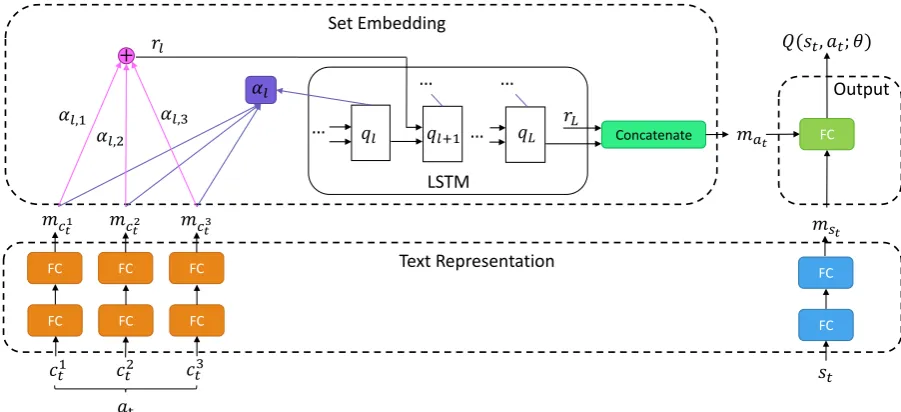
In this work, we propose a new deep neural net-work model, named DRRN-Attention, to
approxi-mate the Q-function for the task of thread popular-ity prediction and tracking. The input to our model is a state,st, and an action,at={c1t, . . . , cKt }, as
defined in Section3.2. The output is the prediction of Q-value, i.e., Q(st, at;θ) ∈ R. Figure1
illus-trates the overall architecture of DRRN-Attention. We divide our model into three modules as fol-lows.
4.1 Text Representation Module
The text representation module reads st and
at={c1t, . . . , cKt }. We first convertst, c1t, . . . , cKt
into bag-of-words (BOW) representations,
bst, bc1
t, . . . , bcKt . Then, we use a 2-layer feed-forward neural network to embed bst into a d-dimensional state embedding vector,mst ∈R
d.
After that, we use another 2-layer feedforward neural network to embedbci
t into ad-dimensional comment embedding vector, mci
t ∈ R
d, for
i = 1, . . . , K. This module outputs mst and
{mc1
t, . . . , mcKt }.
4.2 Set Embedding Module
The input to this module is a set ofd-dimensional comment embeddings,{mc1
t, . . . , mcKt }. The out-put is an action embedding vector, mat ∈ R
h+d,
which is invariant to the ordering of comment em-beddings. The module consists of a single-layer LSTM with a hidden size ofh, and a shared atten-tion mechanism, f : Rh×Rd → R. The initial
hidden state,q0 ∈ Rh, of the LSTM is a trainable
vector. Inspired by (Vinyals et al.,2016), we per-formL steps of computations over the comment embedding vectors. More specifically, at each step of computationl= 0,1, . . . , L−1:
• The query vector,ql∈Rh, is the current
hid-den state of the LSTM.
• Apply the attention mechanism to compute an attention coefficient, ei,l, between the
query, ql, and a comment embedding, mci t, fori= 1, . . . , K. In general, this framework is agnostic to the underlying attention mech-anism. In this work, we closely follow the attentional setup in (Bahdanau et al., 2014), as shown in the following equation.
ei,l =vT tanh(Wemci
t+Ueql), (1)
where v ∈ Rh0, W
e ∈ Rh
0×d
, and Ue ∈
Rh
0×h
The 4-th Greater China MOOC Symposium, July 21, 2017, Hong Kong Hou Pong CHAN
1 𝑐𝑡1 𝑐𝑡3
𝑎t
𝑐𝑡2
FC FC
FC FC
FC FC
𝑚𝑐𝑡1 𝑚𝑐 𝑡3
𝑚𝑐𝑡2
𝑞𝑙
… 𝑞𝑙+1 … 𝛼𝑙,1
𝛼𝑙,2
𝛼𝑙,3
𝑟𝑙
… Concatenate 𝑚𝑎𝑡
𝑟𝐿
𝑞𝐿
… 𝛼𝑙
𝑠𝑡 FC FC
𝑚𝑠𝑡
𝑄(𝑠𝑡, 𝑎𝑡; 𝜃)
LSTM
Text Representation
Output Set Embedding
+
[image:5.595.72.523.63.269.2]FC
Figure 1: Architecture of DRRN-Attention model. The text representation module first converts statestand each
commentcit in actionat into embedding vectors. Then, the comment embedding vectors are passed to the set
embedding module to learn an action embedding vector. Finally, the state embedding and the action embedding are passed to the output module to output a prediction of Q-value.
• Apply softmax function to normalize the at-tention coefficients,
αi,l=
exp(ei,l)
PK
j=1exp(ej,l)
. (2)
• Use the normalized attention coefficients to compute a weighted sum of the comment em-bedding vectors, as the readout in this com-putation step,
rl= K
X
i=1
αi,lmci
t. (3)
• The LSTM takesqlandrl as input and
com-putes the next hidden state,ql+1,
ql+1=LSTM([ql, rl]). (4)
Note that swapping any two comment embed-ding vectors, mci
t and mcjt, will not affect the query vector ql as well as the attention readout
rl. AfterLsteps of computation, this module
con-catenatesqLandrLto yield the final output action
embedding,mat = [qL, rL]∈R
h+d.
4.3 Output Module
The input to this module is a state embedding vec-tor, mst ∈ R
d, and an action embedding
vec-tor, mat ∈ R
h+d. We simply concatenate m st andmat and pass them through a fully-connected layer. The output isQ(st, at;θ)∈R, which is the
prediction ofQ(st, at).
Algorithm 1Greedy(st, ct, Q(·,·;θ), K) 1: a=∅
2: fori= 1→K do
3: c∗ = argmaxc∈ct\aQ(st, a∪c;θ)
4: a=a∪c∗
5: returna
5 Greedy Procedure
The next challenge that we need to address is to approximate the predicted optimal action in a combinatorial action space. Finding the predicted optimal action,argmaxaQ(st, a;θ), is intractable
since it requires the prediction of all NK
actions. In this work, we use a greedy procedure to com-pute an approximation. The complete procedure is shown in Algorithm1. We start from an empty action, at = ∅, and then iteratively adds intoat
the comments that leads to the largest increase in Q(st, at;θ), until|at| = K. The procedure
con-sists ofK iterations. In each iterationi, we need to predict the Q-value forn−iactions. In total, it only requires the prediction ofO(N K)actions, which is tractable. The advantage of this proce-dure over existing methods is that it does not re-quire another pre-trained model to generate candi-date actions.
6 Parameter Learning
We use the deep Q-learning algorithm (Mnih et al.,
Q-learning algorithm (Watkins and Dayan,1992), to learn the model parameters ofQ(s, a;θ)from the received rewards. The complete training proce-dure is shown in Algorithm 2 in the Appendix. The network parameters θ are first initialized ar-bitrarily. At each time step t, the agent selects an actionataccording to the-greedy policy,
re-ceives a rewardrt+1, and transits to the next state
st+1. Thus, it yields a transition tuple, ζt = (st, at, rt+1, st+1). Instead of using the current
transition tuple, ζt, to update the parameters, we
first storeζtinto an experience memory,D. This
experience memory has a limited capacity, |D|, and the stored transition tuples are rewritten in a first-in-first-out manner. Then, we sample mini-batches of transition tuples(s, a, r, s0)fromD uni-formly at random. Using the sampled transition tuples, we perform a step of stochastic gradient de-scent to minimize the following loss function,
L(θ) =E(s,a,r,s0)∼U(D)[(y−Q(s, a;θ))2], (5)
where y = r + γmaxa0Q(s0, a0;θ−) is the
Q-learning target,θ− are the network parameters of the Q-learning target. We updateθ−to match the network parameters, θ, after everyF time steps, whereF is a hyperparameter.
7 Experimental Setup
In the experiments, we analyze the performances of different neural network models and differ-ent approximation procedures. First, their perfor-mances are evaluated on five real-world datasets, with a fix action sizeK. Then, we evaluate their performances with different action sizes, on one dataset. For each experiment setting, we do the following comparative analysis:
• Compare the performance of our
DRRN-Attention model with the baseline models us-ing different approximation procedures.
• Compare the performance of the greedy cedure with the baseline approximation pro-cedures using different neural network mod-els.
• Find the approach (combination of neural network model and approximation proce-dure) that achieves the best performance.
Finally, we conduct a case study to better illus-trate the difference between our DRRN-Attention model and the DRRN-BiLSTM baseline.
Subreddit # Posts # Comments
askscience 0.94k 0.15M
askmen 4.45k 0.94M
todayilearned 9.44k 4.65M
worldnews 8.00k 4.28M
[image:6.595.323.511.63.152.2]nfl 11.73k 5.72M
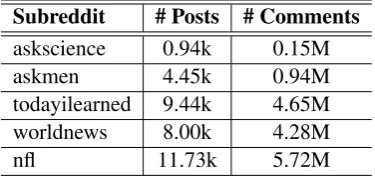
Table 1: Basic statics of discussion threads data from five subreddits.
7.1 Datasets
All the experiments are conducted on discussion thread data from the Reddit discussion forum. In Reddit, threads are grouped into different cate-gories, called subreddits, according to different discussion themes. Registered users are allowed to give up-votes or down-votes to a comment, these votes are then aggregated to compute a karma score for the comment. We use it as the re-ward for recommending that comment. Using the post IDs provided by He et al. (2016c), we crawl five datasets from five different subreddits respectively, including askscience, askmen, today-ilearned, worldnews, and nfl. These subreddits cover a wide range of discussion topics and lan-guage styles. The basic statistics of the datasets are presented in Table1. Since some of the posts and comments were deleted by Reddit, we re-move all the deleted posts and comments from the datasets. Thus, the statistics of our datasets are different from that inHe et al.(2016c). For each dataset, we use the simulator provided byHe et al.
(2016c) to partition 90% of the data as a training set, and 10% of the data as a testing set.
7.2 Evaluation
The evaluation metric is the cumulative reward per episode averaged over 1,000 episodes (He et al.,
Models Procedure Askscience Askmen Todayilearned Worldnews NFL
DRRN-BiLSTM
Random 546.9±21.8 183.1±7.2 654.9±27.3 427.4±21.9 438.7±16.1
Two-stage 643.2±28.2 184.3±9.2 659.0±25.6 424.0±14.0 455.9±18.7 Greedy 672.2±22.2 190.2±11.5 665.7±11.4 428.8±21.0 459.7±9.3
DRRN-Mean
Random 594.5±21.9 184.7±6.9 649.6±21.7 413.9±11.7 434.1±22.9
Two-stage 581.1±13.0 183.3±5.6 670.4±29.7 426.7±24.2 441.9±20.3
Greedy 732.3±25.7 194.2±7.8 680.0±31.0 435.4±18.5 452.3±22.6
Our model
Random 648.6±19.6 186.1±8.2 670.5±26.5 429.4±20.8 452.5±17.9
Two-stage 685.6±24.6 184.7±7.5 672.2±37.8 426.1±18.2 460.3±15.7
Greedy 757.4±10.9 210.6±11.3 689.5±13.3 436.0±21.9 454.2±12.0
Table 2: Comparison of average episodic reward on different datasets.
7.3 Baselines
Our DRRN-Attention model is compared with two baselines. The first one is DRRN-BiLSTM, which is the current state-of-the-art model to approxi-mate the Q-value for this task (He et al., 2016c). We modify the DRRN-BiLSTM model by replac-ing the Bi-directional LSTM with a mean opera-tor and call this new model DRRN-Mean. This DRRN-mean is used as the second baseline model. In addition, we compare the greedy procedure with two baseline approximation procedures. The first is random sampling procedure in (He et al.,
2016c). The second is the two-stage Q-learning procedure in (He et al.,2017), which is the state-of-the-art approximation procedure for this task.
7.4 Implementation Details
In preprocessing, we remove all punctuations and lowercase all alphabetic characters. To construct the bag-of-words representations, we use the dic-tionary provided byHe et al.(2016c). This dictio-nary contains the most frequent 5,000 words in the data. All model parameters are initialized by a uni-form distribution within the interval [−0.1,0.1]. In our DRRN-Attention model, we set the com-ment embedding size dto 16, the hidden size of the LSTM h to 16, the hidden size of the atten-tion mechanism h0 to 16, and the steps of atten-tion L to 2. In the text embedding module of DRRN-Attention, each fully-connected layer has a hidden size of 16. In the baseline models, we set the hidden size of the bidirectional LSTM to 20, the comment embedding size to 20. The text embedding module of the baselines has two lay-ers and each layer has a hidden size of 20. For the deep Q-learning algorithm, we setF = 1000. We update the model parameters using stochas-tic gradient descent with RMSprop (Tieleman and
Hinton, 2012). We set different initial learning rates for different datasets (askscience: 0.00001; askmen: 0.00008; todayilearned, worldnews, and nfl: 0.00002). The mini batch size is 100. All the above hyperparameters are tuned by five-fold cross-validation. We also found that the model performances tuned by five-fold cross-validation are similar to that tuned by the testing set. We set the remaining hyperparameters according to (He et al.,2017). The memory size|D|is set to 10000. The discount factorγ is set to 0.9. The candidate size m of the baseline approximation procedures is set to 10.
8 Experimental Results
8.1 Agent Performances on Various Datasets
us-Models Procedure K=2 K=3 K=4 K=5
DRRN-BiLSTM
Random 431.6±18.8 546.9±21.8 743.7±15.9 899.5±53.9 Two-stage 484.3±10.6 643.2±28.2 765.7±32.8 928.6±20.5 Greedy 467.8±24.5 672.2±22.2 772.9±28.2 929.2±18.6
Our model
Random 482.7±18.1 648.6±19.6 806.0±13.5 941.2±7.3 Two-stage 537.5±26.1 685.6±24.6 772.8±22.8 903.5±22.4
[image:8.595.99.500.64.164.2]Greedy 545.2±27.3 757.4±10.9 820.1±24.2 944.1±29.6
Table 3: Comparison of average episodic reward with different action sizes on askscience dataset.
ing DRRN-Attention model with the greedy pro-cedure outperforms all the baselines in four of the datasets.
8.2 Agent Performances on Various Action Sizes
We evaluate all the neural network models and approximation procedures across various action sizes with K = 2,3,4,5 and fix N = 10 on the askscience dataset. The results are presented in Table 3. Our DRRN-Attention model outper-forms the baselines across all the action sizes form K = 2toK = 5with the random sampling pro-cedure or the greedy propro-cedure. With the two-stage Q-learning procedure, our model achieves a higher cumulative reward than the baseline mod-els whenK = 2,3,4. Then, we analyze the per-formance of the greedy procedure in each neural network model. When using the DRRN-BiLSTM to parameterize the Q-function, the greedy pro-cedure outperforms the baseline propro-cedures when K = 3,4,5. When using our DRRN-Attention, the greedy procedure achieves a higher cumulative reward than the baselines whenK = 2,3,5. Over-all, using the DRRN-Attention model with the greedy procedure achieves the best performances across all the action sizes formK = 2toK = 5.
8.3 Case Study
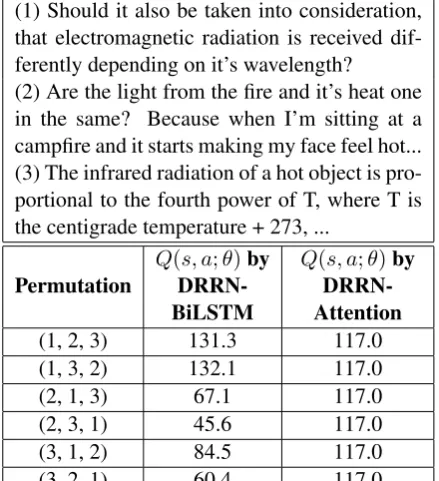
Table4presents an example of Q-value prediction of a state and three sub-actions on the askscience dataset. In this study, we enumerate every per-mutation of these three sub-actions, e.g., (1, 3, 2) denotes a permutation of comments that we place comment (1) in the first position, comment (3) in the second position, and comment (2) in the third position. Then, we use a trained DRRN-BiLSTM model and a trained DRRN-Attention model to predict the Q-value of each permutation of com-ments. When we use the DRRN-BiLSTM model, a different permutation of comments yields a
dif-State
Is the heat I feel when I face a bonfire trans-mitted to me mostly by infrared radiation or by heated air?
Sub-actions (comments)
(1) Should it also be taken into consideration, that electromagnetic radiation is received dif-ferently depending on it’s wavelength?
(2) Are the light from the fire and it’s heat one in the same? Because when I’m sitting at a campfire and it starts making my face feel hot... (3) The infrared radiation of a hot object is pro-portional to the fourth power of T, where T is the centigrade temperature + 273, ...
Permutation
Q(s, a;θ)by DRRN-BiLSTM
Q(s, a;θ)by DRRN-Attention
(1, 2, 3) 131.3 117.0
(1, 3, 2) 132.1 117.0
(2, 1, 3) 67.1 117.0
(2, 3, 1) 45.6 117.0
(3, 1, 2) 84.5 117.0
[image:8.595.307.527.271.512.2](3, 2, 1) 60.4 117.0
Table 4: A Q-value prediction example using DRRN-BiLSTM and DRRN-Attention.
ferent Q-value prediction. The Q-value predic-tion of the permutapredic-tion (1, 3, 2) almost triples that of the permutation (2, 3, 1). On the other hand, any permutation of the comments does not change the Q-value prediction when we use our DRRN-Attention model. This example demon-strates that the ordering of the comments can sig-nificantly affect the predicted Q-value when we use the DRRN-BiLSTM model.
8.4 Discussions
com-Subreddit # Cmts (their) # Cmts (our)
askscience 0.32M 0.15M
askmen 1.06M 0.94M
todayilearned 5.11M 4.65M
worldnews 5.99M 4.28M
[image:9.595.70.291.64.154.2]nfl 6.12M 5.72M
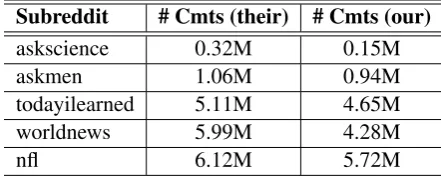
Table 5: The number of comments in the datasets used byHe et al.(2016c) and us.
Subreddit Reward (their) Reward (our)
askscience 833.9 643.2
askmen 148.0 184.3
todayilearned 697.9 659.0
Table 6: The cumulative reward achieved by the DRRN-BiLSTM + two-stage Q-learning baseline re-ported byHe et al.(2017) and us.
pares the number of comments in the datasets used by (He et al., 2016c) and us. The experiments in (He et al., 2017) used three of the datasets (askscience, askmen, and todayilearned) from (He et al.,2016c). We compare our results and the re-sults reported in (He et al., 2017) of the DRRN-BiLSTM + two-stage Q-learning baseline on these three datasets in Table6. On the askscience and to-dayilearned datasets, the results of our implemen-tation are worse than the results reported by them. Since the number of comments in our askscience dataset is only half of that in (He et al.,2017), the results of our implementation on the askscience dataset are significantly worse than the results re-ported by them. On the askmen dataset, the num-ber of comments that we use is slightly less than the askmen dataset used by them. However, the results of our implementation on askmen are bet-ter than the results reported by them. We suspect that the deleted comments may have low karma scores, which cause the agent to achieve a higher cumulative reward.
9 Conclusion
In this work, we propose a new approach to the task of thread popularity prediction and tracking. In our approach, we propose a new neural network architecture, DRRN-Attention, to approximate the Q-function, which well respect the permutation in-variance of the comments in an action. Moreover, our approach employs the greedy procedure to approximate the predicted optimal action, which does not require an additional pre-trained model
to generate candidate actions. Empirical studies on real data demonstrate that our approach beats the current state-of-the-art in most of the experi-mental settings.
Acknowledgments
The work described in this paper was partially supported by the Research Grants Council of the Hong Kong Special Administrative Region, China (No. CUHK 14208815 of the General Research Fund) and the Ministry of Education of China (D.01.16.00101). We would like to thank Jiani Zhang, Hongyi Zhang, Wang Chen, Yifan Gao, and Xiaotian Yu for their comments.
References
Dzmitry Bahdanau, Kyunghyun Cho, and Yoshua Ben-gio. 2014. Neural machine translation by jointly learning to align and translate. InICLR, 2014.
David M. Blei, Andrew Y. Ng, and Michael I. Jordan. 2003. Latent dirichlet allocation. Journal of Ma-chine Learning Research, 3:993–1022.
S. R. K. Branavan, David Silver, and Regina Barzi-lay. 2011. Learning to win by reading manuals in a monte-carlo framework. InACL, 2011.
S. R. K. Branavan, Luke S. Zettlemoyer, and Regina Barzilay. 2010. Reading between the lines: Learn-ing to map high-level instructions to commands. In ACL, 2010.
Christian Buck, Jannis Bulian, Massimiliano Cia-ramita, Andrea Gesmundo, Neil Houlsby, Wojciech Gajewski, and Wei Wang. 2017. Ask the right ques-tions: Active question reformulation with reinforce-ment learning. InICLR, 2018.
Jianshu Chen, Chong Wang, Lin Xiao, Ji He, Lihong Li, and Li Deng. 2017. Q-LDA: uncovering latent patterns in text-based sequential decision processes. InNIPS, pages 4984–4993, 2017.
Hao Cheng, Hao Fang, and Mari Ostendorf. 2017. A factored neural network model for characteriz-ing online discussions in vector space. InEMNLP, pages 2296–2306, 2017.
Justin Cheng, Lada A. Adamic, P. Alex Dow, Jon M. Kleinberg, and Jure Leskovec. 2014. Can cascades be predicted? InWWW, pages 925–936, 2014.
Alex Graves and J¨urgen Schmidhuber. 2005. Frame-wise phoneme classification with bidirectional LSTM and other neural network architectures. Neu-ral Networks, 18(5-6):602–610.
Di He, Yingce Xia, Tao Qin, Liwei Wang, Nenghai Yu, Tie-Yan Liu, and Wei-Ying Ma. 2016a. Dual learn-ing for machine translation. In NIPS, pages 820– 828, 2016.
Ji He, Jianshu Chen, Xiaodong He, Jianfeng Gao, Li-hong Li, Li Deng, and Mari Ostendorf. 2016b. Deep reinforcement learning with a natural language ac-tion space. InACL, Volume 1, 2016.
Ji He, Mari Ostendorf, and Xiaodong He. 2017. Re-inforcement learning with external knowledge and two-stage q-functions for predicting popular reddit threads. CoRR, abs/1704.06217.
Ji He, Mari Ostendorf, Xiaodong He, Jianshu Chen, Jianfeng Gao, Lihong Li, and Li Deng. 2016c. Deep reinforcement learning with a combinatorial action space for predicting popular reddit threads. In EMNLP, pages 1838–1848, 2016.
Liangjie Hong, Ovidiu Dan, and Brian D. Davison. 2011. Predicting popular messages in twitter. In WWW, pages 57–58, 2011
Jiwei Li, Will Monroe, Alan Ritter, Dan Jurafsky, Michel Galley, and Jianfeng Gao. 2016. Deep re-inforcement learning for dialogue generation. In EMNLP, pages 1192–1202, 2016.
Volodymyr Mnih, Koray Kavukcuoglu, David Silver, Andrei A. Rusu, Joel Veness, Marc G. Bellemare, Alex Graves, Martin A. Riedmiller, Andreas Fidje-land, Georg Ostrovski, Stig Petersen, Charles Beat-tie, Amir Sadik, Ioannis Antonoglou, Helen King, Dharshan Kumaran, Daan Wierstra, Shane Legg, and Demis Hassabis. 2015. Human-level con-trol through deep reinforcement learning. Nature, 518(7540):529–533.
Karthik Narasimhan, Adam Yala, and Regina Barzilay. 2016. Improving information extraction by acquir-ing external evidence with reinforcement learnacquir-ing. InEMNLP, pages 2355–2365, 2016.
Charles Ruizhongtai Qi, Hao Su, Kaichun Mo, and Leonidas J. Guibas. 2017. Pointnet: Deep learning on point sets for 3d classification and segmentation. InCVPR, pages 77–85, 2017.
Reddit. 2017. The best of reddit in 2017. https://redditblog.com/2017/12/ 19/the-best-of-reddit-in-2017/. Accessed: May 22, 2018.
Pei-Hao Su, Milica Gasic, Nikola Mrksic, Lina Maria Rojas-Barahona, Stefan Ultes, David Vandyke, Tsung-Hsien Wen, and Steve J. Young. 2016. Con-tinuously learning neural dialogue management. CoRR, abs/1606.02689.
Sainbayar Sukhbaatar, Arthur Szlam, Jason Weston, and Rob Fergus. 2015. End-to-end memory net-works. InNIPS, pages 2440–2448, 2015.
Ilya Sutskever, Oriol Vinyals, and Quoc V Le. 2014. Sequence to sequence learning with neural net-works. InNIPS, pages 3104–3112, 2014.
Chenhao Tan, Lillian Lee, and Bo Pang. 2014. The effect of wording on message propagation: Topic-and author-controlled natural experiments on twitter. InACL, pages 175–185, 2014.
Tijmen Tieleman and Geoffrey Hinton. 2012. Lecture 6.5-rmsprop: Divide the gradient by a running av-erage of its recent magnitude. COURSERA: Neural networks for machine learning, 4(2):26–31.
Petar Velickovic, Guillem Cucurull, Arantxa Casanova, Adriana Romero, Pietro Li`o, and Yoshua Ben-gio. 2017. Graph attention networks. CoRR, abs/1710.10903.
Oriol Vinyals, Samy Bengio, and Manjunath Kudlur. 2016. Order matters: Sequence to sequence for sets. InICLR, 2015.
Adam Vogel and Daniel Jurafsky. 2010. Learning to follow navigational directions. InACL, pages 806– 814, 2010.
Christopher JCH Watkins and Peter Dayan. 1992. Q-learning.Machine learning, 8(3-4):279–292.
Jason Weston, Sumit Chopra, and Antoine Bordes. 2015. Memory networks. InICLR, 2015.
Tae Yano and Noah A Smith. 2010. What’s worthy of comment? content and comment volume in political blogs. InICWSM, 2010.
Manzil Zaheer, Satwik Kottur, Siamak Ravanbakhsh, Barnab´as P´oczos, Ruslan R. Salakhutdinov, and Alexander J. Smola. 2017. Deep sets. In NIPS, pages 3394–3404, 2017.
Jiani Zhang, Xingjian Shi, Irwin King, and Dit-Yan Ye-ung. 2017. Dynamic key-value memory networks for knowledge tracing. In WWW, pages 765–774, 2017.