Proceedings of the 3rd Workshop on Neural Generation and Translation (WNGT 2019), pages 108–117 108
On the use of BERT for Neural Machine Translation
St´ephane Clinchant NAVER LABS Europe, France [email protected]
Kweon Woo Jung NAVER Corp.,
South Korea
Vassilina Nikoulina NAVER LABS Europe, France [email protected]
Abstract
Exploiting large pretrained models for var-ious NMT tasks have gained a lot of vis-ibility recently. In this work we study how BERT pretrained models could be ex-ploited for supervised Neural Machine Trans-lation. We compare various ways to in-tegrate pretrained BERT model with NMT model and study the impact of the mono-lingual data used for BERT training on the final translation quality. We use WMT-14 English-German, IWSLT15 English-German and IWSLT14 English-Russian datasets for these experiments. In addition to standard task test set evaluation, we perform evaluation on out-of-domain test sets and noise injected test sets, in order to assess how BERT pretrained representations affect model robustness.
1 Introduction
Pretrained Language Models (LM) such as ELMO and BERT (Peters et al., 2018; Devlin et al., 2018) have turned out to significantly improve the quality of several Natural Language Process-ing (NLP) tasks by transferrProcess-ing the prior knowl-edge learned from data-rich monolingual corpora to data-poor NLP tasks such as question answer-ing, bio-medical information extraction and stan-dard benchmarks (Wang et al., 2018;Lee et al., 2019). In addition, it was shown that these rep-resentations contain syntactic and semantic infor-mation in different layers of the network (Tenney et al., 2019). Therefore, using such pretrained LMs for Neural Machine Translation (NMT) is appealing, and has been recently tried by several people (Lample and Conneau,2019;Edunov et al., 2019;Song et al.,2019).
Unfortunately, the results of the above-mentioned works are not directly comparable to each other as they used different methods, datasets and tasks. Furthermore, pretrained LMs have
mostly shown improvements in low-resource or unsupervised NMT settings, and has been little studied in standard supervised scenario with rea-sonable amount of data available.
Current state of the art NMT models rely on the Transformer model (Vaswani et al., 2017), a feed-forward network relying on attention mech-anism, which has surpassed prior state of the art architecture based on recurrent neural nets (Bah-danau et al.,2014;Sutskever et al.,2014). Beyond machine translation, the transformer models have been reused to learn bi-directional language mod-els on large text corpora. The BERT model (De-vlin et al.,2018) consists in a transformer model aiming at solving a masked language modelling task, namely correctly predicting a masked word from its context, and a next sentence prediction task to decide whether two sentences are consecu-tive or not. In this work, we study how pretrained BERT models can be exploited for transformer-basedNMT, thus exploiting the fact that they rely on the same architecture.
The objective of this work is twofold. On one hand, we wish to perform systematic comparisons of different BERT+NMT architectures for stan-dard supervised NMT. In addition, we argue that the benefits of using pretrained representations has been overlooked in previous studies and should be assessed beyond BLEU scores on in-domain datasets. In fact, LMs trained on huge datasets have the potentials of being more robust in general and improve the performance for domain adapta-tion in MT.
The paper is organized as follows. In section 2, we review relevant state of the art. Section 3 enumerates different models we experiment with. Finally section4and5present our results before discussing the main contributions of this work in section6.
2 Related Works
The seminal work of (Bengio et al., 2003; Col-lobert and Weston,2008) were one of the first to show that neural nets could learn word represen-tations useful in a variety of NLP tasks, paving the way for the word embedding era thanks to word2vec (Mikolov et al., 2013) and its vari-ants (Pennington et al.,2014;Levy and Goldberg, 2014).
With the recent advances and boost in perfor-mance of neural nets, ELMO (Peters et al.,2018) employed a Bi-LSTM network for language mod-elling and proposed to combine the different net-work layers to obtain effective word representa-tions. Shortly after the publication of ELMO, the BERT model (Devlin et al.,2018) was shown to have outstanding performance in various NLP tasks. Furthermore, the BERT model was refined in (Baevski et al., 2019) where the transformer self-attention mechanism is replaced by two di-rectional self-attention blocks: a left-to-right and right-to-left blocks are combined to predict the masked tokens.
With respect to NMT, backtranslation (Sennrich et al.,2016a) is up to now one of the most effective ways to exploit large monolingual data. However, backtranslation has the drawback of being only applicable for target language data augmentation, while pretrained LMs can be used both for source and target language (independently (Edunov et al., 2019) or jointly (Lample and Conneau, 2019; Song et al.,2019)).
Lample and Conneau (2019) initializes the entire encoder and decoder with a pretrained MaskLM or Crosslingual MaskLM language mod-els trained on multilingual corpora. Such ini-tialization proved to be beneficial for unsuper-vised machine translation, but also for English-Romanian supervised MT, bringing additional im-provements over standard backtranslation with MLM initialization.
Edunov et al.(2019) uses ELMO (Peters et al., 2018) language model to set the word embed-dings layer in NMT model. In addition, the
ELMO embedding are compared with the cloze-style BERT (Baevski et al.,2019) ones. The em-bedding network parameters are then either fixed, or fine-tuned. This work shows improvements on English-German and English-Turkish translation tasks when using pretrained language model for source word embedding initialization. However, the results are less clear when reusing embedding on the target language side.
Futhermore, Song et al. (2019) goes one step further and proposes Masked Sequence-to-Sequence pretraining method. Rather than mask-ing a smask-ingle token, it masks a sequence of token in the encoder and recovers them in the decoder. This model has shown new state of the art for un-supervised machine translation.
Our work is an attempt to perform systematic comparison on some of the aforementioned archi-tectures that incorporate pretrained LM in NMT model, concentrating on BERT pretrained LM rep-resentations applied on supervised machine trans-lation. However, we restrict ourselves to encoder part only, and leave the decoder initialization for future work.
Regarding robustness, several recent studies (Karpukhin et al.,2019;Vaibhav et al.,2019) have tackled robustness issues with data augmentation. In this work, we study whether the robustness problem can be addressed at the model level rather than at data level.Michel et al.(2019) address ro-bustness problem with generative adversarial net-works. This method, as well as data augmentation methods are complementary to our work and we believe that they address different issues of robust-ness.
3 Methods
Typical NMT model adopts the encoder-decoder architecture where the encoder forms contextual-ized word embedding from a source sentence and the decoder generates a target translation from left to right.
Pretrained LM, namely BERT, can inject prior knowledge on the encoder part of NMT, providing rich contextualized word embedding learned from large monolingual corpus. Moreover, pretrained LMs can be trained once, and reused for different language pairs1.
1As opposed to backtranslation techniques which requires
In this study, we focus on reusing BERT mod-els for the NMT encoder2. We will compare the following models:
• Baseline:. A transformer-big model with shared decoder input-output embedding pa-rameters.
• Embedding (Emb): The baseline model where the embedding layer is replaced by the BERT parameters (thus having6 + 6encoder layers). The model is then fine tuned simi-lar to the ELMO setting from (Edunov et al., 2019)
• Fine-Tuning (FT):The baseline model with the encoder initialized by the BERT parame-ters as inLample and Conneau(2019)
• Freeze: The baseline model with the en-coder initialized by the BERT parameters and frozen. This means that the whole encoder has been trained in purely monolingual set-tings, and only parameters responsible for the translation belong to the attention and de-coder models.
We exploit the fact that BERT uses the same architecture as NMT encoder which allows us to initialize NMT encoder with BERT pretrained pa-rameters. BERT pretraining has two advantages over NMT training:
• it solves a simpler (monolingual) task of ‘source sentence encoding’, compared to NMT (bilingual task) which has to ‘encode source sentence information’, and ‘translate into a target language’.
• it has a possibility to exploit much larger data, while NMT encoder is limited to source side of parallel corpus only.
Even though the role of NMT encoder may go beyond source sentence encoding (nothing pvents the model from encoding ‘translation re-lated’ information at the encoder level), better ini-tialization of encoder with BERT pretrained LM allows for faster NMT learning. Comparing set-tings where we freeze BERT parameters against fine-tuning BERT allows to shed some light on the capacity of the encoder/decoder model to learn ‘translation-related’ information.
2Similar approach can be applied on the target language
but we leave it for future work.
Moreover, since the BERT models are trained to predict missing tokens from their context, their representations may also be more robust to miss-ing tokens or noisy inputs. We perform extensive robustness study at section4verifying this hypoth-esis.
Finally, language models trained on huge datasets have the potentials of being more robust in general and improve the performance for do-main adaptation in MT. We therefore compare BERT models trained on different datasets, and perform evaluation on related test sets in order to assess the capacity of pretrained LMs on domain adaptation.
4 WMT experiments
4.1 Preprocessing
We learn BPE (Sennrich et al.,2016b) model with 32K split operations on the concatenation of Wiki and News corpus. This model is used both for Pre-trained LM subwords splitting and NMT source (English) side subwords splitting. German side of NMT has been processed with 32K BPE model learnt on target part of parallel corpus only. Please note, that this is different from standard settings for WMT En-De experiments, which usually uses joint BPE learning and shared source-target em-beddings. We do not adopt standard settings since it contradicts our original motivation for using pre-trained LM: English LM is learnt once and reused for different language pairs.
4.2 Training
BERT For pretraining BERT models, we use three different monolingual corpora of different sizes and different domains. Table1summarizes the statistics of these three monolingual corpora.
• NMT-src: source part of our parallel corpus that is used for NMT model training.
• Wiki: English wikipedia dump
• News: concatenation of 70M samples from ”News Discussion”, ”News Crawl” and ”Common Crawl” English monolingual datasets distributed by WMT-2019 shared task3. This resulted in total 210M samples.
The motivation of using NMT-src is to test whether the resulting NMT model is more robust
Lines Tokens
NMT-src 4.5M 104M
Wiki 72M 2086M
[image:4.595.332.501.62.157.2]News 210M 3657M
Table 1: Monolingual (English) training data
after having being trained on the source corpora. The Wiki corpora is bigger than the NMT-src but could be classified as out-of-domain compared to news dataset. Finally, the news dataset is the biggest one and consists mostly of in-domain data. In all of our experiments, we only consider us-ing the masked LM task for BERT as the next sen-tence prediction tasks put restrictions on possible data to use. We closely follow the masked LM task described in (Devlin et al.,2018) with few ad-justments optimized for downstream NMT train-ing. We use frequency based sampling (Lample and Conneau,2019) in choosing 15% of tokens to mask, instead of uniformly sampling. Instead of MASK token we used UNK token hoping that thus trained model will learn certain representation for unknowns that could be exploited by NMT model. Warm-up learning scheme described in (Vaswani et al., 2017) results in faster convergence than linear decaying learning rate. The batch size of 64000 tokens per batch is used, with maximum to-ken length of 250, half the original value, as we in-put single sentence only. We do not use [CLS] to-ken in the encoder side, as attention mechanism in NMT task can extract necessary information from token-level representations. The BERT model is equivalent to the encoder side of Transformer Big model. We train BERT model up to 200k iterations until the accuracy for masked LM on development saturates.
NMT For NMT system training, we use WMT-14 English-German dataset.
We useTransformer-Bigas our baseline model. We share input embedding and output embed-ding parameters just before softmax on the de-coder side. Warm up learning scheme is used with warm-up steps of 4000. We use batch size of 32000 tokens per batch. Dropout of 0.3 is ap-plied to residual connections, and no dropout is applied in attention layers. We decode with beam size 4 with length penalty described in Wu et al. (2016). We conduct model selection with perplex-ity on development set. We average 5 checkpoints around lowest perplexity.
Lines Tok/line (en/de)
news14 3003 19.7/18.3
news18 2997 19.5/18.3
iwslt15 2385 16.4/15.4
OpenSub 5000 6.3/5.5
KDE 5000 8/7.7
wiki 5000 17.7/15.5
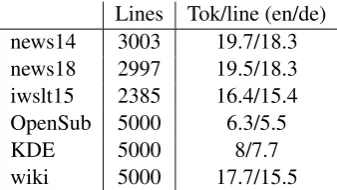
Table 2: In/Out of Domain test sets. news14 and news18 are test sets from WMT-14 and WMT-18 news translation shared task. iwslt: test set from IWSLT-15 MT Track4. Wiki is randomly 5K sampled from parallel Wikipedia distributed by OPUS5, OpenSub, KDE and Wiki are randomly 5K sampled from paral-lel Wikipedia, Open Subtitles and KDE corpora dis-tributed by OPUS6
4.3 Evaluation
We believe that the impact of pretrained LM in NMT model can not be measured by BLEU per-formance on in-domain test set only. Therefore we introduce additional evaluation that allows to measure the impact of LM pretraining on different out-of-domain tests. We also propose an evalua-tion procedure to evaluate the robustness to vari-ous types of noise for our models.
Domain Besides standard WMT-14 news test set, models are evaluated on additional test sets given by Table 2. We include two in-domain (news) test sets, as well as additional out-of-domain test sets described in Table2.
Noise robustness. For robustness evaluation, we introduce different type of noise to the standard news14test set:
Typos: Similar toKarpukhin et al.(2019), we add synthetic noise to the test set by randomly (1) swapping characters (chswap), (2) randomly in-serting or deleting characters (chrand), (3) upper-casing words (up). These test sets translations are evaluated against the goldennews14reference.
Unk: An unknown character is introduced at the beginning (notedUNK.S) or at the end of the sen-tence (notedUNK.E) before a punctuation symbol if any (this unknown character could be thought as as an unknown emoji, a character in different script, a rare unicode character). This token is in-troduced both for source and target sentence, and the evaluation is performed with the augmented-reference.
[image:4.595.115.249.62.118.2]Interestingly, this simple test seems to produce poor translations, therefore puzzling the attention and decoding process a lot. Table3 gives an ex-ample of such translations for baseline model7.
Since the tasks are correlated, a better model might be better on noisy test sets as it behaves bet-ter in general. If we want to test that some models are indeed better, we need to disentangle this ef-fect and show that the gain in performance is not just a random effect. A proper way would be to compute the BLEU correlation between the orig-inal test set and the noisy versions but it would require a larger set of models for an accurate cor-relation estimation.
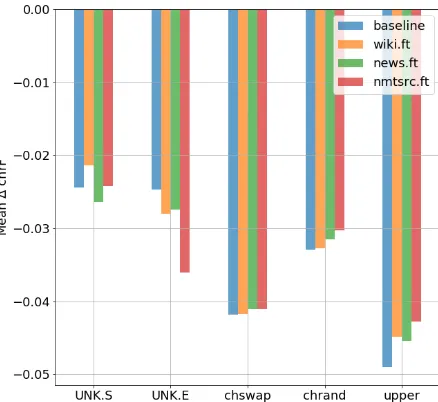
∆(chrF) :We propose to look at the distribu-tion of the difference of sentence charf between the noisy test set and the original test set. Indeed, looking at BLEU delta may not provide enough in-formation since it is corpus-level metric. Ideally, we would like to measure a number of sentences or a margin for which we observe an ‘important decrease’ in translation quality. According toMa et al. (2018); Bojar et al. (2017), sentence level chrF achieves good correlation with human judge-ments for En-De news translations.
More formally, letsbe a sentence from the stan-dard news14 test set, n a noise operation, m a translation model andrthe reference sentence8:
∆(chrF)(m, n, s) = chrF(m(n(s)), r)−
chrF(m(s), r) (1)
In the analysis, we will report the distribution of ∆(chrF)and its mean value as a summary. If a model is good at dealing with noise, then the pro-duced sentence will be similar to the one propro-duced by the noise-free input sentence. Therefore, the ∆(chrF) will be closer to zero.
4.4 Results
Table 4 presents the results of our experiments. As expected, freezing the encoder with BERT pa-rameters lead to a significant decrease in transla-tion quality. However, other BERT+NMT archi-tectures mostly improve over the baseline both on in-domain and out-of-domain test sets. We con-clude, that the information encoded by BERT is useful but not sufficient to perform the translation
7
Output for (UNK.S+src) input is not an error, the model does produces an English sentence!
8In the case of UNK transformation, the reference is
changed but we omit that to simplify the notation.
task. We believe, that the role of the NMT encoder is to encode both information specific to source sentence, but also information specific to the tar-get sentence (which is missing in BERT training). Next, we observe that even NMTSrc.FT (NMT encoder is initialized with BERT trained on source part of parallel corpus) improves over the baseline. Note that this model uses the same amount of data as the baseline. BERT task is simpler compared to the task of the NMT encoder, but it is still related, thus BERT pretraining allows for a better initial-ization point for NMT model.
When using more data for BERT training (Wiki.FT and News.FT), we gain even more im-provements over the baseline.
Finally, we observe comparable results for News.Emb and News.FT (the difference in BLEU doesn’t exceed 0.3 points, being higher for News.FT on in-domain tests, and News.Emb for out-of-domain tests). Although News.FT config-uration keeps the size of the model same as stan-dard NMT system, News.Emb adds BERT param-eters to NMT paramparam-eters which doubles the size of NMT encoder. Additional encoder layers intro-duced in News.Emb does not add significant value.
4.5 Robustness analysis
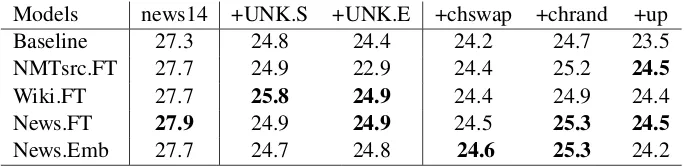
Table5reports BLEU scores for the noisy test sets (described in section 4.3). As expected, we ob-serve an important drop in BLEU scores due to the introduced noise. We observe that most pre-trained BERT models have better BLEU scores compared to baseline for all type of noise (except NMTSrc.FT which suffers more from unknown token introduction in the end of the sentence com-pared to the Baseline). However, these results are not enough to conclude, whether higher BLEU scores of BERT-augmented models are due to bet-ter robustness, or simply because these models are slightly better than the baseline in general.
source sentence ”In home cooking, there is much to be discovered - with a few minor tweaks you can achieve good, if not sometimes better results,” said Proctor. translation(src) ”Beim Kochen zu Hause gibt es viel zu entdecken - mit ein paar kleinen
nderungen kann man gute, wenn nicht sogar manchmal bessere Ergebnisse erzielen”, sagte Proktor.
[image:6.595.141.458.205.301.2]translation(UNK.S + src) •”In home cooking, there is much to be discovered - with a few minor tweaks you can achieve good, if not sometimes better results”, sagte Proktor.
Table 3: Example of a poor translation when adding unknown token to source sentences (translation done with a baseline transformer model)
news14 news18 iwslt15 wiki kde OpenSub
Baseline 27.3 39.5 28.9 17.6 18.1 15.3
NMTsrc.FT 27.7 40.1 28.7 18.3 18.4 15.3
Wiki.FT 27.7 40.6 28.7 18.4 19.0 15.4
News.FT 27.9 40.2 29.1 18.8 17.9 15.7
News.Emb 27.7 39.9 29.3 18.9 18.2 16.0
[image:6.595.76.295.355.556.2]News.Freeze 23.6 35.5 26.5 15.0 15.1 13.8
Table 4: FT: initialize NMT encoder with BERT and finetune; Freeze: fix NMT encoder parameters to BERT parameters; Emb: fix encoder embeddding layer with BERT contextual word embeddings.
Figure 1: Mean∆(chrF) for several noisy test set and models. For the UNK test, the BERT models are sim-ilar or worst than the basline. For the chrand, chswap, upper, the BERT models are slightly better.
NMT encoders but the full potential of masked LM task is not fully exploited for NMT.
5 IWSLT experiments
In order to explore the potential of masked LM encoder pretraining for NMT in lower re-source settings, we train NMT models on
English-German IWSLT 20159 and English-Russian IWSLT 201410 MT track datasets. These are pretty small datasets (compared to previous exper-iments) which contain around 200K parallel sen-tences each.
5.1 Experimental settings
In these experiments we (1) reuse pretrained BERT models from previous experiments or (2) train IWSLT BERT model. IWSLT BERT model is trained on the concatenation of all the data avail-able at IWSLT 2014-2018 campaigns. After filter-ing out all the duplicates it contains around 780K sentences and 13.8M tokens.
We considered various settings for IWSLT base-line. First, for source side of the dataset, we took 10K BPE merge operations, where BPE model was trained (1) either on the source side of NMT data only, or (2) on all monolingual English IWSLT data. Target side BPE uses 10K merge operations trained on the target side of the NMT dataset in all the IWSLST experiments. In our first set of experiments, BPE model learnt on source data only lead to similar translation performance as BPE model learnt on all IWSLT English data. Therefore, in what follows we report results only
9
https://sites.google.com/site/iwsltevaluation2015/mt-track
10
Models news14 +UNK.S +UNK.E +chswap +chrand +up
Baseline 27.3 24.8 24.4 24.2 24.7 23.5
NMTsrc.FT 27.7 24.9 22.9 24.4 25.2 24.5
Wiki.FT 27.7 25.8 24.9 24.4 24.9 24.4
News.FT 27.9 24.9 24.9 24.5 25.3 24.5
[image:7.595.128.473.62.145.2]News.Emb 27.7 24.7 24.8 24.6 25.3 24.2
Table 5: Robustness tests. BLEU scores for clean and ’noisified’ (with different noise type)news14testset.
for the latter (referred asbpe10k).
NMT model training on IWSLT datasets with Transformer Big architecture on IWSLT data has diverged both for en-de and en-ru dataset. There-fore we use Transformer Base (tbase) architecture as a baseline model for these experiments. IWSLT BERT model is also based ontbase architecture described inVaswani et al.(2017) and for the rest follows same training procedure as described in the section4.
In order to explore the potential of single pre-trained model for all language pairs/datasets we try to reuse Wiki and News pretrained BERT mod-els from previous experiments for encoder initial-ization of NMT model. However, in the previous experiments, our pretrained BERT models used 32K BPE vocabulary and Transformer Big (tbig) architecture which means that we have to reuse the same settings for the encoder trained on IWSLT dataset. It has been shown byDing et al.(2019), these are not optimal settings for IWSLT train-ing because it leads to too many parameters for the amount of data available. Therefore, in or-der to reduce the amount of the parameters of the model, we also consider the case where we re-duce the amount of the decoder layers from 6 to 3 (tbig.dec3).
5.2 Results
Table6 reports the results of different sets of the experiments on IWSLT data. First, we observe that BERT pretrained model improves over the baseline, in any settings (BPE vocabulary, model architecture, dataset used for pretraining). In particular, it is interesting to mention that with-out pretraining, bothtbig.bpe32kandtbig.bpe10k
models diverge when trained on IWSLT. How-ever, BERT pretraining gives a better initializa-tion point, and allows to achieve very good per-formance both for en-de and en-ru. Thus, such pretraining can be an interesting technique in low-resource scenarios.
en-de en-ru Baseline
tbase.bpe10k 25.9 9.6
tbase.dec3.bpe10k 26.4 16.3
BERT+NMT IWSLT.FT.tbase.bpe10k 27.4 17.6 IWSLT.FT.tbase.dec3.bpe10k 27.2 18.1
Wiki.FT.tbig.bpe32k 26.9 17.6
Wiki.FT.tbig.dec3.bpe32k 27.7 17.8
News.FT.tbig.bpe32k 27.1 17.9
[image:7.595.311.524.187.338.2]News.FT.tbig.dec3.bpe32k 27.6 17.9
Table 6: IWSLT dataset results. IWSLT.FT: encoder is initialised with BERT model trained on IWSLT data;tbase/tbig: transformer base/big architecture for NMT model; dec3: decoder layers reduced for 6 to 3;bpe10k/bpe32k: amount of BPE merge operations used for source language, learnt on the same dataset as BERT model (IWSLT or Wiki+News).
We do not observe big difference between IWSLT pretrained model and News/Wiki pre-trained model. We therefore may assume that News/Wiki BERT model can be considered as ”general” English pretrained encoder, and be used as a good starting point in any new model trans-lating from English (no matter target language or domain).
6 Discussion
BERT pretraining has been very successful in NLP. With respect to MT, it was shown to pro-vide better performance in Lample and Conneau (2019); Edunov et al. (2019) and allows to in-tegrate large source monolingual data in NMT model as opposed to target monolingual data usu-ally used for backtranslation.
In this experimental study, we have shown that:
• The next sentence prediction task in BERT is not necessary to improve performance - a masked LM taskalready is beneficial.
corpora, therefore supporting the claim that pretraining the encoder provide a better in-tialization for NMT encoders.
• Similar toEdunov et al. (2019), we observe that the impact of BERT pretraining is more important as the size of the training data de-creases (WMT vs IWSLT).
• Information encoded by BERT is not suffi-cient to perform the translation: NMT en-coder encodes both information specific to source sentence, and to the target sentence as well (cf the low performance of BERT frozen encoder).
• Pretraining the encoder enables us to train bigger models. In IWSLT, the transformer big models were diverging, but when the en-coder is initialized with pretrained BERT the training became possible. For WMT14, train-ing a 12 layer encoder from scratch was prob-lematic, but News.Emb model (which con-tains 12 encoder layers) was trained and gave one of the best performances on WMT14.
• Finetuning BERT pretrained encoder is more convenient : it leads to similar performance compared to reusing BERT as embedding layers, with faster decoding speed.
• BERT pretrained models seem to be gener-ally better on different noise and domain test sets. However, we didn’t manage to obtain clear evidence that these models are more ro-bust.
This experimental study was limited to a par-ticular dataset, language pair and model architec-ture. However, many other combinations are pos-sible. First, similar type of study needs to be per-formed with BERT pretrained model for NMT de-coder. Also, the model can be extended to other scenarios with BERT models such asBaevski et al. (2019). In addition, the comparison with ELMO embeddings is also interesting as inEdunov et al. (2019). Using embedding mostly influenced by neighboring words seems to echo the recent re-sults of convolutional self attention network (Yang et al., 2019). Using convolutional self attention network in BERT could bring additional benefit for the pretrained representations. Another direc-tion could look at the impact of the number of lay-ers in BERT for NMT.
Besides, one key question in this study was about the role of encoder in NMT as the roles of encoders and decoders are not clearly understood in current neural architectures. In the transformer architecture, the encoder probably computes some interlingual representations. In fact, nothing con-straints the model in reconstructing or predicting anything about the source sentences. If that is the case, why would a monolingual encoder help for the NMT task?
One hypothesis is that encoders have a role of self encoding the sentences but also a translation effect by producing interlingual representations. In this case, a monolingual encoder could be a bet-ter starting point and could be seen as a regular-izer of the whole encoders. Another hypothesis is that the regularization of transformers models is not really effective and simply using BERT mod-els achieve this effect.
7 Conclusion
In this paper, we have compared different ways to use BERT language models for machine transla-tion. In particular, we have argued that the ben-efit of using pretrained representations should not only be assessed in terms of BLEU score for the in-domain data but also in terms of generalization to new domains and in terms of robustness.
Our experiments show that fine-tuning the en-coder leads to comparable results as reusing the encoder as an additional embedding layers. How-ever, the former has an advantage of keeping the same model size as in standard NMT set-tings, while the latter adds additional parameters to the NMT model which increases significantly the model size and might be critical in certain sce-narios.
For MT practioners, using BERT has also sev-eral practical advantages beyond BLEU score. BERT can be trained for one source language and further reused for several translation pairs, thus providing a better initialization point for the mod-els and allowing for better performance.
References
Alexei Baevski, Sergey Edunov, Yinhan Liu, Luke Zettlemoyer, and Michael Auli. 2019. Cloze-driven pretraining of self-attention networks.CoRR, abs/1903.07785.
Dzmitry Bahdanau, Kyunghyun Cho, and Yoshua Ben-gio. 2014. Neural machine translation by jointly learning to align and translate. arXiv e-prints, abs/1409.0473.
Yoshua Bengio, R´ejean Ducharme, Pascal Vincent, and Christian Janvin. 2003. A neural probabilistic lan-guage model.J. Mach. Learn. Res., 3:1137–1155.
Ondˇrej Bojar, Yvette Graham, and Amir Kamran. 2017. Results of the wmt17 metrics shared task. In Proceedings of the Second Conference on Ma-chine Translation, Volume 2: Shared Task Papers, pages 489–513, Copenhagen, Denmark. Association for Computational Linguistics.
Ronan Collobert and Jason Weston. 2008. A unified architecture for natural language processing: Deep neural networks with multitask learning. In Pro-ceedings of the 25th International Conference on Machine Learning, ICML ’08, pages 160–167, New York, NY, USA. ACM.
Jacob Devlin, Ming-Wei Chang, Kenton Lee, and Kristina Toutanova. 2018. BERT: pre-training of deep bidirectional transformers for language under-standing. CoRR, abs/1810.04805.
Shuoyang Ding, Adithya Renduchintala, and Kevin Duh. 2019. A call for prudent choice of subword merge operations. CoRR, abs/1905.10453.
Sergey Edunov, Alexei Baevski, and Michael Auli. 2019. Pre-trained language model representations for language generation.CoRR, abs/1903.09722.
Vladimir Karpukhin, Omer Levy, Jacob Eisenstein, and Marjan Ghazvininejad. 2019. Training on synthetic noise improves robustness to natural noise in ma-chine translation.CoRR, abs/1902.01509.
Guillaume Lample and Alexis Conneau. 2019. Cross-lingual language model pretraining. CoRR, abs/1901.07291.
Jinhyuk Lee, Wonjin Yoon, Sungdong Kim, Donghyeon Kim, Sunkyu Kim, Chan Ho So, and Jaewoo Kang. 2019. Biobert: a pre-trained biomedical language representation model for biomedical text mining. CoRR, abs/1901.08746.
Omer Levy and Yoav Goldberg. 2014. Neural word embedding as implicit matrix factorization. In Pro-ceedings of the 27th International Conference on Neural Information Processing Systems - Volume 2, NIPS’14, pages 2177–2185, Cambridge, MA, USA. MIT Press.
Qingsong Ma, Ondej Bojar, and Yvette Graham. 2018.
Results of the wmt18 metrics shared task: Both char-acters and embeddings achieve good performance. InProceedings of the Third Conference on Machine Translation, Volume 2: Shared Task Papers, pages 682–701, Belgium, Brussels. Association for Com-putational Linguistics.
Paul Michel, Xian Li, Graham Neubig, and Juan Miguel Pino. 2019. On evaluation of ad-versarial perturbations for sequence-to-sequence models. CoRR, abs/1903.06620.
Tomas Mikolov, Ilya Sutskever, Kai Chen, Greg Cor-rado, and Jeffrey Dean. 2013. Distributed represen-tations of words and phrases and their composition-ality. InProceedings of the 26th International Conference on Neural Information Processing Systems -Volume 2, NIPS’13, pages 3111–3119, USA. Curran Associates Inc.
Jeffrey Pennington, Richard Socher, and Christopher Manning. 2014. Glove: Global vectors for word representation. In Proceedings of the 2014 Con-ference on Empirical Methods in Natural Language Processing (EMNLP), pages 1532–1543, Doha, Qatar. Association for Computational Linguistics.
Matthew E. Peters, Mark Neumann, Mohit Iyyer, Matt Gardner, Christopher Clark, Kenton Lee, and Luke Zettlemoyer. 2018. Deep contextualized word rep-resentations.CoRR, abs/1802.05365.
Rico Sennrich, Barry Haddow, and Alexandra Birch. 2016a. Improving neural machine translation mod-els with monolingual data. In Proceedings of the 54th Annual Meeting of the Association for Compu-tational Linguistics (Volume 1: Long Papers), pages 86–96, Berlin, Germany. Association for Computa-tional Linguistics.
Rico Sennrich, Barry Haddow, and Alexandra Birch. 2016b. Neural machine translation of rare words with subword units. InProceedings of the 54th An-nual Meeting of the Association for Computational Linguistics (Volume 1: Long Papers), pages 1715– 1725, Berlin, Germany. Association for Computa-tional Linguistics.
Kaitao Song, Xu Tan, Tao Qin, Jianfeng Lu, and Tie-Yan Liu. 2019. Mass: Masked sequence to sequence pre-training for language generation.
Ilya Sutskever, Oriol Vinyals, and Quoc V. Le. 2014.
Sequence to sequence learning with neural net-works. In Proceedings of the 27th International Conference on Neural Information Processing Sys-tems - Volume 2, NIPS’14, pages 3104–3112, Cam-bridge, MA, USA. MIT Press.
Ian Tenney, Dipanjan Das, and Ellie Pavlick. 2019.
Bert rediscovers the classical nlp pipeline.
Ashish Vaswani, Noam Shazeer, Niki Parmar, Jakob Uszkoreit, Llion Jones, Aidan N Gomez, Ł ukasz Kaiser, and Illia Polosukhin. 2017. Attention is all you need. In I. Guyon, U. V. Luxburg, S. Bengio, H. Wallach, R. Fergus, S. Vishwanathan, and R. Gar-nett, editors, Advances in Neural Information Pro-cessing Systems 30, pages 5998–6008. Curran As-sociates, Inc.
Alex Wang, Amanpreet Singh, Julian Michael, Fe-lix Hill, Omer Levy, and Samuel Bowman. 2018.
GLUE: A multi-task benchmark and analysis plat-form for natural language understanding. In Pro-ceedings of the 2018 EMNLP Workshop Black-boxNLP: Analyzing and Interpreting Neural Net-works for NLP, pages 353–355, Brussels, Belgium. Association for Computational Linguistics.
Yonghui Wu, Mike Schuster, Zhifeng Chen, Quoc V. Le, Mohammad Norouzi, Wolfgang Macherey, Maxim Krikun, Yuan Cao, Qin Gao, Klaus Macherey, Jeff Klingner, Apurva Shah, Melvin Johnson, Xiaobing Liu, Lukasz Kaiser, Stephan Gouws, Yoshikiyo Kato, Taku Kudo, Hideto Kazawa, Keith Stevens, George Kurian, Nishant Patil, Wei Wang, Cliff Young, Jason Smith, Jason Riesa, Alex Rudnick, Oriol Vinyals, Greg Corrado, Macduff Hughes, and Jeffrey Dean. 2016. Google’s neural machine translation system: Bridging the gap between human and machine translation. CoRR, abs/1609.08144.