Proceedings of the Third Conference on Machine Translation (WMT), Volume 2: Shared Task Papers, pages 882–887
An Unsupervised System for Parallel Corpus Filtering
Viktor Hangya and Alexander Fraser
Center for Information and Language Processing LMU Munich, Germany
{hangyav, fraser}@cis.lmu.de
Abstract
In this paper we describe LMU Munich’s submission for theWMT 2018 Parallel Cor-pus Filteringshared task which addresses the problem of cleaning noisy parallel corpora. The task of mining and cleaning parallel sen-tences is important for improving the quality of machine translation systems, especially for low-resource languages. We tackle this prob-lem in a fully unsupervised fashion relying on bilingual word embeddings created without any bilingual signal. After pre-filtering noisy data we rank sentence pairs by calculating bilingual sentence-level similarities and then remove redundant data by employing mono-lingual similarity as well. Our unsupervised system achieved good performance during the official evaluation of the shared task, scoring only a few BLEU points behind the best sys-tems, while not requiring any parallel training data.
1 Introduction
Machine translation is important for eliminating language barriers in everyday life. To train sys-tems which can produce good quality translations large parallel corpora are needed. Mining paral-lel sentences from various sources in order to train better performing MT systems is essential, espe-cially for low resource languages. Previous ef-forts1 showed that it is possible to crawl parallel
data from the web, but also showed that additional steps are necessary to filter noisy sentence pairs. In this paper we introduce our approach to filter noisy parallel corpora without the need of any ini-tial bilingual signal to train the filtering system.
We participate in theWMT 2018 Parallel Cor-pus Filtering shared task with our system which tackles the problem of selecting the best quality
1https://paracrawl.eu
sentence pairs for training both statistical and neu-ral MT systems (Koehn et al., 2018). A lot of previous work has studied the problem of par-allel data cleaning. Espl`a-Gomis and Forcada
(2010) proposed BiTextor which filters data based on sentence alignment scores and URL informa-tion. Similarly, word alignments and language modeling were used in (Denkowski et al., 2012) to select sentence pairs that are useful for training an MT system. Xu and Koehn (2017) proposed Zipporah, a logistic regression based model that uses bag-of-words translation features to measure fluency and adequacy in order to score sentence pairs. Another line of work is to select data based on the target domain. A static sentence-selection method was used for domain adaptation based on the internal sentence embedding of NMT (Wang et al.,2017) whilevan der Wees et al.(2017) used domain-based cross-entropy as a criterion to grad-ually fine-tune the NMT training in a dynamic manner. In contrast with previous work, we do not rely on any bilingual supervision, making our approach applicable to language pairs which lack initial parallel resources. Similarly to the work of
Kajiwara and Komachi (2016), where word em-beddings were used to mine monolingual sentence pairs for text simplification, we use a word level metric to compute sentence pair similarity in a computationally efficient way.
Our approach consists of three steps. Due to the noisiness of the input data we use a pre-filtering step which detects sentences which are not useful. We developed a simple rule-based method which looks for sentence pairs which for example came from the wrong languages or have significantly different lengths. As a second step, we calcu-late sentence pair similarities using bilingual word embeddings and orthographic information. In the third step, we perform post-ranking where we counterweight source language sentences which
are less fluent or redundant using language model-ing and monolmodel-ingual document similarity respec-tively. Our system is fully unsupervised, i.e., we do not use any parallel data for the training of our methods. We show results on the official test sets of the shared task which includes six datasets from different sources. Although, our method is fully unsupervised it achieves good performance on the extrinsic task of training MT systems on the fil-tered parallel data, scoring only2.17BLEU points
behind the best systems.
2 Approach
In this section we introduce our approach for the filtering task. Since parallel sentence mining is most crucial for resource-poor languages our goal was to develop a system that does not need any bilingual signal for training. Our approach is based on recent developments in the field of bilin-gual word embeddings, i.e., it was shown that good quality bilingual embeddings can be trained using only source and target language monolin-gual data (Conneau et al., 2017). As was men-tioned in the previous section our approach con-sists of three steps which we introduce below. In each step we score the input candidate sentence pairs which are used at the sampling step to se-lect sentence pairs before the training of MT sys-tems. Higher score means higher probability for being selected during the sampling process. For more detail about the data, the preprocessing and the sampling procedure see section3.
2.1 Pre-Filtering
The input data, released by the shared task orga-nizers, contain a large amount of erroneous can-didate sentence pairs which can be filtered out based on some simple heuristics. For detecting these instances we use the following rules and set the weight of these noisy candidate pairs to zero. Note, we ignore the candidates selected here in later steps for reasons of speed.
1. Hunalign scores of the sentence pairs were released with the data. We ignore candidates if the initial score is less then0.0.
2. If either of the sentences has alengthof less then 3 tokens we consider it as noise.
3. A good indicator of bad alignment of sen-tences is theirlength difference. If this value
is greater than15tokens we set its weight to zero.
4. We also consider a candidate as noise if the
number and URL ratio, compared to the number of all tokens, is greater than0.6.
5. In many cases thelanguageof the sentences is incorrect. We use the system of Sarwar et al.(2001) to detect these instances.
2.2 Scoring
In the main step of our approach we calculate the score of a candidate sentence pair based on the similarities of the contained words. First, we de-scribe how we train bilingual word embeddings and then we describe the method for sentence sim-ilarity.
Bilingual word embeddings Recently, Con-neau et al.(2017) showed that good quality bilin-gual embeddings can be produced by training monolingual word embedding spaces for both source and target languages and mapping them to a shared space without any bilingual signal. We follow this approach and use bilingual word em-beddings, trained in an unsupervised fashion. For this we use the system released by (Conneau et al.,
2017). We discuss the used data and parameters in section3.
Sentence pair similarity Given a candidate pair of source and target sentencesS andT, the
sim-ilarity score is calculated by iterating over the words in S from left to right and pairing each word s ∈ S, in a greedy fashion, with the word t∈ T that has the highest cosine similarity based
on our dictionary. We then greedily eliminate t
from T, so that it cannot be matched by a later
word “s”. Then, the averaged word-pair similarity gives the final score. We remove stopwords, digits and punctuation from texts before calculating sim-ilarity. Note, this idea is similar toWord Movers Distance introduced in (Kusner et al., 2015) but simpler due to runtime considerations on huge cor-pora.
As was shown in previous work (Braune et al.,
language word pairs and their similarity. We de-fine orthographic similarity as one minus the nor-malized Levenshtein distance. We use this ortho-graphic dictionary together with the BWE-based dictionary when mining parallel sentences by us-ing the higher value from the two dictionaries. If the given word pair is not in a dictionary we con-sider their similarity as0.0for that dictionary. One
issue with orthographic similarity of words is that it tends to give high scores to sentences which con-tain many orthographically similar words, e.g., a sentence with a list of named entities, which are often not useful for MT systems. To overcome this issue, we multiply the orthographic word similari-ties with0.2.
2.3 Post-Ranking
In the third step we re-rank candidates from the previous step in order to reduce the number of re-dundant sentence pairs and to ensure that we have more fluent sentences. We apply these steps only to the source sentences due to speed considera-tions.
Monolingual Document Similarity The input corpus contains redundant sentences, i.e., sen-tences which have similar structure and meaning, and which are often generated based on predefined sentence templates. It is enough to use only one el-ement from these clusters of redundant sentences since the rest does not have a big impact on the translation quality. Due to the huge size of the in-put data we used a simple thus fast approach to de-tect redundant sentences and decrease their score. First, we embed each source side sentence to a fixed sized sentence embedding by simply averag-ing the word embeddaverag-ings of the words in the sen-tence. We calculate sentence similarities of each possible pairs which can be done efficiently even for large inputs (Johnson et al.,2017). We use co-sine as the similarity metric and we consider those sentences as redundant which have lower differ-ence than0.02between the similarity value of its
top two most similar sentences. We multiply the original score of redundant sentences by0.5. Language model It is beneficial to use fluent sentences for training MT systems. To take this aspect into consideration we used KenLM lan-guage model (Heafield et al.,2013) to change the score of a candidate pair based on the source side sentence’s normalized language model probabil-ity. We multiply scores if the given sentence has
higher (lower) probability than1×10−3(5×10−6)
by1.5(0.5).
3 Experimental Setup
The goal of the shared task is, given a noisy par-allel corpus, to filter candidate sentence pairs that are most useful for training MT systems. Candi-date pairs have to be scored based on the predicted quality of the corresponding candidate where the scores do not have a special meaning except that higher values indicate better quality. To produce the actual training data for the MT systems the scored corpus is sampled using an official tool, re-leased by the organizers, which samples sentences with a probability proportional to their scores.
3.1 Data
A German-English dataset was released contain-ing 1 billion (English) tokens. The corpus was crawled from the web as part of the ParaCrawl
project. After extracting texts from web pages with BiTextor (Espl`a-Gomis and Forcada,2010), documents and sentences were aligned using (Buck and Koehn, 2016) and Hunalign (Varga et al., 2007) respectively. The aligned sentence pairs are the candidates which have to be scored for the sampling process and used as training par-allel data for the MT systems. The alignment scores of the candidate sentence pairs were also released which do not by themselves correlate strongly with sentence pair quality which we show in section4. For more details of the data see the overview paper of the shared task (Koehn et al.,
2018). As an additional data source we use mono-lingual German and English NewsCrawl sentences from the time period between 2011 and 2014 ( Bo-jar et al., 2014) which we use to train word em-beddings and the language model.
3.2 Evaluation
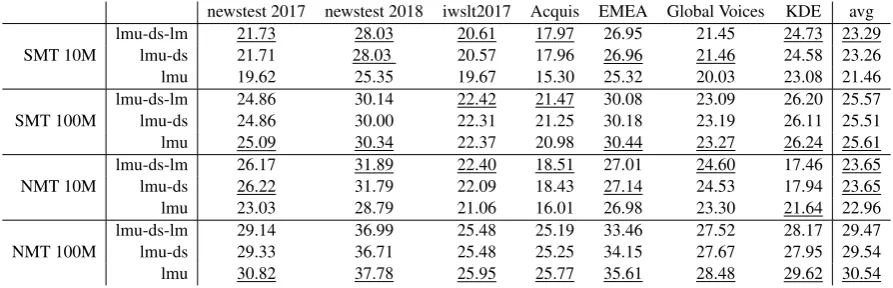
newstest 2017 newstest 2018 iwslt2017 Acquis EMEA Global Voices KDE avg SMT 10M lmu-ds-lmlmu-ds 21.7321.71 28.0328.03 20.6120.57 17.9717.96 26.9526.96 21.4621.45 24.73 23.2924.58 23.26
lmu 19.62 25.35 19.67 15.30 25.32 20.03 23.08 21.46
SMT 100M
lmu-ds-lm 24.86 30.14 22.42 21.47 30.08 23.09 26.20 25.57
lmu-ds 24.86 30.00 22.31 21.25 30.18 23.19 26.11 25.51
lmu 25.09 30.34 22.37 20.98 30.44 23.27 26.24 25.61
NMT 10M lmu-ds-lmlmu-ds 26.1726.22 31.8931.79 22.4022.09 18.5118.43 27.0127.14 24.5324.60 17.46 23.6517.94 23.65
lmu 23.03 28.79 21.06 16.01 26.98 23.30 21.64 22.96
NMT 100M lmu-ds-lmlmu-ds 29.1429.33 36.9936.71 25.4825.48 25.1925.25 33.4634.15 27.6727.52 28.17 29.4727.95 29.54
[image:4.595.73.520.62.206.2]lmu 30.82 37.78 25.95 25.77 35.61 28.48 29.62 30.54
Table 1: BLEU scores of our setups on the different datasets. We underline best results for each setup and dataset.
Insitution SMT 10M SMT 100M NMT 10M NMT 100M RWTH 24.58 26.21 28.01 31.29 Microsoft 24.45 26.50 28.62 32.06 Alibaba 24.11 26.44 27.60 31.93 NRC 23.89 26.40 27.41 31.88 Speechmatics 23.88 25.85 27.97 31.00 NICT 23.46 25.98 25.94 30.04 AFRL 23.36 25.32 27.09 30.28 Vicomtech 23.29 25.91 26.35 30.40 LMU 23.29 25.61 23.65 30.54 Tilde 23.03 26.19 26.56 31.24 Prompsit 22.94 26.41 26.05 31.83 ARC 22.68 26.13 25.79 31.34 JHU 22.61 25.84 25.41 30.16 MAJE 22.53 26.07 24.81 31.20 Univ. Tartu 22.31 25.70 25.17 30.60 Systran 21.83 25.44 24.30 29.91 UTFPR 20.81 22.35 21.75 22.23 DCU 15.67 21.19 6.27 18.60
Table 2: Best systems of participants on the four setups av-eraged over all test sets.
2018, iwslt2017, Acquis, EMEA, Global Voices and KDE were the undisclosed test sets (Koehn et al.,2018).
3.3 Parameter setup
We preprocessed all data using the tokenizer from Moses with aggressive mode (Koehn et al.,2007) and lower casing. To train monolingual word em-beddings we used FastText (Bojanowski et al.,
2016) with default parameters except the dimen-sion of the vectors which is300. As input the
con-catenation of the shared task data and NewsCrawl was used. For the unsupervised mapping we ran (Conneau et al., 2017) using the source and tar-get language monolingual spaces. As a language model we used KenLM (Heafield et al., 2013), with n-gram size 5 and using default values for the rest of the parameters, on the source side of our data. All other parameters introduced earlier are based on manual analysis of the data and non-exhaustive tuning on the development set. During
development we only run SMT 10M due to time constraints.
4 Results
We present official BLEU scores of our systems on the four setups and seven datasets in table 1. Our default system lmu applies pre-filtering and scoring and we incrementally add monolingual document similarity and language modeling post-ranking steps. During development we calculated the performance of only applying the pre-filtering step on newstest 2017 with SMT 10M which re-sulted in a score of15.53BLEU while the released
hunalign scores resulted in a score of6.88. This
result shows the noisiness of the data and the im-portance of pre-filtering.
Based on table 1 it can be seen that our de-fault system, without post-ranking, could already achieve good performance. The additional post-ranking steps were most helpful for the setups with only 10M tokens in the training data. This in-dicates that giving less weight to redundant and not fluent sentences is especially important in the low resource setups. During the development we also performed an ablation study on the post-ranking methods. Using only the language model on top of pre-filtering and scoring gave 20.67
BLEU points while activating only the document similarity module we got 21.66 with SMT 10M.
the best performance on the newstest 2017 dataset. In contrast, post-ranking steps only helped for the iwslt2017 and Acquis datasets in the case of the 100M token setups. We conjecture that the down-weighting of candidates by these steps was too heavy which resulted in lower importance of these candidates comparing to candidates which are not even parallel. This issue could be overcome by better fine tuning of hyperparameters.
In table 2 we show the averaged results over all test sets of the best system of the official par-ticipants. Our systems performs better then the average in three out of four cases and scores be-low the best system by only 2.17 BLEU points
on average. Our results are less competitive with NMT which is because we only used SMT during development. Our results show that competitive performance can be achieved without the use of any bilingual signal for the parallel corpus filter-ing task.
5 Conclusion
In this paper we introduced LMU Munich’s sub-mission to the WMT 2018 Parallel Corpus Filter-ing shared task. Such systems are especially use-ful in low resource setups, so we proposed a use-fully unsupervised system which is built on three mod-ules: (i) we apply a pre-filtering step to remove noisy data (ii) we score sentences based on bilin-gual word embeddings and (iii) as a post-ranking step we penalize sentence pairs which are redun-dant or not fluent enough. We achieved good re-sults with all setups which shows the competitive-ness of our unsupervised system.
Acknowledgments
We would like to thank Fabienne Braune, Yuliya Kalasouskaya and the anonymous reviewers for their valuable input. This project has received funding from the European Research Council (ERC) under the European Union’s Horizon 2020 research and innovation programme (grant agree-ment№640550).
References
Piotr Bojanowski, Edouard Grave, Armand Joulin, and Tomas Mikolov. 2016. Enriching word vectors with subword information. CoRR, abs/1607.04606.
Ondrej Bojar, Christian Buck, Christian Federmann, Barry Haddow, Philipp Koehn, Johannes Leveling,
Christof Monz, Pavel Pecina, Matt Post, Herve Saint-Amand, Radu Soricut, Lucia Specia, and Aleˇs Tamchyna. 2014. Findings of the 2014 workshop on statistical machine translation. InProceedings of the Ninth Workshop on Statistical Machine Translation, pages 12–58.
Fabienne Braune, Viktor Hangya, Tobias Eder, and Alexander Fraser. 2018. Evaluating bilingual word embeddings on the long tail. InProceedings of the 2018 Conference of the North American Chapter of the Association for Computational Linguistics: Hu-man Language Technologies, Volume 2 (Short Pa-pers), pages 188–193.
Christian Buck and Philipp Koehn. 2016. Quick and reliable document alignment via tf/idf-weighted co-sine distance. In Proceedings of the First Confer-ence on Machine Translation: Volume 2, Shared Task Papers, pages 672–678.
Alexis Conneau, Guillaume Lample, Marc’Aurelio Ranzato, Ludovic Denoyer, and Herv´e J´egou. 2017. Word Translation Without Parallel Data. CoRR, abs/1710.04087.
Michael Denkowski, Greg Hanneman, and Alon Lavie. 2012. The cmu-avenue french-english translation system. InProceedings of the Seventh Workshop on Statistical Machine Translation, pages 261–266.
Miquel Espl`a-Gomis and Mikel Forcada. 2010. Com-bining content-based and url-based heuristics to har-vest aligned bitexts from multilingual sites with bi-textor. The Prague Bulletin of Mathematical Lin-guistics, pages 77–86.
Kenneth Heafield, Ivan Pouzyrevsky, Jonathan H. Clark, and Philipp Koehn. 2013. Scalable modi-fied Kneser-Ney language model estimation. In Pro-ceedings of the 51st Annual Meeting of the Associa-tion for ComputaAssocia-tional Linguistics, pages 690–696.
Jeff Johnson, Matthijs Douze, and Herv´e J´egou. 2017. Billion-scale similarity search with gpus. CoRR, abs/1702.08734.
Marcin Junczys-Dowmunt, Roman Grundkiewicz, Tomasz Dwojak, Hieu Hoang, Kenneth Heafield, Tom Neckermann, Frank Seide, Ulrich Germann, Alham Fikri Aji, Nikolay Bogoychev, Andr´e F. T. Martins, and Alexandra Birch. 2018. Marian: Fast neural machine translation in C++. InProceedings of the 56th Annual Meeting of the Association for Computational Linguistics, System Demonstrations, pages 116–121.
Philipp Koehn, Hieu Hoang, Alexandra Birch, Chris Callison-Burch, Marcello Federico, Nicola Bertoldi, Brooke Cowan, Wade Shen, Christine Moran, Richard Zens, et al. 2007. Moses: Open source toolkit for statistical machine translation. In Pro-ceedings of the 45th annual meeting of the Associ-ation for ComputAssoci-ational Linguistics on interactive poster and demonstration sessions, pages 177–180.
Philipp Koehn, Huda Khayrallah, Kenneth Heafield, and Mikel Forcada. 2018. Findings of the wmt 2018 shared task on parallel corpus filtering. In Proceed-ings of the Third Conference on Machine Transla-tion, Volume 2: Shared Task Papers.
Matt Kusner, Yu Sun, Nicholas Kolkin, and Kilian Weinberger. 2015. From word embeddings to docu-ment distances. InProceedings of the 32nd Interna-tional Conference on Machine Learning, pages 957– 966.
Badrul Sarwar, George Karypis, Joseph Konstan, and John Riedl. 2001. Item-based collaborative filtering recommendation algorithms. InProceedings of the 10th international conference on World Wide Web, pages 285–295.
D´aniel Varga, P´eter Hal´acsy, Andr´as Kornai, Viktor Nagy, L´aszl´o N´emeth, and Viktor Tr´on. 2007. Par-allel corpora for medium density languages. Ams-terdam Studies In The Theory And History Of Lin-guistic Science Series 4, page 247.
Rui Wang, Masao Utiyama, Lemao Liu, Kehai Chen, and Eiichiro Sumita. 2017. Instance weighting for neural machine translation domain adaptation. In
Proceedings of the 2017 Conference on Empirical Methods in Natural Language Processing, pages 1482–1488.
Marlies van der Wees, Arianna Bisazza, and Christof Monz. 2017. Dynamic data selection for neural ma-chine translation. arXiv preprint arXiv:1708.00712.