Proceedings of the Third Conference on Machine Translation (WMT), Volume 2: Shared Task Papers, pages 917–922
Alibaba Submission to the WMT18 Parallel Corpus Filtering Task
Jun Lu, Xiaoyu Lv, Yangbin Shi, Boxing Chen Machine Intelligence Technology Lab, Alibaba Group
Hangzhou, China
{joelu.luj, anzhi.lxy, taiwu.syb, boxing.cbx}@alibaba-inc.com
Abstract
This paper describes the Alibaba Machine Translation Group submissions to the WMT 2018 Shared Task on Parallel Corpus Filter-ing. While evaluating the quality of the par-allel corpus, the three characteristics of the corpus are investigated, i.e. 1) the bilin-gual/translation quality, 2) the monolingual quality and 3) the corpus diversity. Both rule-based and model-rule-based methods are adapted to score the parallel sentence pairs. The final par-allel corpus filtering system is reliable, easy to build and adapt to other language pairs.
1 Introduction
The parallel corpus is an essential resource for machine translation and multilingual natural lan-guage processing. Apart from the quantity and domain, the quality of parallel corpus is also very important in MT system training (Koehn and Knowles, 2017; Khayrallah and Koehn, 2018). The Internet contains a large number of multilin-gual resources, including parallel and comparable sentences (Resnik and Smith, 2003). Many suc-cessful machine translation systems are built using the corpus crawled from the web. But in practice, this kind of parallel corpus may be very noisy. The task of Parallel Corpus Filtering tackles the prob-lem of cleaning noisy parallel corpus.
In this task, we can divide the corpus cleaning task into three parts. Firstly, ahigh-quality paral-lel sentence pair should have the property that its target sentence precisely translates the source sen-tence, and vice versa. In this task, we attempt to quantify the translation quality (also called bilin-gual score) and accuracy of the sentence pair. Sec-ondly, the quality of the target and/or source sen-tences of the parallel corpus should also be eval-uated. In this work, the target side sentences are concerned a lot for their importance in NMT.
Thirdly, as described by theParallel Corpus Fil-teringtask, the participants should not pay atten-tion to the domain-relatedness. We need to focus on all the domains so that the resulting MT sys-tem can be widely used. So the diversity should be evaluated while subsampling the parallel cor-pus. Finally, the three characteristics of the par-allel corpus are combined to build the final clean corpus.
The paper is structured as follows: Section 2 de-scribes our methods which are used in parallel cor-pus filtering. Section 3 specifies the experiments and results. The dataset for building model-based methods is also detailed in this section. Conclu-sions are drawn in Section 4.
2 Parallel Sentence Pairs Scoring Methods
In this section, three kinds of scoring/filtering methods are detailed.
2.1 Bilingual Quality Evaluation
Here, we describe the noisy corpus filtering rules and two kinds of translation quality evaluation methods: (1) Word Alignment Based bilingual scoring and (2) Bitoken CNN Classifier based bilingual scoring(Chen et al.,2016).
Rule-based Filtering
A series of heuristic rules are applied to filter
badsentence pairs. They are simple but efficient, which are described below.
• The length ratio of source sentence to target
sentence. Sentence length is calculated as the number of tokens/words. In our system, the ratio is set between 0.4 and 2.5.
• The edit distance between the source token sequence and the target token sequence. A
small edit distance indicates that the source and target sentences are very similar. This kind of corpus harms the performance of the NMT system a lot (Khayrallah and Koehn,
2018). Besides, the edit distance can be nor-malized by the average length of source and target sentence length, which represents the
edit distance ratio. Both edit distance and edit distance ratio are used to filter sentence pairs in which the source and target sentence are similar. In our system, a sentences pair will be dropped if its edit distance is less than 2 or edit distance ratio is less than 0.1.
• The consistency of special tokens (Taghipour
et al., 2010). For example, the high-quality sentence pairs should contain the same email address in both source and target sentences (if exists). In this task, special tokens are an email address, URL, and a big Arabic num-ber.
Word Alignment-based Bilingual Scoring The word alignment model can be used for evalu-ating the translation quality of bilingual sentence pairs (Khadivi and Ney, 2005; Taghipour et al.,
2010; Ambati, 2011). Inspired by the work of (Khadivi and Ney, 2005), we simplify the origi-nal algorithm, and the translation score of sentence pairs is given below:
score(s, t) =1 m
X
si,tj∈as2t
logp(tj|si)
+ 1 n
X
si,tj∈at2s
logp(si|tj) (1)
In Equation (1), sandtrepresent the source and target sentences respectively, p(w1|w2) indicates the word translation probability,as2tindicates the
source words to target words alignment,mandn are the lengths of source and target sentences.
In this task, the word alignment model is trained on a clean parallel corpus provided by WMT18 New Translation Task. We use the fast align toolkit (Dyer et al.,2013) to train the model, and get the forward and reverse word translation prob-ability tables.
[image:2.595.310.530.62.189.2]This model is also called alignment scoring model.
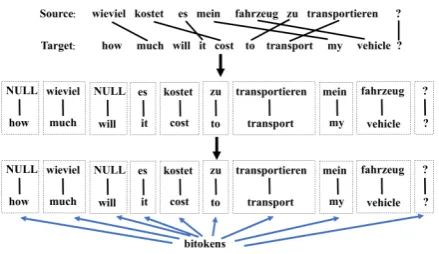
Figure 1: Bitoken sequence
Bitoken CNN Classifier-based Bilingual Scoring
Following the work of (Chen et al.,2016), a bito-ken CNN based scoring model is built for transla-tion quality evaluatransla-tion.
In this model, the bitokens are extracted from aligned sentence pairs. Figure 1 shows how a bito-ken sequence can be obtained from a word-aligned sentence pair. Each bitoken in the sequence is treated as a word, and each bitoken sequence is treated as a normal sentence. Then these bitoken sentences are fed to the CNN Classifier to build the bilingual scoring model. For every candidate sentence pair, this model will give two probabili-ties:ppos andpneg, and the quality score is treated
asscorebitoken =ppos−pneg. For the train data
set, the bitoken sequences obtained from the high-quality corpus are labeled as positive. As for the negative train data, we manually construct some noisy data based on the clean data.(Lample et al.,
2017) For example, shuffle the target side sen-tences of the clean parallel corpus, or randomly delete the source or target sentence’s words. So the negative bitoken sequences could be obtained from this unparallel corpus.
This scoring model can also be called bito-ken CNN scoring model.
2.2 Monolingual Quality Evaluation Rule based Filtering
A few rules are applied to filtering the sentence pairs whose source or target side are not good. These rules are:
• The ratio of valid tokens counts to the length of the sentence. Here, valid tokens are the tokens which contain the letters in the corre-sponding language. For example, a valid to-ken in English should contain English letters. In our system, the sentence is filtered if its valid-tokens ratio is less than 0.2.
• Language filtering. For German-English
par-allel corpus, the source and target sentences’ languages should be English and German. We can detect the sentence’s language by us-ing a language detection tool we developed1. The sentences pair is filtered if the languages of its source and target sides are not German and English.
Language Model Scoring
We use the language model to evaluate the qual-ity of sentences. The language model is success-fully used to select domain-related corpus (Yasuda et al., 2008; Moore and Lewis, 2010). Besides, the language model can also be used to filter out ungrammatical data (Denkowski et al.,2012; Al-lauzen et al.,2011), which is suitable for this task. In our corpus filtering system, we focus on the quality of target sentences, i.e. English sentences, as they are more important in NMT. Firstly, a large language model is built on all available English monolingual corpus provided by WMT18. The training corpus is cleaned using some rules men-tioned above. Then the normalized-length lan-guage model score can be regarded as the mono-lingual quality score. But in practice, this method has a shortcoming: it gives lower scores for the good sentences that contain rare words. The train-ing corpus needs to be generalized to overcome this shortness, for example, we can replace the words that occur less than 10 times in LM train corpus with their part of speech tag(Axelrod et al.,
2015). Finally, the language model is re-built on the generalized corpus.
2.3 Corpus Diversity Rule-based Filtering
We could use a simple rule to reduce the number of similar sentence pairs. Firstly, source and tar-get sentences should be generalized. In our ex-periment, for the English sentence, the general-ization is done by removing all the characters
ex-1This tool is similar to Google’s CLD2:
https://github.com/CLD2Owners/cld2
cept for English letters. Also, a similar operation is done for generalizing German sentences. After that, if some sentence pairs have the same gener-alized source or target sentences, the sentence pair that has the highest quality score will be selected. N-gram based Diversity Scoring
In this method, we aim to sub-select a corpus which contains a variety of N-grams. Such a cor-pus is regarded as high diversity. We follow the work of (Ambati, 2011; Bic¸ici and Yuret, 2011), with the motivation for introducing a feature decay function for the n-gram weight. In our system, af-ter selecting a subsetS1j−1, the next sentencesj’s
diversity score is given by:
f(sj|Sj1−1) =
PN n=1
P
ng∈N G(sj,n)weight(ng, j−1) norm(sj)
(2)
weight(ng, j−1) =F req(ng, S)∗e−λ∗F req(ng,Sj1−1),
where S1j−1 represents the set of selected sen-tences which contains1st to(j−1)th sentences, andSis the whole sentences pool to be selected.
f(sj|S1j−1)is the diversity score of sentencesj
under the condition that corpusS1j−1is selected. N G(sj, n)is alln-grams of sizenin sentence
sj.|N G(sj, n)|is the size of theN G(sj, n).
norm(sj) is the normalization factor for
sen-tencesj, and equalsPNn=1|N G(sj, n)|.
F req(ng, S) is the frequency ofn-gram in se-lection dataS.
λis the exponential decay hyper parameter,λ= 1in our experiment.
The equation (2) indicates that the n-gram is weighted by its frequency in the pool set S and selected setS1j−1. The higher the frequency of n-grams in the selected set, the lower the weight; the higher the frequency of n-gram in the pool set, the higher the weight. In practice, firstly, the sentences pairs in the pool S are sorted by their quality scores(combined by bilingual and mono-lingual score) in descending order. Then the se-lection method described above is carried out on the target side of the bilingual corpus.
Parallel Phrases Diversity Scoring
phrases. With this kind of corpus, the MT model will learn more translation knowledge.
Firstly, we use the fast align toolkit to train a word alignment model. And then the phrase table of the corpus can be extracted by using the Moses toolkit. Next, we can obtain the parallel phrases pairs for each sentence pair from the phrase table using the methods of maximum matching. Finally, following the method described in sectionN-gram based Diversity Scoring, the same selection pro-cedure (in which, N-gram is replaced by phrase pairs) is used for sentence pairs’ scoring. In our system, it works best when the phrase length is less than 7.
2.4 Methods Combination and corpus sampling
In our corpus filtering system, all the methods are combined into a pipeline.
First of all, we apply all the bilingual and mono-lingual rules to filter very noisy sentence pairs. Then, two bilingual scores and target side lan-guage model score could be produced by the above corresponding models. These three scores are individually normalized and then linearly com-bined to produce a single quality score. Here, the weights of these scores are selected with gird search method(Hsu et al., 2003). After that, we sort the sentence pairs by their corresponding quality scores in the descending order. The diver-sity method is then used to re-score/re-order the corpus. Finally, we select two sets of the top-N sentence pairs that contain totally 10 million words and 100 million words.
3 Experiments and Results
In this section, we specify the experimental set-tings and results in corpus filtering task.
3.1 Corpora and Settings
The selection data pool2 is provided by WMT18
Corpus Filtering Task, which contains about 100 million sentences pairs. It is very noisy. The task’s participants are asked to sub-select sentence pairs that amount to (a) 100 million words and (b) 10 million words.3 The quality of the resulting sub-sets is determined by the BLEU scores of a sta-tistical machine translation (Moses, phrase-based)
2
http://www.statmt.org/wmt18/parallel-corpus-filtering-data/data.gz
3
http://www.statmt.org/wmt18/parallel-corpus-filtering.html
and neural machine translation system (Marian) trained on this data. In our SMT and NMT exper-iments, we used the SMT and NMT configuration that are provided by the task organizer4, as well as the development and test set.
While building the alignment scoring model, after using the bilingual and monolingual filter-ing rules, 4,337,154 sentence pairs are selected from the corpora provided by theWMT18 English-German news translation task. Next, the fast align tool is used to build the word alignment model on the clean corpus, and then we can obtain the for-ward and reverse word translation probability ta-bles.
When building the bitoken CNN scoring model, 20,000 positive labeled bitoken sequences and 20,000 negative labeled bitoken sequences are constructed. The fast align toolkit is also used here. Then, we use the CONTEXT5 toolkit to train the CNN models. The bitokens’ embedding vectors are trained by word2vec6, and the size of each vector was set to 200.
For target sentences’ quality evaluation, we use the KenLM(Heafield et al., 2013) toolkit to train the normal and generalized LM. The clean train-ing corpus contains 60 million English sentences, which are sub-selected from the corpora provided byWMT18 News Translation Task.
3.2 Experimental Results
Firstly, the whole corpus which contains about 100 million sentence pairs was evaluated by train-ing the SMT and NMT system. The final BLEU scores are 21.21 and 7.8 respectively. This experi-ment shows that the whole corpus is really noisy.
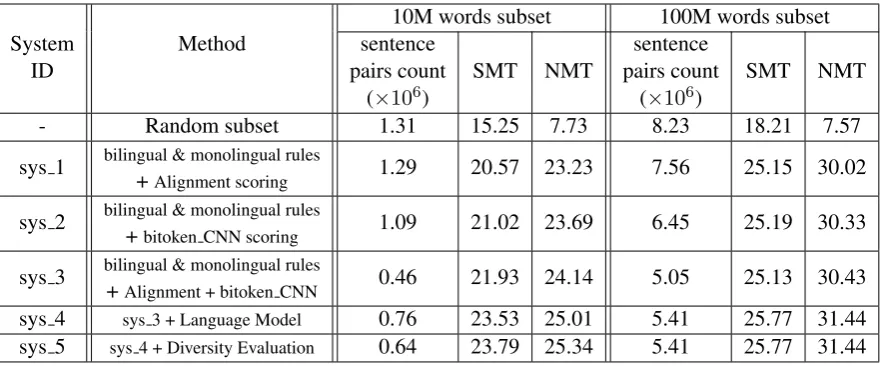
Other experimental results are detailed in Ta-ble 1. The randomly sub-selected corpus’ perfor-mance is also very poor. Thesys 1system uses the bilingual/monolingual rules and alignment scor-ing, which performed much better. We replace the alignment scoring method by bitoken CNN method and then build the sys 2 system. We find that the alignment scoring method and bito-ken CNN method are very similar in sentences pairs scoring. As a result, a lot of sentence pairs (about 70% in the subset) are selected by both methods. The two methods are combined insys 3, which has a little improvement. While combining,
4
http://www.statmt.org/wmt18/parallel-corpus-filtering-data/dev-tools.tgz
System ID
Method sentence10M words subset 100M words subset
pairs count (×106)
SMT NMT
sentence pairs count
(×106)
SMT NMT
- Random subset 1.31 15.25 7.73 8.23 18.21 7.57
sys 1 bilingual & monolingual rules+
Alignment scoring 1.29 20.57 23.23 7.56 25.15 30.02
sys 2 bilingual & monolingual rules+
bitoken CNN scoring 1.09 21.02 23.69 6.45 25.19 30.33
sys 3 bilingual & monolingual rules
+Alignment + bitoken CNN 0.46 21.93 24.14 5.05 25.13 30.43
sys 4 sys 3 + Language Model 0.76 23.53 25.01 5.41 25.77 31.44
[image:5.595.78.519.61.244.2]sys 5 sys 4 + Diversity Evaluation 0.64 23.79 25.34 5.41 25.77 31.44
Table 1: Methods used in Corpus selection and their performance
the original scores are normalized to the interval [0,1], and then the linear model is used to produce a new score. Insys 3system, the weights of align-ment score and bitoken CNN score are 0.4 and 0.6 respectively.
The sys 4 introduced language mode score based on sys 3. The weights of the align-ment score, bitoken CNN score, and the language model score are 0.4, 0.6 and 0.8 respectively. It shows that the language model is useful in select-ing clean sentences pairs.
Finally, based onsys 4, the corpus diversity fil-tering rules and scoring are introduced in sys 5. We find that the diversity method (only Parallel Phrases Diversity Scoringis used insys 5system) works well in selecting the smaller subset corpus, e.g. the 10 million words corpus. For large subset corpus selection, it almost has no improvement. We attribute this to the sufficiently high diversity of larger subset corpus.
4 Conclusions
In this paper, we present our corpus filtering sys-tem for theWMT 2018 Corpus Filtering Task. In our system, sentence pairs are evaluated in three aspects: (1) the bilingual translation quality, (2) the monolingual quality of the source and target sentences and (3) the diversity of the sub-selected corpus. Our experiments show that all the meth-ods are contributed to building a cleaner parallel corpus.
References
Alexandre Allauzen, H´elene Bonneau-Maynard, Hai-Son Le, Aur´elien Max, Guillaume Wisniewski, Franc¸ois Yvon, Gilles Adda, Josep M Crego, Adrien Lardilleux, Thomas Lavergne, et al. 2011. Limsi@ wmt11. In Proceedings of the Sixth Workshop on Statistical Machine Translation, pages 309–315. As-sociation for Computational Linguistics.
Vamshi Ambati. 2011. Active learning and crowd-sourcing for machine translation in low resource scenarios. Ph.D. thesis, University of Southern Cal-ifornia.
Amittai Axelrod, Philip Resnik, Xiaodong He, and Mari Ostendorf. 2015. Data selection with fewer words. In Proceedings of the Tenth Workshop on Statistical Machine Translation, pages 58–65, Lis-bon, Portugal. Association for Computational Lin-guistics.
Ergun Bic¸ici and Deniz Yuret. 2011. Instance selec-tion for machine translaselec-tion using feature decay al-gorithms. InProceedings of the Sixth Workshop on Statistical Machine Translation, pages 272–283. As-sociation for Computational Linguistics.
Boxing Chen, Roland Kuhn, George Foster, Colin Cherry, and Fei Huang. 2016. Bilingual methods for adaptive training data selection for machine transla-tion. InProc. of AMTA, pages 93–103.
Michael Denkowski, Greg Hanneman, and Alon Lavie. 2012. The cmu-avenue french-english translation system. InProceedings of the Seventh Workshop on Statistical Machine Translation, pages 261–266. As-sociation for Computational Linguistics.
Kenneth Heafield, Ivan Pouzyrevsky, Jonathan H. Clark, and Philipp Koehn. 2013. Scalable modi-fied Kneser-Ney language model estimation. In Pro-ceedings of the 51st Annual Meeting of the Associa-tion for ComputaAssocia-tional Linguistics, pages 690–696, Sofia, Bulgaria.
Chih-Wei Hsu, Chih-Chung Chang, Chih-Jen Lin, et al. 2003. A practical guide to support vector classifica-tion.
Shahram Khadivi and Hermann Ney. 2005. Automatic filtering of bilingual corpora for statistical machine translation. In International Conference on Appli-cation of Natural Language to Information Systems, pages 263–274. Springer.
Huda Khayrallah and Philipp Koehn. 2018. On the impact of various types of noise on neural machine translation. InProceedings of the 2nd Workshop on Neural Machine Translation and Generation, pages 1–10.
Philipp Koehn and Rebecca Knowles. 2017. Six challenges for neural machine translation. arXiv preprint arXiv:1706.03872.
Guillaume Lample, Ludovic Denoyer, and Marc’Aurelio Ranzato. 2017. Unsupervised machine translation using monolingual corpora only. CoRR, abs/1711.00043.
Robert C Moore and William Lewis. 2010. Intelligent selection of language model training data. In Pro-ceedings of the ACL 2010 conference short papers, pages 220–224. Association for Computational Lin-guistics.
Philip Resnik and Noah A Smith. 2003. The web as a parallel corpus. Computational Linguistics, 29(3):349–380.
Kaveh Taghipour, Nasim Afhami, Shahram Khadivi, and Saeed Shiry. 2010. A discriminative approach to filter out noisy sentence pairs from bilingual cor-pora. InTelecommunications (IST), 2010 5th Inter-national Symposium on, pages 537–541. IEEE.