245
Dual Monolingual Cross-Entropy-Delta Filtering of Noisy Parallel Data
Amittai Axelrod DiDi AI Labs Los Angeles, CA
Anish Kumar Steve Sloto
Abstract
We introduce a purely monolingual approach to filtering for parallel data from a noisy cor-pus in a low-resource scenario. Our work is inspired byJunczys-Dowmunt(2018), but we relax the requirements to allow for cases where no parallel data is available. Our pri-mary contribution is a dual monolingual cross-entropy delta criterion modified from Cynical data selection (Axelrod,2017), and is compet-itive (within 1.8 BLEU) with the best bilingual filtering method when used to train SMT sys-tems. Our approach is featherweight, and runs end-to-end on a standard laptop in three hours.
1 Introduction
The 2018 WMT shared task on parallel corpus fil-tering (Koehn et al.,2018) required participants to select subcorpora of 10M and 100M words from an extremely noisy 1B word German-English par-allel corpus from Paracrawl (Buck and Koehn,
2016). These subcorpora were then used to train machine translation systems, and evaluated on held-out test sets. The best submission ( Junczys-Dowmunt,2018) comprised:
1. a filter based on language ID
2. a dual conditional cross-entropy filter to de-termine whether the halves of a sentence pair were of roughly equal translation probability
3. a cross-entropy difference filter to prioritize in-domain sentence pairs
The 2019 WMT shared task on parallel corpus filtering (Koehn et al., 2019) was set for low-resource conditions, with the goal of translat-ing Wikipedia texts both Sinhala-to-English and Nepali-to-English (Guzm´an et al.,2019).
We participated only in the Sinhala-English track, basing our system on that of Junczys-Dowmunt(2018) but extensively modified for the
2019 low-resource scenario. As compared to their work, ours comprised: a minor upgrade of their first element, a relaxation of the second, a mod-ern replacement for the third, and an additional length-based filter. The resulting entirely mono-lingual pipeline to filter noisy parallel data proved to be competitive with the other multilingual en-tries when used to train downstream SMT systems.
2 Related Work
We now describe the Junczys-Dowmunt (2018) system that was the inspiration for ours.
2.1 2018 Language ID Filter
The first feature used the langid Python mod-ule to classify the language of each half of each sentence pair to a language. Any sentence pair where either half was classified as being in an in-correct language was removed, and sentence pairs with correctly-classified halves were kept.
2.2 2018 Dual Conditional Cross-Entropy
The dual conditional cross-entropy filtering method rewards sentence pairs with minimal
symmetric translation disagreement. That is the difference in average (per-word) conditional cross-entropy of the sentence pair halves:
|HF→E(sE|sF)−HE→F(sF|sE)|
For a sentence pair (sE, sF), the per-word con-ditional cross-entropyHF→E(sE|sF) of one half of the sentence pair is computed by a transla-tion model F → E, and the corresponding HE→F(sF|sE) of the other half of the sentence pair is computed by a translation model in the op-posite direction. The two translation models are trained in inverse directions on the same parallel corpus, so they should be equally expressive.
are good or not. A perfectly translated sentence pair where the translation models agree perfectly would have the same score as a poorly translated sentence pair where the translation models also agree. This same weakness is found in the cross-entropy difference criterion (Moore and Lewis,
2010) on which the conditional cross-entropy dif-ference is based. To force the better sentence pair to have a lower feature score than the other pair,
Junczys-Dowmunt(2018) add a term consisting of the average per-word conditional cross-entropy of the two halves. Worse sentences have higher en-tropy, so a score of 0 remains ideal. The equation for the dual conditional cross-entropy is thus:
h(sE, sF) =| H
F→E(sE|sF)−EH→F(sF|sE)|
+1
2 FH→E(sE|sF) +EH→F(sF|sE)
(1)
The first term is the translation disagreement, and the second term is the average entropy. The score is exponentiated so that good sentence pairs have a feature score of 1, and bad sentence pairs have a score of 0:
f(sE, sF) =e−h(sE,sF)
In describing their approach,Junczys-Dowmunt
(2018) criticize the Moore and Lewis (2010) cross-entropy difference method for “missing” an adequacy component. This is misguided, as the Moore-Lewis method was originally designed for language modeling and was only later repurposed for machine translation. In MT, the two halves of a sentence pair might be fluent but not express the same thing, and so the notion ofadequacyis used to describe how well the halves correspond in meaning. In language modeling, there is no such thing as a sentence pair, and there should not be much doubt that a sentence rather adequately (and tautologically) manages to express exactly that which it does express. It would be more proper to state that the omission of adequacy is a weak-ness of the bilingual extension of Moore-Lewis to machine translation byAxelrod et al.(2011).
2.3 2018 Moore-Lewis Filtering
The third and final feature in the best 2018 system was a monolingual (English) cross-entropy differ-ence (Moore and Lewis,2010) score:
Hin(sE)−Hout(sE) (2)
The cross-entropies H were computed using language models trained on 1M sentences of WMT news data as in-domain, and 1M random Paracrawl sentences as out-of-domain data. This is an ideal setup for cross-entropy difference, as Equation 2 fundamentally assumes that the two corpora are as different as possible.
3 Cynical Data Selection
Both the relaxation of the dual conditional entropy filter and our replacement of the cross-entropy difference filter are based on Cynical data selection (Axelrod,2017), described below. The Moore-Lewis cross-entropy difference approach fundamentally views the training data as being ei-therin-domain orout/general-domain. This stark distinction is not realistic. Cynical data selection relaxes that assumption, and starts with one corpus of representative data (REPR), and one of avail-abledata (AVAIL). The representative data is ex-actly that: representative of what we would like to be translating. Theavailabledata is similarly the data pool from which one can select a subcorpus. No relationship is assumed between the represen-tativeandavailablecorpora, nor between the do-mains they cover.
The algorithm incrementally grows a corpus of sentences, selecting from AVAIL, in order to bet-ter model REPR. First, it estimates the perplex-ity of a language model trained on the already-selected data and evaluated on the REPR corpus. Next, for each sentence still available, it estimates the change in that perplexity (or entropy, ∆H) that would result from adding it as a new sentence to the LM training data and re-training the LM (Sethy et al.,2006). The sentence with the lowest cross-entropy delta is removed fromAVAIL, added to the selected pile, and the process repeats. Iden-tifying the next single sentence to add is O(n2) and not computationally practical, but it is efficient to find the best wordv in the vocabularyVREP R to add once to the selected data. From there, it is now practical to pick the best sentence still in AVAIL that contains that word. Then+ 1th itera-tion, after selectingnsentences, is:
2. Find the single sentence s ∈ AVAIL con-taining v that would (also) most lower the entropy (evaluated on REPR) of a language model trained on thensentences pluss.
3. Removesfrom AVAIL, update the language model with the countcof all words ins, and addsto the selected sentences.
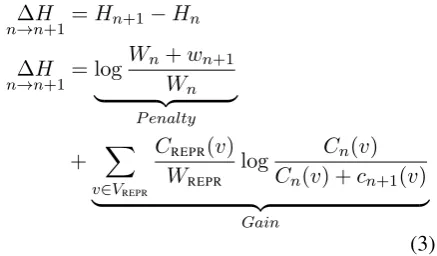
The cross-entropy delta∆H is the change in the entropy of a language model, evaluated on a con-stant test set, after adding a new entry to the lan-guage model’s training corpus. This is straight-forward to compute, as there is a entropic length penalty for increasing the size of the training cor-pus, and an entropy gain for adding new informa-tion to the training set. This was first formulated by Sethy et al. (2006) as “relative entropy”, and clarified byAxelrod(2017) as:
∆H
n→n+1=Hn+1−Hn
∆H
n→n+1= log
Wn+wn+1 Wn
| {z }
P enalty
+ X v∈VREPR
CREPR(v)
WREPR
log Cn(v) Cn(v) +cn+1(v)
| {z }
Gain
(3)
The penalty term depends on the lengthwn+1 of then+ 1thline, and the size in wordsW
nof the already-selected data. The gain term depends on the empirical probability of each word v in the REPR corpus, and then the countCnof the word so far in thenselected lines, and the count cn+1 of the word in then+ 1thline.
4 Sinhala-English Data
The 2019 iteration of the shared task focused ex-clusively on filtering a noisy parallel corpus for low-resource language pairs, and had consider-ably less data than the 2018 German-English task. Table 1 shows that only 645k lines of parallel Sinhala-English were provided in total– less than the small 1M German-English sentence pair sub-sets used to train the dual NMT engines for the scoring function ofJunczys-Dowmunt(2018).
4.1 Data
The 2019 Si-En parallel data was drawn from con-versations and technical manuals, unlike the wiki-based evaluation data. Larger and more relevant,
Corpus Lines Tok (Si) Tok (En) Open Subtitles 601,164 3.4M 3.6M
Ubuntu 45,617 175k 151k
[image:3.595.311.531.64.118.2]Total 646,781 3.5M 3.7M
Table 1: Parallel Data for Sinhala-English
yet monolingual, corpora were provided from both Wikipedia and Common Crawl, detailed in Ta-ble2.
Corpus Lines Tokens
[image:3.595.72.291.317.445.2]Sinhala Wikipedia 156k 4.7M English Wikipedia 67.8M 1.9B Sinhala Common Crawl 5.2M 110M English Common Crawl 380M 8.9B English Subset Wikipedia 150k 5.5M English Subset Common Crawl 6M 123M
Table 2: Corpus statistics for provided monolingual data in Sinhala and English, and an English subset of comparable size to the Sinhala data.
The provided monolingual English data was several orders of magnitude larger than the Sinhala data, which would have made it difficult to create equally strong (or weak) monolingual models used in this work. We therefore assembled a monolin-gual English corpus comparable in size and con-tent to the Sinhala one by randomly selecting 150k lines from Wikipedia and 6M lines from Com-mon Crawl. We used SentencePiece (Kudo and Richardson,2018), withmodel type=word, to preprocess the Sinhala and English sides sepa-rately, producing a fairly word-like vocabulary of 100k subwords for each language. Each Sentence-Piece model was trained on 1M lines of monolin-gual data: 150k Wiki + 850k Common Crawl.
5 Our Submission
We used the feature framework from Junczys-Dowmunt (2018) as the basis for ours. For each sentence pair (sSi, sEn) in the noisy corpus, we computed a final score f(sSi, sEn) ∈ [0,1] by multiplying each of the individual feature scores for the sentence pair:
f(sSi, sEn) =
Y
i
fi(sSi, sEn) (4)
the lines were sorted from highest to lowest over-all score, and then selected in that order until the number of selected English words reached the evaluation threshold. Any feature score being 0 ef-fectively removed that sentence pair from consid-eration. The selected subsets were then submitted for evaluation by the task organizers. The follow-ing are the monolfollow-ingual features we used to score the noisy parallel data.
5.0 Length Ratio Feature
We added one feature as compared to Junczys-Dowmunt(2018), based on the length ratio of the two halves of the sentence pair, penalizing sen-tence pairs with sides of disparate lengths. The provided clean, parallel, training data in Table 1
is inconclusive regarding the expected Si-to-En length ratio, as one of the parallel corpora had more English tokens than Sinhala, and the other had the reverse. The ratios were approximately inverses, so we set the desired ratio to be 1 and penalized sentence pair scores according to how divergent the parallel segment’s length ratio was from 1. A sentence pair with a length ratio within two orders of magnitude, i.e. e−2 < ensi < e2, or |ln(ensi)| < 2, received a feature score of 1, or no penalty. The feature score was set to 0.5 if 2 < |ln(ensi)| < 3. For 3 < |ln(ensi)|the fea-ture was 0.35. For pairs where both segments con-tained fewer than six tokens, we applied less strict penalties as ratios are more likely to vary with shorter segment lengths. For such pairs, we as-signed a score of 0.5 if the ratio is greater than 4 orders of magnitude, 0.75 if between 3 and 4, and 0.9 if within 2-3 factors. We also observed that large numbers of non-parallel Paracrawl sentence pairs contained mostly numbers on one side. Any sentence pair where at least 15% of either half was only numerals received a score of 0.
5.1 Language ID Feature
As with the 2018 task, a considerable quantity of the provided Paracrawl data was not in the correct language. Following Junczys-Dowmunt (2018), we classified the halves of the sentence pair using thelangidPython module and assigned 0 to any sentence pair with an incorrectly-labeled half. If the correct languages were selected, then the fea-ture value was the product of thelangid confi-dence scores. Inspecting the filter output showed that it was not strong enough. Thelangid clas-sification had many false positives, as well as
source-side (Sinhala) sentences that were mixed with a significant amount of English. The shared task’s hard limit on the number of selectable words made it important to minimize the amount of En-glish on the Sinhala side. The languages have non-overlapping writing scripts, so it was easy to de-tect erroneous characters. We therefore multiplied the lang id score by the proportion of characters (excluding numerals and punctuation) in each sen-tence that belong to the correct Unicode block, resulting in an overall language ID feature that slightly extends the original.
5.2 Dual Monolingual Cross-Entropy Deltas
Junczys-Dowmunt(2018) trained MT systems on clean parallel data for the 2018 task, but used only the translation probability of each to score the Paracrawl data and not the translation output itself. The motivation for training the dual NMT systems on the same parallel corpus was to en-sure that the models would have similar BLEU scores and translation probabilities for the halves of a truly parallel sentence pair.
We did not have enough good parallel data for Sinhala and English, which ruled out train-ing models on identical information. However, perhaps the translation models themselves were not inherently necessary as long as similar scores could be obtained. Language models require less training data than an MT engine to be reliable, and can also output an average per-word probability for a sentence– and we were provided with good monolingual data. We set out to construct lan-guage models with similaramountsof information hoping they might have similar perplexities for the halves of a parallel sentence pair, and differ-ent perplexities for a non-parallel pair. The result was a relaxation of the dual conditional translation cross-entropy feature that only required monolin-gual data, and used equal relative informativeness instead of equal translation probability.
5.2.1 Setting Up Language Models
subwords). First, we hoped a standard lexicon size would mitigate the effect of morphology differ-ences affecting sentence length and word sparsity. Secondly, we hoped it would encourage language models trained on similar– but not parallel– En-glish and Sinhala texts to have similar perplexities over each half of a parallel test set.
This would mean the two LMs had similar es-timates of how much information is in each half of the parallel data. The two halves of the paral-lel corpus presumably contain the same amount of actual information, but two LMs would only come up with the same estimate if they themselves con-tained comparable amounts of information, even if they did not the same information.
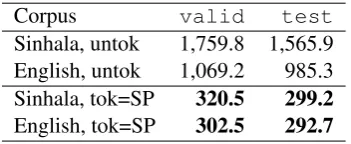
To test this, we trained 4-gram language mod-els using KenLM (Heafield, 2011) on the Sin-hala monolingual data and the restricted-size En-glish data in Table 2, both unprocessed and af-ter tokenizing with SentencePiece. The models were evaluated on the provided parallel valid
andtestsets. Table3shows that, indeed, forc-ing English and Sinhala LMs to have identical vo-cabulary sizes was enough to obtain nearly identi-cal perplexities on the halves of a parallel corpus, even though the language models were trained on similar but not parallel data.
Corpus valid test
Sinhala, untok 1,759.8 1,565.9 English, untok 1,069.2 985.3 Sinhala, tok=SP 320.5 299.2
[image:5.595.94.270.441.513.2]English, tok=SP 302.5 292.7
Table 3: Using SentencePiece to equalize LM perplex-ities in different languages on the dev sets.
5.2.2 Parallel Scoring with Monolingual LMs
Wse used the “greedy cross-entropy delta” term from Cynical data selection in a novel way: to score each side of the Paracrawl data as a mem-oryless stream of text. In this setup, we had a language model trained on the monolingual Wikipedia data, which is the REPR corpus, and representative of the kind of data the organizers will evaluate on. We compute the∆H of adding each sentencesin Paracrawl to theREPR corpus, retraining a LM onREPR+s, and recomputing the perplexity onREPRcorpus. After computing all of the∆H scores for the Paracrawl data, cynical data selection would normally extract the best one,
in-corporate it into the training set, and iterate. In-stead, we modified the public implementation1 of Cynical data selection to not update anything, and the scoring is done in a single pass as done by
Sethy et al.(2006).
The difference between a LM perplexity and the ∆H score is that the LM quantifies the likelihood, and the∆H score quantifies informativeness. The ∆H score estimates, for a fixedREPRcorpus: does this next line contain any information at all about REPR that we do not already know? A negative score would indicate a estimated decrease in en-tropy, so adding this line should improve a model trained on the selected data.
We constructed monolingual Sinhala and En-glish LMs with similar perplexities on a parallel test set that resembled the task evaluation, so we hoped that sentences with equal ∆H scores ac-cording to these two models could be parallel. Or, at least, that sentences with disparate∆H scores would be deemed not-parallel, and filtered out.
One could simply replace the translation system conditional cross-entropies in Equation1with the cross-entropies from the two comparable language models just described. However, that would only characterize the fluency, without any sense of the content. It is not clear whether identical perplexi-ties or identical∆H scores is a better indicator of “these sentences are parallel”: being equally likely and being equally informative are each positive in-dicators. The goal of the shared task was to as-semble the parallel corpus that produced the best downstream MT system for Wikipedia test; prior-itizing informative sentences seemed more impor-tant here than prioritizing likely ones. Our version of Equation1thus used Equation3’s∆H scores, dual monolingual cross-entropy deltas, for each sentence pair(sSi, sEn), instead of dual bilingual conditional cross-entropies:
|∆HEn(sEn|REPREn)−∆HSi(sSi|REPRSi)|
+1
2 ∆HEn(sEn|REPREn) + ∆HSi(sSi|REPRSi)
(5)
This was exponentiated to be in the range of[0,1].
5.3 Dual Monolingual Cynical Data Selection
The final feature from (Junczys-Dowmunt,2018) was a monolingual Moore-Lewis score, intended to bias the filtering towards in-domain news data.
However, the Moore-Lewis method for data selec-tion has some notable flaws, as described in Ax-elrod(2017). The biggest is that it has no sense of sufficiency: while it is not helpful to see an identical sentence pair 10,000 times, the Moore-Lewis criterion will assign the same score to all copies. Cynical data selection selects sentences only if they contribute new information to the set of sentences already selected, and has previously been shown to help domain adaptation in SMT (Santamar´ıa and Axelrod,2017) and NMT (Zhang et al.,2019), and a variation of it was used for the 2018 corpus filtering task (Erdmann and Gwinnup,
2018). As a side effect, Cynical selection elim-inates the need for explicit vocabulary coverage features that were used in the previous shared task (Lo et al.,2018;Azpeitia et al.,2018).
For each language, we used Cynical data se-lection to rank the sentences in the noisy cor-pus. We set the Paracrawl data to be the Avail-able set, and the clean monolingual Wikipedia data to be theRepresentativeset. This selects the subset of Paracrawl that best models monolingual Wikipedia. The re-ranked Paracrawl corpus was then scored by converting the Cynical ranking to a percentage and subtracted from 1. Thus the sen-tence selected as number 15,000 out of 3M would have a score of1− 153Mk, and 1 would be the best score and 0 the worst. The ranking score for a sen-tence pair was the product of the monolingual rank scores for each half.
6 Results and Discussion
Our submission was entirely monolingual, and used parallel data only to sanity-check the lan-guage models trained in Section 5.2.1. Further-more, all of the preprocessing, language model-ing, data selection, and feature computation in this work was run on a laptop. As such, we had no expectations for whether our method would be ef-fective compared against bilingual or multilingual methods trained for days on GPU machines.
We tried to predict results using NMT systems after the submission deadline, thanks to the scripts, code, and standard settings provided by the orga-nizers, but all of our system BLEU scores ( Pap-ineni et al.,2002) were under 0.20 and worse than a random baseline. While the evaluation campaign cutoff was set to be 1M or 5M English words, the Sinhala sides of our filtered corpus contained only 740k and 3.6M words respectively. Our length
ra-tio feature was overly complicated and not aggres-sive enough; the Si→En NMT systems tended to stutter to produce English sentences of appropriate length. Discarding anything with a length differ-ence>20%would probably have been better.
The official evaluation results were a pleasant surprise. Table4shows the top and bottom scores for each evaluation category, providing context for our submission. We were in the bottom third of the SMT systems, yet within 1.8 BLEU of the best system at 1M, and 1.3 BLEU of the best system at 5M. This is rather competitive for a gratuitously-monolingual approach to a bilingual task!
Our submitted system, like roughly 30% of the submissions, was not suitable for filtering data for a low-resource NMT pipeline. However, the NMT systems trained on 1M words were several BLEU points better than systems trained on 5M words, so training an NMT system on small amounts of data is unpredictable. Better feature engineering would certainly help.
1M 1M 5M 5M
[image:6.595.319.512.358.428.2]System SMT NMT SMT NMT Rank 1 4.27 6.39 4.94 4.44 DiDi 2.53 0.19 3.70 0.20 Rank 10 0.92 0.03 2.73 0.10
Table 4: Bleu scores ontestfor systems trained on subsets with 1M and 5M English words of the noisy Paracrawl data.
7 Conclusion
We presented a purely monolingual method, based on cynical data selection (Axelrod,2017), for fil-tering noisy parallel data. Our approach is a relax-ation of the dual conditional cross-entropy method ofJunczys-Dowmunt(2018), that does require any parallel data. As secondary contributions, we have used Cynical data selection in a streaming scenario for the first time, and used relativeinformativeness
References
Mikel Artetxe and Holger Schwenk. 2019. Margin-based Parallel Corpus Mining with Multilingual Sentence Embeddings. ACL (Association for Com-putational Linguistics).
Amittai Axelrod. 2017. Cynical Selection of Language Model Training Data.arXiv [cs.CL].
Amittai Axelrod, Xiaodong He, and Jianfeng Gao. 2011. Domain Adaptation Via Pseudo In-Domain Data Selection.EMNLP (Empirical Methods in Nat-ural Language Processing).
Andoni Azpeitia, Thierry Etchegoyhen, and Eva Mart´ınez garcia. 2018. STACC, OOV Density and N-gram Saturation: Vicomtech’s Participation in the WMT 2018 Shared Task on Parallel Corpus Filter-ing. WMT Conference on Statistical Machine Trans-lation.
Christian Buck and Philipp Koehn. 2016. Findings of the WMT 2016 Bilingual Document Alignment Shared Task. WMT Conference on Statistical Ma-chine Translation.
Grant Erdmann and Jeremy Gwinnup. 2018. Coverage and Cynicism: The AFRL Submission to the WMT 2018 Parallel Corpus Filtering Task. WMT Confer-ence on Statistical Machine Translation.
Francisco Guzm´an, Peng-Jen Chen, Myle Ott, Juan Pino, Guillaume Lample, Philipp Koehn, Vishrav Chaudhary, and Marc’Aurelio Ranzato. 2019. Two New Evaluation Datasets for Low-Resource Ma-chine Translation: Nepali-English and Sinhala-English.arXiv [cs.CL].
Kenneth Heafield. 2011. KenLM : Faster and Smaller Language Model Queries. WMT (Workshop on Sta-tistical Machine Translation).
Marcin Junczys-Dowmunt. 2018. Dual Conditional Cross-Entropy Filtering of Noisy Parallel Corpora.
WMT Conference on Statistical Machine Transla-tion.
Philipp Koehn, Francisco Guzm´an, Vishrav Chaud-hary, and Juan Pino. 2019. Findings of the WMT 2019 Shared Task on Parallel Corpus Filtering for Low-Resource Conditions. WMT Conference on Statistical Machine Translation.
Philipp Koehn, Huda Khayrallah, Kenneth Heafield, and Mikel Forcada. 2018. Findings of the WMT 2018 Shared Task on Parallel Corpus Filtering.
WMT Conference on Statistical Machine Transla-tion.
Taku Kudo and John Richardson. 2018. Sentence-Piece: A Simple and Language Independent Sub-word Tokenizer and Detokenizer for Neural Text Processing. EMNLP (Empirical Methods in Natu-ral Language Processing) System Demonstrations.
Chi-kiu Lo, Michel Simard, Darlene Stewart, Samuel Larkin, Cyril Goutte, and Patrick Littell. 2018.
Accurate Semantic Textual Similarity for Clean-ing Noisy Parallel Corpora usClean-ing Semantic Ma-chine Translation Evaluation Metric: The NRC Su-pervised Submissions to the Parallel Corpus Filter-ing task. WMT Conference on Statistical Machine Translation.
Robert C Moore and William D Lewis. 2010. Intel-ligent Selection of Language Model Training Data.
ACL (Association for Computational Linguistics).
Kishore Papineni, Salim Roukos, Todd Ward, and Wei-jing Zhu. 2002. BLEU: A Method for Automatic Evaluation of Machine Translation. ACL (Associa-tion for Computa(Associa-tional Linguistics).
Luc´ıa Santamar´ıa and Amittai Axelrod. 2017. Data Selection with Cluster-Based Language Difference Models and Cynical Selection. IWSLT (Interna-tional Workshop on Spoken Language Translation).
Abhinav Sethy, Panayiotis G. Georgiou, and Shrikanth Narayanan. 2006. Text Data Acquisition for Domain-Specific Language Models. EMNLP (Em-pirical Methods in Natural Language Processing).
Xuan Zhang, Pamela Shapiro, Gaurav Kumar, Paul McNamee, Marine Carpuat, and Kevin Duh. 2019.