Proceedings of NAACL-HLT 2019, pages 1493–1503 1493
Improving Lemmatization of Non-Standard Languages with Joint
Learning
Enrique Manjavacas1,Akos K´ad´ar´ 2, andMike Kestemont1
1Computational Linguistics and Psycholinguistics Research Center, University of Antwerp, Belgium 2Tilburg Center for Cognition and Communication, Tilburg University, The Netherlands
{firstname,lastname}@uantwerpen.be,[email protected]
Abstract
Lemmatization of standard languages is con-cerned with (i) abstracting over morphologi-cal differences and (ii) resolving token-lemma ambiguities of inflected words in order to map them to a dictionary headword. In the present paper we aim to improve lemmatization per-formance on a set of non-standard histori-cal languages in which the difficulty is in-creased by an additional aspect (iii): spelling variation due to lacking orthographic stan-dards. We approach lemmatization as a string-transduction task with an encoder-decoder ar-chitecture which we enrich with sentence con-text information using a hierarchical sentence encoder. We show significant improvements over the state-of-the-art when training the sen-tence encoder jointly for lemmatization and language modeling. Crucially, our architec-ture does not require POS or morphological annotations, which are not always available for historical corpora. Additionally, we also test the proposed model on a set of typolog-ically diverse standard languages showing re-sults on par or better than a model without en-hanced sentence representations and previous state-of-the-art systems. Finally, to encourage future work on processing of non-standard va-rieties, we release the dataset of non-standard languages underlying the present study, based on openly accessible sources.
1 Introduction
Lemmatization is the task of mapping a token to its corresponding dictionary head-form to allow downstream applications to abstract away from orthographic and inflectional variation (Knowles and Mohd Don, 2004). While lemmatization is considered to be solved for analytic and resource-rich languages such as English, it remains an open challenge for morphologically complex (e.g. Es-tonian, Latvian) and low-resource languages with unstable orthography (e.g. historical languages).
Especially for languages with higher surface vari-ation, lemmatization plays a crucial role as a pre-processing step for downstream tasks such as topic modeling, stylometry and information retrieval.
In the case of standard languages, lemmatiza-tion complexity arises primarily from two sources: (i) morphological complexity affecting the num-ber of inflectional patterns a lemmatizer has to model and (ii) token-lemma ambiguities (e.g. “liv-ing” can refer to lemmas “liv“liv-ing” or “live”) which require modeling sentence context information. In the case of historical languages, however, the aforementioned spelling variation introduces fur-ther complications. For instance, the regularity of the morphological system is drastically reduced since the evidence supporting token-lemma map-pings becomes more sparse. As an example, while the modern Dutch lemma “jaar” (en. “year”) can be inflected in 2 different ways (“jaar”, “jaren”), in a Middle Dutch corpus used in this study it is found in combination with 70 different forms (“iare”, “ior”, “jaer”, etc.). Moreover, spelling variation increases token-lemma ambiguities by conflating surface realizations of otherwise unam-biguous tokens—e.g. Middle Low German “bath” can refer to lemmas “bat” (en. “bad”) and “bid-den” (en. “bet”) due to different spellings of the dental occlusive in final position.
Spelling variation is not exclusive of histori-cal languages and it can be found in contempo-rary forms of on communication, such as micro-blogs, with loose orthographic conventions ( Crys-tal, 2001). An important difference, however, is that while for modern languages normalization is feasible (Schulz et al., 2016), for many historic languages such is not possible, because one is dealing with an amalgam of regional dialects that lacked any sort of supra-regional variant function-ing as target domain (Kestemont et al.,2016).
learning to lemmatization of historical languages. Our method shows improvements over a plain encoder-decoder framework, which reportedly achieves state-of-the-art performance on lemmati-zation and morphological analysis (Bergmanis and Goldwater,2018;Peters et al.,2018). In particu-lar, we make the following contributions:
1. We introduce a simple joint learning ap-proach based on a bidirectional Language Model (LM) loss and achieve relative im-provements in overall accuracy of 7.9% over an encoder-decoder trained without joint loss and 30.72% over edit-tree based approaches.
2. We provide a detailed analysis of the linguis-tic and corpus characterislinguis-tics that explain the amount of improvement we can expect from LM joint training.
3. We probe the hidden representations learned with the joint loss and find them signifi-cantly better predictors of POS-tags and other morphological categories than the represen-tations of the simple model, confirming the efficiency of the joint loss for feature extrac-tion.
Additionally, we test our approach on a typolog-ically varied set of modern standard languages and find that the joint LM loss significantly improves lemmatization accuracy of ambiguous tokens over the encoder-decoder baseline (with a relative in-crease of 15.1%), but that, in contrast to previ-ous literature (Chakrabarty et al.,2017;Bergmanis and Goldwater,2018), the overall performance of encoder-decoder models is not significantly higher than that of edit-tree based approaches. Tak-ing into account the type of inflectional morphol-ogy dominating in a particular language, we show that the benefit of encoder-decoder approaches is highly dependent on typological morphology. Fi-nally, to assure reproducibility, all corpus prepro-cessing pipelines and train-dev-test splits are re-leased. With this release, we hope to encourage future work on processing of lesser studied non-standard varieties.1
1
Datasets and training splits are available at https: //www.github.com/emanjavacas/pie-data. Ex-periments are conducted with our framework pie avail-able at:https://www.github.com/emanjavacas/ pie. All our experiments are implemented usingPyTorch
(Paszke et al.,2017).
2 Related Work
Modern data-driven approaches typically treat lemmatization as a classification task where classes are represented by binary edit-trees in-duced from the training data. Given a token-lemma pair, its binary edit-tree is induced by com-puting the prefix and suffix around the longest common subsequence, and recursively building a tree until no common character can be found. Such edit-trees manage to capture a large propor-tion of the morphological regularity, especially for languages that rely on suffixation for morphologi-cal inflection (e.g. Western European languages), for which such methods were primarily designed.
Based on edit-tree induction, different lemma-tizers have been proposed. For example,Chrupala et al. (2008) use a log-linear model and a set of hand-crafted features to decode a sequence of edit-trees together with the sequence of POS-tags using a beam-search strategy. A related approach is pre-sented byGesmundo and Samardˇzi(2012), where edit-trees are extracted using a non-recursive ver-sion of the binary edit-tree induction approach. More recently,Cotterell et al.(2015) have used an extended set of features and a second-order CRF to jointly predict POS-tags and edit-trees with state-of-the-art performance. Finally,Chakrabarty et al.
(2017) employed a softmax classifier to predict edit-trees based on sentence-level features implic-itly learned with a neural encoder over the input sentence.
With the advent of current encoder-decoder ar-chitectures, lemmatization as a string-transduction task has gained interest partly inspired by the success of such architectures in Neural Machine Translation (NMT). For instance, Bergmanis and Goldwater (2018) apply a state-of-the-art NMT system with the lemma as target and as source the focus token with a fixed window over neighboring tokens. Most similar to our work is the approach byKondratyuk et al.(2018), which conditions the decoder on sentence-level distributional features extracted from a sentence-level bidirectional RNN and morphological tags.
For instance, Eger et al. (2016) evaluates differ-ent pre-existing models on a dataset of German and Medieval Latin, and Dereza (2018) focuses on Early Irish. The most similar to the present paper in this area is work by Kestemont et al.
(2016), which tackled lemmatization of Middle Dutch with a neural encoder that extracts charac-ter and word-level features from a fixed-length to-ken window and predicts the target lemma from a closed-set of true lemmas.
Using Language Modeling as a task to extract features in a Transfer Learning setup has gained momentum only in the last year, partly thanks to overall improvements over previous state-of-the-art across multiple tasks (NER, POS, QA, etc.). Different models have been proposed around the same idea varying in implementation, optimiza-tion and task definioptimiza-tion. For instance,Howard and Ruder(2018) present a method to fine-tune a pre-trained LM for text classification. Peters et al.
(2018) learn task-specific weighting schemes over different layer features extracted by a pretrained bidirectional LM. Recently, Akbik et al. (2018) used context-sensitive word-embeddings extracted from a bidirectional character-level LM to im-prove NER, POS-tagging and chunking.
3 Proposed Model
Here we describe our encoder-decoder architec-ture for lemmatization. In Section3.1we start by describing the basic formulation known from the machine translation literature. Section3.2 shows how sentential context is integrated into the decod-ing process as an extra source of information. Fi-nally, Section 3.3 describes how we learn richer representations for the encoder through the addi-tion of an extra language modeling task.
3.1 Encoder-Decoder
We employ a character-level Encoder-Decoder ar-chitecture that takes an input token xt
character-by-character and has as goal the character-level decoding of the target lemma lt conditioned on
an intermediate representation of xt. For token
xt, a sequence of token character embeddings
cx
1, . . . , cxn is extracted from embedding matrix
Wenc ∈ R|C|×d (where |C|and d represent, re-spectively, the size of the character vocabulary and the embedding dimensionality). These are then passed to a bidirectional RNN encoder, that com-putes a forward and a backward sequence of
hid-den states:−−→henc1 , . . . ,−−→hencn and←−−henc1 , . . . ,←−−hencn . The final representation of each characteriis the con-catenation of the forward and the backward states: henci = [−−→henci ;←−−henci ].
At each decoding stepj, a RNN decoder gener-ates the hidden statehdecj , given the lemma charac-ter embeddingclj from embedding matrixWdec∈
R|L|×d, the previous hidden statehdecj−1 and addi-tional context. This addiaddi-tional context consists of a summary vector rj obtained via an attentional
mechanism (Bahdanau et al., 2014) that takes as input the previous decoder statehdec
j−1 and the se-quence of encoder activationshenc1 , . . . , hencn .2 Fi-nally, the output logits for character j are com-puted by a linear projection of the current decoder state hencj with parameters O ∈ RH×|L|, which
are normalized to probabilities with thesof tmax function. The model is trained to maximize the probability of the target character sequence ex-pressed in Equation1using teacher-forcing.
P(lt|xt) = m
Y
j=1
P(clj|cl<j, rj;θenc, θdec) (1)
3.2 Adding sentential context
Lemmatization of ambiguous tokens can be im-proved by incorporating sentence-level informa-tion. Our architecture is similar to Kondratyuk et al.(2018) in that it incorporates global sentence information by extracting distributional features with a hierarchical bidirectional RNN over the in-put sequence of tokensx1, ..., xm. For each token
xt, we first extract word-level features re-using the
last hidden state of character-level bidirectional RNN Encoder from Section3.1wt= [
−−→
henct ;←−−henct ]. Optionally, word-level features can be enriched with extra lookup parameters from an embedding matrix Wword ∈ R|V|×e – where V and e de-note respectively the vocabulary size in words and the word embedding dimensionality.3 Given these word-level features wt, the sentence-level
featuresst are computed as the concatenation of
2We refer toBahdanau et al.(2014) for the description of
the attentional mechanism.
3
forward and backward activations of an additional sentence-level bidirectional RNNst= [−→st;←s−t].
In order to perform sentence-aware lemmatiza-tion for tokenxt, we condition the decoder on the
sentence-level encodingstand optimize the
prob-ability given by Equation2.
P(lt|xt) = m
Y
j=1
P(clj|cl<j, rj, st;θenc, θdec) (2)
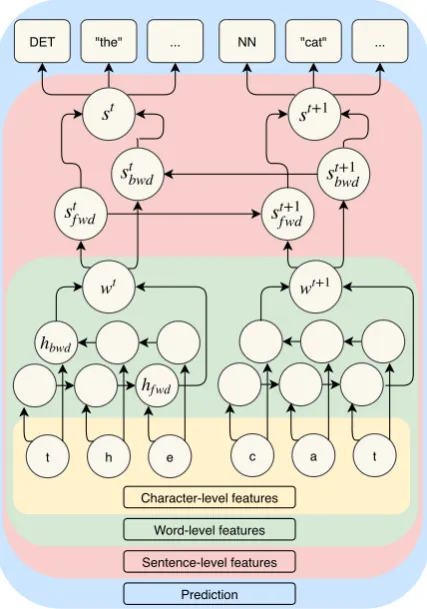
Our architecture ensures that both word-level and character-level features of each input token in a sentence can contribute to the sentence-level features at any given step and therefore to the lemmatization of any other token in the sentence. From this perspective, our architecture is more general than those presented in Kestemont et al.
(2016); Bergmanis and Goldwater (2018), where sentence information is included by running the encoder over a predetermined fixed-length win-dow of neighboring characters. Moreover, we let the character-level embedding extractor and the lemmatizer encoder share parameters in order to amplify the training signal coming into the latter. Figure1visualizes the proposed architecture.
3.3 Improved sentence-level features
We hypothesize that the training signal from lemmatization alone might not be enough to ex-tract sufficiently high quality sentence-level fea-tures. As such we include an additional bidirec-tional word-level language-model loss over the in-put sentence. Given the forward and backward
subvectors of the sentence encodingst= [−→st;←s−t], we train two additional softmax classifiers to pre-dict tokenxt+1 given−→st andxt−1 given←s−t with
parametersOLM f wdandOLM bwd∈RS×|V|.4 We train our model to jointly minimize the neg-ative log-likelihood of the probability defined by Equation 2 and the LM probability defined by Equation3.
PLM(x) = 1/2 n
Y
t=2
P(xt|x1, . . . , xt−1)
+ 1/2
n−1 Y
t=1
P(xt|xt+1, . . . , xn)
(3)
4We have found the joint loss most effective when both
forward and backward classifiers shared parameters.
t h e
hbwd
hfwd
c a t
wt wt+1
st fwd
st bwd
st+1 fwd
st+1 bwd
st st+1
Character-level features
Word-level features
Sentence-level features DET
Prediction
[image:4.595.310.524.64.369.2]"the" ... NN "cat" ...
Figure 1: Hierarchical sentence encoding architecture with feature extraction at different levels.
Following a Multi-Task Learning (Caruana,
1997), we set a weight on the LM negative log-likelihood which we decrease over training based on lemmatization accuracy on development data to reduce its influence on training after convergence.
4 Experiments
Section 4.1 first introduces the datasets, both the newly introduced dataset of historical languages, and the dataset of modern standard languages sam-pled from Universal Dependencies (v2.2) corpus (Nivre et al.,2016). Finally, Section4.2describes model training and settings in detail.
4.1 Datasets
[image:4.595.74.290.665.738.2]0 20000 40000
# Tokens
60000 80000 100000fro
tr
fr
it
hu
cs
he
sl
llat
ur
lv
bg
fa
cgr
de
fi
eu
en
ar
nb
goo
et
es
gml
cgl
cga
crm
ru
Language
Total number of Tokens
0.00 0.17 0.34 0.52 0.69 0.86
% Tokens
[image:5.595.79.289.67.371.2]% of Unknown Tokens % of Ambiguous Tokens
Figure 2: Statistics of total number of tokens, ambigu-ous and unknown tokens in the test sets. The full list of languages for both historical and standard corpora as well as the corresponding ISO 639-1 codes used in the present study can be found in the Appendix. Statis-tics for unknown and ambiguous tokens are shown as percentages.
French, Historical Slovene and Medieval Latin, which we take from the following sources.
Bothcgaandcglcontain medieval Dutch ma-terial from the Gysseling corpus curated by the In-stitute for Dutch Lexicology5cgais a charter col-lection (administrative documents), whereascgl
concerns a variety of literary texts that greatly vary in length. crm is another Middle Dutch charter collection from the 14th century with wide geo-graphic coverage (Van Reenen and Mulder,1993;
van Halteren and Rem, 2013). cgr, finally, is a smaller collection of samples from Middle Dutch religious writings that include later medieval texts (Kestemont et al., 2016). fro offers a corpus of Old French heroic epics, known as chansons de geste (Camps, 2016). llat dataset is taken from the Late Latin Charter Treebank, consisting of early medieval Latin documentary texts ( Korki-akangas and Lassila,2013). goocomes from the
5https://ivdnt.org/taalmaterialen.
reference corpus of historical Slovene, sampled from 89 texts from the period 1584-1899 (Erjavec,
2015).gmlrefers to the reference corpus of Mid-dle Low German and Low Rhenish texts, found in manuscripts, prints and inscriptions (Barteld et al., 2017). Finally, cap is a corpus of early medieval Latin ordinances decreed by Carolingian rulers (Eger et al.,2016).
Standard Languages For a more thorough comparison between systems across domains and a better examination of the effect of the LM loss, we evaluate our systems on a set of 20 standard languages sampled from the UD corpus, trying to guarantee typological diversity while selecting datasets with at least 20k words. We use the pre-defined splits from the original UD corpus (v2.2).6. Figure 2 visualizes the test set sizes in terms of total, ambiguous and unknown tokens for both historical and standard languages.
4.2 Models
We refer to the full model trained with joint LM loss by Sent-LM. In order to test the effec-tiveness of sentence information and the impor-tance of enhancing the quality of the sentence-level feature extraction, we compare against a sim-ple encoder-decoder model without sentence-level information (Plain) and a model trained with-out joint LM loss (Sent). Moreover, we compare to previous state-of-the-art lemmatizers based on binary edit-tree induction: Morfette(Chrupala et al.,2008) andLemming(Cotterell et al.,2015), which we run with default hyperparameters.
For all our models, we use the same hyperpa-rameter values as follows. All recurrent layers have 150 cells per layer and use GRUs (Cho et al.,
2014). Encoder and Decoder have 2 layers but the sentence encoder has only 1. We apply 0.25 dropout (Srivastava et al.,2014) after the embed-ding layer and before the output layer and 0.25 variational dropout (Gal and Ghahramani, 2016) in between recurrent layers. Models are optimized with Adam (Kingma and Ba, 2015) using an ini-tial learning rate of 1e-3 which is reduced by 25% after each epoch without improvement on devel-opment accuracy. Models are trained until
fail-6
Full Ambiguous Unknown
Edit-tree 91.11 91.79 35.48
Plain 91.61 87.39 65.69
Sent 93.4 91.14 66.98
Sent-LM 94.0 92.81 65.39
Table 1: Average accuracy across historical languages.
Lemmingand Morfetteare shown aggregated by taking the best performing model per dataset.
ing to achieve any improvement for 3 consecutive epochs. Initial LM loss weight is set to 0.2 and it is halved each epoch after two consecutive epochs without achieving any improvements on develop-ment perplexity.
We use sentence boundaries when given and otherwise use POS tags corresponding to full stops as clues. In any case, sentences are split into chunks of maximum 35 words to accommodate to limited memory. Target lemmas during both train-ing and testtrain-ing are lowercased in agreement with the implementation ofLemmingandMorfette, which also do so. For models with joint loss, we truncate the output vocabulary to the top 50k most frequent words for similar reasons. We run a max-imum of 100 optimization epochs in randomized batches containing 25 sentences each. The learn-ing rate is decreased by a factor of 0.75, after ev-ery 2 epochs without accuracy increase on held-out data and learning stops after failing to improve for 5 epochs. Decoding is done with beam search with a beam size of 10.7
5 Results
As is customary, we report exact-match accuracy on target lemmas. Besides overall accuracy, we also compute accuracy of ambiguous tokens (i.e. tokens that map to more than 1 lemma in the train-ing data) and unknown tokens (i.e. tokens that do not appear in the training data).
5.1 Historical languages
Table 1 shows the aggregated results over all datasets in our historical language corpus.8 In 4 cases (cga, cgl, crm and gml), Lemming
failed to converge due to memory requirements ex-ceeding 250G RAM due to the large amount of
7 For all languages, we observed relatively small gains
ranging from 0.1% to 0.5% in overall accuracy.
8 We aggregate both edit-tree based approaches by
se-lecting the best performing model for each corpus. When
Lemmingconverge, the results were better thanMorfette.
Full Ambiguous Unknown
K-2016 91.88 51.64
Edit-tree 89.01 91.18 20.46
Plain 90.21 87.4 61.93
Sent 92.55 91.6 64.61
Sent-LM 93.25 93.31 62.1
Table 2: Accuracy for the Gysseling subcorpora.
edit-trees. Following Søgaard et al. (2014), we compute p-values with a Wilcoxon’s signed rank test.Sent-LMis the best performing model with a relative improvement of 7.9% (p < .01) over
Sentand 30.72% (p < .01) over the edit-tree ap-proach on full datasets and 10.27% (p < .1) and 18.66% (p < .01) on ambiguous tokens. More-over, the edit-tree approach outperforms encoder-decoder modelsPlainandSenton ambiguous tokens, and it is only due to the joint loss that the encoder-decoder paradigm gains an advantage. Fi-nally, for tokens unseen during training, the best performing model is Sent with a relative error reduction of 47% (p < .01) over the edit-tree ap-proach and 4.77% (p < .1) overSent-LM.
Table 2compares scores for a subset from the corpora coming from the Gysseling corpus, which have been used in previous work on lemmatiza-tion of historical languages. The model described byKestemont et al.(2016) is included asK-2016
for comparison.9 It is apparent that both Sent
and Sent-LM outperform K-2016 on full and unknown tokens. It is worth noting thatK-2016, a model that uses distributed contextual features but no edit-tree induction, performs better than
Plain– which highlights the importance of con-text for the lemmatization of historical languages –, and also better than the edit-tree approaches – which highlights the difficulty of tree induction on this dataset. We findSent-LMto have a signifi-cant advantage overSenton full and ambiguous tokens, but a disadvantage vs Sent andPlain
on unknown tokens.
5.2 Standard languages
Table4shows overall accuracy scores aggregated across all languages.10 We observe that on aver-ageSent-LMis the best model on full datasets.
9Unfortunately, scores on ambiguous tokens were not
re-ported and therefore cannot be compared.
10 Similarly to results on historical languages, we
Full Ambiguous Unknown
Type 1 Type 2 Type 3 Type 1 Type 2 Type 3 Type 1 Type 2 Type 3
Edit-tree 96.34 93.02 98.37 92.47 92.47 97.5 84.99 74.66 91.39
Plain 96.21 94.6 97.5 88.87 90.51 95.34 85.43 83.78 86.37
Sent 96.42 94.41 97.84 91.12 92.01 96.65 85.44 84.02 86.67
[image:7.595.75.523.63.157.2]Sent-LM 96.52 94.62 97.86 93.01 92.07 97.48 85.15 83.32 85.36
Table 3: Average accuracy across morphologically related standard languages. Type 1 enclosesbg,cs,lv,ru
andsl. Type 2 compriseset,fi,hu,tr. Finally, Type 3 encompassesde,en,es,fr,itandnb.
Full Ambiguous Unknown
Edit-tree 96.1 94.35 83.26
Plain 95.93 91.44 83.02
Sent 96.19 93.25 82.61
Sent-LM 96.28 94.08 82.58
Table 4: Average accuracy across all 20 standard lan-guages. LemmingandMorfetteare shown aggre-gated by taking the best performing model per dataset.
However, in contrast to previous results, the edit-tree approach has an advantage over all encoder-decoder models for both ambiguous and unknown tokens.
Since the differences in performance are not sta-tistically significant (p > 0.05), we seek to shed light on the advantages and disadvantages of the encoder-decoder and edit-tree paradigms by con-ducting a more fine-grained analysis with respect to the morphological typology of the considered languages. To this end, we group languages into morphological types depending on the dominant morphological processes of each language and ag-gregate scores over languages in each type:
Type 1. Balto-Slavic languages which are known for their strongly suffixing morphology and complex case system.
Type 2. Uralic and Altaic languages, which are characterized by agglutinative morphology and a tendency towards monoexponential case and vowel harmony.
Type 3. Western European languages with a ten-dency towards synthetic morphology and par-tially lacking nominal case.
Table3shows accuracy scores per morphologi-cal group for each model type. It is apparent that the Edit-tree approach is very effective for Type 3 languages both in ambiguous and unknown
tokens. In both Type 1 and Type 2 languages, the best overall performing model isSent-LM. In the case of ambiguous tokens,Sent-LMachieves highest accuracy for Type 1 languages, but it is surpassed by theEdit-tree approach on Type 2 languages. Finally, in the case of unknown to-kens, we observe a similar pattern to the historical languages where Plain and Sent have an ad-vantage overSent-LM.
6 Discussion
For clarity, we group the discussion of the main findings according to four major discussion points.
How does the joint LM loss help? As Section5
shows, Sent-LM is the overall best model, and its advantage is biggest on ambiguous datasets, always outperforming the second-best encoder-decoder model on ambiguous tokens. For a more detailed comparison of the two models we tested the following two hypotheses: (i) the joint LM loss helps by providing sentence representations with stronger disambiguation capacities (ii) The joint LM loss helps in cases when the evidence of a token-lemma relationship is sparse —e.g in lan-guages with highly synthetic morphological sys-tems and in the presence of spelling variation.
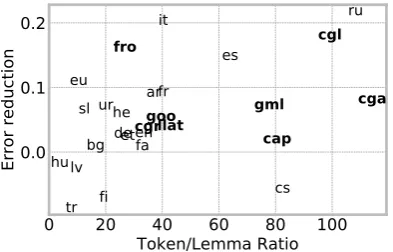
As Figure 3 shows, improvement over Sent
is correlated with percentage of token-lemma am-biguity in the corpus, providing evidence for hy-pothesis (i). Finally, as Figure4shows, improve-ment overSent is correlated with higher token-lemma ratio, suggesting that the improvement is likely to be due to learned representations that bet-ter identify the input token. These two aspects help explain the efficiency of the joint learning ap-proach on non-standard languages where high lev-els of spelling variation provide increased ambi-guity by conflating unrelated forms and also lower evidence for token-lemma mappings.
of the proposed joint LM-loss is the size of the training dataset. However, dataset size should be considered a necessary but not a sufficient condi-tion for the feasibility of the joint LM-loss and has therefore weak explanation power for the perfor-mance of the proposed approach.
0.1
0.2
0.3
0.4
0.5
Ambiguity (%)
0.1
0.0
0.1
0.2
Error reduction
bgur he
fi de it
et
fr es
cs en ru
hufa lv eu
tr
ar sl
cap
llat
fro
goo
cga
cgl
[image:8.595.309.524.63.134.2]crm
cgr
gml
Figure 3: Error reduction of Sent-LM vs Sentby percentage of ambiguous tokens (Spearman’s R = 0.53;p < .01). Historical languages are shown in bold.
0
20
40
60
80
100
Token/Lemma Ratio
0.0
0.1
0.2
Error reduction
bgurhe
fi de
it
et fr
es
cs en
ru
hulv fa eu
tr
ar sl
cap
llat
fro
goo
cga
cgl
cgr
gml
Figure 4: Error reduction of Sent-LM vs Sentby Token-Lemma ratio on 50k tokens of the training set (Spearman’sR= 0.47;p < .05). Historical languages are shown in bold.
LM loss leads to better representations In or-der to analyze the representations learned with the joint loss, we turn to “representation probing” ex-periments following current approaches on inter-pretability (Linzen et al., 2016;Adi et al.,2017). Using the same train-dev-test splits from the cur-rent study, we exploit additional POS, Number, Gender, Case and syntactic function (Dep) annota-tions provided in the UD corpora and compare the ability of the representations extracted by Sent
and Sent-LM to predict these labels.11 Model parameters are frozen and a linear softmax layer
11 Note that not all tasks are available for all languages,
due to some corpora not providing all annotations and some categories not being relevant for particular languages.
Pos Dep Gender Case Num
Majority 82.61 62.93 85.83 80.76 83.92
Sent 79.27 64.14 83.39 83.01 81.01
Sent-LM 83.62 68.36 86.55 84.44 84.37
[image:8.595.78.284.157.283.2]Support 29 20 15 19 20
Table 5: Overall accuracy of Sent and Sent-LM
models and aMajoritybaseline on 5 probing tasks and actual number of languages per morphological cat-egory. All differences overSentexcept for Case are significant atp < 0.05. Support is shown in terms of number of languages exhibiting such grammatical dis-tinctions.
Q ∈ RH×V per task is learned using a
cross-entropy loss function.12 The results of this ex-periment are reported in Table 5. The classifier trained withSent-LMoutperforms the one with
Senton all considered labeling tasks, confirming the efficiency of the LM loss at extracting better representations.
Edit-tree vs. Encoder-Decoder Our fine-grained analysis suggests that the performance of the edit-tree and encoder-decoder approaches de-pends on the underlying morphological typology of the studied languages. Neural approaches seem to be stronger for languages with complex case systems and agglutinative morphology. In con-trast, edit-tree approaches excel on more synthetic languages (e.g. Type 3) and languages with lower ambiguity (e.g. Type 2).
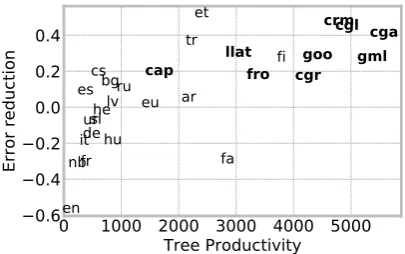
Figure 5illustrates that as the number of edit-trees increase the encoder-decoder models start to excel. This is most likely due to the fact that, from an edit-tree approach perspective, a large number of trees creates a large number of classes, which leads to higher class imbalance and more spar-sity. However, edit-tree based approaches do out-perform representation learning methods for lan-guages with lower number of trees, which leads to the intuition that the edit-tree formalism does pro-vide a useful inductive bias to the task of lemma-tization and it should not be discarded in future work. Our results, in fact, point to a future di-rection which applies the edit-tree formalism, but alleviates the edit-tree explosion by exploiting the relationships between the edit-tree classes poten-tially using representation learning methods.
12Models trained for 50 epochs using the Adam optimizer
[image:8.595.84.281.357.483.2]0
1000 2000 3000 4000 5000
Tree Productivity
0.6
0.4
0.2
0.0
0.2
0.4
Error reduction
bg urhe
nb
fi
de it
et
fr escs
en ru
hu lv
fa eu
tr
ar sl
cap
llat
fro
goo
cga
cgl
crm
cgr
gml
Figure 5: Error reduction of best encoder-decoder model vs best tree-edit model over tree productivity computed as number of unique binary edit-trees in the first 50k tokens of the training corpora (Spearman’s
R = 0.79;p < .001). Historical languages are shown in bold.
Accuracy on unknown tokens We observe that while overall the joint loss outperforms the sim-pler encoder-decoder, it seems, however, detri-mental to the accuracy on unknown tokens. This discrepancy is probably due to the fact that (i) un-known tokens are likely unambiguous and there-fore less likely to profit from improved context representations and to (ii) our design choice of word-level language modeling, where the model is forced to predict UNK for unknown words. As
Sent-LMis the overall best model, in future work we will explore character-level language modeling in order to harness the full potential of the joint-training approach even on unknown tokens.
7 Conclusion
We have presented a method to improve lemmati-zation with encoder-decoder models by improving context representations with a joint bidirectional language modeling loss. Our method sets a new state-of-the-art for lemmatization of historical lan-guages and is competitive on standard lanlan-guages. Our examination of the learned representations in-dicates that the LM loss helps enriching sentence representations with features that capture morpho-logical information. In view of a typomorpho-logically in-formed comparison of encoder-decoder and edit-tree based approaches, we have shown that the lat-ter can be very effective for highly synthetic lan-guages. Such result might have been overlooked in previous studies due to only considering a re-duced number of languages (Chakrabarty et al.,
2017) or pooling results across typology ( Bergma-nis and Goldwater, 2018). With respect to
lan-guages with higher ambiguity and token-lemma ratio, the encoder-decoder approach is preferable and the joint loss generally provides a substan-tial improvement. Finally, while other models use morphological information to improve the repre-sentation of context (e.g. edit-tree approaches), our joint language modeling loss does not rely on any additional annotation, which can be crucial in low resource and non-standard situations where annotation is costly and often not trivial.
Acknowledgments
We thank NVIDIA for donating 1 GPU that was used for the experiments in the present paper. We would also like to thank the anonymous reviewers for their valuable comments.
References
Yossi Adi, Einat Kermany, Yonatan Belinkov, Ofer Lavi, and Yoav Goldberg. 2017. Fine-grained anal-ysis of sentence embeddings using auxiliary predic-tion tasks.ICLR ’17.
Alan Akbik, Duncan Blythe, and Roland Vollgraf. 2018. Contextual String Embeddings for Sequence Labeling. InProceedings of the 27th International Conference on Computational Linguistics, pages 1638–1649. Association for Computational Linguis-tics.
Dzmitry Bahdanau, Kyunghyun Cho, and Yoshua Ben-gio. 2014. Neural machine translation by jointly learning to align and translate. arXiv preprint arXiv:1409.0473.
Fabian Barteld, Katharina Dreessen, Sarah Ihden, and Ingrid Schr¨oder. 2017. Das Referenzko-rpus Mittelniederdeutsch/Niederrheinisch (1200– 1650)–Korpusdesign, Korpuserstellung und Korpus-nutzung. Mitteilungen des Deutschen Germanisten-verbandes, 64(3):226–241.
Toms Bergmanis and Sharon Goldwater. 2018. Con-text Sensitive Neural Lemmatization with Lematus. In North American Chapter of the Association for Computational Linguistics: Human Language Tech-nologies Volume 1.
Marcel Bollmann and Anders Søgaard. 2016. Im-proving historical spelling normalization with bi-directional LSTMs and multi-task learning. In Pro-ceedings of COLING 2016, the 26th International Conference on Computational Linguistics: Techni-cal Papers, pages 131–139. The COLING 2016 Or-ganizing Committee.
[image:9.595.80.283.63.190.2]Rich Caruana. 1997. Multitask learning. Machine learning, 28(1):41–75.
Abhisek Chakrabarty, Onkar Arun Pandit, and Utpal Garain. 2017.Context Sensitive Lemmatization Us-ing Two Successive Bidirectional Gated Recurrent Networks. InProceedings of the 55th Annual Meet-ing of the Association for Computational LMeet-inguistics (Volume 1: Long Papers), pages 1481–1491. Asso-ciation for Computational Linguistics.
Kyunghyun Cho, Bart van Merrienboer, Dzmitry Bah-danau, and Yoshua Bengio. 2014. On the Prop-erties of Neural Machine Translation: Encoder– Decoder Approaches. In Proceedings of SSST-8, Eighth Workshop on Syntax, Semantics and Struc-ture in Statistical Translation, pages 103–111. As-sociation for Computational Linguistics.
Grzegorz Chrupala, Georgiana Dinu, and Josef van Genabith. 2008. Learning Morphology with Mor-fette. In Proceedings of the Sixth International Conference on Language Resources and Evaluation (LREC’08), Marrakech, Morocco. European Lan-guage Resources Association (ELRA).
Ryan Cotterell, Alexander Fraser, and Hinrich Sch¨utze. 2015.Joint Lemmatization and Morphological Tag-ging with LEMMING. InProceedings of the 2015 Conference on Empirical Methods in Natural Lan-guage Processing.
D. Crystal. 2001. Language and the Internet. Cam-bridge University Press.
Oksana Dereza. 2018. Lemmatization for Ancient Languages: Rules or Neural Networks? In Con-ference on Artificial Intelligence and Natural Lan-guage, pages 35–47. Springer.
Steffen Eger, Rdiger Gleim, and Alexander Mehler. 2016. Lemmatization and Morphological Tagging in German and Latin: A Comparison and a Survey of the State-of-the-art. InProceedings of the Tenth In-ternational Conference on Language Resources and Evaluation (LREC 2016), Paris, France. European Language Resources Association (ELRA).
Tomaˇz Erjavec. 2015. Reference corpus of historical slovene goo300k 1.2. Slovenian language resource repository CLARIN.SI.
Yarin Gal and Zoubin Ghahramani. 2016. A theoret-ically grounded application of dropout in recurrent neural networks. InAdvances in neural information processing systems, pages 1019–1027.
Andrea Gesmundo and Tanja Samardˇzi. 2012. Lem-matisation as a Tagging Task. InProceedings of the 50th Annual Meeting of the Association for Compu-tational Linguistics (Volume 2: Short Papers), pages 368–372, Jeju Island, Korea. Association for Com-putational Linguistics.
Hans van Halteren and Margit Rem. 2013. Dealing with orthographic variation in a tagger-lemmatizer for fourteenth century dutch charters. Language Re-sources and Evaluation, 47(4):1233–1259.
Jeremy Howard and Sebastian Ruder. 2018. Univer-sal Language Model Fine-tuning for Text Classifica-tion. InProceedings of the 56th Annual Meeting of the Association for Computational Linguistics (Vol-ume 1: Long Papers), pages 328–339. Association for Computational Linguistics.
Mike Kestemont, Guy De Pauw, Renske van Nie, and Walter Daelemans. 2016. Lemmatization for variation-rich languages using deep learning. Dig-ital Scholarship in the Humanities, 32(4):797–815.
Diederik P. Kingma and Jimmy Lei Ba. 2015. Adam: a Method for Stochastic Optimization. Inter-national Conference on Learning Representations 2015, pages 1–15.
G. Knowles and Z. Mohd Don. 2004. The notion of a lemma. Headwords, roots and lexical sets. Interna-tional Journal of Corpus Linguistics, 9(1):69–81.
Daniel Kondratyuk, Tom Gavenˇciak, and Milan Straka. 2018. LemmaTag: Jointly Tagging and Lemma-tizing for Morphologically-Rich Languages with BRNNs. InProceedings of the 2018 Conference on Empirical Methods in Natural Language Process-ing, pages 4921–4928, Brussels, Belgium.
Timo Korkiakangas and Matti Lassila. 2013. Abbre-viations, fragmentary words, formulaic language: treebanking mediaeval charter material. In Proceed-ings of The Third Workshop on Annotation of Cor-pora for Research in the Humanities, pages 61–72.
Tal Linzen, Emmanuel Dupoux, and Yoav Goldberg. 2016. Assessing the Ability of LSTMs to Learn Syntax-Sensitive Dependencies.Transactions of the Association for Computational Linguistics, 4:521– 535.
Joakim Nivre, Marie-Catherine De Marneffe, Filip Ginter, Yoav Goldberg, Jan Hajic, Christopher D Manning, Ryan T McDonald, Slav Petrov, Sampo Pyysalo, Natalia Silveira, Reut Tsarfaty, and Daniel Zeman. 2016. Universal Dependencies v1: A Mul-tilingual Treebank Collection. In Proceedings of the Tenth International Conference on Language Resources and Evaluation (LREC 2016), Portoroˇz, Slovenia. European Language Resources Associa-tion (ELRA).
Adam Paszke, Sam Gross, Soumith Chintala, and Gre-gory Chanan. 2017. Pytorch: Tensors and dynamic neural networks in python with strong gpu acceler-ation. PyTorch: Tensors and dynamic neural net-works in Python with strong GPU acceleration.
of the North American Chapter of the Association for Computational Linguistics: Human Language Technologies, Volume 1 (Long Papers), pages 2227– 2237. Association for Computational Linguistics.
Eva Pettersson, Beta Megyesi, and Joakim Nivre. 2014. A Multilingual Evaluation of Three Spelling Nor-malisation Methods for Historical Text. In Proceed-ings of the 8th Workshop on Language Technology for Cultural Heritage, Social Sciences, and Human-ities (LaTeCH), pages 32–41. Association for Com-putational Linguistics.
Michael Piotrowski. 2012. Natural language process-ing for historical texts. Synthesis Lectures on Hu-man Language Technologies, 5(2):1–157.
Sarah Schulz, Guy De Pauw, Orphe De Clercq, Bart Desmet, Veronique Hoste, Walter Daelemans, and Lieve Macken. 2016. Multimodular text normaliza-tion of dutch user-generated content.ACM Transac-tions on Intelligent Systems and Technology (TIST), 7(4):61.
Anders Søgaard, Anders Johannsen, Barbara Plank, Dirk Hovy, and Hctor Mart´ınez Alonso. 2014. What’s in a p-value in NLP? In Proceedings of the Eighteenth Conference on Computational Natu-ral Language Learning, pages 1–10. Association for Computational Linguistics.
Nitish Srivastava, Geoffrey Hinton, Alex Krizhevsky, Ilya Sutskever, and Ruslan Salakhutdinov. 2014. Dropout: A Simple Way to Prevent Neural Networks from Overfitting. Journal of Machine Learning Re-search, 15:1929–1958.
Gongbo Tang, Fabienne Cap, Eva Pettersson, and Joakim Nivre. 2018. An Evaluation of Neural Machine Translation Models on Historical Spelling Normalization. In Proceedings of the 27th Inter-national Conference on Computational Linguistics, pages 1320–1331. Association for Computational Linguistics.
P. Van Reenen and M. Mulder. 1993. Een gegevens-bank van 14de-eeuwse middelnederlandse dialecten op computer. Lexikos, 3:259–279.
A Appendix
A.1 Dataset Statistics
Table6shows the dataset sources and codes from our Historical Languages.
Language Dataset Code
Medieval Latin Capitularia cap LLCT1 llat Middle Dutch Gys (Admin) cga Gys (Literary) cgl Religious cgr Adelheid crm Medieval French Geste fro Middle Low German ReN gml
[image:11.595.308.525.63.209.2]Slovenian goo300k goo
Table 6: Corpus identifier and description in the histor-ical languages dataset. “Gys” refers to the Gysseling corpus, which consists of several subsets.
Table7shows the languages from the UD cor-pus that were sampled for the study. We have used ISO 639-1 codes (instead of the more general ISO 639-2) in order to avoid clutter in the plots.
Language Dataset Code
Arabic Arabic-PDAT ar
Bulgarian Bulgarian-BTB bg
Czech Czech-CAC cs
German German-GSD de
English English-EWT en
Spanish Spanish-AnCora es Estonian Estonian-EDT et
Basque Basque-BDT eu
Persian Persian-Seraji fa
Finnish Finnish-TDT fi
French French-GSD fr
Hebrew Hebrew-HTB he
Hungarian Hungarian-Szeged hu Italian Italian-ISDT it Latvian Latvian-LVTB lv Norwegian (Bokmaal) Norwegian-Bokmaal nb Russian Russian-SynTagRus ru Slovenian Slovenian-SSJ sl Turkish Turkish-IMST tr
Urdu Urdu-UDTB ur
[image:11.595.307.527.338.603.2]