The CoNLL-2013 Shared Task on Grammatical Error Correction
Hwee Tou Ng
Department of Computer Science National University of Singapore
Siew Mei Wu
Centre for English Language Communication National University of Singapore
Yuanbin Wu and Christian Hadiwinoto Department of Computer Science
National University of Singapore {wuyb,chrhad}@comp.nus.edu.sg
Joel Tetreault
Nuance Communications, Inc. [email protected]
Abstract
The CoNLL-2013 shared task was devoted to grammatical error correction. In this paper, we give the task definition, present the data sets, and describe the evaluation metric and scorer used in the shared task. We also give an overview of the various approaches adopted by the participating teams, and present the evaluation results.
1 Introduction
Grammatical error correction is the shared task of the Seventeenth Conference on Computational Natural Language Learning in 2013 (CoNLL-2013). In this task, given an English essay written by a learner of English as a second language, the goal is to detect and correct the grammatical errors present in the essay, and return the corrected essay. This task has attracted much recent research in-terest, with two shared tasks Helping Our Own (HOO) 2011 and 2012 organized in the past two years (Dale and Kilgarriff, 2011; Dale et al., 2012). In contrast to previous CoNLL shared tasks which focused on particular subtasks of natural language processing, such as named entity recog-nition, semantic role labeling, dependency pars-ing, or coreference resolution, grammatical error correction aims at building a complete end-to-end application. This task is challenging since for many error types, current grammatical error cor-rection systems do not achieve high performance and much research is still needed. Also, tackling this task has far-reaching impact, since it is esti-mated that hundreds of millions of people world-wide are learning English and they benefit directly from an automated grammar checker.
The CoNLL-2013 shared task provides a forum for participating teams to work on the same gram-matical error correction task, with evaluation on the same blind test set using the same evaluation metric and scorer. This overview paper contains a detailed description of the shared task, and is orga-nized as follows. Section 2 provides the task def-inition. Section 3 describes the annotated training data provided and the blind test data. Section 4 de-scribes the evaluation metric and the scorer. Sec-tion 5 lists the participating teams and outlines the approaches to grammatical error correction used by the teams. Section 6 presents the results of the shared task. Section 7 concludes the paper.
2 Task Definition
The goal of the CoNLL-2013 shared task is to evaluate algorithms and systems for automati-cally detecting and correcting grammatical errors present in English essays written by second lan-guage learners of English. Each participating team is given training data manually annotated with corrections of grammatical errors. The test data consists of new, blind test essays. Prepro-cessed test essays, which have been sentence-segmented and tokenized, are also made available to the participating teams. Each team is to submit its system output consisting of the automatically corrected essays, in sentence-segmented and tok-enized form.
Grammatical errors consist of many different types, including articles or determiners, preposi-tions, noun form, verb form, subject-verb agree-ment, pronouns, word choice, sentence structure, punctuation, capitalization, etc. Of all the er-ror types, determiners and prepositions are among
the most frequent errors made by learners of En-glish. Not surprisingly, much published research on grammatical error correction focuses on arti-cle and preposition errors (Han et al., 2006; Ga-mon, 2010; Rozovskaya and Roth, 2010; Tetreault et al., 2010; Dahlmeier and Ng, 2011b), with rel-atively less work on correcting word choice errors (Dahlmeier and Ng, 2011a). Article and preposi-tion errors were also the only error types featured in the HOO 2012 shared task. Likewise, although all error types were included in the HOO 2011 shared task, almost all participating teams dealt with article and preposition errors only (besides spelling and punctuation errors).
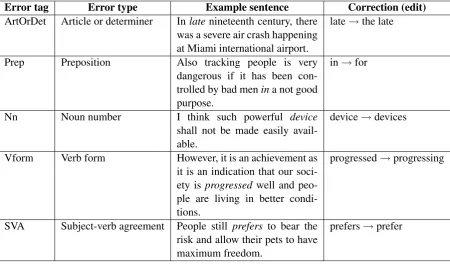
In the CoNLL-2013 shared task, it was felt that the community is now ready to deal with more error types, including noun number, verb form, and subject-verb agreement, besides arti-cles/determiners and prepositions. Table 1 shows examples of the five error types in our shared task. Since there are five error types in our shared task compared to two in HOO 2012, there is a greater chance of encountering multiple, interacting errors in a sentence in our shared task. This increases the complexity of our shared task relative to that of HOO 2012. To illustrate, consider the following sentence:
Although we have to admit some bad
effect which is brought by the new technology, still the advantages of the new technologies cannot be simply dis-carded.
The noun number erroreffectneeds to be corrected (effect→effects). This necessitates the correction of a subject-verb agreement error (is → are). A pipeline system in which corrections for subject-verb agreement errors occur strictly before correc-tions for noun number errors would not be able to arrive at a fully corrected sentence for this ex-ample. The ability to correct multiple, interacting errors is thus necessary in our shared task. The re-cent work of (Dahlmeier and Ng, 2012a), for ex-ample, is designed to deal with multiple, interact-ing errors.
Note that the essays in the training data and the test essays naturally contain grammatical errors of all types, beyond the five error types focused in our shared task. In the automatically corrected essays returned by a participating system, only correc-tions necessary to correct errors of the five types
are made. The other errors are to be left uncor-rected.
3 Data
This section describes the training and test data released to each participating team in our shared task.
3.1 Training Data
The training data provided in our shared task is the NUCLE corpus, the NUS Corpus of Learner English (Dahlmeier et al., 2013). As noted by (Leacock et al., 2010), the lack of a manually an-notated and corrected corpus of English learner texts has been an impediment to progress in gram-matical error correction, since it prevents com-parative evaluations on a common benchmark test data set. NUCLE was created precisely to fill this void. It is a collection of 1,414 essays written by students at the National University of Singa-pore (NUS) who are non-native speakers of En-glish. The essays were written in response to some prompts, and they cover a wide range of topics, such as environmental pollution, health care, etc. The grammatical errors in these essays have been hand-corrected by professional English instructors at NUS. For each grammatical error instance, the start and end character offsets of the erroneous text span are marked, and the error type and the cor-rection string are provided. Manual annotation is carried out using a graphical user interface specif-ically built for this purpose. The error annotations are saved as stand-off annotations, in SGML for-mat.
To illustrate, consider the following sentence at the start of the first paragraph of an essay:
From past to the present, many impor-tant innovations have surfaced.
Error tag Error type Example sentence Correction (edit) ArtOrDet Article or determiner Inlatenineteenth century, there
was a severe air crash happening at Miami international airport.
late→the late
Prep Preposition Also tracking people is very dangerous if it has been con-trolled by bad menina not good purpose.
in→for
Nn Noun number I think such powerful device
shall not be made easily avail-able.
device→devices
Vform Verb form However, it is an achievement as it is an indication that our soci-ety isprogressed well and peo-ple are living in better condi-tions.
progressed→progressing
SVA Subject-verb agreement People still prefers to bear the risk and allow their pets to have maximum freedom.
[image:3.595.74.525.62.326.2]prefers→prefer
Table 1: The five error types in our shared task.
<MISTAKE start par="0" start off="5" end par="0" end off="9"> <TYPE>ArtOrDet</TYPE>
<CORRECTION>the past</CORRECTION> </MISTAKE>
Figure 1: An example error annotation.
The NUCLE corpus was first used in (Dahlmeier and Ng, 2011b), and has been publicly available for research purposes since June 20111. All instances of grammatical errors are annotated in NUCLE, and the errors are classified into 27 error types (Dahlmeier et al., 2013).
To help participating teams in their prepara-tion for the shared task, we also performed au-tomatic preprocessing of the NUCLE corpus and released the preprocessed form of NUCLE. The preprocessing operations performed on the NU-CLE essays include sentence segmentation and word tokenization using the NLTK toolkit (Bird et al., 2009), and part-of-speech (POS) tagging, constituency and dependency tree parsing using the Stanford parser (Klein and Manning, 2003; de Marneffe et al., 2006). The error annotations, which are originally at the character level, are then mapped to error annotations at the word to-ken level. Error annotations at the word toto-ken
1http://www.comp.nus.edu.sg/∼nlp/corpora.html
level also facilitate scoring, as we will see in Sec-tion 4, since our scorer operates by matching to-kens. Note that although we released our own preprocessed version of NUCLE, the participating teams were however free to perform their own pre-processing if they so preferred.
3.1.1 Revised version of NUCLE
NUCLE release version 2.3 was used in the CoNLL-2013 shared task. In this version, 17 es-says were removed from the first release of NU-CLE since these essays were duplicates with mul-tiple annotations.
Training data Test data (NUCLE)
# essays 1,397 50
[image:4.595.80.284.62.133.2]# sentences 57,151 1,381 # word tokens 1,161,567 29,207
Table 2: Statistics of training and test data.
In our shared task, in order to facilitate the detec-tion and correcdetec-tion of article/determiner errors and preposition errors, we performed automatic map-ping of error types in the original NUCLE cor-pus. The mapping relies on POS tags, constituent parse trees, and error annotations at the word token level. Specifically, we map the error types Wcip and Rloc to Prep, Wci, ArtOrDet, and Rloc−. Prepositions in the error type Wcip or Rloc are mapped to a new error type Prep, and redundant articles or determiners in the error type Rloc are mapped to ArtOrDet. The remaining unaffected Wcip errors are assigned the new error type Wci and the remaining unaffected Rloc errors are as-signed the new error type Rloc−. The code that performs automatic error type mapping was also provided to the participating teams.
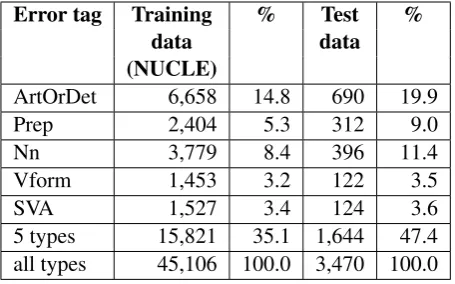
The statistics of the NUCLE corpus (release 2.3 version) are shown in Table 2. The distribution of errors among the five error types is shown in Table 3. The newly added noun number error type in our shared task accounts for the second highest number of errors among the five error types. The five error types in our shared task constitute 35% of all grammatical errors in the training data, and 47% of all errors in the test data. These figures support our choice of these five error types to be the focus of our shared task, since they account for a large percentage of all grammatical errors in English learner essays.
While the NUCLE corpus is provided in our shared task, participating teams are free to not use NUCLE, or to use additional resources and tools in building their grammatical error correction sys-tems, as long as these resources and tools are pub-licly available and not proprietary. For example, participating teams are free to use the Cambridge FCE corpus (Yannakoudakis et al., 2011; Nicholls, 2003) (the training data provided in HOO 2012 (Dale et al., 2012)) as additional training data.
Error tag Training % Test %
data data
(NUCLE)
ArtOrDet 6,658 14.8 690 19.9
Prep 2,404 5.3 312 9.0
Nn 3,779 8.4 396 11.4
Vform 1,453 3.2 122 3.5
SVA 1,527 3.4 124 3.6
[image:4.595.307.535.63.205.2]5 types 15,821 35.1 1,644 47.4 all types 45,106 100.0 3,470 100.0
Table 3: Error type distribution of the training and test data.
3.2 Test Data
25 NUS students, who are non-native speakers of English, were recruited to write new essays to be used as blind test data in the shared task. Each student wrote two essays in response to the two prompts shown in Table 4, one essay per prompt. Essays written using the first prompt are present in the NUCLE training data, while the second prompt is a new prompt not used previously. As a result, 50 test essays were collected. The statis-tics of the test essays are shown in Table 2.
Error annotation on the test essays was carried out by a native speaker of English who is a lecturer at the NUS Centre for English Language Commu-nication. The distribution of errors in the test es-says among the five error types is shown in Ta-ble 3. The test essays were then preprocessed in the same manner as the NUCLE corpus. The pre-processed test essays were released to the partici-pating teams.
Unlike the test data used in HOO 2012 which was proprietary and not available after the shared task, the test essays and their error annotations in the CoNLL-2013 shared task are freely available after the shared task.
4 Evaluation Metric and Scorer
A grammatical error correction system is evalu-ated by how well its proposed corrections or edits match the gold-standard edits. An essay is first sentence-segmented and tokenized before evalua-tion is carried out on the essay. To illustrate, con-sider the following tokenized sentence S written by an English learner:
ID Prompt
1 Surveillance technology such as RFID (radio-frequency identification) should not be used to track people (e.g., human implants and RFID tags on people or products). Do you agree? Sup-port your argument with concrete examples.
[image:5.595.139.259.529.620.2]2 Population aging is a global phenomenon. Studies have shown that the current average life span is over 65. Projections of the United Nations indicate that the population aged 60 or over in developed and developing countries is increasing at 2% to 3% annually. Explain why rising life expectancies can be considered both a challenge and an achievement.
Table 4: The two prompts used for the test essays.
hasbrought many benefits in this infor-mation age .
The set of gold-standard edits of a human annota-tor isg ={a doubt→ doubt, system→systems, has→have}. Suppose the tokenized output sen-tenceH of a grammatical error correction system given the above sentence is:
There is no doubt, tracking system has brought many benefits in this informa-tion age .
That is, the set of system edits is e= {a doubt → doubt}. The performance of the grammatical error correction system is measured by how well the two sets g andematch, in the form of recall
R, precisionP, andF1 measure: R = 1/3, P =
1/1, F1 = 2RP/(R+P) = 1/2.
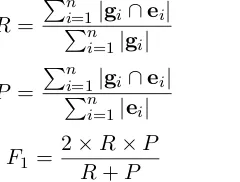
More generally, given a set of n sentences, wheregi is the set of gold-standard edits for sen-tencei, andei is the set of system edits for sen-tence i, recall, precision, and F1 are defined as follows:
R= Pn
i=1|gi∩ei|
Pn
i=1|gi|
(1)
P = Pn
i=1|gi∩ei|
Pn
i=1|ei|
(2)
F1 =
2×R×P
R+P (3)
where the intersection betweengi andei for sen-tenceiis defined as
gi∩ei ={e∈ei|∃g∈gi, match(g, e)} (4)
Evaluation by the HOO scorer (Dale and Kilgar-riff, 2011) is based on computing recall, precision, andF1measure as defined above.
Note that there are multiple ways to specify a set of gold-standard edits that denote the same cor-rections. For example, in the above learner-written
sentenceS, alternative but equivalent sets of gold-standard edits are{a→, system→systems, has → have}, {a→ , system has→ systems have}, etc. Given the same learner-written sentence S
and the same system output sentence H shown above, one would expect a scorer to give the same
R, P, F1 scores regardless of which of the equiv-alent sets of gold-standard edits is specified by an annotator.
However, this is not the case with the HOO scorer. This is because the HOO scorer uses GNU wdiff2 to extract the differences between the learner-written sentenceSand the system out-put sentence H to form a set of system edits. Since in general there are multiple ways to spec-ify a set of gold-standard edits that denote the same corrections, the set of system edits com-puted by the HOO scorer may not match the set of gold-standard edits specified, leading to erroneous scores. In the above example, the set of system edits computed by the HOO scorer forSandHis {a→}. Given that the set of gold-standard edits
gis{a doubt→doubt, system→systems, has→ have}, the scores computed by the HOO scorer are
R=P =F1 = 0, which are erroneous.
The MaxMatch (M2) scorer3 (Dahlmeier and Ng, 2012b) was designed to overcome this limita-tion of the HOO scorer. The key idea is that the set of system edits automatically computed and used in scoring should be the set that maximally matches the set of gold-standard edits specified by the annotator. The M2 scorer uses an efficient al-gorithm to search for such a set of system edits using an edit lattice. In the above example, given
S, H, and g, the M2 scorer is able to come up with the best matching set of system editse={a doubt → doubt}, thus giving the correct scores
R = 1/3, P = 1/1, F1 = 1/2. We use the M2
2
http://www.gnu.org/s/wdiff/
scorer in the CoNLL-2013 shared task.
The original M2 scorer implemented in (Dahlmeier and Ng, 2012b) assumes that there is one set of gold-standard edits gi for each sentence i. However, it is often the case that multiple alternative corrections are acceptable for a sentence. As we allow participating teams to submit alternative sets of gold-standard edits for a sentence, we also extend the M2 scorer to deal with multiple alternative sets of gold-standard edits.
Based on Equations 1 and 2, Equation 3 can be re-expressed as:
F1 =
2×Pn
i=1|gi∩ei|
Pn
i=1(|gi|+|ei|)
(5)
To deal with multiple alternative sets of gold-standard edits gi for a sentence i, the extended M2 scorer chooses thegi that maximizes the cu-mulative F1 score for sentences 1, . . . , i. Ties are broken based on the following criteria: first choose the gi that maximizes the numerator
Pn
i=1|gi∩ei|, then choose thegithat minimizes the denominatorPn
i=1(|gi|+|ei|), finally choose thegi that appears first in the list of alternatives.
5 Approaches
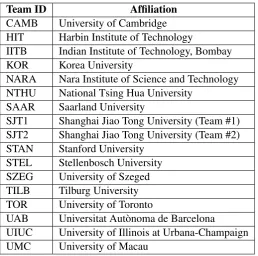
54 teams registered to participate in the shared task, out of which 17 teams submitted the output of their grammatical error correction systems by the deadline. These teams are listed in Table 5. Each team is assigned a 3 to 4-letter team ID. In the remainder of this paper, we will use the as-signed team ID to refer to a participating team. Every team submitted a system description paper (the only exception is the SJT2 team).
Many different approaches are adopted by par-ticipating teams in the CoNLL-2013 shared task, and Table 6 summarizes these approaches. A com-monly used approach in the shared task and in grammatical error correction research in general is to build a classifier for each error type. For ex-ample, the classifier for noun number returns the classes{singular, plural}, the classifier for article returns the classes{a/an, the,}, etc. The classi-fier for an error type may be learned from train-ing examples encodtrain-ing the surroundtrain-ing context of an error occurrence, or may be specified by deter-ministic hand-crafted rules, or may be built using a hybrid approach combining both machine learn-ing and hand-crafted rules. These approaches are
denoted by M, R, and H respectively in Table 6. The machine translation approach (denoted by T in Table 6) to grammatical error correction treats the task as “translation” from bad English to good English. Both phrase-based translation and syntax-based translation approaches are used by teams in the CoNLL-2013 shared task. An-other related approach is the language modeling approach (denoted by L in Table 6), in which the probability of a learner sentence is compared with the probability of a candidate corrected sen-tence, based on a language model built from a background corpus. The candidate correction is chosen if it results in a corrected sentence with a higher probability. In general, these approaches are not mutually exclusive. For example, the work of (Dahlmeier and Ng, 2012a; Yoshimoto et al., 2013) includes elements of machine learning-based classification, machine translation, and lan-guage modeling approaches.
When different approaches are used to tackle different error types by a system, we break down the error types into different rows in Table 6, and specify the approach used for each group of error types. For instance, the HIT team uses a machine learning approach to deal with article/determiner, noun number, and preposition errors, and a rule-based approach to deal with subject-verb agree-ment and verb form errors. As such, the entry for HIT is sub-divided into two rows, to make it clear which particular error type is handled by which approach.
Table 6 also shows the linguistic features used by the participating teams, which include lexical features (i.e., words, collocations, n-grams), parts-of-speech (POS), constituency parses, dependency parses, and semantic features (including semantic role labels).
While all teams in the shared task use the NU-CLE corpus, they are also allowed to use addi-tional external resources (both corpora and tools) so long as they are publicly available and not pro-prietary. The external resources used by the teams are also listed in Table 6.
6 Results
Team ID Affiliation CAMB University of Cambridge HIT Harbin Institute of Technology
IITB Indian Institute of Technology, Bombay KOR Korea University
NARA Nara Institute of Science and Technology NTHU National Tsing Hua University
SAAR Saarland University
SJT1 Shanghai Jiao Tong University (Team #1) SJT2 Shanghai Jiao Tong University (Team #2) STAN Stanford University
STEL Stellenbosch University SZEG University of Szeged TILB Tilburg University TOR University of Toronto
UAB Universitat Aut`onoma de Barcelona
[image:7.595.171.430.60.316.2]UIUC University of Illinois at Urbana-Champaign UMC University of Macau
Table 5: The list of 17 participating teams.
Rank Team R P F1 1 UIUC 23.49 46.45 31.20 2 NTHU 26.35 23.80 25.01 3 HIT 16.56 35.65 22.61 4 NARA 18.62 27.39 22.17 5 UMC 17.53 28.49 21.70 6 STEL 13.33 27.00 17.85 7 SJT1 10.96 40.18 17.22 8 CAMB 10.10 39.15 16.06 9 IITB 4.99 28.18 8.48 10 STAN 4.69 25.50 7.92 11 TOR 4.81 17.67 7.56 12 KOR 3.71 43.88 6.85 13 TILB 7.24 6.25 6.71 14 SZEG 3.16 5.52 4.02 15 UAB 1.22 12.42 2.22 16 SAAR 1.10 27.69 2.11 17 SJT2 0.24 13.33 0.48
Table 7: Scores (in %) without alternative an-swers.
from barely half a per cent to 31.20% for the top team.
The nature of grammatical error correction is such that multiple, different corrections are of-ten acceptable. In order to allow the participating teams to raise their disagreement with the original gold-standard annotations provided by the anno-tator, and not understate the performance of the teams, we allow the teams to submit their pro-posed alternative answers. This was also the prac-tice adopted in HOO 2011 and HOO 2012. Specif-ically, after the teams submitted their system out-put and the error annotations on the test essays were released, we allowed the teams to propose al-ternative answers (gold-standard edits), to be sub-mitted within four days after the initial error an-notations were released. The same annotator who provided the error annotations on the test essays also judged the alternative answers proposed by the teams, to ensure consistency. In all, five teams (NTHU, STEL, TOR, UIUC, UMC) submitted al-ternative answers.
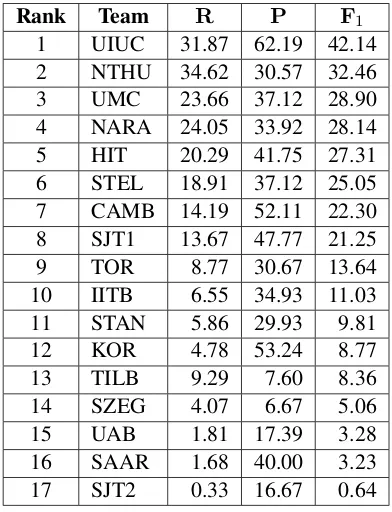
The same submitted system output was then evaluated using the extended M2 scorer, with the original annotations augmented with the alterna-tive answers. Table 8 shows the recall (R), preci-sion (P), andF1 measure of all teams under this new evaluation setting.
[image:7.595.84.279.417.671.2]evaluated with alternative answers. Not surpris-ingly, the teams which submitted alternative an-swers tend to show the greatest improvements in their F1 measure. Overall, the UIUC team (Ro-zovskaya et al., 2013) achieves the best F1 mea-sure, with a clear lead over the other teams in the shared task, under both evaluation settings (with-out and with alternative answers).
For future research which uses the test data of the CoNLL-2013 shared task, we recommend that evaluation be carried out in the setting that does
notuse alternative answers, to ensure a fairer eval-uation. This is because the scores of the teams which submitted alternative answers tend to be higher in a biased way when evaluated with alter-native answers.
[image:9.595.83.279.292.548.2]Rank Team R P F1 1 UIUC 31.87 62.19 42.14 2 NTHU 34.62 30.57 32.46 3 UMC 23.66 37.12 28.90 4 NARA 24.05 33.92 28.14 5 HIT 20.29 41.75 27.31 6 STEL 18.91 37.12 25.05 7 CAMB 14.19 52.11 22.30 8 SJT1 13.67 47.77 21.25 9 TOR 8.77 30.67 13.64 10 IITB 6.55 34.93 11.03 11 STAN 5.86 29.93 9.81 12 KOR 4.78 53.24 8.77 13 TILB 9.29 7.60 8.36 14 SZEG 4.07 6.67 5.06 15 UAB 1.81 17.39 3.28 16 SAAR 1.68 40.00 3.23 17 SJT2 0.33 16.67 0.64
Table 8: Scores (in %) with alternative answers.
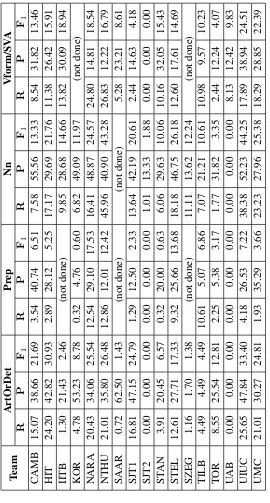
We are also interested in the analysis of scores of each of the five error types. To compute the recall of an error type, we need to know the er-ror type of each gold-standard edit, which is pro-vided by the annotator. To compute the precision of each error type, we need to know the error type of each system edit, which however is not avail-able since the submitted system output only con-tains the corrected sentences with no indication of the error type of the system edits.
In order to determine the error type of system edits, we first perform POS tagging on the submit-ted system output using the Stanford parser (Klein
and Manning, 2003). We also make use of the POS tags assigned in the preprocessed form of the test essays. We then assign an error type to a system edit based on the automatically determined POS tags, as follows:
• ArtOrDet: The system edit involves a change (insertion, deletion, or substitution) of words tagged as article/determiner, i.e., DT or PDT.
• Prep: The system edit involves a change of words tagged as preposition, i.e., IN or TO.
• Nn: The system edit involves a change of words such that a word in the source string is a singular noun (tagged as NN or NNP) and a word in the replacement string is a plu-ral noun (tagged as NNS or NNPS), or vice versa. Since a word tagged as JJ (adjective) can serve as a noun, a system edit that in-volves a change of POS tags from JJ to one of {NN, NNP, NNS, NNPS} or vice versa also qualifies.
• Vform/SVA: The system edit involves a change of words tagged as one of the verb POS tags, i.e., VB, VBD, VBG, VBN, VBP, and VBZ.
The verb form and subject-verb agreement error types are grouped together into one category, since it is difficult to automatically distinguish the two in a reliable way.
The scores when distinguished by error type are shown in Tables 9 and 10. Based on theF1 mea-sure of each error type, the noun number error type gives the highest scores, and preposition errors re-main the most challenging error type to correct.
7 Conclusions
types. The evaluation data sets and scorer used in our shared task serve as a benchmark for future research on grammatical error correction4.
Acknowledgments
This research is supported by the Singapore Na-tional Research Foundation under its InternaNa-tional Research Centre @ Singapore Funding Initiative and administered by the IDM Programme Office.
References
Steven Bird, Ewan Klein, and Edward Loper.
2009. Natural Language Processing with Python.
O’Reilly Media.
Daniel Dahlmeier and Hwee Tou Ng. 2011a. Cor-recting semantic collocation errors with L1-induced
paraphrases. InProceedings of the 2011 Conference
on Empirical Methods in Natural Language Pro-cessing, pages 107–117.
Daniel Dahlmeier and Hwee Tou Ng. 2011b. Gram-matical error correction with alternating structure
optimization. In Proceedings of the 49th Annual
Meeting of the Association for Computational Lin-guistics, pages 915–923.
Daniel Dahlmeier and Hwee Tou Ng. 2012a. A beam-search decoder for grammatical error correction. In
Proceedings of the 2012 Joint Conference on Empir-ical Methods in Natural Language Processing and Computational Natural Language Learning, pages 568–578.
Daniel Dahlmeier and Hwee Tou Ng. 2012b. Better evaluation for grammatical error correction. In Pro-ceedings of the 2012 Conference of the North Amer-ican Chapter of the Association for Computational Linguistics: Human Language Technologies, pages 568–572.
Daniel Dahlmeier, Hwee Tou Ng, and Siew Mei Wu. 2013. Building a large annotated corpus of learner English: The NUS Corpus of Learner English. In
Proceedings of the Eighth Workshop on Innovative Use of NLP for Building Educational Applications, pages 22–31.
Robert Dale and Adam Kilgarriff. 2011. Helping Our
Own: The HOO 2011 pilot shared task. In
Proceed-ings of the 13th European Workshop on Natural Lan-guage Generation, pages 242–249.
Robert Dale, Ilya Anisimoff, and George Narroway. 2012. HOO 2012: A report on the preposition and determiner error correction shared task. In Proceed-ings of the 7th Workshop on the Innovative Use of NLP for Building Educational Applications, pages 54–62.
4http://www.comp.nus.edu.sg/∼nlp/conll13st.html
Marie-Catherine de Marneffe, Bill MacCartney, and Christopher D. Manning. 2006. Generating typed dependency parses from phrase structure parses. In
Proceedings of the Fifth Conference on Language Resources and Evaluation, pages 449–454.
Michael Gamon. 2010. Using mostly native data to correct errors in learners’ writing: A meta-classifier
approach. InProceedings of the Annual Meeting of
the North American Chapter of the Association for Computational Linguistics, pages 163–171.
Na-Rae Han, Martin Chodorow, and Claudia Leacock. 2006. Detecting errors in English article usage by
non-native speakers. Natural Language
Engineer-ing, 12(2):115–129.
Dan Klein and Christopher D. Manning. 2003. Ac-curate unlexicalized parsing. InProceedings of the 41st Annual Meeting of the Association for Compu-tational Linguistics, pages 423–430.
Claudia Leacock, Martin Chodorow, Michael Gamon,
and Joel Tetreault. 2010. Automated Grammatical
Error Detection for Language Learners. Morgan & Claypool Publishers.
Diane Nicholls. 2003. The Cambridge Learner Cor-pus: Error coding and analysis for lexicography and
ELT. InProceedings of the Corpus Linguistics 2003
Conference, pages 572–581.
Alla Rozovskaya and Dan Roth. 2010. Generating confusion sets for context-sensitive error correction. In Proceedings of the 2010 Conference on Empiri-cal Methods in Natural Language Processing, pages 961–970.
Alla Rozovskaya, Kai-Wei Chang, Mark Sammons, and Dan Roth. 2013. The University of Illinois
system in the CoNLL-2013 shared task. In
Pro-ceedings of the Seventeenth Conference on Compu-tational Natural Language Learning: Shared Task.
Joel Tetreault, Jennifer Foster, and Martin Chodorow. 2010. Using parse features for preposition selection and error detection. InProceedings of the ACL 2010 Conference Short Papers, pages 353–358.
Helen Yannakoudakis, Ted Briscoe, and Ben Medlock. 2011. A new dataset and method for automatically
grading ESOL texts. InProceedings of the 49th
An-nual Meeting of the Association for Computational Linguistics, pages 180–189.
Ippei Yoshimoto, Tomoya Kose, Kensuke Mitsuzawa,
Keisuke Sakaguchi, Tomoya Mizumoto, Yuta