Grammatical Error Correction Considering Multi-word Expressions
Tomoya Mizumoto Masato Mita Yuji Matsumoto
Nara Institute of Science and Technology 8916-5 Takayama, Ikoma, Nara 630-0192, Japan
{tomoya-m, mita.masato.mz2, matsu}@is.naist.jp
Abstract
Multi-word expressions (MWEs) have been recognized as important linguistic information and much research has been conducted especially on their extraction and interpretation. On the other hand, they have hardly been used in real application areas.
While those who are learning English as a second language (ESL) use MWEs in their writings just like native speakers, MWEs haven’t been taken into consideration in grammatical error correction tasks. In this paper, we investigate the grammatical er-ror correction method using MWEs. Our method proposes a straightforward appli-cation of MWEs to grammatical error cor-rection, but experimental results show that MWEs have a beneficial effect on gram-matical error correction.
1 Introduction
Publicly usable services on the Web for assisting second language learning are growing recently. For example, there are language learning social networking services such as Lang-81 and English
grammar checkers such as Ginger2. Research on
assistance of second language learning also has re-ceived much attention, especially on grammatical error correction of essays written by learners of English as a second language (ESL) . In the past, three competitions for grammatical error correc-tion have been held: Helping Our Own (Dale and Kilgarriff, 2011; Dale et al., 2012) and CoNLL Shared Task (Ng et al., 2013; Ng et al., 2014).
1http://lang-8.com
2http://www.gingersoftware.com
Most previous research on ESL learners’ gram-matical error correction is targeted on one or few restricted types of learners’ errors. ESL learners make various kinds of grammatical errors (Mizu-moto et al., 2012). For dealing with any types of errors, grammatical error correction methods using phrase-based statistical machine translation (SMT) are proposed (Brockett et al., 2006; Mizu-moto et al., 2012). Phrase-based SMT carries out translation with phrases which are a sequence of words as translation units. However, since phrases are extracted in an unsupervised manner, an MWE like “a lot of” may not be treated as one phrase. In machine translation fields, phrase-based SMT considering MWEs achieved higher performance (Carpuat and Diab, 2010; Ren et al., 2009).
In this paper, we propose a grammatical er-ror correction method considering MWEs. To be precise, we apply machine translation methods considering MWEs (Carpuat and Diab, 2010) to grammatical error correction. They turn MWEs into single units in the source side sentences (En-glish). Unlike typical machine translation that translates between two languages, in the grammat-ical error correction task, source side sentences contain errors. Thus, we propose two methods; one is that MWEs are treated as one word in both source and target side sentences, the other is that MWEs are treated as one word in only the target side sentences.
2 Related work
Research on grammatical error correction has re-cently become very popular. Grammatical error correction methods are roughly divided into two types; (1) targeting few restricted types of errors (Rozovskaya and Roth, 2011; Rozovskaya and Roth, 2013; Tajiri et al., 2012) and (2) targeting
any types of errors (Mizumoto et al., 2012). In the first type of error correction, classifiers like Support Vector Machines have mainly been used. In the second type, statistical machine translation methods have been used. The only features for grammatical error correction that have been con-sidered in many of previous works are token, POS and syntactic information of single words, and fea-tures considering two (or more) words as a whole such as MWEs have never been used.
There is the work dealing with collocations, a kind of MWEs, as target of error detection (Futagi et al., 2008). Our method is different in that we are aiming at correcting not MWEs but other expres-sions like articles, prepositions and noun numbers as targets considering MWEs.
A lot of research for identifying MWEs and constructing MWE resources have been conducted (Schneider et al., 2014; Shigeto et al., 2013). In addition, there is some research in natural language processing applications using MWEs; i.e., statistical machine translation (Carpuat and Diab, 2010; Ren et al., 2009), information re-trieval (Newman et al., 2012) and opinion mining (Berend, 2011).
Our task is very similar to the research of SMT using MWEs (Carpuat and Diab, 2010; Ren et al., 2009). However we are in different situation where incorrect words may be included in source sentence side, thus identifying MWEs in source side may make mistakes.
3 Multi-word expressions
MWEs are defined as expressions having “id-iosyncratic interpretations that cross word bound-aries (or spaces)” (Sag et al., 2002). In this paper, we mainly deal with fixed expressions that func-tion either as adverbs, conjuncfunc-tions, determiners, prepositions, prepositional phrases or pronouns.
3.1 Multi-word expressions in native corpora and learner corpora
ESL learners also use a lot of MWEs in their writings just like native speakers. For comparing MWEs usages of ESL learners and native speak-ers, we prepare a native corpus and a learner cor-pus. We use the MWE data set from (Shigeto et al., 2013), MWE-annotated Penn Treebank sections of OntoNotes Release 4.03as the native corpus. We
[image:2.595.343.487.113.245.2]3https://catalog.ldc.upenn.edu/ LDC2011T03
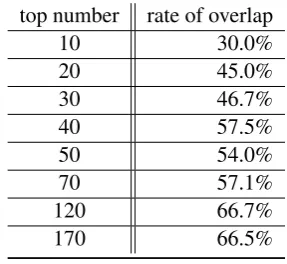
Table 1: The rate of overlap of multi-word expres-sions from Penn Treebank section of OntoNotes and Lang-8 Learner Corpora
top number rate of overlap
10 30.0%
20 45.0%
30 46.7%
40 57.5%
50 54.0%
70 57.1%
120 66.7%
170 66.5%
use Lang-8 Learner Corpora4 as the learner
cor-pus5.
Table 1 shows the rate of overlap of multi-word expressions from Penn Treebank section of OntoNotes and Lang-8 Learner Corpora in taking top N. Although they are in different domains, MWEs used by learners overlap about 60% with those used by native speakers.
The occurrence frequency of MWEs obeys the Zipf’s law. In the learner corpus, top 70 MWEs cover about 50%, top 120 MWEs cover about 80% and top 170 MWEs cover 90% of all the MWEs in the corpus by token count.
3.2 Advantage of using Multi-word Expressions for Grammatical Error Correction
There are two advantages to use MWEs in gram-matical error correction. The first advantage is that it prevents translation of correct parts of MWEs to other words. To illustrate this, let us consider the following example:
He ate sweets, for example ice and cake.
This sentence does not have grammatical errors, thus error correction systems does not need to cor-rect it. However, the system might corcor-rect the word “example”, into the following:
He ate sweets, for examples ice and cake.
This is because the system has no knowledge of MWEs.
4http://cl.naist.jp/nldata/lang-8/ 5MWEs are automatically tagged by tools which
The second advantage is that the system be-comes capable of considering longer contexts when using MWEs. To illustrate this, let us con-sider the following example:
I have a lot of red apple.
Without considering MWEs, the system takes “I have a”, “have a lot”, “a lot of”, “lot of red”, “of red apple”as word 3-grams, unable to consider the relationship between “a lot of” and “apple”. 4 Grammatical error correction methods
using multi-word expressions
In this section, we describe our error correction method with MWEs. We use statistical machine translation approaches for grammatical error cor-rection. We apply MWEs to the phrase-based SMT.
4.1 Error correction with phrase-based SMT
The error correction method with phrase-based SMT was proposed for the first time by (Brock-ett et al., 2006). Although they used phrase-based SMT for grammatical error correction, they only handled one error type, noun number. Mizumoto et al. (2012) also used phrase-based SMT, however they targeted all error types. In this paper, we use phrase-based SMT which many previous research used for grammatical error correction.
4.2 Error correction methods considering multi-word expressions
We propose two methods for grammatical error correction considering MWEs. Previous research of machine translation using MWEs (Carpuat and Diab, 2010) handled MWEs in source side sen-tences by simply turning MWEs into single units (by conjoining the constituent words with under-scores). We essentially apply their method to grammatical error correction; however, in our case identifying MWEs might fail because source side sentences contain grammatical errors. Therefore, we propose and compare the following two meth-ods.
Using MWEs in both source side and target side In this method, MWEs are considered in both source side and target side. We show an ex-ample in the following:
[image:3.595.307.526.86.209.2]Source: I have a lot of pen. Target: I have a lot of pens.
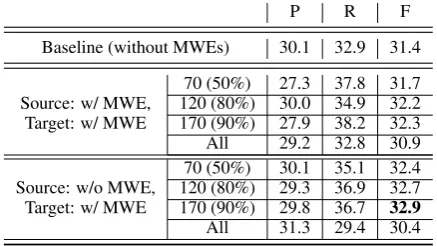
Table 2: Results of grammatical error correction
P R F
Baseline (without MWEs) 30.1 32.9 31.4 70 (50%) 27.3 37.8 31.7 Source: w/ MWE, 120 (80%) 30.0 34.9 32.2 Target: w/ MWE 170 (90%) 27.9 38.2 32.3 All 29.2 32.8 30.9 70 (50%) 30.1 35.1 32.4 Source: w/o MWE, 120 (80%) 29.3 36.9 32.7 Target: w/ MWE 170 (90%) 29.8 36.7 32.9 All 31.3 29.4 30.4
Using MWEs in target side In this method, MWEs are considered only in target side. We show an example in the following:
Source: I have a lot of pen. Target: I have a lot of pens.
We train both language model and translation model using texts of considering MWEs.
5 Experiments of grammatical error correction using multi-word expressions
5.1 Experimental settings
We used cicada 0.3.06for the machine translation
tool. This includes a decoder and a word aligner. As the language modeling tool we used expgram 0.2.07. We used ZMERT8as the parameter tuning
tool.
For automatic identifying MWEs, we use AMALGr 1.09(Schneider et al., 2014). The MWE
identification tool is re-trained using the MWE data set tagged by (Shigeto et al., 2013) on the Penn Treebank sections of OntoNotes Release 4.0. This is because their annotation was more conve-nient for our purpose.
The translation model was trained on the Lang-8 Learner Corpora v2.0. We extracted En-glish essays which were written by ESL learners whose native language is Japanese from the cor-pora and cleaned the noise with the method pro-posed in (Mizumoto et al., 2011). As the results, we got 629,787 sentence pairs. We used a 5-gram
6http://www2.nict.go.jp/univ-com/ multi_trans/cicada/
7http://www2.nict.go.jp/univ-com/ multi_trans/expgram/
Table 3: Examples of system outputs
Learner Last month, she gave me a lot of rice and onion. Baseline Last month, she gave me a lot of rice and onion. with MWE Last month, she gave me a lot of rice and onions.
language model built on corrected sentences of the learner corpora. Konan-JIEM Learner Corpus10
(Nagata et al., 2011) are used for evaluation and development data. We use 2,411 sentences for evaluation, and 300 sentences for development.
5.2 Experimental Result
As evaluation metrics, we use precision, recall and F-score. We compare phrase-based SMT with-out using MWEs (baseline) with the two meth-ods explained in 4.2. In addition, we varied the number of MWEs used for training the transla-tion model and the language model. This is be-cause MWEs that appear few times may introduce noises. We use top 70 (50%), 120 (80%) and 170 (90%) MWEs described in 3.1.
Table 2 shows the experimental results. The methods considering MWEs achieved higher F-score than baseline except for the case that uses All MWEs. In addition, using more MWEs in-creases the F-score.
5.3 Discussion
Using all MWEs shows worse results because in-frequent MWEs become noise in training and test-ing.
We got better results when we use MWEs only in the target side. This is likely because learners tend to fail to write MWEs correctly, only writing them in partial forms. One cause of deterioration of precision is that a single word like “many” is wrongly corrected into an MWE like “a lot of”, although it is actually not incorrect.
There are two reasons why the performance im-proved considering MWEs. The first reason is that the system becomes capable of considering the re-lationship between MWEs which are made up of a sequence of two or more lexemes and words lie ad-jacent to MWEs. We show an example of system results in Table 3. Although the baseline system did not correct the example, the system consider-ing MWEs was able to correct this error. This is
10http://www.gsk.or.jp/en/catalog/ gsk2015-a/
because the system was able to consider the MWE “a lot of”.
The second reason is that the probabilities of translation model and language model are im-proved by handling MWEs as single units. Let us consider the two sentences, “There are a lot of pens” and “There is a pen.” as examples of lan-guage model. Without considering MWEs, the word 3-grams, “There are a” and “There is a”, have high probability. With considering MWEs, however, the former trigram becomes to “There are a lot of pens” and then the probabilities of tri-grams that should not be given high probability like “There are a” come to low. The correction performance of articles and prepositions that are likely to become a component word of MWEs is considered to improve by this revision. The num-ber of true positive for article as compared with baseline and MWE (170) of only target side are 190 and 227, respectively. Likewise, the number of true positive for preposition as compared with them are 108 and 121, respectively.
6 Conclusion
We proposed a grammatical error correction method using multi-word expressions. Our method proposes a straightforward application of MWEs to grammatical error correction, but exper-imental results show that MWEs have quite good effects on grammatical error correction. Experi-mental results show that the methods considering MWEs achieved higher F-score than baseline ex-cept for the case that uses all MWEs. We plan to use more multi-word expressions which we did not handle in this paper, such as phrasal verbs. Moreover, we plan to conduct grammatical error correction considering MWEs which contain gaps that are dealt with (Schneider et al., 2014).
References
G´abor Berend. 2011. Opinion Expression Mining by Exploiting Keyphrase Extraction. InProceedings of IJCNLP, pages 1162–1170.
Ga-mon. 2006. Correcting ESL Errors Using Phrasal SMT Techniques. InProceedings of COLING-ACL, pages 249–256.
Marine Carpuat and Mona Diab. 2010. Task-based Evaluation of Multiword Expressions: a Pilot Study in Statistical Machine Translation. InProceedings of HLT-NAACL, pages 242–245.
Robert Dale and Adam Kilgarriff. 2011. Helping Our Own: The HOO 2011 Pilot Shared Task. In Pro-ceedings of ENLG, pages 242–249.
Robert Dale, Ilya Anisimoff, and George Narroway. 2012. HOO 2012: A Report on the Preposition and Determiner Error Correction Shared Task. In Pro-ceedings of BEA, pages 54–62.
Yoko Futagi, Paul Deane, Martin Chodorow, and Joel Tetreault. 2008. A Computational Approach to De-tecting Collocation Errors in the Writing of Non-Native Speakers of English. Computer Assisted Language Learning, 21(4):353–367.
Tomoya Mizumoto, Mamoru Komachi, Masaaki Na-gata, and Yuji Matsumoto. 2011. Mining Re-vision Log of Language Learning SNS for Auto-mated Japanese Error Correction of Second Lan-guage Learners. InProceedings of IJCNLP, pages 147–155.
Tomoya Mizumoto, Yuta Hayashibe, Mamoru Ko-machi, Masaaki Nagata, and Yuji Matsumoto. 2012. The Effect of Learner Corpus Size in Grammatical Error Correction of ESL Writings. InProceedings of COLING, pages 863–872.
Ryo Nagata, Edward Whittaker, and Vera Shein-man. 2011. Creating a Manually Error-tagged and Shallow-parsed Learner corpus. In Proceedings of ACL-HLT, pages 1210–1219.
David Newman, Nagendra Koilada, Jey Han Lau, and Timothy Baldwin. 2012. Bayesian Text Segmen-tation for Index Term Identification and Keyphrase Extraction. In Proceedings of COLING, pages 2077–2092.
Hwee Tou Ng, Siew Mei Wu, Yuanbin Wu, Christian Hadiwinoto, and Joel Tetreault. 2013. The CoNLL-2013 Shared Task on Grammatical Error Correction. InProceedings of CoNLL Shared Task, pages 1–12.
Hwee Tou Ng, Siew Mei Wu, Ted Briscoe, Christian Hadiwinoto, Raymond Hendy Susanto, and Christo-pher Bryant. 2014. The CoNLL-2014 Shared Task on Grammatical Error Correction. InProceedings of CoNLL Shared Task, pages 1–14.
Zhixiang Ren, Yajuan L¨u, Jie Cao, Qun Liu, and Yun Huang. 2009. Improving Statistical Machine Trans-lation Using Domain Bilingual Multiword Expres-sions. InProceedings of Workshop on MWE, pages 47–54.
Alla Rozovskaya and Dan Roth. 2011. Algorithm Se-lection and Model Adaptation for ESL Correction Tasks. InProceedings of ACL-HLT, pages 924–933. Alla Rozovskaya and Dan Roth. 2013. Joint Learning and Inference for Grammatical Error Correction. In
Proceedings of EMNLP, pages 791–802.
Ivan A. Sag, Timothy Baldwin, Francis Bond, Ann A. Copestake, and Dan Flickinger. 2002. Multiword Expressions: A Pain in the Neck for NLP. In Pro-ceedings of CICLing, pages 1–15.
Nathan Schneider, Emily Danchik, Chris Dyer, and Noah A. Smith. 2014. Discriminative Lexical Se-mantic Segmentation with Gaps: Running the MWE Gamut. Transactions of the Association for Compu-tational Linguistics, 2:193–206.
Yutaro Shigeto, Ai Azuma, Sorami Hisamoto, Shuhei Kondo, Tomoya Kouse, Keisuke Sakaguchi, Ak-ifumi Yoshimoto, Frances Yung, and Yuji Mat-sumoto. 2013. Construction of English MWE Dic-tionary and its Application to POS Tagging. In Pro-ceedings of Workshop on MWE, pages 139–144. Toshikazu Tajiri, Mamoru Komachi, and Yuji