Neural Architectures for Fine-grained Entity Type Classification
Sonse Shimaoka†∗, Pontus Stenetorp‡, Kentaro Inui† and Sebastian Riedel‡ †Graduate School of Information Sciences, Tohoku University
‡Department of Computer Science, University College London
{simaokasonse,inui}@ecei.tohoku.ac.jp
{p.stenetorp,s.riedel}@cs.ucl.ac.uk
Abstract
In this work, we investigate several neu-ral network architectures for fine-grained entity type classification and make three key contributions. Despite being a natural comparison and addition, previous work on attentive neural architectures have not considered hand-crafted features and we combine these with learnt features and es-tablish that they complement each other. Additionally, through quantitative analysis we establish that the attention mechanism learns to attend over syntactic heads and the phrase containing the mention, both of which are known to be strong hand-crafted features for our task. We introduce param-eter sharing between labels through a hi-erarchical encoding method, that in low-dimensional projections show clear clus-ters for each type hierarchy. Lastly, de-spite using the same evaluation dataset, the literature frequently compare models trained using different data. We demon-strate that the choice of training data has a drastic impact on performance, which de-creases by as much as 9.85% loose mi-cro F1 score for a previously proposed method. Despite this discrepancy, our best model achieves state-of-the-art results with 75.36% loose micro F1 score on the well-established FIGER (GOLD) dataset and we report the best results for models trained using publicly available data for the OntoNotes dataset with 64.93% loose micro F1 score.
a match series against New Zealand is held on Monday Output
Word Embeddings LSTM Layers A9en:ons Context Representa:on Men:on Representa:on
[image:1.595.311.517.227.392.2]/organiza)on, /organiza)on/sports_team
Figure 1: An illustration of the attentive en-coder neural model predicting fine-grained seman-tic types for the mention “New Zealand” in the ex-pression “a match series against New Zealand is held on Monday”.
1 Introduction
Entity type classification aims to label entity men-tions in their context with their respective semantic types. Information regarding entity type mentions has proven to be valuable for several natural lan-guage processing tasks; such as question answer-ing (Lee et al., 2006), knowledge base popula-tion (Carlson et al., 2010), and co-reference reso-lution (Recasens et al., 2013). A natural extension to traditional entity type classification has been to divide the set of types – which may be too coarse-grained for some applications (Sekine, 2008) – into a larger set offine-grained entity types (Lee et al., 2006; Ling and Weld, 2012; Yosef et al., 2012; Gillick et al., 2014; Del Corro et al., 2015); for examplepersonintoactor,artist, etc.
Given the recent successes of attentive neural ∗This work was conducted during a research visit to
Uni-versity College London.
models for information extraction (Globerson et al., 2016; Shimaoka et al., 2016; Yang et al., 2016), we investigate several variants of an atten-tive neural model for the task of fine-grained entity classification (e.g. Figure 1). This model category uses a neural attention mechanism – which can be likened to a soft alignment – that enables the model to focus on informative words and phrases. We build upon this line of research and our contri-butions are three-fold:
1. Despite being a natural comparison and ad-dition, previous work on attentive neural ar-chitectures do not consider hand-crafted fea-tures. We combine learnt and hand-crafted features and observe that they complement each other. Additionally, we perform ex-tensive analysis of the attention mechanism of our model and establish that the atten-tion mechanism learns to attend over syn-tactic heads and the tokens prior to and af-ter a mention, both which are known to be highly relevant to successfully classifying a mention.
2. We introduce label parameter sharing using a hierarchical encoding that improves perfor-mance on one of our datasets and the low-dimensional projections of the embedded la-bels form clear coherent clusters.
3. While research on fine-grained entity type classification has settled on using two eval-uation datasets, a wide variety of training datasets have been used – the impact of which has not been established. We demonstrate that the choice of training data has a dras-tic impact on performance, observing per-formance decreases by as much as 9.85% loose Micro F1 score for a previously pro-posed method. However, even when compar-ing to models trained uscompar-ing different datasets we report state-of-the-art results of 75.36% loose micro F1 score on the FIGER(GOLD) dataset.
2 Related Work
Our work primarily draws upon two strains of re-search, fine-grained entity classification and atten-tion mechanisms for neural models. In this secatten-tion we introduce both of these research directions.
By expanding a set of coarse-grained types into a set of 147 fine-grained types, Lee et al. (2006)
were the first to address the task of fine-grained entity classification. Their end goal was to use the resulting types in a question answering system and they developed a conditional random field model that they trained and evaluated on a manually an-notated Korean dataset to detect and classify en-tity mentions. Other early work include Sekine (2008), that emphasised the need for having ac-cess to a large set of entity types for several NLP applications. The work primarily discussed de-sign issues for fine-grained set of entity types and served as a basis for much of the future work on fine-grained entity classification.
The first work to use distant supervision (Mintz et al., 2009) to induce a large – but noisy – train-ing set and manually label a significantly smaller dataset to evaluate their fine-grained entity classi-fication system, was Ling and Weld (2012) who introduced both a training and evaluation dataset FIGER (GOLD). Arguing that fine-grained sets of types must be organised in a very fine-grained hierarchical taxonomy, Yosef et al. (2012) in-troduced such a taxonomy covering 505 distinct types. This new set of types lead to improve-ments on FIGER(GOLD), and they also demon-strated that the fine-grained labels could be used as features to improve coarse-grained entity type classification performance. More recently, con-tinuing this very fine-grained strategy, Del Corro et al. (2015) introduced the most fine-grained en-tity type classification system to date, covering the more than16,000types contained in the WordNet hierarchy.
While initial work largely assumed that mention assignments could be done independently of the mention context, Gillick et al. (2014) introduced the concept of context-dependent fine-grained en-tity type classification where the types of a men-tion is constrained to what can be deduced from its context and introduced a new OntoNotes-derived manually annotated evaluation dataset. In addi-tion, they addressed the problem of label noise in-duced by distant supervision and proposed three label cleaning heuristics. Building upon the noise reduction aspects of this work, Ren et al. (2016) introduced a method to reduce label noise even further, leading to significant performance gains on both the evaluation dataset of Ling and Weld (2012) and Gillick et al. (2014).
or-der to facilitate information sharing between both related types and features. A pure feature learn-ing approach was proposed by Dong et al. (2015). They defined22types and used a two-part neural classifier that used a recurrent neural network to obtain a vector representation of each entity men-tion and in its second part used a fixed-size win-dow to capture the context of a mention. A re-cent workshop paper (Shimaoka et al., 2016) intro-duced an attentive neural model that unlike previ-ous work obtained vector representations for each mention context by composing it using a recurrent neural network and employed an attention mecha-nism to allow the model to focus on relevant ex-pressions in the mention context. Although not pointed in Shimaoka et al. (2016), the attention mechanism used differs from previous work in that it does not condition the attention. Rather, they used global weights optimised to provide attention for every fine-grained entity type classification de-cision.
To the best of our knowledge, the first work that utilised an attention architecture within the context of NLP was Bahdanau et al. (2014), that allowed a machine translation decoder to attend over the source sentence. Doing so, they showed that adding the attention mechanism significantly improved their machine translation results as the model was capable of learning to align the source and target sentences. Moreover, in their qualitative analysis, they concluded that the model can cor-rectly align mutually related words and phrases. For the set of neural models proposed by Hermann et al. (2015), attention mechanisms are used to fo-cus on the aspects of a document that help the model answer a question, as well as providing a way to qualitatively analyse the inference process. Rockt¨aschel et al. (2015) demonstrated that by ap-plying an attention mechanism to a textual entail-ment model, they could attain state-of-the-art re-sults, as well as analyse how the entailing sentence would align to the entailed sentence.
Our work differs from previous work on fine-grained entity classification in that we use the same publicly available training datawhen com-paring models. We also believe that we are the first to consider thedirect combination of hand-crafted features and an attentive neural model.
Feature Description Example
Head Syntactic head of the mention Obama
Non-head Non-head words of the mention Barack, H.
Cluster Brown cluster for the head token 1110, . . . Characters Character trigrams for the mention head :ob, oba, . . .
Shape Word shape of the mention phrase Aa A. Aa
Role Dependency label on the mention head subj Context Words before and after the mention B:who, A:first
Parent The head’s lexical parent picked
Topic The LDA topic of the document LDA:13
Table 1: Hand-crafted features, based on those of Gillick et al. (2014), used by the sparse fea-ture and hybrid model variants in our experiments. The features are extracted for each entity mention and the example mention used to extract the ex-ample features in this table is “. . . who [Barack H. Obama] first picked . . . ”.
3 Models
In this section we describe the neural model vari-ants used in this paper as well as a strong feature-based baseline from the literature. We pose fine-grained entity classification as a multi-class, multi-label classification problem. Given a men-tion in a sentence, the classifier predicts the types
t∈ {1,0}KwhereKis the size of the set of types.
Across all the models, we compute a probability
yk ∈ Rfor each of theK types using logistic
re-gression. Variations of the models stem from the ways of computing the input to the logistic regres-sion.
At inference time, we enforce the assumption that at least one type is assigned to each mention by first assigning the type with the largest proba-bility. We then assign any additional types based on the condition that their corresponding probabil-ities must be greater than a threshold of0.5, which was determined by tuning it using development data.
3.1 Sparse Feature Model
For each entity mentionm, we create a binary fea-ture indicator vector f(m) ∈ {0,1}Df and feed
[image:3.595.308.526.61.149.2]et al. (2014) did not make the data used for their clusters publicly available. Secondly, we learned a set of 15 topics from the OntoNotes dataset using the LDA (Blei et al., 2003) implementation from the popular gensim software package,1in contrast
to Gillick et al. (2014) that used a supervised topic model trained using an unspecified dataset. De-spite these differences, we argue that our set of features is comparable and enables a fair compar-ison given that the original implementation and some of the data used is not publicly available.
3.2 Neural Models
The neural models from Shimaoka et al. (2016) processes embeddings of the words of the mention and its context; and we adopt the same formalism when introducing these models and our variants. First, the mention representation vm ∈ RDm×1
and context representationvc ∈ RDc×1 are
com-puted separately. Then, the concatenation of these representations is used to compute the prediction:
y = 1
1 + exp
−Wy
vm
vc
(1)
WhereWy ∈ RK×(Dm+Dc) is the weight
ma-trix.
Let the words in the mention be
m1, m2, ..., m|m|. Then the representation of the mention is computed as follows:
vm= |m1|
|m|
X
i=1
u(mi) (2)
Where u is a mapping from a word to an em-bedding. This relatively simple method for com-posing the mention representation is motivated by it being less prone to overfitting.
Next, we describe the three methods from Shi-maoka et al. (2016) for computing the context rep-resentations; namely, Averaging, LSTM, and At-tentive Encoder.
3.2.1 Averaging Encoder
Similarly to the method of computing the mention representation, the Averaging encoder computes the averages of the words in the left and right con-text. Formally, let l1, ..., lC andr1, ..., rC be the
words in the left and right contexts respectively, where C is the window size. Then, for each se-quence of words, we compute the average of the
1http://radimrehurek.com/gensim/
corresponding word embeddings. Those two vec-tors are then concatenated to form the representa-tion of the contextvc.
3.2.2 LSTM Encoder
For the LSTM Encoder, the left and right contexts are encoded by an LSTM (Hochreiter and Schmid-huber, 1997). The high-level formulation of an LSTM can be written as:
hi, si=lstm(ui, hi−1, si−1) (3)
Where ui ∈ RDm×1 is an input embedding,
hi−1 ∈RDh×1is the previous output, andsi−1 ∈
RDh×1is the previous cell state.
For the left context, the LSTM is applied to the sequencel1, ..., lC from left to right and produces
the outputs −→hl
1, ..., −→
hl
C. For the right context, the
sequencerC, ..., r1 is processed from right to left
to produce the outputs←h−r
1, ...,←−hrC. The
concatena-tion of−→hl
C and←h−r1then serves as the context
repre-sentationvc.
3.2.3 Attentive Encoder
An attention mechanism aims to encourage the model to focus on salient local information that is relevant for the classification decision. The at-tention mechanism variant used in this work is defined as follows. First, bi-directional LSTMs (Graves, 2012) are applied for both the right and left context. We denote the output layers of the bi-directional LSTMs as −→hl
1,←h−l1, ...,h−→lC,←−hlC and −
→
hr
1,←h−r1, ...,h−→rC,←−hrC.
For each output layer, a scalar value ˜ai ∈ R
is computed using a feed forward neural network with the hidden layerei ∈RDa×1 and weight
ma-tricesWe∈RDa×2DhandWa ∈R1×Da:
el
i = tanh We
" −→
hli
←−
hli
#!
(4)
˜
ali = exp(Waeli) (5)
Next, the scalar values are normalised such that they sum to1:
ali = PC ˜ali
i=1a˜li+ ˜ari
(6)
These normalised scalar values ai ∈ R are
LSTMs, weighted by the attentionsai as the
rep-resentation of the context:
vc= C
X
i=1
ali
" −→
hl i ←−
hli
#
+ari
" →−
hr i ←−
hri
#
(7)
An illustration of the attentive encoder model variant can be found in Figure 1.
3.3 Hybrid Models
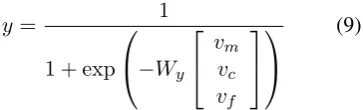
To allow model variants to use both human back-ground knowledge through hand-crafted features as well as features learnt from data, we extended the neural models to create new hybrid model variants as follows. Let vf ∈ RDl×1 be a
low-dimensional projection of the sparse featuref(m):
vf =Wff(m) (8)
Where Wf ∈ RDl×Df is a projection matrix.
The hybrid model variants are then defined as fol-lows:
y= 1
1 + exp
−Wy
vvmc
vf (9)
These models can thus draw upon learnt fea-tures through vm and vc as well as hand-crafted
features usingvf when making classification
deci-sions. While existing work on fine-grained entity type classification have used either sparse, man-ually designed features or dense, automatically learnt embedding vectors, our work is the first to propose and evaluate a model using the combina-tion of both features.
3.4 Hierarchical Label Encoding
Since the fine-grained types tend to form a for-est of type hierarchies (e.g. musicianis a sub-type of artist, which in turn is a subtype of
person), we investigated whether the encoding
of each label could utilise this structure to enable parameter sharing. Concretely, we compose the weight matrixWy for the logistic regression layer
as the product of a learnt weight matrixVy and a
constant sparse binary matrixS:
WyT =VyS (10)
We encode the type hierarchy formed by the set of types in the binary matrix S as fol-lows. Each type is mapped to a unique col-umn in S, where membership at each level of
/p er so n/a rt is t/ act o r /p er so n/a rt is t /p er so n /l o ca tio n /l o ca tio n/ci ty
[image:5.595.310.518.64.231.2]W
TyS
V
y /p er so n/a rt is t/ act o r /p er so n/a rt is t /p er so n /l o ca tio n /l o ca tio n/ci tyFigure 2: Hierarchical label encoding illustration.
Work W2M W2M+D W2.6M GN1 GN2
Ling and Weld (2012) X
Gillick et al. (2014) ×
Yogatama et al. (2015) ×
Ren et al. (2016) X ×
Shimaoka et al. (2016) X
Table 2: Training datasets used and its avail-ability. W2M and W2.6M are Wikipedia-based, +D indicates denoising, and GN1/GN2 are two company-internal Google News datasets. The symbolsXand×indicates publicly available and unavailable data.
its type hierarchy is marked by a 1. For exam-ple, if we use the set of types defined by Gillick et al. (2014), the column for /person could be encoded as [1,0, . . .], /person/artist as [1,1,0, . . .], and/person/artist/actor as [1,1,1,0, . . .]. This encoding scheme is illustrated in Figure 2.
This enables us to share parameters between labels in the same hierarchy, potentially making learning easier for infrequent types that can now draw upon annotations of other types in the same hierarchy.
4 Experiments 4.1 Datasets
[image:5.595.109.291.354.409.2]fair comparison between methods even more dif-ficult. For evaluation, in our experiments we use the two well-established manually annotated datasets FIGER (GOLD) and OntoNotes, where like Gillick et al. (2014), we discarded pronomi-nal mentions, resulting in a total of 8,963 men-tions. For training, we use the automatically in-duced publicly available datasets provided by Ren et al. (2016). Ren et al. (2016) aimed to elimi-nate label noise generated in the process of distant supervision and we use the “raw” noisy data2
pro-vided by them for training our models.
4.2 Pre-trained Word Embeddings
We use pre-trained word embeddings that were not updated during training to help the model gener-alise to words not appearing in the training set (Rockt¨aschel et al., 2015). For this purpose, we used the freely available 300-dimensional cased word embeddings trained on 840 billion tokens from the Common Crawl supplied by Pennington et al. (2014). For words not present in the pre-trained word embeddings, we use the embedding of the “unk” token.
4.3 Evaluation Criteria
We adopt the same criteria as Ling and Weld (2012), that is, we evaluate the model performance by strict accuracy, loose macro, and loose micro scores.
4.4 Hyperparameter Settings
Values for the hyperparameters were obtained from preliminary experiments by evaluating the model performance on the development sets. Con-cretely, all neural and hybrid models used the same
Dm = 300-dimensional word embeddings, the
hidden-size of the LSTM was set toDh = 100, the
hidden-layer size of the attention module was set toDa= 100, and the size of the low-dimensional
projection of the sparse features was set toDl =
50. We usedAdam(Kingma and Ba, 2014) as our optimisation method with a learning rate of0.001, a mini-batch size of1,000, and iterated over the training data for five epochs. As a regularizer we
2 Although Ren et al. (2016) provided both “raw” data and code to “denoise” the data, we were unable to replicate the performance benefits reported in their work after running their pipeline. We have contacted them regarding this as we would be interested in comparing the benefit of their denois-ing algorithm for each model, but at the time of writdenois-ing we have not yet received a response.
Model Acc. Macro Micro
Hand-crafted 51.33 71.91 68.78
Averaging 46.36 71.03 65.31
Averaging + Hand-crafted 52.58 72.33 70.04
LSTM 55.60 75.15 71.73
LSTM + Hand-crafted 57.02 76.98 73.94
Attentive 54.53 74.76 71.58
Attentive + Hand-crafted 59.68 78.97 75.36
FIGER(Ling and Weld, 2012) 52.30 69.90 69.30
FIGER(Ren et al., 2016) 47.4 69.2 65.5
Table 3: Performance on FIGER (GOLD) for models using thesameW2M training data.
Model Data Acc. Macro Micro
Attentive + Hand-crafted W2M 59.68 78.97 75.36
Attentive (Shimaoka et al., 2016) W2.6M 58.97 77.96 74.94
FIGER+ PLE (Ren et al., 2016) W2M+D 59.9 76.3 74.9
HYENA + PLE (Ren et al., 2016) W2M+D 54.2 69.5 68.1
K-WASABIE (Yogatama et al., 2015) GN2 n/a n/a 72.25
Table 4: Performance on FIGER (GOLD) for models usingdifferenttraining data.
used dropout (Hinton et al., 2012) with probabil-ity 0.5 applied to the mention representation and sparse feature representation. The context win-dow size was set toC = 10 and if the length of a context extends beyond the sentence length, we used a padding symbol in-place of a word. After training, we picked the best model on the develop-ment set as our final model and report their perfor-mance on the test sets. Our model implementation was done in Python using the TensorFlow (Abadi et al., 2015) machine learning library.
4.5 Results
When presenting our results, it should be noted that we aim to make a clear separation between re-sults from models trained using different datasets.
4.5.1 FIGER(GOLD)
We first analyse the results on FIGER (GOLD) (Tables 3 and 4). The performance of the baseline model that uses the sparse hand-crafted features is relatively close to that of the FIGER system of Ling and Weld (2012). This is consistent with the fact that both systems use linear classifiers, similar sets of features, and training data of the same size and domain.
hier-Model Acc. Macro Micro
Hand-crafted 48.16 66.33 60.16
Averaging 46.17 65.26 58.25
Averaging + Hier 47.15 65.53 58.25
Averaging + Hand-crafted 51.57 70.61 64.24
Averaging + Hand-crafted + Hier 51.74 70.98 64.91
LSTM 49.20 66.72 60.52
LSTM + Hier 48.96 66.51 60.70
LSTM + Hand-crafted 48.58 68.54 62.89
LSTM + Hand-crafted + Hier 50.42 69.99 64.57
Attentive 50.32 67.95 61.65
Attentive + Hier 51.10 68.19 61.57
Attentive + Hand-crafted 49.54 69.04 63.55
Attentive + Hand-crafted + Hier 50.89 70.80 64.93
FIGER(Ren et al., 2016) 36.90 57.80 51.60
Table 5: Performance on OntoNotes for models using thesameW2M training data.
archical label encoding were inconsistent, some-times increasing, somesome-times decreasing perfor-mance. We thus opted not to include them in the results table due to space constraints and hypothe-sise that given the size of the training data, param-eter sharing may not yield any large performance benefits. Among the neural models, we see that the averaging encoder perform considerably worse than the others. Both the LSTM and attentive en-coder show strong results and the attentive enen-coder with hand-crafted features achieves the best per-formance among all the models we investigated.
When comparing our best model to previously introduced models trained using different train-ing data, we find that we achieve state-of-the-art results both in terms of loose macro and micro scores. The closest competitor, FIGER+ PLE (Ren et al., 2016), achieves higher accuracy at the ex-pense of lower F1 scores, we suspect that this is due to an accuracy focus in their label pruning strategy. It is worth noting that we achieve state-of-the-art results without the need for any noise re-duction strategies. Also, even with 600,000 fewer training examples, our variant with hand-crafted features of the attentive model from Shimaoka et al. (2016) outperforms its feature-learning variant. In regards to the impact of the choice of training set, we observe that the model introduced in Shi-maoka et al. (2016) drops as much as3.36points of loose micro score when using a smaller dataset. Thus casting doubts upon the comparability of re-sults of fine-grained entity classification models using different training data.
4.5.2 OntoNotes
Secondly, we discuss the results on OntoNotes (Tables 5, and 6). Again, we see consistent
per-Model Data Acc. Macro Micro
Averaging + Hand-crafted + Hier W2M 51.74 70.98 64.91
Attentive + Hand-crafted + Hier W2M 50.89 70.80 64.93
FIGER+ PLE (Ren et al., 2016) W2M+D 57.2 71.5 66.1
HYENA + PLE (Ren et al., 2016) W2M+D 54.6 69.2 62.5
Hand-crafted (Gillick et al., 2014) GN1 n/a n/a 70.01
K-WASABIE (Yogatama et al., 2015) GN2 n/a n/a 72.98
Table 6: Performance on OntoNotes for models usingdifferenttraining data.
formance improvements when the sparse hand-crafted features are added to the neural models. In the absence of hand-crafted features, the aver-aging encoder suffer relatively poor performance and the attentive encoder achieves the best per-formance. However, when the hand-crafted fea-tures are added, a significant improvement oc-curs for the averaging encoder, making the per-formance of the three neural models much alike. We speculate that some of the hand-crafted fea-tures such as the dependency role and parent word of the head noun, provide crucial information for the task that cannot be captured by the plain av-eraging model, but can be learnt if an attention mechanism is present. Another speculative reason is that because the training dataset is noisy com-pared to FIGER (GOLD) (since FIGER(GOLD) uses anchors to detect entities whereas OntoNotes uses an external tool), and the size of the dataset is small, the robustness of the simpler averaging model becomes clearer when combined with the hand-crafted features.
Another interesting observation can be seen for models with the hierarchical label encoding, where it is clear that consistent performance in-creases occur. This can be explained by the fact that the type ontology used in OntoNotes is more well-formed than its FIGERcounterpart. While we do not obtain state-of-the-art performance when considering models using different training data, we do note that in terms of F1-score we perform within 1 point of the state of the art. This being achieved despite having trained our models on dif-ferent non-proprietary noisy data.
hesi-(a)
(b)
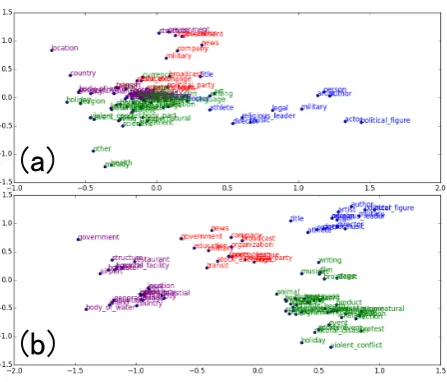
Figure 3: PCA projections of the label embed-dings learnt from the OntoNotes dataset where subtypes share the same color as their parent type. Sub-figure (a) uses the non-hierarchical encoding, while sub-figure (b) uses the hierarchical encod-ing.
tate to speculate as to exactly why this drop is so dramatic, but similar observations have been made for entity linking (Ling et al., 2015). This clearly underlines how essential it is to compare models on an equal footing using the same training data.
4.6 PCA visualisation of label embeddings
By visualising the learnt label embeddings (Fig-ure 3) and comparing the non-hierarchical and hi-erarchical label encodings, we can observe that the hierarchical encoding forms clear distinct clusters.
4.7 Attention Analysis
While visualising the attention weights for specific examples have become commonplace, it is still not clear exactly what syntactic and semantic patterns that are learnt by the attention mechanism. To better understand this, we first qualitatively anal-ysed a large set of attention visualisations and ob-served that head words and the words contained in the phrase forming the mention tended to re-ceive the highest level of attention. In order to quantify this notion, we calculated how frequently the word strongest attended over for all mentions of a specific type was the syntactic head or the words before and after the mention in its phrase. What we found through our analysis (Table 7) was that our attentive model without hand-crafted fea-tures does indeed learn that head words and the phrase surrounding the mention are highly
[image:8.595.73.297.60.251.2]indica-Type Parent Before After Frequent Words /location 0.319 0.228 0.070 in, at, born /organization 0.324 0.178 0.119 at, the, by /art/film 0.207 0.429 0.021 film, films, in /music 0.259 0.116 0.018 album, song, single /award 0.583 0.292 0.083 won, a, received /event 0.310 0.188 0.089 in, during, at
Table 7: Quantitative attention analysis.
tive of the mention type, without any explicit su-pervision. Furthermore, we believe that this in part might explain why the performance benefit of adding hand-crafted features was smaller for the attentive model compared to our other two neural variants.
5 Conclusions and Future Work
In this paper, we investigated several model vari-ants for the task of fine-grained entity type classifi-cation. The experiments clearly demonstrated that the choice of training data – which until now been ignored for our task – has a significant impact on performance. Our best model achieved state-of-the-art results with 75.36% loose micro F1 score on FIGER (GOLD) despite being compared to models trained using larger datasets and we were able to report the best results for any model trained using publicly available data for OntoNotes with 64.93% loose micro F1 score. The analysis of the behaviour of the attention mechanism demon-strated that it can successfully learn to attend over expressions that are important for the classifica-tion of fine-grained types. It is our hope that our observations can inspire further research into the limitations of what linguistic phenomena attentive models can learn and how they can be improved.
As future work, we see the re-implementation of more methods from the literature as a desirable target, so that they can be evaluated after utilis-ing the same trainutilis-ing data. Additionally, we would like to explore alternative hierarchical label encod-ings that may lead to more consistent performance benefits.
To ease the reproducability of our work, we make our code used for the experiments available at https://github.com/
shimaokasonse/NFGEC.
Acknowledgments
[image:8.595.309.546.61.137.2]Curie Career Integration Award, and an Allen Dis-tinguished Investigator Award. We would like to thank Dan Gillick for answering several questions related to his 2014 paper.
References
Mart´ın Abadi, Ashish Agarwal, Paul Barham, Eugene Brevdo, Zhifeng Chen, Craig Citro, Greg S. Cor-rado, Andy Davis, Jeffrey Dean, Matthieu Devin, Sanjay Ghemawat, Ian Goodfellow, Andrew Harp, Geoffrey Irving, Michael Isard, Yangqing Jia, Rafal Jozefowicz, Lukasz Kaiser, Manjunath Kudlur, Josh Levenberg, Dan Man´e, Rajat Monga, Sherry Moore, Derek Murray, Chris Olah, Mike Schuster, Jonathon Shlens, Benoit Steiner, Ilya Sutskever, Kunal Tal-war, Paul Tucker, Vincent Vanhoucke, Vijay Vasude-van, Fernanda Vi´egas, Oriol Vinyals, Pete Warden, Martin Wattenberg, Martin Wicke, Yuan Yu, and Xi-aoqiang Zheng. 2015. TensorFlow: Large-scale machine learning on heterogeneous systems. Dzmitry Bahdanau, Kyunghyun Cho, and Yoshua
Ben-gio. 2014. Neural machine translation by jointly learning to align and translate. arXiv preprint arXiv:1409.0473.
David M. Blei, Andrew Y. Ng, and Michael I. Jordan. 2003. Latent dirichlet allocation. the Journal of ma-chine Learning research, 3:993–1022.
P.F. Brown, P.V. Desouza, R.L. Mercer, V.J. Della Pietra, and J.C. Lai. 1992. Class-based n-gram models of natural language. Computational linguistics, 18(4):467–479.
Andrew Carlson, Justin Betteridge, Richard C. Wang, Estevam R. Hruschka Jr., and Tom M. Mitchell. 2010. Coupled semi-supervised learning for infor-mation extraction. InProceedings of the third ACM international conference on Web search and data mining, pages 101–110. ACM.
Luciano Del Corro, Abdalghani Abujabal, Rainer Gemulla, and Gerhard Weikum. 2015. Finet: Context-aware fine-grained named entity typing. In
Conference on Empirical Methods in Natural Lan-guage Processing, pages 868–878. ACL.
Li Dong, Furu Wei, Hong Sun, Ming Zhou, and Ke Xu. 2015. A hybrid neural model for type classification of entity mentions. InProceedings of the 24th Inter-national Conference on Artificial Intelligence, pages 1243–1249. AAAI Press.
Dan Gillick, Nevena Lazic, Kuzman Ganchev, Jesse Kirchner, and David Huynh. 2014. Context-dependent fine-grained entity type tagging. arXiv preprint arXiv:1412.1820.
Amir Globerson, Nevena Lazic, Soumen Chakrabarti, Amarnag Subramanya, Michael Ringaard, and Fer-nando Pereira. 2016. Collective entity resolution with multi-focal attention. In Proceedings of the
54th Annual Meeting of the Association for Compu-tational Linguistics (Volume 1: Long Papers), pages 621–631, Berlin, Germany, August. Association for Computational Linguistics.
Alex Graves. 2012. Supervised sequence labelling. Springer.
Karl Moritz Hermann, Tomas Kocisky, Edward Grefenstette, Lasse Espeholt, Will Kay, Mustafa Su-leyman, and Phil Blunsom. 2015. Teaching ma-chines to read and comprehend. InAdvances in Neu-ral Information Processing Systems, pages 1684– 1692.
Geoffrey E. Hinton, Nitish Srivastava, Alex Krizhevsky, Ilya Sutskever, and Ruslan R. Salakhut-dinov. 2012. Improving neural networks by preventing co-adaptation of feature detectors. arXiv preprint arXiv:1207.0580.
Sepp Hochreiter and J¨urgen Schmidhuber. 1997. Long short-term memory. Neural computation, 9(8):1735–1780.
Diederik Kingma and Jimmy Ba. 2014. Adam: A method for stochastic optimization. arXiv preprint arXiv:1412.6980.
Changki Lee, Yi-Gyu Hwang, Hyo-Jung Oh, Soojong Lim, Jeong Heo, Chung-Hee Lee, Hyeon-Jin Kim, Ji-Hyun Wang, and Myung-Gil Jang. 2006. Fine-grained named entity recognition using conditional random fields for question answering. In Informa-tion Retrieval Technology, pages 581–587. Springer. Xiao Ling and Daniel S. Weld. 2012. Fine-grained en-tity recognition. InIn Proc. of the 26th AAAI Con-ference on Artificial Intelligence. Citeseer.
Xiao Ling, Sameer Singh, and Daniel Weld. 2015. Design challenges for entity linking. Transactions of the Association for Computational Linguistics, 3:315–328.
Mike Mintz, Steven Bills, Rion Snow, and Dan Ju-rafsky. 2009. Distant supervision for relation ex-traction without labeled data. InProceedings of the Joint Conference of the 47th Annual Meeting of the ACL and the 4th International Joint Conference on Natural Language Processing of the AFNLP: Vol-ume 2-VolVol-ume 2, pages 1003–1011. Association for Computational Linguistics.
Jeffrey Pennington, Richard Socher, and Christo-pher D. Manning. 2014. Glove: Global vectors for word representation. InEMNLP, volume 14, pages 1532–1543.
Marta Recasens, Marie-Catherine de Marneffe, and Christopher Potts. 2013. The life and death of dis-course entities: Identifying singleton mentions. In
Xiang Ren, Wenqi He, Meng Qu, Clare R Voss, Heng Ji, and Jiawei Han. 2016. Label noise reduction in entity typing by heterogeneous partial-label embed-ding. arXiv preprint arXiv:1602.05307.
Tim Rockt¨aschel, Edward Grefenstette, Karl Moritz Hermann, Tom´aˇs Koˇcisk`y, and Phil Blunsom. 2015. Reasoning about entailment with neural attention.
arXiv preprint arXiv:1509.06664.
Satoshi Sekine. 2008. Extended named entity ontol-ogy with attribute information. InLREC, pages 52– 57.
Sonse Shimaoka, Pontus Stenetorp, Kentaro Inui, and Sebastian Riedel. 2016. An attentive neural ar-chitecture for fine-grained entity type classification.
arXiv preprint arXiv:1604.05525.
Jakob Uszkoreit and Thorsten Brants. 2008. Dis-tributed word clustering for large scale class-based language modeling in machine translation. In Pro-ceedings of ACL-08: HLT, pages 755–762, Colum-bus, Ohio, June. Association for Computational Lin-guistics.
Zichao Yang, Diyi Yang, Chris Dyer, Xiaodong He, Alex Smola, and Eduard Hovy. 2016. Hierarchi-cal attention networks for document classification. InProceedings of the 2016 Conference of the North American Chapter of the Association for Computa-tional Linguistics: Human Language Technologies, pages 1480–1489, San Diego, California, June. As-sociation for Computational Linguistics.
Dani Yogatama, Dan Gillick, and Nevena Lazic. 2015. Embedding methods for fine grained entity type classification. In Proceedings of the 53rd Annual Meeting of the Association for Computational Lin-guistics and the 7th International Joint Conference on Natural Language Processing of the Asian Feder-ation of Natural Language Processing, ACL, pages 26–31.

![Table 1:Hand-crafted features, based on thoseof Gillick et al. (2014), used by the sparse fea-ture and hybrid model variants in our experiments.The features are extracted for each entity mentionand the example mention used to extract the ex-ample features in this table is “...who [Barack H.Obama] first picked ...”.](https://thumb-us.123doks.com/thumbv2/123dok_us/1315429.661788/3.595.308.526.61.149/features-gillick-variants-experiments-features-extracted-mentionand-features.webp)