Isolation and characterization of superior rumen
bacteria of cattle (
Bos taurus
) and potential
application in animal feedstuff
Krushna Chandra Das1,2,Wensheng Qin2*
1National Research Centre on Mithun, Indian Council of Agricultural Research, Medziphema, India 2Biorefining Research Institute, Department of Biology,Lakehead University, Thunder Bay, Canada; *Corresponding Author: [email protected]
Received 16 August 2012; revised 20 September 2012; accepted 28 September 2012
ABSTRACT
Rumen of cattle harbors many microorganisms responsible for bioconversion of nutrients into a source of energy for the animals. In recent years many rumen microbes have been isolated and characterized by sequence analysis of 16S ri-bosomal RNA gene. Some of the microbes have also been recommended as feed additives for improving the overall growth or production of animals. Rumen bacteria which have potential application in animal feed stuffs were isolated and characterized in this experiment. Isolation was carried out from the rumen of cattle (Bos taurus) using techniques of serial dilutions and repeated tubing of the selectively enriched mi-crobial cultures by using the specific media for rumen bacteria. All the isolates were then screened for in vitro gas production and cellu-lase enzyme activity and four superior isolates were selected and characterized. There were 18.00% to 23.00% increases in gas production on addition of these isolates to the rumen fluid of cattle and there was better cellulase enzyme activity. Two isolates were identified as Bu-tyrivibrio fibrisolvens, one isolate as Strepto-coccus species and one isolate as Clostridium aminophilum. This indicated that, these isolates are superior and may have potential to be used as microbial feed additive in ruminants if fed in higher quantity.
Keywords: Rumen; Bacteria; Feed Additive; Characterization
1. INTRODUCTION
Rumen microbes are of great importance for livestock
and they are able to utilize plant nutrients efficiently as source of energy. Microbes survive in the rumen under different constraints which may be either natural or feed associated as some of the feeds contain a significant amount of anti-nutritional factors [1]. Any contaminant which cannot survive these constraints is eliminated. Therefore, the microbes which harbor the rumen are unique and for better understanding of rumen environ- ment, identification and molecular characterization of microbes are highly essential. Moreover, the rumen ma- nipulation by improving the digestibility of plant nutrient is a priority area for improving the growth or production of livestock.
In recent years many rumen microbes have been iso-lated and characterized by sequence analysis of 16S ri-bosomal RNA gene. Prokaryote diversity in the rumen of
yak (Bos grunniens) and Jinnan cattle (Bos Taurus) were
estimated by 16S rDNA homology analysis [2]. Some of the microbes have also been recommended as feed addi-tive for improving the overall growth or production of
animals [3]. The tropical forage Leucaena leucocephala
contains mimosine, a non-protein amino acid. When consumed by ruminants in Australia and some parts of India, DHP causes goitrogenic effects. The detoxification
of the 3-hydroxy-4(1H)-pyridone (DHP) by Synergistes
jonesii, isolated from Hawaiian cattle, is one of the
ex-amples in manipulating rumen fermentation with bacteria
[4]. Similarly addition of Megasphaera elsdenii has also
2. MATERIALS AND METHODS
Isolation of bacteria was done from the rumen of cattle (Bos Taurus, Simmental breed) of Canada. The slaughter
house of Thunder Bay (Thunder Bay Meat Processing Plant, Murille, Thunder Bay) Canada was selected for sample collection and samples were collected immedi-ately after slaughtering of animals (5 to 6 no) in the slaughter house. About 3 to 4 samples of rumen content were collected from rumen of each animal in the slaugh-ter house and then mixed together to form a composite sample which was brought to the laboratory in strict an-aerobic conditions for further processing.
2.1. Isolation Procedure
The isolation was carried out using conventional tech-niques of serial dilutions and repeated tubing of the se-lectively enriched microbial cultures by using the
spe-cific media for rumen bacteria (Figure 1). Strict
anaero-bic conditions were maintained during the isolation pro-cedure.
The growth media contained: 15 ml Mineral Solution I (KH2PO4 3.0 g; (NH4)2SO4 6.0 g; NaCl 6.0 g; MgSO4 0.6
g; CaCl2·2H2O 0.795 g per Litre), 15 ml Mineral Solu-
tion II (K2HPO4 3 g/litre), 0.25 g Yeast Extract, 1 g Tryp-tone, 0.1 ml Resazurine (0.1%), 0.2 ml Hemin (0.05%), 0.5 g Microcrystaline Cellulose, 0.1 g Cellobiose, 0.4 g Sodium Carbonate, 20 ml Clear Rumen Fluid, 50 ml Distilled Water and 50 mg Cysteine Hydrochloride. Fifty bacterial isolates were obtained and screened for superior isolates.
2.2. In Vitro Gas Production
The pure isolates were screened for in vitro gas
pro-duction [8]. 100 ml calibrated glass syringes (haeberle Labortechnik, Germany) were used for this purpose and 24 hours gas production was recorded in triplicate for each isolate. The amount of gas produced during the in-cubation of isolates with rumen liquor is closely related to degradability and energetic value of isolates.
[image:2.595.69.278.604.720.2]Rumen fluid was obtained from three adult Simmental breed of cattle. The rumen liquor was collected into the
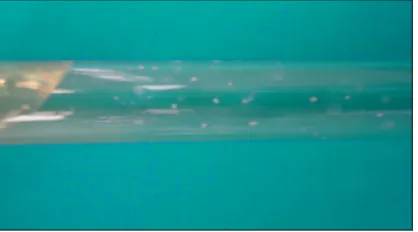
Figure 1. Bacteria colonies in roll tube.
thermo flask that had been pre warmed to a temperature
of 39˚C. Incubation procedure was done by using special
type of calibrated transparent glass syringes with fitted silicon tube. Inoculums (30 ml) containing strained ru-men liquor, buffer and mineral solution under continuous
flushing with CO2 was dispensed using 50 ml plastic
calibrated syringe after which 2 ml of isolates were im-mediately pushed by using another 10 ml syringe. The glass syringe was tapped and pushed upward by the pis-ton in order to completely eliminate air in the inoculums. The silicon tube in the syringe was then tightened by a metal clip so as to prevent escape of gas. Incubation was
carried out at 39˚C ± 1˚C and the volume of gas
produc-tion was measured after 24 hours of incubaproduc-tion. The av-erage of the volume of gas produced from the blanks was deducted from the volume of gas produced per sample against the incubation time.
2.3. Carboxy Methyl Cellulase (CMC) Activity
The pure isolates were also screened for enzymatic ac-tivity. The CMC enzyme activity was determined by measuring the amount of reducing sugar released from carboxymethyl cellulose. The reaction mixture contained 1.0 ml phosphate buffer (0.1 M pH 6.8), 0.5 ml of 1% carboxymethyl cellulose solution prepared in 0.1 M phosphate buffer (pH 6.8), 0.5 ml enzyme and incubated
for 60 minutes at 39˚C. The reaction was halted and
re-ducing sugars were determined by the addition of 3.0 ml of Dinitrosalicylic acid reagent [9]. Glucose was used as standard for determination of reducing sugars. The en-zyme activity is expressed as International Unit (IU) which is micromole of glucose released per ml per hour.
2.4. Total Cellulase Activity by Filter Paper
Microplate-based filter paper assay [10] was con-ducted to measure total cellulose activity. Total cellulose activity is measured by the amount of glucose released from filter paper after two hrs incubation and is referred to as glucose equivalent. One FPU is defined as an aver-age of one micromole of glucose equivalents released per min in the assay reaction.
2.5. DNA Isolation and PCR Amplification
Genomic DNA was extracted from the microbes of five isolates by using the standard kit (Nucleospin soil,
manufactured by Macherey-Nagel GmbH & Co. KG).
TACCTTGACGACTTCACCCC-3’) of bacteria. The
PCR reaction was set up in 20 μl volumes containing 1 μl
template (100 ng/μl), 2 μl 10× buffer, 1.6 μl 25 mM
MgCl2, 1 μl of each primer (10 μM), 0.4 μl of 10 mM
dNTP mix, 0.2 μl Taq DNA polymerase and 12.8 μl
dis-tilled water. The amplification conditions were standard-ized for universal primer. The amplification conditions
were as follows: 3 min of initial denaturation at 95˚C,
followed by 30 cycles of denaturation at 94˚C for 30 sec,
annealing at 60˚C for 30 sec, extension at 72˚C for 2 min with the last cycle followed by a 10 min extension step at 72˚C.
The PCR product was then visualized on an agarose
gel (Figures 2 and 3). The bands were excised and DNA
was purified from the gel slices using the standard kit (NORGEN Biotek Corporation, ON, Canada). The puri-fied PCR product was sent for sequencing. The se-quences were queried online in the NCBI BLAST data-base. The isolates were again confirmed by using the specific primer of bacteria.
2.6. Phylogenetic Analysis
The sequences of the isolates were compared with those available in the database. The reference sequences were downloaded from the nucleotide sequence data-bases and were used in further analysis for comparison. The obtained sequences were aligned using clustal V method of megAlign software (DNASTAR) and then phylogenetic tree was plotted.
3. RESULTS AND DISCUSSION
The isolation was carried out using conventional tech-niques of serial dilutions and repeated tubing of the se-lectively enriched microbial cultures by using the spe-cific media for rumen bacteria. Strict anaerobic condi-tions were maintained during the isolation procedure.
[image:3.595.336.512.373.552.2]L5 L4 L3 L2 L1
Figure 2. Agarose gel electrophoresis
of PCR Products after amplification with Universal Primer (L1: 1 kb DNA Marker, L2-L5: isolates of BF12, BF14, SB13 and CA22).
3.1. In Vitro Gas Production
Four bacterial isolates i.e. BF12, BF14, SB13 and
CA22 were observed in microscope and found to be cocci. On addition of these isolates to the rumen fluid of
cattle, there was increase in gas production (Table 1).
The gas production of isolates after 24 hours incubation varied from 8 to 10.5 ml/ml of isolate, highest in CA22 and lowest in BF14. It was observed that, there were 18.00% to 23.00% increases in gas production indicating release of energy on fibre-based mixed ration. In vitro gas production is the indicator of digestibility and nutri-tive value of feed stuffs [11,12]. Increased gas produc-tion in this experiment indicated that, these isolates may be termed as superior isolates and have potential to be
used as microbial feed additives in ruminants (Table 1).
3.2. Enzymatic Analysis of Isolates
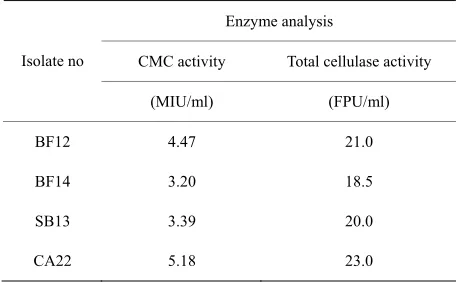
The isolates were subjected to enzymatic analysis like carboxymethyl cellulose (CMC), and total cellulose ac-tivity (filter paper acac-tivity). All the four isolates showed superior fibre degrading activity like CMC, and total cellulose activity, highest in CA22 and lowest in BF14
L3 L2 L1
Figure 3. Agarose gel electrophoresis of PCR
products amplification with specific primers of
[image:3.595.102.242.539.677.2]B. fibrisolvens. L1: 1 kb DNA Marker, L2-L3: B. fibrisolvens isolates (BF12, BF14).
Table 1. In vitro gas production of bacterial isolates.
In vitro gas production
Isolate no Increase in gas production
(ml per 1 ml isolate)
Percentage of increase in gas production (%)
BF12 10.0 22.0
BF14 8.0 18.0
SB13 9.0 20.0
[image:3.595.311.537.626.735.2](Table 2). The in vitro gas productions were in same
order as enzymatic analysis of the isolates.
3.3. Identification of Isolates
For identification of isolates, DNA was isolated from all pure isolates and DNA was found to be sufficient for PCR reaction as quantified by spectrophotometer. The DNA was amplified by universal and specific primers of bacteria and amplification product of required band size
was obtained (Figures 2 and 3). The bands were excised
and purified PCR products were sent for sequencing.
One isolate (BF12) was homologus to Butyrivibrio
fi-brisolvens (Genbank Accession number EU684229) where
as other isolate (BF14) was homologus to Butyrivibrio
fibrisolvens (Genbank accession number EF 427365).
Isolate SB13 was homologus to Streptococcus species
(Genbank Accession number FJ611790)where asisolate
CA22 was homologus to Clostridium aminophilum (Gen-
bank Accession number DQ278862). This indicated that, these isolates have potential to be used as microbial feed additive in ruminant animal for better growth and pro- duction. There is also ample scope in using the enzymes of these bacteria as microbial feed additives.
3.4. Phylogenetic Characterisation
The phylogenetic tree displayed three main groups of
bacteria i.e. Butyrivibrio, Streptococcus and Clostridium
under the phylum Firmicutes (Figure 4). The isolates
BF12 was closely related to Butyrivibrio fibrisolvens
isolated from sheep rumen (Accession no EU684229)
and isolate no BF14 was closely related to Butyrivibrio
fibrisolvens strain of 16S ribosomal RNA gene (Acession
no EF427365). The isolate SB13 was closely related to
Streptococcus equinus isolated from sheep rumen (Aces-
sion no AB563264) and the isolate CA22 was closely
related to Clostridium aminophilum isolated from cow
[image:4.595.57.285.593.734.2]rumen (Accession no DQ278862). This shows that, three bacteria isolated in the present experiment are inhabitant of rumen.
Table 2. Enzymatic analysis of bacterial isolates.
Enzyme analysis
CMC activity Total cellulase activity
Isolate no
(MIU/ml) (FPU/ml)
BF12 4.47 21.0
BF14 3.20 18.5
SB13 3.39 20.0
CA22 5.18 23.0
X89978, B. fibrisolvens BFU77343, B. fibrisolvens AF125217, B. fibrisolvens EU684229, B. fibrisolvens, Sheep AJ270493, B. fibrisolvens
AB003393, Butyrivibrio species, Bovine BF12
EF427365, B. fibrisolvens BF14
DQ278862, Cl aminophilum, cow L04165, clostridium aminophilum
AB563264, Streptococcus equines, sheep CA22
FJ611790, Streptococcus species SB13
Figure 4. Phylogenetic characterization of isolates.
3.5. Potential of Rumen Bacteria as Microbial Feed Additives
Butyrivibrio species is the major cellulose and hemi-cellulose degrading bacteria in the rumen [13] and rap-idly degrade xylan necessary for improving the overall efficiency of livestock production [14]. This may also be used as probiotics for reducing the aberrant crypt foci in the colon and rectum of mice [15]. Butyrivibrio species isolated in this experiment contained higher source of cellulolytic enzyme and in vitro gas production was in-creased on addition of these isolates to the rumen fluid of cattle.
Streptococcusspecies are the predominant cellulolytic
micro-organisms that are associated with the possession of complex cellulose enzyme systems [16,17]. Some strains of streptococcus species are responsible for starch hydrolysis in the rumen [18]. Pulse dosing alone or pulse
dosing with daily feeding of Streptococcus faecium M74
resulted in improved performance of incoming feedlot cattle [19]. Streptococcus species identified in this ex-periment are superior because of higher enzymatic activ-ity and in vitro gas production. It has also been reported
that, Streptococcus equinus are phylogenetically similar
to Streptococcus bovis [20].
Clostridium strain IY-2 isolated from gut content of giant Panda possess cellulase activity towards untreated natural materials such as bamboo fibres, cellulose, rice straw and saw dust and comprises three major cellulases
[21]. Clostridialisolate from swinewere effective in
de-grading cell wall components from grasses [22]. As per
the result of other worker, Clostridium aminophilum pro-
duces ammonia and is responsible for digestion of pro-tein in the feed stuffs [23]. Though effectiveness depends on the strain of microbes, positive results were observed in this experiment.
4. CONCLUSION
fibrisol-[11] Akinfemi, A., Adesanya, A.O. and Aya, V.E. (2009) Use of an in vitro gas production technique to evaluate some Nigerian feedstuffs. American-Eurasian Journal of Sci-entific Research,4, 240-245.
vens, Steptococcus species and Clostridium aminophilus
are superior and may have potential to be used as micro-bial feed additive as a source of micromicro-bial enzymes if fed in higher quantity. However, animal experiments are re-quired to confirm the effectiveness of these three species of microorganism.
[12] Das, K.C., Hundal, J., Mahapatra, P.S., Subudhi, P.K. and Sharma, K. (2010) Chemical composition and in vitro gas
production of fodder tree leaves and shrubs. Indian Vet-erinary Journal, 87, 899-901.
5. ACKNOWLEDGEMENTS
[13] Krause, D.O., McSweeney, C.S. and Forster, R.J. (1999)Molecular ecological methods to study fibrolytic ruminal bacteria: Phylogeny, competition, and persistence. In: Bell, C.R., Brylinsky, M. and Johnson-Green, P., Eds.,
Microbial Biosystems: New Frontiers Proceedings of the
8th International Symposium on Microbial Ecology, At- lantic Canada Society for Microbial Ecology, Halifax, 1999.
We are thankful to lab personnel Dr. Wenju Wan, Mehdi Dashtban, Miranda Maki, Bruce Rosa, Xi Chen and Yuanyuan Hong during the research work at Biorefining Research Initiative and Department of
Biology,Lakehead University, Thunder Bay, Canada for providing help
and cooperation for successful completion of this research work. This work was supported by NSERC-RCD funding of Canada to W. Q. and
Indian Overseas fellowship of DBT to K. C. D. [14] Cotta, M.A. and Zeltwanger, R.L. (1995) Degradation
and utilization of xylan by the ruminal bacteria Butyrivi-brio fibrisolvens and Selenomonas ruminantium. Applied and Environmental Microbiology, 61, 4396-4402.
REFERENCES
[15] Ohkawara, S., Furuya, H., Nagashima, K., Asanuma, N. and Hino, T. (2005) Oral administration of Butyrivibrio fibrisolvens, a butyrate-producing bacterium, decreases
the formation of aberrant crypt foci in the colon and rec-tum of mice. Journal of Nutrition, 135, 2878-2883.
[1] Kamra, D.N. (2005) Rumen microbial ecosystem. Cur-rent Science, 89, 124-135.
[2] An, D.D., Dong, X.Z. and Dong, Z.Y. (2005) Prokaryote diversity in the rumen of yak (Bos grunniens) and Jinnan
cattle (Bos taurus) estimated by 16S rDNA homology
analyses. Anaerobe, 11, 207-215.
doi:10.1016/j.anaerobe.2005.02.001
[16] Schwarz, W.H. (2001) The cellulosome and cellulose degradation by anaerobic bacteria. Applied Microbiology & Biotechnology, 56, 634-649.
doi:10.1007/s002530100710
[3] Mamen, D., Vadivel, V., Pugalenthi, M. and Parimelaz-hagan, T. (2010) Evaluation of fibrolytic activity of two different anaerobic rumen fungal isolates for their utiliza- tion as microbial feed additive. Animal Nutrition and Feed Technology,10, 37-49.
[17] Oyeleke, S.B. and Okusanmi, T.A. (2008) Isolation and characterization of cellulose hydrolyzing microorganism from the rumen of ruminants. African Journal of Bio-technology,7, 1503-1504.
[4] Allison, M.J., Mayberry, W.R., McSweeney, C.S. and Stahl, D.A. (1992) Synergistes jonesii, gen. nov., sp.nov:
A rumen bacterium that degrades toxic pyridinediols.
Systematic and Applied Microbiology, 15, 522-529.
doi:10.1016/S0723-2020(11)80111-6
[18] Dunican, L.K. and Seeley, H.W. (1962) Starch hydrolysis by Streptococcus equinus. Journal of Bacteriology, 83, 264-269. http://www.ncbi.nlm.nih.gov/pubmed/13888473
[19] Lee, R.W. and Botts, R.L. (1988) Evaluation of a single oral dosing and continuous feeding of Streptococcus fae-cium M74 (Syntabac) on the performance of incoming
feedlot cattle. Journal of Animal Science, 66, 460. [5] Robinson, J.A., Smolenski, W.J., Greening, R.C., Ogilvie,
M.L., Bell, R.L., Barsuhn, K. and Peters, J.P. (1992) Pre-vention ofacute acidosis and enhancement of feed intake
in the bovine by Megasphaera elsdenii 407A. Journal of Animal Science, 70,310 (Abstract).
[20] Saitou, N. and Nei, M. (1987) The neighbor-joining method: A new method for reconstructing phylogenetic trees. Molecular Biology and Evolution, 4, 406-425. [6] Anonymous (2011) Cow rumen enzymes for better
biofu-els. Science Daily, 2011. [21] Yu, I.K. (1996) Secretion of Clostridium cellulase by E. coli. United States Patent 5496725.
[7] Yang, W.Z., Beauchemin, K.A. and Rode, L.M. (2000) A comparison of methods of adding fibrolytic enzymes to lactating cow diets. Journal of Dairy Science, 83, 2512-
2520. doi:10.3168/jds.S0022-0302(00)75143-5
[22] Varel, V.H. and Pond, W.G. (1992) Characteristics of a new cellulolytic Clostridium sp. isolated from pig
intes-tinal tract. Applied and Environmental Microbiology, 58,
1645-1649. [8] Menke, H.H. and Steingass, H. (1988) Estimation of the
energetic feed value obtained from chemical analysis and
in vitro gas production using rumen fluid. Animal Re-search and Development, 28, 7-55.
[23] Atiwood, G.T., Reilly, K. and Patel, B.K.C. (1996) Clos-tridium proteoclasticum sp.nov., a novel proteolytic
bac-terium from the bovine rumen. International Journal of Systematic Bacteriology,46, 753-758.
doi:/10.1099/00207713-46-3-753
[9] Miller, G.L. (1959) Use of dinitrosalicylic acid reagent for determination of reducing sugar. Analytical Chemistry,31,
426-428. doi:10.1021/ac60147a030
[10] Xiao, Z., Storms, R. and Tsang, A. (2004) Microplate- based filter paper assay to measure total cellulose activity.