IJEDR1704167
International Journal of Engineering Development and Research (
www.ijedr.org
)
1035
Direct Synthesis Based Controller Design for
Interacting Process Using ETF
R.Sandeep 1,R.Kiranmayi2, K.Nagabhushanam3
1Student, Dept. of Electrical &Electronics Engineering, JNTUACEA, Anantapuramu, A.P., India. 2Professor, dept. Of Electrical &Electronics Engineering, JNTUACEA, Anantapuramu, A.P., India.
3Lecturer, dept. Of Electrical &Electronics Engineering, JNTUACEA, Anantapuramu, A.P., India
________________________________________________________________________________________________________
Abstract: A scheme for designing controller for multi-input multi-output systems with associating interactions from other loops using equivalent transfer function (ETF) is presented in this paper. Differing from customary existing techniques for deriving Equivalent transfer function here the Equivalent transfer function is directly assessed by exploiting the relationship between the equivalent closed-loop transfer function and inverse of open-loop transfer function. Based on the derived transfer function centralized and decentralized controllers are composed utilizing the existing tuning rules and simple Direct synthesis control method. Simulation examples are considered to illustrate the better control performance of a system with centralized controllers over decentralized controllers.
Index Terms: Interactions, ETF, centralized and decentralized controller.
________________________________________________________________________________________________________
I.INTRODUCTION
Due to the demand of high product quality and energy integration, most modern industrial processes take the form of multi-input multi-output systems. The PID control is still widely used method for controlling the MIMO systems because of its adequacy and moderately basic structure contrasted with other cofounded strategies. Be that as it may, because of interactions associated among control loops, MIMO systems are generously harder to control compared to single input single output systems.
Therefore, a lot of research has been made to successfully consider loop interactions into account while deriving equivalent SISO systems from MIMO systems [1]. Numerous control design methods have been outlined, which includes the detuning method [2, 3], sequential loop closing method [4, 5], independent design method [6, 7] ,and so on. Another way to deal with this problem and for utilization of single input single output system Huang et al. proposed equivalent transfer function strategy by building closely related process transfer function for each loop.
In detuning strategy, at first every individual controller is composed using Z-N tuning rules without managing process interactions from different loops. At that point, the interactions are considered by detuning each controller until the point when the moment that multivariable Nyquist stability is satisfied. Yet, burden of this strategy is that the controller settings are impervious to change.
In Sequential loop closing system, every controller is tuned successively. At first the controller of speediest loop is tuned by considering a picked input-output combination; this loop is then shut and after that the controller of the slowest loop is tuned for a next match while the main loop staying shut and so on. In independent loop technique, every controller is independently composed based closed and open loop transfer functions, fulfilling the disparity constraints on process interactions. A noteworthy inconvenience of independent loop technique is that it doesn't exploit the data with respect to controllers in different loops. The potential bother engaged with above procedures is that controllers of each loop communicate with different loops, the execution of one loop can't be accessed without data of controllers in different loop.
To solve this issue, a few approaches by developing equivalent individual loop have been proposed. The successful open loop transfer function is formulated without earlier data of controller progression of different loops. Additionally, the compelling open-loop transfer function work is inferred to separate multi-loop control system into an arrangement of proportionate independent single loop systems, at this point decentralized controllers are composed independently in view of the comparable open-loop transfer function model. The ETF is acquired by increasing original transfer function by multiplicative model factor inside the neighborhood of individual control loop critical frequency.
In this paper, a novel unified PI controller outline strategy for multivariable processes is proposed. By utilization of the relationship in between the inverse of open-loop transfer function and equivalent closed loop transfer function
the articulation of ETF model is made. On the basis of designed ETF, multi-loop PI controllers are composed utilizing DS control technique. Especially, this ETF strategy is more advantageous for higher dimensional processes with entangled interactions nodes compared with other already available methodologies. The proposed technique is checked utilizing cases deliberately to exhibit the suitability and viability of proposed strategy.
IJEDR1704167
International Journal of Engineering Development and Research (
www.ijedr.org
)
1036
Consider an n * n open-loop stable multivariable system as shown in Fig. 1, where ri,,ui, ei and yi , i 1, 2,..., n are the reference inputs,manipulated variables, error and outputs of system, respectively; Gc(s)is the controller to be foundand G(s) is the process transfer function matrix, both of which are given by
G(s) =
(1)
Fig. 1. Multi-loop control system and independent SISO system
As portrayed in Fig. 1, designing a multi-loop controller is breakdown to design of controller for equivalent single input and single output system. When entire system is closed, there are interactions among control loops due to the presence of elements other than diagonal elements in the transfer function. Considering the influence of other loops, the equivalent transfer functions can be compactly given in terms of Dynamic relative gain array (DRGA) , as follows[11]
𝐺̂(𝑠) = [𝐺(𝑠)]−𝑇 (2)
And 𝐺̂(𝑠) is
(3) Note that the Equivalent transfer function (ETF) of each loop comprise of process dynamics terms only and they do not have knowledge of controller parameters under the assumption of perfect control estimate.
DERIVATION OF ETF:
As seen from equation (2), we got fundamental relationship between ETF and G–T(s). The equivalent transfer function can be derived as follows by utilizing the steady and transient information of given processes,
Considering the first order plus time delay model.
g(s) =𝑘𝑒−𝜃𝑠
𝜏𝑠+1 (4)
From (2) and (4) , The equivalent transfer function for each loop is derived as
𝜏𝑠+1
𝑘 𝑒
−𝜃𝑖∗𝑠 = 𝑎𝑑𝑗 𝐺𝑖𝑖
|𝐺| (5)
Where |𝐺|the determinant of G, and adj is𝐺𝑖𝑖(𝑠) is the adjugate matrix corresponding to 𝐺𝑖𝑖(𝑠)
Taking double derivative on both sides of equation (5) and letting s = 0 gives the parameters of the first order plus time delay model and they are given as:
𝑘𝑖= 1 𝑎𝑖𝑖
𝜏𝑖=√(𝑏𝑎𝑖𝑖
𝑖𝑖)
2− (𝑐𝑖𝑖
IJEDR1704167
International Journal of Engineering Development and Research (
www.ijedr.org
)
1037
𝜃𝑖𝑖= 𝑏𝑖𝑖 𝑎𝑖𝑖 -√( 𝑏𝑖𝑖 𝑎𝑖𝑖) 2− (𝑐𝑖𝑖𝑎𝑖𝑖) = 𝑏𝑖𝑖
𝑎𝑖𝑖 - 𝜏𝑖 𝑎𝑖𝑖 =
𝑎𝑑𝑗 𝑘𝑖𝑖
|𝑘| at s=0 (6) 𝑏𝑖𝑖= −
1
|𝑘|2 ∑𝑝=1𝑛 [∑𝑞=1𝑛 (𝑎𝑑𝑗 𝐾𝑖𝑞)𝑔𝑞𝑝` ]𝑎𝑑𝑗 𝑘𝑝𝑖 at s=0 (7)
(7)
𝑐𝑖𝑖= |𝑘|13 ∑𝑚=1𝑛 [∑𝑙=1𝑛 [∑𝑝=1𝑛 [∑𝑞=1𝑛 (𝑎𝑑𝑗 𝐾𝑖𝑞)𝑔𝑞𝑝` ]]𝑔𝑙𝑚` ] 𝑎𝑑𝑗 𝐾𝑚𝑖− 1
|𝑘|2 ∑ [∑ (𝑎𝑑𝑗 𝐾𝑖𝑞)𝑔𝑞𝑝
`` 𝑛
𝑞=1 ]
𝑛
𝑝=1 𝑎𝑑𝑗 𝑘𝑝𝑖 at s=0 (8)
In order for the resulting FOPTD ETF model to be realizable, 𝜏𝑖 and 𝜃𝑖 should be real and positive.
Therefore from equations (6) – (8) following conditions must be satisfied
(𝑏𝑖𝑖
𝑎𝑖𝑖) 2
> 𝑐𝑖𝑖
𝑎𝑖𝑖> 0 (9)
III. DESIGN OF DS CONTROLLER FOR MULTIVARIABLE PROCESS
As equivalent transfer functions now contains information of loop interactions, the complex multivariable process can be down converted to set of single input single output (SISO) process and then controllers can be designed using Direct synthesis method [15] to stabilize these SISO loops independently.
Direct synthesis method is based on a desired form system response and then finding controller strategy and parameters to give that response.
Fig.2: Block diagram for unity feedback system A unity feedback system is illustrated in Fig .2
For the feedback control above the closed loop transfer functions between the output and set point are
𝑌` 𝑌𝑠𝑝 ̅̅̅̅̅ ̅̅̅̅
= 𝐺𝑐∗𝐺𝑝
1+𝐺𝑐∗𝐺𝑝 (10)
Where 𝐺𝑐∗ 𝐺𝑝the loop gain one. A more viable response would be: 𝑌`
𝑌𝑠𝑝 ̅̅̅̅̅=
𝑒−𝑑𝑠
𝜆𝑠+1 (11)
Where λ and d are adjustable parameters to satisfy performance and implementation requirement, respectively. By substituting Eq. (11) in (10) we get
𝐺𝑐= [ 𝑌` 𝑌𝑠𝑝 ̅̅̅̅̅ ̅̅̅̅
] ∗ 𝐶 (12)
Where C= 1
1−𝑒−𝑑𝑠𝜆𝑠+1
(13) Which can be implemented as by the unit shown in Fig.3
Fig.3. Feedback control unit
to convert the DS controller to PI controller we have to expand the 𝐺𝑐 in Maclaurine series as follows
𝐺𝑐 =f(s)/s=1
𝑠[𝑓(0) + 𝑓
`(0)𝑠 + ℎ𝑜𝑑 𝑡𝑒𝑟𝑚𝑠] (14)
Expanding 𝐺𝑐in frequency domain and neglecting higher order terms gives
𝑔𝑐 = 𝑘𝑐(1+ (1/𝜏𝑙𝑖s)) (15)
Comparing (15) and (16) we get controller parameters as
𝑘𝑐 = 𝑓`(0). (16) 𝜏𝑙𝑖 =
𝑓(0)
𝑓`(0). (17)
If the equivalent transfer function has a strong lead term, the derivative and integral constants calculated using (16, 17) may have negative values. Under the said conditions, a controller with first order lag filter structure is recommended.
IJEDR1704167
International Journal of Engineering Development and Research (
www.ijedr.org
)
1038
Generally for detailed analysis and comparison with other existing methods integral absolute error and integral time absolute error criterions are considered.
IAE criterion is considered for evaluation of closed loop systems, which is defined as:
IAE=∫ |𝑒(𝑡)| 𝑑𝑡0∞ (18) Where e (t) is r (t)-y (t)
Secondly, ITAE criterion to evaluate performance over long period of time.
ITAE = ∫ |𝑒(𝑡)|𝑡 𝑑𝑡0∞ (19)
At last, to investigate the robustness [16, 17] of came about control system, a robust technique is utilized for a reasonable examination with other existing strategies. The robustness can be researched under output multiplicative uncertainty as it is regularly less prohibitive than input uncertainty regarding execution. For a framework with yield vulnerability as [I+∆(s)] G(s), the closed loop is steady if
ϒ < 1/max (sigma(Y(s)/U(s)))
(20)
ϒ represents degree of robust stability which is double norm of ∆(𝑗𝑤), where ∆(𝑗𝑤)represents multiplicative output uncertainty. For a reasonable correlation ϒ esteem ought to be the same as or bigger than that of other reenactment strategies.
V. Simulation studies
Example 2.The distillation column of ISP reactor was quoted to verify performance of proposed equivalent transfer function method.
G(s)=[
22.89∗𝑒−0.2𝑠 4.572𝑠+1
−11.64∗𝑒−0.4𝑠 1.807𝑠+1 4.689∗𝑒−0.2𝑠
2.174𝑠+1
5.8∗𝑒−0.4𝑠 1.801𝑠+1
]. The SOPTD model with a lead term is considered.
We get equivalent transfer functions as below g11eff = 32.3∗(2.878∗𝑠+1)𝑒−0.2𝑠
9.972𝑠2+6.753∗𝑠+1 . , g12eff = −
39.9535∗(2.8757∗𝑠+1)𝑒−0.4𝑠
8.2562𝑠2+6.3779𝑠+1 .
g21eff = 16.09437∗(2.8755∗𝑠+1)𝑒−0.2𝑠
9.9313𝑠2+6.744𝑠+1 . , g22eff =
8.18∗(2.876∗𝑠+1)𝑒−0.4𝑠
3.925𝑠2+3.98𝑠+1 .
Loop pairing technique for decentralized controller is 1-1/2-2 [8].Robustness index ϒ is 0.59.
Implementation of Decentralized Control system:
The decentralized two input two output system can be implemented as follows.
Fig.4. Implementation of Decentralized controller for TITO process
𝐺𝑒𝑓𝑓(𝑠) = [
32.3∗(2.878𝑠+1)𝑒−0.2𝑠
9.972𝑠2+6.753∗𝑠+1 0
0 8.18∗(2.876𝑠+1)𝑒−0.4𝑠
3.925𝑠2+3.98𝑠+1
]
IJEDR1704167
International Journal of Engineering Development and Research (
www.ijedr.org
)
1039
𝐺𝑐11= [(9.972𝑠2+6.753𝑠+1)(1−0.2𝑠)𝑠(15.80𝑠2+98.47𝑠+32.3003)] . , 𝐺𝑐22= [
(3.925𝑠2+3.98𝑠+1)(1−0.2𝑠)
𝑠(15.80𝑠2+98.47𝑠+32.3003)] .
Implementation of centralized Control system:
The centralized two input two output system can be implemented as shown in Fig.5.
Fig.5. Implementation of centralized controller for TITO process
𝐺𝑒𝑓𝑓(𝑠) =
[
32.3∗(2.878𝑠+1)𝑒−0.2𝑠
9.972𝑠2+6.753∗𝑠+1 −
39.953∗(2.8757𝑠+1)𝑒−0.4𝑠
8.2562𝑠2+6.3779𝑠+1
16.0947∗(2.875𝑠+1)𝑒−0.2𝑠 9.9313𝑠2+6.744𝑠+1
8.18∗(2.876𝑠+1)𝑒−0.4𝑠 3.925𝑠2+3.98𝑠+1
].
Direct synthesis based centralized controllers are derived using equations (12) and (13) as follows Gc=
[
0.031 ∗ (9.972𝑠2+ 6.753𝑠 + 1)𝑒−0.2𝑠∗ 𝑐1 2.446𝑠2+ 3.728𝑠 + 1
0.062 ∗ (9.9313𝑠2+ 6.744𝑠 + 1)𝑒−0.2𝑠∗ 𝑐2 3.45𝑠2+ 4.075𝑠 + 1
−0.025(8.2562𝑠2+ 6.3779𝑠 + 1) ∗ 𝑐1 2.44 ∗ 𝑠2+ 3.725𝑠 + 1
0.122 ∗ (3.925𝑠2+ 3.98𝑠 + 1) ∗ 𝑐2
3.45 ∗ 𝑠2+ 4.076𝑠 + 1 ]
Where c1 = 1
1− 𝑒−0.4𝑠
0.85𝑠+1
, c2= 1
1− 𝑒−0.4𝑠
1.2𝑠+1 .
IJEDR1704167
International Journal of Engineering Development and Research (
www.ijedr.org
)
1040
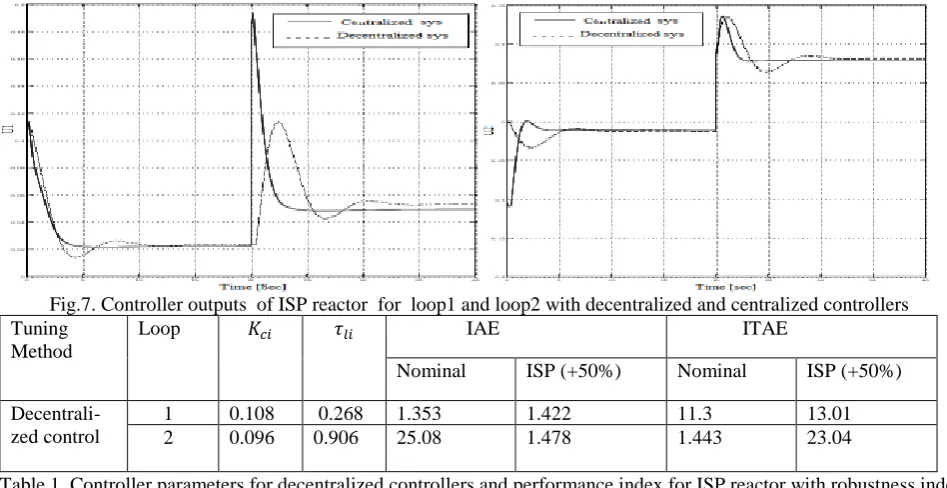
Fig.7. Controller outputs of ISP reactor for loop1 and loop2 with decentralized and centralized controllers Tuning
Method
Loop 𝐾𝑐𝑖 𝜏𝑙𝑖 IAE ITAE
Nominal ISP (+50%) Nominal ISP (+50%)
Decentrali-zed control
1 0.108 0.268 1.353 1.422 11.3 13.01
2 0.096 0.906 25.08 1.478 1.443 23.04
Table 1. Controller parameters for decentralized controllers and performance index for ISP reactor with robustness index
λ𝑖=0.85. +50 % indicate plant model uncertainty.
Tuning Method
Loop J=1 J=2 IAE ITAE
𝐾𝑐𝑖 𝜏𝑙𝑖 𝐾𝑐𝑖 𝜏𝑙𝑖 Nominal ISP
(+50%)
Nominal ISP (+50%) Centraliz
ed control
1 0.108 0.268 0.162 0.271 3.748 2.457 52.55 29.4
2 -0.16 0.125 0.096 0.906 2.522 1.878 45.82 34.09
IJEDR1704167
International Journal of Engineering Development and Research (
www.ijedr.org
)
1041
Example2: Consider a 3*3 transfer function matrix [14].
G(s)=
[ 𝑒−0.1𝑠 𝑠2+2𝑠+1
0.3𝑒−0.1𝑠 2𝑠2+3𝑠+1
0.3𝑒−0.1𝑠 2𝑠2+3𝑠+1
0.3𝑒−0.1𝑠
2𝑠2+3𝑠+1
𝑒−0.1𝑠
𝑠2+2𝑠+1
0.3𝑒−0.1𝑠
2𝑠2+3𝑠+1
0.3𝑒−0.1𝑠 2𝑠2+3𝑠+1
0.3𝑒−0.1𝑠 2𝑠2+3𝑠+1
𝑒−0.1𝑠 𝑠2+2𝑠+1]
We get equivalent transfer functions as below
𝑔𝑖𝑗(𝑖=𝑗),𝑒𝑓𝑓=
0.86153∗𝑒−0.582𝑠
1.258∗𝑠+1 . , 𝑔𝑖𝑗(𝑖≠𝑗),𝑒𝑓𝑓 =
−3.7335∗(2.227∗𝑠+1)𝑒−0.576𝑠
2.155𝑠2+2.792𝑠+1
Where i=1, 2, 3 j=1, 2, 3 ,Loop pairing is 1-1/2-2 [8],Robustness index ϒ is 0.85.
Implementation of Decentralized Control system:
𝑔𝑐,𝑖𝑗(𝑖=𝑗)= [
(1.258𝑠+1)
𝑠∗0.8615∗(1.08)]
Direct synthesis based decentralized controller
are derived using equations (12) and (13) are as follows:
𝑔𝑐11= 𝑔𝑐22 = 𝑔𝑐33 = [
(1.258𝑠+1)
𝑠∗0.8615∗(1.08)] .
The Decentralized three input three output System can be implemented as follows
Fig: 8.Implementation of Decentralized controller for Three input three output process
Implementation of centralized Control system:The centralized two input two output systemCan be implemented as shown in Fig.9
𝑔𝑐,𝑖𝑗(𝑖=𝑗)= [
(1.258𝑠+1)
𝑠∗0.8615∗(1.08)] ,𝑔𝑐,𝑖𝑗(𝑖≠𝑗) =[
(2.155𝑠2+2.792∗𝑠+1)𝑒−0.526𝑠
−3.733𝑠(2.227𝑠+1)(1.08𝑠) ]
IJEDR1704167
International Journal of Engineering Development and Research (
www.ijedr.org
)
1042
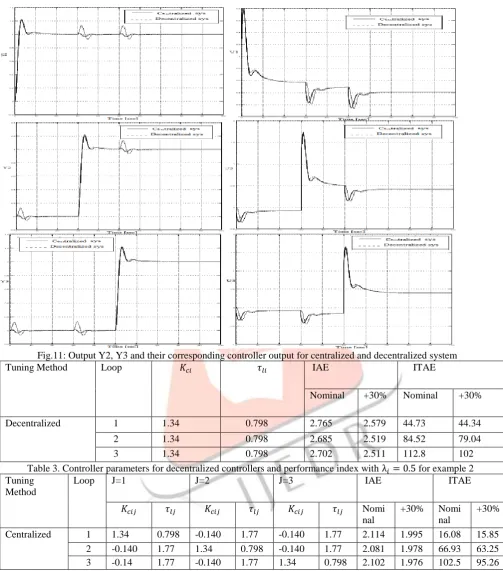
Fig.11: Output Y2, Y3 and their corresponding controller output for centralized and decentralized system
Tuning Method Loop 𝐾𝑐𝑖 𝜏𝑙𝑖 IAE ITAE
Nominal +30% Nominal +30%
Decentralized 1 1.34 0.798 2.765 2.579 44.73 44.34
2 1.34 0.798 2.685 2.519 84.52 79.04
3 1.34 0.798 2.702 2.511 112.8 102
Table 3. Controller parameters for decentralized controllers and performance index with λ𝑖= 0.5 for example 2
Tuning Method
Loop J=1 J=2 J=3 IAE ITAE
𝐾𝑐𝑖𝑗 𝜏𝑙𝑗 𝐾𝑐𝑖𝑗 𝜏𝑙𝑗 𝐾𝑐𝑖𝑗 𝜏𝑙𝑗 Nomi
nal
+30% Nomi
nal
+30% Centralized 1 1.34 0.798 -0.140 1.77 -0.140 1.77 2.114 1.995 16.08 15.85 2 -0.140 1.77 1.34 0.798 -0.140 1.77 2.081 1.978 66.93 63.25 3 -0.14 1.77 -0.140 1.77 1.34 0.798 2.102 1.976 102.5 95.26 Table 4. Controller parameters for centralized controllers and performance index with λ11= λ22= 0.5 for example 2, +30 %
indicate plant model uncertainty.
It is clear from the response of example 1 and example 2 that interactions of one loop over other loops can be minimized by using centralized controllers than decentralized controllers.
VI. Conclusion
A ETF based controller design has been developed in this project. The analytical expression of equivalent transfer function is derived based on relationship between closed-loop and inverse of open-loop transfer function. Simulation results for typical industrial processes with decentralized and centralized controllers shows that the centralized controllers provides better or compatible performance compared to decentralized controller. A conceivable heading for future work is the expansion of the ETF technique to non – square multivariable systems.
REFRENCES
IJEDR1704167
International Journal of Engineering Development and Research (
www.ijedr.org
)
1043
[2] D. Chen and D .E. Seborg, “Design of decentralized PI control systems based on Nyquist stability analysis,” Journal of Process Control, vol.13, no.1, pp. 27-29, 2003.
[3] T. J. Monica, C. C. Yu, and W. L. Luyben, “Improved multiloop single-input/single-output (SISO) controllers for multivariable processes, “ Ind. Eng. Chem. Res., vol.27, no.6, pp. 654-660, 1986
[4] W. L. Luyben, “simple method for tuning SISO controllers in multivariable systems,” Ind. Eng. Chem. Process Des. Dev., vol. 25, no. 3, pp. 654-660, 1986
[5] M. Hovd and S. Skogestad, “Sequential design of decentralized controllers,” Automatica, vol. 30, no.10, pp. 1601-1607, 1994. [6] S. J. Shiu and S. H. Hwang, “ Sequential design method for multivariable decoupling and multiloop PID controllers,” Ind. Eng. Chem. Res., vol.37, no.1, pp. 107-119, 1998
[7] M. Hovd and S. Skogestad, “Improved independent design of robust decentralized controllers, “Journal of Process Control, vol. 3, no .1, pp.43-51, 1993.
[8] Q. Xiong and W. J. Cai. “Effective transfer function method for decentralized control system design of multi-input multi-output processes.” Journal of Process Control. Vol. 16 .no. 8, pp. 773-784, 2006.
[9] W. Hu, W. J. Cai, and G. Xiao, “Decentralized control system design for MIMO processes with integrator/differentiators,” Ind. Eng. Chem. Res., vol.49, no.24, pp.12521-2528, 2010.
[10] N. Naini, M. Fatehi, and A. Sedigh, “Input-Output pairing using effective relative energy array,” Ind. Eng. Chem. Res., vol. 48,no. 15,pp. 7137-7144, 2009.
[11] T. N. L. Vu and M. Lee, “Independent design of multi-loop PI/PID controllers for interacting multivariable processes,” Journal of Process Control, vol. 20, no. 8, pp. 922-933, 2010.
[12] Q. Xiong and W. J. Cai., “Effective transfer function method for decentralized control system design of input multi-output processes,” Journal of Process Control, vol. 16, no. 8, pp. 773-784, 2006.
[13] T. N. L. Vu and M. Lee, “Multi-loop PI controller design based on direct synthesis for interacting multi-time delay processes,” ISA Transactions, vol.49, no. 1 , pp. 79-86, 2010.
[14] Rajapandyan C, Chidambaram M. Closed-loop identification of second-order plus time delay (SOPTD) model of multivariable systems by optimization method. Ind Eng Chem Res 2012; 51(28): 9620-33.
[15]Kumar VV.Rao VSR.Chidambaram M. Centralized PI controllers for interacting multivariable processes by synthesis method. ISA Transactions 2012; 51(3); 400-9.