Part I –What Is a Virus?
“I can’t believe I’m a college sophomore,” thought Terry in amazement while taking the train back home for the summer. “Th e school year went by so fast, but I made it through even though I had to change my major.”
A text popped up on Terry’s smartphone, “Terry, when r u going on ur trip? Let’s meet up before u go.” Terry recognized that the message was from Alex, a long-time friend from high school. “Leaving in a week,” Terry quickly texted back. “Never been on a trip outside of the US and can’t wait to work with doctors and nurses to help sick people. Alex, let’s meet up Fri.”
After a week of seeing family and friends, Terry was off to the west coast of Africa for ten weeks. Th is would be a life-changing experience. Th e agency placed Terry in a rural site where residents had limited access to medical care. Th e locals sometimes traveled miles to be seen at their clinic. Th e health care professionals on the team were unbelievably positive and devoted to educating and providing patients with the best care possible. Residents came in with many types of ailments. Terry’s responsibilities included greeting patients and their families, bandaging wounds, and providing additional assistance to doctors and nurses as needed.
Just like the school year, the summer experience seemed as though it was over in no time. Terry was about to return home when unexpected news came. Terry’s team was contacted by the Centers for Disease Control and Prevention (CDC) and notifi ed that they had likely been exposed to a patient infected with the Ebola virus as there was an outbreak near the medical relief site. Th e patient who had contracted the virus had died. Struck with fear, Terry quickly tried to determine which patient it could have been and her likelihood of being infected, but she found this nearly impossible to fi gure out. As a precaution, all individuals on the team returning to the US had to be screened and undergo a 21-day quarantine where they would be monitored for any Ebola-like symptoms. Not doing so could potentially place others at risk for contracting this deadly virus.
“I need to fi nd out more about viruses so that I can understand what’s going on,” thought Terry as she reached for her general biology textbook. Glancing through the section on virology, she was surprised to discover that viruses are tiny particles considered to be non-living since they cannot metabolize energy, do not create waste, do not grow, and
General Edition
General Edition
by
Tracie M. Addy, Yale School of Medicine Teaching and Learning Center, Yale University
Linda M. Iadarola , Department of Biological Sciences, Quinnipiac University
Derek Dube, Department of Biology, University of Saint Joseph
The Ebola Wars
The Ebola Wars
In every battle therecomes a time when both sides consider themselves beaten, then he who continues the attack
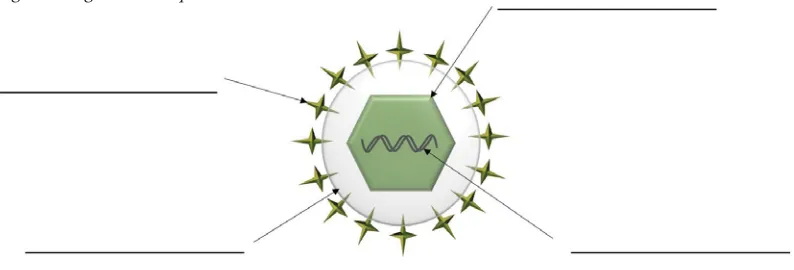
Viruses have either a DNA or RNA genome, which can be single- or double-stranded. Th ese genomes are housed in a capsid made of proteins. Viruses can be classifi ed by their specifi c genomes and the unique features of their capsids, including shape and protein constituents. Some viruses have lipid envelopes derived from host membranes that enclose the virus particle, while others do not. Surface glycoproteins on these membranes, or spike proteins protruding from the viral capsid in non-enveloped viruses, can play a role in viral attachment and entry into the host cell.
Terry spent the next few minutes summarizing the information she had just read.
Questions
1. Which structural features are in common to all viruses, and which are not? Complete the table below to answer this question based upon the information provided in the case.
Shared Attributes Diff erences
2. Why are viruses considered parasites?
3. Examine the diagram of the viral particle below. Label all of the important structures on this virus that you identifi ed in the table above.
4. Design an imaginary viral particle. Create a diagram of your virus and label its major features. Your virus should have a diff erent capsid shape (e.g., icosahedral, helical, complex) than the one above and be non-enveloped.
Part II – How Could a Virus Have Entered?
Terry considered what she had learned so far. “So the Ebola virus could be inside my cells? But how? How exactly could a virus get inside? It seems to start at the plasma membrane... I’d better keep reading.”
In the fi rst step of infection, viral proteins interact specifi cally with host cells. Diff erent viruses like infl uenza, rabies and even Ebola each have unique glycoproteins on their surface that bind only to specifi c receptors on the particular host cells they infect. For example, the infl uenza virus uses the HA (hemagglutinin) protein for binding to the host cell receptors on respiratory epithelial cells. A rabies virus relies on the G protein protruding out of its viral envelope to attach to the host cell receptors of neurons. Ebola virus uses GP to bind to the host cell receptors on a wide variety of cells, beginning with the macrophages and dendritic cells of the lymphatic system. Once viruses attach to the host cell in this very specifi c manner, there are three major ways for them to complete the second stage of infection, entry into the host cell. Th e fi rst is by direct injection of its genome (DNA or RNA) into the host cell at the cell surface. Th e second is the binding of the virus to the plasma membrane, followed by the fusion of the viral envelope with the host membrane to transfer the viral genome (DNA or RNA) into the host cell. Th e third way is for the virus to bind to the host cell membrane and become internalized into the host cell via the endocytic pathway.
“Th is is very strange,” she thought.
Questions
1. Why is viral attachment to the host cell specifi c between one virus and one type of cell?
2. List several types of host cells and the associated virus that binds to the host cell.
3. What are three major ways in which a virus enters a host cell to deliver its genome?
Part III – The Battle between Viruses and Cells
“Now if the virus and its genetic material have gotten inside of my cells, what happens next?” Determined to fi nd out, Terry read further and paraphrased the text.
“Th e next step is viral synthesis. So, it looks like once the virus enters my cells it hijacks the cell machinery including many of my cells’ enzymes and ribosomes normally used to make my own proteins. Th e virus does not have these proteins and structures so it relies heavily on the host cell to do the work for it. Th is process involves not only replication of the genome, but also transcription of viral genes and translation of viral proteins. I remember learning about transcription and translation in biology class. Now this is starting to come together. Still, this really bothers me to think that the Ebola virus could be in my cells doing all this crazy stuff .
“So after viral synthesis comes viral assembly. Th is step sounds a lot like a factory, because the viral proteins and genomes are put together to make complete viral particles. But then they still have to get out of the cells ... .
“Ah, I see, this step is called viral release and can diff er between viruses. Some viruses with envelopes bud from the host cell, taking pieces of the host cell membrane with viral proteins incorporated within, while others leave by exocytosis in vesicles that bud from the endoplasmic reticulum or Golgi. Viruses without envelopes lyse (break open) the host cell and leave that way, often killing the cell in the process.”
“It’s almost like a battle between the virus and my cells. Th ese viruses invade the cell to take over, and the cell doesn’t even know it right away! Th en a whole army of new viruses leave the cell and go out to invade and do battle with all my other nearby cells.”
Questions
1. Describe the essential cell “machinery” that viruses use to make a new virus.
2. Why do viruses need the machinery to make more viruses? Why can’t they replicate on their own?
3. What are the structures that need to be put together during viral assembly? Consider the key structural components of viruses described earlier.
5. Examine the diagram below depicting viral infection of a typical cell.
a. Identify all (fi ve) of the steps used by viruses to get into the cell, make copies of viral proteins and leave the cell as an army of viruses out to attack nearby cells.
i. __________________________
ii. __________________________
iii. __________________________
iv. __________________________
v. __________________________
b. Label the two cellular components indicated on the diagram.
Part IV – The Ebola Wars
In the middle of searching for more information on the Ebola virus, Terry began to feel gravely ill. Feverish, achy, nauseated and weak, Terry’s worst fears came true—the symptoms were consistent with an Ebola virus infection. While she now knew that Ebola virus could not be transmitted through the air, she recalled that during her trip to West Africa she had a small cut on her hand while she was bandaging a patient who had high fever and was hemorrhaging. Th e exchanged fl uid may have contained Ebola virus particles that infected Terry’s cells. After fi ve days of illness including repeated vomiting and extreme pain, Terry wondered if this was the end. A decision was made to transport Terry to a special facility for treatment and isolation.
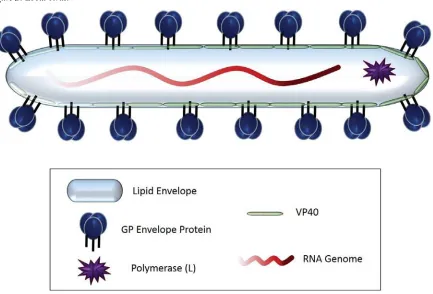
Ebola is an enveloped, single-stranded RNA virus with a capsid and matrix made of VP40 and other viral proteins. Ebola packages its own RNA-dependent RNA polymerase (L) (see Figure 3). Like many viruses, Ebola goes through
the processes of viral attachment, entry, synthesis, assembly and release. Recall that the Ebola virus has the protein GP on its surface, which is required for attachment and entry to the host cell.
Once the virus attaches to the host cell, a series of events through the endocytic pathway leads to its entry into the cell. Th is means the virus comes into the cell enclosed in a vesicle from the plasma membrane and gets delivered to endosomes. Inside the endosome, the virus relies on the low pH to modify GP and help it fuse with the membrane of the endosome. Once the viral genome is inside the cell cytoplasm, viral synthesis can begin, including genome
at the cell’s plasma membrane and acquire GP proteins that are already inserted in the host cell membrane. At this point, the complete viruses can bud from the cell to spread the infection.
Th is very battle was occurring between Terry’s cells and the Ebola virus.
Questions
1. Examine the diagram (Figure 4, next page) showing the life cycle of the Ebola virus.
a. Label the fi ve major steps used by Ebola virus to infect cells. In what specifi c ways are these similar or diff erent from those you labeled in the general virus life cycle?
i. __________________________
ii. __________________________
iii. __________________________
iv. __________________________
v. __________________________
Key similarities and diff erences:
b. Label the key viral and cellular factors in the indicated areas of the diagram. Describe each of their roles.
2. Formulate a hypothesis as to what would happen to viral replication and budding from the cell if the ribosomes did not make VP40.
Part V – Treatment
Terry’s doctor knew quick action was necessary to help her survive the Ebola infection. Th e doctor had four options to treat Terry’s condition: a vaccine, a standard antiviral medication, an immunotherapy-based method of treatment, and serum from an Ebola patient who had fully recovered.
Th e fi rst option, a vaccine in clinical trials, could potentially provide protection against a viral infection when used prior to contracting the disease. Vaccines typically introduce the body to an antigen, consisting of the dead virus, or parts of a virus, such as a specifi c glycoprotein from the viral protein coat/envelope. Th ese non-self antigens are considered foreign to the body and invoke an immune response where antibodies are made against the viral protein in the vaccine. Once antibodies are made and circulated throughout the body, they can attach to the viral antigens and the immune system destroys the antigen. Th is immune response takes time.
When considering the second option, Terry’s doctor thought about antiviral therapies for other viruses, like the fl u. She knew that with infl uenza infection, the antiviral medicine Tamifl u™ was only eff ective if administered within the fi rst 48 hrs of infection. Unfortunately, Terry was in late stages of the disease, and there were no such approved Ebola-specifi c antiviral medicines currently available for use.
Th e third option was immunotherapy with the investigational treatment ZMapp.™ ZMapp is a treatment method that uses three unique antibodies against Ebola GP made in tobacco plants. While there had not been any large-scale human trials at the time of Terry’s infection, when these antibodies were injected into Ebola-infected mice and rhesus macaque primates, the animals showed increased survival. As such, ZMapp was thought to be a potentially eff ective antiviral/immunotherapy-based treatment for Ebola infections in humans, and in a few cases was used to treat human Ebola patients during the 2014 outbreak. Although the mechanism of action for ZMapp had not been elucidated yet, researchers believed that since the antibodies in ZMapp bound to the glycoprotein (antigen) on the Ebola virus, it prevented viral attachment to the cells and thus did not allow entry or viral replication.
A fi nal option would be to give Terry serum from a patient who had recovered from an Ebola infection of the same strain. Th is serum would be rich with Ebola-specifi c antibodies to enhance Terry’s immune response. However, this method of treatment required identifying an Ebola virus survivor who had blood type compatibility with Terry and who was willing and able to donate serum in a timely fashion.
Question
Part VI – Recovery
Terry’s symptoms cleared and she was virus free. Th e battle was now over and Terry’s cells won. One would never know whether it was the treatment, Terry’s own immune system, or a combination of the two that won the war against Ebola. In the end, Terry survived the potentially-deadly infection and was able to return home without any long-term eff ects, other than a newfound understanding and appreciation of how viruses, like Ebola, replicate and cause disease.
Victory at all costs, victory in spite of all terror, victory however long and hard the road may be;
for without victory, there is no survival.
—Winston Churchill—