POWER SAVE AWARE - LINK BREAK
AVOID AD HOC ON DEMAND
DISTANCE VECTOR ROUTING
PROTOCOL
(PoSAL-AODV)
K.SUBRAMANIAN
Assistant Professor, PG and Research Department of Computer Science H.H. The Rajah’s College
Pudukkottai, Tamilnadu INDIA
R.GNANAKUMARAN
Research Scholar, PG and Research Department of Computer Science J.J College of Arts and Science
Pudukkottai, Tamilnadu INDIA [email protected]
Abstract— The infrastructure less Mobile Ad-hoc Network (MANET) is one of the future networks. MANET is a decentralized on demand network. Communication in this network needs well organized routing protocol. MANETs are typically limited in resources like available wireless transmission bandwidth, available node battery power etc. which makes the routing complex compare to the normal infrastructure based wireless network. The proposed Power Save Aware – Link Break Avoid Ad hoc On demand Distance Vector Routing Protocol (PoSAL-AODV) concentrated on power savings works and power save related link break avoidance over Ad Hoc On demand Distance Vector (AODV) protocol. PoSAL-AODV is implemented and tested by the use of OMNeT++.
1. INTRODUCTION
Mobile Ad-hoc Networks (MANET’s), nodes all are moving, they don’t have any defined infrastructure and they are not connected permanently. They are dynamically in a temporary arbitrary way. Nodes can communicate within its radio ranges directly throw radio communication links, if the destination is in out of its radio transmission range.
The sender has to enlist its neighbors and by the use of neighbor (intermediate) node it transfer packets to its destination. Mobile device in an ad-hoc network travel dynamically consequently keeping track of the network topology is a difficult task to achieve communication.
MANET all nodes are mobile it is operated its limited battery power. So if the network wants to make effective communication, each node in the network has to retain its battery power. Routing protocols of MANET operation is not only to find the optimal dynamic path, but it has to retain the power of each node.
1. Energy efficient routing path 2. Reliable routing path
3. Routing path with higher energy nodes
In energy efficient routing path, protocol focus is to reduce the energy cost during the communication so as to minimize the energy consumption of all nodes present in a network. They achieve the goal by either reducing the active energy required to communicate packet reception/transmission or minimize the inactive energy waste during idle state of nodes. In Reliable routing path, Protocol focus to find the route based on expected transmission count, in which routing link needs minimum number of retransmission to recover from loss of packets. In routing path with higher energy nodes, protocols find the routes with maximum energy nodes path. Every protocol has its own advantage and limitations but it is not an easy task to judge which protocol is best for a given network condition.
2.ROUTINGMANETS
Routing in MANETs faces an extra overhead and challenges when compared to infra-structured networks. There are lots of routing protocols presented in the literature, which have been developed with extra efforts in order to cope with characteristics of MANETS environment. The routing in MANETS is challenging task by limiting factors such as dynamic network topology, heterogeneity and mobility. Most of the existing routing protocols in MANETS follow different design patterns so as to confront the inherent characteristics of MANETs, based on proactive and reactive approaches. Proactive routing protocol initiate the route ahead of time, and maintain the routing information at all-time regarding connectivity of every node to all other nodes present in a network with the help of periodic update. Proactive routing protocols allow the nodes to have clear view of the network topology. Thus all nodes are able to make a quick decision about routing. On the other hand periodic messages make an extra overhead. Examples of proactive routing protocols are
Distance Source Distance Vector and Optimized Link State Routing Protocol [4].
An alternative to proactive approach is followed by on demand protocols is the reactive source initiative routing. Route is established only when source wants to communicate with destination. Initiation of route is started by request function of the source node followed by route reply function of destination. Established route is maintained by route maintain function until it is required. Examples of reactive routing protocols are Dynamic Source Routing and Ad-Hoc On-Demand Distance Vector.
[A] AODV Routing Protocol
The AODV protocol uses RREQ (route request) [3] packets which are flooded throughout the network to discover the route between sources and destination. When an intermediate node gets RREQ packets, it replies to it by generating a RREP (route reply) packet only if it has routing information to destination with maximum sequence number. The sequence number is useful to determine freshness of the route. Otherwise an intermediate node broadcasts the RREQ packet to its neighbor nodes till RREQ packets reach the destination node. The destination uni-casts a RREP packet to the source node via intermediate nodes, where all the intermediate nodes set up route in their routing tables. AODV uses a route maintenance process for link layer notification.
3.EARLY WORK
According to the early work of this paper AODV routing protocol is the moderate routing protocol for MANET. The proposed work is try to provide better algorithm for Power Save Aware and Link Break Avoidance. Because the Link Break took more batter power to find the new dynamic optimal path. So the proposed PoSAL-AODV provides better power saving over the AODV reactive routing protocol. The proposed algorithm is implemented over High Level Security with Optimal Time Bound Ad-Hoc On-demand Distance Vector Routing Protocol[5][6][7] (HiLeSec-OptiB AODV) it is introduced by Karthikeyan et al.
3.1Proposed Work
The proposed PoSAL-AODV has two major parts. The First part of the algorithm concentrate the power consumption of the optimal path and the Second part of the algorithm avoids the Link Break.
PART 1
OpPNoE[Optimal Path][Node]=OpNoRE[Optimal Path][Node] + OpNoTE[Optimal Path][Node] + OpNoPE[Optimal
Path][Node]…(1)
Where
OpPNoE = Optimal Path Node Energy
OpPNoTE = Optimal Path Node Transmission Energy OpNoRE = Optimal Path Node Receiving Energy OpPNoPE = Optimal Path Node Processing Energy
The following equation is used to find the optimal path consume power ratio. Which optimal path has less OpPCPR will be used for communication by PoSAL.
OpPCPR[Optimal Path]= OpNoRE[Optimal Path][Node]. OpNoTE[Optimal Path][Node] …. (2) Where
OpPCPR =Optimal Path Consuming Power Ratio OpPNoTE = Optimal Path Node Transmission Energy OpPNoPE = Optimal Path Node Processing Energy
λ = wave length rtr= radio transmission range
PART 2
This part of the algorithm is used to avoid the link break by the use of the believe node. The believe node is find by the ratio of node’s number of packet sent and received. The following equation is used to find whether the node is a believe node or not.
nrp=trp-orp; nsp=tsp-osp;
B = nsp/nrp …. (3)
Where
B= Believe node
nsp= Number of sent packets nrp= Number of received packets
Proposed Algorithm PoSAL- AODV
//Belief Node List Table Structure struct BeNLT{
BN_IP=32 bit; BN_Hop_Count=32bits
}
//One Hop Neighbor Node Table Structure struct OHNeNT
{
NeN_IP=32 bits; HNREQ_Seq_No=32bits; HNREP_Seq_No=32bits;
}
if(RREP) {
//rvcl=route valid check local
rvcl=rep_check(RREP); //Reply Check Method if(rvcl)
{
LiNo[]=Find Minimum number in RC entry in L2T; // sorting according to RC Loop: LiNo[] //list node
orp=count(if (tpct.Dest_IP==node.addr)) osp= count(if(tpct.Orig_IP==node.addr)) trp=count(if(tpct.Pkt_Ty==”RREP”) ) tsp= count(if(tpct.Pkt_Ty==”RREQ”) )
nrp=trp-orp; nsp=tsp-osp; B = nsp/nrp
If (B==1) {
Belief Node, add into the BNLT; }
Else {
Not a Belief node }
Loop end:LiNo[] Loop: BNLT[]
If(BNLT.Hop_Count==0) {
Add information to OHNeNT }
Loop end : BNLT[] // Update Optimal Path array Update OpPNoA[n][m] array
for(i=0; i< n;i++) {
for (j-1;j<m;j++){
OpPNoE[i][j]=OpNoRE[i][j] + OpNoTE[i][j] + OpNoPE[i][j]; OpPCPR[i]= OpNoRE[i][j]. OpNoTE[i][j]
} }
//Finding Average Consuming Power Ratio Copy OpPCPR array value to OPPCPRT
for (i=0; i<n;i++) {
for (j=i+1; j<n;j++) {
If(OpPCPRT[i]>OpPCPRT[j]) {
OpPCPRT[j]=TCPR; }
} } If((n%2)==0)
{
MVal=n/2; }
Else {
MVal=round(n/2); }
ESum=0; for(i=0; i<MVal;i++)
{
ESum=ESum+ OpPCPRT[i]; }
AvgLow =ESum/MVal; ESum=0; for(i=MVal; i<n;i++)
{
ESum=ESum+ OpPCPRT[i]; }
AvgHigh =ESum/MVal; //RSS Receiving Signal Strength
//LAvgSSr Low Average Signal Strength in Receiving Direction //HAvgSSr High Average Signal Strength in Receiving Direction
// BL Battery Level // RP Remaining Power
//OpP Optimal Path LAvgSSr=(SS/100) * 35; HAvgSSr=(SS/100) * 85;
RP= OpPNoE[OpP][node] - OpNoPE[OpP][node];
if ( (RSS > LAvgSSr) && (RP > 15%) && (OpPCPRT[Node Optimal Path] > AvgLow)) {
Follow normal AODV Flow and Exit. (Drop if duplicate else forward RREQ and Data) }
Else
Drop RREQ to stop including such node in new routing path and exit if(Rpt==DATA)
{
If (the neighbours find the alternate path) {
Routing tables will be updated to bypass the current node }
Else
{ Continue the current path
Loop End: watch incoming packets
4. RESEARCH METHODOLOGY
Consumed Energy
The number of nodes in the network versus the total consumed energy is considered as a metric. Remaining Energy
The remaining energy available in each node after the transmission. Packet Delivery Fraction [PDF]
This is the ratio of the data packets delivered to the destination to those generated by the traffic source. Routing Overhead
Routing overhead is the number of routing packets transmitted per data packet delivered to the destination.
Normalized Routing Load [NRL]
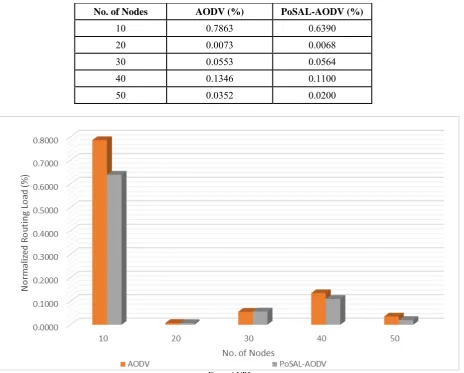
This will be the ratio between the number of routing packets and the number of received packets. The Normalized Routing load must be low.
4.1Simulation
OMNeT++ is an object-oriented discrete event simulation environment developed by Andr´as Varga at the Technical University of Budapest. Its major use is in simulation of network communications. The developers of OMNeT++ predict that one might use it as well for simulation of compound IT systems, queuing networks or h/w architectures, since OMNeT++ is built generic, flexible and modular. As the architecture is modular, the simulation kernel and models can be embedded easily into an application. C++ is the programming language used for the modules in OMNeT++.
Simulation Parameter
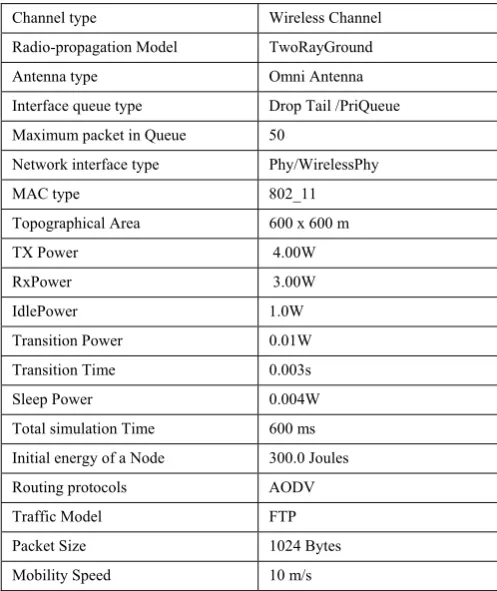
Table 1.Simulation Parameters
Channel type Wireless Channel
Radio-propagation Model TwoRayGround
Antenna type Omni Antenna
Interface queue type Drop Tail /PriQueue Maximum packet in Queue 50
Network interface type Phy/WirelessPhy
MAC type 802_11
Topographical Area 600 x 600 m
TX Power 4.00W
RxPower 3.00W
IdlePower 1.0W
Transition Power 0.01W
Transition Time 0.003s
Sleep Power 0.004W
Total simulation Time 600 ms
Initial energy of a Node 300.0 Joules
Routing protocols AODV
Traffic Model FTP
Packet Size 1024 Bytes
Mobility Speed 10 m/s
5. Result and Discussion
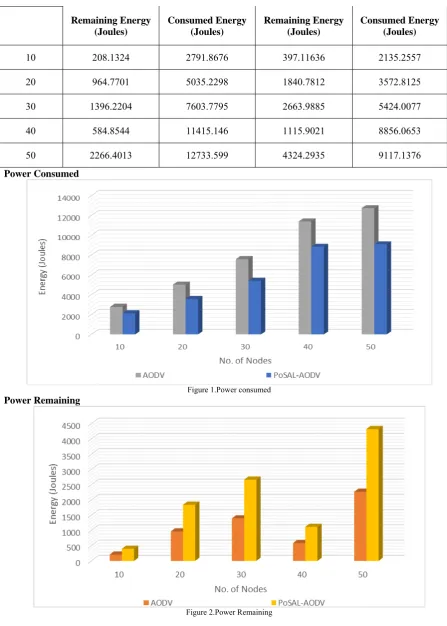
Table 2.Power Consumption and Remaining power
No. of
Remaining Energy (Joules)
Consumed Energy (Joules)
Remaining Energy (Joules)
Consumed Energy (Joules)
10 208.1324 2791.8676 397.11636 2135.2557
20 964.7701 5035.2298 1840.7812 3572.8125
30 1396.2204 7603.7795 2663.9885 5424.0077
40 584.8544 11415.146 1115.9021 8856.0653
50 2266.4013 12733.599 4324.2935 9117.1376
Power Consumed
Figure 1.Power consumed Power Remaining
Figure 2.Power Remaining
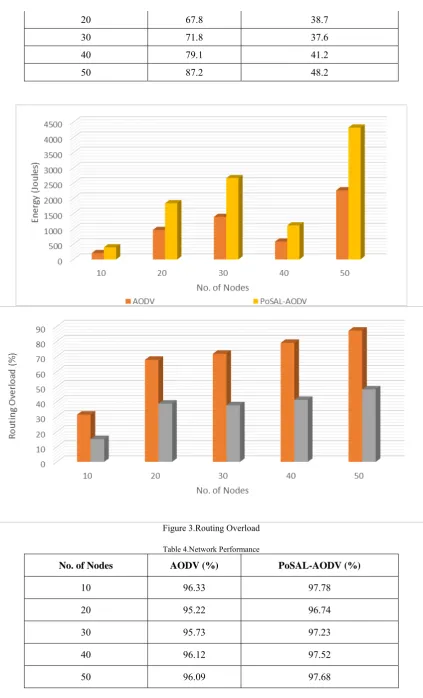
Table 3. Routing Overload
No. of Nodes AODV (%) PoSAL-AODV (%)
20 67.8 38.7
30 71.8 37.6
40 79.1 41.2
50 87.2 48.2
Figure 3.Routing Overload
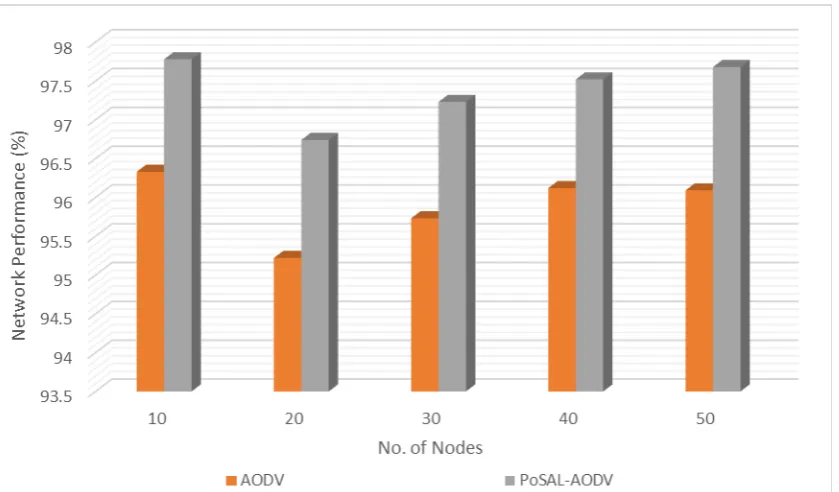
Table 4.Network Performance
No. of Nodes AODV (%) PoSAL-AODV (%)
10 96.33 97.78
20 95.22 96.74
30 95.73 97.23
40 96.12 97.52
Figure 4.Network Performance
Table 5. Packet Delivery Ratio
No. of Nodes AODV (%) PoSAL-AODV (%)
10 45.88 64.89
20 40.28 64.29
30 40.18 63.91
40 42.37 65.42
50 44.58 64.81
Figure 5. Packet Delivery Ratio
No. of Nodes AODV (%) PoSAL-AODV (%)
10 0.7863 0.6390
20 0.0073 0.0068
30 0.0553 0.0564
40 0.1346 0.1100
50 0.0352 0.0200
Figure 6.NRL
CONCLUSION
The proposed PoSAL-AODV provides better power saving compare to the normal AODV. It is evaluated by the testing metrics. This result is obtained in the prescribed scenarios. The PoSAL Algorithm is implemented and tested with six different scenarios. PoSAL gives excellent power saving in defined environment. In future it has to implement and test in the real time test bed.
REFERENCES
[1] Arshad ahmad khan mohammad, ali mirza and rikanth vemuru, “energy aware routing for manets based on current processing state of nodes”, journal of theoretical and applied information technology(issn : 1992-8645) , vol.91, no.2, 30th september 2016., pp. 340-351. [2] Javad Vazifedan, R. Venkatesha Prasad, and lgnas Niemegeers “Energy- Efficient Reliable Routing Considering Residual Energy in
wireless Ad Hoc Networks” IEEE Trans.Issue No.02 - Feb. (2014 vol.13) pp: 434-447
[3] Kanika, Dr andVineet Sharma, “Implementation and Analysis of IPS˗AODV for Emergency scenario in MANET”, International Journal of Computer Science and Information Technologies(ISSN : 0975 9646), Vol. 7 (4) , 2016, pp. 1783-1787
[4] Manesh P. Patil, “A New Approach of Secure Power Aware Routing for Mobile Ad-Hoc Network”, International Journal of Computer Applications (ISSN : 0975 – 8887),Volume 67– No.3, April 2013, pp. 24-34
[5] B. Karthikeyan and Dr.S.Hari Ganesh, “Encrypt - Security Improved Ad Hoc On Demand Distance Vector Routing Protocol (En-SIm AODV)”, ARPN Journal of Engineering and Applied Sciences (ISSN: 1819-6608), Vol. 11, No. 2, January 2016, pp. 1092-1096. [6] B.Karthikeyan, Dr.S.Hari Ganesh and Dr. J.G.R. Sathiaseelan, “ Optimal Time Bound Ad-Hoc On-demand Distance Vector Routing
Protocol (OpTiB-AODV)”,International Journal of Computer Applications (ISSN:0975 – 8887),Vol. 140, No.6, April 2016,pp 7-11. [7] B.Karthikeyan, Dr.S.Hari Ganesh and Dr. J.G.R. Sathiaseelan, “High Level Security with Optimal Time Bound Ad-Hoc On-demand