Comparative Analysis Of Performance And
Emissions Of An Engine With Palm Oil
Biodiesel Blends With Diesel
N.JANARDHANA RAO
Assistant Professor, Department of Mechanical Engineering Gudlavalleru Engg. College, Gudlavalleru, A.P.-521356,India.
M.R.CH.SASTRY
Associate Professor, Department of Mechanical Engineering Gudlavalleru Engg. College, Gudlavalleru, A.P.-521356,India
.
Dr. P.NAGESWARA REDDY
Professor & Principal
Gudlavalleru Engg. College, Gudlavalleru, A.P.-521356,India
Abstract
Biodiesel is an environmentally friend renewable diesel fuel alternative. A single cylinder direct injection diesel engine was first run with diesel fuel and then with blends of biodiesel based palm oil. The performance and emission characteristics of the engine run with both the fuel have been compared and the results obtained are shown in this paper. From the results obtained, it is understood that the thermal efficiency is slightly less and the specific fuel consumption is slightly higher with biodiesel when compared with Diesel. This is due to the lower calorific value of the biodiesel. It is concluded that the biodiesel can be used as alternative fuel in the Diesel engine without any engine modifications.
Key words: Biodiesel,Brake power, NOx emissions
1. Introduction
Biodiesel is defined as the mono-alkyl esters of long chain fatty acids derived from vegetable oil or animal fats (Rand, 2003; Sorensen et al., 2008). It can be classified as a combustible rather viscous liquid consisting of alkyl esters of fatty acids derived from vegetable oil or cooking grease (Gibilisco, 2006). It is also described as fatty acid methyl esters prepared from any kind of biological feedstock including vegetable oil, animal fat, single cells oil and waste material (Stevens and Verhé, 2004). According to the American Society for Testing and Materials (ASTM) Standard Specification for Biodiesel Fuel Blend Stock (B100) for Middle Distillate Fuels, biodiesel is defined as a mono alkyl esters of long chain fatty acids derived from vegetable oils or animal fats, for use in compression-ignition diesel engines
The mixture of biodiesel and petroleum diesel fuel, defined as biodiesel blends, is designated as (BX) where X is the percentage of biodiesel, for example: (B20) is a blend of 20% of biodiesel and 80% of diesel fuel; (B100) is 100% biodiesel; (B0) is 0% biodiesel (Rand, 2003; Sorensen et al., 2008).
Biodiesel and petroleum diesel have similar properties, hence, nearly all conventional diesel engines is able to work fueled without any modification with blends from pure diesel up to B20 (Pahl G., McKibben B., 2008). Compared to convectional diesel fuel, biodiesel has some disadvantages, such as: higher viscosity; lower energy content; higher nitrogen oxide (NOx) emissions; slight reduce in performance; decrease in torque, power and fuel efficiency (Demirbas,2008; Gibilisco, 2006).
increase in the combustion efficiency. The energy balance ratio compares the energy require to grow or extract, process, and distribute a fuel to the energy stored in a fuel. The energy balance ratio of biodiesel is nearly three times higher than of petroleum diesel (Tickell, J et al., 2006; Pahl G., McKibben B., 2008). Biodiesel has others advantages, compared to conventional diesel fuel, such as: saferportability, ready availability, renewability, biodegradability, higher centane number, flash point, cloud point and cold filter plugging point (Demirbas, 2008; Kemp, 2005; Faiz, 1996). Since biodiesel comes from a renewable energy source, its production and use as a replacement for fossil fuel provides three main benefits: reduces economic dependence on petroleum oil; decreases gas emissions that cause the greenhouse effect; and diminishes the proliferation of deceases caused by the pollution of the environment (Demirbas, 2009; Gibilisco, 2006; Gevorkian, 2006).
Analysis of the exhaust gas emission of diesel engines fueled with biodiesel, extracted from several researches, showed similar results: most of them, about 85 %, have found NOx increases; 10 % have obtained the same level of NOx emissions; and about 5% have showed some decrease in NOx emission. Concerning to CO, total hydrocarbon (THC) and particulate matter (PM), tests results were more homogeneous: more than 90% presented a decrease in the emissions and about 1 to 3% showed an increase (Lapuerta, 2008).
Although test results revealed a slight increase in the emission of nitrogen oxides (NOx), the replacement of convectional diesel fuel by biodiesel promotes the reduction in the other components of exhaust gas emissions, such as: carbon monoxide (CO), carbon dioxide (CO2) and particulate matter (PM) and sulfur
dioxide (SO2), which is one of the components that form acid precipitation.
The following paragraphs show relevant results from studies conducted on the performance and exhaust gas emission of compression engines, fueled with diesel fuel, pure biodiesel (B100) and its blends with diesel fuel (BX) reported in the literature.
Zheng et al. (2008) conducted experiments in a naturally-aspirated four-stroke single-cylinder DI diesel engine coupled to a DC motoring dynamometer. The engine was modified to include exhaust gas recirculation (EGR), sequential port-injection and intake air pre-heating. Test compared an ultra-low sulphur diesel fuel with three categories of biodiesel (B100): soy, canola and yellow grease. Results showed that, without EGR and with the start of injection (SOI) fixed, the biodiesel with CN similar to diesel fuel produced greater NOx emissions. Meanwhile, the biodiesel with CN greater than that of diesel produced similar NOx emissions. The soot, CO and THC emissions were generally lower for the biodiesel. It was observed in all fuels tested that, with the diesel engine operating at steady-state conditions, as EGR was increased, NOx decreased. It was also observed that the soot increased with increasing EGR until the ignition delay (_ID) was prolonged by 50–70%. After this point, as the ignition delay was prolonged further, the soot decreased with increasing EGR.
Almeida et al. (2002) studied the performance and the exhaust gas emissions of a naturally aspirated MWM 229 direct injection four-stroke, 70 kW diesel-generator, fuelled with preheated palm oil and diesel fuel. The tests showed that, when the engine was operating with palm oil, exhaust temperature increased with load and specific fuel consumption was almost 10% higher at low loads. It was also observed for both fuels that, increasing the load, the CO emission also increased. Tests also showed that: the HC emissions of both fuels were low (up to 75% of the load) but tended to increase at higher loads; NOx emissions increased as the load increased and, compared with diesel fuel, NOx emissions were lower when the engine was fueled with palm oil; the levels of CO2 and O2 emissions were almost the same, regardless the engine was operating with diesel or biodiesel; and
the lowest CO emissions were obtained with diese
The objective of the present study is to know the operational characteristics of single cylinder diesel engine using different fuels such as commercial diesel , blends of palm oil biodiesel B(20),B(30) and B(40) and blends of sunflower oil bio diesel B(20),B(30) and B(40).Vegetable oils need to be Trans-esterified for their conversion to Bio-Diesel and avoid above problems. Biodiesel was produced by the process Transesterification of vegetable oil triglycerides with methanol in the presence of sodium hydroxide catalyst.
2. Experimental Investigation And Test 2.1 Fuel Property Measurement
The improvement in the performance of the CI engines, over the past century, has resulted from the complimentary refinement of the engine design and fuel properties. Replacement of the existing fuels with new fuels call for an understanding of critical fuel properties to ensure that the new fuels can be used. Calculate the fuel properties like flash point, fire point, specific gravity, calorific value for different oils for different blends using the suitable equipment.
Some of the fuel properties include: Flash point,Fire point,Specific gravity,Calorific value Table1: Properties of Diesel and Palm oil Blends
Fuel Properties Diesel B10 B20 B30
Calorific Value(KJ/Kg) 45350 44450 43615 43050
Specific Gravity 0.802 0.8032 0.8078 0.813
Flash Point 520c 530c 550c 570c
Fire Point 550c 560c 580c 600c
2.2 Experimental Set Up
The performance and emissions of bio diesels for different blends are obtained by using 4-stroke single cylinder diesel engine.
Table 2.Engine Specifications
Make Kirlosker model AVI
Number of cylinders 1
Bore 80mm
Stroke 110mm
Rated speed 1500rpm
Maximum B.P 3.7Kw
Compression ratio 16.5:1
Break drum diameter 0.3m
Rope diameter 0.015m
Equivalent diameter 0.315m
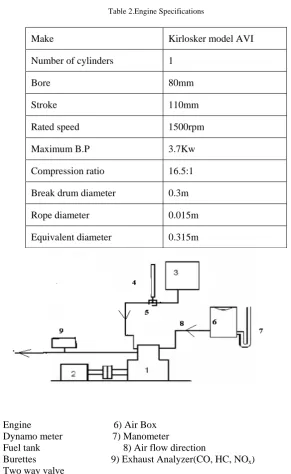
1) Engine 6) Air Box 2) Dynamo meter 7) Manometer
3) Fuel tank 8) Air flow direction
4) Burettes 9) Exhaust Analyzer(CO, HC, NOx)
5) Two way valve
Fig2: Experimental Setup
Table3: Multi (5) Gas Analyzer Specifications
Principle NDIR(Non-dispersive infrared based technology)
Gas measured CO,CO2,HC,O2,and NOx(electro chemical sensor)
Resolution CO(0.01%),CO2(0.1%),HC(1ppm),O2(0.01%), NOx(1ppm)
Gas flow rate 1000ml/min
Response time <15sec
Warm-up time 2 min
Display 20x4 Alpha numeric LCD
Sample extraction Diaphragm pump
Supply voltage 100-240v
Frequency 50-60HZ
Sampling probe Corrosion resistant flexible stainless steel probe
Gas analyzer is mainly used to know the emissions. Gas analyzer measures the concentration of CO,CO2,and O2 in volume percentages and the concentration of HC and NOx in parts per million(ppm).The system uses a non-dispersive infrared system for determining the concentration CO,CO2,and HC, and performs the measurement of O2 and NOx by electro chemical cells.
3.Results And Discussions
The following graphs are plotted for palm oil blends under various loads and compared with ordinary diesel.
• B.P vs B.S.F.C
• Load vs Brake thermal efficiency
• Load vs CO Emissions
• Load vs HC Emmisions
• Load vs NOx Emissions
3.1 Comparison Of Diesel And Palm Oil Blends
Fig3. Variation of Bsfc with BP
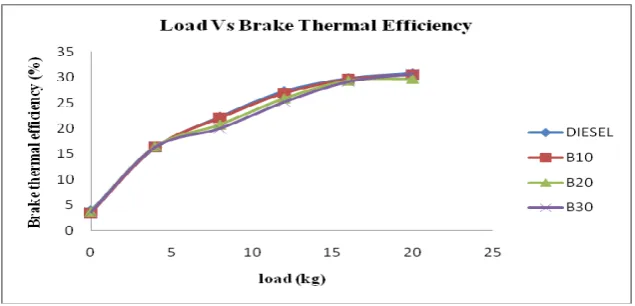
Fig4. Variation of brake thermal efficiency with load
However the brake thermal efficiency for biodiesel is found to be nearly equal to diesel. BTE of blends are low due to higher viscosity, density, poor volatility and lower calorific value.
Fig. 5 varation of co emissions with load
CO emissions for all blends of palm oil are lower in comparison with diesel. The emissions of CO of different blends are found to be increasing with increase in load and decrease with increase in percentage of blend of biodiesel due to 10-12% of excess oxygen and better combustion due to higher cetane number.
Fig. 6 varation of HC emissions with load
Fig. 7 varation of NOX emissions with load
NOx emissions increase with increase in power for all the bio diesel blends of B10, B20, B30 due to increase in the amount of fuel burnt with load, which results in increase in combustion temperature. Methyl esters with their lower stoi-chiometric air-fuel ratio relative to diesel can burn with less air requirement for combustion. This results in higher combustion temperatures.
As methyl esters are oxygenated fuels more oxygen is available for the formation of NOx compared to diesel. NOX emissions are found to be increasing with increase in percentage of methyl esters in the blend.
4.Conclusion
Successful alternative fuels fulfill environmental and energy security needs without sacrificing operating performance. Biodiesel is simple to use, biodegradable, nontoxic, and essentially free of sulfur and aromatics The real advantages for use of biodiesel are in reducing petroleum consumption and greenhouse gas emissions. Biodiesel produces lesser exhaust emissions (CO, CO2, HC, Smoke etc.) from the engines. Use of biodiesel blends can significantly reduce PM and toxic compound emissions, but may slightly increase NOx
which can be reduced by retarding the fuel injectiontiming and by blending biodiesel blends with kersosene or Fischer-Tropsch diesel. Successful alternative fuels fulfill environmental and energy security needs without sacrificing operating performance. Biodiesel is simple to use, biodegradable, nontoxic, and essentially free of sulfur and aromatics. Bio diesel blends (B10, B20, and B30) can be directly used in the engines with little or no engine modifications. The real advantages for use of biodiesel are in reducing petroleum consumption and greenhouse gas emissions. However the brake thermal efficiency for biodiesel is found to be nearly equal to diesel. The specific fuel consumption is noticed to be decreased with increase in loads and increasing with the increase in blend ratio.
5.References
[1] Almeida, S. C. A., , Belchior, C. R., Nascimento, M. V. G., Vieira, L. S. R. and Fleury, G., 2002, “Performance of a Diesel generator fuelled with palm oil”, Fuel, Vol.81, pp. 2097-102.
[2] CCH Incorporated, Commerce Clearing House, CCH Tax Law Editors, 2007, “U.S. Master Tax Guide 2008”, Ed. CCH,864 p. [3] Demirbas, Ayhan, 2008, “Biodiesel: A Realistic Fuel Alternative for Diesel Engines” Ed. Springer, London, England,208 p. [4] Ellstrand, Norman C., 2005, “Dangerous liaisons: when cultivated plants mate with their wild relatives”, Ed. JHU Press, 264 p. [5] Gevorkian, Peter, 2006, “Sustainable Energy Systems Engineering: the Complete Green Building Design Resource”, Ed. McGraw-Hill
Professional, 568 p
[6] Faiz A., Weaver C. S. and Michael P., 1996a, “Walsh Air pollution from motor vehicles: standards and technologies for controlling emissions”, Ed. World Bank Publications, 246 p.
[7] Gibilisco, Stan, 2006, “Alternative Energy Demystified”, Ed. McGraw-Hill Professional, 322 p.
[8] Lapuerta, M., Armas, O. and Fernandez. J. R., 2008, “Effect of Biodiesel Fuels on Diesel Engine Emissions”, Progress in Energy and Combustion Science,Vol.34, pp 198–223.
[9] Johnston, R. M., Bock, A. E. and Keating, E. L., 1992, “Elements of applied thermodynamics”, Ed. Naval Institute Press, 574 p. [10] Kader, J. Claude, Delseny, M., 2002, “Advances in botanical research”, Ed. Academic Press, 272 p.
[11] Kemp, W. H., 2005, “The renewable energy handbook: a guide to rural independence, off-grid and sustainable living”,Ed. Aztext Press, 567 p.
[12] Pahl G.; McKibben B., 2008, “Biodiesel: Growing a New Energy Economy”, Ed. Chelsea Green Publishing, 368 p. [13] Rand, Salvatore J., 2003, “Significance of tests for petroleum products”, Ed. STM International, 258 p.
[14] Rakopoulos, C. D., Antonopoulos, K. A., Rakopoulos, D.C., Hountalas, D. T. nd Giakoumis, E. G., 2006,
[15] “Comparative Performance and Emissions Study of a Direct Injection Diesel Engine Using Blends of Diesel fuel with Vegetable Oils or Biodiesels of Various Origins”, Energy Conversion and Management, Vol.47, pp. 3272–3287.
[16] Soetaert, W., Vandamme, E., 2009, “Biofuels”. Ed. John Wiley and Sons, 256 p.
[18] S, Christian V., Verhé, Roland, 2004, “Renewable Bioresources: Scope and Modification for Non-Food Applications” Ed. John Wiley and Sons, 310 p.
[19] Tickell, J.; Murphy, M.; Graziano C.; National Biodiesel Board, Biodiesel America, 2006, “Biodiesel America: How to Achieve Energy Security, Free America from Middle-East Oil Dependence, and Make Money Growing Fuel”, Ed.
[20] Biodiesel America, 340p.