www.jeseh.net
Enhancing Teacher Beliefs through an
Inquiry-Based Professional Development
Program
Tammy R. McKeown, Lisa M. Abrams, Patricia W. Slattum, Suzanne V. Kirk
Virginia Commonwealth University
To cite this article:
McKeown, T.R., Abrams, L.M., Slattum, P.W., & Kirk, S.V. (2016). Enhancing teacher
beliefs through an inquiry-based professional development program. Journal of Education in
Science, Environment and Health (JESEH), 2(1), 85- 97.
This article may be used for research, teaching, and private study purposes.
Any substantial or systematic reproduction, redistribution, reselling, loan, sub-licensing,
systematic supply, or distribution in any form to anyone is expressly forbidden.
Authors alone are responsible for the contents of their articles. The journal owns the
copyright of the articles.
Enhancing Teacher Beliefs through an Inquiry-Based Professional
Development Program
Tammy R. McKeown*, Lisa M. Abrams, Patricia W. Slattum, Suzanne V. Kirk
Virginia Commonwealth University
Abstract
Inquiry-based instructional approaches are an effective means to actively engage students with science content and skills. This article examines the effects of an ongoing professional development program on middle and high school teachers’ efficacy beliefs, confidence to teach research concepts and skills, and science content knowledge. Professional development activities included participation in a week long summer academy, designing and implementing inquiry-based lessons within the classroom, examining and reflecting upon practices, and documenting ways in which instruction was modified. Teacher beliefs were assessed at three time points, pre- post- and six months following the summer academy. Results indicate significant gains in reported teaching efficacy, confidence, and content knowledge from pre- to post-test. These gains were maintained at the six month follow-up. Findings across the three different time points suggest that participation in the professional development program strongly influenced participants’ fundamental beliefs about their capacity to provide effective instruction in ways that are closely connected to the features of inquiry-based instruction.
Key words: Inquiry-based learning, teacher professional development, diverse student populations, teacher self-efficacy beliefs, science teaching
Introduction
Students in the United States consistently underperform relative to standards which have been set in science education (National Center for Education Statistics, 2012). To promote improved academic performance and achievement in science the Next Generation Science Standards (NGSS), have been developed to provide all students an internationally benchmarked science education. The NGSS essentially raise the performance expectations for what all students in K-12 science classes should know and be able to do. These new standards reflect a higher benchmark for all students by promoting the use of inquiry-based methods when teaching science. The NGSS generally define inquiry in science as a process that requires a wide range of cognitive, social, and physical activities (NGSS, 2013). The implementation of the NGSS demonstrates a fundamental shift from previous National Science Education Standards (NRC, 1996, 2001) in two significant ways: (a) a substantial increase in the level of higher-order thinking skills that all students are expected to master and (b) greater integration of authentic scientific practice with traditional science content (Marshall & Alston, 2014). The NGSS do not contain a precise definition of inquiry teaching but includes examples that frame inquiry as scientific practices similar to the actual work of scientists (NRC, 2012). Generally, the essential features of inquiry include the learner asking scientific questions, generating hypotheses, collecting data to provide evidence for conclusions and explanations, and communicating findings (NRC, 2001). As a result, Inquiry-based learning is essentially a question-driven approach to teaching and learning that can benefit students in a number of ways including increased engagement in the learning process, enhanced understanding, development of higher-order thinking abilities, and the acquisition of research skills (Spronken-Smith, Bullard, Ray, Roberts, & Keiffer, 2008). Research has found that effective science teachers use features of inquiry-based instruction such as encouraging students to actively participate with ideas and evidence, utilizing challenging curricular tools in order to promote deeper understanding, and fostering an environment in which students investigate and construct their own knowledge (Tyler, 2003). Using inquiry-based teaching and learning techniques in science education allows students to develop important skills such as observing and describing objects and events, formulating research questions, testing hypotheses, collecting data, developing valid explanations, and the ability to communicate findings. This type of student-centered learning allows students to construct their
*
Corresponding Author: Tammy R
knowledge and understanding of science concepts with reasoning and higher thinking skills (National Research Council, 1996).
While there is strong evidence that supports the value of inquiry-based science instruction for students from all demographic backgrounds, extant research suggests that creating student-centered knowledge that is applicable to every-day life may be especially advantageous for students with known academic risk factors such as those with low-socio-economic status or English language learners (Lee, Buxton, Lewis, & LeRoy, 2005; Marshall & Alston, 2014). Teaching science in school settings that have larger percentages of English language learners and students from lower socio-economic backgrounds can be difficult since teachers are presented with formidable challenges such as overcrowding, scarce funding and resources, and lack of high-quality science instructional materials (Lee, Buxton, Lewis, & LeRoy, 2005). However, research has shown that students from diverse backgrounds can master complex science concepts when provided with learning opportunities equal to their counterparts with more resources (Lee & Buxton, 2008). In fact, inquiry-based strategies have been shown to reduce the achievement gap of minority students when accompanied with teacher professional development and support from school administrators (Geier et al., 2008). Marshall and Alston (2014) analyzed a professional development project for teachers designed to facilitate more frequent and higher quality use of inquiry-based instruction; improve student achievement in science, and narrow the achievement gap among various student groups. The five-year program, which included more than 10,000 students, found significant gains in achievement on three science tests for all student groups when compared to a comparison group of students of non-participating teachers. Specifically, students of teachers who focused heavily on inquiry-based instruction significantly outperformed similar students in classrooms where teachers used more traditional forms of instruction. In addition to an increase in overall performance for all groups, a narrowing of the achievement gap of minority students compared to Caucasian students was observed, and findings held for female, Hispanic, and black students at all ability levels.
Despite the fact that inquiry-oriented approaches have been shown to be beneficial to student learning, implementing these methods in a classroom setting can be challenging. Encouraging students to pose questions, design experiments, collect data, and draw conclusions has been broadly appealing to teachers, however inquiry-oriented approaches to teaching and learning are demanding because they often require teachers to change their classroom management strategies, as well as how they organize content and assessment procedures. Inquiry methods place additional demands on teachers’ subject-matter knowledge, which must be deeper and broader than in traditional passive teaching methods in order to accommodate students’ questions and use of research procedures (Fishman, Marx, Best, & Tal, 2003). Effective implementation of the inquiry method can also be difficult because it calls for teachers to understand students’ learning styles, plan and use a variety of teaching strategies, and encourage student investigations within a supportive classroom context (Bhattacharyya, Volk, & Lumpe, 2009). Inquiry-based methods also require teachers to assume complex and varied roles. In a case study of a high school biology teacher who successfully implemented inquiry-based instruction in his classroom, Crawford (2000) found that the teacher assumed several nontraditional roles, including that of scientist, innovator, diagnostician, motivator, learner, guide, monitor, mentor and collaborator to support student learning. Crawford asserts that typical teacher education programs do not adequately prepare teachers for these roles and most teachers do not see these types of roles modeled by their peers within school settings.
Fishman, Marx, Best, & Tal (2003) also argue that since teacher beliefs have been shown to have a strong positive correlation to instructional practice, an important goal of professional development should be to influence teacher beliefs. Similarly, Luft and Roehrig (2007) found that teacher beliefs are, in fact, malleable and can change or be modified by external factors, such as professional development. Ballone and Czerniak (2001) posit that research on the role of teacher beliefs is essential for successful science education reform. Consequently, evaluating teacher change as an outcome of professional development, would therefore involve measuring changes in teacher beliefs as well as changes in teacher knowledge and classroom practice (Ballone & Czerniak).
Essential to the development of students’ inquiry skills, in addition to pedagogy and teachers’ content knowledge, are teachers’ personal characteristics and beliefs about science teaching. These beliefs are referred to as science self-efficacy (Haney, Lumpe & Czerniak, 2002). Teacher beliefs, particularly efficacy beliefs, are especially relevant to science teaching when using inquiry methods (Bhattacharyya, Volk & Lumpe, 2009). Self-efficacy refers to one’s belief in one’s own ability to successfully perform a specific task. Bandura (1994) defined perceived self-efficacy as “people’s beliefs about their capabilities to produce designated levels of performance that exercise influence over the events that affect their lives” (p.1). Teacher efficacy is the extent to which teachers believe that they can have a positive impact on student performance (Henson, 2001). Teachers are generally concerned about the adequacy of their professional training as well as their ability to apply new teaching methods. Therefore, training which focuses solely on content knowledge and pedagogy, without aiming to increasing teachers’ self-efficacy, is not likely to increase inquiry-based teaching (Bhattacharyya, Volk, & Lumpe, 2009).
Research supports the connection between teachers’ self-efficacy and effective classroom practice. The relationship between teacher efficacy and increased student achievement has also been documented (Allinder, 1995; Bruce, Esmonde, Ross, Dookie, & Beatty, 2010). Czerniak and Schriver (1994) found that science teachers with high self-efficacy used a wider variety of instructional strategies as compared with teachers who reported lower levels of efficacy and who relied heavily on didactic teaching methods. Both groups implemented science experiments approximately the same number of times in their classrooms, however the high efficacy group encouraged more discussion with the whole class and with small group of students, as well as before and after the lab experiments. Allinder (1995) found that teachers with higher personal efficacy and higher teaching efficacy set rigorous end-of-year goals for students more often than teachers with lower personal and teaching efficacy. Higher levels of efficacy among teachers were aslo associated with greater growth in student performance than those of low efficacy teachers. Lakshmanan, Heath, Perlmutter, and Elder (2011) contend that understanding and implementing professional development programs which improve teacher self-efficacy can eventually result in improving student achievement.
There have been a number of studies which link teacher efficacy beliefs to classroom practice and student achievement. This paper explores an initial examination of the impact of participation in a teacher professional development program on teachers’ beliefs. Specifically, the following research question guided the study design and data collection: What impact does participating in an inquiry-based professional development program have on teacher beliefs?
Project Context
partnerships among University faculty from multiple units including the Schools of Education, Pharmacy, Medicine and the College of Humanities and Sciences. The project activities and curriculum have been informed by middle and high school teachers, students, and parents.
Teacher Professional Development
Ball and Cohen (1999) created a “practice-based” theory of professional development that emphasizes long-term active engagement, connections between teachers’ work and their students’ learning, and opportunities to practice and apply what students learn in a real world context. Teacher participants in Project CRESST attend a week-long professional summer academy in which they are engaged in activities that focus on the clinical research process, have authentic experiences with childhood health sciences, and model the CRESST curriculum. The academy, when combined with pre-academy assignments, exposes teachers to over 50 hours of professional development activities. During the academy, teachers develop an instructional plan which encourages reflection and requires teachers to identify how they can re-structure or modify their existing lesson plans to include inquiry activities as well as replace lessons with the curricular tools provided by the project. Consistent with Ball and Cohen’s (1999) theory of professional development, the program’s curricular activities aim to ultimately increase students’ active participation in meaningful, real world research that affects their every-day lives.
Inquiry-Based Curricular Tools
Fishman, Marx, Best, & Tal (2003) maintain that curriculum holds a central place in any model of teacher learning because it embodies what teachers are required to teach in classrooms. They assert that curriculum should play a large role in influencing the kinds of professional development activities that are to be offered. Some researchers have argued that curriculum materials play a significant role in teacher learning because curricular tools themselves are a potential source of professional development (Ball & Cohen, 1996). The concept of professional development that is content-driven and includes opportunities for active engagement and activities aligned with state and national standards has been shown to enhance teachers’ knowledge and skills (Garet, Porter, Desimone, Birman, & Yoon, 2001). Similarly, Loucks-Horsley, Hewson, Love and Stiles (1998) identified high quality professional development strategies, one of which is curriculum implementation which involves having teachers use and refine instructional materials in the classroom. Development of the CRESST Curriculum was informed by extant research on inquiry-based tools. The CRESST Curriculum was created prior to the implementation of the summer professional development component of the project and was guided by highly qualified and experienced science and physical education teachers. The curriculum is inquiry-based and aligns with state and national standards. The lessons and suggested activities encourage students to interact with research concepts and the clinical research process in authentic ways. During the summer academy these activities are modeled and participating teachers experience the curricular materials as their students would.
Follow-up Classroom Implementation
Loucks-Horsley, Hewson, Love, and Stiles (1998) maintain that high quality professional development includes activities in which teachers examine practice such as discussion of classroom scenarios or examining actual classroom instruction. Following the CRESST professional development, teachers continue to increase their knowledge of inquiry based methods during the academic year through a series of follow up activities. Throughout this process, teachers are provided with continued support for implementing inquiry-based practices in their classrooms. Follow up activities include designing and implementing inquiry based lessons that reflect techniques and content introduced during the academy. Teachers also examine their classroom practices, document ways in which they modify their instruction, reflect on how students respond to the inquiry based lessons, and identify opportunities for cross-disciplinary as well as interdepartmental collaborations.
Methods
Participants
in Table 1, participants taught in urban (18%), suburban (44%) and rural (38%) school districts in a south eastern state in the US. They had an average of 14 years of teaching experience, with a range of 1-38 years, and taught in traditional and alternative school settings (see Table 1).
Table 1. Demographic information for teacher participants
Characteristics N %
Teaching Experience (years)
Mean 14 --
Range 1 - 38 --
Grade Currently Teaching
Middle School 44 61
High School 28 39
School Setting
Urban 13 18
Suburban 32 44
Rural 27 38
Content Area
Physical Education 20 28
Life Science 14 19
Physical Science 13 18
Earth Science 5 7
Biology 15 21
Chemistry 4 6
Physics 1 1
Ethnicity
African American 9 13
Asian 2 3
Caucasian 61 88
Gender
Male 14 19
Female 58 81
Note: Total N = 72
Research Design
In order to examine the research question posed for this study, a pre-post follow-up design was employed. Participants completed a pre-survey prior to attending the summer academy and a post-survey at completion of the program. Participants were then administered a follow-up survey approximately six months after the academy to determine if any of the pre- to post-test differences were maintained over the school year.
Data Sources
Teacher Self-Report Measures
from a four-point, Likert-type response scale ranging from “weak” to “very strong beliefs in my capabilities”. The instrument contains 31 items which measures six subscales – accommodating individual differences (AID), maintaining positive classroom climate (PCC), monitoring and feedback for learning (MFL), managing learning routines (MLR), motivating students (MS), and higher-order thinking skills (HOTS).
The SETAKIST-R (Pruski et al., 2013) measures efficacy and knowledge beliefs related to teaching research concepts. The measure includes 16 items and participants select from a five-point response scale ranging from “strongly disagree” to “strongly agree” with mean values approaching five, indicating high levels of efficacy and knowledge. In addition to items from the TEBS-Self and SETAKIST-R, several items were developed to measure teachers’ confidence in teaching research concepts using inquiry-based methods. Respondents selected from a five-point, Likert-type response scale ranging from “not confident” to “very confident” with mean values approaching five indicating higher levels of confidence. The surveys included several open-ended questions in addition to the select-response items. These questions were designed to enhance the quantitative items in attempting to ascertain how participation in the academy supported teaching (Greene, Caracelli, & Graham, 1989). The quantitative measures provided information concerning patterns and trends within the data, while the open-ended items allowed for a more detailed analysis of individual teacher data.
Data Analyses
The data for this study were analyzed in three steps. First, in order to examine differences between mean scores for efficacy and confidence items, a RM-ANOVA was performed across two time points (pre- and post-) for all four cohorts. Second, to determine if significant mean differences on the efficacy and confidence scales were present across three time points (pre-, post-, follow-up) a repeated-measures ANOVA (RM-ANOVA) was conducted for teachers who participated in the first three years of the project (n = 23) as follow-up surveys have not yet been administered to the most recent Project CRESST cohort of teachers. If significant mean differences were found, post hoc comparisons were conducted utilizing Bonferroni tests. Last, teachers’ narrative responses were examined using thematic analysis to supplement the findings of the quantitative survey results.
Results
Quantitative Findings
Self-Efficacy
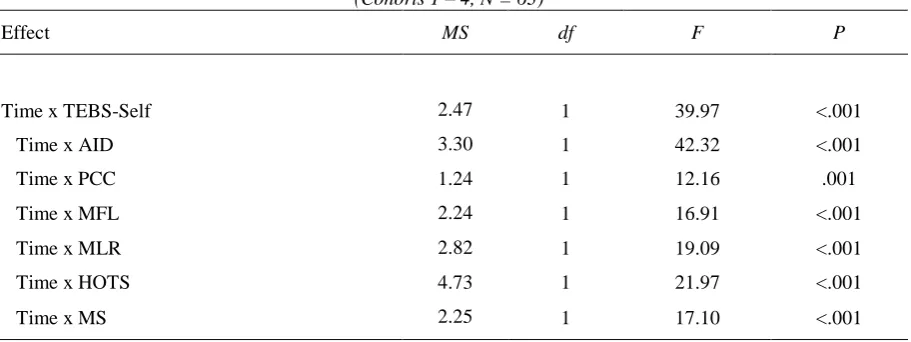
Statistical analyses were conducted using SPSS in order to compare the mean differences between pre- and post-test items related to teacher self-efficacy. The RM-ANOVA for cohorts one through four revealed significant change in overall efficacy scores from pre- to post- test, F (1, 62) = 39.97, p < .001 (see Table 2). Composite variables on the TEBS-Self subscales were computed and exhibited reliability estimates ranging from .66 to .92.
Table 2. Repeated measures analysis of variance for efficacy beliefs
(Cohorts 1 – 4, N = 63)
Effect MS df F P
Time x TEBS-Self 2.47 1 39.97 <.001
Time x AID 3.30 1 42.32 <.001
Time x PCC 1.24 1 12.16 .001
Time x MFL 2.24 1 16.91 <.001
Time x MLR 2.82 1 19.09 <.001
Time x HOTS 4.73 1 21.97 <.001
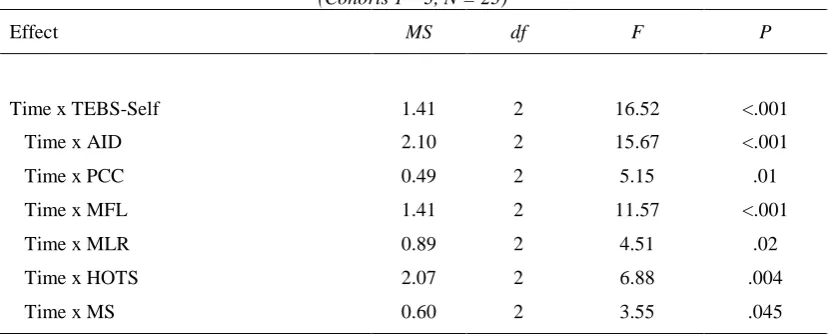
The RM-ANOVA for cohorts one through three revealed significant change in overall efficacy scores across time as measured by the TEBS-Self, F (2, 22) = 16.52, p < .001. Post hoc analysis using the Bonferroni test revealed that teacher efficacy increased significantly from pre- to post-test (p = .002). Self-efficacy scores, however, did not differ significantly from post- to follow-up test, indicating that teachers’ increased sense of efficacy had not diminished over time. Significant changes were also indicated on each of the six efficacy components within the TEBS-Self as shown in Tables 3 and 4.
Table 3. Univariate statistics for efficacy beliefs
Means
Construct T1 (n) T2 (n) T3 (n)
TEBS-Self 2.82 (63) 3.15 (63) 3.30 (23)
AID 2.63 (63) 2.96 (63) 3.15 (23)
PCC 3.05 (63) 3.25 (63) 3.32 (23)
MFL 2.84 (63) 3.11 (63) 3.18 (23)
MLR 2.89 (63) 3.19 (63) 3.28 (23)
HOTS 2.44 (63) 2.83 (63) 2.97 (22)
MS 2.90 (63) 3.17 (63) 3.24 (22)
Table 4. Repeated measures analysis of variance for efficacy beliefs
(Cohorts 1 – 3, N = 23)
Effect MS df F P
Time x TEBS-Self 1.41 2 16.52 <.001
Time x AID 2.10 2 15.67 <.001
Time x PCC 0.49 2 5.15 .01
Time x MFL 1.41 2 11.57 <.001
Time x MLR 0.89 2 4.51 .02
Time x HOTS 2.07 2 6.88 .004
Time x MS 0.60 2 3.55 .045
Teaching Research Content and Skills
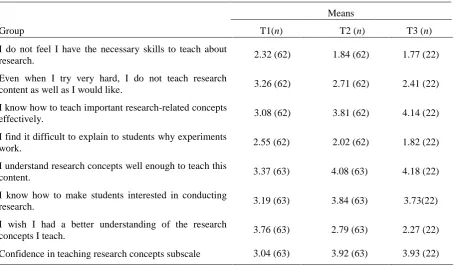
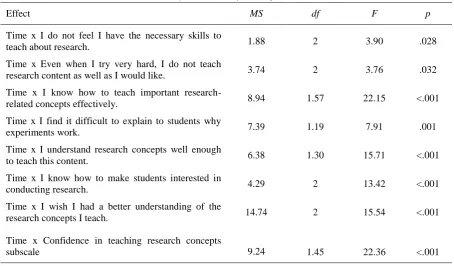
Of the 15 items adapted from the SETAKIST-R, seven indicated significant increases in teachers’ self-efficacy and knowledge beliefs for teaching research concepts (see Tables 5, 6, and 7). For example, the mean response to “I know how to teach important research-related concepts effectively” increased across time for cohorts one through three, F (2, 21) = 22.15, p < .001. Similar to other survey results, the increased item-level means were maintained at follow-up as evidenced by the lack of statistically significant mean differences from post-test to follow-up. Scores from this item also increased significantly from pre- to post- test for all four cohorts F (1, 61) = 31.96, p < .00. An additional example includes responses to “I understand research concepts well enough to teach this content” in which mean responses increased significantly across time for cohorts one through three, F
Table 5. Repeated measures analysis of variance for items related to teaching research concepts
(Cohorts 1 – 4, N = 63)
Effect MS df F p
Time x I do not feel I have the necessary skills to
teach about research. 7.25 1 19.47 <.001
Time x Even when I try very hard, I do not teach
research content as well as I would like. 9.32 1 3.76 .007
Time x I know how to teach important
research-related concepts effectively. 16.33 1 31.96 <.001
Time x I find it difficult to explain to students why
experiments work. 8.78 1 12.54 .001
Time x I understand research concepts well enough
to teach this content. 16.07 1 31.71 <.001
Time x I know how to make students interested in
conducting research. 13.34 1 32.88 <.001
Time x I wish I had a better understanding of the
research concepts I teach. 29.53 1 37.39 <.001
Time x Confidence in teaching research concepts
subscale 23.66 1 65.67 <.001
There was a significant change in confidence scores for cohorts one through three across time, F (2, 21) = 22.36,
p < .001 (see Tables 3 and 4). Bonferroni post hoc tests indicated a significant increase in teachers’ confidence scores from pre- to post-test (p < .001). Similar to the self-efficacy scores, there was no significant change in confidence scores from post-test to follow-up (p = .348), indicating that the increase in teachers’ confidence maintained throughout the school year. Confidence scores for all four cohorts also indicate significant change from pre- to post-test F (1, 62) = 65.67, p < .001 (see Tables 5, 6, and 7).
Table 6. Univariate statistics for items related to teaching research concepts Means
Group T1(n) T2 (n) T3 (n)
I do not feel I have the necessary skills to teach about
research. 2.32 (62) 1.84 (62) 1.77 (22)
Even when I try very hard, I do not teach research
content as well as I would like. 3.26 (62) 2.71 (62) 2.41 (22)
I know how to teach important research-related concepts
effectively. 3.08 (62) 3.81 (62) 4.14 (22)
I find it difficult to explain to students why experiments
work. 2.55 (62) 2.02 (62) 1.82 (22)
I understand research concepts well enough to teach this
content. 3.37 (63) 4.08 (63) 4.18 (22)
I know how to make students interested in conducting
research. 3.19 (63) 3.84 (63) 3.73(22)
I wish I had a better understanding of the research
concepts I teach. 3.76 (63) 2.79 (63) 2.27 (22)
Table 7. Repeated measures analysis of variance for items related to teaching research concepts
(Cohorts 1 – 3, N = 22)
Effect MS df F p
Time x I do not feel I have the necessary skills to
teach about research. 1.88 2 3.90 .028
Time x Even when I try very hard, I do not teach
research content as well as I would like. 3.74 2 3.76 .032
Time x I know how to teach important
research-related concepts effectively. 8.94 1.57 22.15 <.001
Time x I find it difficult to explain to students why
experiments work. 7.39 1.19 7.91 .001
Time x I understand research concepts well enough
to teach this content. 6.38 1.30 15.71 <.001
Time x I know how to make students interested in
conducting research. 4.29 2 13.42 <.001
Time x I wish I had a better understanding of the
research concepts I teach. 14.74 2 15.54 <.001
Time x Confidence in teaching research concepts
subscale 9.24 1.45 22.36 <.001
Narrative Survey Response Findings
Data from open ended comments on follow-up surveys further enhance findings from the self-report surveys. Selected comments reflect increase confidence, content knowledge, implementation of inquiry-based activities, and collaborative efforts. Comments selected for inclusion are exemplars that represent teacher responses. Participants expressed feeling more confident as a result of their participation in the program. Responses included:
“I feel more confident in my field and I feel it helped me to want to introduce different types of lessons into my curriculum and lesson planning.”
“[participation] made me a better teacher, it taught me to use more inquiry-based instruction than the typical cookie cutter models.”
“[I am now] more knowledgeable, flexible and creative.
“I feel more comfortable talking with parents and students about science related topics, questions, and concerns.”
Teachers indicated having a better understanding of how to implement inquiry-based lessons.
“I completely changed how I taught a Biochemistry unit. Year after year, students would struggle with the concepts taught in this unit. However, the labs and materials that were presented to me allowed me the opportunity to be able to teach the concepts in a more hands-on environment. I saw much more success.”
“My participation in CRESST afforded me a learning opportunity, materials, and lesson plans to implement inquiry-based learning activities with my students, especially during the first 9 weeks. It proved to be a great way to motivate all students…”
“Participating in the Academy gave me an introduction to teaching research concepts and techniques in which to apply and implement research concepts and inquiry-based learning.”
Teachers also reflected on how their participation in the program resulted in increased collaborative efforts to implement inquiry-based methods.
“[participation] broadened my knowledge base and allowed me to give and receive teaching ideas among colleagues that I would've never had the opportunity to collaborate with.”
“I had wonderful exposure to teachers across the state who are doing great things with their students. It was so motivating to me as a new teacher with the Middle School students! I learned a lot from the Academy experience and eagerly shared these tools with other Life Science teachers as we implemented some of the CRESST activities throughout the year.”
“…[I shared] the CRESST Curriculum with two other 7th grade Life Science teachers [in my school]. Throughout the remainder of the year, my colleagues and I focused on providing our students with additional inquiry-based activities, influenced by the CRESST activities. It was a great collaborative effort between Life Science and the Physical Ed classes!”
Discussion and Conclusion
This paper captures a first look at the impact of participation in a teacher development program on teachers’ beliefs related to self-efficacy to deliver effective instruction within the classroom context and confidence in their abilities to teach complex research content and skills using inquiry-based instructional approaches. Holding positive beliefs about their own capacity is a perquisite or stepping stone for effective change in instructional practices that apply and integrate more complex teaching strategies. The ability to affect change in teacher beliefs provides a strong foundation for the promise of a comprehensive teacher development program designed to support teachers’ development and use of inquiry in their practice. Ballone and Czerniak (2001) highlight the need for profession development programs to evaluate changes in teacher beliefs as an important outcome. As noted by Riggs (1995), higher levels of self-efficacy among science teachers have been associated with greater use of authentic and inquiry-based strategies. The results of the three administrations of the Teachers’ Efficacy Beliefs System-Self (TEBS-Self; Dellinger, Bobbett, Oliver, & Ellett, 2008) demonstrate favorable trends regarding the positive impact of the Project CRESST program. As described, the TEBS-Self was administered prior to the week-long professional development experience, immediately following the completion of the summer program, and again roughly six months following the summer program. These three administration time points allowed us to determine the immediate impact of participation on teachers’ reported levels of efficacy as well as the longer-term influence on participation.
The results indicate that teachers reported statistically significant gains across all of the subscales comprising the TEBS-Self at post-test. These data suggest the promising range of the CRESST professional development program to influence a variety of areas related to teaching and the classroom context in which teaching occurs. For example, significant efficacy gains were evident for teachers’ abilities to accommodate individual learning differences in their classroom, including planning for differentiated instruction, providing accommodations to meet the individual needs of students, and develop appropriate evaluation procedures tailored to individual students. These data suggest that the CRESST program was able to foster greater efficacy among teacher participants to provide more flexible and individualized instruction that relied on multiple teaching methods and materials. These changes in efficacy are closely associated with the essential features of inquiry-based instruction that involve supporting students to conduct scientific inquiries of their own questions using data as evidence to draw conclusions and answer initial questions (Crawford, 2000; NRC, 1996).
collaboration in the classroom and to maintain a climate in which students are highly engaged and one that reflects a culture of courtesy and respect.
Most encouraging about the study findings is that teachers’ reported high levels of efficacy as measured by the TEBS-Self maintained over the course of the academic year. These results suggest that the shift in teachers’ belief systems evident immediately following participation in the CRESST professional development program continued at the same level throughout the school year. When the efficacy data are considered in relation to the characteristics of inquiry-based instruction, these initial findings are noteworthy and suggest the professional development program was effective in fostering long-term changes in teachers’ beliefs in ways that are closely aligned with the implementation of inquiry-based instruction. The beliefs are also consistent with the new policies and standards for science education outlined in the Next Generation Science Standards, suggesting that participating teachers will be well-positioned to enact the reform-based instruction in their classrooms and may do so in ways that help to reduce existing disparities or achievement gaps that persist among minority student populations (Geier et al., 2008; Marshall and Alston, 2014).
In addition to efficacy beliefs, this study also examined teachers’ general knowledge of research concepts as well as their confidence to teach research content and skills. The patterns in the confidence survey results are similar to those of the efficacy data. Statistically significant gains were evident between teachers’ pre- and post- survey responses. The results indicated that teachers’ reported greater levels of confidence in a variety of activities related to scientific investigations. For example, gains were evident for confidence in encouraging student interest in inquiry and ability to engage them in inquiry-oriented as well as hands-on activities. Closely related to these results are teachers’ heightened levels of content knowledge and expertise to provide instruction of research content. These data demonstrate a greater comfort and confidence with teaching inquiry-related material. The reported gains in content knowledge confidence were maintained over the course of the following school year. These results complement the efficacy findings, and demonstrate a comprehensive shift in teacher beliefs across multiple and closely related areas – efficacy, content knowledge related to inquiry, and confidence. Such beliefs are closely linked to the essential features of effective implementation of inquiry-based instruction and may enable teachers to overcome the barriers associated with teaching science using this approach, such as lack of knowledge and experience with inquiry (Blanchard, Southerland & Granger, 2009). The findings of this initial study demonstrate the promise of a professional development program that combines features known to be effective based on the literature with a sustained follow-up and continuous support. According to Capps, Crawford, and Constas’ (2012) synthesis of the literature on general teacher professional development as well as professional development specific to inquiry-based instruction, the CRESST program exhibits many salient characteristics. These characteristics include: sufficient time for teachers to learn the material; support beyond the initial professional development workshop or experience; materials aligned to state and national content standards; opportunities to experience and participate in inquiry-based activities as learners; time for reflection; and support to apply what was learned in the professional development program to individual teachers’ classrooms (Capps &Crawford, 2012). The survey data suggest that when best-practices in professional development are at the core of a teacher development program, profound changes in teachers’ beliefs systems can occur. The survey efficacy, confidence, and content knowledge results over three different time points suggest that participation in CRESST strongly influenced teachers’ fundamental beliefs about their capacity to provide effective instruction in ways that are closely connected to the features of inquiry-based instruction.
These data should be considered with the limitations of self-report survey data. Further study of the Project CRESST professional development program is needed to examine teachers’ actual classroom practice and the extent to which the survey findings are consistent with direct measures of inquiry implementation. Capps and Crawford (2012) conducted a mixed-methods study of teachers’ inquiry practice and found teachers’ demonstrated a variety of inquiry-based practices and there was little evidence of implementing inquiry “beyond simple process skills and at times, the collection of data” (p. 520). They also concluded that many teachers believed that they were teaching in ways consistent with inquiry but were not doing so in actual practice.
Recommendations
systems. Concerted efforts to construct professional development programs in ways that are evidenced-based are an essential feature of effective and meaningful teacher professional development. In addition, a methodological strength of the present study was the use of survey measures aligned to features of inquiry. This approach further enhanced the nature of the conclusions drawn from the study and linked connections between changes in teachers’ efficacy levels and the potential for implementing inquiry-based instruction. Similarly, these initial findings were strengthened by the use of other measures to examine complementary constructs that when considered in combination presented a robust picture of the change in teachers’ beliefs. Developing an evaluation or research design in concert with the core components of the professional development programs will enable practitioners to further advance the field of professional development as well as address the critical need to support teachers’ implementation of reform-based science teaching.
Acknowledgements
This material is based upon work supported by the National Institutes of Health under the Science Education Partnership Award No. R25 OD010983-03. Any opinions, findings, conclusions or recommendations expressed in this material are those of the authors and do not necessarily reflect the views of the NIH.
References
Allinder, R.M. (1995). An examination of the relationship between teacher efficacy and curriculum-based measurement and student achievement. Remedial and Special Education, 16, 247-254.
Ball, D.L., & Cohen, D.K. (1996). Reform by the book: What is—or might be—the role of curriculum materials in teacher learning and instructional reform? Educational Researcher, 25(9), 6-8.
Ball, D.L., & Cohen, D.K. (1999). Developing practice, developing practitioners: Toward a practice-based theory of professional education. In G. Sykes and L. Darling Hammond (Eds.), Teaching as the
learning profession: Handbook of policy and practice (pp. 3-32). San Francisco: Josey Bass.
Ballone, L.M., & Czerniak, C.M. (2001). Teachers’ beliefs about accommodating students’ learning styles in science classes. Electronic Journal of Science Education, 6(2), 1-43.
Bandura, A. (1994). Self-efficacy. In V.S. Ramachaudran (ed.), Encyclopedia of human behavior (vol. 4). New York: Academic Press.
Bhattacharyya, S., Volk, T., & Lumpe, A. (2009). The influence of an extensive inquiry-based field experience on pre-service elementary student teachers’ science teaching beliefs. Journal of Science Teacher
Education, 20, 199-218.
Blanchard, M.R., Southerland, S.A., & Granger, E.M. (2009). No silver bullet for inquiry: Making sense of teacher change following an inquiry-based research experience for teachers. Science Education, 93(2), 322-360.
Bruce, C.D., Esmonde, I., Ross, J., Dookie, L., & Beatty, R. (2010). The effects of sustained classroom-embedded teacher professional learning on teacher efficacy and related student achievement. Teaching and Teacher Education, 26(8), 1598-1608.
Capps, D.K. & Crawford, B.A. (2013). Inquiry-based professional development: What does it take to support teachers in learning about inquiry and science? International Journal of Science Education, 35(12), 1947-1978.
Capps, D.K., Crawford, B.A., & Constas, M.A. (2012). A review of the empirical literature on inquiry professional development: Alignment with best practices and a critique of the findings. Journal of Science Teacher Education, 23(3), 291-318.
Crawford, B.A. (2000). Embracing the essence of inquiry: New roles for science teachers. Journal of Research in Science Teaching, 37,916-937.
Czerniak, C.M., & Schriver, M. (1994). An examination of preservice science teachers’ beliefs and behaviors as related to self-efficacy. Journal of Science Teacher Education, 5(3), 77-86.
Dellinger, A.B., Bobbett, J.J., Olivier, D.F., & Ellett, C.D. (2008). Measuring teachers’ self-efficacy beliefs:
Development and use of the TEBS-Self. Teaching and Teacher
Education,24, 751-766.
Desimone, L.M., Porter, A.C., Garet, M.S., Yoon, K.S., & Birman, B.F. (2002). Effects of professional development on teachers’ instruction: Results from a three-year longitudinal study. Educational
Evaluation and Policy Analysis, 24(2), 81-112.
Garet, M., Porter A., Desimone L., Birman B., & Yoon K. (2001). What makes professional development effective? Results from a national sample of teachers. American Educational Research Journal, 38, 915-946.
Geier, R., Blumenfeld, P.C., Marx, R.W., Krajcik, J.S., Fishman, B., Soloway, E., & Clay-Chamber, J. (2008). Standardized test outcomes for students engaged in inquiry-based science curricula in the context of urban reform. Journal of Research in Science Teaching, 45, 922-939.
Greene, J.C., Caracelli, V.J., & Graham, W.F. (1980). Toward a conceptual framework for mixed-method evaluation designs. Educational Evaluation and Policy Analysis, 11, 255-274.
Haney, J.J., Lumpe, A.T., & Czerniak, C.M. (2002). From beliefs to actions: The beliefs and actions of teachers implementing change. Journal of Science Teacher Education, 13(3), 171-187.
Henson, R.K. (2001). The effects of participation in teacher research on teacher efficacy. Teaching and Teacher education, 17, 819-836.
Lakshmanan, A., Heath, B.P., Perlmutter, A., & Elder, M. (2011). The impact of science content and professional learning communities on science teaching efficacy and standards-based instruction.
Journal of Research in Science Teaching, 48(5), 534-551.
Lee, O., & Buxton, C. (2008). Science curriculum and student diversity: A framework for equitable learning outcomes. The Elementary School Journal, 109(2), 123-137.
Lee, O., Buxton, C., Lewis, S., & LeRoy, K. (2005). Science inquiry and student diversity: Enhanced abilities and continuing difficulties after and instructional intervention. Journal of Research in Science
Teaching, 43(7), 607-636.
Loucks-Horsley, S. Hewson, P.W., Love, N., & Stiles, K.E. (1998). Designing professional development for teachers of science and mathematics. Thousand Oaks, CA: Corwin Press.
Luft, J.A., & Roehrig, G.H. (2007). Capturing science teachers’ epistemological beliefs: The development of the Teacher Beliefs Interview, Electronic Journal of Science Education, 11(2), 38-63.
Marshall, J.C., & Alston, D.M. (2014). Effective, sustained inquiry-based instruction promotes higher science proficiency among all groups: A 5-year analysis. Journal of Science Teacher Education. 25, 807-821. National Center for Education Statistics. (2012). The nation’s report card: science 2011 (NCES
2012-465).Institute of Education Sciences, U.S. Department of Education, Washington, D.C.
National Commission on Mathematics and Science Teaching. (2000). Before it’s too late: A report to the nation
from the national commission on mathematics and science teaching for the 21st century. Washington, D.C: Author.
National Research Council. (1996). National science education standards. Washington, DC: National Academy Press.
National Research Council, (2001). Inquiry and the national science education standards. Washington, DC: National Academies Press.
National Research Council, (2012). A framework for K-12 science education: Practices, crosscutting, concepts, and core ideas. Washington, DC: The National Academies Press.
National Research Council (Ed.). (1996). National science education standards. National Academy Press.
NGSS Lead States (2013). Next generation science standards: For states, by states. Washington, DC:The National Academies Press.
Pruski, L.A., Blanco, S.L., Riggs, R.A., Grimes, K.K., Fordtran, C.W., Barbola, G.M., & Cornell, J.E. (2013). Construct validation of the Self-Efficacy Teaching and Knowledge Instrument for Science Teachers-Revised (SETAKIST-R): Lessons learned. Journal of Science Teacher Education, 24(4), 1133-1156.
Riggs, I. (1995, April). The characteristics of high and low efficacy elementary teachers. Paper presented at the annual meeting of the National Association for Research in Science Teaching, San Francisco. Spronken-Smith, R., Bullard, J., Ray, W., Roberts, C., & Keiffer, A. (2008). Where might sand dunes be on
Mars? Engaging students through inquiry –based learning in geography. Journal of Geography in Higher Education, 32(1), 71-86.
Tyler, R. (2003). A window for a purpose: Developing a framework for describing effective science teaching and learning. Research in Science Education, 33, 273-298.