The complexity of teacher professional growth –
experiences of professional learning and development,
including practice-based inquiry
Philip Robert Taylor
Thesis submitted in fulfilment of the requirements for the
Doctor of Philosophy in Education
awarded by Birmingham City University
Faculty of Health, Education and Life Sciences
Contents
Contents ... 3
Acknowledgements ... 5
Abstract ... 6
Chapter One – Introduction ... 7
The practical and theoretical basis for this thesis ... 7
The rationale and importance of this research ... 11
Research aims and questions ... 13
Chapter Two – Literature Review ... 17
Understanding teacher professional growth through complexity thinking ... 17
Teacher professional growth – a combination of learning and development ... 21
The ‘P’ in CPLD – professional, professionalism, professionality and professionalisation ... 23
From professionalism to performativity – autonomy, accountability and inequality ... 28
Characteristics of effective CPLD – the gap between values and experience ... 33
The quest for ‘what works’ – models of effectiveness and the concept of recursion ... 41
Teacher professional growth – learning and development as a recursive process ... 49
From deliverology to heutagogy – the complex basis for self-determined learning ... 54
Practice-based inquiry – a vehicle for self-determined professional learning ... 59
Performativity revisited – the possibilities of practice-based inquiry ... 62
The responsibilities of practice-based inquiry and the role of the tutor ... 67
Summary – towards a complexity-informed methodology ... 71
Chapter Three – Research Methodology ... 76
Utilising complexity thinking to shape methodology... 76
Research paradigms – debates, typologies, simplicity and complexity ... 78
An ontology of complexity – nested, contingent, agential and relational ... 86
An epistemology of complexity – participation, connection, enaction and intra-action ... 96
An axiology of complexity – possibility, responsibility, response-ability and complicity ... 104
A methodology of complexity – case study, phenomenography and bricolage... 108
Gathering and interpreting evidence – listening, conversing and unravelling ... 116
Chapter Four – Perceptions and Possibilities of Professional Growth ... 124
Teacher professional growth – the person in context ... 124
Distinctions and conjunctions in conceptualisations of professional learning and CPD ... 129
Categories of description and variation in purpose, opportunity and response ... 133
Categories of description and variation in organisational contexts and external conditions 144 Changing perceptions and projections of professional learning and development ... 154
Chapter Five – The Role of Practice-based Inquiry in Professional Growth ... 160
Possibilities of practice-based inquiry ... 161
Situational enablers and inhibitors of practice-based inquiry ... 179
Independent and collaborative working through practice-based inquiry ... 184
Chapter Six – The Lived Experience of Teacher Professional Growth ... 191
Ways of experiencing and interpreting teacher learning and development ... 192
Ways of integrating and applying teacher learning and development within practice ... 197
Ways of shaping of teacher learning and development through ongoing intra-actions ... 203
Teacher professional growth – ways of being, becoming and belonging ... 209
Chapter Seven – Conclusions and Contributions ... 217
Perceptions, conceptualisations and future formations of teacher professional growth ... 218
The possibilities for practice-based inquiry in teacher professional growth ... 221
Rethinking the lived experience of teacher professional growth ... 223
References... 231
Appendices ... 255
Appendix One – recorded conversation summaries ... 255
Appendix Two – practice-based inquiry summaries ... 301
Appendix Three – dynamic process abstractions ... 327
Acknowledgements
There are many contributions to this study that have made it possible, from family, friends and colleagues in the past and present, all accomplices, who have shaped me, my learning and development in profound and important ways, for which I will always be thankful.
This study would not have been possible without the experiences of professional growth and accounts of practice-based inquiry, shared willingly and generously by the six participating teachers, to whom I am sincerely grateful.
I am indebted to my supervisors, Professor Alex Kendall and Professor Richard Hatcher, who have both supported and challenged me along the way with knowledge, insight and wisdom, giving me time and space to learn and grow. I thank them and their colleagues at Birmingham City University, where I am proud to have worked for six years.
Most of all I thank my family, particularly those closest to me, who have put up with my semi-detached and study-absorbed moments, always encouraging and enabling me to carry on. I dedicate this work to them.
Abstract
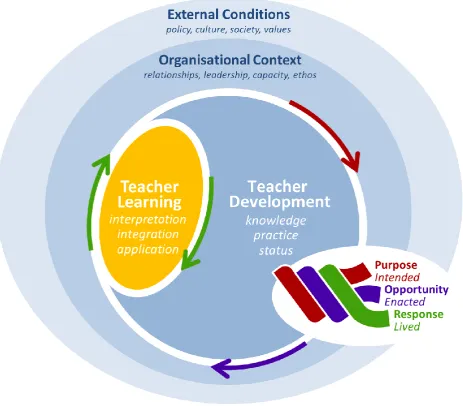
In this thesis, teacher professional growth is conceived as complex, relational, adaptive and recursive, comprising processes of learning and development. Teacher learning is considered an ongoing, everyday process of building on experience through interpretation, integration and application. Teacher development is viewed as a continuous, longer-term process of journeying, more outward-facing to encompass professional knowledge, practice and status. Professional growth unfolds within one or more organisational contexts that mediate the external
conditions of an educational system currently dominated by performativity. Teacher practice-based inquiry is explored as a vehicle for professional growth.
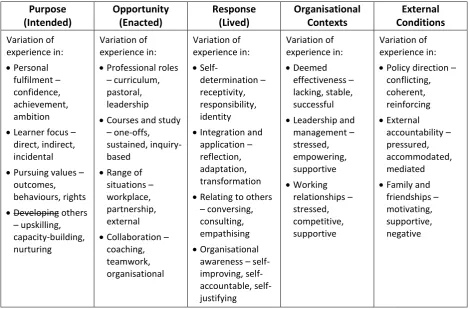
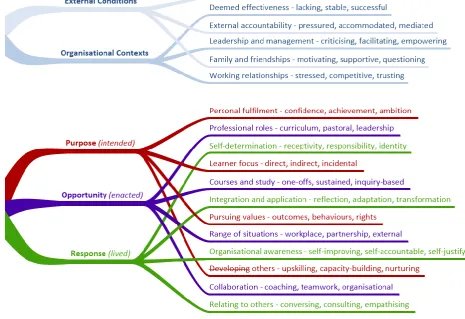
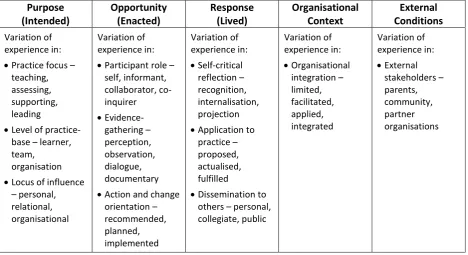
Suggested critical aspects of teacher professional growth are intended purpose, enacted opportunity and lived response, considered intertwined or complex and employed as an interpretive framework. Six secondary teachers have participated in this study, through
recorded conversational accounts of professional growth and twenty written accounts of their practice-based inquiries. Unravelling purposes, opportunities and responses in this material suggests categories of description and variation that together form a possibility space, for both interpreting past experience and projecting future potential. Teacher practice-based inquiry offers an expanded space of possibilities for professional growth.
This study utilises the theoretical perspectives of complexity thinking and participatory inquiry, complemented by agential realism, enactivism and relational being. Together, these trans-disciplinary approaches challenge representationalist ontologies and epistemologies,
embracing axiology, and positioning researcher and participants as part of the phenomena to be studied. A recurring theme is complicity, mutually adaptive change, between teacher and learner, leader and teacher, teacher and context, and researcher and research. The
contribution made by this thesis is a re-working of conceptualisations of teacher professional growth, combining identity, experience, learning and development, in a continual and complicit process of being and becoming, sustained through a sense of belonging. The resulting
Chapter One
–
Introduction
The practical and theoretical basis for this thesis
The purpose of this research is to understand ways in which teachers interpret, integrate and apply developmental experience within their practice – how they live their learning and grow professionally. It explores perceptions of teachers who have utilised practice-based inquiry as a vehicle for learning, the factors that enable and inhibit their endeavours and the perceived impact on their communities. While teacher professional learning and development is a well-established field, this research builds on the relatively few published accounts of actual teacher experience and perceptions of their own learning. The starting point is the notion of
‘heutagogy’ as ‘learner-centred learning that sees the learner as the major agent in their own learning, which occurs as a result of personal experiences’ (Hase and Kenyon, 2007, p.112). Teacher learning thereby embodies occupational knowledge and skills acquisition, through agentive response in further integration and application to practice. In this study, purpose, opportunity and response in teacher development and learning, defined together as professional growth (Taylor, 2017), are identified as critical aspects and understood to be
‘woven together’ or complex (Morin, 2007, p.6).
Complexity thinking, a strand of complexity theory, has become an orienting perspective for this thesis, providing a conceptual, metaphorical, philosophical and methodological framework. Heutagogy is characterised as a ‘child of complexity theory’, due to its focus on self-organised or self-determined learning (Hase and Kenyon, 2007). Complex (in this case living) systems, in contrast to those that are simple or complicated, are distinguished as those that learn, through interaction with others, their organisational context and external conditions. A simple
deterministic conception of professional growth assumes teacher development opportunities necessarily lead to changes in individual or group practices in line with stated training goals. A more complicated approach acknowledges many factors in the development of teacher
This thesis contributes to a growing body of complexity-oriented research in education, exploring the self-determined learning of six secondary teachers as case study participants. Four of these teachers have been my students when undertaking further professional and academic studies, two have become known to me mainly through this research. Complexity thinking is motivated by the practical, forward-looking question of ‘[h]ow should we act?’, more than the ‘fact seeking “What is?” or the interpretation seeking “What might be?”’ (Davis and Sumara, 2006, p.25). This realisation has consolidated during the research process, moving the study from ‘mirroring to making’– a ‘future forming orientation’ (Gergen, 2015, p.294). Such a shift implies that the ‘aim of research would not be to illuminate what is, but to create what is to become’ (Gergen, 2015, p.294). Therefore, exploring teacher development and learning affords expanded future contributions and possibilities for professional growth. This study becomes, in part, autoethnographic and, as an account of self-determined learning, my own practice-based inquiry.
A related methodological perspective is offered by the ‘participatory inquiry paradigm’, encouraging a shift from research ‘on people’ or ‘about people’ to research ‘with people’
(Heron and Reason, 1997, p.285, original emphasis). A participatory approach, as understood and applied here, offers case study participants opportunities to co-design ways of exploring their professional growth, including through self-determined practice-based inquiry. Teacher development and learning, conceived as complex and unpredictable, individually and
collectively self-generated, invites a participatory orientation, with profound implications for both research methods and their philosophical principles. Complexivist, participatory inquiry positions the researcher as part of the phenomenon to be studied, with the potential to influence and shape its reality, in contrast with forms of research positioning the researcher as objective onlooker, seeking representations of an independent reality. In the participatory paradigm, ‘experiential encounter with the presence of the world is the ground of our being and knowing’ (Heron and Reason, 1997, p.276).
The participatory and complexity paradigms also embrace axiology, in a broad conception of
is understood as oriented towards the good or benefit of those involved and the self-similarity of teachers tending to conceive their own learning needs in terms of others’ needs, particularly those of their own students (Taylor, 2017). Therefore, this research does not attempt to
narrowly define the impact of teacher learning by measuring student achievement and surmising linear cause and effect. Instead, teachers’ perceived impacts of their own
development and learning in relation to that of others are sought, within the much broader conception of praxis. Reciprocal relationships between teacher experiences, their lived learning and the organisational contexts in which these occur, influenced by external conditions, are of principal interest.
Both complexity thinking and the participatory worldview are informed by an ‘enactive view of cognition’, which maintains that living beings ‘enact or bring forth significance in their intimate engagements with their environments’ (Thompson, 2011, p.114). Enactivism, in which cognition
is considered ‘a biological act’ (Proulx, 2008, p.12), extends some forms of constructivism in asserting that ‘our participation is affected by and affects back the world we live in’ (p.23). A deeper understanding of the lived realities of teacher professional growth are sought through the experiences, perceptions and interpretations of participants, including my own. The bringing together of multiple perspectives, using material to hand and offered by participants, is a form of ‘bricolage’ that entails an ‘active role for humans both in shaping reality and in creating the research processes and narratives that represent it’ (Kincheloe, 2005, p.325). This study also utilises ‘phenomenography’, focusing on ‘the variation in ways of experiencing
phenomena’ (Marton and Booth, 1997, p.111, original emphasis), in this case the complex processes of teacher professional growth, comprising learning and development.
Compatible insights are offered by ‘agentialrealism’, in which agency is understood as
‘enactment, not something that someone or something has’ (Barad, 2007, p.178, original emphasis). Bringing together quantum physics and discursive social practices, agential realism asserts that ‘knowing, thinking, measuring, theorizing, and observing are material practices of intra-acting within and as part of the world’ (ibid, p.91). Through intra-action Barad provides a unifying concept between complexivist and participatory worldviews and, further, posits
‘ethico-onto-epistem-ology’, as ‘an appreciation of the intertwining of ethics, knowing, and
‘[h]uman beings are depicted as essentially self-referential and reflexive, and human enterprise as inescapably responsive and participative’. Similarly, within social constructivism, proposing our relational being Gergen (2009, p.53) suggests it is through ‘collaborative action that all meaning emerges’. These perspectives share with the participatory paradigm emphasis on
‘experientialknowing’ and the co-creation of reality through interaction with the ‘given’ world (Heron and Reason, 1997, p.278). Ontologically and epistemologically, ‘both the nature of the world and human sense-making are dynamic and emergent’ (Kuhn, 2008, p.174).
The theoretical perspectives shaping this research and my positionality as researcher receive fuller discussion and justification in subsequent chapters. They are introduced at this stage to give meaning to the research aims and questions that follow and to make explicit from the outset my own complicity. Stewart (2007), interweaving the words simplicity and complexity, explains that education is an example of complicity because ‘the student is changed by the educational process – but so is the teacher’ (p.106, original emphasis). Here, this notion of complicity is extended to propose that what is researched is changed by the research process –
but so is the researcher. Complexity thinking requires acknowledgement of the complicity of the researcher, who has an ethical responsibility to question how they are ‘affecting or hoping to affect’ what they study (Davis, 2008, pp.63-64). Complicity calls for the critical reflection of researchers or learners who are ‘entangled’ in what they are researching and learning (ibid, p.174). It is through complicity that I become a participant in my own research, recognising that
‘we are woven into what we research, just as it is woven into us’ (ibid, 2006, p.16).
Complicity, as used here, transcends everyday, often negative, connotations to become a recurrent theme in this work, across physical, biological, cognitive, social and educational fields. It offers a heuristic for many abiding dichotomies, between mind and body, nature and nurture, structure and agency, quantity and quality, cause and effect, objectivity and subjectivity,
change again ...’. In a paradigm of complexity, this is ‘recursive causality’, wherein ‘[t]he
product is the producer of that which produces it’ (Morin, 2008, p.61). This study suggests that professional growth emerges at the boundary between teacher experience and context, through the interwoven relationship between purpose (intended), opportunity (enacted) and response (lived) (Lo, 2012; Taylor, 2017). These critical aspects are considered recursive, such that feedback shapes dynamic change and ‘[c]auses produce effects that are necessary for their own causation’ (Morin, 2007, p.14). New insights into the processes of teacher learning and development, as professional growth, are pursued through an understanding of complicity.
The rationale and importance of this research
Reflecting on my own complicity, aspirations for professional growth wherein cultures of trust promote active responses to contextual needs, promoting ownership of opportunity and transformative purpose, will be apparent. Recognising that teachers work in politicised and normative public services, where expectations of multiple stakeholders are not necessarily or easily aligned, my work involves supporting heutagogy and praxis through action research and practice-based inquiry. Individuals and groups of teachers are afforded planned opportunities for self-determined learning, combining evidence, action and reflection, while respecting their context and acknowledging competing occupational demands. This approach contrasts with top-down effectiveness and improvement agendas, which tend to view teachers as the last stage of a centrally prescribed delivery chain. The term ‘performativity’ is short-hand for this latter outlook, which ‘requires individual practitioners to organize themselves as a response to targets, indicators and evaluations’ (Ball, 2003, p.215). Complexity thinking explores such issues by studying relationships between systems as a whole and their parts – a ‘whole-part mutual implication’ (Morin, 2006, p.6). For example, in the current education system, student and teacher performance is driven and measured competitively by examination results, with perceived success dependent on above-average outcomes (Taylor, 2015).
Renewed manifestations of performativity arise in calls for based or
question what works, implying that ends justify means when the follow-up questions for what purpose and for whom are overlooked. These ends are often taken for granted as the targets and indicators of performativity, expressed as published outcomes for learners in high-stakes examinations. Contemporary and influential examples of research seeking evidence-based practice of what works are found in the work of John Hattie (2008, 2012) and the Education Endowment Foundation (EEF) Teaching and Learning Toolkit (EEF, 2016), as well the
contribution of physician and populist exposer of ‘bad science’ Ben Goldacre (2013). Hattie’s (2008) synthesis of over 800 meta-studies quantifies wide-ranging influences on pupil achievement in average effect sizes across the available evidence. Most teacher effects are between 0 to 0.4, leading Hattie to conclude that we should be implementing approaches that, on average, exceed 0.4 and bring about more ‘visible learning’. We should not be content with
‘what works’, which is ‘almost everything’, so instead we should be concerned with ‘what works best’ (Hattie, 2008, p.18, my emphasis).
Another synthesis of influences on attainment, provided by the Teaching and Learning Toolkit (EEF, 2016), recommends expenditure of Pupil Premium funding targeted at children
considered ‘disadvantaged’. Impact is estimated as ‘additional months progress’, based on effect sizes, acknowledging that gains may or may not be realised when applying the toolkit. It becomes clear that what works is principally concerned with average effects on pupil
achievement, privileging measures of attainment from testing. Goldacre (2013) makes the case for randomised controlled trials (RCTs) in education, asserting their rigour for establishing ‘what works best’, for teachers to adopt similar practices. This demands experimental designs
Complexity thinking calls into question any ‘assumption that what works well in one context should work well in most contexts’ (Davis and Sumara, 2006, p.100). This was realised long ago by Stenhouse (1981, p.107), pointing out that teaching approaches cannot be assumed or predicted for all circumstances because the ‘teacher’s task is to differentiate’. The detail of different approaches for individual pupils and interactions in specific contexts, as opposed to average effects across samples, may be more useful evidence for teachers. Education
understood as complex leads to acceptance of less prescriptive and controlling roles for research, towards ‘description and critical explanation’ (Radford, 2008, p.145). Rather than seeking a ‘finished reality’, this approach emphasises ‘temporal’, ongoing ‘ways of interacting’
with reality (Osberg et al, 2008, p.206). Emphasis on dynamic processes and systemic change through interactions between individuals, collectives and their contexts, rather than measured outcomes or essential features, is found in several theoretical perspectives coherent with complexity thinking, including organisational learning, participatory inquiry, agential realism, enactivism and relational being.
This research is important because its point of departure is an understanding that findings from published research cannot be put into practice simplistically and unproblematically. Teachers re-contextualise such evidence through heutagogy (interpretation, integration and application) and praxis (action for the good of all involved). A complexivist view proposes that ‘knowledge must be contextual’ (Haggis, 2008) and teachers are not detached observers but insider participants who come to know their learners and contexts well. Of central interest is practice-based inquiry as a vehicle for heutagogy and praxis, alongside experiences of professional growth where learning is less formalised, expansive or tacit. This work seeks ways to understand and nourish professional growth, through reading and listening to teacher
accounts, conversing with and working alongside them, together describing, interpreting and acting upon experiences such that further insights can be gained and progressed.
Research aims and questions
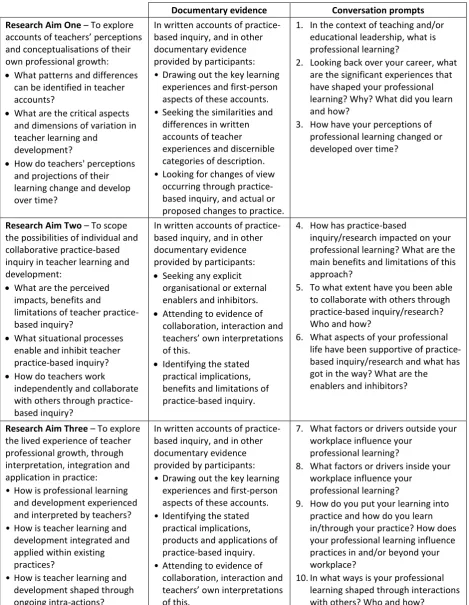
Three research aims emerge from the preceding discussion, each with three associated
different across cases, their critical aspects and features and how they change over time. The second aim focuses more closely on the vehicle of practice-based inquiry, the perceived benefits and limitations of this approach, the situational enablers and inhibitors and ways of working independently and collaboratively through inquiry. The third, aim explores the heutagogy of lived learning, how learning is experienced and interpreted, how it is integrated and applied within existing practices and how it is shaped and shared through intra-actions. The term intra-action is used to indicate, beyond social interaction and communication, the agentic, complicit role teachers play as participators in the educational practices they pursue.
Research Aim One – To explore teachers’ perceptions and conceptualisations of their own professional growth:
• What patterns and differences can be identified in teacher conceptualisations?
• What are the critical aspects and dimensions of variation in teacher accounts of learning and development?
• How do teachers’ perceptions and projections of their learning change and develop over time?
Research Aim Two – To scope the possibilities for individual and collaborative practice-based inquiry in teacher learning and development:
• What are teachers’ perceived impacts, benefits and limitations of practice-based inquiry?
• What situational processes enable and inhibit teacher experiences of practice-based inquiry?
• How do teachers learn and develop independently and collaboratively through practice-based inquiry?
Research Aim Three – To explore lived experiences of teacher professional growth, through interpretation, integration and application to practice:
• How is professional learning and development experienced and interpreted by teachers?
These three aims and associated questions are pursued throughout this thesis, first within a literature review offering a more thorough explication of the ideas introduced above. Drawing on a range of relevant theory, policy and research, the main literature review themes are summarised here. First, meanings of teacher professional growth are addressed, conceived as the combination of teacher development and teacher learning. While these terms are often used interchangeably, recent distinctions in the literature are explored and a definition arrived at based on existing ideas and models. The catch-all term continuing professional development (CPD) is located within this debate, and professionalism and professional identity are explored, recognising that what it means to ‘beprofessional’ is far from settled. Complexity thinking is also introduced, threading it through the literature on teacher learning and development, establishing terminology that informs the entire thesis. Addressing the organisational contexts and external conditions for teacher professional growth, issues of leadership, power and policy are considered, focusing on tensions between autonomy and accountability, emancipation and efficiency, performativity and creativity. These are located within discussions of educational effectiveness and improvement, which began as distinct research and development traditions but have become increasingly overlapped and conflated.
Published research is reviewed to establish the characteristics of teacher professional growth typically deemed effective and valuable, as well as the extent to which these are experienced. This material ranges from quantified studies seeking effects of professional learning and development, teacher responses to local, national and international surveys to more context-based and situated accounts of teacher learning and development. Teacher descriptions and perspectives are less prominent within the research literature, with much of the published material emanating from university teacher education and school effectiveness and
improvement traditions. The underlying assumptions and causal models informing this research are addressed and problematised. Controversies over evidence-based practice are also
The literature review then turns to heutagogy, its relevance to teacher professional growth and links to other contemporary learning theories, including Illeris’ comprehensive theory of
learning, Engeström’s expansive learning and Marton and Lo’s variation theory. The place of practice-based inquiry as a vehicle for self-determined learning, its relationship to evidence-based/informed practice and debates over what counts as research are considered. Complexity thinking as a trans-disciplinary perspective draws upon not only the cognitive and social aspects of learning, but also biological, evolutionary and physical considerations. It is explored
Chapter Two
–
Literature Review
Understanding teacher professional growth through complexity thinking
Assertions of teacher professional learning and development as complex processes are
frequently found in the extensive literature (e.g. Day and Sachs, 2004; Timperley, 2008; Avalos, 2011). However, it is less common for complexity theory, particularly the variant known as complexity thinking, to be used as an explanatory or developmental framework. An important theme of this chapter is that while the features of effective teacher professional development are well-documented and commonly understood, they are neither prevalent in educational practice nor guaranteed to bring about desirable change. Allied to this are contested
conceptions of teacher development, as done to teachers to improve their effectiveness, or done by teachers to grow professionally. Further emerging realisations are that causal assumptions underlying attempts to measure the effectiveness of teacher learning and
development are seriously undermined by complexity thinking and that measuring apparatuses are constitutive of the phenomena they seek to gauge.
The etymology of complexity can be traced to the 17th century French complexe, meaning
‘composed of parts’, ‘complicated’ and ‘intricate’ (Harper, 2017). Further back, the word complex stems from the Latin complexus, meaning ‘surrounding, encompassing’; complecti, meaning ‘to encircle, embrace’; and complectere, meaning ‘to weave, braid, entwine’. Harper (2017) notes a further meaning of complex as ‘not easily analyzed’, first recorded in the early 18th century. These origins point to principles of complexity thinking introduced here and threaded through this work, which have provenance and relevance in various theoretical traditions. As Morin (2008, pp.42-43) suggests, elements of complexity thinking can be found in the words, 2,500 years ago, of the Greek philosopher Heraclitus and in ancient Eastern
philosophies. Nevertheless, the coalescing of ideas from many fields within complexity thinking, as a relatively new orientation, can productive in conceptualising teacher professional growth.
(Richardson and Cilliers, 2001, pp.7–8). Drawing on the related field of organisational learning, complexity thinking involves ‘Seeing Interrelationships, Not Things, and Processes, Not
Snapshots’ (Senge, 2006, p.781, original emphasis and capitalisation). Complex systems
contrast with ‘simple’, mechanical systems in which stimulus or change in one component leads to a predictable effect on another, and ‘complicated’ systems with a larger number of elements that interact in probabilistic or determinable ways (Cilliers, 1998; Davis and Sumara, 2005a). Complex, often living, systems are those that learn through the interaction of their
components, individually and collectively, responding to situational conditions and exhibiting
‘self-organization ... also known as emergence’ (Davis and Sumara, 2006, p.81, original
emphasis). A tendency towards treating the complexity of education, teaching and learning as merely complicated or even simple, has perhaps stifled attempts to understand it.
Complexity characterises processes at work in the brain, language and social collectives, interactions between parts or members in the system forming networked, connectionist structures where information and knowledge is distributed (Cilliers, 1998, Gershenson and Heylighen, 2005). Such networks tend to be ‘scale-free’ and ‘decentralised’, whereby nodes form clusters with relatively small degrees of separation between them (Davis and Sumara, 2006, pp.50-52). This combines efficient movement or information flow with robustness to node failure, the Internet providing a key example wherein each computer is linked to every other by no more than twelve steps (ibid). Systems that learn over time embody a history, past experience influencing future behaviour, where interaction with the environment characterises them as open (Cilliers, 1998, p.4). However, complex living beings are also organisationally closed, maintaining a boundary with their environment while structurally coupled and congruent with it (Thompson, 2010, p.45).
Complexity features context-sensitivity or responsiveness to initial conditions, leading to dynamic and unpredictable organisations and environments (Morrison, 2008, p.19).
Unpredictability does not imply complex systems are chaotic or emergence is random (Cilliers, 2005, p.12) – they have a ‘richstructure’ (e.g. the brain, language) (p.11) – but non-linear interactions mean ‘small causes can have large effects’ and vice-versa (p.10). Multiple
systems, including agents and collectives, over time, within the larger systems of which they form a part (Haggis, 2008, pp.159-161).
Emergence and self-organisation are important distinguishing features of complex, as compared to simple or complicated, systems. Emergence is a ‘bottom-up’ process, whereby discernible properties or capabilities of systems are not reducible to their components and require no ‘overarching governing structures’ (Davis and Sumara, 2006, p.5). This does not imply the absence of environmental influences, rather complex systems are adaptive in responding to these, with downward causation exerted from the higher-level organisation of the system to the lower-level parts (Capra and Luisi, 2016, p.158). All living beings exemplify complex emergence, through the autopoietic manufacture of their own components and the evolutionary process (Murphy, in Murphy et al, 2009, p.7). Similarly, self-organisation refers to the tendency of collectives to develop capabilities that ‘exceed the possibilities of the same group of agents if they were made to work independently’, for example ant colonies, flocking birds or human social groups (Davis and Sumara, 2006, p.81). Gershenson and Heylighen (2005, p.55) define organisation as ‘structure with function’, the latter implying goals or purposes that in most basic terms are associated with survival or flourishing. Self-organisation in complex systems features flexibility, adaptiveness and openness, without centralised control, arising from interactions between agents or components (Gershenson and Heylighen, 2005, pp.55-6).
The human process of complexity thinking is ‘practice-oriented’ with a ‘pragmaticemphasis’
(Davis and Sumara, 2006, p.25), resonating with the professional judgement and practical wisdom required for teaching. A growing body of literature conceptualises education, teaching and leadership in terms of complexity, sometimes referring to ‘wickedity’ (Bore and Wright, 2009). A ‘wicked’ issue or problem is one that is ‘not easily defined, has many causal levels and cannot be solved by generic principles or linear heuristics’ (ibid, p.242). In contrast, ‘tame’
Applying complexity thinking to teacher professional growth, a simplistic approach might assume development opportunities necessarily precipitate changes in individual or group practices, following stated training goals. A more complicated approach would acknowledge multiple factors for developing teacher practice, supposing that appropriate conditions and interventions are likely to bring about desired changes. A complex approach accepts that development is influenced in unpredictable ways, through participant volition and motivation, their interactions with each other and with their environments. Such agentive responses also shape and are shaped by past experiences, current circumstances and future directions. Such contingencies can be considered, in complexity terms, as attractors or ‘the organising forces that guide behaviour’ (Kuhn, 2009, p.80). The model of professional growth developed and utilised in this thesis, based on previous work (Taylor, 2017), responds to Opfer and Pedder’s (2011a) call for more research in this field to adopt a complexity framing. The epistemological implication is a focus on cases of the functioning of relationships between agents in context, ‘as
if from within’ (Haggis, 2008, pp.159-161, original emphasis).
Distinguishing complexity thinking from other strands of complexity theory, it makes no claims as a metanarrative or theory of everything, but ‘is an attitude toward the interpretation of particular sorts of phenomena’,‘foregrounds its own implicatedness in those interpretations’
and ‘shapes attitudes and actions towards those phenomena’ (Davis and Sumara, 2006, p.35). Thereby, complexity thinking has both epistemological and ontological implications for the phenomena we study and of which we form a part. A recurring theme of complexity thinking for this work is complicity, with derivations in 17th century French complicit, meaning
‘accomplice’, suggesting criminal connotations in common usage. However, complicity also stems from the Latin complicem, meaning ‘partner’ or ‘confederate’ and complicare meaning
‘to fold together’ (Harper, 2017). Jack Cohen and Ian Stewart, from work in biology and mathematics respectively, derive the terms simplexity and complicity through interplay of simplicity and complexity (Cohen and Stewart, 2000). Simplexity describes a ‘process whereby a system of rules can engender simple features’ (ibid, p.411), whereas complicity occurs when
‘systems interact in a way that changes both and erases their dependence on initial conditions’
learns teaches in the act of learning’. In a further expression of complicity, ‘[a]s teachers learn, new knowledge emerges from the interaction of the teacher learning systems, and this new knowledge then recursively influences future learning and also what is to be known about
teaching’ (Opfer and Pedder, 2011a, p.388).
A contention here is that much teacher learning and development research and policy seeks simplexity, invoking input-output path models that assume training leads to changes in teaching and thereby student learning or outcomes. The measurement assumption is that output
(effect), can simply be attributed to input (cause). However, this overlooks reciprocal relationships and confederations, folded together between teachers and learners, their
colleagues and leaders, their organisational contexts and external conditions. Thus, complexity thinking may be more apt for attempting to understand teacher professional growth. This entails a shift away from ‘input-output ‘black-box’ causal models’ towards the exploration of
‘specific, local linkages that actually interconnect actors, practices, and events across multiple levels of organization’ (Lemke and Sabelli, 2008, p.122). The attraction of simplexity is obvious, particularly for policy-makers; if we can find what works and do more of it, surely we achieve better results or outcomes. However, this way of thinking becomes inadequate if we accept that learning and action result from agentive responses to experiences and opportunities, including those emanating from policy, such that initial purposes and intentions are re-shaped and dependency erased. This perspective is one of complicity.
Teacher professional growth – a combination of learning and development
Drawing on a range of published material and through listening to and interpreting teachers’
accounts, professional growth can be conceptualised as a combination of learning and development (Taylor, 2017). A distinction between these two overlapping terms is evident in connotations of ‘systematic career progression’ in teacher development, and ‘critically reflective and less performative’ aspirations for teacher learning (O’Brien and Jones, 2014, p.684). A similar contrast is made by Timperley (2011), associating teacher professional development with ‘delivery’ (p.4) through ‘someone else’s desire to tell’ (p.14, original
professional growth is used to encompass both teacher learning and development. As an ongoing process, perhaps punctuated with breaks, professional growth is viewed as
synonymous with continuing professional learning and development (CPLD), adding learning to the more prevalent term CPD (O’Brien and Jones, 2014, pp.683-4).
Associations of development with delivery are relatively contemporary, for as Eraut (1977, p.10) pointed out forty years ago, ‘it is the teacher who develops (active) and not the teacher who is developed (passive)’. This prompts consideration of what precipitated this shift of meaning and how widespread it has become. In Eraut’s earlier definition, teacher development is ‘the
natural process of professional growth in which a teacher gradually acquires confidence, gains new perspectives, increases in knowledge, discovers new methods and takes on new roles’
(ibid). This encompasses teacher learning and implies other earlier conceptions of teacher development emphasising ‘refinement of judgement’ (Stenhouse, 1975, p.24) and ‘reflection upon experience’ (Holt and Juraschek, 1998, p.24). Similarly, a more recent formulation of teacher development invokes ‘change that would generally be categorised as learning’ (Evans, 2002, p.132) and a decade of research concludes that ‘professional development is about teachers learning, learning how to learn, and transforming their knowledge into practice for the benefit of their students’ growth’ (Avalos, 2011, p.10).
For Timperley (2011, p.14), development as delivery emanates from ‘policy makers, researchers or professional development providers’, promoting evidence indicative of more effective
practices and therewith teacher compliance. However, her earlier study (Timperley et al, 2007) (discussed below) is perhaps an example of this approach. Similarly, Senge (2012, p.397)
organisational conditions and the importance of relationships and involvement among all parties, including parents (ibid, pp.397-8).
A point of departure in this thesis is recognition of both a distinction and a conjunction between learning and development as interrelated contributors to teacher professional growth. This draws on Morin’s (2006, pp.6-7) articulation of complexity thinking, wherein the relationships between the two elements or aspects are recognised, maintaining their
distinction, while the recursive conjunction between them and the whole is also contemplated. At this stage, the distinction is made between learning as more reflective, generative and interpretive, and development as more externally influenced and mediated. However, the conjunction of learning and development resides in their common orientation towards processes of growth and change. Models for exploring the critical aspects, dimensions and features of professional growth, comprising learning and development, introduced in this chapter. First, meanings of the term professional and its variants are considered, prompting a discussion of performativity in establishing the external conditions for the teaching profession, followed by common characteristics and prevalent models of CPLD.
The ‘P’ in CPLD – professional, professionalism, professionality and professionalisation
The highly contested and debated term professional requires clarification when conceptualising professional growth or CPLD. The term is used by Hargreaves (2000, p.152) to encompass both
‘professionalism’–‘quality and standards of practice’, and ‘professionalization’–‘status and
standing’. More recently, Hargreaves and Fullan (2012, p.80, original emphasis) similarly distinguish between ‘beingprofessional’ through actions, behaviour, character, conduct and performance, and ‘being a professional’ within the external views of others and associated self-regard. Behaviours ascribed to being professional include, ‘not getting too personally involved with children, refraining from gossiping about parents, and learning to challenge colleagues’
The recognised features of a profession include an identifiable body of knowledge and associated skills in its practical application, which may be indeterminate and ‘relatively
inaccessible to the uninitiated’ (MacBeath, 2012, p.15). Typically, professions have a high degree of autonomy and self-determination over entry requirements, representative bodies and regulation of practices (ibid). Evetts (2013, p.780) emphasises the placing of trust in professionals by those they serve, their clients, often involving an exchange of confidential knowledge which both preserves trust and confers status. Thorpe (2014, p.2) confirms that, for a profession, ‘those who are in it define the key terms’, before suggesting that teaching lacks such self-determination. Similarly, Winch (2011) questions the professional characteristics of teaching, particularly the existence of an agreed body of theoretical knowledge to inform practice, partly arising from the contestability of much educational research. According to Winch (2011, p.16), the skilful application of such a knowledge base, in the role of technician, is associated with professionals such as doctors and lawyers but often resisted by teachers. Resistance may result from perceived loss of teacher autonomy in England over the last thirty years, following the establishment of a statutory National Curriculum and school inspection regime, as well as non-statutory government interventions such as the National Strategies (ibid, p.13). In this context, the teacher may become a ‘low-level technician’ who follows
prescriptions with limited opportunity to exercise professional judgement (ibid, p.23).
An alternative to the technician is the ‘craft worker’, who does not rely on established theory but applies ‘situationaljudgement’ in response to ‘local needs and conditions’ (Winch, 2011, pp.16-17). This view of teaching, with training through apprenticeship, has recently been advocated by the former Secretary of State for Education in England, Michael Gove (Orchard and Winch, 2015, p.12). However, Winch finds difficulty applying this role to teaching, as the
‘aims and general principles’ of craft work are handed down and may be built on ‘prejudice’
rather than knowledge (p.17). Winch (2011, p.24) concludes that to enhance teaching as a profession the establishment of a more ‘rigorous knowledge base’ is preferable to the ‘craft
knowledge and/or technical recipes’ pursued by successive governments, involving teachers in the generation, understanding and evaluation of theory to inform practice. Orchard and Winch (2015, p.14), rejecting teaching as purely technical or craft-oriented, set out their view of the
to make good situational judgments does not rely on hearsay or unreflective prejudice. She draws on a well-thought-through and coherent conceptual framework, on knowledge of well-substantiated empirical research, and on considered ethical principles, to arrive at decisions in the classroom context.
Similarly, the ‘teacher as professional’, in terms of ‘effectiveness’ and ‘identity’, combines ‘subject and pedagogical knowledge’, ‘practical experience’ and‘research literacy’ (BERA, 2014,
p.10), the latter entailing critical understanding of published educational research (p.40).
Informed teacher decision-making is formulated in ‘professionalcapital’, with capital defined as the ‘assets that can be leveraged to accomplish desired goals’ (Hargreaves and Fullan, 2012, p.1). This in an alternative to ‘businesscapital’, which views teachers as educational assets to be deployed for a quick return, rather than developed or invested in (ibid, p.2) and teaching as
‘technicallysimple’ requiring only minimal training (p.36). In contrast, professional capital
‘requires technical knowledge, high levels of education, strong practice within schools, and continuous improvement over time that is undertaken collaboratively, and that calls for the development of wise judgment’ (Hargreaves and Fullan, 2012, p.37). Professional capital is a function of three other forms: human capital, involving subject and pedagogical knowledge (p.89); social capital, concerning relationships and interactions, support and trust (pp.89-90); and decisional capital, in the ability to make sound judgements based on practice and
experience, including in uncertain situations (pp.93-94). For Hargreaves and Fullan (2012, p.86, original emphasis) it is through building teachers’ professional capital that both teacher quality and status can be addressed –‘[t]eachers need to be professional and to be professionals’.
Professionalism, as proposed by Evans (2008, pp.25-6), encompasses both practice and status, viewed as a ‘collective notion ... shared by many’, with ‘professionality’ as one’s individual, singular stance towards/within this ‘plurality’. For Evans (2008, pp.26-7) professionalism is ‘the
amalgam of multiple ‘professionalities’– professionality writ large’, within an iterative rather than linear relationship. Citing Archer, Evans compares this idea to the critical realist
explanation of interaction between structure and agency. Mediation through interaction involves reflexivity, such that ‘by reflexively defining their doings, subjects are ultimately responsible for shaping and reshaping the social order – while simultaneously being shaped by it, as persons, agents and actors’ (Archer, 2013, p.8). Evans (2008, p.27) explains that ‘the
professionalism, which, in turn, stimulates or provokes responses in individuals that determine their professionality orientations’. Similarly, theorists of human development propose a
mutually dependent ‘dialectic between autonomy and self-regulation’, where the latter
concerns the developmental internalisation of social values and norms (Sawyer, 2013, p.92-3). Development is thereby emergent in the social structures arising from autonomous
interactions, with these structures exerting causal influence over individuals (ibid). These dialectics between agency and structure, autonomy and self-regulation can also be interpreted as expressions of complicity.
The complex, mutually implicated relationship between professionalism and professionality (Evans, 2008) parallel Bourdieu’s (1998) subtle and relational concepts of ‘field’ and ‘habitus’. Professionalism, as an amalgam of professionalities, seems consistent with the notion that
‘fields comprise both the structural relations sedimented from the past (actors long dead both individual and collective) and those current’ (Byrne and Callaghan, 2014, p.113). Similarly, professionality implies the embodied ‘reproductive dimension of human action’ associated with habitus (ibid). However, Byrne and Callaghan (2014) further explain habitus in terms of ‘pre -conscious orientations to action’ (p.113), such that individuals are ‘carriers of habitus but this is not synonymous with agency’ (p.114). Arguing against utilitarianism and ‘consciouscalculation’, Bourdieu (1998, pp.78-80) proposes:
a relationship of ontological complicity between the habitus and the field. Between agents and the social world there is a relationship of infraconsclous, infralinguistic complicity: in their practice agents constantly engage in theses which are not posed as such.
Complicity as evoked here by Bourdieu appears to deny individuals conscious agency through the socialised routines of habitus. Instead, Archer (2013, p.5) argues for the ‘extensiveness of reflexivity’ in contemporary life, which accompanies a ‘decline in routine action’.
Following Bourdieu (1998, pp.80-1), professionalism as enactment might be conceptualised as a
‘feel for the game’, where one is ‘absorbed in their affairs’ or ‘doings’, through their practices.
Thus absorbed, they are ‘not like subjects faced with an object’, they perceive and act through
structural and cultural factors upon social action’. Gergen (2009, p.56, my emphasis) notes a
‘family resemblance’ between his idea of reciprocal influences, or ‘confluence’, and habitus, while questioning Bourdieu’s implications of ‘individual dispositions acquired from determining structures of family, education, physical location, and the like’. Following Gergen (2009, p.58),
professionalism as enactment might be a case of ‘drawing from our relational histories in such a
way that new and more promising confluences result’. Introducing the term confluence, Gergen
(2009, p.56) is attempting to move beyond ‘traces of both a mind-world dualism and
cause-effect explanation’ found in habitus.
As teaching and teacher education are externally regulated and accountable practices, inevitably evidence of efficacy is sought in the assumed effects on student outcomes, particularly as measured in standardised and/or public assessments. The UK government Department for Education (DfE) publishes professional quality standards DfE, 2011, 2015, 2016b) and, through the Office for Standards in Education (Ofsted), evaluation criteria (Ofsted, 2017), which are used to inform training, development, performance management and
inspection. Characterisations of these standards as instruments of government control are increasingly commonplace (Ball et al, 2012; Beck, 2008, 2009; Evans, 2011). Currently in England the Teachers’ Standards (DfE, 2011), ‘developed by an independent review group made up of leading teachers, headteachers and other experts’ (DfE, 2014, p.1), are overseen by the government rather than teacher-led professional bodies, though this may change with the recent establishment of a ‘Chartered Collegeof Teaching’ (Astle, 2017, p.124). Nevertheless, even within a political climate of prescribed curricula, recommended best practices, published performance measures and external scrutiny, teaching requires the exercise of agency and discretion in the application of policy to practice. Published professional standards and quality frameworks are ‘enacted’, or ‘observed, perceived and interpreted’, which is the ‘only
meaningful conception of professionalism’ (Evans, 2011, p.862, original emphasis).
regulatory bodies simultaneously restricts it. This is compounded by limited coordination among teacher bodies to take on roles of professional gatekeeping and upholding and developing practice. These complex circumstances offer a plausible explanation for the relatively recent association of teacher professional development with delivery (Timperley, 2011, p.4), exacerbated by a shift from professionalism to performativity. Whether teachers consciously and actively influence their professional domain remains a fundamental question in debates over structure as a socialising force and agency as a reflexive response. Such issues of complicity, pertaining to teacher professional growth, are returned to throughout this study.
From professionalism to performativity – autonomy, accountability and inequality
The professional circumstances of teachers have been described as ‘unstable’, emphasising audit cultures as potential de-motivators (Stronach et al, 2002, p.131). These exemplify a business capital approach, whereby ‘data give you all the answers’ and ‘numbers and
spreadsheets will set you free’ (Hargreaves and Fullan, 2013, p.36). Contrasts between business capital and professional capital are mirrored in ‘managerial’ and ‘democratic’ professionalism (Day and Sachs, 2004, pp.6-8), and ‘organizational’ and ‘occupational’ professionalism (Evetts, 2006, p.140-1; 2013, p.787-8). The former is externally regulated by hierarchies, standards and accountability, and permeates through institutions in a ‘discourse of control’, displacing the latter traditional ‘discourse constructed within’ teacher groups, based on collegiality, trust and discretion (ibid). Concern for ‘teaching quality’, fostering innovation and collaborative practice development, is re-focused on ‘teacher quality’, measured using student test scores to
‘standardise practice and attribute blame to teachers where their students fail to ‘measureup”
(Mockler, 2013, p.37, my emphasis). Shifts towards teacher development as delivery are
encapsulated in ‘performativity’, which ‘links effort, values, purposes and self-understanding to measures and comparisons of output’, typically using standardised tests (Ball, 2012, p.19). In a system driven by targets and performance, teachers are the last stage of a centrally prescribed
‘deliverychain’ (Barber, cited by Ball et al, 2012, pp.514-5). The neologism ‘deliverology’,
coined as a ‘light-hearted term of abuse’ by the British Civil Service for Prime Minister Blair’s
The pervasiveness of performativity is delineated in the ‘global education reform movement’ or GERM, widely infecting educational systems, symptoms including standardisation, prioritisation of basic skills, high-stakes testing and associated accountability (Sahlberg, 2011). Contemplating impacts of these reforms on educational practice, Sahlberg (2011, p.180) cites teaching to the test, narrowing of curricula, stifling of creativity and risk-taking, distancing from moral purpose, and professional demoralisation. A further impact is ‘increased control’ from bureaucracy, holding schools to account for the autonomy required for parental choice within a marketised system (ibid, original emphasis), a paradoxical situation also noted by Day and Sachs (2004, p.5). Autonomy and accountability are described by Sugrue (2009, p.373) as the ‘twin policy towers that cast the longest shadows on the educational landscape’, leading to a ‘competing
and conflicting policy agenda’. The bottom-up rhetoric of autonomy coexists in uneasy tension with the top-down tendencies of accountability. Accountability eclipses autonomy when we spend longer ‘reporting on what we do rather than doing it’ (Ball, 2012, p.19).
The supposed advantages of accountability include informing parents of their children’s
educational achievement in comparison to their peers and ensuring public funding is well spent in schools to secure ever-improving results (Mansell, 2007, pp.14-15). However, the education policy imperative of examination results, by which teachers ‘live or die’, has led to ‘hyper -accountability’, with many unintended consequences associated with an ‘education by
numbers’ where ends justify means (ibid). Mansell highlights many issues raised by the GERM, questioning the reliability of examination results and inspection judgements, whether rising results represent better educational standards, the narrowing of education to spoon-feeding for test readiness, and temptations to seek shortcuts, even cheating, to improve results (ibid, pp.219-225). For O’Neill (2013, p.14) such ‘perverseincentives’ are fuelled by an ‘expensive irrelevance’ of ‘bogus units of measurement’ across disparate and non-comparable educational programmes. Perhaps the most damning indictment of hyper-accountability is that it may be
‘anti-educational’, turning ‘the pupil into a passenger in the learning experience’ and placing effort and responsibility with the teacher (Mansell, 2007, p.226).
Performativity and audit cultures are frequently traced to neoliberalism, which takes an
‘accountable and utilitarian approach to education’ (Kascak et al, 2011, p.71). Neoliberalism promotes belief in the market as a ‘natural, normal and desirable’ for directing society,
belief is manifested in increased competition, performance measures and accountability structures, with education a product to be bought and sold, prioritising ‘economicproductivity’
over ‘the social good’ (ibid, p.254). Performativity as an ‘enactment’ of neoliberalism, ‘formed
within the logic of competition’, shapes teacher identity (Ball and Olmedo, 2013, p.88). School effectiveness and improvement studies signal neoliberalism when tending to avoid ‘debate about educational values and purpose’, emphasising ‘basicskills’ in primary schooling and
‘vocationalpreparation’ in secondary (Wrigley, 2008, p.145). Similarly, neoliberal educational reforms outlined by Apple (2013, p.50) comprise prescribed curricula and pedagogies, testing and accountability, within a context of privatisation and competition. This ‘oddcombination’ of marketisation and centralisation has impacted globally on ‘institutions throughout society and even on our commonsense’ (ibid, p.49). However, Apple rejects ‘TINA’, that ‘there is no
alternative’, proposing the democratic pursuit of wider educational goals, relevant to the lives of students beyond the measures of standardised testing (ibid, p.50).
Exploring the encapsulated beliefs of neoliberalism and marketisation, as external conditions for teacher professional growth, Apple (2013, p.6) asserts their ‘religiousstatus’ in assuming
‘choice, competition, markets’ lead to ‘efficient and effective schools’. However, this rarely promotes greater equality and, despite commonplace commitments to social justice and inclusion, prevailing educational policy and institutionalised practices often entrench the opposite (ibid). For example, the ranking of measurable performance at student, teacher, school, university and regional levels reinforces elitism and inequality (Dorling, 2010, 2015). In the wider global economy, despite reductions in severe poverty, the gaps in wealth between richest and poorest are widening to the point where the richest 1% now own more wealth than the rest of the world (Oxfam et al, 2016). Oxfam have calculated that ‘[i]n 2015, just 62
individuals had the same wealth as 3.6 billion people – the bottom half of humanity’; the wealth of these 62 increased by 44% in the previous five years, while the bottom half declined by 41% (ibid, p.2). From a complexity perspective, the ‘absurdity’ of pursuing ‘unlimited
Dorling (2010) posits inequality as both an ‘antecedent’ and ‘outcome’ of social injustice, underpinned by five related beliefs –‘elitism is efficient, exclusion is necessary, prejudice is natural, greed is good and despair is inevitable’ (p.2). While these beliefs are seldom openly supported, the few who accept them are rarely confronted or challenged (Dorling, 2015, p.3). A belief in elitism is perpetuated by ‘bell-curve thinking’, whereby national and international tests are designed so that results fit a normal distribution, most individuals clustered around average scores or grades with the highest and lowest attainers tapering off to either side (Dorling, 2015, p.46; Taylor, 2015, p.247). The normal distribution is found in many naturally-occurring
phenomena such as heights and weights of populations, with ‘normality’ indicating closeness to
the mean, leading to fallacious yet widespread notions in education of the ‘normal’ child (Davis
et al, 2000, p.107). Dorling (2015, p.51) traces bell-curve thinking to ‘IQism’, the intelligence quotient used as a measure of ‘ability’ in post-World War Two Britain to select age 11-plus pupils for type of secondary school. The modern-day equivalents, cognitive ability tests, are still deployed where selective schooling remains and more widely for grouping students by ability. In the early 1980s, Stephen Jay Gould (1996) first drew attention to the ‘mismeasure’ of
intelligence, using mathematical constructs (factor analysis) of correlations and rankings of
results from mental tests. Challenging Herrnstein and Murray’s (1994) famous bell-curve hypothesis, Gould (1996, p.26) exposes ‘deep and instructive fallacies’ in the reification of IQ to
a ‘unitary, linearly ranked, innate, and minimally alterable intelligence’.
The Programme for International Student Assessment (PISA) exemplifies bell-curve thinking, with student scores in reading, mathematics and science tests normally distributed across seven levels (OECD, 2014, Annex B). The stated emphasis in PISA is ‘mastery of processes, the understanding of concepts and the ability to function in various situations within each domain’
(OECD, 2013, p.15) with the words ‘capacity’ and ‘proficiency’ used repeatedly as shorthand. Assumption of normally distributed outcomes is buried within PISA technical documentation, confirming that however students perform in tests the aggregated results would fit a bell-curve (Dorling, 2015, p.52). Designed to compare performance between national education systems by sampling their students’‘capacities’, the resulting bell-curve:
Dorling (2015, p.46) challenges claims that league table rankings help countries at the bottom to pull themselves up. Even if overall standards improve, bell-curve thinking ensures that those at the extremes are kept in their respective places and gaps remain, such that:
[t]his imagined world is a utopia with all benefiting from increased competition, from being labelled by their apparent competencies. This is a world where it is imagined that the good of the many is most enhanced by promoting the ability of the few (ibid).
In England, over 500,000 15/16-year-old students each year take the General Certificate of Secondary Education (GCSE), usually in at least eight subjects. The grades awarded across all subjects (A* to G, becoming 9 to 1) have remained similar in recent years, in a normal distribution skewed slightly towards higher grades (Taylor, 2015, p.240). The Office of
Qualifications and Examinations Regulation (Ofqual) and the examination boards it regulates
ensure ‘comparable outcomes’:
Awarding organisations predict GCSE outcomes for each subject based on prior attainment of the cohort. The aim is that, in normal circumstances, roughly the same proportion of students will achieve each grade in a given subject as in previous years (DfE, 2017c, p.42).
This reveals not only bell-curve thinking, but also self-fulfilling prophecy, because statistical projections of GCSE results from prior attainment at primary school are used to maintain comparable outcomes (Taylor, 2015, p.244). The examination is system is designed, not so that all can do well but to differentiate students, acting as a ‘limiter and sorter’, rendering system-wide improvement unachievable (ibid, original emphasis). The embeddedness of bell-curve thinking and its potentially damaging consequences for those below average are long-standing concerns. Fifty years ago, Benjamin Bloom described normal-curve conditioning and the self-fulfilling prophecies perpetuated, through tests that differentiate students ‘even if the differences are trivial in terms of the subject matter’ (Bloom, 1968, pp.2-3). Education as a purposive activity should lead to a very different distribution of outcomes than the normal-curve and its assumptions of underlying randomness (ibid).
attainment but also predict future events’ (ibid, original emphasis). An alternative to the ‘ability thinking’ of labelling, ranking and grouping young people by their supposed capacities has been called ‘learning without limits’ (Hart et al, 2004; Dorling, 2015, p.55). However, achieving this entails abandoning normal-curve conditioning in standardised tests, which are used to compare students, teachers, schools, regions and nations, and also to measure the effectiveness of teacher professional learning and development. The profound importance of such a shift in educational beliefs, purposes and aspirations is difficult to overstate, with academics and activists reinvigorating long-standing debates over the ‘mismeasurement of learning’ (NUT,
2016). As Gould (1996, p.50) concluded over twenty years ago:
We pass through this world but once. Few tragedies can be more extensive than the stunting of life, few injustices deeper than the denial of an opportunity to strive or even to hope, by a limit imposed from without, but falsely identified as lying within.
Characteristics of effective CPLD – the gap between values and experience
There is widespread consensus among researchers and educators about characteristics of
‘effective’ teacher CPLD. Effectiveness tends to be associated with positive changes in teacher practices, particularly those benefitting students, in terms of perceived or measured impact on outcomes. Agreed characteristics of effective CPLD are summarised in this section, informed by an overlapping evidence base of literature reviews, meta-studies and surveys, including six prominent sources from the UK, USA and New Zealand (Timperley et al, 2007;
Considering these characteristics more closely, CPLD opportunities that are ongoing and sustained over a period of weeks or months are generally considered more effective than one-off events (Opfer and Pedder, 2011b, p.4; Cordingley and Bell, 2012, p.4). While time is
important, it ‘must be well organized, carefully structured, purposefully directed, and focused on content or pedagogy or both’ (Guskey and Yoon, 2009, p.497), with an emphasis on
curriculum content or subject matter (Darling-Hammond et al, 2009, p.10; Opfer and Pedder, 2011b, p.4). A sustained, learner-centred approach suggests a ‘moral imperative and shared
focus’ based on ‘aspirations for students’ (Cordingley and Bell, 2012, p.4), with professional development informed by ‘assessment of individual and school needs’ (Stoll et al, 2012, p.5). Relatedly, assessment is emphasised as a bridge between identifying ‘professional learning
needs’ and ‘student learning needs’ (Timperley et al, 2007, p.xxxii).
There is similarly broad agreement that effective CPLD is goal-directed and aligned with
institutional priorities (Darling-Hammond et al, 2009, p.10; Cordingley and Bell, 2012, p.5). Such an approach ‘starts with the end in mind’ and, again, desired ends are defined in relation to
learners’ identified needs and tracked outcomes (Stoll et al, 2012, p.4). For teachers, the changes that result from CPLD concern ‘classroompractice’,‘subject or process knowledge’, as well as ‘personal’ and ‘interpersonalcapacity’ demonstrated through confidence, motivation and collaboration (Stoll et al, 2012, p.4). For Opfer and Pedder (2011b, p.4) the integration and alignment of CPLD priorities with day-to-day practices signals coherence. However, Stoll et al (2012, p.4, citing Argyris and Schön) recognise that tracing intentions and changes through to outcomes requires a theory of action, ‘a set of logically connected statements that connect
people’s actions with their consequences for quality and performance’. Effective activity sequences typically involve a ‘catalyst to engage’, followed by ‘instruction in key theoretical
principles’, leading to application of ‘theory into practice’ (Timperley et al, 2007, p.xxxvi). They also maintain a ‘studentperspective’, linking teaching with learning, as well as teacher
opportunities to ‘discuss and negotiate’ both their existing theories and those introduced through ‘professionalinstruction’ (ibid).
Another prominent claim is that effective CPLD is collaborative, building ‘strong working