Reclamation Of Heavy Metal Contaminated Soil By
Using Biochar As Soil Conditioner
Nyo Nyo Mar, Lianxi Huang, Zhongzhen Liu
Mandalay Technological University,
Tazoe, Biotechnological Research Department, Myanmar, PH-95 9 428 323 196
Key Laboratory of Plant Nutrition and Fertilizer in South Region, Ministry of Agriculture, Institute of Agricultural Resources and Environment, Guangdong Academy of Agricultural Sciences, Guangzhou 510640, China, PH-86-020 5816 1402
Key Laboratory of Plant Nutrition and Fertilizer in South Region, Ministry of Agriculture, Institute of Agricultural Resources and Environment, Guangdong Academy of Agricultural Sciences, Guangzhou 510640, China, PH-86-020 5816 1402
Abstract: Increasing population density and scarce funds available for environmental restoration gearing to explore and speed-up the low-cost and ecologically sustainable remedial options to restore contaminated lands so as to reduce the associated risks, make the water and land resources available for agricultural production, enhance food security and scale down the land tenure problems. Biochar is a carbon negative, charcoal based, soil amendment that can be designed to help reclaim and improve marginal soils by increasing soil water holding capacity and enhancing fertility, while also generating high-value renewable energy co-products during its production. In this study, the soil samples collected form a field which is assumed to be contaminated with various heavy metals (esp: Cd and Pb) was conducted to reclaim by using biochar from difference raw material sources (coconut shell, peanut shell, wheat straw, rice husk and biogas byproduct) with the same dosages. Biochar from coconut shell was used in three difference particle sizes 30-60 mesh, 60-80 mesh and 80-200 mesh. The experiment was carried out in pot trial under nursery house with four replicas. Soil organic matter analysis, pH, cation exchange capacity of soil, N, P, K assimilation and incorporated heavy metal concentration from both soil and plant samples were tested in order to know the effect of amended biochar. The purpose of this research is to evaluate the effectiveness of biochar from difference raw material sources to reduce levels of heavy metal in the soil through the analysis of their status and sorption behavior on biochar. The research was conducted at Guangdong Academy of Agricultural Science, Guangzhou, China.
Keywords: Biochar; Sustainable; Raw materials; Contaminated; Sorption
1.
Introduction
Nowadays, according to industrialization, civilization and anthropogenic activities, excessive loss of arable soil pace a way to handle the soil contamination as a common global challenging problem. Soils are the major sink for heavy metals released into the environment by human activities and most metals can‟t undergo microbial or chemical degradation and their total concentration in soils persists for a long time after their introduction [1]. Although heavy metal can be found in the soil naturally from the pedogenetic processes of weathering of parent materials at levels that are regarded as trace (<1000mgkg−1), and not reaches to toxic level [2]. The primary culprits of agricultural and urban soil contamination are mining, manufacturing, and the use of synthetic products (e.g. pesticides, paints, batteries, industrial waste, and land application of industrial or domestic sludge). Risks associated with polluted soils can imply underground water pollution, the bioavailability of toxic elements (i.e. ability to enter the different compartments of the food chain) and primarily to the phytoavailability (i.e. availability to plants). Plants are fundamental components of natural ecosystem and agroecosystems, and also the basic compartments of the terrestrial food chain [3]. The Itai-Itai disease that affected on farmers is the best example for long-term diet of cadmium-contaminated rice [4]. On the other hands, due to the high level of toxic elements in their tissue, plants may also lost their nutritional value, dramatic reduce in growth and crop yields that may lead to further economic damage of farmers, as can be observed near metal smelters or mine spoils. Even though it will be toxic and negative effects at high concentrations, some essential elements still need to be
materials in a sustainable way [3]. In addition, biochar
darkens the colour of soil, so that it warms more quickly in spring. The effects of biochar on the mobility of metals in soils are, however, poorly understood as their interactions are complex and several sorption mechanisms have been proposed for divalent metals such as lead, copper, cadmium, zinc and nickel (Pb, Cu, Cd, Zn and Ni), including electrostatic attraction with negatively charged biochar surfaces [11]. One of the concerns regarding the use of biochar for soil remediation is its long-term impact on the persistence of biodegradable pollutants [12]. Biochar may also increase beneficial microbial activity in the soil, which can contribute to higher crop yields. Moreover, adding biochar usually darkens the color of the soil, and since dark soils absorb more solar energy they may, depending on water content and plant cover, result in higher soil temperatures. This will affect rate processes, such as the nutrient cycling, and potentially prolong the growing season in seasonal environments. For example, in Japan it is a customary farming practice to apply charcoal to speed up snow melt [13]. Not all biochar is the same; the properties of the biochar will vary according to the type feedstock used (wood, animal waste, etc) and the temperature and duration of pyrolysis through which it is produced. This gives biochar the potential to be engineered for specific properties that would meet specific needs in different types of soil. All of the fertility benefits of biochar will also vary depending on original soil properties, type of crop, local climate and geography [14].
2.
Material and Methods
Bioremediation is an effective and widely accepted method of treating heavy metal polluted soils. In this research, the agricultural soil samples which have high level of heavy metal incorporating were collected from the field of Renhua, Shaoguan City, Guangdong Province. The possible sources of pollutants in that soil samples might be accumulation from the environment as the place is surrounded by numerous mining industries. The potential contaminants are Pb and Cd whereas other type of metals may also be possible. The ex-situ remediation treatment of was conducted by difference biochar and soil conditioner in small pots at the nursery house of Guangdong Academy of Agricultural Science, Guangzhou. During soil preparation for mustard cultivation, eight difference pots (including control one) with four replicas were prepared by amending the soil with biochar of seven different types: biochar from coconut shell in three difference particle sizes (30-60 meshs, 60-80 meshs, 80-200 meshs), biochar from peanut shell, biochar wheat straw, biochar from rice husk and biochar from biogas byproducts. Beside these amended biochar, the soil was also nourished by adding N, P, K in appropriate ratio. The vegetable mustard was cultivated in each pot for eight weeks and then collected the plants and soil samples for further analysis in laboratory. The soluble concentration of N, P, K, Zn, Ca, Pb, Cd, enzymes, pH and cation exchange capacity (CEC) were measured from the collected soil whereas the total concentrations of those incorporated metals and other parameters were also found-out in plant samples.
3.
Result and Discussion
The properties of biochar solely depend on the type and particle size of raw material used, temperature and process of pyrolysis. Difference biochar possess difference capacity
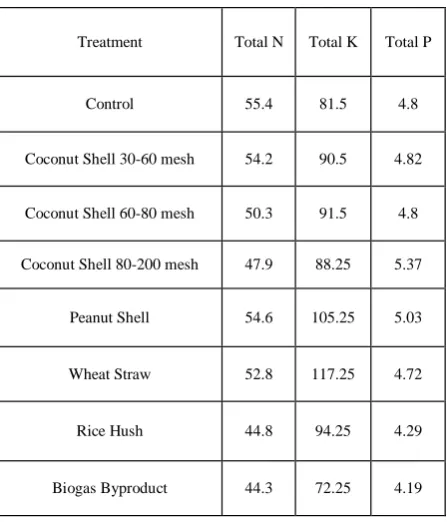
and some particular materials might be more suitable than others to remediate different heavy metals. So, it is very important to consider not only soil type and characteristics but also the key biochar properties such as raw material source, surface area, pH, ash and carbon content which can be affected by post-treatments in order to promote biochars‟ ability to immobilize heavy metals [15]. According to experimental result biochar from difference sources play a difference role in plant growth. In the case of macronutrient uptake by plants, those all treatments are slightly less than the control one. In the case of heavy metal uptake by plant, those all the analyzed results showed that the amount detected in the biochar treatment were far less than the control one. The most significant treatments were the pots with coconut shell (80-200 mesh) derived biochar and pots with biogas byproduct derived biochar. In the heavily contaminated soil with biogas byproduct derived biochar added to it, the result measured about 20 percent uptake reduction of the heavy metal cadmium and lead whereas 16 percent of chromium uptake in comparison to those of the vegetable that grew in the same soil with no biochar. The treatment with coconut shell biochar (60-200 mesh) stands at the second less uptake of heavy metal into the plant. Amongst all the treatment, biochar from coconut 30-60 mesh and 60-80 mesh amended pots revealed far least effectiveness compare to other pots but they still can reduce heavy metal uptake by plants. Table 1 and 2 showed all the experimental results of the plant samples for N, P, K and other contaminants. The plants‟ uptake of heavy metals was substantially reduced in soil which contained biochar. Biochar could also be used as a soil conditioner prior to plant colonisation in acidic, polluted mine tailings. The results of Hartley et al. (2009) show that biochar can be used in combination with Miscanthus for phyto-stabilisation. More recent research has proved that biochar can have an added environmental benefit, improving the greenhouse gas balance of other bioenergy crops such as Miscanthus [16].
Table 1: N, P, K assimilation in plant samples (mg/kg)
Treatment Total N Total K Total P
Control 55.4 81.5 4.8
Coconut Shell 30-60 mesh 54.2 90.5 4.82
Coconut Shell 60-80 mesh 50.3 91.5 4.8
Coconut Shell 80-200 mesh 47.9 88.25 5.37
Peanut Shell 54.6 105.25 5.03
Wheat Straw 52.8 117.25 4.72
Rice Hush 44.8 94.25 4.29
Table 2: Incorporated heavy metal concentration in plant samples (mg/kg)
Treatment Pb Cd Cr Cu Zn As Hg
Control 102 17.1 15 23.6 1667 3.56 0.019
Coconut Shell 30-60 mesh
50 15.1 9.9 21.1 1727 1.49 0.01
Coconut Shell 60-80 mesh
37 13 5.9 18.2 1447 1.09 0.006
Coconut Shell 80-200 mesh
19 8.6 2 15.9 989 0.797 0.003
Peanut
Shell 26 9.6 1.9 17.1 779 0.619 0.005
Wheat
Straw 33 16.6 4 16.5 1196 0.92 0.007
Rice Hush 23 9.6 1.6 14.8 1044 0.779 0.005
Biogas
Byproduct 21 3.5 2.5 9.3 188 0.98 0.006
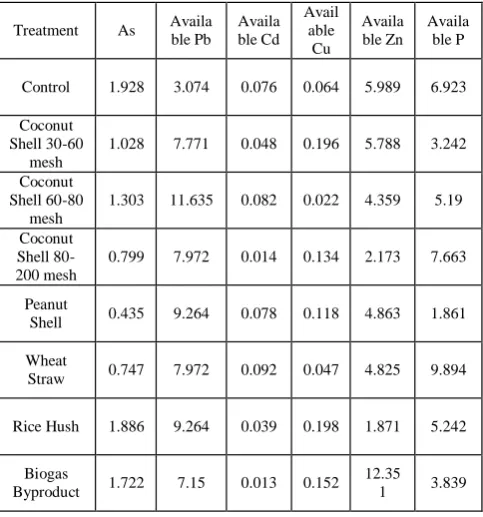
Biochar is incorporated in soil with organic or inorganic fertilizer as a soil ameliorant to enhance certain soil properties such as pH, CEC and microbial proliferation. As deliberate soil amendment, biochar is, in most cases, incorporated within the soil, rather than just being added on the surface where wind or water erosion can transport biochar particles [17]. Biochar has some unique properties that make it particularly susceptible to movement in the soil [4]. Uptake and accumulation of trace elements by plants are affected by several soil factors, including pH, Eh, clay content, organic matter content, cation exchange capacity, nutrient balance, concentration of other trace elements in soil, and soil moisture and temperature. Many findings confirm that the solubility of heavy metals in soil is directly correlated with the redox potential [18]. H. S. Helmisaari et al. (2007) showed that under same pH values, metal solubility increases as redox potential decreases. As redox potential decreases, trace elements become less available. The experiments for determination of pH, total N, P, K assimilation and available concentration of phosphorus, Pb, Cd, Cu and Zn in soil samples were also carried out. The long lasting benefits of biochar include the soil‟s increased retention of nutrients and water, which enhances crop growth. The most significant improvement is increase in soil pH from 5.95 up to 7.4 and it can provide short-term benefits by contributing nutrients and offering a liming effect for soils. The available concentrations of Pb, Cd, Cu, Zn and P were also increased compare with non-biochar treated one. Biochar can have an unusually high cation exchange capacity, but also appears able to adsorb phosphate and an anion. All the experimental results for soil samples analysis were shown in Table 3 and Table 4. It is likely that that one of the best approaches to combine biochar and phyto-extractors would be in multicontaminated soils, where both can target at different elements.
Table 3: Chemical assimilation in soil samples (mg/kg)
Treatment pH OM Total N
Total P
Total K
Hydr ol ytic
N
Control 5.95 0.078 0.126 0.105 0.623 29.21
Coconut Shell 30-60
mesh
6.06 0.189 0.029 0.148 1.03 16.98
Coconut Shell 60-80
mesh
5.94 0.168 0.048 0.12 0.118 39.23
Coconut Shell 80-200 mesh
6.12 0.078 0.0647 0.135 0.207 22.49
Peanut
Shell 6.37 0.196 0.073 0.152 1.095 36.43
Wheat
Straw 6.18 0.159 0.039 0.229 0.515 20.46
Rice Hush 6.14 0.191 0.047 0.098 0.778 25.84
Biogas
Byproduct 7.4 0.117 0.046 0.099 0.623 11.37
Table 4: Chemical assimilation in soil samples (mg/kg)
Treatment As Availa ble Pb
Availa ble Cd
Avail able Cu
Availa ble Zn
Availa ble P
Control 1.928 3.074 0.076 0.064 5.989 6.923
Coconut Shell 30-60
mesh
1.028 7.771 0.048 0.196 5.788 3.242
Coconut Shell 60-80
mesh
1.303 11.635 0.082 0.022 4.359 5.19
Coconut Shell 80-200 mesh
0.799 7.972 0.014 0.134 2.173 7.663
Peanut
Shell 0.435 9.264 0.078 0.118 4.863 1.861
Wheat
Straw 0.747 7.972 0.092 0.047 4.825 9.894
Rice Hush 1.886 9.264 0.039 0.198 1.871 5.242
Biogas
Byproduct 1.722 7.15 0.013 0.152 12.35
1 3.839
4.
Conclusion
postulate that it is mostly a pH effect. The changes that
biochar can undergo also depend upon its production conditions. These conditions are of great importance to achieve long-term soil enhancement – for example, its sorption properties are initially strongly influenced by the production temperature [4] and atmosphere, which determine the surface area of the particles. Less leaching of nutrients (such as calcium, potassium, magnesium, and nitrogen) means that more nutrients are available for plant uptake. Therefore adding biochar to soil will result in greater fertilizer efficiency: the crop can use a greater amount of the fertilizer added. Although biochar is not a fertilizer itself, it improves the overall health and quality of the soil [20]. According to this experiment, it is clear that biochar from biogas by-product is the most effective one amongst all other treatment. They may be due to the use of integrated biomass for its production. Coconut shell derived biochar of 80-200 mesh also show promising result and effectiveness whereas the rest two coconut shell derived biochar, 30-60 mesh and 60-80 mesh, have the least improvement. Further investigation for relationship between particle size and sorption behavior was needed. Increasing the efficiency of crop-bearing soil could be one of the greatest breakthroughs to food provision around the world and this may help to reduce such fluctuations of the most important supplies that human beings rely upon for survival.
References
[1] Al Agely, A., Sylvia, D. M., and Ma, L. Q, “Mycorrhizae increase arsenic uptake by the hyperaccumulator Chinese brake fern (Pteris vittata L.)” Journal of Environmental Quality, VI, 2181– 2186, 2005.
[2] F . Rees , M. O. Simonnot, J. L. Morela, “Short-term Effects of Biochar on Soil Heavy Metal Mobility are Controlled by Intra-particle Diffusion and Soil pH Increase”, European Journal of Soil Science., 65, 149– 161, 2004.
[3] Lehmann, “A handful of carbon in Nature”, 447. 2007
[4] Kassam, A. H., van Velthuizen, H.T., Fischer, G.W. and Shah, M. M., “Resources Data Base and Land Productivity. Agro-Ecological Land Resource Assessment for Agricultural Development Planning: A Case Study of Kenya, Soil Resources Report”, 1991.
[5] Zyrin, D. and Orlov, D. (eds.), “Physical and chemical investigation of soil,” Moscow: Publishing House of Moscow State University. 382 p /in Russian, 1980.
[6] Zimmerman, A.R, “Abiotic and Microbial Oxidation of Laboratory-Produced Black Carbon (Biochar)”, Environmental Science and Technology, 2010.
[7] Beesley, L. Moreno-Jiménez, E. Gomez-Eyles, J.L, “Effects of biochar and Green Waste Compost Amendments on Mobility, Bioavailability and Toxicity of Inorganic and Organic Contaminants in a Multi-element Polluted Soil,” 2010.
[8] Johannes Lehmann, Stephen Joseph, Journal of Science and Technology, “Biochar for Environmental Management” Science and Technology, 4-449, 2009.
[9] Ogawa, M, “Utilization of Symbiotic Microorganisms
and Charcoal in Tropical agriculture and Forestry and CO2 Fixation” Soil Microorganisms, 73–79,1999.
[10] Jin, H., Lehmann, J. and Thies, J. E. (2008) „Soil Microbial Community Response to Amending Maize Soils with Mmaize Stover Charcoal‟, in Proceedings of the 2008 Conference of International Biochar Initiative, 2008.
[11] Uchimiya, M., Lima, I. M., Klasson, K. T., and Wartelle, L. H, “Contaminant Immobilization and Nutrient Release by Biochar Soil Amendment”, 935– 940, 2010.
[12] Rhodes, A.H., Carlin, A., Semple, K.T., “Impact of Black Carbon in the Extraction and Mineralization of Phenanthrene in Soil,” Environmental Science and Technology, 42. 2008.
[13] P.Meynet, E. Moliterni, R.J. Davenport, W.T. Sloan., J. V. Camacho., D. Werner, “Predicting the Effects of Biochar on Volatile Petroleum Hydrocarbon Biodegradation and Emanation from Soil”, Soil Biology and Biochemistry, 30-40, 2014.
[14] Lu, H., Zhang, Y. Y., Huang, X., Wang, S., and Qiu, R, “Relative Distribution of Pb2+ Sorption Mechanisms by Sludge-derived Biochar,” 854–862, 2012.
[15] M. Ghosh and S. P. Singh, “A review on Phytoremediation of Heavy Metals and Utilization of Its Byproducts,” Applied Ecology and Environmental Research, Vol. 3, No. 1, 1–18, 2005.
[16] Hartley, W., Dickinson, N. M., Riby, P., and Lepp, N. W, “Arsenic Mobility in Brownfield Soils Amended with Green Waste Compost or Biochar and Planted with Miscanthus,” 2654–2662, 2009.
[17] Kabata-Pendias, A. and Pendias, H.. “Trace Elements in Soil and Plants,” CRC press, 403, 2001.
[18] S. Dushenkov, “Trends in Phytoremediation of Radionuclides,” Plant and Soil, 249, 167–175, 2003.
[19] H. S. Helmisaari, M. Salemaa, J. Derome, O. Kiikkil¨o, C. Uhlig, and T. M. Nieminen, “Remediation of Heavy Metal Contaminated Forest Soil Using Recycled Organic Matter and Native Woody Plants,” Journal of Evironmental Quality, 36, 1145–1153, 2007.
Author Profile
Dr. Nyo Nyo Mar joined Yangon
Technological University (YTU) in 2002 and she got B.S (Biotechnology) in 2006. Then, she graduated M.S and Ph.D degrees in Environmental Biotechnology from Mandalay Technological University (MTU) in 2006 and 2010, respectively. During her study, she also worked as lecturer at Biotechnological Department of YTU and MTU. In the year 2014, she started her job as Research Officer/ Assistant Director at Biotechnological Research Department (BRD), Kyaukse. She was also selected as a candidate for Talented Young Scientist Program awarded by Chinese Ministry of Science and Technology and she conducted this research during her stay in China 2015-2016. Now, she is working at BRD and conducting the researches collaboration with International Atomic Energy Agency (IAEA).