United Kingdom Vol. VI, Issue 8, August 2018
Licensed under Creative Common Page 483
http://ijecm.co.uk/
ISSN 2348 0386
HUMAN RESOURCE MANAGEMENT PRACTICES: A CASE
OF SMEs IN ZIMBABWE
Mapetere Denver
Centre for Entrepreneurship, Midlands State University, Zimbabwe [email protected]
Mavhiki Gibson
Department of Business Management, Midlands State University, Zimbabwe
Nyamwanza Tonderayi
Centre for Entrepreneurship, Midlands State University, Zimbabwe
Mavhiki Severino
Department of Business Management, Midlands State University, Zimbabwe
Abstract
The study was motivated by the rapid growth of employment in the SME sector Zimbabwe. An
average of 24.5% of the economically active persons is employed in the private sector and thus
the study sort to establish the Human Resource Management practices of SMEs in Zimbabwe.
Using data collected to through a Likert scale and analysed using STATA it was established that
SME owner/manager are failing to adopt best practices in Human Resources Management
mainly due to financial challenges. Employees in SMEs do not possess the necessary skills to
perform their duties effectively. Owner/managers with previous work experience before
establishing their own organisations had adopted some form of formalised HRM system after
the first year of operation. SME owner/managers were encouraged to attend Human Resource
Management training programmes to broaden their knowledge.
Keywords: Human resources management, training, formal, practices, small to medium scale
Licensed under Creative Common Page 484
INTRODUCTION
The importance of Small and Medium Enterprises (SMEs) in a developing economy can never be underestimated. SMEs are historically taken as a significant part in contributing to economic progress of many countries around the world (Kongolo, 2010). From a socio-economic development view, SMEs provide a variety of benefits (Advani, 1997); a well supported and enhanced small business sector is likely to continue contributing to the economic development process in the same way as a large business (Abraham, 2003). SMEs contribute to socio-economic development through poverty reduction (Syed, Ahmadani, Shaikh and Shaikh 2012) in addition SMEs are also significant as a source of indigenous knowledge (IK) which is embedded in their social and economic activities (Yokakul and Zawdie 2010). Given the vast amount of research linking sound human resource management to effective change, it is somewhat surprising that in transition-based economies the majority of the emphasis has been placed on creating the applicable political and economic environment within which SMEs can develop. Little attention has been shown to the “people” resource side of the equation (Szamosi,
Duxbury and Higgins 2004). The study of Human Resources Management (HRM) practices in small organisations is thus imperative because these firms are the economic drivers of the future through increasing the tax collection net for government, poverty alleviation through employment creation and utilization of indigenous resources.
SMEs are also regarded as the pinnacle of economic recovery. In Zimbabwe, the hyper-inflationary environment in the year 2008 saw many big organisations winding up their operations or opting for temporary closure. According to Raftopoulus (2009) the formal sector employment shrunk from 1.4 million in 1998 to 998 000 in the year 2004 and hyperinflation reached an official level of 230 million percent by the end of 2008. Due to high levels of formal employment many economically active individuals resorted to the establishment of their own Small to Medium Scale Enterprises. According to Zimstat (2011) an average of 24.5% of the economically active persons are employed in the private sector, where the bulk of the employers are SMEs. Although there are high levels of employment in the country of 89% in accordance to the official Zimstat (2011) research results, 85% of these employees are unskilled. SMEs being the biggest employers are therefore negatively affected by the use of unskilled labour just like any other big organisations. Zimstat (2014) also concluded that 83% of the employment population were unskilled whilst 80% were reported to be working excessive hours and 13% were in precarious employment.
Licensed under Creative Common Page 485 responsibility of the owner/manager to ensure that employees are equipped quality with the right skills and attitudes if they are to help an organisation record sustainable revenues and profits.
The main of this study is to then explore the HRM practices in SMEs focusing on aspects of recruitment and selection, training and development, compensation and reward systems and appraisal in order to address skills shortage and labour turnover problems.
LITERATURE REVIEW
Schuler and Jackson (1987) reviewed HRM as a process that involves deliberate formal and informal planning, staffing, appraisal, compensation, training and development of employees. Minbaeva (2005) also substantiates that HRM practices involves staffing, training, compensation, promotion and appraisal of employees. Tan and Nasurdin (2011) corroborates with Schuler and Jackson (1987) as well as Minbaeva (2005) by concluding that HRM practices relate to specific practices, formal policies, and philosophies that are designed to attract, develop, motivate and retain employees who ensure the effective functioning and survival of the organisation.
Given the above view points on HRM practices it can therefore be further concluded that HRM practices should be viewed as a strategic process that relates to the deliberate formal and informal policies designed to identify, attract, compensate, retain, appraise and develop manpower in a manner that ensures sustainable growth and development of both the employee and the employing organisation. This assertion intends to acknowledge that HRM practices have to strike a balance between employee and employer‟s needs for it to lead to high levels of
organisational performance.
Barret and Mayson (2007) posits that strategic HRM provides firms with the internal capacity to adapt and adjust to competitive environments by aligning recruitment, selection, training, reward systems and development with business strategies. Human resources management practices in small organisations are chiefly centred on their operational needs that relates to record keeping, customer service, product quality, cost, reliability, variety and volume. Henceforth their desire is to be able to meet both the market needs and the organisation‟s
needs through effective human resources management.
According to Penrose (1959), the Resource Based View approach emphasises the importance of the firms‟ resources as drivers of growth, competitive advantage (Barney 1991)
Licensed under Creative Common Page 486 attitudes within the firm that are difficult to imitate. The human potential in any company is generally much more difficult for competitors to duplicate than the plant, equipment or even products that a company produces (Flanagan and Despande 1996).
Firms can acquire knowledge resources through proper HR planning, (Khandekar and Sharma (2005) where attracting, retaining and motivating of quality resource pool are must for ensuring the sustained success for the organisation (Wright, McMaham and McWilliams,1994). Khandekar and Sharma (2005) also posed that recruitment procedures that provide qualified applicants, couple with selection procedure has significant influence over the quality and types of skills that new employees possess. Poor recruitment and selection can lead to a huge skills gap in any organisation especially that are resource constrains and offer any training. Gupta (1994) noted that the knowledge gap and void needs to be treated with readymade training programmes by real trainers. In addition performance appraisal systems and management can be designed to encourage employees to learn and share their knowledge with others (Khandekar and Sharma 2005).
Most SMEs in Zimbabwe were established in an unstable economic environment marred by scarcity of resources which affected most of their operations such as HRM. Cardon and Stevens (2004) opined that in small firms, where resources are likely to be scarce, there may be a very small number of formal HR departments or professionals, increased difficulty in recruiting and retaining employees due to lack of financial resources and an increased reluctance to engage in costly or restrictive practices. Many owners and managers of small businesses do not have significant human resource training and knowledge and hence do not implement HRM best practices within their organisations.
Firm size in most cases influence the type and breath of decision making. Mazzarol (2003) conjectures that as a small business grows its owners must begin to increase their staff and learn how to develop and implement human resource management. Growth in business entails that more demand will be placed upon the employees to perform more tasks individually or collectively. This greater demand on staff create many HRM problems that can only be managed through formalized HRM practices. However, due to their smaller size most small firms are unable to adopt formal HR designs that ensures their sustained growth.
Licensed under Creative Common Page 487 Vast literature is in agreement that in the first five years, there are greater chances of small firms failure, thus this create a human resource management dilemma for many entrepreneurs, (Fatoki and Garwe (2010) Petković, Jäger and Sašić (2016), Fatoki (2014). For instance, initial
stages of small firm development are characterised by high degree of centralisation whereby the owner/managers do not delegate HR activities. In such instances, HRM tends to be very informal where manager/owners make adjustments as and when change is needed. Thus this stage of firm development is characterised by unplanned changes as firms muddle through the business environment. The lack of key HR decision precedence also further affects the consistency of HR practices.
This micro-management according to Formichelli (1997) cited in Ogarca (2009) is known as nanomanagement. The need to prevent failure in most cases causes managers and small firms owners to pay attention to detail thereby centralising decision making leading to nanomanagement. Hess (1987) finds owners of small businesses rank HRM practices as the
second most important management activity (next to general management). The review that HRM plays second fiddle to other management activities create a huge resource based competitive advantage deficiency in SMEs. Baldwin, Gray, Johnson, Proctor, Rafiquzzaman, Sabourin (1997) noted that “almost half of the firms in Canada that go bankrupt do so primarily
because of their own deficiencies rather than externally generated problems. They do not develop basic internal strengths to survive. Moreover, Baldwin et al (1997) in a study of bankrupt firms in Canada highlighted that overall weakness in management, combined with a lack of market for their product, cause these firms to fail where the managers of bankrupt firms do not have the experience, knowledge or vision to run their businesses.”
Storey and Westhead (1997) advanced that training is lower in small than in large firms. Storey and Westhead refutes the allegations that small firms do not train due to owner/manager‟s ignorance of training benefits. Given the size of their sales most small firms
are not able to meet the costs of formal training and as such when they eventually do the training is generally inferior as compared to large organisations. For example multimillion dollar firms in Zimbabwe like in many other countries all have designated training manager, full funded training programmes and facilities. OECD (2002) corroborates this by arguing that SMEs often have limited resources which affect their ability to adapt quickly to evolving markets and changing environments. Storey and Westhead (1997) further concluded that the reluctance of small firms to provide training is attributed more to supply and demand factors than to small firm owner‟s ignorance of the benefit of training. OECD (2002) further supports Story and Westhead
Licensed under Creative Common Page 488 though studies indicate that there is a positive correlation between the degree of formal training and the bottom-line performance of SMEs and subsequent failure.
Betcherman, Leckie and McMullen (1997) obtained that 86% of firms with more than 100 workers had formal training where as 36% of firms with less than 20 employees provided training. An argument to this might be that small firms record low profit levels and thus can not sustain training costs. More so, in most small firms the levels of delegation by owner manager are fairly low and thus the organisation relies on the knowledge and experience of owner/managers. Furthermore, most small firms to do not carry out employee appraisals and henceforth they cannot denote the individual contribution of each employee.
Given the importance of HRM in institutional survival and growth as well as the roles played by SMEs towards economic development in Zimbabwe it is imperative that more insights are gathered on HRM practices amongst small businesses. Litz and Stewart, (2000) posits that human resource management is about creating and sustaining superior human resource contributions for firms. Aladwan, Bhanugopan, Fish, (2014) asserts that “Jordanian
organizations are facing major problems surrounding the development of human capital, including high turnover rates and a lack of skilled employees. Zimbabwe as a nation has had a huge brain drain in the past decade and the majority of skilled personnel have sort for better employment in neighbouring countries that have relatively stable economies. Most small businesses in Zimbabwe are engaged in high customer contact businesses where employees form the interface between the business and its stakeholders. McEvoy (1984) noted that without proper human resource practices most small business are likely to fail. As such it imperative that formal human resource practices that attracts, develops and retains the best manpower are adopted to ensure a sustainable organisational success. Hornsby and Kurakto (2003) noted in a study of 262 small businesses in the United States that owners of the firms considered the quality of workers as their major concerns.
RESEARCH METHODOLOGY
Licensed under Creative Common Page 489
EMPIRICAL FINDINGS AND DISCUSSION
Relationship between sector of operation and prevalence human resource policies
It can be hypothesised that the type of business operation has no bearing on the adoption of HRM practices as each and every operation has to provide high quality, affordable products and services. As such the study examined whether the sector of operation affected adoption of HRM practices by SMEs and the results are presented in Table 1.
Table 1 Relationship between sector of operation and adoption of formal human resource management policy
Sector Coef. Std. Err. t P>t [95% Conf. Interval]
HRM policy -.6153846 .5604294 -1.10 0.284 -1.774721 .543952 _cons 4.230769 .8754187 4.83 0.000 2.419828 6.041711
A t-stat of 4.83 and p value of 0.000 from table 2 indicated that there was a strong link between sector of operation and adoption of HRM policies. Raw data from the study indicated that 78% of the SMEs operating in the manufacturing sector had some form of HRM policy as compared to 62% operating in the service sector. The results show that all owner/managers in both manufacturing and service sectors were adopting some forms of HRM practices. This shows that employee contribution is regarded as a vital component of small firm operations regardless of sector of trading.
The relationship between owner experience and Human resource policy formulation
The study established that there is a strong relationship between business experience of the SME managers and the presence of a formally drafted Human Resource Policy. From the study 88% of the respondents had more than one year of previous working experience and had adopted a formal HRM policy in their organisations.
Table 2 The relationship between owner experience and Human resource policy formulation Years of prior employed Coef. Std. Err. t P>t [95% Conf. Interval] HRM policy -.6730769 .4351242 -1.55 0.136 -1.5732 .227046 _cons 3.596154 .6796857 5.29 0.000 2.190117 5.002191
Licensed under Creative Common Page 490 results makes the assertion that prior work experience allows SME owner/manager apply lesson learnt in previous employment in instituting some form of formal human resource management system.
The relationship between Business Age and HRM Policy formulation
The size of the firm has a strong bearing on the formulation of human resource management policies. Mintzberg (1979) argued that with the increasing size of firms, jobs become more specialized, the span of control increases, a more formalized structure develops and there is a higher need for decentralization. The study sort to test the relationship between firm age and the presence of human resource management policy, from the study 83% of the respondents opined that there exists a relationship between the two variable.
Table 3 The relationship between Business Age and HRM Policy formulation
Business Age Coef. Std. Err. t P>t [95% Conf. Interval] HRM policy -.7179487 .3892328 -1.84 0.078 -1.523138 .0872406 _cons 4.102564 .608001 6.75 0.000 2.844818 5.36031
Using t stat and p value, the study obtained a t stat of 6.75 and a p value of 0.000 which are all significant in to accept that there is a relationship between firm age and the crafting of HRM policies. Also research results further showed that 89% of the businesses had more than a single year of business operation, which was deemed long enough for owner/managers to see the importance of HRM to their survival.
The relationship between organisational training and HRM policy formulation
Table 4 The relationship between organisational training and HRM policy formulation Training Coef. Std. Err. t P>t [95% Conf. Interval]
HRM policy .3461538 .1808161 1.91 0.068 -.0278927 .7202004 _cons .8076923 .2824437 2.86 0.009 .2234129 1.391972
Licensed under Creative Common Page 491 challenges that small firms face. The lack of financial resources has led to most firms abandoning formal training of employees. Cardon and Stevens (2004); Andenova and Zuleta (2007) corroborated with this by noting that resource constraints have led to the adoption of more informal HRM practices that are limited in scope. From the study 63% of the respondents noted that lack of finance to send their employees for training was hampering adoption of formal training practices.
From a HRM perspective, the resource constraints of smaller firms may mean that HRM
activities may be less formal and more limited in their scope and sophistication. Study results can be used to confirm this assertion, 85% of the respondents indicated that they relied more on the job training, as compared to 14% who had some form of off the job training. Use of on the job training may also be influenced by the number of employees engaged. For instance only 45% of the participating organisations had more than 15 employees and of these 46% of them had a HRM policy related budget. The lack of training may be attributed to the high costs of formal training leading to the non financing of budgets.
Apart from firm‟s specific attributes, owner/manager characteristics also have an impact
on the adoption of HRM practices. Due to the lack of separation between ownership and management, many small firms are negatively affected by the owner/manager deficiencies. As such, the study evaluates the link between owner/manager‟s level of education, age, previous
experience and human resource management practices.
Table 5 Influence of owner/manager education level on HRM policy
Owner/manager Education level Coef. Std. Err. t P>t [95% Conf. Interval] HRM policy -1.083333 .6072116 -1.78 0.088 -2.339446 .1727795 _cons 5.083333 .9484948 5.36 0.000 3.121222 7.045444
Licensed under Creative Common Page 492 Table 6 Influence of owner/manager age on HRM policy
Owner/manager age Coef. Std. Err. t P>t [95% Conf. Interval] HRM policy -.5320513 .5278846 -1.01 0.324 -1.624064 .5599612 _cons 3.147436 .8245821 3.82 0.001 1.441658 4.853214
A t-stat of 3.82 and p value of 0.001 were used to confirm the link between the two variables. 76% of the respondents below the age of 40 had some form of HRM policy as compared to 24% of those above the age of 40. This result also shows that more youths are venturing in business as a result of the general lack of formal employment after they graduate and also due to the various youth and SME empowerment programmes set up by the government of Zimbabwe.
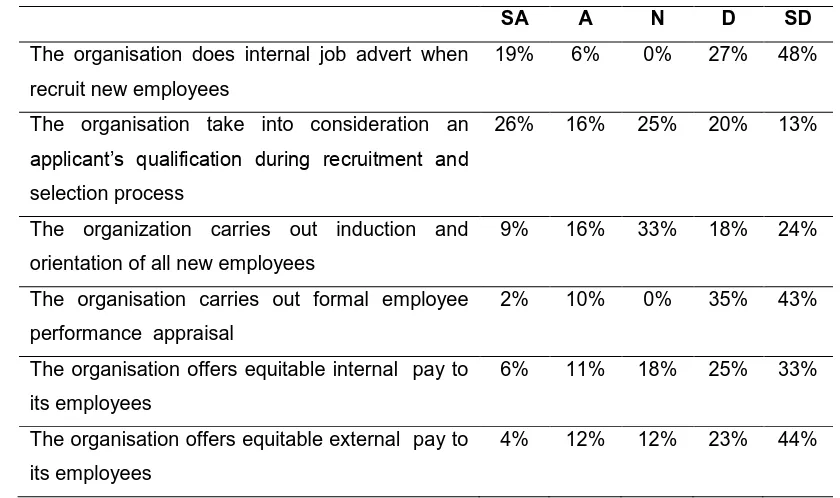
Table 7 Descriptive analysis of Human resource practices
SA A N D SD
The organisation does internal job advert when recruit new employees
19% 6% 0% 27% 48%
The organisation take into consideration an applicant‟s qualification during recruitment and selection process
26% 16% 25% 20% 13%
The organization carries out induction and orientation of all new employees
9% 16% 33% 18% 24%
The organisation carries out formal employee performance appraisal
2% 10% 0% 35% 43%
The organisation offers equitable internal pay to its employees
6% 11% 18% 25% 33%
The organisation offers equitable external pay to its employees
4% 12% 12% 23% 44%
External job adverts
Licensed under Creative Common Page 493 suitable candidates or higher level jobs. External recruitment helps in injecting new blood in the organization (Zinyemba, 2014).
Qualifications based recruitment and selection
The majority of respondents, 42%, indicated that their organization recruits and select new employees based on qualifications, 25% of respondents expressed a neutral view whilst 33% were of the opinion that qualifications were not considered. Ofori and Aryeetey (2011) state that the purpose of recruitment and selection is to obtain the best qualified individuals so as to service the organization‟s strategic needs. Results indicate that most of the employees in small
firms lack the prerequisite skills to perform their day to day tasks. Due to limited financial resources, small firms often find it difficult to attract highly skilled manpower, as they cannot afford the minimum wages and salaries.
Employee Induction and orientation
From the study, 42% of respondents disagreed that there is formal induction and orientation process to help new employees understand the organization. 33% of respondents did not decide on that question. However, only 25% of respondents agreed that their firms had formal induction and orientation practice. These findings were cemented by Litz and Stewart (2000) who established that SMEs do not have sufficient time to educate new members of their organization due to critical job demands. Due to their flat structures, many small firm owner/managers tend to centralise decision making and hence they end up without ample time to properly administer better human resource management practices.
Performance appraisal
The majority of respondents, 78%, disclosed that their company does not carry out performance appraisal as a practice. A meagre 12% of respondents revealed that appraisal sessions are being done on yearly basis. These results show that small firms do not carry out performance measurement of their employees. Thus small firms are not aware of the total contribution of each employee and this may be influenced by owner/manager‟s lack of professional HRM
Licensed under Creative Common Page 494
Pay (remuneration) equity
An average of 58% of the respondents revealed that there was no equity in rewards payment when comparing employees doing the same jobs in their organisation, 18% of respondents were neutral and only 17% agreed that their salaries were fair whereas 58% were in disagreement. The lack of employee performance appraisal may be the major cause of unequal remuneration. According to Caliskan (2014) and Omotayo, Pavithra and Adenike (2014), compensation is crucial to any employee. Caliskan (2014) explained that the design of a compensation system in terms of internal and external pay equity affect employees‟ performance. Lack of internal equity destroys team culture and spirit among employees and in turn cause serious mistrust, (Zinyemba, 2014)
Furthermore the study sort to establish whether, small firms carried out industry survey on HRM practices related to employee remuneration. The results indicated that 67% respondents highlighted that their pay was not linked to pay given to other employees doing the same job in the same industry, 15% of respondents were neutral and 18% of respondents agreed that their pay was being linked to what other employees at same level and in the same industry were getting. The results mean that small firms were either failing to take into account industrial standards when determining their pay levels or were affected by their level of financial performance.
CONCLUSIONS AND RECOMMENDATIONS
Study concludes that the majority of small firms in Zimbabwe have not yet adopted formalised strategic human resources management practices. Those that have, they have only partially adopted it and thus are not fully benefiting from the internally based resource.
It is therefore recommended that small firms should fully adopt HRM practices as part of their formal strategic competitive tools. These HRM practices should consciously include variables such as, recruitment and selection, training, development, compensation, motivation and appraisal of employees in order to make them a key sustainable competitive tool.
Licensed under Creative Common Page 495 Also due to lack of financial resources the study concluded that it provides the explanation as to why SME employees at the same levels and similar duties experienced pay differentials between their organisations.
Owner/managers for SME should participate in Human Resource Management development programmes in order to gain more knowledge and insights into how they can best manage their employees. SME owner managers should all strive to ensure that they provide the necessary training to their employees in order to improve their performance on the job. Institutions that offer financial support to SMEs should also avail funding options solely earmarked for Human Resource Development. SMEs even though they are cognisant of the benefits derived from proper employee training are failing to do so due to lack of financial resources thus availing of human resource management targeted financial packages will help boost employee skills. When operating in the same sector SMEs should endeavour to standardise their wages and salaries in order to ensure that there is low levels of labour turnover and limited pay differentials in a single sector.
REFERENCES
Abraham D (2003). Local Economic Development (LED) in South Africa: A useful tool for sustainable development. Urban Forum, 14: 185-200
Advani A (1997). Industrial clusters: A support system for small and medium-seized enterprises, the private sector development. World Bank Occasional Paper No. 32, Washington DC.
Andenova, V. and Zuleta, H. (2007), “The effect of enforcement on human resources practices: a case study in rural Colombia”, International Journal of Manpower, Vol. 28 No. 5, pp. 344-53
Anwar Ali Shah G. Syed, Muhammad Muneer Ahmadani, Naved Shaikh, and Faiz Muhammad Shaikh (2012): “Impact Analysis of SMEs Sector in Economic Development of Pakistan: A Case of Sindh”, Journal of Asian Business Startegy, Vol. 2, No.2, pp. 44-53.
Barrett, R. and Mayson, S. (2007), “Human resource management in growing small firms”, Journal of Small Business and Enterprise Development, Vol. 14 No. 2, pp. 307-20.
Barney, J. (1991), “Firm resources and sustained competitive advantage”, Journal of Management, Vol. 17 No. 1, pp. 99-120.
Betcherman, G., N. Leckie and K. McMullen. 1997. “Developing Skills in the Canadian Workplace: The Results of the Ekos Workplace Training Survey,” Canadian Policy Research Network Study W02, 152 pages
Bratnicki, M. (2005), “Organizational entrepreneurship: theoretical background, some empirical tests, and directions for future research”, Human Factors and Ergonomics in Manufacturing, Vol. 15 No. 1, pp. 15-33.
Burke, R.J. and El-Kot, G., 2014, „Human Resource Management Practices in Small- and Medium-Sized Enterprises in Egypt‟, Journal of Transnational Management, 19(3), 211-226. Business and Enterprise Development, 9(3), 245-259.
Butt, I.A., and Hussain, S., 2015, „An Empirical Investigation of HRM Practices of Pakistani-Owned Smes in the UK‟, International Journal of Management Sciences and Business Research, 4(11).
Caliskan, B.O.O.Z., 2014, HRM Practices and Problems in Family SMEs. In: Machado, C and Melo, P (2014).ed. Effective Human Resource Management in Small and Medium Enterprises: Global Perspectives. Hershley, IGI Global.
Licensed under Creative Common Page 496
Cardon S Mellisa and Stevens E Christopher (2004). Managing human resources in small organizations: What do we know? Human Resource Management Review 14 (2004) 295–323
Fatoki, O., & Garwe, D. (2010). Obstacles to the growth of new SMEs in South Africa: A principal Component analysis approach. African Journal of Business Management, 729-738.
Fatoki Olawale Mediterranean Journal of Social Sciences MCSER Publishing, Rome-Italy Vol 5 No 20 September 2014
Flanagan D.S., & S.P. Despande. (1996). Top management‟s perceptions of changes in HRM practices after union elections in small firms. Journal of Small Business Management, 34(4), 23-34.
Garengo, P., Biazzo, S. andBititci, U.S., 2005, „Performance measurement systems in SMEs: A review for a research agenda‟, International Journal of Management Reviews, 7(1), 25–47.
Hess, D. W. (1987) “Relevance of Small Business Courses to Management Needs.” Journal of Small Business Management, January, pp. 26-34.
Hornsby, Jeffrey S; Kuratko, Donald F. (2003) Human resource management in U.S. small businesses: A replication and extension. Journal of Developmental Entrepreneurship; Norfolk Vol. 8, Iss. 1, (Apr 2003): 73-92.
John Baldwin, Tara Gray, Joanne Johnson, Jody Proctor, Mohammed Rafiquzzaman, David Sabourin (1997) Failing Concerns: Business Bankruptcy in Canada. Minister of Industry, 1997
Khaled Aladwan , Ramudu Bhanugopan , Alan Fish , (2014) "Managing human resources in Jordanian organizations: challenges and prospects", International Journal of Islamic and Middle Eastern Finance and Management, Vol. 7 Iss: 1, pp.126 – 138
Khandekar Aradhana, Sharma Anuradha (2005) "Managing human resource capabilities for sustainable competitive advantage: An empirical analysis from Indian global organisations", Education + Training, Vol. 47 Issue: 8/9, pp.628-639
Kongolo, M. (2010). Job creation versus job shedding and the role of SMEs in economic development. African Journal of Business Management, 4, 11, 2288-2295
Leslie T. Szamosi, Linda Duxbury, Chris Higgins, (2004) "Toward an understanding of people management issues in SMEs: a South‐Eastern European perspective", Education + Training, Vol. 46 Issue: 8/9, pp.444-453,
Litz, R.A. and Stewart, A.C., 2000, „Trade-Name Franchise Membership as a Human Resource Management Strategy: Does Buying Group Training Deliver „True Value‟ for Small Retailers?‟ Entrepreneurship Theory and Practice, 25 (1), 125–135.
Mazzarol Tim, (2003) "A model of small business HR growth management", International Journal of Entrepreneurial Behavior & Research, Vol. 9 Issue: 1, pp.27-49
McEvoy, Glenn M. (1984), "Small Business Personnel Practices," Journal of Small Business Management, 1-8. Minbaeva, D B (2005) HRM practices and MNC knowledge transfer. Personnel Review, 34(1), 125-44
Mintzberg, H. 1979. The Structuring of Organizations. Englewood Cliffs, N.J.: Prentice-Hall. OECD (2002), High-Growth SMEs and Employment, OECD Paris
Ofori, D., and Aryeetey, M., 2011, „Recruitment and selection practices in small and medium enterprises‟, Internationkn al Journal of Business Administration, 2(3):45-60.
Ogarcă Radu (2009)EMPLOYEES INVOLVEMENT IN DECISION MAKING: THE CASE OF THE ROMANIAN SMES. Management – Marketing – Tourism. Revista Tinerilor Economişti (The Young Economists Journal)-
Omotayo, O.A., Pavithra, S. andAdenike, A.A., 2014, „Compensation Management and Organisational Commitment in Developing Economies: Indian Perspective‟, Acme Intellects International Journal of Research in Management, Social Sciences and Technology, 8(8).
Penrose, E. (1959), The Theory of the Growth of the Firm, Basil Blackwell and Mott, London.
Zinyemba, A.Z., 2014, „The Challenges of Recruitment and Selection of Employees in Zimbabwean Companies‟, International Journal of Science and Research, 3(1), 29-33.
Licensed under Creative Common Page 497
Saša Petković* Clemens Jäger** Boban Sašić***(2016) CHALLENGES OF SMALL AND MEDIUM SIZED COMPANIES AT EARLY STAGE OF DEVELOPMENT: INSIGHTS FROM BOSNIA AND HERZEGOVINA Management, Vol. 21, 2016, 2, pp. 45-76
Schuler S Randall and. Jackson E Susan (1987) Linking Competitive Strategies with Human Resource Management Practices. The Academy of Management EXECUTIVE, 1987, Vol. 1, No. 3, pp. 207-219
Storey, D. J. and Westhead, P. (1997). 'Management Training in Small Firms - A Case of Market Failure?' Human Resource Management Journal, 7, pp.61-71.
Tan, C, L and Nasurdin, A, M. ―Human Resource Management Practices and Organizational Innovation: Assessing the Mediating Role of Knowledge Management Effectiveness‖ The Electronic Journal of Knowledge Management Volume 9 Issue 2 (pp155-167),
Wernerfelt, B. (1984), “A resource-based view of the firm”, Strategic Management Journal, Vol. 5 No. 2, pp. 171-80. Wright, P., McMaham, G. and McWilliams, A., 1994 “Human resources and sustained competitive advantage: a resource-based perspective” Int. J. of HRM, Vol. 5, No 2, pp 301-326.
Yokakul, Nattaka and Zawdie, Girma (2010) Promoting growth of indigenous knowledge-based industry via the Triple Helix system : a case of the Thai dessert industry. In: The Triple Helix VIII International Conference on University, Industry and Government Linkages, 2010-10-20 - 2010-10-22. University of Strathclyde [email protected]