EXPLORATIO OF ATI-IFLAMMATORY POTETIAL OF
CITRUS LIMETTA RISSO AD CITRUS MAXIMA (J. BURM.) MERR.
Sriparna KunduSen1, Malaya Gupta1, Upal K Mazumder1, Pallab K Haldar1*, Prerona
Saha1,2, Sanjib Bhattacharya3, Sagar askar1, Siva P Panda1
1
Deptt. of Pharmaceutical Technology, Jadavpur University, Kolkata, West Bengal, India.
2
Guru $anak Institute of Pharm. Sciences and Technology, Panihati, West Bengal, India.
3
Bengal School of Technology, Delhi Road, Sugandha, Hooghly, West Bengal, India.
*Corresponding author: E-mail: [email protected]
Summary
Citrus fruits are rich in flavonoids and limonoids which are known to possess antitumor and anti-inflammatory activities. Citrus limetta Risso and Citrus maxima (J. Burm.) Merr. are two widely distributed indigenous plants found in Indian subcontinent. Methanol extracts of peel of Citrus limetta fruits (MECL) and leaves of Citrus maxima (MECM) were evaluated in two dose levels (200 mg kg-1 and 400 mg kg-1) in histamine, carrageenan and dextran induced acute rat paw oedema models for their anti-inflammatory potential in Wistar albino rats. Both MECL and MECM were able to significantly (p < 0.001) reduce the inflammatory potential produced by different inflammatory mediators in different experimental models in a dose dependant manner. The effects were compared to reference drug and MECL was able to produce significant anti-inflammatory activity better than the reference drug used (phenylbutazone 100 mg kg-1 b.w. p. o.).
Key words: Anti-inflammatory, Citrus limetta, Citrus maxima, histamine, carrageenan,
dextran.
Introduction
Medicinal plants are a rich source of compounds used in pain healing (1). Citrus fruits are very abundant in the Indian subcontinent and lemon, lime, orange, sweet lime, pomelo are the different variety of fruits that are cultivated in a large scale. Citrus fruits are very rich source of flavonoids like hespiridin, naringin (2). The peels of the fruits are richer sources of hydroxy cinnamic acid than juice and pectin (3). Flavonoids hespiridin and naringin are found to be present in the peel and inner part of the fruit of Citrus limetta (4).The essential oils α-pinene, β-pinene, sabinene, β-myrcene, p-cymene, limonene, γ-terpinene, neryl acetate, β-bisabolene ,α-bergamotene were isolated from the zests of Citrus limetta
Risso (5). Limonene, γ-terpinene was isolated from the peel and their minimum inhibitory concentration (MIC) and maximal tolerated concentration (MTC) was estimated against
The major flavanones of Citrus maxima are neohesperidin and naringin, which are high in the seed than in unripe fruits(7). Hespiridin, naringin, caffeic, p-coumaric, ferulic and vanillic acid are present in the fruit juice (8). A C-C linked bisacridone alkaloid buntanbismine, was isolated from the stem bark of C. grandis (9). C. maxima essential oil is composed of α-pinene, sabinine, β-pinine, methyl heptenone , β-myrcene, hexanal, sabinine, DL-limonine, t-ocimine, linalool, 1-hexene, 4-methyl; 1-hexene,3,3-dimethyl; geranyl formate, Z-citral, geranyl formate, E-citral, geranyl acetate, β-farnesene (10). The chemical in vitro antioxidant assay showed that hesperidin significantly reduced the level of the DPPH‚ in a similar way to the antioxidant trolox (11).
The intestinal anti-inflammatory activity of hesperidin was evaluated in the acute stage of the trinitrobenzene sulfonic acid (TNBS) model of rat colitis. The results obtained showed that pre-treatment hesperidin (10 and 25 mg/kg) reduced colonic damage compared to TNBS control rats (12). Naringenin is a potent inhibitor of the pro-inflammatory cytokine response induced by lipopolysaccharide in both macrophages and in whole blood. Naringenin markedly inhibited the phosphorylation on serines 63 and 73 of Jun proto-oncogene-encoded AP-1 transcription factor in lipopolysaccharide-stimulated macrophages (13). Naringin and its aglycone naringenin showed high percentage edema reduction in carrageenan induced in vivo models (14).
In the concentration range 250-500 µM, hesperidin and its aglycone hesperetin showed potent inhibition of LPS-induced expression of the COX-2 gene in RAW 264.7 cells, suggesting the anti-inflammatory activity of these compounds (15). Naringenin , the aglycone of naringin, proved to be a potential immunomodulator for inhibiting bleomycin induced lung fibrosis and metastasis (16). Flavonoids are known to have protective effects against coronary heart disease, have anti-inflammatory, antitumor and antimicrobial effects (17). Citrus carotenoids, hydroxy cinnamic acid and pectin have lowered the risk of cancer. Pectin has the property of lowering the blood sugar and cholesterol levels (18). The current study involves the exploration of anti-inflammatory potential of the peel of sweet lime (Citrus limetta) fruits and the leaves of pomelo (Citrus maxima).
Experimental
Plant materials
Citrus maxima (J. Burm.) Merr. leaves and the Citrus limetta Risso fruits (Rutaceae) were collected from Nadia region of West Bengal, India in the month of March-April 2007. The plant materials were authenticated by the Botanical Survey of India, Shibpur, Howrah; and the voucher specimens (PMU-1/JU/2007 and PMU-2/JU/2007 respectively) are stored in our research laboratory for further references.
Extraction
The leaves of Citrus maxima were dried under shade and powdered by mechanical grinder. About 500 g of the plant material was successively extracted with petroleum ether and methanol in a Soxhlet apparatus. The methanol was then evaporated under reduced pressure to get the crude extract (MECM, yield 18.1%).
Chemicals
Carrageenan (S. D. Fine Chemicals Limited, Bombay, India), Dextran, Histamine (Sigma Chemicals Co., USA) and Phenylbutazone were used in the study.
Animals
Six to eight week old male Wistar albino rats (180 - 200 g) were procured from B. N. Ghosh & Co., Kolkata. The animals were housed in polyacrylic cages with six animals per cage. They were acclimatized to identical laboratory conditions prior to the study for seven days. The animals were kept at 25 ± 2°C and a relative humidity of 40 - 45% with alternative day and night cycles of 12 hours each. The animals had free access to commercial pellet diet (Hindustan Lever, Kolkata, India) and water ad libitum.
Phytochemical Screening
The plant extracts were subjected to screening for various phytochemicals employing standard protocol for determining the presence of steroids, alkaloids, tannins, flavonoids, glycosides etc (19).
Acute toxicity
The acute toxicity of the extracts was determined according to the OECD guideline No. 420 (20). Male albino mice weighing 27-30 g were used for this study. MECL and MECM were given to four groups (n = 5) of animals each at 5, 50, 300 and 2000 mg kg-1 b.w. p. o. The treated animals were under observation for 14 days, for mortality and general behaviour. No death was observed till the end of the study. The test samples were found to be safe up to the dose of 2000 mg/kg.
Anti-inflammatory activity
Carrageenan induced rat paw edema
The rats were divided into six groups (n = 6). Acute inflammation was produced by the subplantar administration of 0.1 ml of 1% Carrageenan in normal saline in the right hand paw of the rats. The paw volume was measured at 0 hr and 3 hrs after Carrageenan injection using plethysmometer (21,22). The first group received normal saline (3 ml kg-1 b.w. p. o.), while the second and the third groups were treated with MECL (200 and 400 mg kg-1 b.w. p. o. respectively). The fourth and fifth groups received MECM (200 and 400 mg kg-1 b. w. p. o. respectively). The sixth group received phenylbutazone (100 mg kg-1 b. w. p. o.). The animals were pre-treated with the drug 1 hour before the administration of carrageenan.
Mediator-induced inflammation
The anti-inflammatory activity of the extracts was measured with phlogistic agents (viz. histamine, dextran) which act as mediator of inflammation. The paw edema was induced in rats by subplantar injection of freshly prepared histamine (1 mg/ml) and serotonin (1 mg/ml) solutions respectively (23) and the paw edema was measured as mentioned earlier.
Calculation of final paw volume
Calculation of % inhibition
% inhibition= ×100
Statistical Analysis
All the values were expressed as mean ± standard error of mean (SEM). One way ANOVA was performed followed by Dunnet’s ‘t’ test. The values of p < 0.001 were considered as statistically very significant and p < 0.05 was considered as statistically significant. The GraphPad Prism software ver. 5.0 was used.
Results
Sub-plantar injection of carrageenan exhibited increase in rat paw volume in a time dependent manner. The increase in rat paw volume in respect to the initial volume was recorded after 180 minutes for MECL and MECM. For the standard drug treated group also i.e. phenylbutazone the initial volume and the final paw volume at 180 minutes was measured. The percentage inhibition of the rat paw edema in comparison to carrageenan control and phenylbutazone is summarised in Table 1.
Table 1: % inhibition of carrageenan induced paw edema by MECL and MECM in rats (n = 6).
Treatment Dose (mg/kg) Final Paw
volume (ml)
% inhibition p value
Carrageenan
control
0 0.470 ±0.015 - -
MECL 400 0.180 ±0.006 61.70 < 0.001
MECL 200 0.208 ±0.004 55.74 <0.001
MECM 400 0.210 ±0.011 55.39 <0.001
MECM 200 0.264 ±0.005 43.83 <0.001
Phenylbutazone 100 0.182 ±0.004 61.27 <0.001
Table 2: % inhibition by MECL and MECM in dextran induced rat paw edema (n = 6).
Treatment Dose (mg/kg) Final Paw
volume (ml)
% inhibition p value
Dextran control 0 0.335 ±0.010 - -
MECL 400 0.040 ± 0.005 88.05 < 0.001
MECL 200 0.188 ± 0.007 43.88 <0.001
MECM 400 0.207 ±0.012 38.21 <0.001
MECM 200 0.313 ±0.015 6.57 <0.001
Phenylbutazone 100 0.137 ±0.005 59.10 <0.001
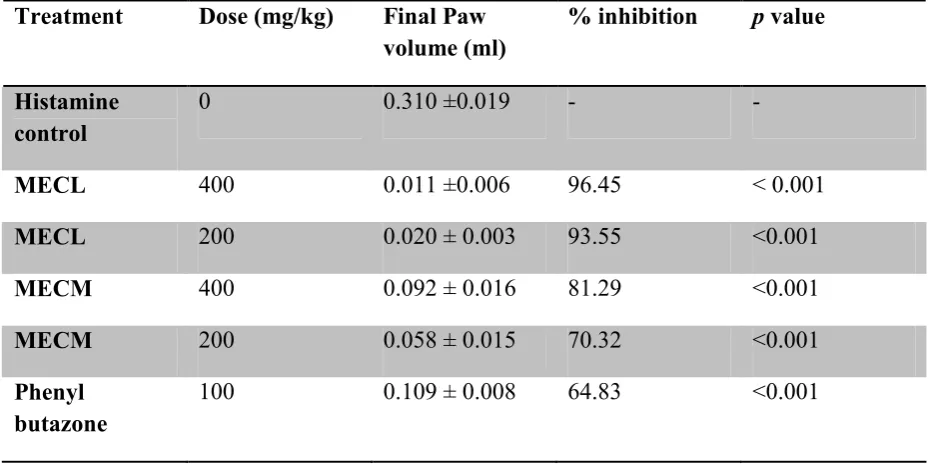
Percentage inhibition of histamine induced rat paw edema as exhibited by MECL and MECM in comparison with histamine control and phenylbutazone is summarised in Table 3.
Table 3: % inhibition of histamine induced rat paw edema by MECL and MECM (n = 6).
Treatment Dose (mg/kg) Final Paw volume (ml)
% inhibition p value
Histamine control
0 0.310 ±0.019 - -
MECL 400 0.011 ±0.006 96.45 < 0.001
MECL 200 0.020 ± 0.003 93.55 <0.001
MECM 400 0.092 ± 0.016 81.29 <0.001
MECM 200 0.058 ± 0.015 70.32 <0.001
Phenyl butazone
100 0.109 ± 0.008 64.83 <0.001
Discussion
Carrageenan induced rat paw edema is commonly used as an experimental animal model for assessment of acute inflammation and is believed to be biphasic, of which the first phase is mediated by the release of histamine and 5-HT in the early stage followed by kinin release and then prostaglandin and bradykinins in the later phase (24, 25). From the present results it is evident that MECL exhibited maximum activity at the dose level of 400 mg kg-1 with respect to all other groups against all three phlogistic agents.
Preliminary phytochemical study indicated the presence of flavonoids, alkaloids, tannins and saponin in MECL and MECM. The flavonoids and limonoids present in citrus plants are postulated to be the cause of their antitumor and anti-inflammatory effects (26).
As discussed in the introduction section, the flavonoids hesperidin and naringin are found in Citrus maxima and Citrus limetta both. The flavonoids and their respective aglycones viz. hesperetin and naringenin have shown potent anti-inflammatory activity against different in vitro and in vivo models as discussed earlier.
The in vitro free radical scavenging activity of MECM and MECL was evaluated and the extracts were found to be possess significant free radical scavenging activity when tested against different free radicals (27).
The plants Citrus limetta and Citrus maxima both contain high quantity of flavonoids of proven anti-inflammatory potential. Therefore, it can be concluded that due to the presence of the flavonoids both MECM and MECL can act as potent anti-inflammatory agents.
Acknowledgements
The financial assistance of the University Grants Commission, New Delhi, India and the technical assistance of Jadavpur University, Kolkata, India are hereby gratefully acknowledged by the authors.
References
1. Almeida R.N., Navarro D.S., Barbosa-Filho J.M., 2001. Plants with central analgesic activity, Phytomed., 8: 310-322.
2. Manthey, A., & Grohmann, K., 1996. Concentrations of hesperidin and other orange peel flavonoids on citrus processing byproducts. J. Agri. Food Chem., 44: 811–814. 3. Manthey, A., & Grohmann, K., 2001. Phenols in citrus peel by-products.
Concentrations of hydroxycinnamates and polymethoxylated flavones in citrus peel molasses. J. Agri. Food Chem., 49: 3268–3273.
4. Nogata, Y., Sakamoto, K., Shiratsuchi, H., Ishii, T., Yano, M., Ohta, H., 2006. Flavonoid composition of fruit tissues of citrus species. Biosci. Biotech. Biochem., 70: 178–192.
5. H´erent M.F., De Bie V., Tilquin B., 2007. Determination of new retention indices for quick identification of essential oils compounds. Journal of Pharm. Biomed. Anal., 43: 886–892
7. Chung, S. K., Kim, S. H., Choi, Y. H., Song, E. Y., & Kim, S. H. 2000. Status of Citrus fruit production and view of utilization in Cheju. Food Industry and Nutrition, 5: 42–52.
8. Xu G., Liu D., Chen J., Ye X., Ma Y., Shi J., 2008. Juice components and antioxidant capacity of citrus varieties cultivated in China. Food Chem., 106: 545–551.
9. Wu T.S., Huang S. C., Wu P. L., 1996. Buntanbismine, a bisacridone alkaloid from
Citrus grandis F. Buntan. Phytochem., 42: 221-223.
10.Singh P., Shukla R. , Prakash B., Kumar A., Singh S., Mishra P. K., Dubey N. K., 2010. Chemical profile, antifungal, antiaflatoxigenic and antioxidant activity of Citrus maxima Burm. and Citrus sinensis (L.) Osbeck essential oils and their cyclic monoterpene, DL-limonene. Food and Chemical Toxicol., 48 : 1734–1740.
11.Wilmsen P. K., Spada D. S., Salvador M., 2005. Antioxidant Activity of the Flavonoid Hesperidin in Chemical and Biological Systems. J. Agric. Food Chem., 53: 4757-4761.
12.Crespo M. E., Gálvez J., Cruz T., Ocete M. A., Zarzuelo A., 1999. Anti-inflammatory activity of diosmin and hesperidin in rat colitis induced by TNBS. Planta Med., 65: 651-653.
13.Bodet C., La V. D., Epifano F., Grenier D., 2008. Naringenin has anti-inflammatory properties in macrophage and ex vivo human whole-blood models. J. Periodontal Res., 43: 400-407
14.Ribeiro I. A., Rocha J., Sepodes B., Mota-Filipe H., Ribeiro M. H., 2008. Effect of naringin enzymatic hydrolysis towards Naringenin on the anti-inflammatory activity of both compounds. J. Mol. Cat. B: Enzymatic , 52–53: 13–18
15.Hirata A., Murakami Y., Shoji M., Kadoma Y., Fujisawa S., 2005. Kinetics of Radical-Scavenging Activity of Hesperetin and Hesperidin and their Inhibitory Activity on COX-2 Expression. Anticancer Res., 25: 3367-3374
16.Du G., Jin L., Han X., Song Z. , Zhang H. , Liang W. , 2009. Naringenin: A Potential Immunomodulator for Inhibiting Lung Fibrosis and Metastasis. Cancer Res. , 69: 3205 -3212
17.Harborne, J. B., & Williams, C. A., 2000. Advances in flavonoid research since 1992. Phytochemistry, 55, 481–504.
18.Baker, R. A., 1994. Potential dietary benefits of citrus pectin and fiber. Food Technology (November), 133–138.
19.Trease G.E., Evans M.C.: Textbook of Pharmacognosy, 12th. edition, Balliere, Tindal, London;1983;343-383
20.Anonymous. OECD Guidelines for the Testing of Chemicals: Test No. 420: Acute Oral Toxicity: Fixed Dose Procedure. Paris: OECD Publishing; 2008.
21.Winter CA, Risley EA, Nuss GW., 1962. Carrageenan-induced edema in hind paw of the rat as an assay for antiinflammatory drugs. Proc. Soc. Exp. Biol. Med., 111:544– 52.
22.Sugishita, E., Amagaya, S., Ogihara, Y., 1981. Antiinflammatory testing methods: comparative evaluation of mice and rats. J. Pharmacodynamics, 4: 565–575.
23.Suleyman H., Demirezer L.O., Kuruzum A, Banoglu Z.N., Gocer F., Ozbakir G., Gipdiremen A.,1991. Antiinflammatory effect of the aqueous extract from Rumex potentia roots. J. Ethnopharmacol., 65:141-148.
25.Castro, J., Sasame H., Sussaman H., Buttette P., 1968. Diverse effect of SKF 52 and antioxidants onCCL4 induced changes in liver microbial P-450 content and ethyl-morphine metabolism. Life Sci., 7: 129-136.
26.Middleton, E., Kandaswami, C., Theoharides, T.C., 2000. The effects of plant flavonoids on mammalian cells: implications for inflammation, heart disease,and cancer. Pharmacological Reviews , 52: 673–751.