A Secure Data Transmission Using Fuzzy Logic
And Multi-Key Generation Algorithm
B. Hemalatha
Abstract: In late examinations demonstrate that Distributed Denial of Service (DDoS) assaults assume a significant job in the security of PCs since they can diminish the productivity of unfortunate casualty assets inside a brief timeframe. It is valuable by and by and additionally trying for formal convention confirmation to decide if a service is helpless even to asset limited gatecrashers that can't create or catch self-assertive huge volumes of traffic. In this paper we displayed a Fuzzy logic based tool and multi-key generation algorithm, which might be useful for the discovery of Distributed Denial of Service (DDoS) assault in system condition. As DDoS assault turns out to be ground-breaking with the progression of time, in the event that it is recognized from the start, at that point the assault might be limited. So we concentrated on assault recognition component to verify the system condition utilizing Fuzzy logic.
Keywords: DDOS Attacks, Fuzzy reasoning, Attacker, PDR, Multi-key generation algorithm
——————————◆——————————
I. INTRODUCTION
As the most predominant risk a DDoS assault floods the processing and correspondence assets of a system targets making the service blocked off for legitimate clients by misusing the enormous asset irregularity between the Internet and the objective framework in which an enough number of controlled hubs organized to send superfluous bundles toward an objective in a specific time. Soft registering techniques, for example, fuzzy logic and neural systems are generally utilized interruption recognition approaches as of late [2]. Be that as it may, it is difficult to decide if a service is defenseless against such assaults. While an exceptionally incredible interloper with unbounded assets would just flood the service rendering it inaccessible, an asset limited gatecrasher completes an assault by misusing the conventions utilized by the objective service. He not just triggers a specific grouping of occasions to devour the service's assets, yet additionally shrewdly attempts to limit his exertion by activating occasions as lethargically as could be expected under the circumstances, recharging service breaks as late as could reasonably be expected, or by enrolling the assistance of other generous hubs in the system. Undoubtedly, in numerous assaults [6], the volume of traffic created by the interloper is tantamount to the volume of an authentic customer along these lines making it hard for system overseers to try and recognize when the service is enduring an onslaught. In this manner, deciding such vulnerabilities ahead of time may help counteract assaults by introducing reasonable countermeasures. Gatecrashers can likewise misuse a wide scope of sorts of assets [7]. With the creating of PC innovation, DDoS was first propelled by worms or Botnet.
Recently, DDoS has demonstrated some new inclines. It very well may be begun consequently, constrained by a middle PC which appropriates the assaults. Since an extraordinary parcel of PCs were tainted and constrained by the Attacker, DDoS can gather more than 1Gbps, at this point it can stick any server or system with undesirable traffic. Our technique depends on the explanation of DDoS. DDoS needs a ton of PCs synchronously and consequently assault a similar server. Aggressor needs a toolbox to control numerous hosts. For halting DDoS, we need perceive and enter this remote control technique, and after that by utilizing another strategy, to stop the assaults [4]. There are numerous sorts of assault, which may wreck the system condition inside a second if there is no counteracting component. The most well-known assault in system condition is Distributed Denial of Service (DDoS) assault. This assault focuses on the machine running in a systems administration framework and produces huge number of traffics. These traffics assaults the server framework in the system condition. The servers all of a sudden get pressurized as it needs to process gigantic number of traffic. On the off chance that there is no counteractive action component in the framework, at that point, the parcel landing rate turns out to be high with the expanding of time [1]. We proposed a Fuzzy based component to distinguish the assault in the system framework. We realize Fuzzy framework is utilized to diminish the human mind weight, as it can perform logical activity like human cerebrum can do. So it is conceivable to recognize the odd conduct of parcels on the off chance that we actualize the Fuzzy logic in the system framework. All the approaching information will be sifted through the Fuzzy framework before touching base in the system condition.
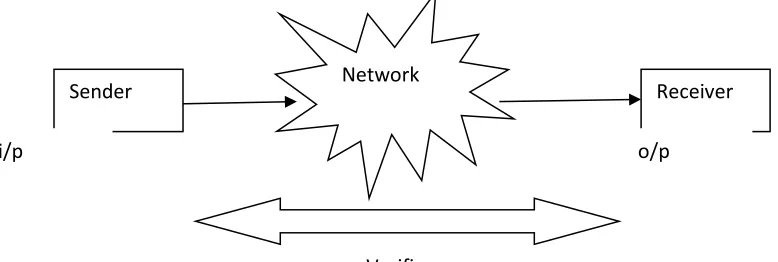
Fig 1: Data Transmission using fuzzy logic architecture
Sender
Network
Receiver
Verifies
2827
A) DDOS ATTACK OVERVIEW
A denial-of-service assault is described by an express endeavor to counteract the genuine utilization of a service [4]. A distributed denial-of-service assault sends multiple assaulting substances to accomplish this objective. This paper is exclusively worried about DDoS assaults in the PC domain, executed by making the injured individual get noxious traffic and endure some harm as a result. One as often as possible practiced way to play out a DDoS assault is for the assailant to send a surge of bundles to an injured individual; this stream devours some key asset, in this way rendering it inaccessible to the unfortunate casualty's authentic customers. Another normal methodology is for the assailant to send a couple of deformed bundles that befuddle an application or a convention on the injured individual machine and power it to solidify or reboot. In September 2002 there was a beginning of assaults that over-burden the Internet foundation as opposed to focusing on explicit unfortunate casualties [5]. One more conceivable approach to refuse assistance is to subvert machines in an unfortunate casualty organize and devour some key asset with the goal that genuine customers from a similar system can't acquire some inside or outside service. This rundown is a long way from thorough. It is sure that there are numerous different approaches to refuse assistance on the Internet, some of which we can't foresee, and these may be found after they have been misused in a huge assault. In this paper we primarily centered around DDoS assault location system utilizing Fuzzy logic. The blueprint is structured as, related works are examined in segment II, the approach of the proposed framework is introduced in segment III. The outcomes are talked about in area IV, where we have displayed results by changing the parameters. Area V depends on end and future works.
II. BACKGROUND STUDY
Boroujerdi, A. S., & Ayat, S [2] proposed A DDoS assault is a kind of web assault which attempts to interfere with the ordinary usefulness of the focused on PC organize. By and large, this assault endeavors to make the system assets inaccessible to its authentic clients. Soft registering techniques roused essentially are broadly used to conquer the unpredictability of the discovery procedure however they experience the ill effects of the issue of the feeble interpretability. In this way, mixture techniques are acquainted with take the benefits of every technique without confronting the interpretability issues. In this paper, we proposed a troupe of neuro-fuzzy classifier which is a blend of a creative arrangement of classifiers and a basic and proficient boosting technique to upgrade the identification procedure of DDoS assaults. It offers the benefits of higher exactness and lower false caution yields contrasted with other broadly utilized AI plots in the interruption identification frameworks. The proposed engineering likewise improves the computational productivity by dispersing the outstanding task at hand of the identification procedure to the various classifiers other than the abuse of ability of every classifier to distinguish a specific assault type by utilizing an interesting arrangement of highlights in the recognition procedure. Peng, D., Chang, G., Guo, R., & Qin, Y., [4] proposed the resistance component of DDoS assaults, especially the multi-based, multi-drew nearer and enhanced stream
strategy for offensive stratagem, reproducing the challenge of legitimate clients, possesses a keystone and trouble in the web security field, particularly for the assailant utilizing bunches of Bots. This paper examines and actualizes the utilization of the Differential Game Model with Hybrid Strategy to contend with an Attacker. Wu, D., Li, J., Das, S. K., Wu, J., Ji, Y., & Li, Z., [5] proposed a novel DDoS plan utilizing head part examination, to distinguish DDoS assault on SDN condition. At that point, we have assessed the presentation of the proposed plan with test entropy, a well known utilized plan. We have demonstrated that this plan have more clear outcomes has another. In the interim, we have recognized a novel DDoS assault pointing on SDN condition, which could cause more harms on SDN, and utilized the two recognition strategy on this novel DDoS assault, and discovered this novel assault is not really recognized by test entropy, and still be caught by PCA.
Rahman, O., Quraishi, M. A. G., & Lung, C.-H., [8] planned a SDN structure to identify and ensure the controller and the OF change from DDoS assaults. This structure includes preparing an AI model with caught information to foresee DDoS assaults. The expectation is then utilized by our alleviation content to settle on choices in our SDN organize. The accompanying headings could be abused for future research. In our situation, the assailants port is hindered for 30 seconds and the port is unblocked a short time later for proof-of idea. Nonetheless, another methodology could be to make a different investigation server for innovative work in the proposed arrange. This server ought to have huge transmission capacity, memory and handling assets. At the point when a host's bundles are anticipated to be a DDoS assault, at that point an order to make a stream passage from the aggressor's port to the examination server is sent through the controller. Every new bundle from the assault PC will be sent to the investigation server for a period. The examination server which is outfitted with incredible investigation and observing capacities further examines the caught parcels to improve the recognition and adequacy of the whole procedure. Besides, an opportunity to distinguish a DDoS assault might be additionally decreased by limiting the quantity of steps for arranging bundles utilizing progressively effective AI devices. Swami, R., Dave, M., & Ranga, V., [10] Software characterized organizing (SDN) has picked up the consideration of numerous analysts and systems administration datacenters. SDN gives adaptability and programmability to the system which makes it simple to adjust the changes. As SDN controller has a brought together perceivability to the total system topology, it might be focused by the assailants. By breaking the reconciliation of sending and steering rules in a solitary gadget, it offers cost productive systems administration services. In any case, SDN may experience the ill effects of different sorts of Distributed denial of service (DDoS) assaults. DDoS can aggravate the total system usefulness by devouring assets and preparing intensity of controller. A few scientists have planned numerous productive resistance systems as of late. In this exploration work, entropy which is utilized to register the haphazardness of any occasion is used to distinguish the DDoS assaults. The assault location module is executed in POX controller which screens the insights of all the approaching streams.
In this area we've examined our proposed technique for location of DDoS assault in system condition. We've for the most part proposed a framework which needs to execute in the system condition for a speedy identification of assaults and guarantee the protected workplace. DDoS assault focuses on the remote servers and assaults the machines with an enormous number of bundles. On the off chance that the assault can pick up the entrance of focal server by bypassing the defenseless security framework, at that point it makes an enormous number of phony traffic which is difficult to deal with for the focal server arrangement of Network. Accordingly, fresh introduction bundles can't be prepared by the machine and need to confront the peculiar condition for the client. With the progression of time the assault ends up higher, so it is conceivable to limit the assault on the off chance that it is recognized toward the start. On the off chance that we utilize Fuzzy framework in the system condition, at that point it can recognize the odd conduct of the approaching bundles. As we probably am aware, Fuzzy framework is useful for basic leadership criteria, it can decrease the human reasoning, we can undoubtedly actualize in Network Simulator Tool.
Fig 2: Node creation
In figure 2 illustrates the Node creation and selected the source as 6th node and destination is 4th node.
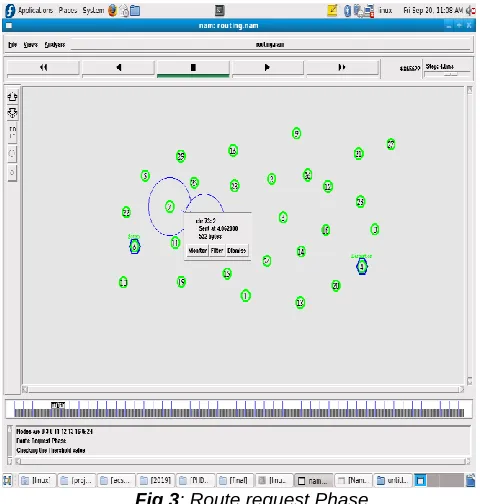
Fig 3: Route request Phase
In figure 3 shows the route request phase based on the threshold value.
Fig 4: Route reply process
In figure 4 represents the route reply process and the data transmission over the network and checking for the threshold value.
A) DDoS Attacks
2829 number of clients. A DDoS assault has the potential to do
huge damage, significantly more than the mischief that can be created upon single rented structures
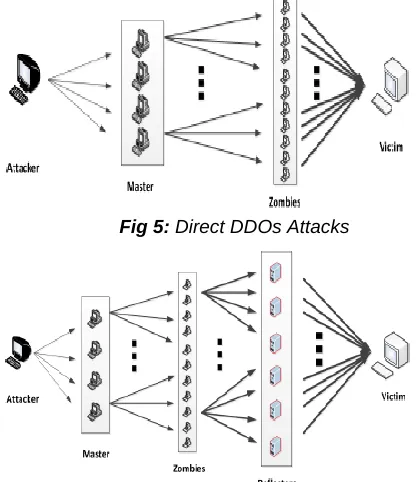
Fig 5: Direct DDOs Attacks
Fig 6: Reflection/Indirect DDos Attacks
In figure 5 and figure 6 illustrates the how the DDOs Attacks as Direct and the Indirect DDos attacks are happen. Here represents the Master and reflectors and attackers are sown in the figure 5,6.
1. Low-traffic stream. The work [8] presented that, regardless of how overwhelming the traffic of another stream is, just the initial couple of parcels of the stream will be exemplified in the bundle in messages and sent to the controller. In this way, the aggressors will want to utilize low-traffic streams to acquire effect to trigger assault on controller.
2. Substantial traffic stream. Despite what might be expected, we could utilize substantial traffic that every bundle loaded up with futile information to accomplish most extreme size to devour the space of switches.
B) Multi-key Generation:
ACK requires all affirmation parcels to be carefully marked before they are conveyed and checked until they are acknowledged. In any case, we completely comprehend the additional assets that are required with the presentation of advanced mark in WSNs. To address this worry, we actualized the two plans. The objective is to locate the most ideal answer for utilizing advanced mark in WSNs. Uneven key cryptography defeats the key administration issue by utilizing distinctive encryption and unscrambling multiple key sets. Knowing about multiple key, say the encryption key, isn't adequate enough to decide the other key - the unscrambling key. Subsequently, the encryption key can be made open, gave the decoding key is held uniquely by the gathering wishing to get scrambled messages (thus the name open/private key cryptography). Anybody can not utilize the open key for other people, open keys and to encode a message, just for beneficiary can unscramble it.
The scientific connection between people in general/private key pair allows a general principle: any message encoded with one key for one space of the pair can be effectively decoded uniquely with that key's partner. To encode with the open key methods you can decode just with the private key for space by opening. The opposite is additionally valid - to scramble with the private key methods you can decode just with the open key.
Encryption process: ➢ Set the number ➢ Set dummy symbol
➢ Combine symbol table and dummy symbol table to symbol table with dummy (STWD)
➢ Set rotated byte and rotate symbol table with dummy
➢ Transpose the symbol table after rotation ➢ Shift the symbol table after transposition ➢ Complement the symbol table after shift ➢ Packed control byte table
➢ Shift the control byte table ➢ Combine symbol table after
➢ complement and control byte after shift to ➢ get cipher text (CT)
Decryption process:
➢ Get the cipher text (CT)
➢ Separate cipher text into control byte after separation (CBAS) and symbol table after separation (STAS)
➢ Shift control byte after separation ➢ Pack control byte after shift
➢ Complement symbol table after separation ➢ Shift symbol table after complement ➢ Transpose the symbol table after shift ➢ Rotate symbol table after transposition ➢ Get plaintext (PT).
IV. RESULTS AND DISCUSSION
Fig 7: Overheads using fuzzy
In figure 7 shows the Data transmission overheads using fuzzy logic. In here the x axis represents the Time (sec) and Y axis reprints the data overheads.
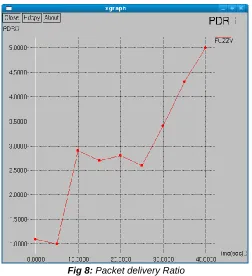
Fig 8: Packet delivery Ratio
In figure 8 represents the packet delivery ratio (PDR) using fuzzy logic. In this figure x axis represents Time(sec) and y axis represents the PDR.
Fig 9: Data Delay using Fuzzy.
In figure 9 represents the delay for data transmission using in the fuzzy logic technique.The outcome depends on Fuzzy logic equality of follows, applied, specifically on confirmation of protection properties, not DDoS. Like our parameterized activity execution, formalized utilizing SPEC work, they likewise manage calculation time to length of data sources. The model permits portrayal of other "side-channel" assets that can be spilled by the execution, for example, control utilization. As this methodology depends on the decrease of time follow identicalness to length follow comparability, it stays to be explored whether such a methodology might be material to the general DDoS issue, covering convention speculations with fluctuated execution time, as of now examined previously.
V. CONCLUSION
There are numerous articles and arrangements about DDoS recognition, assurance or moderation. The majority of them are centered around quick recognition with high identification precision and legitimate alleviation without false positives during the assault. Be that as it may, this paper contrasts from such explores and is engaged of the genuine effect of DDoS assault before the relief happens. The assailants consistently attempt to find an approach to sidestep the security framework to make the framework helpless. So the security framework may require more research to forestall the new found assaults. It is conceivable to procure increasingly productive outcome later on by including progressively factor utilizing the Fuzzy framework, which will be increasingly dependable, dynamic and give better secure execution to the clients.
VI. REFERENCES
2831 logic", 2017 3rd International Conference on Electrical
Information and Communication Technology (EICT). [2] Boroujerdi, A. S., & Ayat, S. "A robust ensemble of
neuro-fuzzy classifiers for DDoS attack detection", Proceedings of 2013 3rd International Conference on Computer Science and Network Technology.
[3] Shiaeles, S. N., & Papadaki, M., "FHSD: An Improved IP Spoof Detection Method for Web DDoS Attacks", The Computer Journal, 58(4), 892–903.
[4] Peng, D., Chang, G., Guo, R., & Qin, Y., "DG-Based DDoS Detection Using Hybrid Strategy", 2008 Fifth International Conference on Fuzzy Systems and Knowledge Discovery.
[5] Wu, D., Li, J., Das, S. K., Wu, J., Ji, Y., & Li, Z., "A Novel Distributed Denial-of-Service Attack Detection Scheme for Software Defined Networking Environments", 2018 IEEE International Conference on Communications (ICC).
[6] Mladenov, B., "Studying the DDoS Attack Effect over SDN Controller Southbound Channel", 2019 X National Conference with International Participation (ELECTRONICA).
[7] Aires Urquiza, A., AlTurki, M. A., Kanovich, M., Ban Kirigin, T., Nigam, V., Scedrov, A., & Talcott, C., "Resource-Bounded Intruders in Denial of Service Attacks", 2019 IEEE 32nd Computer Security Foundations Symposium (CSF).
[8] Rahman, O., Quraishi, M. A. G., & Lung, C.-H., "DDoS Attacks Detection and Mitigation in SDN Using Machine Learning", 2019 IEEE World Congress on Services (SERVICES).
[9] Giachoudis, N., Damiris, G.-P., Theodoridis, G., & Spathoulas, G., "Collaborative Agent-based Detection of DDoS IoT Botnets", 2019 15th International Conference on Distributed Computing in Sensor Systems (DCOSS).