© 2017 IJSRST | Volume 3 | Issue 1 | Print ISSN: 2395-6011 | Online ISSN: 2395-602X Themed Section: Science and Technology
Classical Kinematics of Material Point in Non-inertial Frames of Reference
Zvezdelin Ivanov Peykov
*1, Angel Todorov Apostolov
2Department of Physics, University of Architecture, Civil Engineering and Geodesy, Sofia, Bulgaria
ABSTRACT
The leading questions of classical kinematics of material point have been examined: inversion of time, inversion of space, inversion of time and space, density of space and time, defined in the inertial frames of reference. The conditions are specified below, which must be met in order these concepts to apply in non-inertial frames of reference as well.
Keywords: Non-Inertial Frames of Reference
I.
INTRODUCTION
A. Inertial frame of reference
1. Definition
We shall give kinematic definition of concept of inertial frame of reference:
One frame of reference is called inertial when: if the acceleration of the material point in this frame of reference is 0 (
a
0
), the point moves uniformly or is at rest (v const,0).Uniform motion of a material point is also called inertial motion.
2. Motion in inertial frame of reference [1].
Let consider inertial frame of reference K and other frame of reference K´ that is moving uniformly toward K. Let mark the velocity of the beginning of K´ toward
K´ as
v
0
const
, the radius vector of an arbitrary
material point M toward K to mark as r and toward K´
as r . Radius vector of the beginning of K´ is
r
0
.The connection between the coordinates of the point and time in both frames of reference is provided by Galileo's transformations:
r
r
r
0
t = t′
Let mark the velocity of the material point in K with
v
and in K´ with
v
. The relationship between both velocities is obtained by differentiating the relation between the coordinates by the time:v
v
v
0
The resulting equation is called Galileo's theorem for
addition of velocities. Very often
v
is called absolutevelocity,
v
- relative velocity, andv
0
- frame velocity.
Let the material point moves with acceleration
a
in the frame of reference K, at the same time its acceleration inthe frame of reference K´ is
a
. The connection between both accelerations obtains as differentiates connection between the velocities multiplied by time:a
a
Or accelerations in both systems are equal.
Conclusion:
From here Galileo made the following key findings:
1) All frames of reference, which are moving uniformly or are at rest toward a certain inertial frame of reference are also inertial.
3) Kinematics of material point is one and the same in all inertial frames of reference, in particular this applies to any conclusions concerning the characteristics of time, its inversion [2], the inversion of space [3], [4] and the density of space and time [5].
B. Non - inertial frame of reference
1. Definition
Non - Inertial Frame of reference is this one, in which if
the acceleration of the material point is 0 (
a
0
), it isnot moving uniformly or is not at rest (vconst,0).
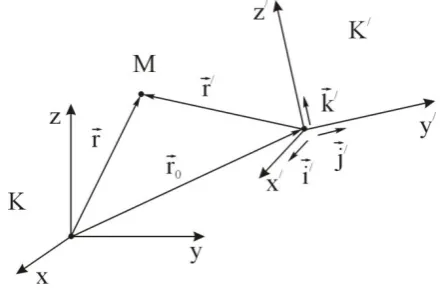
2. Motion in non - inertial frame of reference [1]. Let consider inertial frame of reference K and other frame of reference K´, which moves in an arbitrary manner in relation toward K (Fig. 1).
Figure 1: Non - inertial frame of reference
Let the radius-vector of an arbitrary material point M in K is r, in K´ is r and radius-vector of the beginning of
K´ toward K is
r
0
. The arbitrary motion of K´ can be represented as the sum of translational and rotational movement toward momentary axis of rotation (see [1]).
a) Transformation of coordinates and time.
Galileo's transformations in classical mechanics are in force here as well:
r
r
r
0
t = t′
b) Transformation of velocities.
Let the velocity of the point M in K is
v
, in K´ isv
,and the velocity of the beginning of K´ toward K is
v
0
. Differentiating the connection between the coordinates by the time, we receive:v
r
v
v
0
This connection between the velocities differs from the theorem of Galileo for addition of the velocities in
inertial case by member:
v
rot
r
conditioned by rotation of K´ toward K.
c) Transformation of accelerations.
Let the acceleration of the material point in K is
a
, itsacceleration toward K´ is
a
, and the acceleration of thebeginning of K´ compared to K is
a
0
. Differentiating relationship between velocities by the time, we receive:
a
v
2
r
r
a
a
0
(
)
This equality is called as well theorem of Coriolis. Here:
n
a
a
a
- Absolute acceleration of the point toward K,0n 0
0
a
a
a
- Acceleration of the beginning of K´toward K,
r
a
rot - Tangential acceleration of rotation of K´ toward K,n rot
a
r
)
(
- Normal (centripetal) acceleration of rotation of K´ toward K,e
0
r
r
a
a
(
)
- Reference-frameacceleration conditioned by movement of K´ toward K,
c
a
v
2
- Coriolis acceleration, conditioned bysimultaneous movement of the point in K´ and by
movement of K´ toward K,
a
a
a
n
With these indications theorem of Coriolis is written briefly as follows:
a
a
a
a
e
c
d) Conclusions:
1) Coriolis acceleration is always perpendicular to the
velocity
v
and modifies only its direction but not its size. Normal parts of all accelerations in the right part of the theorem of Coriolis are always perpendicular to the respective velocities: a0nv0 , arotn vrot , anv ,and do not change their sizes (but may change the sizes of the other velocities). Tangential parts of the accelerations are always parallel to the respective
velocities
a
0v
0a
rotv
rota
v
,
,
, and
change these velocities only in size (but they can change the direction of the other velocities).
2) Non-Inertial frames of reference
K is an inertial frame of reference. If in it 0
const v
0
a , . What kind of system is K´? From the theorem of Coriolis follows:
0
a
a
ea
ca
ea
ca
and the point is notmoving uniformly and is not at rest toward K´. The main conclusion that can be drawn is that all frames of reference, which are not moving uniformly or are not at rest toward particular frame of reference, are non-inertial. Or in non-inertial frames of reference alterations are necessary to be done in all kinematics values and laws deduced for inertial frames of reference.
II.
METHODS AND MATERIAL
A. Inversion of time in non-inertial frames of reference.
In [2] we gave a definition of reversing the course of time in classical kinematics of material point as an opportunity the point to go through the same spatial positions, but in reverse order, with the same size of velocity, but in opposite direction. Practically the inversion of time is carried - out by replacing in the laws the moments of time with their negative values: t ' = - t
and the vector of velocity with:
v
v
.The definition requires law of motion to be even function in case of inversion of time:
) ( ) (t rt
r
and the law for velocity - to be odd function:
) ( ) (t vt
v
From these two requirements follows the necessary condition the acceleration of the point to be even function in case of inversion of time:
) ( ) (t at
a
which, however, cannot always be carried out (see [2]). How the inversion of time looks like in Non-Inertial frame of reference K´?
Let in inertial frame of reference K (Figure 1) the inversion of time to be possible and the laws of motion, velocity and acceleration to fulfill the above conditions. If we reverse the direction of time in the transformation of the velocities between K and K´ we have:
)
(
)
(
)
(
)
(
)
(
)
(
)
(
)
(
t
t
t
t
t
t
t
t
v
v
v
v
v
v
v
v
rot 0 rot 0
It is seen that the law of velocity in K´ is odd function toward the inversion of time. (Here t' means inverted time).
For the law of motion we have:
const t dt t dt t dt t dt t dt t dt t dt t t d t t d t t d t t d t const t
) ( ) ( ) )( ( ) )( ( ) )( ( ) )( ( ) )( ( ) )( ( ) ( ) ( ) ( ) ( ) ( r v v v v v v v v v v v r rot 0 rot 0 rot 0 Or the law of motion remains an even function at the inversion of time.
) ( ) ( ) ( ) ( ) ( ) ( )
(tatatatantatat
a0
0nrot
rotcAt the inversion of time we have: )
( ) (t at
a
(
)
(
)
)
(
)
(
v
)
(
)
(
)
(
v
)
(
2 2t
t
t
t
t
t
t
t
rot rot0n
0n
n
n
a
a
(
)
(
)
)
(
)
(
v
)
(
)
(
)
(
v
)
(
n 2 2n
t
t
t
R
t
t
t
R
t
t
rot rotrot
rot
n
n
a
a
)
(
)
(
)
(
2
))
(
(
))
(
(
2
)
(
)
(
)
(
t
t
t
t
t
t
t
t
i ca
v
v
v
2
a
Which always are odd functions.
We shall consider that tangential accelerations are not proportional to an arbitrary exponent of the relevant velocity (see [2]):
v vrot rot rot vo 0
0 v e a v e a v e
a
n n n
k k
k , ,
Then they are also even functions.
Finally, from the theorem of Coriolis follows:
) ( ) ( ) ( ) ( ) ( ) ( ) ( ) ( ) ( ) ( ) ( ) ( ) ( ) ( n n t t t t t t t t t t t t t t a a a a a a a a a a a a a a c rot rot 0n 0 c rot rot 0n 0
Or the relative acceleration is an even function of time as well.
From everything mentioned above follows that in non-inertial frame of reference K´ inversion of time is possible analogous of inversion of time in K. Accordingly remain in force as well the classification of different types of movements in K´ regarding reverse the course of time: fully reversible and semi- reversible (see [2]).
In the case where at least one of the three equations is in force: v vrot rot rot vo 0
0 v e a v e a v e
a
n n
n
k k
k , ,
Corresponding accelerations are not even function of time, the movements are completely irreversible and
inversion of time without external assistance is impossible ([2]).
B. Inversion of space in non-inertial frames of reference.
In [3] we gave a definition of inversion of space in classical kinematics of material point, based on the reversal of the direction of movement within it.
Inversion of space means the material point to go through the same spatial positions in reverse order, with reverse direction of velocity, as it retains the character of the initial movement. This means as well that the initial position and velocity of the point becomes end ones, and vice versa.
All this requires co-ordination in the laws of motion and velocity according their starting and end parameters.
In the inertial frame of reference ([3]) movements
inverted in space are those that are uniform (
a
0
) or in particular case, those about which:
v
e v akn
All other movements for which
a
0
prove irreversible in space.
What will we have in a non-inertial frame of reference K´? We shall use the theorem of Coriolis in the form:
) ( ) ( ) ( ) ( ) ( ) ( ) ( ) ( ) (
n t t t t
t t t t t n c rot rot 0n 0 n a a a a a a a a a
In case of inversion of the movement Coriolis acceleration does not change:
)
(
)
(
)
(
)
(
2
)
(
t
ct
c
v
2
v
2
v
a
a
(Here ' means inversion of the movement). It is always perpendicular to the relative velocity and does not modify its size. The same is true for normal part of the
relative acceleration
a
n(
t
)
. This however is not true in general for other normal accelerations:
a
0nv
0a
rotv
rota
nv
,
(
)
,
(
)
)
which may not be perpendicular to
v
and can modify itboth in size and in direction. Then if in K
a
0
, in order movement in K´ to be reversible in space, it is necessary in any given moment of time:
)
(
)
(
)
(
)
(
)
(
)
(
t
a
nt
a
0t
a
0nt
a
rott
a
rotnt
a
i.e. the relative tangential acceleration must compensate the change of the magnitude of the relative velocity on the part of all these accelerations. Then the movement of the point in K´ will be uniform and inversion of the space is feasible there. From the theorem of Coriolis under this condition remains:
)
(
)
(
t
ct
n
a
a
Which corresponds only to the type of trajectory.
For the coordination of the laws of velocity and movement we shall use (as in [3]) the trajectory of point for generalized coordinate S. Then in K´ we have for the law of velocity and movement:
v
S(
t
)
v
0S(
t
0)
const
S
(
t
)
S
0(
t
0)
v
0St
The inversion of the space leads to:
v
S(
t
)
v
0S(
t
0)
const
v
S(
t
)
v
0S(
t
0)
const
v
0S(
t
)
S
(
t
)
S
0
(
t
0)
v
0St
But:
S
0
(
t
0)
S
(
t
)
, then:)
(
v
v
)
(
v
)
(
)
(
t
S
t
0St
S
0t
0 0St
0St
S
0t
0S
Or in K´ all uniform movements are convertible in space as well.
As regards the specific case of reversible movements in
K at: a vev n
k
, it does not exist in the non-inertial frame of reference due to the fact that the
reference-frame acceleration
a
e(
t
)
in the general case may not be
always parallel to the relative velocity
v
.In all other cases the movements in K´ are irreversible and inversion of space is impossible without external interference.
C. Simultaneous inversion of time and space in non-inertial frames of reference.
All mentioned in B. and C. relates to simultaneous inversion of time and space in non-inertial frames of reference as well, which is possible only in case of uniform movements [4].
D. Density of space and time in non-inertial frames of reference.
In [5] we gave a definition of average and differential linear density of space and time, based on random motion of a material point. This definition is based on the mathematical definition of the density of function and argument [6], which is effective for monotonous, continuous and differentiable functions in a particular interval and equal quality of arrays of values of the function and argument. Using the trajectory of the material point in an inertial frame of reference K as a summary coordinate S, law of motion S (t) and equalizing quality between time and distance St = ct (where c = 1 - normalizing velocity), we have introduced relative linear differential and average density of the space toward the time through the formulas:
t
t s
t
dS
cdt
dS
dS
)
(
v
c
t t
t
s t t t t
t
c
S
t
c
)
(
v
It is seen that the density of the space may be different from the density of the time.
What will we have in the non-inertial frame of reference K´?
consider that the average and differential density of time is preserved in non-inertial frame of reference as well:
t
t
Accordingly, equalization of quality between time and distance preserves as well:
S
t
c
t
where here c '= 1 m / s - normalizing velocity as well.
Second, and here we shall examine the trajectory of the material point as a summarized coordinate S', providing the monotony of the law of motion toward the time:
S(t)S0v0(tt0)
a
(t)dtdtLaw of velocity:
v(t)v0
a(t)dtas well as the formula for average velocity:
atdtdtt ()
1 v
v 0
According to the theorem of Coriolis:
a
(
t
)
a
S(
t
)
a
eS(
t
)
(Here the projection of Coriolis acceleration by S is:
0
cS
a
).and according to the transformation of velocities:
v
(
t
)
v
S(
t
)
v
0S(
t
)
v
rotS(
t
)
Then in K´ the same definitions of linear differential and average density of space toward the density of time remain as well and the following equations are effective:
t
t s
t
S
d
dt
c
S
d
S
d
)
(
v
c
t t
t
s t t t t
t
c
S
t
c
)
(
v
as the density of the space may be different from the density of time.
III. RESULTS AND DISCUSSION
From all these considerations the following conclusions can be made:
The concepts: inversion of time, inversion of space, simultaneous inversion of time and space, density of time and space in classical kinematics can be summarized in the case of non-inertial frames of reference at relevant additional conditions:
a) Validity of Galileo's transformations concerning the coordinates and time at the transition from inertial to non-inertial frame of reference;
b) Preservation of evenness of the law of motion and the law of acceleration and oddness of the law of velocity regarding the inversion of time in non-inertial frame of reference;
c) Compensation of all accelerations changing the relative velocity in non-inertial frame of reference by the relative acceleration:
a
(
t
)
a
n(
t
)
a
0(
t
)
a
0n(
t
)
a
rot(
t
)
a
rotn(
t
)
which ensures uniform movement of the point there.
IV. REFERENCES
[1]. Детлаф А., Б. Яворский. Курс физики. Высшая школа, Москва, 1989. (Detlaf A., Iavorski B. Kurs Fiziki. Vissha Shkola, Moskva, 1989.)
[2]. Z. Peykov, T. Spiridonov, A. Apostolov, Inversion of Time in the Classical Kinematics of Material Point, IJSRST, V.2, №4, p.116-125, (2016).
[3]. Z. I. Peykov, A. Apostolov, Inversion of space in the classical kinematics of material point, IJSRST , V.2, №5, p.309 (2016).
[4]. Z. I. Peykov, A. T. Apostolov, Inversion of Time and Space in the Classical Kinematics of Material Point, IJSRST , V.2, №5, p.317 (2016).
[5]. Z. I. Peykov, A. T. Apostolov and N. Mihailov, Density of Space and Time in the Classical Kinematics of Material Point, IJSRST, V.2, №6, p.471 , (2016). [6]. A. T. Apostolov, Z. I. Peykov, Density of Function in