63
Indonesian Teaching Material Based On Fun Self
Learning For Foreign Speaker
Aninditya Sri Nugraheni, Mohammad RofiqAbstract: The requirement of Indonesian Language mastery for refugees in Rudenim is needed. For instance, it is utilized to communicate with the Rudenim watchmen and as their preparation to be placed at a community house where they will socialize with Indonesian Societies. The lack of refugees’ intention to learn Bahasa Indonesia, moreover with learning schedule which is only performed once a week becomes the teachers’ problem. Therefore, the author was attempted to develop the teaching material that can be used by the teachers to enable them in presenting the material. The development of teaching material emphasizes on the learners’ independence self-learning. This research was aimed to know the process of Indonesian Language learning for Foreign Speaker (ILFS) at the Immigration Detention Centre of Semarang and develop ILFS teaching material. The methods of this study were research and development. The result of this research was the Concept of Indonesian Language for Foreign Speaker learning which was performed by the teacher based on active, creative, effective, and fun learning principles. Fun Self Learning was a teaching material concept which emphasizes on independence aspect in the learning process. The material was presented thematically and used the drill method. Bilingual was used as the Grammar, while the graphic was made using Fun Learning concept.
Keywords: Teaching Material, refugee, fun learning, self-learning.
————————————————————
1
I
NTRODUCTIONThe dynamic of international society’s development has experienced rapid change. It has been known from the development of knowledge and technology. Therefore, the transportation technology becomes one of important matters for population migration from one country to another country [1]. It is memorized clearly about the case which is experienced by Rohingya Moslem minority in Myanmar that they tossed in the sea until they finally arrive on Indonesian water. Automatically, Indonesia must accommodate them. The existence of United Nations High Commissioner for Refugees (UNHCR) which is given mandate from the United Nation to protect refugees and help them to find solution on their situation has become the objective of the sanctuary seeker and refugees to come to Indonesia [2]. Moreover, International Organization for Migration (IOM) in Indonesia that provides service for the sanctuary seekers and refugees becomes the benefit for them to survive. In this case, IOM has a very important role because it is inter-government organization, especially in migration field. IOM is dedicated to develop organized and humanistic migration for collective interest. It is implemented by improving an understanding on migration issues, helping the government to respond the challenge of migration, support social and economic development, upholding migrant and the community. However, Indonesian government has not signed Convention 1951 and Protocol 1967 on refugees. Therefore, legally Indonesia is not required to acknowledge or even give a protection for sanctuary seekers in Indonesia. However, as one of countries that accepts and ratify Human Rights Public Declaration, Indonesia acknowledges the rights to seek sanctuary based on Indonesian Regulations.
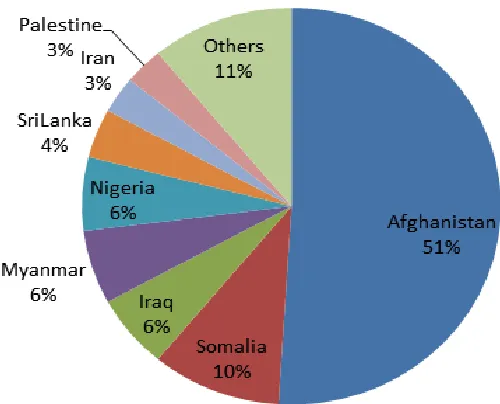
The rights cover rights to determine, choose and get education, teaching, and develop cultural as the intention to build interest [3]. The role of handling refugees and sanctuary seekers are equalized with illegal immigrants who come to Indonesia [4]. During the sanctuary seeker process, the refugees are placed at Immigration Detention Centre (Rudenim) which is distributed is some areas in Indonesia. Based on immigration role, the length period of staying at Rudenim has no limit. They can leave Indonesia if there has been solution settlement of refugees and any country acknowledges their citizenship for the sanctuary seekers [5]. Those immigrants are placed at immigration detention distributed in 13 areas in Indonesia [6]. Based on statistical data of 2017 owned by IOM, there are 14.425 illegal migrants in Indonesia who are divided into 8.039 refugees and 6.386 sanctuary seekers, while 8.679 are under IOM [7]. The Figure 1 is the statistical data of rudenim residents in all regions in Indonesia:
Figure 1. Immigrant Statistical Data in Indonesia Based on their Citizenship (Source: IOM Document)
_______________________
Aninditya Sri Nugraheni, Faculty of Tarbiyah and
Education State Islamic University Sunan Kalijaga
Yogyakarta, [email protected]
Mohammad Rofiq, Faculty of Tarbiyah and Education
State Islamic University Sunan Kalijaga Yogyakarta,
64 International Organization for Migration (IOM) as the
organization which guarantee the welfare of refugees and sanctuary seekers has an authority in Human Rights fulfillment. One of them is education field. The human rights law essence organizes humanity without being bound with space and time attributes [8]. IOM which handles immigrants at Rudenim in Semarang City has cooperated with The Association of Indonesia Family Planning (AIFP) to implement an education program for immigrants who are at Rudenim of Semarang City. The forms of this program are 3 main activities, such as English, Indonesian, and handicraft class. Until present, Immigration detention center in Semarang are stayed by 80 refugees who majorities have family life, consisting parents, teenagers, and children. Language has an important role in humans’ life, especially if it is related to communicative function. Language as the connector and recognition for each individual is utilized to interact [9]. Language is called as social dimension because it is one of human’s life activity aspects. The existence of language in humans’ life cannot be considered as an empty space without any function. Language is the main humans’ control instrument [10]. The requirement of teaching material of Indonesian Language mastery is very required [11]. For example it is to communicate with Rudenim watchmen and their preparation after being placed at the community house in which they can socialize with Indonesian society. Besides, as the Indonesian citizen, we are required to introduce Indonesian Language to every foreign citizen. We want Indonesian language becomes international language which can be mastered by foreign citizens. The guideline of Indonesian Language for Foreign Speaker is very important to support the effectiveness of Indonesian Language learning for Rudenim residents [12]. The learning of Indonesian Language at the Immigration Detention Centre in Semarang City has been performed for a month. Thus, it becomes the challenge for the teachers so that they in the future to be maximum in Indonesian Language learning. However, what become the problems is the lack of immigrants’’ interest to learn Indonesian Language. Moreover, the learning schedule is only carried out once a month. Therefore, the writer tries to develop the teaching material that will furthermore be utilized by the teachers to enable them in the material presentation. Furthermore, this learning material teaching will emphasize on the learners’ independence, in this case is immigrants to self-learn. Based on the observation of document scrutiny, learning material which is organized by the language body center conceptually still needs a teacher to present the material. Besides, of the researcher’s analysis concerning the teaching material as developed by the previous researcher, the learning concept offered is still limited to the material explanation, not to memorize the language material. Therefore, the researcher develops the teaching material that builds readers’ interest and can be self-learnt by the learners, which is entitled as ―Fun Self Learning-based (FSL) Teaching Material Development of Indonesian Language for Foreign Speaker (ILFS) for refugees at Immigration Detention Centre in Semarang City‖. This research is aimed to: find out the process of ILFS learning at Immigration Detention House in Semarang City and develop Fun Self Learning-Based ILFS Teaching Material.
2
METHOD
This research is included in the Research and Development (R&D). The procedure which was utilized in the research utilizes development procedure as proposed by Borg and Gall using the steps or procedures of R&D application [13]. This research is limited by small scale, divided into six stages which is done systematically [14]. The limitation of research stages are adjusted with the level of research need. The data collection techniques that will be utilized in this research are interview, documentation, observation, and questionnaire. The data source is obtained from foreign speakers, ILFS and expert lecturers. The foreign speaker source is utilized to find out the needs of teaching material development. ILFS teachers are utilized to find out the teaching material development validators. While the expert lecturers as the validators of teaching material has been developed. The research of Fun self-learning based ILFS teaching material development requires two different data, such as: (1) the data of Fun self-learning based ILFS teaching material, and (2) prototype test result of material teaching obtained from this research. The data of ILFS teaching material is collected using need questionnaire. It is directed to foreign speakers. The data collection is obtained from the foreign speakers at Rudenim in Semarang City. The instrument of the second data collection is prototype validation test of ILFS teaching material in form of evaluation sheet of ILFS teaching material. The assessment result of expert teacher and ILFS teacher is furthermore utilized as the guideline of prototype revision of created teaching material. Furthermore, in order to find out the appropriateness of Fun Self Learning-based ILFS teaching material in improving the Indonesian Language Mastery of refugees which is developed through this research, it is required both qualitative or quantitative data analysis, as follow: (1) Quantitative data, qualitative data analysis is performed using data obtained from observation, interview and documentation. (2) Quantitative Data, the utilized quantitative data analysis technique is descriptive statistic. Quantitative data is obtained from the collected questionnaires which are grouped based on the variable and types of respondents. Furthermore, it is utilized to perform data tabulation and calculation to draw a conclusion.
3
FINDINGS
AND
DISCUSSION
3.1 The process of ILFS Learning at Immigration Detention Center in Semarang
65 3.2 The Concept of IFLS learning for refugees
As non-formal education program, the implementation does not refer to the curriculum created by the government. The lesson plan is not far from the signs as the government curriculum. Lesson Plan which is created by IFLS teachers only covers: learning output. The lesson plan is made for one-month learning process. Thus the teacher has owned the image of learning process that will occur. In creating a lesson plan, the teacher creates situation and need of the learners. Based on the researcher’s observation in the classroom, the learners still lack of attendance discipline. Besides, there is not rule that binds them to come to the class. They come to the class based on their will, even when the class has almost finished. Thus, it becomes the main obstacle of teaching-learning process. Although the teacher has prepared the teaching material as good as possible but they still lack of learning material motivation, as a result the learning material cannot be presented effectively [16]. The concept of Indonesian Language Learning for Foreign Speakers as performed by the teacher is based on the following principles [17]:
a. Fun Teaching learning activity
The concept of fun learning in this case refers to teaching technique done by a teacher. At Firstly in IFLS learning, the teacher begins the class by giving ice breaking. After giving icebreaking, the teacher presents the learning material. When their brain is refreshed, it will work optimally. However, if it is forced to think hard, they will experience learning boredom [18].
b. Activate the learners
The approach can be utilized to change the learners’ thinking pattern who will learn because they want to learn something, not be forced is by involving students in the learning process [19]. By actively learning, the learning process which takes place is the initiative of learners. The learners really explore their environment. The concept of IFLS learning as implemented by the teachers on refugees is to maximize knowledge possessed by the students in order to present an idea so that there is a feedback between the teacher and learners, for example, their original language used in enriching vocabularies into diverse languages which are mastered by them.
c. Combine various learning and development aspects
Learners have various development aspects, such as cognitive, language, emotional, social, physical development, etc. Diverse learners in the classroom certainly demand the teacher to adapt the learning as their development [20]. Therefore, there should be a main and assistant teacher in the ILFS learning. In this case, the teacher should prepare two materials in each learning process. One for beginner and the other is fore intermediate group.
3.3 The development of Fun Self Learning Indonesian Language for Foreign Speaker Teaching Material
Initial competence test for refugees as the beginner level foreign speakers.
Learners who become the target of research are refugees who live at Immigration detention center of Semarang. During their stay at the center, they get Indonesian language learning as the effort to equip their communication ability. Based on the
researcher observation, the refugees only get Indonesian Language material once a week. Therefore, the meeting process between the teacher and learners are limited. Thus, it should be teaching material development that can be used for self-learning. First, the researcher performs initial competence test of the refugees. It is intended as the consideration in the development of fun self-learning teaching material. Based on the initial competence test result, the researcher finds that the highest score is 35, while the lowest is 29, and the mean is 32.64. The maximum score is 50, thus the mean score on medium level.
The Principles of Fun Self Learning-based ILFS Teaching material Development
The organization of fun self-learning-based ILFS teaching material for foreign speakers is based on the observation analysis result of ILFS learning process. The principles are elaborated into the following four aspects:
a. The Rules of Material/ Content
The material of fun self-learning-based (FSL) IFLS material teaching is based on the relevance, sufficiency, adaptive, and innovative principle [21]. The core material content needed according to the perception of foreign speakers include (1) dialog and reading, (2) enrichment, and (3) grammar. The independent learning/self-learning also becomes the main point of attention of the teaching material. Foreign speakers can learn independently therefore they do not depend on the teacher because of learning time limit in the classroom. The material content is adapted with the situation and needs of learners. The implementation of discussion which is presented on the teaching material includes seven topics, such as: (1) introduction, (2) self-identity, (3) family, (4) location, (5) health, (6) daily activity, (7) buy and sell, (8) society’s service, (9) walk, and (10) meeting. The ten topics are integrated on dialog and reading. Teaching material is presented by material explanation which consists of knowledge as the present condition. Besides the four principles, the teaching material is presented using thematic principles. So, in order to enable the understanding of foreign speakers, the materials should be integrated with their daily life situation and condition. The essence of thematic learning is the effort to provide meaningful learning experience for learners through interdisciplinary review [22]. For example, Discussion topic can be approached from the perspective of various science disciplines.
b. Material presentation
The material presentation uses self-instructional and systematic [23]. The order of teaching material is started with dialog or reading, then it is continued with enrichment and ended with grammar material and exercise. Besides, the material presentation also utilizes drill method. It is a teaching method by train the learners towards material that has been taught/given so that they have skill of what it is [24]. This method is identical with many exercises in the end of chapter. It is aimed to strengthen their material understanding.
c. Language and Readability Bahasa and Legibility
66 utilized is adjusted with the level and knowledge of foreign
speakers on beginner level. Bilingual principles are utilized to enable them in understanding the intention of teaching material content, both which in form of reading or instruction sentences in doing the exercise. Besides, using bilingual cause the foreign speakers to self-learn without a teacher’s guide.
d. Graphics
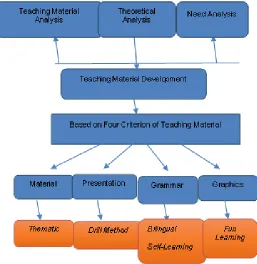
Relevancy and fun learning principles are applied on graphics aspect. As the need analysis result, ILFS teaching material is completed with illustration which is appropriate with the content and explanation of each teaching material. The consistency principles become the base of teaching development, especially on the letter style, size, and color selection. Fun learning principle is intended to attract the interest of foreign speakers so that they are motivated to learn. By attractive performance, the learning is more fun. An individual will be more attracted toward interesting visual compared to general visual. The principal of fun learning aimed to interesting the foreign speaker. The Figure 2 is thinking framework scheme of ILFS learning teaching material.
Figure 2. The framework scheme of ILFS learning teaching material
Need Analysis of Fun Self Learning-based ILFS Material Teaching According to The Foreign Speakers’ Perception
The need analysis of material teaching development is an initial step of understanding the need of foreign speakers towards the teaching material. The need analysis result is utilized as the reference to develop ILFS teaching material which contains of Javanese language. According to the foreign speakers, the need analysis of fun self-learning-based ILFS material teaching consists of two aspects, which are (1) needs towards fun self-learning-based ILFS teaching material and (2) expectation towards ILFS material teaching. Both aspects are elaborated as follow: According to the foreign speakers, the
need aspects towards fun self-learning-based ILFS material teaching involve the required profile of ILFS teaching material which is needed. The picture is elaborated into four important points. Such as: (1) content/material, (2) language, (3) presentation, and (4) graphic.
The four aspects are explained as follow:
(1) IFLS teaching material needed according to the perception of the foreign speakers. The analysis of teaching material development need is the initial step to understand the need and perception of learners towards fun self-learning-based teaching material. The analysis result is utilized as the reference to know the characteristics of desired teaching material. The material characteristics explained in Table 1.
TABLE1
INDICATOR TEACHING MATERIAL
No. Indicators Teaching Material Needs
1. Material that should exist
Direction, public spots guidance, introduction, self-identity.
2. difficult to understand. Language material which is Story Reading
3. Desired complementary material.
Language information (Enhanced Spelling),
Indonesian culture information, success story, moral values.
4. The form of desired material Thematic
5. Example attachment in the material
Examples which are accompanied with an explanation and adjusted with Indonesian Culture.
(2) The needed presentation of ILFS Teaching Material Based on The Foreign Speakers’ Perception The characteristics of fun self-learning-based ILFS teaching material (Table 2) is needed through some indicators, such as (1) material presentation concept, (2) introductory form, (3) the structuring systematic of material description, (4) evaluation location, and (5) evaluation form (Table 2).
TABLE2
PRESENTATION CHARACTERISTICS OF TEACHING MATERIALS
No. Indicator Teaching Material Need
1. Material presentation concept
Drill method is presented using example of each chapter.
2. Introductory form
A short description on material that will be discussed by explaining the benefit in daily life context. It is also accompanied with interesting illustration.
3.
Structuring Systematic of material description
Introduction, content, example, summary, exercise
4. Evaluation source On each teaching material chapter.
67 (3) Foreign speakers has three indicators. The three
indicators are (1) needed language variations, (2) desired dictions, and (3) sentence use (Table 3).
TABLE3
LANGUAGE AND READABILITY OF TEACHING MATERIALS NEEDED ACCORDING TO FOREIGN SPEAKERS'PERCEPTIONS
No. Indicator Teaching Material Need 1. Language Variations Non formal language variation 2. Word Choice or Diction Words which are easy to
understand
3. Sentence Choice Correct diction and use effective and unambiguous sentence.
(4) Needed ILFS Teaching Material Graphic according to the Foreign Speakers
Therefore five question indicators of presented on graphical aspects. The five indicators are (1) Teaching material display/presentation, (2) color for picture illustration, (3) the size of illustration picture, (4) Font type, and (5) book size (Table 4).
TABLE4
THE INTEGRITY OF TEACHING MATERIALS NEEDED ACCORDING TO FOREIGN SPEAKERS'PERCEPTIONS
No. Indicator Teaching Material Need
1. Teaching book presentation
Presenting the closest material to the environment of learners and is accompanied with interesting illustration picture and layout. 2. Picture illustration color Colorful color
3. The size of illustration
picture A half of book page
4. Font Type Tahoma
5. Book Size A4
Prototype of Fun Self Learning-based ILFS Teaching Material
This teaching material is structured based on the characteristics of teaching material and the development principles of material teaching. The prototype of teaching material is categorized into two parts, which are: (a) content/material and (b) presentation description.
a. Content/Material
The completeness of teaching material content covers three parts, such as (a) introduction, (b) content and (c) closing. The introductory page consists of cover page in the book, book identity, foreword, book presentation, use instructions, and table of contents, and letter pronunciation in Indonesian language. On the introductory part, there are use instructions for the foreign speakers and ILFS teachers. The next part is table content. It contains of all materials and the page list to enable finding the discussion point faster. Besides, the letter pronunciation in Indonesian Language is presented on this part. The content parts of ILFS teaching material are as follow:
1. Introduction
This part contains of title/chapter theme that will be learnt by the foreign speakers. The information which is presented includes chapter title which is adjusted to the syllabus. On the
introductory page, it is accompanied with pictures which are aimed to draw the foreign speakers’ curiosity and motivate them in learning the material of each chapter. The material introduction is presented simply with the chapter title.
2. Core Material
Based on the need of foreign speakers and ILFS teachers, the content of core material is grouped into three parts with the following orders (1) dialog and reading, (2) enrichment, and (3) grammar. Beside them, the part is integrated with exercise part of four language aspects. The material detail is based on the competence that should be mastered by the foreign speakers. The order of material content presentation has been adjusted with the respondents’ needs and the stages of competence achievement and material difficulty level. Mind mapping content is presented on grammar part which is integrated on the dialog and reading on each chapter. Therefore, thematic impression on the presentation can be seen. All teaching materials are equipped with illustration to support the understanding of foreign speakers. The understanding of core materials on each chapter are as follow:
1. Thematic Learning
Thematic learning concept is utilized to develop material which is presented in the teaching material. The theme which is utilized is the picture of environment around them which occurs in their daily life.
2. Dialog and Reading
Dialog which is presented is a conversation which prioritizes daily topic on events which can be applied by the foreign speakers in their daily communication. The learning material as in form of dialog is very useful to increase and enrich the foreign speakers’ vocabulary mastery and introduce accepted language structure for daily language use. Besides the part of dialog, in this part is also presented with reading. The reading is aimed grow the foreign speakers’ self confidence that they are able to read Indonesian text. The reading presentation is chosen by adjusting the foreign speakers’ competence on beginner level. The material is neither too easy nor difficult. The materials are developed by the researcher and based on the existing reading.
3. Enrichment
This part is presented as the effort to enrich material of each chapter. The enrichment is presented as the terms used in daily life. The enrichment material is in form of terms which is aimed to enable the foreign speakers to learn Indonesia as a whole.
4. Grammar
68 is different with English sentence structure which has
describing and described sentence pattern, for example: beautiful girl, new bicycle, and red lamp.
5. Exercise
In order to deepen the given material, the competence of foreign speakers is tested using exercise. It is aimed to find out their level of material mastery and absorption. The exercise is presented in four Indonesian language aspects, which are listening, speaking, reading and writing. Besides the four aspects, grammar exercise is also presented in this part.
6. Complementary material on each end of chapter
The complementary material on each end of chapter is inform of additional vocabulary, fluent speaking, and basic knowledge. The part of additional vocabularies contains of vocabulary collection concerning topic of each chapter. The additional material in form of knowledge is also presented in this part. The following is the presentation of complementary material.
b. Presentation description.
As the rules of teaching material organizations that have been explained in the principles of teaching material development, the teaching material profile which is developed is also explained based on the three main rules, which are (1) language, (2) writing, and (3) graphic.
1) Language
Based on the presentation rules that have been organized in the development principles, the language which is utilized in fun self-learning-based ILFS teaching material is formal language variations which is guided by well and correct Indonesian language use. The language rules are applied in all material in the teaching material, either main or complementary one. Besides using formal language, this teaching material also uses bilingual, which means that the author uses both Indonesian and English. The English language is chosen because it is an international language. It is aimed to make the foreign speakers to understand each instruction in the teaching material without guidance of a teacher.
2) Writing
The writing profile of the teaching material is related to the type and size of letter. The major letter used by the author is Tahoma and has size 12. The translation is typed in italic. It is utilized to differ the use of Indonesian and English Language as the translation language.
3) Graphics
Graphic aspect that becomes the main highlight in the teaching material profile is divided into three aspects, which are (a) book physical form, (b) cover, and (c) illustration and symbol.
(a) Book Physical Shape
Skill thematically teaching material which is to understand written work instruction is designed with size A4 (210 x 297 mm), consisting 125 pages. The core page on the book uses HVS paper, 80 grams and the book cover uses soft cover. The page numbers are adjusted with the existing material need.
(b) Book Cover
The cover is designed as the characteristics of teaching material and need analysis result of graphical aspect according to the perception of foreign speakers and IFSL teachers. The cover is designed with rousing and interesting writing. The bright color variation is chosen. The following is the prototype of fun self-learning-based teaching material cover.
(c) Illustration and Symbol used in the book
The use of pictures that become the illustrations or symbols in the teaching material is intended to add the learners’ reading interest. The selection of illustration and symbol pictures consider between the relevancy and competence and consistency and the use.
Validation Data Presentation
a)Validation Result of Expert Lecturer
Development product which is given to the expert lecturer is teaching material. The following is the explanation of validation result of expert lecturer which is obtained through questionnaire method:
1. The use of teaching material content to support Indonesian Learning for Foreign Speakers obtains the assessment with percentage 100%. It indicates that the teaching material has been able to support ILFS learning.
2. The relevancy between teaching material and the achievement of Indonesian Language for Foreign Speaker learning is obtained percentage 100%. It indicates that the content of teaching material with ILFS learning objective is very relevant.
3. The assessment quality of ILFS teaching material which is related to original work (not plagiarism result), does not affect different Ethical group, Race, Religion, and Group and gender discrimination is obtained assessment with percentage 100%. It indicates that the assessment of ILFS teaching material content related to original work is very good.
4. The relevancy between ILFS and sophisticated and accurate science development is obtained the percentage of 100%. It indicates that the content is relevant with Technology and Science Development. 5. The quality of content introduction in ILFS teaching
material is obtained percentage 100%. It indicates that the content instruction is very good.
6. The relevancy between ILFS teaching material and the learners’ cognitive development is obtained percentage 100%. It indicates that the content is appropriate with the learners’ cognitive development.
7. The relevancy between the illustration presentation and material example in the teaching material and learning in the inquiry approach is obtained the assessment with percentage 75%. It indicates that it has good relevancy.
69 9. The assessment quality of IlFS teaching material
content presentation concerning the order and systematic is obtained percentage 100%. It indicates that the content presentation of ILFS reading material is very good.
10.The relevancy of complicities stages of ILFS teaching material presentation is obtained percentage 100%. It indicates that the complicities stages of ILFS teaching material presentation is very relevant.
11.The language quality which is utilized with ethical, aesthetic, and communicative aspects (as the understanding level of target readers), functional, contextual, effective and efficient aspects is obtained with percentage 75%. It indicates that the language which is utilized with ethical, aesthetical and communicative aspects are very great.
12.Language relevancy (spelling, punctuation, vocabulary, sentence and paragraph) with formal rules and terms is obtained percentage 75%. It indicates that the language (spelling, punctuation, vocabulary and paragraph) is very appropriate.
13.The accuracy of title selection of IFSL teaching material is obtained the percentage 100%. It indicates that the title selection of teaching material title and its content is correct.
14.Typography quality utilized with readability is obtained the percentage 75%. It indicates that typography which is utilized with readability level is very good.
15.The layout quality of graphical elements such as aesthetic, dynamic, and illustration to clarify the understanding of material/content is obtained the percentage 75%. It indicates that the layout of aesthetic, dynamic, and illustration graphical elements is very great to clarify the material understanding. 16.The relevancy of paper size of teaching material is
obtained percentage 100%. It indicates that the paper size is appropriate.
17.Color composition relevancy about the cover is obtained percentage 100%. It indicates that the color composition is very harmonious.
18.The relevancy of letter type and size is obtained percentage 100%
It indicates that letter type and size is relevant.
19.The relevancy of writing presentation on cover is obtained percentage 100%. It indicates that writing presentation has been appropriate.
19.Based on the quantitative data as the validator result given by the expert lecturers, the further step is to analyze the data. Therefore, it can be calculated through achievement level percentage. It is explained as follow:
P = X 100%
Remark:
X : Validator’s answer score X1 : The highest answer score P : The presentation of validity level.
The frequency distribution on expert lecturers’ validity level is 68% for highly valid and 31% with valid category. Based on the previous table, it indicates that the validation result of expert
lecturer is 68%, which is stated as valid and 31% is stated as valid.
b)The Validation Result of ILFS teachers
The product of development given to the expert lecturers is in form of teaching material. The following is the explanation of validation result of the expert lecturer which is obtained through questionnaire.
1. The use of teaching material content to support Indonesian Learning for Foreign Speakers obtains the assessment with percentage 100%. It indicates that the teaching material has been able to support ILFS learning.
2. The use of teaching material content to support Indonesian Learning for Foreign Speakers obtains the assessment with percentage 100%. It indicates that the teaching material has been able to support ILFS learning.
3. The assessment quality of ILFS teaching material which is related to original work (not plagiarism result), does not affect different Ethical group, Race, Religion, and Group and gender discrimination is obtained assessment with percentage 100%. It indicates that the assessment of ILFS teaching material content related to original work is very good.
4. The relevancy between ILFS and sophisticated and accurate science development is obtained the percentage of 100%. It indicates that the content is relevant with Technology and Science Development. The quality of content introduction in ILFS teaching material is obtained percentage 100%. It indicates that the content instruction is very good.
5. The relevancy between ILFS teaching material and the learners’ cognitive development is obtained percentage 100%. It indicates that the content is appropriate with the learners’ cognitive development.
6. The relevancy between the illustration presentation and material example in the teaching material and learning in the inquiry approach is obtained the assessment with percentage 75%. It indicates that it has good relevancy.
7. The relevancy between moral values content in IFSL material teaching and learners’ daily life is obtained percentage 75%. It indicates that moral values content in IFSL teaching material and learners’ daily life is very relevant.
8. The assessment quality of IlFS teaching material content presentation concerning the order and systematic is obtained percentage 100%. It indicates that the content presentation of ILFS reading material is very good.
9. The relevancy of complicities stages of ILFS teaching material presentation is obtained percentage 100%. It indicates that the complicities stages of ILFS teaching material presentation is very relevant.
70 11.Language relevancy (spelling, punctuation, vocabulary,
sentence and paragraph) with formal rules and terms is obtained percentage 75%. It indicates that the language (spelling, punctuation, vocabulary and paragraph) is very appropriate.
12.The accuracy of title selection of IFSL teaching material is obtained the percentage 100%. It indicates that the title selection of teaching material title and its content is correct.
13.Typography quality utilized with readability is obtained the percentage 75%. It indicates that typography which is utilized with readability level is very good.
14.The layout quality of graphical elements such as aesthetic, dynamic, and illustration to clarify the understanding of material/content is obtained the percentage 75%. It indicates that the layout of aesthetic, dynamic, and illustration graphical elements is very great to clarify the material understanding.
15.The relevancy of paper size of teaching material is obtained percentage 100%. It indicates that the paper size is appropriate.
16.Color composition relevancy about the cover is obtained percentage 100%. It indicates that the color composition is very harmonious.
17.The relevancy of letter type and size is obtained percentage 100%. It indicates that letter type and size is relevant.
18.The relevancy of writing presentation on cover is obtained percentage 100%. It indicates that writing presentation has been appropriate.
Based on the quantitative data as the validator result given by the expert lecturers, the further step is to analyze the data. Therefore, it can be calculated through achievement level percentage. It is explained as follow:
P = X 100%
Remark:
X : Validator’s answer score X1 : The highest answer score P : The presentation of validity level.
The frequency distribution on expert lecturers’ validity level is 84% for highly valid and 25% for valid category. Based on the previous table, it indicates that IFSL teachers or 84% is stated as very valid and 15% is valid.
4
C
ONCLUSIONThe learning concept of Indonesian language for foreign speakers which is performed by the teacher is based on several principles, such as the teaching learning activities are fun, activate learners, and combine various aspects of learning and development, the learners’ center on the process from teacher to learners that pay attention to information, skill, value, and attitude. It is in line with education psychological principle. The learning method which is utilized by the teacher is storytelling, inquiry, role play, card sort, and discussion method. The principles are elaborated into four aspects, such as: Material Rules/Content, Material Presentation, Graphic, Language and Legibility. Fun self-learning-based ILFS teaching material characteristics include two main
characteristics, which are material and presentation. Material characteristic can be seen from the material coverage such as introduction, family, direction, public place, and complementary information in the material includes language information, Indonesian culture, inspirational story and vocabulary. The organization systematics of material description are (a) introduction, (b) core material, (c) grammar material and (d) exercise. The principles of fun self-learning-based ILFS material teaching development includes content and presentation structure. While the presentation structure includes elements such as (a) linguistic, (b) writing, and (c) graphics. In order to deepen the material provided, the ability of the foreign speakers are tested using exercise on the end of chapter. The complementary material on the end of chapter is in form of additional vocabulary, fluent speaking and basic knowledge.
A
CKNOWLEDGMENTThe research team thanked the religion ministry for their thanks provide grant funds to fund this research. Furthermore, all the academics in Immigration Detention Center in Semarang who have become part of this research, both as research subjects, observers, and giving permission to conduct research..
References
[1] M. Riadhussyah, ―Tanggung Jawab Indonesia sebagai Negara Transit bagi Pengungsi Anak Berdasarkan Hukum Internasional,‖ Jurnal Hukum IUS QUIA IUSTUM, vol. 23, no. 2, pp. 250-330, April 2016.
[2] Suaka. Refugees and Asylum Seekers in Indonesia, from www.suaka.or.id, accessed in October 15, 2018.
[3] Wagiman, Hukum Pengungsi Internasional. Jakarta: Sinar Grafika, 2012
[4] Peraturan Direktur Jenderal Imigrasi Nomor IMI-1489.UM.08.05 Tahun 2010 tentang Penanganan Imigran Ilegal.
[5] Mulhadi, Pelanggaran Hukum Nasional Indonesia yang dilakukan oleh pengungsi yang berada di Wilayah Indonesia. Makassar: FH UNHAS, 2014.
[6] Keputusan Menteri Kehakiman dan HAM RI No. M. 01.PR.07.04 tahun 2004 tentang daftar Rumah Detensi Imigrasi dan wilayah kerja dilingkungan Departemen Kehakiman dan HAM RI.
[7] IOM, ―Irregular Migrant Condition in Indonesia: Identification and Contextual-Analysis,‖ paper presented in I-Care 2 National Capacity Building for NGO, Sentul, 21-23 February 2017.
[8] A. Fadillah, Pengantar Hukum Internasional dan Hukum Humaniter Internasional. Jakarta: Elsam, pp. vi, 2007.
[9] A. Sadiman, Media Pendidikan: Pengertian, Pengembangan, dan Pemanfaatannya. Jakarta: PT. RajaGrafindo, pp. 1, 2005.
71 Pembelajaran Bahasa Indonesia bagi Penutur Asing di
UPT P2B Universitas Sebelas Maret Surakarta,‖ Jurnal Pendidikan Bahasa dan Sastra, vol. 1, no. 2, pp. 140-154, July 2013.
[11] J.R. Awasthi, ―Textbook and its Evaluation,‖ Journal of NELTA, vol. 11, no. 1-2, pp. 1-10, December 2006.
[12] L. Nurlila and S.R. Eko, ―BIPA Learning Material Development for Empowering Thailand Students’ Writing Competence,‖ International Journal for Educational Studies, vol. 7, no. 1, pp. 57-66, August 2014.
[13] Sugiono, Metode Penelitian Pendidikan Pendekatan Kuantitatif, Kualitatif dan R&D. Bandung: Alfabeta, pp. 150, 2014.
[14] Z. Arifin, Penelitian Pendidikan Metode dan Paradigma Baru. Bandung: Remaja Rosdakrya, pp. 127, 2011.
[15] M. Kusumaatmadja, Pengantar Hukum Internasional. Bandung: Alumni, pp. 18, 2003.
[16] Hernowo, Menjadi Guru yang Mau dan mampu mengajar secara menyenangkan. Bandung: Mizan Learning Center, pp. 17, 2006.
[17] Y. Rachmawati and K. Euis, Strategi Pengembangan Kreativitas Pada Anak Usia Taman Kanak-kanak. Jakarta: Kencana, pp. 27, 2010.
[18] Suyono and Hariyanto, Belajar dan Pembelajaran: Teori dan Konsep Dasar. Bandung: Remaja Rosdakarya, pp. 209, 2012.
[19] Remiswal and R. Amelia, Format Pengembangan Strategi PAIKEM dalam Pembelajaran Pendidikan Agama Islam. Yogyakarta: Graha Ilmu, pp. 46, 2013.
[20] C. Kyriacou, Efffective Teaching: Theory and Practice, Translated by M. Khozim. Bandung: Nusa Media, pp. 125, 2012.
[21] Daryanto, Menyusun Modul (Bahan Ajar untuk Persiapan Guru dalam Mengajar). Yogyakarta: Gava Media, pp. 9-10, 2013.
[22] Y.H. Miarso, Landasan Teknologi Pendidikan. Jakarta: Program Pascasarjana S2 Jurusan Teknologi Pendidikan UNJ, pp. 24, 2007.
[23] Depdiknas, Panduan Pengembangan Bahan Ajar. Jakarta: Depdiknas, pp. 12, 2008.