S
URFACE
E
LECTROMYOGRAPHY
:
D
ETECTION
AND
R
ECORDING
Carlo J. De Luca
© 2002 by DelSys Incorporated. All rights reserved.
C
ONTENTSGENERAL CONCERNS
... 2
CHARACTERISTICS OF THE EMG SIGNAL
... 2
CHARACTERISTICS OF THE ELECTRICAL NOISE
... 3
MAXIMIZING THE FIDELITY OF THE EMG SIGNAL
... 3
ELECTRODE AND AMPLIFIER DESIGN
... 4
ELECTRODE GEOMETRY
... 6
THE PARALLEL-BAR ELECTRODE... 7
EMG ELECTRODE PLACEMENT
... 8
REFERENCE ELECTRODE PLACEMENT
... 9
ELECTRICAL SAFETY CONCERNS... 9
EMG SIGNAL PROCESSING... 9
INTRODUCTIONTO SURFACE EMG GENERAL CONCERNS
G
ENERALC
ONCERNSWhen detecting and recording the EMG signal, there are two main issues of concern that influence the fidelity of the signal. The first is the signal to noise ratio. That is, the ratio of the energy in the EMG signal to the energy in the noise signal. In general, noise is defined as electrical signals that are not part of the wanted EMG signal. The other is the distortion of the signal, meaning that the relative contribution of any frequency component in the EMG signal should not be altered.
C
HARACTERISTICS OF THEEMG
SIGNALIt is well established that the amplitude of the EMG signal is stochastic (random) in nature and can be rea-sonably represented by a Gausian distribution function. The amplitude of the signal can range from 0 to 10 mV (peak-to-peak) or 0 to 1.5 mV (rms). The usable energy of the signal is limited to the 0 to 500 Hz fre-quency range, with the dominant energy being in the 50-150 Hz range. Usable signals are those with energy above the electrical noise level. An example of the frequency spectrum of the EMG signal is pre-sented in Figure 1.
INTRODUCTIONTO SURFACE EMG CHARACTERISTICSOFTHE ELECTRICAL NOISE
C
HARACTERISTICS OF THEE
LECTRICALN
OISEThe noise may emanate from various sources such as:
• Inherent noise in the electronics components in the detection and recording equipment - All elec-tronics equipment generates electrical noise. This noise has frequency components that range from 0 Hz to several thousand Hz. This noise cannot be eliminated; it can only be reduced by using high qual-ity electronic components, intelligent circuit design and construction techniques.
• Ambient noise - This noise originates from sources of electromagnetic radiation, such as radio and television transmission, electrical-power wires, light bulbs, fluorescent lamps, etc. In fact, any electro-magnetic device generates and may contribute noise. The surfaces of our bodies are constantly inun-dated with electric-magnetic radiation and it is virtually impossible to avoid exposure to it on the surface of the earth. The dominant concern for the ambient noise arises from the 60 Hz (or 50 Hz) radiation from power sources. The ambient noise signal may have an amplitude that is one to three orders of magnitude greater than the EMG signal.
• Motion artifacts - There are two main sources of motion artifact: one from the interface between the detection surface of the electrode and the skin, the other from movement of the cable connecting the electrode to the amplifier. Both of these sources can be essentially reduced by proper design of the electronics circuitry. The electrical signals of both noise sources have most of their energy in the fre-quency range from 0 to 20 Hz.
• Inherent instability of the signal - The amplitude of the EMG signal is quasi-random in nature. The frequency components between 0 and 20 Hz are particularly unstable because they are affected by the quasi-random nature of the firing rate of the motor units which, in most conditions, fire in this fre-quency region. Because of the unstable nature of these components of the signal, it is advisable to con-sider them as unwanted noise and remove them from the signal.
M
AXIMIZING THEF
IDELITY OF THEEMG S
IGNALIt is desirable to obtain an EMG signal that contains the maximum amount of information from the EMG signal and the minimum amount of contamination from electrical noise. Thus, the maximization of the sig-nal-to-noise ratio should be done with minimal distortion to the EMG signal. Therefore, it is important that any detecting and recording device process the signal linearly. In particular, the signal should not be clipped, that is, the peaks should not be distorted and no unnecessary filtering should be performed. Because the power line radiation (50 or 60 Hz) is a dominant source of electrical noise, it is tempting to design devices that have a notch-filter at this frequency. Theoretically, this type of filter would only remove the unwanted power line frequency, however, practical implementations also remove portions of the adjacent frequency components. Because the dominant energy of the EMG signal is located in the 50-100 Hz range, the use of notch filters is not advisable when there are alternative methods of dealing with the power line radiation.
INTRODUCTIONTO SURFACE EMG ELECTRODEAND AMPLIFIER DESIGN
E
LECTRODE ANDA
MPLIFIERD
ESIGNThe design of the electrode unit is the most critical aspect of the electronics apparatus which will be used to obtain the signal. The fidelity of the EMG signal detected by the electrode influences all subsequent treatment of the signal. It is very difficult (almost impossible) to improve the fidelity and signal-to-noise ratio of the signal beyond this point. Therefore, it is important to devise an electrode unit that provides minimal distortion and highest signal-to-noise ratio. The following characteristics are important for achieving this requirement.
• Differential amplification - In order to eliminate the potentially much greater noise signal from power line sources, a differential detecting configuration is employed. The differential amplification tech-nique is shown schematically in Figure 2. The premise is simple. The signal is detected at two sites, electronics circuitry subtracts the two signals and then amplifies the difference. As a result, any signal that is "common" to both detection sites will be removed and signals that are different at the two sites will have a "differential" that will be amplified. Any signal that originates far away from the detection sites will appear as a common signal, whereas signals in the immediate vicinity of the detection sur-faces will be different and consequently will be amplified. Thus, relatively distant power lines noise signals will be removed and relatively local EMG signals will be amplified. This explanation requires the availability of a highly accurate "subtractor". In practice, even with the wondrous electronics of today, it is very difficult to subtract signals perfectly. The accuracy with which the differential ampli-fier can subtract the signals is measured by the Common Mode Rejection Ratio (CMRR). A perfect subtractor would have a CMRR of infinity. A CMRR of 32,000 or 90 dB is generally sufficient to sup-press extraneous electrical noises. Current technology allows for a CMRR of 120 dB, but there are at least three reasons for not pushing the CMRR to the limit:1) Such devices are expensive. 2) They are difficult to maintain electrically stable, and 3) the extraneous noise signals may not arrive at the two detection surfaces in phase, and hence they are not common mode signals in the absolute sense.
INTRODUCTIONTO SURFACE EMG ELECTRODEAND AMPLIFIER DESIGN
• Input impedance - The source impedance at the junction of the skin and detection surface may range from several thousand ohms to several megohms for dry skin. In order to prevent attenuation and dis-tortion of the detected signal due to the effects of input loading, the input impedance of the differential amplifier should be as large as possible, without causing ancillary complications to the workings of the differential amplifier. Present day electronics devices easily provide input impedances of the order of 1012 ohms in parallel with 5 picofarads. In addition to the magnitude of the input impedance, the bal-ance between the impedbal-ances of the two detection sites is also of great importbal-ance. This consideration requires careful circuit design.
• Active electrode design - The requirement for a high input impedance introduces a problem known as capacitance coupling at the input of the differential amplifier. A small capacitance between the wires leading to the input of the differential amplifier and the power line will introduce a power line noise signal into the amplifier. This phenomenon is similar to that which causes a television signal strength to increase when one places ones hand near the antenna input, but does not touch it. The solution is to place the differential amplifier as close as possible to the detection surfaces of the electrode. This solu-tion has become known as the "active electrode". One other advantage of this configurasolu-tion is that the output impedance of the differential amplifier can be made to be very low, on the order of 10 ohms. Therefore, any movement of the cable from the output of the electrode will not generate significant or even notable noise signals in the cable which feeds into the subsequent amplifier.
• Filtering - Even with the above considerations, the EMG signal will be contaminated by some noise. The signal to noise ratio can be increased by judicious filtering between 20-500 Hz with a roll-off of 12 dB/oct. (Strict design characteristics could consider 400 Hz as the upper bandwidth cut-off. The 500 Hz value allows for a safety margin in the design of the circuitry.) This filtering is generally accomplished at the amplifier stage located outside the active electrode.
• Electrode stability - When an electrode is placed on the skin, the detection surfaces come in contact with the electrolytes in the skin. A chemical reaction takes place which requires some time to stabi-lize, typically in the order of a few seconds if the electrode is correctly designed. But, more impor-tantly, the chemical reaction should remain stable during the recording session and should not change significantly if the electrical characteristics of the skin change from sweating or humidity changes. • Preferred method of use - Given the high performance and small size of modern day electronics, it is
possible to design active electrodes that satisfy the above requirements without requiring any abrasive skin preparation and removal of hair.
INTRODUCTIONTO SURFACE EMG ELECTRODE GEOMETRY
E
LECTRODEG
EOMETRYThroughout the history of electromyography, the shape and the layout of the detection surface of the elec-trode have not received much attention. Most likely because past users of electromyography have been interested only in the qualitative aspects of the EMG signal. The advent of new processing techniques for extracting quantitative information from the EMG signal requires greater focus on the configuration of the electrode. The major (but not all) points to consider are:
1.) the signal to noise ratio of the detected signal, 2.) the bandwidth of the signal,
3.) the muscle sample size, and 4.) the susceptibility to crosstalk.
• Signal-to-noise ratio - The signal-to-noise ratio is a function of complicated interactions between the electrolytes in the skin and the metal of the detection surfaces of the electrode. This is an involved sub-ject that is beyond the scope of this short treatise. Suffice it to say that there are several approaches for reducing the noise, such as using large surface areas for the detection surfaces, employing conductive electrolytes to improve the contact with the skin, and removing dead (less conductive) dermis from the surface of the skin. Through trial and error we have found that detection surfaces made of pure (>99.5%) silver in the form of bars 1 cm in length and 1 mm in width provide a sufficiently good medium for the detection surface.
The amplitude of the EMG signal is directly proportional to the distance between the detection sur-faces. Hence, this distance should be maximized. But, increasing this distance introduces undesirable characteristics to the electrode design. As the electrode becomes larger, it becomes unwieldy and can-not be used to detect EMG signals from relatively small (in width as well as in length) muscles such as those found in the hand, forearm and the leg. Additionally, as the distance increases the filtering char-acteristics of the differential amplification decreases in bandwidth. (Explanation of this esoteric point may be found in Chapter 2 of Muscles Alive (1985) by Basmajian and De Luca.) Thus, a compromise is necessary. We have found by calculations and by heuristics that an inter-detection surface spacing of 1 cm provides an acceptable compromise.
• Bandwith -The bandwidth of the EMG signal is affected by the inter-detection surface spacing and the conduction velocity of the action potentials along the muscle fibers. The differential configuration pos-sesses a spatial filtering feature that can be expresses as a bandpass filter in the spectral frequency region of the EMG signal. Again see Muscles Alive (1985) pp. 46-50 for details. For an average con-duction velocity of 4.0 m/s and an inter-detection surface distance of 1.0 cm, the pass frequency is 200 Hz and the null point is at 400 Hz. This bandwidth captures the full frequency spectrum of the EMG signal and suppresses noise at higher frequencies.
• Muscle sample size - The muscle sample size need not be large because the muscle fibers of motor units are distributed throughout most of the muscle cross-section. Therefore, it is not necessary to cover a large portion of the muscle with the detection surface of the electrode to obtain a representative sample of the EMG signal for a particular set of active motor units.
INTRODUCTIONTO SURFACE EMG THE PARALLEL-BAR ELECTRODE
T
HEP
ARALLEL-B
ARE
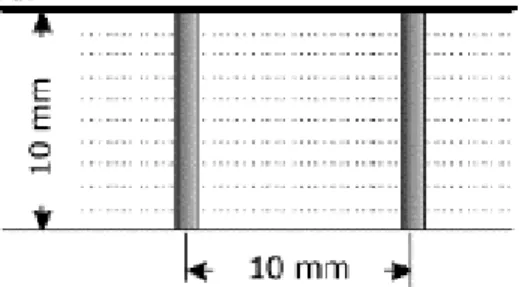
LECTRODEFrom the above discussion, it is apparent that the design of a general-purpose electrode can only be real-ized by making compromises on the dimensions and configuration of the detection surfaces and the inter-detection surface distance. Our experience has led us to use parallel bars (1cm long and 1mm wide) spaces 1 cm apart as shown in the following figure.
In addition to satisfying most of the above requirements this configuration also has some practical advan-tages:
1. It can be constructed so that it is sufficiently small and lightweight as to not be obtrusive to the subject.
2. The spacing of 1 cm between the detection surfaces is sufficiently large so as not to provide a pro-hibitive electrical shorting path when the skin sweats.
INTRODUCTIONTO SURFACE EMG EMG ELECTRODE PLACEMENT
EMG E
LECTRODEP
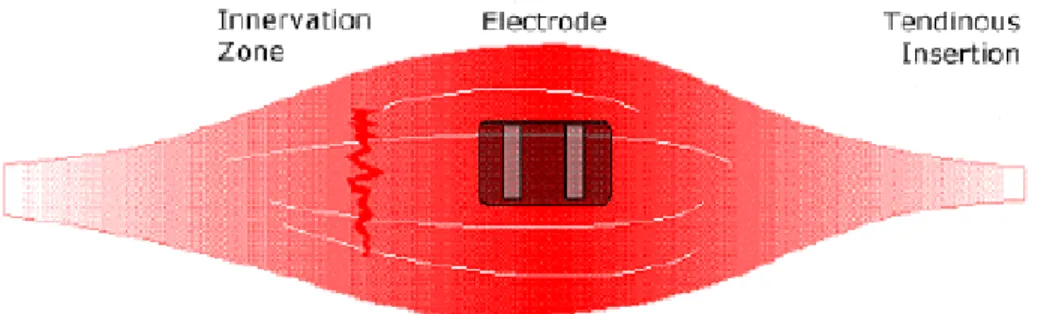
LACEMENT• Location and orientation of the electrode - The electrode should be placed between a motor point and the tendon insertion or between two motor points, and along the longitudinal midline of the mus-cle. The longitudinal axis of the electrode (which passes through both detection surfaces) should be aligned parallel to the length of the muscle fibers. Figure 4 provides a schematic representation of the preferred electrode location.
• NOT on or near the tendon of the muscle - As the muscle fibers approach the fibers of the tendon, the muscle fibers become thinner and fewer in number, reducing the amplitude of the EMG signal. Also in this region the physical dimension of the muscle is considerably reduced rendering it difficult to properly locate the electrode, and making the detection of the signal susceptible to crosstalk because of the likely proximity of agonistic muscles.
• NOT on the motor point - During the past one-half century it has been taught that for the purpose of detecting a surface EMG signal the electrode should be located on a motor point of the muscle. The motor point is that point on the muscle where the introduction of minimal electrical current causes a perceptible twitch of the surface muscle fibers. This point usually, but not always, corresponds to that part of the innervation zone in the muscle having the greatest neural density, depending on the anisot-ropy of the muscle in this region. Presumably, the motor points have been used as landmarks because they were identifiable and provided a fixed anatomical landmark. Unfortunately from the point of view of signal stability, a motor point provides the worst location for detecting an EMG signal. In the region of a motor point, the action potentials travel caudally and rostrally along the muscle fibers, thus the positive and negative phases of the action potentials (detected by the differential configuration) will add and subtract with minor phase differences causing the resulting EMG signal to have higher frequency components. In the time domain, the signal appears as more jagged and with more sharp peaks. The loss of stability occurs from the fact that a minor displacement ( 0.1 mm) will affect in an unpredictable fashion the amount of change in the frequency characteristics of the signal.
Figure 4: The preferred electrode location is between the motor point (or innervation zone) and the tendinous insertion, with the detection surfaces arranged so that they intersect as many muscle fibers as possible.
INTRODUCTIONTO SURFACE EMG REFERENCE ELECTRODE PLACEMENT
• NOT at the outside edges of the muscle - In this region, the electrode is susceptible to detecting crosstalk signals from adjacent muscles. It is good practice to avoid this situation. For some applica-tions, crosstalk signals may be undesirable.
• Orientation of the electrode with respect to the muscle fibers - The longitudinal axis of the elec-trode (which passes through both detection surfaces) should be aligned parallel to the length of the muscle fibers. When so arranged, both detection surfaces will intersect most of the same muscle fibers. Hence, the spectral characteristics of the EMG signal will reflect the properties of a fixed set of muscle fibers in the region of the electrode. Also, the frequency spectrum of the EMG signal will be independent of any trigonometric factor that would provide an erroneous estimate of the conduction velocity. The resultant value of the conduction velocity affects the EMG signal by altering the tempo-ral characteristics of the EMG signal, and consequently its frequency spectrum.
R
EFERENCEE
LECTRODEP
LACEMENTThe reference electrode (at times called the ground electrode) is necessary for providing a common refer-ence to the differential input of the preamplifier in the electrode. For this purpose, the referrefer-ence electrode should be placed as far away as possible and on electrically neutral tissue (say over a bony prominence). Often this arrangement is inconvenient because the separation of the detecting electrode and reference electrode leads requires two wires between the electrodes and the amplifier.
It is imperative that the reference electrode make very good electrical contact with the skin. For this rea-son, the electrode should be large (2 cm x 2 cm). If smaller, the material must be highly conductive and should have strong adhesive properties that will secure it to the skin with considerable mechanical stability. Electrically conductive gels are particularly good for this purpose. Often, power line interference noise may be reduced and eliminated by judicious placement of the ground electrode.
E
LECTRICALS
AFETYC
ONCERNSThe failure of any electrical instrumentation making direct or indirect galvanic contact with the skin can cause a potentially harmful fault current to pass through the skin of the subject. This concern is less rele-vant in devices that are powered exclusively by low voltage (3-15 V) batteries. To ensure safety, the sub-ject should be electrically isolated from any electrical connection (to the power line or ground) associated with the power source. This isolation is generally achieved in one of two ways: either through the use of optical isolators or through the use of isolation transformers. Both approaches are satisfactory, but both require careful consideration for not distorting the EMG signal. This is especially true when a transformer is used.
This isolation provides the added benefit of reducing the amount of radiated power line noise at the elec-trode detection surfaces.
EMG S
IGNALP
ROCESSINGsig-INTRODUCTIONTO SURFACE EMG APPLICATIONSOFTHE EMG SIGNAL
have excursions of one polarity) the EMG signal, integrating the signal over a specified interval of time and subsequently forming a time series of the integrated values. This approach became widespread and it was possible to make these calculations somewhat accurately and inexpensively with the limited electron-ics technology of earlier decades. The advances made in electronelectron-ics devices during the past decades have made it possible to conveniently and accurately calculate the root-mean-squared (rms) and the average rec-tified (avr) value of the EMG signal. The avr value is similar to the integrated recrec-tified value, if the calcu-lations are made correctly and accurately. Both these variables provide a measurement of the area under the signal but do not have a specific physical meaning. On the other hand, the rms value is a measure of the power of the signal, thus it has a clear physical meaning. For this reason, the rms value ispreferred for most applications.
A
PPLICATIONS OF THEEMG
SIGNALCurrently there are three common applications of the EMG signal. They are:
• To determine the activation timing of the muscle; that is, when the excitation to the muscle begins and ends
• To estimate the force produced by the muscle.
• To obtain an index of the rate at which a muscle fatigues through the analysis of the frequency spec-trum of the signal.
In the not so distant future, we can expect applications in the assessment of neurological diseases which affect the fiber typing or the fiber cross-sectional area of the muscle.
The relationship between the force produced by the muscle and the amplitude of the EMG signal requires further description. During the past five decades, the scientific literature has promulgated an apparent con-troversy on this issue. Some reports describe a relatively linear relationship, whereas others describe a rel-ative non-linear relationship, with the amplitude of the EMG signal increasing greater than the force. In fact, both positions are correct and the controversy is artificial. It is now known that in small muscles where the firing rate of the motor units has a greater dynamic range and motor unit recruitment is limited to the lower end of the force range, the relationship is relatively linear. Whereas, in larger muscles where motor unit recruitment continues into the upper end of the force range and the firing rate has a lower dynamic range, the relationship is relatively non-linear.