Improving Speaker Identification Performance by
Combining Vocal Tract Features
S.Selva Nidhyananthan
Assistant Professor Mepco Schlenk Engineering
College Sivakasi, India
.
R.Shantha Selva Kumari
Professor
Mepco Schlenk Engineering College
Sivakasi, India
G.Jaffino
PG Student
Mepco Schlenk Engineering College
Sivakasi, India
ABSTRACT
This paper proposes fusion and addition techniques of vocal tract features such as Mel Frequency Cepstral Coefficients (MFCC) and Dynamic Mel Frequency Cepstral Coefficients (DMFCC) in speaker identification. Feature extraction plays an important role as a front end processing block in Speaker Identification (SI) process. Mel frequency features are used to extract the spectral characteristics of the speech such as formant frequency and the bandwidth of formant frequency. This feature estimation method leads to robust recognition performance. The Dynamic Mel frequency features are used to extract the dynamic behavior of the human vocal tract using pitch frequency. This work is focused to increase the identification accuracy with databases containing short length speech signal. Experimental evaluation is carried out on TIMIT database with 630 speakers using Gaussian Mixture Model (GMM).
Keywords
DMFCC, MFCC, GMM, Feature extraction, Speaker identification.
1. INTRODUCTION
In speaker identification task the unknown speech signal is provided to the system as input and the system finds out who the speaker is? By matching the input speech signal with the speech signals present in the known database [1]. Speaker recognition system task is categorized into two main phases, Enrollment and verification phases. In enrollment phase, the speakers’ voice is recorded and typically a number of features are extracted to form a model. In verification phase, a speech sample is compared against a previously created voice print. In the modern world technology, speech based techniques are being used in many applications such as, voice recognition as entry point into the secured information access, Biometric applications and Forensic applications. Speech may be categorized into voiced and unvoiced speech. Voiced speech is produced when air flow produced by the lungs are forced through the glottis on to the vocal cords. Voiced sounds are distinguished by the presence of periodicity in the corresponding acoustic waveform. Voiced sounds are having more energy content. Unvoiced speeches, do not have any periodicity, and do not have a distinct association with pitch [2]. The main difference between voiced and unvoiced sounds falls in the significant vibration on the vocal cords.
In this paper Mel Frequency Cepstral Coefficients (MFCC) and Dynamic Mel Frequency Cepstral Coefficients (DMFCC) feature extraction techniques are discussed and then both
these features are added. The MFCC are coefficients that are derived from a sort of cepstral representation of the signal. These feature extraction techniques extract both linear and non-linear properties. The frequency bands are evenly spread out on the Mel scale and this estimates the human auditory system’s response closer than linearly spaced frequency bands would.
Text independent speaker identification system can be modeled using any of the following techniques: Hidden Markov Model (HMM) [3], Gaussian Mixture Model (GMM) [4] and Vector Quantization (VQ) [5]. In this paper Gaussian Mixture Model is used for speaker identification. Gaussian mixture density provides smooth approximation to the sample distribution of observations obtained from utterances of a given speaker. Gaussian Mixture Model is a parametric probability density function represented as a weighted sum of Gaussian component densities [6]. The parameter of GMM is unique for a speaker and it is necessary for speaker identification. Preprocessing is the process of making the speech signal is more suitable for further processing. This step includes silence removal, framing and windowing.
The remainder of this paper is organized as follows. Section 2 describes the procedure for MFCC feature extraction. Section 3 describes the DMFCC feature extraction method. Gaussian Mixture Modeling is given in section 4 and the experimental evaluation is explained in section 5. Section 6 describes the conclusion and suggestions for future work.
2. MFCC FEATURE EXTRACTION
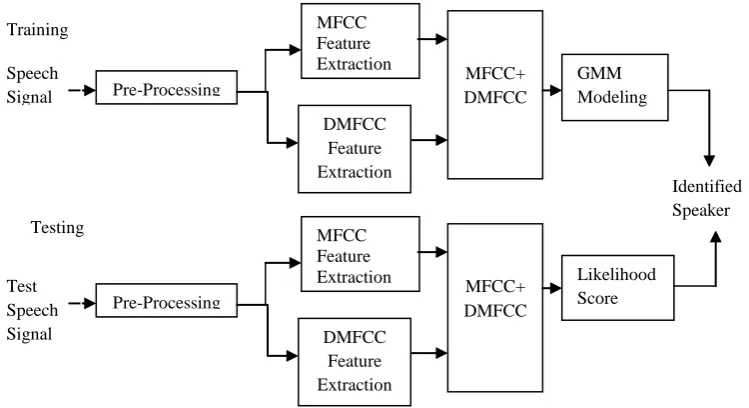
Feature extraction involves simplifying the amount of resources requires to describe a large set of data accurately. The goal of feature selection is to find a transformation to a relatively low-dimensional feature space that preserves the information pertinent to the application while enabling meaningful comparisons to be performed using simple measures of similarity [6]. The block diagram of proposed Fusion based speaker identification is shown in Figure 2.1 and the proposed addition based Speaker Identification is shown in Figure 2.2.2.1 Fast Fourier Transform
(
)
1
1(
)
,
0
1
12
N
n
e
k
X
N
n
x
N
k
kn N j
(1)
1
0
,
)
(
)
(
1
0
2
N
k
e
n
x
k
X
N
n
kn N j
(2)
The sequence
x
(
n
)
and the transformX
(
k
)
specified the interval
0
,
N
1
.Figure 2.1 Block diagram of proposed Fusion based Speaker Identification
Figure 2.2 Block diagram of proposed addition based Speaker Identification
Pre-Processing
MFCC Feature Extraction
DMFCC Feature Extraction Speech
Signal
MFCC+ DMFCC
GMM Modeling
Pre-Processing
MFCC Feature Extraction
DMFCC Feature Extraction Test
Speech Signal
MFCC+ DMFCC
Likelihood Score
Identified Speaker Training
Testing
Identified speaker Training
Testing
Pre-Processing
MFCC Feature Extraction
DMFCC Feature Extraction Speech
Signal
GMM Modeling
GMM Modeling
Pre-Processing
MFCC Feature Extraction DMFCC
Feature Extraction Test
Speech Signal
Likelihood Score
Likelihood Score
2.2 Pre-emphasis
Pre-emphasis refers to a system process designed to increase within a band of frequencies, the magnitude of some higher frequencies with respect to the magnitude of some lower frequencies [7]. Pre-emphasis helps to equalize the spectral the spectral tilt in speech and the signal is spectrally flattened. The output of pre-emphasis is given by,y
(
n
)
x
(
n
)
x
(
n
1
)
(3)
Wherex
(
n
)
is the speech signal,
is pre-emphasis factor. In this paper, the pre-emphasized factor is chosen as 0.97.2.3. Mel-Scale Filter bank
There are two types of filter bank. Uniform and non-uniform filter bank. Since speech signal contains more information in the low frequency range; there is a need of more number of filters in this low frequency range, this prompts the use of non uniform filter bank [8]. So in this project, non-uniform filter bank is used.
For a non-uniform filter bank the bandwidth
b
iand center frequencyf
iis given by,b
1
C
(4)
b
i
b
i1(5)
Q
i
b
b
b
f
f
ii
j j
i
2
,
2
1 1
1 1
(6)
Where
C
and
f
1are the arbitrary bandwidth and center frequency of the first filter and
is the logarithmic growth factor. The mel scale filter bank equation is given by,
700
1
log
2595
)
(
10f
f
mel
(7)
Wheremel
(
f
)
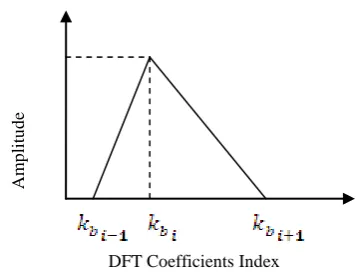
is the subjective pitch in Mels corresponding to the actual frequencies in hertz.Conventionally used filter bank in speech feature extraction is Triangular filter bank. This paper explains the Gaussian filter bank and its advantages over Triangular filter bank. Generally Triangular filter is asymmetric, tapered but does not provide any weight outside the sub band. The response of triangular filter is shown in Figure 2.1.
Figure 2.1 Response of Triangular filter
In triangular filter bank, if there is a high energy area in the left part of the filter bank, this might be partially suppressed as a result of filtering. To overcome this, Gaussian filters are used to better capture the energies in that frequency bin [9]. The response of Gaussian filter is shown in Figure 2.2.
Figure 2.2 Response of Gaussian filter
The filter response is given by,
2 2
2 )) ( ) ( (
)
,
(
icm f k f
e
m
k
H
(8)Where
1
,...
2
,
1
,
)
(
k
N
N
kf
k
f
s(9)
2.4 Discrete Cosine Transform
A discrete cosine transform expresses a sequence of finitely many data points in terms of a sum of cosine functions oscillating at different frequencies. The expression of DCT is given as,
Nn
N
k
n
n
x
k
w
k
y
1
2
)
1
)(
1
2
(
cos
)
(
)
(
)
(
(10)
Am
p
li
tu
d
e
DFT coefficients index DFT Coefficients Index
Am
p
li
tu
d
Where
k
1
,
2
,...
N
N
k
N
k
N
k
w
2
,
2
1
,
1
)
(
(11)
These DCT coefficients are taken as the MFCC features.
3.
DYNAMIC
MEL
FREQUENCY
CEPSTRAL COEFFICIENTS
The Mel frequency cepstral coefficient is the most widely used feature in speech and speaker identification. As the human auditory system can sensitively perceive the pitch changes in the speech, the algorithm, which combines the speaker information obtained by the MFCC with the pitch, can dynamically construct a set of Mel-filters according to the result of pitch detection. The Mel-filters are then used to extract the dynamic MFCC parameter, which represents the speaker’s identity characteristics, and enhance accuracy of speaker recognition [10].
After pre-emphasis, the speech signal is multiplied with the windowed signal and the equation is given by,
S
w(
n
)
y
(
n
)
*
w
(
n
)
(12) where
y
(
n
)
is the pre-emphasized outputw
(
n
)
is the windowed output signal.The pitch frequency
f
pis calculated by using autocorrelation method.This pitch frequency is given to the input of the Mel scale filter bank. This equation is given by,
mel
(
f
)
2595
log
1
f
p700
(13) Next step is to calculate the energy spectrum of the signal. An energy spectrum is a distribution of energy among a large assemblage of particles. It is a statistical representation of wave energy, and an empirical estimator of the spectral function. The energy spectrum is calculated by using,X
(
k
)
DFT
(
S
w(
n
))
(14) where
S
w(
n
)
is the windowed and pre-emphasized multiplied signal.The last step is, discrete cosine transform. The discrete cosine transform attempts to decorrelate the data [11]. After decorrelation, each transform coefficient can be encoded independently without losing compression efficiency. DCT is also used for good energy compaction.
4. GAUSSIAN MIXTURE MODELING
GMMs are commonly used as a parametric model of the probability distribution of continuous measurements or features in a biometric system, such as vocal tract related spectral features in a speaker recognition system [12]. For
D
N
R
X
X
X
1,
2,....
are a given set of N points in D-dimensions, and a family F of probability density functions on
R
D. The functions F could be mixtures of Gaussian functions then,
(
;
)
(
;
,
)
1
Kk
k k k
g
x
m
p
x
f
(15) Where
2
2 1
2
1
)
,
;
(
kk m x
D k k
k
e
m
x
g
is a D-dimensional isotropic Gaussian function
))
,
(
),...,
,
,
((
....,
,
2 1 1 1 ,1
Kp
m
p
Km
K
K
is a
K
(
D
2
)
-dimensional vector containing the mixing probabilitiesp
k as well as the meansm
kand standard deviations
kof the K Gaussian functions in the mixture. Each Gaussian function integrates to one.
RDg
(
x
;
m
k,
k)
dx
1
(16)Since f is a density function, it must be non-negative and integrate to one [13].
K
k k
R k k
K
k k
R R
K
k
k k k
p
dx
m
x
g
p
dx
m
x
g
p
dx
x
f
D
D D
1 1
1
)
,
;
(
)
,
;
(
)
;
(
1
(17)
The numbers
p
kmust be nonnegative,f
(
x
)
takes on negative values must be added up to one.
p
k
0
and1
1
K
k k
This is why the numbers
p
kare called mixing probabilities. The likelihood functions can be defined as,
(
;
)
(
;
)
1
N n nx
f
X
(19) For mixtures of Gaussian functions can be defined as,
(
;
)
(
;
,
)
1 1 k k N n K k n kg
x
m
p
X
(20)Parametric density function problem can be defined as,
arg
max
(
;
)
X
(21) The conditional probability of selected component k given
that data point
x
n is,
K mn
m
q
n
k
q
n
k
p
1)
,
(
)
,
(
)
|
(
(22)The logarithm of likelihood function can be defined as,
(
;
)
log
(
;
,
)
1 1 k k n N n K k
k
g
x
m
p
X
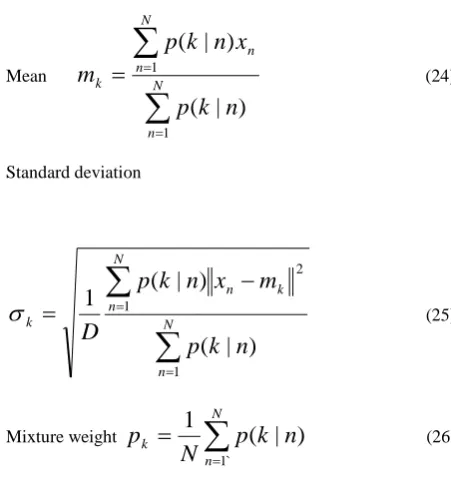
(23)On EM iteration, the following re-estimation formulas are used. Mean
N n N n n kn
k
p
x
n
k
p
m
1 1)
|
(
)
|
(
(24) Standard deviation
N n N n k n kn
k
p
m
x
n
k
p
D
1 1 2)
|
(
)
|
(
1
(25)Mixture weight
Nn
k
p
k
n
N
p
` 1)
|
(
1
(26)These are the parameters in Gaussian Mixture Modeling [14].
The score level fusion of features would perform better if they are provided with speaker specific information that is complementary in nature. A governing equation that describes the fusion of outputs parallel classifiers via weighted sum rule is given as,
) 27 ( ) | ( log ) 1 ( ) | ( log 1 1
T t sDMFCC T t tDMFCC sMFCC tMFCC icom w px w px
S
Where
S
comi denotes the combined score for GMM based system,x
k denotes the feature vector corresponds to MFCC/DMFCC and
ndenotes the object corresponding to MFCC/DMFCC. The identity of the true speakeri
true is given by,
comii
true
S
i
arg
max
(28) The speaker corresponding to the object giving the maximumlikelihood is identified as the currect speaker. All the signals in the database are tested for identification and the percentage of identification for each of these models are computed. Next the MFCC and DMFCC features are added and then modeled using Gaussian Mixture Model.
5. EXPERIMENTAL EVALUATION
This experimental work uses TIMIT speech corpus for speaker identification task. Texas Instruments-Massachusetts Institute of Technology (TIMIT) is a corpus of phonemically and lexically transcribed speech of American English speakers of different sexes and dialects. The speech was recorded at TI, transcribed at MIT, and has been maintained, verified, and prepared for CD-ROM production by the National Institute of Standards and Technology (NIST) [15]. The TIMIT database consists of 630 speakers, out of which 70% are male and 30% are female from 10 different dialect regions in America. Each speaker contains ten speech signals. Out of ten speech signals of every speaker six signals are used for training and the remaining four signals used for testing.The identification performance of DMFCC feature for 1024 frame size is tabulated in Table 1.
Table 1 Identification Performance of DMFCC feature using 1024 frame size
Sl. No Total number of speakers GMM Number of Mixtures Percentage of Correct Identification (%) 1 630
8 55.45
2 16 59.58
For this 1024 frame size, mixture weight 32 gives the maximum identification accuracy of 63.45%. The identification performance of DMFCC feature using 512 frame size is tabulated in Table 2.
Table 2 Identification Performance of DMFCC feature using 512 frame size
Sl.No
Total number
of speakers
GMM Number
of Mixtures
Percentage of Correct Identification (%) 1
630
8 69.39
2 16 80.12
3 32 74.85
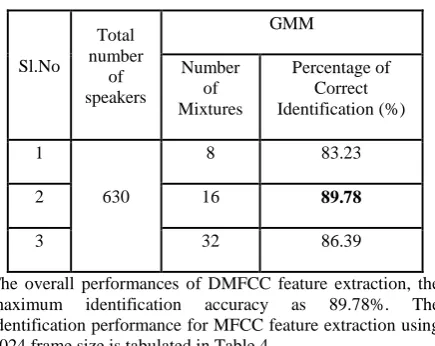
It can be seen from these observations that the maximum percentage of identification achieved is 80.12% which is achieved for the mixture weight of 16.The frame size for this analysis is taken as 512 samples with 256 samples as overlapping. The testing is done for different mixture components and the results are analyzed. The identification performance of DMFCC feature using 256 Frame size are tabulated in Table 3.
Table 3 Identification Performance of DMFCC feature using 256 frame size
Sl.No
Total number
of speakers
GMM Number
of Mixtures
Percentage of Correct Identification (%) 1
630
8 83.23
2 16 89.78
3 32 86.39
The overall performances of DMFCC feature extraction, the maximum identification accuracy as 89.78%. The identification performance for MFCC feature extraction using 1024 frame size is tabulated in Table 4.
Table 4 Identification Performance of MFCC feature using 1024 frame size
Sl.No
Total number
of speakers
GMM Number
of Mixtures
Percentage of Correct Identification
(%) 1
630
8 63.15
2 16 71
3 32 66.2
For this performance of MFCC feature extraction technique the maximum identification accuracy is 71%. The identification performance for MFCC feature extraction using 512 frame size is tabulated in Table 5.
Table 5 Identification Performance of MFCC feature using 512 frame size
Sl.No
Total number of
speakers
GMM Number
of Mixtures
Percentage of Correct Identification (%) 1
630
8 79.67
2 16 81
3 32 86.12
The maximum identification accuracy is 86.12% for the mixture weight of 32. The identification performance for MFCC feature extraction using 256 frame size is tabulated in Table 6.
Table 6 Identification Performance of MFCC feature using 256 frame size
Sl.No
Total number of
speakers
GMM Number of
Mixtures
Percentage of Correct Identification
(%) 1
630
8 88.72
2 16 92.53
3 32 91.01
The fusion technique is used to fuse MFCC and DMFCC with the weight of w=0.77 and it is tabulated in Table 7.
Table 7 Identification performance of Fusion Technique
Frame size Mixture
weight 1024 512 256
8 61.43 75.57 91.56
16 67.32 88.67 98.02
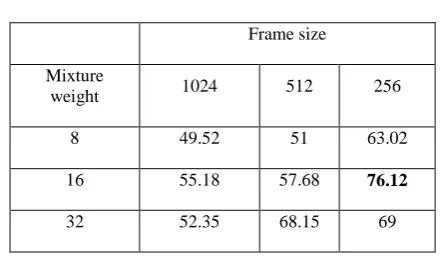
For this fusion technique the maximum identification accuracy is 98.02%. The identification of MFCC+DMFCC added results are tabulated in Table 8.
Table 8 Identification performance for MFCC+DMFCC added feature
Frame size Mixture
weight 1024 512 256
8 49.52 51 63.02
16 55.18 57.68 76.12
32 52.35 68.15 69
6. CONCLUSION
In this project, GMM modeling technique is evaluated for speaker identification using TIMIT speech database under fusion of model scores and addition of features cases. MFCC feature extraction is a better technique for speaker identification system, by adding complementary DMFCC feature along with it. An efficient fusion technique to fuse the scores from the GMM model of MFCC and DMFCC is used. For a TIMIT database with 630 speakers a maximum percentage of 89.78% is achieved for DMFCC feature and 92.53% is achieved for MFCC feature. In this project, good identification accuracy of 98.02% is achieved with fusion of both the features which outperforms the result obtained by adding the complementary features. This work can be further extended to mismatched and noisy conditions of speech signal.
7. REFERENCES
[1] Douglas O’ Shaughnessy,”Speech Communication Human and Machines,” II nd edition, Universities press (India) Limited (2001).
[2] S.Selva Nidhyananthan, R.Shantha Selva Kumari and G.Jaffino,” Text-Independent speaker identification using residual feature extraction Technique,” CiiT International Journal of Digital signal processing, march 2012.
[3] A. E. Rosenberg et al., “Connected word talker verification using whole word Hidden Markov Models,” in Proc. ICASSP, 1991, pp. 381-384. [4] D. A. Reynolds and R.C.Rose published a paper,
“Robust test-independent speaker identification using Gaussian mixture Speaker models.”IEEE Transaction on Speech Audio Processing, vol.3, 1995, pp 72-83. [5] Tomoko Matsui and Sadaoki Furui, “Comparison of
Text Independent Speaker Recognition Methods Using VQ Distortion and Discrete Continuous HMM’s,” IEEE transactions on speech and audio processing, vol. 2, no. 3, July 1994.
[6] Md.Rashidul Hasan, Mustafa Jamil Md.Golam Rabbani,Md.Saifur Rahman, ”Speaker Identification using Mel Frequency Cepstral Coefficients”, 3rd International conference on Electrical and computer engineering ICECE 2004,Dec 2004.
[7] Douglas O’ Shaughnessy, “Speech communication Human and Machines”, IInd edition , Universities
Press(India) Limited(2001).
[8] Prodesy and speech recognition by Alex Waibel, vol. 1, Nos.1-2, 2007.
[9] Sandipan Chakroborty, Goutam Saha, “Improved Text-Independent Speaker Identification using Fused MFCC & IMFCC Feature Sets based on Gaussian Filter” , International Journal of Signal Processing 5:1, 2009. [10] Wang Yutai, Li Bo, Jiang Xiaoqing, Liu Feng, Wang
Lihao,” Speaker Recognition Based on Dynamic MFCC Parameters” IEEE proceedings 2009.
[11] Tomi Kinnunen, Haizhou Li,”An Overview of Text-Independent Speaker Recognition: From Features to Super vectors”, august 2009.
[12] Miyajima, Y.Hattori, K.Tokuda, T.Kabayashi and T.Kitamura ” Text-Independent Speaker Identification using Gaussian Mixture Models based on multispace probability distribution,” IEEE Transactions on information and system, vol.E84-B,2001,pp.847-855. [13] C.Miyajima, Y.Hattori, K.Tokuda, T.Kabayashi and
T.Kitamura,” Text-Independent speaker identification using Gaussian mixture models based on multispace probability distribution,” IEEE Transactions on information and system, vol.E84-B, 2001, pp.847-855. [14] Murthy.K and Yegnanarayana.B,” Combining
evidence from residual phase and MFCC features for speaker Recognition,” Signal Processing Letters; IEEE, vol.13, no.1, pp.52- 55, Jan 2006.