Do Time Series Analyses Provide Consensus
About the Relationship between Education and
Economic Growth?
Hakkı Kutay BOLKOL Istanbul 29 Mayis University, Faculty of Economics, Istanbul, Turkey
Abstract
This paper examines the causal relationship between education and economic growth by investigating and comparing the time-series literature, and making a short empirical analysis for Turkey about this issue. The aim of examining this topic is that the role of human capital is very significant for economic growth and it can be said that the most important factor for human capital is education. In other words, the accumulation of human capital may be seen as a major force of generating economic growth because it not only increases productivity but also has some positive externalities which society can benefit from. The study also touches on different levels of education and education investments (or expenditures) while investigating the causality between education and economic growth. On the other side, the results in the literature about the causal relationship between education and economic growth are not uniform. Also in empirical part, this study finds different results compared to other studies related with Turkey. Moreover, in the literature the results vary even for the same country. For these reasons, this work recommends panel data analysis that uses the qualitative side (cognitive skills) of education in order to examine the causal relationship between education and economic growth because with this way, we can handle the problem of lack of data, especially for developing countries, as the number of countries in the sample increases. However, the important thing here is to create a sample with analogous countries.
Keywords: Causality; Economic Growth; Education; Time Series Analysis; Turkey
JEL Classification: C22; I21; O5; O53
1.INTRODUCTION
The role of human capital is very significant for economic growth. It can be said that the main and the most important factor for human capital is education. In other words, the accumulation of human capital is the major force of generating economic growth because it not only increases productivity but also has some positive externalities. What I mean is, education has some spillover effects because, for example, it may increase the adaptation speed of investors and research productivity with the increased level of knowledge.
Furthermore, it may guarantee the quality of human life which ensures socioeconomic growth in a country (United Nations, 1997). In order to support the importance of education, we can give some real world examples like Asian countries such as South Korea, India and China which have achieved successful economic growth in last few decades through agricultural and educational reforms (Afzal et al., 2011). Moreover, the production of knowledge by an educational sector can induce self-sustained economic growth because the marginal returns on human capital are not decreasing (Monteils, 2004).
Although the role of education in an economy is emphasized in theoretical studies, empirical literature finds mixed results for the relationship between education and growth (Sarı and Soytas, 2006).
If we first investigate the theoretical side with some pioneering works, the relationship between human capital and economic growth has been investigated by many economists starting with Adam Smith (1776). After neoclassical growth theory introduced by Solow (1956) and Swan (1956), there have been a lot of studies which investigate the relationship between economic growth and education. Since Solow (1957) introduced the idea of technical change in growth model, technical change which enhances human capital has investigated by several academicians. Then if we come back to more recent dates, rising importance of new growth theories like Lucas (1988), Romer (1986, 1990) made a great contribution to share of human capital in economic growth. According to Lucas (1988), sustained growth can only be sustained by the help of accumulation of human capital, and for this education is the main channel. The human accumulation rate depends on the time spent in education. Lucas not the only one who mentions this issue, for instance, according to Romer (1986, 1990) growth depends on human capital which generates innovations.
If we look at the pioneering empirical studies, Mankiw et al. (1992) extend Solow’s Model by introducing the accumulation of human capital measured by education levels and he finds that contribution of human capital is very significant. Barro and Lee (1993) examine the rate of schooling success in the adult population at various levels1 from 1960-1985 for 129 countries and they reach the conclusion that the levels of education explain
economic growth significantly and the levels of education are in direct positive relationship with the growth rate of GNP. On the other side, in another pioneering empirical study, Benhabib and Spiegel (1994) find that human capital measured by number of years of education of the working population does not significantly explain the growth rate of per capita output, however, it plays a significant role in growth of per capita income.
The objective of this paper is to review and synthesize the literature that examines the causality between education and economic growth on country base to find whether the causality relation changes from country to country. Furthermore, in the literature review section below, I examine not only the link between pure education and economic growth but also different levels of education and educational investment. After investigating the literature, the paper also includes a short empirical analysis.
The paper is organized as follows. Section 2 gives a review on literature. Section 3 provides a short empirical analysis and section 4 concludes and provides some recommendations.
2. LITERATURE REVIEW
This literature review consists of country base empirical studies related with the causal relationship between education and economic growth. Also it is better to state that the literature review of this paper includes only quantitative measures of education like enrollment rate, average years of schooling, adult literacy index, and number of graduates. What I mean is that it does not include qualitative measures like cognitive skills because in the literature there are more studies which use quantitative measures. The reason of this may be that it is difficult to find enough and accurate data - especially for developing countries - about some tests like PISA which measure cognitive skills. In the literature about the quality of education Hanushek and Woessmann (2008) use these kind of tests for cognitive skills. On the other side, there are some studies which measure the quality of education by investigating the indicator of “graduates and enrollment over teacher” like Deniz and Doğruel (2008). However, because there are different and controversial ways of testing quality of education, this paper uses only quantitative measures of education in order to get certain and tangible result.
The literature review of this paper has four subsections because I divided studies into three as studies about the causal relationship between education and economic growth using different levels of education, tertiary education, and education investments (or expenditures). Lastly, there is a summary part which provides us to see the big picture.
2.1. Literature about the Causal Relationship between Education and Economic Growth using Different Levels of Education
Kreishan and Hawarin (2011) analyze the causal relationship between education and economic growth for Jordan during the period of 1978-2007. The main aim of this paper is to find the answer of whether educated workers at all levels cause economic growth in Jordan or not. It touches on the importance of investments in people because of lack of natural resources in Jordan. Therefore, government has increased the investments on education since 1960s. Also it is said that the demand of higher education has also risen. Paper uses three step procedure to analyze the causality which starts with unit root test and continues with cointegration test and ends with causality test. The study takes educated workers and GDP as variables and since they are integrated of same order, I (1), there is a need to switch on second step which is called cointegration test. In the second step, according to cointegration results, it is found that there is positive long-run relationship between education and economic growth. In the last step, because it is found that the variables are cointegrated, Granger Causality Test based on VECM (Vector Error Correction Model) is used and it is found that there is unidirectional causality runs from education to economic growth, however, this causality is only valid for graduate and bachelor levels, not for primary and secondary levels. Consequently, the paper recommends that the policy makers should enhance the level of quantity and mainly quality of human capital in Jordan.
Self and Grabowski (2004) investigate the causal relationship between education and income growth in India for the time period between 1966 and 1996. For this study, education is divided into three as primary, secondary and tertiary. This paper measures education by using the incorporation of the enrollment rates and ratios and average years of schooling2. Moreover, as a contribution of this work, education is also divided by gender to see whether the causality results vary by gender or not because according to data, there is a big difference between male and female enrollment and stock of human capital rates for the benefit of males. So, the variables which represent education are human capital stock and enrollment rates for male and female while the variable which measures economic growth is GDP. For females, fertility rate is also added into the equation as a distinguishing factor since females attending school could be affected by child-bearing, especially for countries which marriages occur at very low ages. In empirical analysis, since education variables and GDP is integrated of same order, I (1), Self and Grabowski (2004) directly uses Granger Causality Test and according to results, contrast to Kreishan and Hawarin (2011), it is found that there is strong causality running from primary education to economic growth while there is weak causality for secondary and none at all for
tertiary education, for male. This situation is explained by saying that people undertaking tertiary education is too low in India that’s why it is difficult to find causality which runs from tertiary education to economic growth. However, according to results, female education at all levels Granger causes economic growth. This result shows the importance of women’s education for Indian’s economic growth.
Afzal et al. (2011) investigates the cointegration and causality between education and economic growth in Pakistan. Since it is country-specific study, time series data on Real Domestic Product (RGDP), labor force, physical capital and education from 1970-1971 and 2008-2009 are used. It mentions about poor and corrupt taxation system which does not generate sufficient revenue for education investments. This paper, firstly try to examine the causality between education and RGDP, secondly between different levels of education (i.e. school education, collage education and university education) and RGDP with inclusion and exclusion of stock of physical capital and stock of labor force as third and fourth variables. This work constructs education index by adding adult literacy index (ALI3) with two-third weightage and combined primary, secondary and tertiary gross enrollment ratio index (GEI4) with one-third weightage. Log-linear forms of the variables are used. Because all the variables are integrated of order 0 or 1 according to unit root tests (ADF, PP, DF-GLS, Ng-Perron), ARDL (Autoregressive Distributed Lag Model) approach is used to test the cointegration. According to test results, cointegration among education and economic growth is found which means that they have long-run relationship. After that, study uses Toda-Yamamoto Augmented Granger Causality (TYAGC) Test to investigate the causality with bivariate, trivariate and tetravariate framework. According to results,
i. Education Granger causes RGDP in all cases except trivariate case with physical capital (RGDP, RPC5, and Edu6).
ii. RGDP Granger causes education in all cases. iii. School education Granger causes RGDP in all cases. iv. RGDP Granger causes School education in all cases. v. Collage education Granger causes RGDP in all cases.
vi. RGDP Granger causes Collage education in all cases except trivariate case with physical capital (RGDP, RPC, and Edu).
vii. University education Granger causes RGDP in all cases.
viii. RGDP Granger Causes University education in all cases except tetravariate case.
Final result of causality test, proves the saying of Easterly (2001) because he says that Pakistan is a country that made little social process for given GDP rates. According to results, among the all levels of education, the level which most significantly affects economic growth is higher education that’s why this study recommends more investment in university education for the sake of better economic growth.
Since education can be seen as knowledge, some authors investigate the relation between education and economic growth with endogenous growth perspective. For example, Monteils (2004) investigates the relation between education and economic growth for France by mentioning on the endogenous growth perspective. She touches on Lucas’ analysis (1988) which puts education at the heart of the growth process by using subjective conception of knowledge. However, because our aim is to investigate causality relation, the part of causality is in our interest. In order to make an empirical analysis about causality, paper uses growth rate of human capital and growth rate of GDP as variables. For period between 1891 and 1970 growth rate of human capital is based on the opposition of illiteracy and for period between 1970 and 1996, it is based on the level of diplomas (education). Granger Causality test is used for testing the causality between human capital and GDP, however, the test results give the conclusion that there is no causality between these two variables. Consequently, study recommends that it would be better to test causality as level not growth rate, however, it is stated that causality tests are only applicable on static variables, and application of a filter on the primary differences does not permit work on level. Therefore, it is stated that it is not econometrically possible. To sum up, although author believes that there should be causality, it is not mathematically verified that’s why she recommends sophisticating the context of researches.
There are also some studies related with Turkey. Sarı and Soytas (2006) examine the relationship between GDP and enrollments in primary, secondary, high schools, and universities in Turkey for 1937-1996, in a multivariate framework. It is found that Real GDP and educational variables are cointegrated that’s why study uses VECM for investigating the causality between variables, however, according to results of VECM Granger Causality, there are different directions between different levels of education and GDP. Results indicate that primary school and secondary school enrollment Granger cause GDP, and the direction of causality reversed for enrollment in high school, in other words, GDP Granger causes high school enrollment. When it comes to university enrollment, there is bi-directional causality between university enrollment and GDP. This results show
3 It gives an indication of ability to read and write. 4 It gives an indication of level of education. 5 Real Physical Capital
the importance of the university enrollment for Turkey. Furthermore, study also uses the method of variance decomposition and impulse response function. The results of impulse response function and variance decomposition prove the importance of university and secondary school enrollment in explaining economic growth. Consequently, it can be said that the empirical results support the significance of education for economic growth and the study recommends investing in education, especially at the university level.
Telatar and Terzi (2010) also work for Turkey case. In this study, the relationship between economic growth and population and education is investigated for the period between 1968 and 2006. As a difference, this study also includes the population into the analysis, however, since our main aim is to investigate the literature related with the relationship only between education and economic growth, population issue will not be mentioned here. Paper uses VAR Granger Causality to check the causality between economic growth and education. The variables for education are as follows: the number of graduates from technical high school, general high school and university. The variable for economic growth is per capita GDP. According to results, there is positive, uni-directional relationship running from GDP per capita to number graduates from university. On the other hand, there is again positive, uni-directional relationship but this time, it runs from the number of technical high school graduates to GDP per capita. What’s more, for confirming these results, paper also uses impulse response function and variance decomposition methods, and according to them, these results are proved. Consequently, study recommends that the investments in technical high schools should be increased since people who have some certain skills may make important contribution to general economy. To sum up, we can say that Telatar and Terzi (2010) find different result compared to Sarı and Soytas (2006) although these studies both work on Turkey case. The difference may come from the differences in techniques used in the studies or data used in the analyses. For example, one of them uses the measure of enrollment while other uses the measure of the number of graduates.
2.2. Literature about the Causal Relationship between Education and Economic Growth using Tertiary Education
In the literature there are also bulk of studies related with the relationship between tertiary education and economic growth. What I mean is that some studies focuses on the tertiary education level while investigating the relationship between education and economic growth. If we start with Turkey case, Erdem and Tuğcu (2011) investigate the effects of tertiary education on economic growth. The study period is the years between 1970 and 2008 for this work. In order to examine the long-run relationship, study uses ARDL approach of cointegration. After that, to test the causality, it uses Dolado and Luthkepohl causality test. The paper uses linearized augmented Cobb-Douglas production function. In the equation, they use not only economic growth (real income) which is a dependent variable and the tertiary education which is an independent variable, but they also include combination of technology and knowledge, physical capital, and labor as independent variables. Tertiary education variable contains two different indicators. One of them is total tertiary education stock (STOCK) which is the sum of students who enrolled in the tertiary education institutions. The second one is tertiary education graduates (GRAD) which represents the people who graduated from tertiary education institutions. In unit root analysis, because they find that some variables are integrated of order zero while some of them are integrated of order one, they use ARDL cointegration test. According to cointegration test, it is found that there is long run relationship between tertiary education and economic growth. After that, for testing the stability of this long-run relationship, study uses CUSUM and CUSUM Square tests and according to results of these tests, it is stated that the model is also stable. Then, the causality analysis is made and according to results, there is uni-directional causality running from economic growth to stock part of tertiary education and there is also uni-directional causality running from graduates’ part of tertiary education to economic growth. That means that real income causes a change in tertiary education enrollment while the number of tertiary education graduates causes a change in real income. If we think this two part of tertiary education variable as one, we can say that there is bi-directional causality between tertiary education and economic growth. To sum up, this result is consistent with Sarı and Soytas (2006) because they also find bi-directional causality between university enrollment and GDP for Turkey, however, it contradicts to Telatar and Terzi (2010) because they find that there is uni-directional causality running from GDP to number of graduates from university for Turkey case.
tertiary education. Moreover, physical capital investments and tertiary education is very significant for economic growth.
In the literature, there are a lot of studies which investigate the relationship between tertiary education and economic growth for developing countries since education can be seen as one of the key element to become a developed nation. For example, a researcher who investigates this topic can find bulk of works related with Pakistan. For example, Chaudhary et al. (2009) investigate the nexus between tertiary education and economic growth for Pakistan empirically for the period between 1972 and 2005. The variables are as follows: Real GDP as a dependent variable, Tertiary Education measured by the number of enrolled students at university level, Gross Fixed Capital Formation, and the total number of employed people. In empirical side, paper first investigates the integration order of the variables with Dickey Fuller and Augmented Dickey Fuller Unit Root Tests. According to test results, it is found that all variables are integrated of order one. So study uses Johansen Cointegration Test to investigate whether the variables are cointegrated or not. It is found that there is long-run relationship between tertiary education and economic growth. When it comes to Causality, paper uses Toda and Yamamoto Causality approach, and according to results, it is stated that there is unidirectional causality running from economic growth to tertiary education but not vice versa. We can say that this result contradicts with Afzal et al. (2011) since although they also investigate Pakistan case; they find bidirectional causality between tertiary education and economic growth when they exclude some cases.
There is another study related with Pakistan by Qazi et al (2013). They investigate tertiary education and growth performancewith a multivariate framework. The investigation period of this study is the years between 1980 and 2011. The variables are GDP as a dependent variable, labor force, capital stock, and tertiary education determined by the tertiary education enrollment. This study also uses the unit root tests (ADF7 and PP8) to determine the integration order of the variables. According to results, all variables are integrated of order one. Then, study uses ARDL Cointegration method, and finds that there is long run relationship between tertiary education and economic growth. After that, paper uses Toda and Yamamoto Granger Causality test, and finds that there is bidirectional causality between tertiary education and economic growth. Although this result supports the findings of Afzal et al. (2011) because they also find bidirectional causality between tertiary education and economic growth, it contradicts with the result of the study written by Chaudhary et al. (2009) which also works for the Pakistan case and apply almost the same econometric methods. The difference may be caused by the time period or difference in data processing. In other words, like what happened in Turkey case, the results differ even for the same country. On the other side, this paper uses supplementary method called Rolling window estimation which has been used to analyze the stability of coefficients of long run model. Estimation results suggest that the contribution of tertiary education in economic growth is significantly increased after the formation of higher education commission of Pakistan in 2002 that’s why it is stated that higher education commission plays a significant role in development of tertiary education which leads to increase economic growth. So we can also say that the difference between two studies also may come from the end periods because the end period of the study of Chaudhary et al. (2009) was 2005 and as it was mentioned according to Qazi et al. (2013) after 2002 the role of tertiary education in economic growth has significantly increased. Furthermore, by using variance decomposition test, study confirms the bidirectional causality. At the end, paper recommends that policy makers should make policies to strengthen the higher education commission to ensure continuous and rapid economic growth in Pakistan.
2.3. Literature about the Causal Relationship between Education and Economic Growth using Education Investments (or Expenditures)
It is better to mention on educational investments (or expenditures) because it seems a little bit different. Education investment involves all resources used in the education area such as human resources, physical goods and financial resources. In other words, education investment is human resources or physical goods invested in education in the form of currency, which is used to increase labor productivity (Bo-nai and Xiong-xiang, 2006).
Because we found mixed results in the literature related with the causal relationship between education and economic growth, it may be better to investigate this issue from different perspective. What I mean is, in the literature, there are also a lot of studies related with the link between educational investment and economic growth. For example, Bo-nai and Xiong-xiang (2006) investigate the rate of contribution of education investment to economic growth in China. The investigation period of the study is the years between 1952 and 2003. The study uses two variables which are GDP and education investment. It is said that education investment in China consists of funds within the national fiscal budget, off-budget funds, social organizations and individually raised school funds, social donation, and other educational funds. It is stated that the main part of education investment in China comes from the regular national fiscal budget. Since the number of total education funds
input during 1952-1978 was not available, this paper uses the data of education investment within the national fiscal budget. First, paper makes simple correlation analysis and it is found that the correlation coefficient has a value of 0.9757 which means that there is a close interaction between education investment and GDP. Moreover, in order to investigate the causal relationship between these two variables, study uses Granger Causality Method and it is found that there is bidirectional causality. Furthermore, study shows the contribution of education investment to economic growth with simple regression analysis and it is found that the contribution rate is 24.4%. With some further investigation, study states that after market-oriented economy restructuring, the rate increased by 7 percent, from 22.8 to 29.7 percent. Consequently, we can say that this study puts the importance of education investment for economic growth with correlation and causality analyses.
If we investigate another study related with China to check the correctness of the result of the study of Bo-nai and Xiong-xiang (2006), Yu et al. (2014) investigate the dynamic relationship between tertiary educational investment and economic growth empirically using VAR Model. Instead of education of all levels, this study focuses on tertiary educational investments since tertiary education has increasingly been important to socioeconomic development in emerging knowledge economy. The investigation period is the years between 1990 and 2008 for this study. The variables are GDP, tertiary educational fund input and tertiary educational human input. First, paper investigates the integration order of these variables by using Augmented Dickey Fuller Test and it is found that all variables are integrated of order one that’s why as a second step, paper uses Johansen Cointegration test to investigate whether there is a long run relationship between variables or not. It is found that the variables are cointegrated so that there is long-run relationship between these variables. After that, paper uses Granger Causality Method to check the causality between variables. The results show that both tertiary education fund investment and human capital investment Granger causes GDP while GDP does not Granger causes educational fund and human input. Paper also uses Impulse Response Function and Variance Decomposition which also prove this result. So we can say that again two same country studies find different direction of causalities, however, the common point in these studies is the significance of educational investment on economic growth. The difference again may come from the difference of the methods and the variables. For instance, Yu et al. (2014) specified on only tertiary educational investment.
After investigating the relationship between educational investment and economic growth for China case, it is better to look this issue for some other countries. For example, Bosupeng (2015) examines the payoffs of education expenditure in Botswana for long-run economic growth implications. This study looks interesting and important because Botswana is one of the high income countries in Africa. Since the independence in 1966, government has put emphasis on the development of human capital through education and skills development of citizens. The country allocates big share to education investment in government budget. The time period of the study is the years between 1960 and 2013. The variables are GDP and education expenditure. Study uses Johansen cointegration test to examine long-run relationship between variables and it is found that there is no long run comovement between GDP and education expenditure. After that, paper uses Granger causality test and the results show that there isn’t also any Granger causality between these variables. Consequently, this study finds that there is no statistically significant relationship between GDP and education expenditure that’s why the work recommends that government will have to look at several other factors such as business cycle, diversity of workforce etc. for long term economic growth.
There are also some studies which investigate the link between education investments and economic growth for Turkey. For instance, Afşar (2009) examines the relationship between education investments and economic growth for Turkey. The investigation period of this study is the years between 1963 and 2005. The variables are GDP and education investments. First, the work investigates the integration order of the variables and it is found that both variables are integrated of order one that’s why Johansen Cointegration test is applied to examine whether there is any long run relationship or not. It is found that the variables are not cointegrated. In other words, there is no long run relationship between GDP and education investments. After that, paper uses Granger Causality Test and according to results, it is found that there is unidirectional causality running from education investments to economic growth. This result shows that investment in education is important for economic growth of Turkey, however, it is hard to state this kind of certain statement because the results change study to study even for the same country because of the differences in the investigation periods, and techniques that are used in studies.
2.4. Summary of the Literature Review
Table 1. Summary of the Literature
Literature about the Causal Relationship between Education and Economic Growth using Different Levels of Education
Studies Causality Results
Kreishan and Hawarin (2011) (Jordan)
Graduate Level Economic Growth Bachelor Level Economic Growth Primary Level X Economic Growth
Secondary Level X Economic Growth
Self and Grabowski (2004) (India)
Primary Level Economic Growth (for male)
Primary Level Economic Growth (for female)
Secondary Level Economic Growth (for female)
Tertiary Level Economic Growth (for female)
Afzal et al. (2011) (Pakistan)
School Education Economic Growth Collage Education Economic Growth University Education Economic Growth
Note: (1)Most significant effect comes from university
education. (2) There are some exceptional cases depending on inclusion and exclusion of some variables.
Monteils (2004)
(France) No causality between Education and Economic Growth.
Sarı and Soytas (2006) (Turkey)
Primary Level Economic Growth Secondary Level Economic Growth
Economic Growth High School Level University Level Economic Growth Telatar and Terzi (2010)
(Turkey)
Economic Growth Number of University Graduates Technical High School Graduates Economic Growth General High School Graduates X Economic Growth
Literature about the Causal Relationship between Education and Economic Growth using Tertiary Education
Erdem and Tuğcu (2011)
(Turkey) Economic Growth Tertiary Education (Enrollment) Tertiary Education (Graduates) Economic Growth Pegkas and Tsamadias (2014)
(Greece)
Tertiary Education Economic Growth
Chaudhary et al. (2009)
(Pakistan) Economic Growth Tertiary Education
Qazi et al. (2013)
(Pakistan) Tertiary Education Economic Growth
Literature about the Causal Relationship between Education and Economic Growth using Education Investments (or Expenditures)
Bo-nai and Xiong-xiang (2006)
(China) Education Investments Economic Growth
Yu et al. (2014)
(China) Tertiary Education Investments Economic Growth
Bosupeng (2015)
(Botswana) No causality between Education Investments and Economic Growth. Afşar (2009)
(Turkey) Education Investments Economic Growth
Note: X, represents uni-directional causality (by showing the direction), bi-directional causality,
and no causality respectively
3. SHORT EMPIRICAL ANALYSIS FOR TURKEY
3.1. Methods and Data
In this part, causal relationship between tertiary education (enrollment) and economic growth (GDP) is analyzed for Turkey. For this empirical work, E-Views 8 econometric software is used. It is time series work for the period between 1985 and 2012. It is yearly data and the reason of the end year is the lack of education data after 2012. Also there is no available data for tertiary education in 1996 that’s why I assume that in 1996 it grew at the same rate with previous year.
The variables are Tertiary Education Enrollment and Real GDP (with the base year of 2005). I also wanted to investigate cognitive skills but there is lack of data about some international tests which can be used as a measurement of cognitive skills, like PISA for Turkey that’s why I use enrollment rate. I select tertiary education because of an increasing trend of new universities.
The data of Real GDP was taken from the World Bank while the data of Tertiary Education Enrollment was taken from the OECD.
The variables are expressed in natural logarithms in order to allow the estimated coefficients to be considered as the elasticity of the relevant variables.
For this analysis, following abbreviations are used: LRGDP for natural logarithm of real gross domestic product and LTERENR for natural logarithm of tertiary education enrollment.
Moreover, in the empirical analysis, three step produce is used (unit root test – cointegration test – causality test).
Lastly, the method of Impulse Response Function is used to investigate how one variable response to shock or/and innovation in another variable.
3.2. Empirical Results
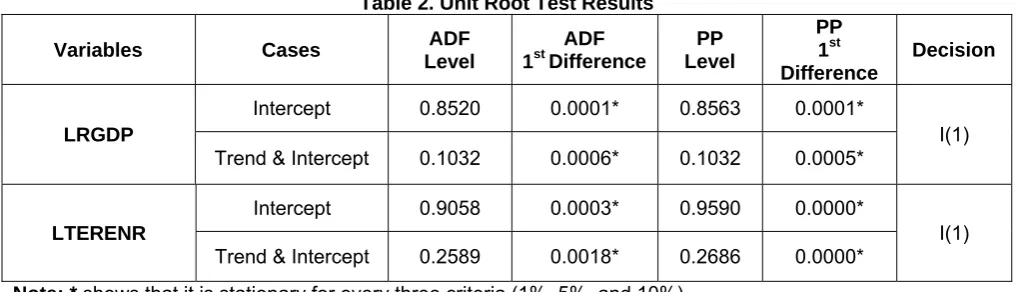
Firstly, it is better to investigate the integration order of the variables. I use PP (Phillips-Perron) and ADF (Augmented Dickey Fuller) unit root tests. Table 2 shows that both variables are integrated of order one.
Table 2. Unit Root Test Results Variables Cases ADF
Level
ADF 1st Difference
PP Level
PP 1st Difference
Decision
LRGDP
Intercept 0.8520 0.0001* 0.8563 0.0001*
I(1) Trend & Intercept 0.1032 0.0006* 0.1032 0.0005*
LTERENR
Intercept 0.9058 0.0003* 0.9590 0.0000*
I(1) Trend & Intercept 0.2589 0.0018* 0.2686 0.0000*
Note: * shows that it is stationary for every three criteria (1%, 5%, and 10%).
After knowing that these variables are integrated of same order, we need to test the cointegration in order to see whether these variables have long-run relationship. But before that, we have to find the optimal lag length. Table 3 shows that the optimal lag length is one for every criteria.
Table 3. Lag Order Selection Criteria
Lag LogL LR FPE AIC SC HQ
0 8.752329 NA 0.001953 -0.562694 -0.464523 -0.536649
1 59.61451 89.00883* 3.94e-05* -4.467876* -4.173363* -4.389742*
2 63.39134 5.979966 4.06e-05 -4.449278 -3.958422 -4.319054
3 66.45664 4.342521 4.48e-05 -4.371387 -3.684189 -4.189073
4 68.80390 2.934069 5.37e-05 -4.233658 -3.350118 -3.999255
Note: * shows the optimal lag length
LR: sequential modified LR test statistic (each test at 5% level) FPE: Final prediction error
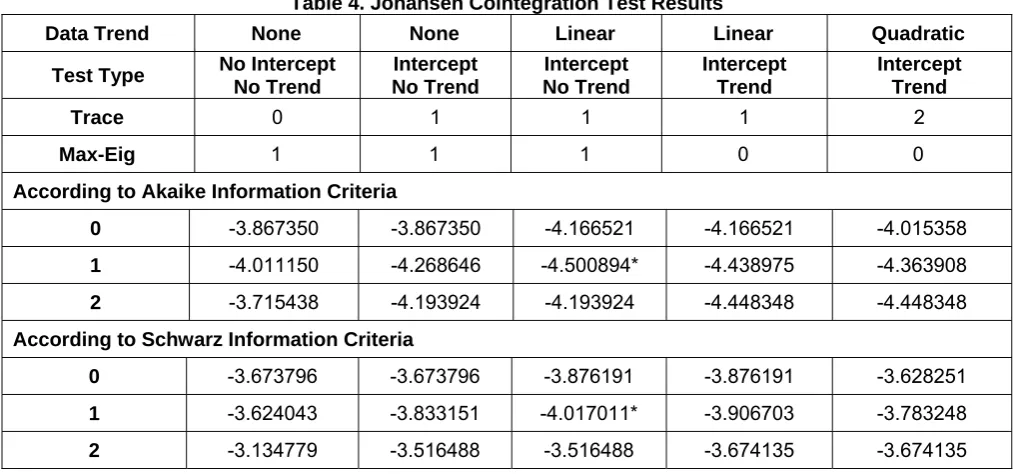
Now we can apply Johansen cointegration test. This test determines the number of cointegrated vectors for any given non-stationary variables for the same order that’s why this test must be applied to level forms of the variables. In order to explain the procedure, it is better to state that the sign of “*” suggests the optimal data trend according to Schwarz and Akaike Information Criterion (criteria: the smallest is the best). So the test result states that the model should be linear and the test type should be intercept and no trend. Table 4 shows the result of Johansen Cointegration test. According to result, there is 1 cointegrated equation for both trace and max-eigen statistics for the case of linear intercept and no trend. So we can say that Real GDP and Tertiary Education Enrollment have long-run relationship.
Table 4. Johansen Cointegration Test Results
Data Trend None None Linear Linear Quadratic Test Type No Intercept
No Trend
Intercept No Trend
Intercept No Trend
Intercept Trend
Intercept Trend
Trace 0 1 1 1 2
Max-Eig 1 1 1 0 0
According to Akaike Information Criteria
0 -3.867350 -3.867350 -4.166521 -4.166521 -4.015358
1 -4.011150 -4.268646 -4.500894* -4.438975 -4.363908
2 -3.715438 -4.193924 -4.193924 -4.448348 -4.448348
According to Schwarz Information Criteria
0 -3.673796 -3.673796 -3.876191 -3.876191 -3.628251
1 -3.624043 -3.833151 -4.017011* -3.906703 -3.783248
2 -3.134779 -3.516488 -3.516488 -3.674135 -3.674135
Since there is a cointegration relationship between two variables, Vector Error Correction Model (VECM) should be applied to check the causality. Table 5 shows the short-run causality between variables. According to short-run Granger Causality results, we can say that there is weak uni-directional causality running from tertiary education to economic growth. The reason of the weakness is the probability value which is bigger than 5% but smaller than 10%. So it can be said that the null hypothesis which states that tertiary education enrollment does not Granger causes Real GDP is rejected according to 10% criteria.
Table 5. VECM Short-run Granger Causality Results
Null Hypothesis Test Statistics Probability Value Result
LTERENR Does Not
Granger Cause LRGDP Chi-sq = 2.730150 0.0985 Rejected
LRGDP Does Not Granger
Cause LTERENR Chi-sq = 0.024298 0.8761 Accepted
Table 6. VEC Model Whose Dependent Variable is LRGDP
Independent Variables Coefficient Probability Value
CointEq(-1) -0.460399 0.0028
D(LTERENR(-1)) -0.125415 0.1127
Now we need to investigate whether this long run causality is bi-directional or uni-directional. To check this, Table 7 gives the results of VEC Model whose dependent variable is tertiary education enrollment. According to table, we can say that there is no long run causality running from Real GDP to tertiary education enrollment because the coefficient value of cointegrated equation is positive although the probability value is significant according to 5% criteria.
Table 7. VEC Model Whose Dependent Variable is LTERENR
Independent Variables Coefficient Probability Value
CointEq(-1) 0.927887 0.0418
D(LRGDP(-1)) 0.085096 0.8776
Consequently, we can say that there is uni-directional causality running from tertiary education enrollment to Real GDP both in the short run and in the long run. Also it is better to state that while in the short run the causality is weak, in the long run it becomes strong.
When it comes to the sign of this causality, we can use Impulse Response Function Method in order to see how one variable will respond to shock/innovation in another variable. Because we found uni-directional causality running from tertiary education enrollment to Real GDP, it is better to give figure of response of Real GDP to shock or innovation in tertiary education. According to Figure 1, we can say that the effect is positive (both in the short run and in the long run) but it becomes more apparent in the long run. This is consistent with our findings which also indicate weak causality in the short run but strong causality in the long run.
Figure 1. Response of LGDP to LTERENR
.00 .01 .02 .03 .04 .05
1 2 3 4 5 6 7 8 9 10
Response of LRGDP to LTERENR
4. CONCLUSIONS AND RECOMMENDATIONS
When we compare our empirical result with existing literature related with the relationship between tertiary education enrollment and economic growth in Turkey, it is also different. For example, Sarı and Soytas (2006) find bi-directional causality between University level education and economic growth while Erdem and Tuğcu (2011) find uni-directional causality running from economic growth to tertiary education enrollment. This situation is also valid for other countries. What I mean is that there is no consensus about the direction of causality between education and economic growth even for the same country. For example, when we investigate Pakistan case while Chaudhary et al. (2009) find uni-directional causality running from economic growth to tertiary education, Qazi et al. (2013) find bi-directional causality between tertiary education and economic growth. These differences may come from the methods that are used in studies or the differences in investigation periods. Generally, because the investigation periods are limited -especially for developing countries - small differences may create econometrically different results. On the other side, at the same time, the empirical part of this paper supports the findings of Pegkas and Tsamadias (2014) because they also find that there is uni-directional causality running from tertiary education enrollment to economic growth for Greece case, however, it is not surprising to find a study which finds same result because in the literature the results are mixed and there is no much alternatives when it comes to the issue of causality.
Consequently, because there is no consensus about the direction of causality between education and economic growth in time series analyses even for the same countries, I recommend panel data analysis because especially for developing countries, one of the reason for lack of consensus about the relationship between education and economic growth is insufficient number of data and panel data analysis increases the number of data as number of countries in the sample increases. However, the key point is creating a sample with analogous countries in order to find an accurate result. After that, maybe by using some control variables or/and dummy variables, we can strengthen our results. Furthermore, using the cognitive skills may be better as a measurement of the quality of the education with the help of some international tests like PISA because the problem of lack of data related with these tests for making an econometric analysis can be solved by using panel data analysis thanks to the reason mentioned above.
To sum up, this paper investigates the literature and makes a small empirical analysis about time-series, quantitative (enrollment rate, average years of schooling, adult literacy index, and number of graduates) part of the education and economic growth. However, we cannot find a common result that’s why investigating this issue with panel data analysis, and using qualitative (cognitive skills) part of education may be a better idea. Also maybe with this way, we can show the importance of education in economic growth and recommend investing in education because it is one of the most important ingredients of human capital and hence economic development. To support this, we can also state that in knowledge based economy; education investment becomes the most significant way to accumulate human capital.
REFERENCES
Afşar, M. (2009). The Relationship between Education Investments and Economic Growth in Turkey (Turkish). Anadolu
University Journal of Social Science, Vol. 9, No. 1, pp. 85-98.
Afzal, M., Rehman, H.U., Farooq, M.S., and Sarwar, K. (2011). Education and economic Growth in Pakistan: A cointegration and causality analysis. International Journal of Educational Research, 50, pp. 321-335.
Barro, R.J., Lee, J.W. (1993). International comparison of educational attainment, Journal of Monetary Economics, Vol.32, pp.363-394.
Benhabib, J., and Spiegel, M.M. (1994). The Role of Human Capital in Economic Development. Journal of Monetary Economics, Vol. 34(2), pp. 143-174.
Bo-nai, F., and Xiong-xiang, L. (2006). A study on the contribution of education investment to the economic growth in China. Front. Educ. China, 4: 521-532.
Bosupeng, M. (2015). Payoffs of Education Expenditure In Botswana: Long Run Economic Growth Implications. Journal of Applied Economics and Business Research, 5(2): 85-96.
Chaudhary, A.R., Iqbal, A., and Gillani, S.Y.M. (2009). The Nexus between Higher Education and Economic Growth: An Empirical Investigation for Pakistan. Pakistan Journal of Commerce and Social Science, Vol. 3, pp. 1-9.
Cheung, Y.N., Lai, K.S. (1995). Lag Order and Critical Values of the Augmented Dickey-Fuller Test. Journal of Business & Economic Statistics, Vol. 13, No. 3, pp.277-280.
Deniz, Z., and Doğruel, A.S. (2008). Disaggregated Education Data and Growth: Some Facts from Turkey and MENA
Countries. Topics in Middle Eastern and North African Economies (electronic journal), 25.07.2013.
Easterly, W. (2001). The middle class consensus and economic development. Journal of Economic Growth, 6(4), pp. 317-335.
Erdem, E., and Tuğcu, C.A. (2011). Higher Education and Economic Growth: An Empirical Investigation of Cointegration and Causality for Turkish Economy. Erciyes Üniversitesi İktisadi ve İdari Bilimler Fakültesi Dergisi, 36, pp. 1-14. Granger, C.W.J. (1969). Investigating Causal Relations by Econometric Models and Cross-spectral Methods. Econometrica,
Vol. 37, No. 3, pp. 424-438.
Granger, C.W.J. (1988). Some Recent Development in a Concept of Causality. Journal of Econometrics, Vol. 39, pp. 198-211.
Gujarati, D.N. (2003). Basic Econometrics, Fourth Edition, McGraw-Hill.
Hanushek, E.A., and Woessmann, L. (2008). The Role of Cognitive Skills in Economic Development. Journal of Economic Literature, 46:3, pp. 607-668.
Johansen, S. (1988). Statistical Analysis of Cointegration Vectors. Journal of Economic Dynamics and Control, Vol. 12, pp. 231-254.
Johansen, S. and Juselius, K. (1990). Maximum Likelihood Estimation and Inference on Cointegration- With Applications to the Demand for Money. Oxford Bulletin of Economics and Statistics, Vol. 52, No. 2, pp. 0305-9049.
Johansen, S. (1991). Estimation and Hypothesis Testing of Cointegration Vectors in Gaussian Vector Autoregressive Models. Econometrica, Vol. 59, No. 6, pp. 1551-1580.
Kreishan, F.M., and Hawarin, I.M. (2011). Education and Economic Growth in Jordan: Causality Test. International Journal of Economic Perspectives, Vol. 5, Issue 1, pp. 45-53.
Lucas, R. E. (1988). On the mechanics of economic development. Journal of Monetary Economics, 22, pp. 3-42.
Mankiw, N. G., and Romer, D. (1992). A Contribution to Empirics of Economic Growth. Quarterly Journal of Economics, Vol. 107, pp. 407-37.
Monteils, M. (2004). The analysis of the relation between education and economic growth. Compare, Vol. 34, No. 1, pp. 103-115.
Naka, A. and Tufte, D. (1997). Examining Impulse Response Functions in Cointegrated Systems. Applied Economics, 29, pp. 1593-1603.
Pegkas, P., and Tsamadias, C. (2014). Does Higher Education Affect Economic Growth? The Case of Greece. International Economic Journal, 28:3, pp. 425-444.
Pesaran, H.H. and Shin, Y. (1998). Generalized Impulse Response Analysis in Linear Multivariate Models. Economic Letters, 58, pp. 17-29.
Phillips, P.C.B. and Perron, P. (1988). Testing for a Unit Root in Time Series Regression. Biometrika, Vol. 75, No. 2, pp. 335-346.
Qazi, W., Raza, S.A., and Jawaid, S.T. (2014). Higher education and growth performance of Pakistan: evidence from multivariate framework. Qual Quant, 48: 1651-1665.
Romer, P. M. (1986). Increasing Returns and Long Run Growth. Journal of Political Economy, 94, pp. 1002-1037. Romer, P. M. (1990). Endogenous Technological Change. Journal of Political Economy,” 98, pp. 71-102.
Sarı, R., Soytas, U. (2006). Income and Education in Turkey: A Multivariate Analysis. Education Economics, Vol. 14, No. 2,
pp. 181-196.
Self, S., and Grabowski, R. (2004). Does education at all levels cause growth? India, a case study. Economics of Education Review, 23, pp. 47-55.
Solow, R. M. (1956). A Contribution to the Theory of Economic Growth. Quarterly Journal of Economics, Vol. 70. pp. 65-94. Solow, R. M. (1957). Technical change and aggregate production function. Review of Economics and Statistics, Vol. 39, pp.
312-320.
Swan, T. W. (1956). Economic Growth and Capital Accumulation. Economic Record, Vol. 32, pp. 334-61.
Telatar, O.M., and Terzi, H. (2010). Nüfus ve Eğitimin Ekonomik Büyümeye Etkisi: Türkiye Üzerine Bir İnceleme (Turkish).
Atatürk Üniversitesi İktisadi ve İdari Bilimler Dergisi, 24:2, pp. 197-214.
Tiwari, A.K. (2011). A Causal Analysis Between Construction Flows and Economic Growth: Evidence from India. Journal of Business and Economy, Vol. 12, No. 2, pp. 27-42.
United Nations. (1997). Human Development Report. New York: Oxford University Press.