887 |
P a g e
TO EVALUTE THE PERFORMANCE OF LIQUID
FLAT PLATE COLLECTOR BY COMPARING TWO
DIFFERENT INSULATION MATERIALS AS GLASS
WOOL AND FOAM
Taliv Hussain
1, Saddamul Haque
2, Rocky Singh Labana
31,2,3
Department of Mechanical Engineering, Lovely Professional University Phagwara,
Punjab (India) -144402
ABSTRACT
Energy consumption is increasing very rapidly as the world is developing. Conventional sources are not able to
fulfil the today’s energy needs. Renewable energy sources eliminate the weaknesses of conventional sources.
But because of less knowledge about these sources and high initial cost of the conversion systems we limit the
use of these resources.Solar energy is one of the such renewable source which is in abundant in nature but it
cannot be effectively utilized because of its intermittent nature. There is a need to trap this energy in some form
to make it a reliable energy source.
In this present work, various studies and investigations are being done to develop the system and device that
can effectively utilize the renewable energy resources for the purpose of industrial and domestic use. One such
device is water flat plate collector which is used for heating water by using solar energy and hence
investigations are being done to check out the performance characteristics of efficiently heating water using
different selective insulating materials like glasswool and foam. It has been seen that on using glass wool as
insulating material maximum collector efficiency is 44.4% and while using foam as insulating material
maximum collector efficiency is 48.6%.Thus by using effective insulation and by varying thickness of insulation
material we can increase the solar collector efficiency.
Keywords: Solar Collector Efficiency, Glass Wool, Foam
I. INTRODUCTION
Depletion of conventional energy resources and its adverse impact on environment have created renewed
interest for the use of renewable energy resources. Hence developments of devices and instruments that can free
us from use of conventional energy resources are of crucial importance. As a result, considerable research and
development activities have taken place to identify reliable and economically feasible alternative clean energy
sources. The solar energy is such a renewable energy resource, the direct incident energy in the form of sunlight
can be converted to thermal energy and transferred to heating devices that are capable of trapping it for long
888 |
P a g e
with some limitations it is not being used on grid scale because of its poor efficiency and higher initial cost. Sothere is a requirement of advancement in the solar water heater using flat plate collector to overcome its
limitations so that it can be used as a replacement of conventional heaters and power generation devices. Solar
collector absorbs the incoming solar radiation, converting it into thermal energy at the absorbing surface, and
transferring the energy to a fluid flowing through the collector.
Clarence Kemp et al. patented the old design of metal tanks exposed to the sun by adding a metal panel to the
tank, in order to increase the efficiency of the solar tank. In the beginning of the 20th century, inventors
designed improved systems, but still the heating and the storage unit were one, and both were exposed to the
weather and the cold nights. William Bailey et al. began selling the Day and Night solar water heater, which
provided an insulated indoor water storage tank, supplied by a separate solar collector located outside the house
and facing south. The collector consisted of a coiled pipe inside a glass covered box which had to be mounted
below the storage tank. This allowed the hot water to circulate from the collector to the storage tank by natural
convection. Otanicar et al. proposed a direct absorption solar collector operated on nanofluids. They demonstrate efficiency improvement up to 5% by utilizing nanofluids as the absorption mechanism. E. Natarajan and R. Sathish et al. suggest the use of nanomaterials in the solar devices to increase the heat transfer and that can be useful in energy saving and compact designs. Groenhout et al. suggested a novel
design of a double-sided absorber with low emissivity selective surface coupled with high reflectance stationary
concentrators to reduce the radiative and conductive losses through the back of the collector. This particular
design reduce the net heat loss to be 30– 70% lower than conventional systems.
II. EXPERIMENTAL SETUP
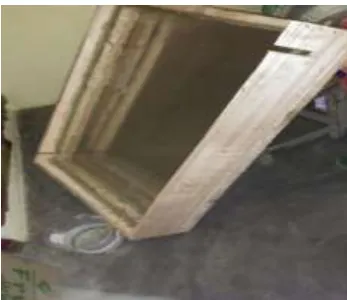
The set up comprises of the wooden frame of dimension 900mm* 1245mm. Two ports one as inlet and other at
other end as outlet are made and the water is allowed to pass through the copper tubes that are installed below
the absorber sheet and the glass cover. The aluminium sheet of 3 mm thickness is used as absorber sheet. The
first experiment is carried out with glass wool as insulating material and other with the foam as insulating
material. The thickness of insulating materials is same i.e 5 cm.
The dimensions of tubes are:
Inner Diameter of Tube
10 mm
Thickness of Tube
2 mm
Spacing between Tubes
100 mm
the function of tubes and channels is to circulate the water. The water flowing through these tubes takes away
889 |
P a g e
Figure 1. Liquid flat plate collector
Measuring devices and instruments
The different parameters are measured in this study. The instruments used are as follows:
1. Solar power meter
2. Temperature Sensor
3. Liquid mass flow rate Measurement
1. Solar power meter: Solar power meter is used to measure intensity of radiation falling on collector Surface in
watt/m2
2. Temperature Sensor: The Dial gauge type temperature sensor is used to measure the temperature of the inlet
and outlet water from the Water flat plate collector. The range of the dial gauge type temperature sensor is from
0-250°C.
3. Liquid mass flow rate Measurement: The liquid flow rate is measured by conventional method in which we
have recorded the time required to fill the beaker of known volume. By the help of this data, we have calculated
discharge(volume/time) at the outlet of the water flat plate collector.
III.CALCULATION AND RESULT
Formulae used and nomenclature:
Collector efficiency is defined as the ratio of the heat transferred to the flowing fluid to the heat received from
the incident radiation (I) falling on the surface of the collector.
𝛈 =
𝐦∗𝐂𝐩∗∆𝐓𝐈∗𝐀
where mf = mass flow rate in kg/sec
Cp = specific heat at constant pressure in J/kg.k
∆T = T2 – T1 T2 is the exit temperature
T1 is the inlet temperature
I = Intensity of radiation falling on Collector Surface in watt/m2
890 |
P a g e
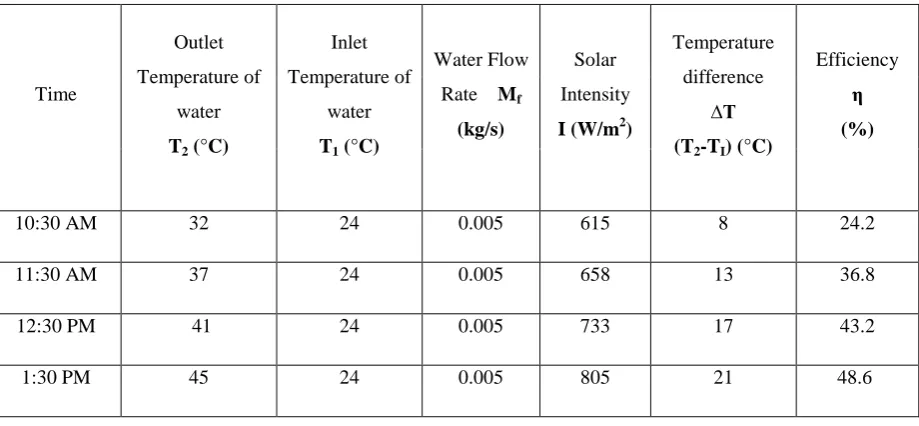
Table 1. Data obtained in experiment
WHEN GLASS WOOL IS USED AS INSULATION MATERIAL
THICKNESS OF GLASS WOOL=5 CM
Table 2. Data obtained in experiment
WHEN FOAM IS USED AS INSULATION MATERIAL
THICKNESS OF FOAM=5 CM Time
Outlet
Temperature of
water
T2 (°C)
Inlet
Temperature
of water
T1 (°C)
Water Flow Rate Mf (kg/s) Solar Intensity
I (W/m2) Temperature
difference ∆T
(T2-TI) (°C)
Efficiency η (%)
10:30 AM 31 24 0.005 615 7 21.2
11:30 AM 35 24 0.005 658 11 31.1
12:30 PM 40 24 0.005 733 16 40.7
1:30 PM 43 24 0.005 805 19 44.4
2:30 PM 41 24 0.005 742 17 42.7
3:30 PM 33 24 0.005 630 9 26.6
4:30 PM 30 24 0.005 605 6 18.5
Time
Outlet
Temperature of
water
T2 (°C)
Inlet
Temperature of
water
T1 (°C)
Water Flow
Rate Mf
(kg/s)
Solar
Intensity
I (W/m2) Temperature
difference ∆T (T2-TI) (°C)
Efficiency η (%)
10:30 AM 32 24 0.005 615 8 24.2
11:30 AM 37 24 0.005 658 13 36.8
12:30 PM 41 24 0.005 733 17 43.2
891 |
P a g e
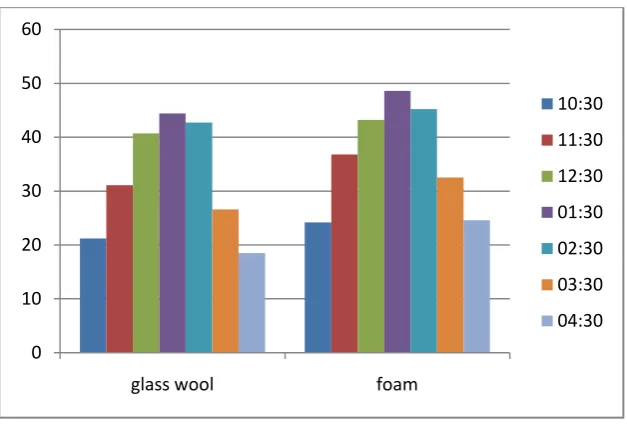
IV. GRAPH ANALYSIS
Comparison of efficiency of insulating material (glass wool and foam)
Table 3. Comparison between two different insulation materials
V. CONCLUSION
Based on the review of the literature on solar collector, it has been found that solar collector was widely
investigated both analytically and experimentally. A number of studies have been carried out in order to
investigate the effect of various parameters on the performance of solar collector. Several promising
advancement are taking place in the field of solar water heating system using flat plate collector. It is quite
evident that by improvement in solar collector it can be used when conditions are not favourable. Optimization
of operating parameters like orientation, fluid flow rate can also increase the efficiency. Thus we can conclude
that by using different effective insulation materials and by varying the thickness of insulation materials we can
increase the efficiency of Liquid flat plate collector. 0
10 20 30 40 50 60
glass wool foam
10:30
11:30
12:30
01:30
02:30
03:30
04:30
2:30 PM 42 24 0.005 742 18 45.2
3:30 PM 35 24 0.005 630 11 32.5
4:30 PM 32 24 0.005 605 8 24.6
Type of Insulating
material
Maximum efficiency
(η)
Max Temperature difference ΔT (°C)
Thickness of material
(cm)
Glass wool 44.4 19 5
892 |
P a g e
REFERENCES
[1] N. K. Groenhout, M. Behnia, G.L. Morrison, (2002). “Experimental measurement of heat loss in an advanced solar collector”, Experimental Thermal and Fluid Science, 26, 131–137
[2] Chow TT. Performance analysis of photovoltaic-thermal collector by explicit dynamic model. Solar
Energy (2003); 75:143–52.
[3] E. Natarajan, R. Sathish, (2009). “Role of nanofluids in solar water heater”.
[4] T. P. Otanicar, P. E. Phelan, R. S. Prasher, G. Rosengarten, and R. A. Taylor, (2010).
“Nanofluid-based direct absorption solar collector” journal of renewable and sustainable energy, 2, 033102.
[5]. Madhukeshwara. N, E. S. Prakash, An investigation on the performance characteristics of solar flat
plate collector with different selective surface coatings, International Journal of Energy and
Environment, 3, Issue 1 (2012) 99-108
Biographical Notes
Taliv Hussain as an Assistant Professor in Mechanical Engineering Department from Lovely Professional University, Phagwara, Punjab, India.
Saddamul Haque as an student of Mechanical Engineering Department from Lovely Professional University, Phagwara, Punjab, India.