A Survey on Face Recognition Techniques
Shehina. T Bintomol Baby
PG Scholar Assistant Professor
Department of Electronics & Communication Engineering Department of Electronics & Communication Engineering MBC College of Engineering & Technology Peermade,
Kerala, India
MBC College of Engineering & Technology Peermade, Kerala, India
Abstract
Face recognition is considered as one of the emerging topics in computer vision application. Currently biometric research is mainly focused on automated face recognition in various applications such as surveillance application in various public security measures. Face recognition is a biometric system used to categorize or authenticate a person from a digital image by extracting its features and then distinguishing it, regardless external conditions. This learning version has mainly two motives: first one is the extensive assortment of profitable and regulation implementation claims, second is the convenience of possible skills. This paper is organised as three sections. The first section describes brief introduction to face recognition. The second section types of face recognition and various problems affecting the process and finally third section describes a comparative study of different face recognition methods.
Keywords: Face Recognition, Face detection, Feature-invariant, Person Recognition, sparse representation
________________________________________________________________________________________________________
I. INTRODUCTION
In several computer vision applications like access control, public security and video surveillance face recognition plays an important role. Face recognition [1], [2] is mainly used to identify or verify a person from an image or from a video source. From the past many face recognition methods have been proposed. The face images are often corrupted by illuminations, expression and occlusions. To overcome these problems the researchers have proposed various effective face recognition techniques. This technique is mainly used in security systems and this can be compared to other biometric like iris or fingerprint recognition systems. Also, machine recognition of human faces is used in fields such as image processing, computer visualization, computer visuals, neural network, pattern recognition and psychology. At present the need for user-friendly systems that can protect our resources and protect our secrecy without losing its characteristics are emerging. One such need is face recognition based ATM counters, a password for computers and so on. Biometric personal documentation such as fingerprint analysis and retinal or iris scans, methods depend on the support of the members whereas personal identification system based on analysis of frontal or profile images of the face is frequently operative without the applicant’s teamwork or knowledge. There are mainly two types of comparison in face recognition:
1) Verification: Identified face of the individual is compared by the system and appropriate decision is taken.
2) Identification: From list of matches obtained from the system given individual to other individual in the data base are compared.
II. FACE RECOGNITION
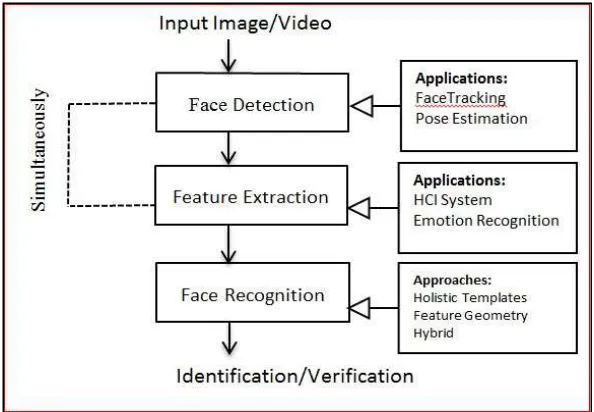
Fig. 1: Configuration of a generic face recognition system Face Detection and Feature Extraction
From the above figure automatic face recognition system is defined in two steps. These steps are named face detection and feature extraction. Here first we have to find face in an image and later the task of the feature extraction is to obtain certain features of a particular face using a classification system. Depending upon the classification system these extracted features can be facial or local features. High recognition performance they should be enough knowledge about accurate face and feature location.
Face Detection
Earlier works were focused on single-face detection from a simple or complex background. These approaches included a deformable feature-based template, whole-face template, skin color, and a neural network. Now automatic face detection is used for face recognition. Earlier methods train machine systems with many samples. This may not be practical in present system since face objects are getting complicated and are similar to each other. In a detection problem, consist of two important parameters
1) True positives (detection rate)
2) False positives (non-face region detection).
An ideal system should consist high true positive and low false positive rates. A two-class classification approach to this problem helps to reduce false positives while maintaining true positives which can be achieved by retraining systems with false positive samples of previously trained systems.
Feature Extraction
Facial features are very important in a face recognition system. All face recognition systems needs the exact position of facial features, for identifying a particular face. It is well identified that even holistic matching methods, for example Eigen faces [2] and Fisher faces [3] need correct positions of key facial features. There are three types of feature extraction methods: (1) generic methods based on lines, edges and curves, (2) feature-template-based methods that are used to identify facial features, (3) structural matching methods that take into concern geometrical constraints on the features. First approach is focused on individual features. These methods have less performance when features change significantly, for example, closed eyes, eyes with glasses, open mouth. To identify the facial features new approaches such as structural matching methods are used. More challenging part of feature extraction is feature “restoration,” which attempts to recover features that are undetectable due to large variations in head pose. This is done by finding out the missing features either by using the bilateral symmetry of the face or another using learned information.
Recognition from Intensity Images
Holistic matching methods
These methods use the entire face region as the rare input to a recognition system. Most commonly used illustrations of the face region are Eigen pictures which are based on principal component analysis. The Holistic based method fails to identify the face with local variation, such as illumination and expression varying conditions.
2) Feature-based matching methods The eyes, nose, and mouth these local features are first extracted and their locations and local data are fed into a basic classifier. This method tackled the difficulties like illumination and expression than previous one. The local binary pattern LBP [5] and gabor based method [6]-[8] are used here.
3) Hybrid methods
A machine recognition system uses both the human perception system uses both local features and the whole face region to recognize a face,
Face recognition problem
The major problems of face recognition are illumination and pose.
1) Illumination Problem: Problem caused by difference in lightning condition 2) Pose Problem: Caused due to different facial poses.
Face Recognition Methods
Based on Feature invariant Based on Template matching Based on Appearance based Based on Knowledge based
III. RELATED ANALYSIS
Lingfeng Wang and Huaiyu Wu and Chunbong [9] proposed a Manifold Regularised Local Sparse Representation for face recognition (MRLSR).In earlier sparse representation based methods can be successfully used, but the sparse representation is problematic in the presence of illumination variation and occlusions. Here we propose a new method MRLSR this remove the difficulties in an image. The basic idea behind this approach is all coding vector in a spare representation is a group sparse, it hold the individual sparsity and local similarity property. Here a homotopy based algorithm is used to optimize this model. The experiment conducted on various illuminations and occlusions based database.so it can provide highest recognition rate. In the future MRLSR integrate with other term to develop its group sparsity.
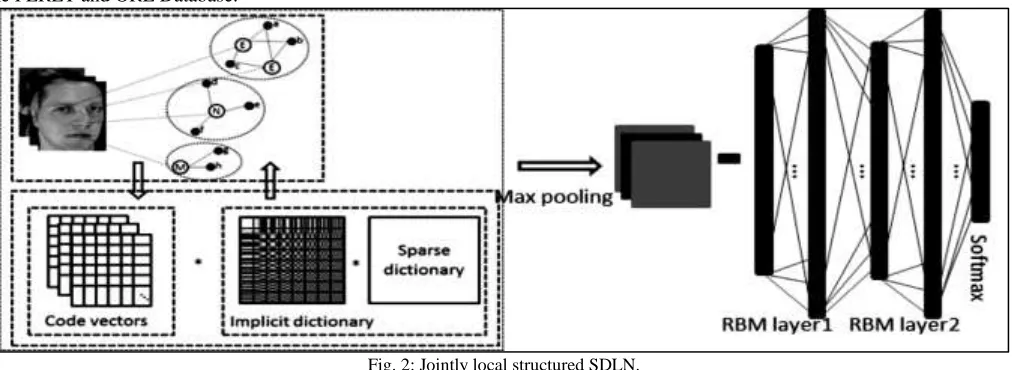
Renjie wu and sei.ichiro kamata [10] proposed an Optimized Sparse Deep Learning Network (SDLN) model for face recognition (FR).This method is studied to the feature coding of human face with SDLN based local structure sparse representation. In the previous sparse face recognition method based various expression and poses of data could affect the recognition result. In this method over complete common dictionary and feature coding for each individual face is obtained. The deep learning technique is most commonly used for face feature learning. The previous deep learning technique cannot contain difference of face uniqueness. The proposed method improves the face recognition and it can also achieved high performance on the FERET and ORL Database.
Fig. 2: Jointly local structured SDLN.
consistent and discriminative channel. Another method named color Channel Concatenation (CCC) which deals with different color channel equally. The CCF method gives better performance than CCA method.
Fig. 3: Color channel fusion approach
Liang Chen, Meng Xi, Desanka Polajnar and Weiyang Tong [12] proposed a deep learning approach for face recognition named as Local Binary Pattern Network. In multilayer hierarchy these methods efficiently removes and compare high level over complete features. When comparing with CNN, LBPNet have a similar topology and thus avoid the cost in learning the massive data by replacing it with convolution method. The proposed LBPNet method give promising output compared with other state-of –art method.
Fig. 4: The deep network part of LBPNet for feature extraction.
Chuan-Xian Ren, Dao-Qing Dai, Ke-Kun Huang and Zhao-Rong Lai [13] proposed Transfer Learning of Structured Representation for Face Recognition. In this method transfer learning algorithm is proposed. In uncontrolled or low resolution condition the algorithm obtains the face identification problems. Gabor-based Kernel representation is demonstrated around invariant classification between dissimilar image domains. Here a transfer learning objective function is constructed for group of structured and transferable illustration weights. Commonality and individuality is measured using an optimal weight and discriminant subspace. The output of this method has good features and they present a right decision showing the importance of sharing discriminant positioning and scales. This compared with other method transfer learning give better performance.
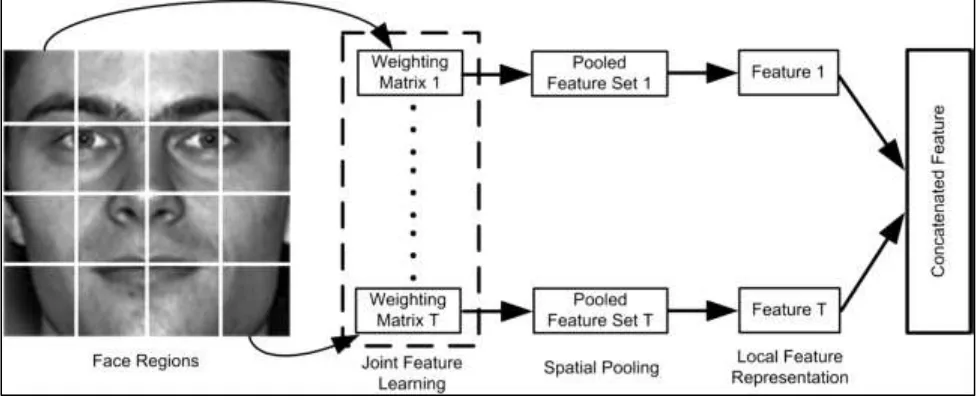
Fig. 5: Basic idea of JFL model
Nanzhou Piao and Rae Hong park [15] proposed Dual Difference Regression Classification (DDRC) based method for face recognition. DDRC classified into two part Pixel Difference Binary Pattern (PDBP) and Differences Regression Classification(DRC).this method consist two type of differences, PDBP represent the difference in training data and DRC represent the differences of training vector. The illumination changes and multicollinearity is the problem of the previous mode to reduce this effects combining the PDBP and DRC method, it overcome such kind of difficulties in face recognition. The proposed method gives better performance than previous method. Sparse coding and sparse coefficient representation for small images could be used for the selection of effective features could be used for future method.
IV. CONCLUSION
This paper presents a survey of face recognition methods and brief review of related studies. Face recognition tasks are usually done in still images and videos. Various issues have been found based on detailed study of related paper. The basic problems of face recognition are illumination, expression and poses. To overcome these limitations different methods are used for face recognition and their characteristics are discussed. Better result can be achieved by using various advanced face recognition in near future.
REFERENCES
[1] S. Z. Li and A. K. Jain, Eds., “Handbook of Face Recognition”, 2nd edi. New York, NY, USA: Springer-Verlag, 2011.
[2] W. Zhao, R. Chellappa, A. Rosenfeld, and P. J. Phillips, “Face recognition: A literature survey,” ACM Computer. Survey. vol. 35, no. 4, pp. 399–458, 2003.
[3] M. Turk and A. Pentland, “Eigen faces for recognition,” J. Cognit. Neurosci., vol. 3, no. 1, pp. 71–86, 1991.
[4] P. N. Belhumeur, J. P. Hespanha, and D. J. Kriegman, “Eigenfaces vs.Fisherfaces: Recognition using class specific linear projection,” IEEE Trans. Pattern
Anal. Mach. Intell, vol. 19, no. 7, pp. 711–720, Jul. 1997.
[5] T. Ojala, M. Pietikainen, and T. Maenpaa, “Multiresolution gray-scale and rotation invariant texture classification with local binary patterns,” IEEE Trans.
Pattern Anal. Mach. Intell., vol. 24, no. 7, pp. 971–987, Jul. 2002.
[6] J. P. Jones and L. A. Palmer, “An evaluation of the two-dimensional Gabor filter model of simple receptive fields in cat striate cortex,”J. Neurophysiol.,
vol. 58, no. 6, pp. 1233–1258, 1987.
[7] S. Xie, S. Shan, X. Chen, and J. Chen, “Fusing local patterns of Gabor magnitude and phase for face recognition,” IEEE Trans. Image Process., vol. 19, no.
5, pp. 1349–1361, May 2010.
[8] M. Yang and L. Zhang, “Gabor feature based sparse representation for face recognition with Gabor occlusion dictionary,” in Proc. 11th Eur.Conf. Comput.
Vis. (ECCV), 2010, pp. 448–461.
[9] Lingfeng Wang, Huaiyu Wu, And Chunhong Pan “Manifold Regularized Local Sparse Representation for Face Recognition” IEEE Transactions On
Circuits And Systems For Video Technology, Vol. 25, No. 4, April 2015.
[10] Renjie Wu, Sei-Ichiro Kamata “A Jointly Local Structured Sparse Deep Learning Network For Face Recognition”
[11] Ze Lu, Student Member, IEEE, Xudong Jiang, Senior Member, IEEE, And Alex C. Kot, Fellow, IEEE “A Color Channel Fusion Approach For Face
Recognition” IEEE Signal Processing Letters, Vol. 22, No. 11, November 2015
[12] Jiwen Lu, Senior Member, IEEE, Venice Erin Liong, Xiuzhuang Zhou, Member, IEEE, and JIE Zhou, Senior Member, IEEE “Learning Compact Binary
Face Descriptor for Face Recognition” IEEE Transactions On Pattern Analysis And Machine Intelligence, Vol. 37, No. 10, October 2015.
[13] Chuan-Xian Ren, Member, IEEE, Dao-Qing Dai, Member, IEEE, Ke-Kun Huang, Member, IEEE,and Zhao-Rong Lai, Student Member, IEEE “Transfer
Learning of Structured Representation for Face Recognition” IEEE Transactions On Image Processing, Vol. 23, No. 12, December 2014.
[14] Jiwen Lu, Member, IEEE, Venice Erin Liong, Gang Wang, Member, IEEE, and Pierre Moulin, Fellow, IEEE “Joint Feature Learning for Face
Recognition” IEEE Transactions On Information Forensics And Security, Vol. 10, No. 7, July 2015
[15] Nanzhou Piao and Rae-Hong Park, Senior Member, IEEE “Face Recognition Using Dual Difference Regression Classification” IEEE Signal Processing