ISSN (e): 2250-3021, ISSN (p): 2278-8719 Vol. 06, Issue 10(Oct. 2016), ||V2|| PP 69-75
Partial Replacement of Cement with Fly Ash In Concrete And Its
Effect
Authors: Vinod Goud
(1)Niraj Soni
(2)Corresponding Authors: (1) Goutam Varma (2) Kapil Kushwah (3) Sharad Chaurasia (4) Vishwajeet Sharma
Abstract:Fly ash a waste generated by thermal power plants is as such a big environmental concern. In modern decades, the industrialization and urbanization are the two phenomena that are spreading all over the world. Apart from the requirement of these phenomena, there should also be investigation into their negative impacts on the worldwide environment and common life. Most important poor effect of these international processes has been the production of large quantities of industrial wastes. Therefore, the problems related with their safe management and dumping has turned into a major test to environmentalists and scientists. Another problem is the stress on land, materials and resources to sustain the developmental activities, including infrastructure. The thermal power plants produce considerably large quantities of solid byproduct namely fly ash.
Keywords— Fly ash, Cement, Compressive strength
I. INTRODUCTION
Fly ash particles at 2,000x magnification
II. CHEMICAL COMPOSITION
Fly ash material solidifies while suspended in the exhaust gases and is collected by electrostatic precipitators or filter bags. Since the particles solidify while suspended in the exhaust gases, fly ash particles are generally spherical in shape and range in size from 0.5 µm to 100 µm. They consist mostly of silicon dioxide (SiO2), which is present in two forms: amorphous, which is rounded and smooth, and crystalline, which is sharp, pointed and hazardous; aluminum oxide (Al2O3) and iron oxide Fly ashes are generally highly heterogeneous, consisting of a mixture of glassy particles with various identifiable crystalline phases such as quartz, mullite, and various iron oxides.
Component Bituminous Sub Bituminous
Lignite
Sio2 (%) 20 – 60 40 – 60 15 – 45
Al2O3 (%) 5 – 35 20 – 30 20 – 25
Fe2O3 (%) 10 – 40 4 – 10 4 – 15
CaO (%) 1 – 12 5 – 30 15 – 40
LOI (%) Loss on Ignetion
0 – 15 0 – 3 0 -5
III. CLASSIFICATION OF FLY ASH
Two classes of fly ash are defined by ASTM C618: Class F fly ash and Class C fly ash. The chief difference between these classes is the amount of calcium, silica, alumina, and iron content in the ash. The chemical properties of the fly ash are largely influenced by the chemical content of the coal burned.
Class F fly ash:
having pozzolanic properties, also has some self-cementing properties. In the presence of water, Class C fly ash will harden and gain strength over time. Class C fly ash generally contains more than 20% lime (CaO).
IV. PROBLEM DEFINATION
We performed work for nominal mix M25 grade concrete for 0.35 w/c ratio. With mineral admixture 10%, 20%, and 30% replacement by mass of cement. In this work we studied the effects of different w/c ratio, percentage of mineral admixture over the properties of concrete like workability & strength further more we studied the effect with age of concrete and slump loss. Quality is essence of good work. Good quality of concrete is a homogenous mixture of water, cement, aggregate and admixture. Only the mixing of these materials is not the matter but to obtain the concrete which governs all the properties of concrete mixes in fresh as well as hardened concrete. To produce good quality concrete the following steps are involved in concrete preparation.
1. Batching of materials. 2. Mixing 3. Compaction. 4. Finishing. 5. Curing and Demoulding. 6. Cube testing.
To produce good quality of concrete the selection of materials as well as selection of required grade of concrete is necessary
We have used M25 grade of concrete with the ratio 1:1:2 i.e. 1 part of cement, 1 part of fine aggregate and 2 part of coarse aggregate
A. Materials Specification Following are the materials used Cement: 53 grade of ordinary Portland cement
Aggregate: 20mm retaining size Sand: Fine aggregate
Water: Potable water Mineral admixtures: Fly ash
B. Characteristic of Material Cement: 53 grade of ordinary Portland cement
Aggregate: 20 mm maximum nominal size of aggregate
Sand: Fine aggregate Water Cement ratio 0.35
We casted three cubes for each w/c ratio and cured these for four days. And from this we get that M25 concrete delivers higher compressive strength with 0.35 w/c ratio. It shows in table I
We also study of variation in slump for different w/c ratio
Table ICOMPRESSIVE STRENGTH OF CONCRETE WITH DIFFERENT W/C RATIO
Sr.No. W/C ratio
Compressive Strength N/Sq.mm
Avg. Comp. Strength N/Sq.mm 1
0.35
21.3
22.4
2 23.7
3 22.2
4
0.45
20.6
20.83
5 20.8
6 21.1
7
0.55
8.97
11.08
8 12.28
FIGURE I Variation in Compressive Strength for Different water cement ratio
Table II SLUMP OF CONCRETE WITH DIFFERENT W/C RATIO
W/C Ratio 0.35 0.45 0.55
Slump in
MM 0 30 160
Table III Compressive strength for different proportion of fly ash after 7 days curing
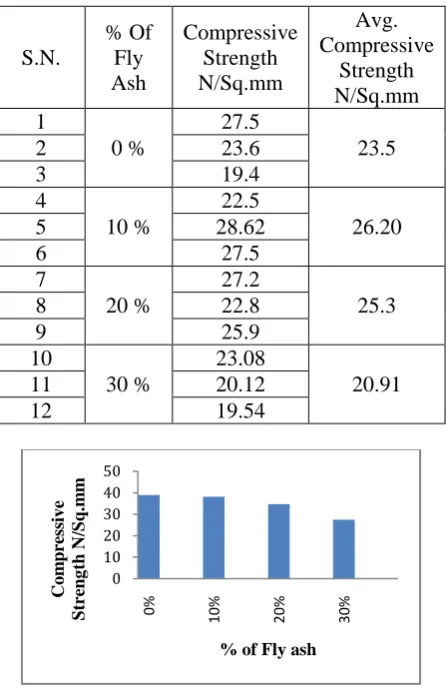
S.N. % Of Fly Ash Compressive Strength N/Sq.mm Avg. Compressive Strength N/Sq.mm 1 0 % 27.5 23.5
2 23.6
3 19.4
4
10 %
22.5
26.20
5 28.62
6 27.5
7
20 %
27.2
25.3
8 22.8
9 25.9
10
30 %
23.08
20.91
11 20.12
12 19.54
FIGURE III Compressive Strength For Different Proportion Of Fly Ash After 7 Days Curing\
Table IV Compressive strength for different proportion of fly ash after 14 days curing
0 5 10 15 20 25
0.35 0.45 0.55
Co m p re ss iv e S tr en g th N/S q .m m W/C ratio 0 10 20 30 40 50
0% 10% 20% 30%
Co m p re ss iv e S tr en g th N/S q .m m
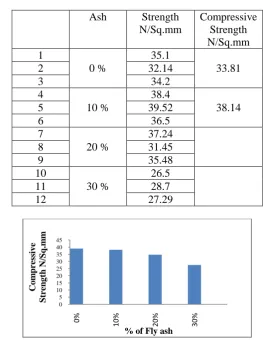
Ash Strength N/Sq.mm Compressive Strength N/Sq.mm 1 0 % 35.1 33.81
2 32.14
3 34.2
4
10 %
38.4
38.14
5 39.52
6 36.5
7
20 %
37.24
8 31.45
9 35.48
10
30 %
26.5
11 28.7
12 27.29
FIGURE II Compressive Strength For Different Proportion Of Fly Ash After 14 Days Curing
Table V Compressive strength for different proportion of fly ash after 28 days curing
S.N. % Of Fly Ash Compressive Strength N/Sq.mm Avg. Compressive Strength N/Sq.mm 1 0 % 38.17 38.96
2 38.48
3 40.25
4
10 %
41.87
43.24
5 44.59
6 43.28
7
20 %
38.95
37.78
8 34.5
9 39.89
10
30 %
33.88
31.46
11 28.92
12 31.58
0 5 10 15 20 25 30 35 40 45
0% 10% 20% 30%
Co m p re ss iv e S tr en g th N/S q .m m
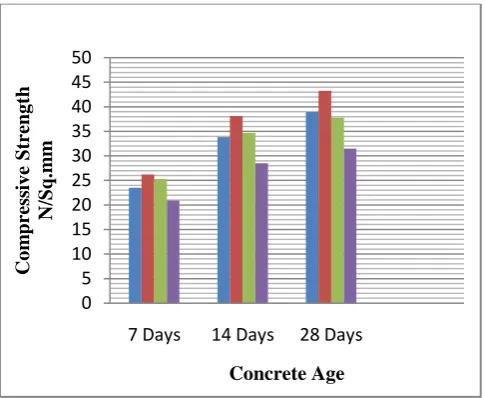
FIGURE IV Compressive Strength For Different Proportion Of Fly Ash After 28 Days Curing In following figure we can compare variation of compressive strength of concrete for different proportion of fly ash and for different age of concrete. From the results obtained it can be clearly seen that for 10% to 20% replacement of fly ash with weight of cement compressive strength is increases and then if we further increases percentage of fly ash, compressive strength decreases.
COMPRESSIVE STRENGTH OF CONCRETE FOR DIFFERENT PERCENTAGE OF ASH AND FOR DIFFERENT AGE OF CONCRETE
V. CONCLUSIONS
This research concludes the study of the effect of fly ash on the properties of concrete‖ for nominal mix of M25 grade of concrete are as follows.
1. Slump loss of concrete increases with increase in w/c ratio of concrete.
2. For w/c ratio 0.35 without any admixtures, initial slump cannot be measured by slump cone test as it is very less.
3. Ultimate compressive strength of concrete decreasing with increase in w/c ratio of concrete. 4. Slump loss of concrete goes on increasing with increase of quantity of fly ash.
5. The 10% and 20% replacement of cement with fly ash shows good compressive strength for 28 days.
6. The 30% replacement of cement with fly ash ultimate compressive strength of concrete decreases. 0
10 20 30 40 50
0% 10% 20% 30%
Co
m
p
re
ss
iv
e
S
tr
en
g
th
N/S
q
.m
m
% of Fly ash
0 5 10 15 20 25 30 35 40 45 50
7 Days 14 Days 28 Days
Co
m
press
iv
e
Str
eng
th
N/Sq
.m
m
REFERENCES
[1] Li Yijin, Zhou Shiqiong,Yin Jian and Gao Yingli, ―EFFECTS OF FLY ASH ON THE FLUIDITY OF CEMENT PASTE, MORTAR AND CONCRETE.‖, International workshop on sustainable development and concrete technology, Central South University, PRC, pp.339-345. [2] Xianyu Jin and Zongjin Li.], ―Effects of Mineral Admixture on Properties of Young Concrete‖,
Journal of materials in Civil Engineering @ ASCE, pp.435- 442 Sept-Oct- 2003.
[3] M.S.Shetty, ―Concrete Technology Theory and Practice‖, S. Chand & Company LTD, pp.124-147, 174-183, 349-361, 2011.
[4] Fly Ash For Cement Concrete, Ash Utilization Division NTPC Limited. [5] M. L. ambhir, ―Concrete technology‖, Tata McGraw-Hill Education, 2004. [6] Fly Ash–Cast in Concrete, NAEB JOURNAL
[7] Amit Mittal, M.B. Kaisare and RajendraKumar Shetty, ―EXPERIMENTAL STUDY ON USE OF FLY ASH IN CONCRETE.
[8] Contribution of Fly Ash to the Properties of Mortar and Concrete‖, International Journal on Earth Science & Engineering, ISSN 0974-5904, Volume 04, No 06 SPL, pp.1017-1023, October 2011.
[9] IS 456:2000, ―PLAIN AND REINFORCED CONCRETE-CODE OF PRACTICE‖ (Fourth Revision).
[10] Semsi Yazici & Hasan Sahan Arel Department of Civil Engineering, Engineering Faculty, 35100 ˙Izmir, Turkey ―Effects of fly ash fineness on the mechanical properties of concrete‖.