Page 367
CASES OF RESEARCH ETHICS EDUCATION AT GRADUATE SCHOOLS IN JAPAN - KYUSHU UNIVERSITY’S CASE
Toshiya Kobayashi
Center for Science, Technology and Innovation Policy Studies, Kyushu University, Japan
Abstract
In the spring of 2014, a research fraud case by a young researcher (STAP cell scandal) was uncovered in Japan, and a scientific research institution’s authority was greatly damaged. In response to such frequent occurrences in Japan over this past decade, the Japanese government implemented anti-fraud measures in 2014. Consequently, research ethics education has been enhanced at Japan’s graduate schools since April 2015. The e-learning program in use is effective in teaching graduate students concrete knowledge about research ethics within a relatively short time frame. However, it is in the format of short test quizzes and is considered insufficient for voluntarily learning of ethics. As a voluntary learning means, advanced researchers in Japan believe that science communication activities are important. The activities make it possible to instill and foster ethics that e-learning cannot cover. Kyushu University actually provides education that adopts science communication. This paper introduces details of the activities.
Key words: research fraud, research ethics, science and technology communication activities,
graduate education in Japan
1. INTRODUCTION
In 2014, the STAP cell scandal was uncovered at RIKEN, one of the foremost public research institutions in Japan, which received heavy media attention as a serious research fraud case. In particular, fraud in scientific research conducted through the use of public funds could lead to public mistrust throughout the country. For this reason, research institutions in Japan have been required to respond to acts of research fraud. This paper introduces initiatives in preventing research fraud at research institutions, in particular universities, in Japan. One year after the occurrence of the STAP cell scandal, the Japanese government developed and announced guidelines for research fraud prevention. In response, research ethics education has been proactively promoted at universities throughout Japan. In this paper, whether such initiatives are appropriate or not is reviewed. Subsequently, initiatives related to research ethics education for students at Kyushu University, which is a national university, are introduced, and the results of a study on their effectiveness are reported.
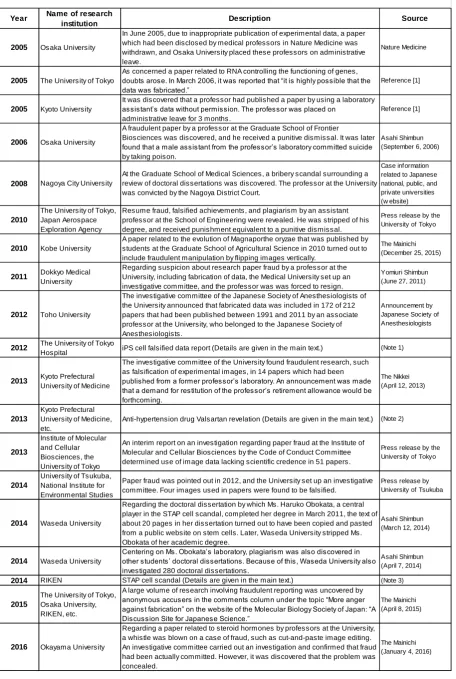
2. FREQUENT OCCURRENCES OF RESEARCH FRAUD CASES IN JAPAN
Page 368 Year Name of research
institution Description Source
2005 Osaka University
In June 2005, due to inappropriate publication of experimental data, a paper which had been disclosed by medical professors in Nature Medicine was withdrawn, and Osaka University placed these professors on administrative leave.
Nature Medicine
2005 The University of Tokyo
As concerned a paper related to RNA controlling the functioning of genes, doubts arose. In March 2006, it was reported that “it is highly possible that the data was fabricated.”
Reference [1]
2005 Kyoto University
It was discovered that a professor had published a paper by using a laboratory assistant’s data without permission. The professor was placed on
administrative leave for 3 months.
Reference [1]
2006 Osaka University
A fraudulent paper by a professor at the Graduate School of Frontier
Biosciences was discovered, and he received a punitive dismissal. It was later found that a male assistant from the professor’s laboratory committed suicide by taking poison.
Asahi Shimbun (September 6, 2006)
2008 Nagoya City University
At the Graduate School of Medical Sciences, a bribery scandal surrounding a review of doctoral dissertations was discovered. The professor at the University was convicted by the Nagoya District Court.
Case information related to Japanese national, public, and private universities (w ebsite)
2010
The University of Tokyo, Japan Aerospace Exploration Agency
Resume fraud, falsified achievements, and plagiarism by an assistant professor at the School of Engineering were revealed. He was stripped of his degree, and received punishment equivalent to a punitive dismissal.
Press release by the University of Tokyo
2010 Kobe University
A paper related to the evolution of Magnaporthe oryzae that was published by students at the Graduate School of Agricultural Science in 2010 turned out to include fraudulent manipulation by flipping images vertically.
The Mainichi (December 25, 2015)
2011 Dokkyo Medical University
Regarding suspicion about research paper fraud by a professor at the University, including fabrication of data, the Medical University set up an investigative committee, and the professor was was forced to resign.
Yomiuri Shimbun (June 27, 2011)
2012 Toho University
The investigative committee of the Japanese Society of Anesthesiologists of the University announced that fabricated data was included in 172 of 212 papers that had been published between 1991 and 2011 by an associate professor at the University, who belonged to the Japanese Society of Anesthesiologists.
Announcement by Japanese Society of Anesthesiologists
2012 The University of Tokyo
Hospital iPS cell falsified data report (Details are given in the main text.) (Note 1)
2013 Kyoto Prefectural University of Medicine
The investigative committee of the University found fraudulent research, such as falsification of experimental images, in 14 papers which had been published from a former professor’s laboratory. An announcement was made that a demand for restitution of the professor’s retirement allowance would be forthcoming.
The Nikkei (April 12, 2013)
2013
Kyoto Prefectural University of Medicine, etc.
Anti-hypertension drug Valsartan revelation (Details are given in the main text.) (Note 2)
2013
Institute of Molecular and Cellular Biosciences, the University of Tokyo
An interim report on an investigation regarding paper fraud at the Institute of Molecular and Cellular Biosciences by the Code of Conduct Committee determined use of image data lacking scientific credence in 51 papers.
Press release by the University of Tokyo
2014
University of Tsukuba, National Institute for Environmental Studies
Paper fraud was pointed out in 2012, and the University set up an investigative committee. Four images used in papers were found to be falsified.
Press release by University of Tsukuba
2014 Waseda University
Regarding the doctoral dissertation by which Ms. Haruko Obokata, a central player in the STAP cell scandal, completed her degree in March 2011, the text of about 20 pages in her dissertation turned out to have been copied and pasted from a public website on stem cells. Later, Waseda University stripped Ms. Obokata of her academic degree.
Asahi Shimbun (March 12, 2014)
2014 Waseda University
Centering on Ms. Obokata’s laboratory, plagiarism was also discovered in other students’ doctoral dissertations. Because of this, Waseda University also investigated 280 doctoral dissertations.
Asahi Shimbun (April 7, 2014)
2014 RIKEN STAP cell scandal (Details are given in the main text.) (Note 3)
2015
The University of Tokyo, Osaka University, RIKEN, etc.
A large volume of research involving fraudulent reporting was uncovered by anonymous accusers in the comments column under the topic “More anger against fabrication” on the website of the Molecular Biology Society of Japan: “A Discussion Site for Japanese Science.”
The Mainichi (April 8, 2015)
2016 Okayama University
Regarding a paper related to steroid hormones by professors at the University, a whistle was blown on a case of fraud, such as cut-and-paste image editing. An investigative committee carried out an investigation and confirmed that fraud had been actually committed. However, it was discovered that the problem was concealed.
The Mainichi (January 4, 2016)
Page 369 (1) iPS cell fraud (2012)
Hisashi Moriguchi, a visiting researcher at the University of Tokyo Hospital reported that a cardiac muscle transplant using iPS cells as the world’s first clinical application had been performed. However, this was found to be false, and he received disciplinary dismissal from the University of Tokyo (Note 1).
(2) Anti-hypertension drug Valsartan revelation (2013)
In clinical research of the anti-hypertension drug Valsartan by professor Hiroaki Matsubara et al. at Kyoto Prefectural University of Medicine, data was artificially manipulated so as to make the drug appear advantageous. Professor Matsubara resigned in February 2013. Upon verification by the University using data from the paper, the results could not be duplicated. The University made the announcement at a press conference, and the president and other university-related staff apologized in front of the press. It was found that an employee of Novartis Pharma AG, a pharmaceutical company that distributes this drug had participated in this clinical research while concealing his employment status, and he was later prosecuted (Note 2).
(3) STAP cell scandal (2014)
At the end of January 2014, Haruko Obokata, a Research Unit Leader of RIKEN et al. reported the discovery of STAP cells. However, as a result of increasing fraudulent work came to light, the paper was retracted in June, and withdrawn from Nature on July 2. According to RIKEN’s survey, the use of fraudulent images by Ms. Haruko Obokata and the oversight responsibilities of Mr. Yoshiki Sasai and Mr. Teruhiko Wakayama, collaborating researchers, were determined in May. Shortly later, Mr. Yoshiki Sasai committed suicide on August 5. Upon verification of experiments, the existence of STAP cells was denied, and Ms. Obokata resigned from RIKEN. Also, Ms. Obokata was later stripped of her Ph.D. degree (Note 3).
3. RESPONSE OF THE JAPANESE GOVERNMENT - FORMULATION OF “GUIDELINES FOR RESPONDING TO MISCONDUCT IN RESEARCH”
In response to the number of research fraud cases that had occurred in succession, the Japanese government drew up “Guidelines for Responding to Misconduct in Research (hereinafter abbreviated as the Guidelines)” on August 26, 2014. The details are introduced below.
3.1. Description of the Guidelines
The Guidelines stipulated that universities and other research institutions should take a stern approach toward misconduct (Note 4). Furthermore, a decision was made to promote environmental improvements to deter misconduct. As a consequence, research ethics education has been enforced nationwide since April 2015. At universities in particular, research ethics education for students has been enhanced (Note 4).
3.2. Definition of research fraud
Page 370
4. REALITY OF RESEARCH ETHICS EDUCATION AT GRADUATE SCHOOLS IN JAPAN BASED ON THE GUIDELINES
Since April 2015, research ethics education has been promoted at each university in Japan based on the Guidelines mentioned above. This section provides a detailed introduction of the case of Kyushu University, a national university the author belongs to.
4.1. Research ethics education by e-learning and in the format of test quizzes
At Kyushu University, research ethics education is provided to graduate students based on the Guidelines in order to prevent research fraud. A system has been established for graduate students by means of e-learning (Note 6). An e-learning program created by an NPO organization called CITI (Collaborative Institutional Training Initiative) JAPAN PROGRAM is in use. The workings of this program are as follows: When the administrator of each university orders the server that controls educational materials to allow medical students to take the course “conflict of interest,” for instance, the server delivers educational materials for the indicated course to students concerned together with test quizzes; students access the e-learning server by using their personal IDs and passwords, and browse and learn the educational materials assigned to them, and then answer the test quizzes; answers are immediately scored, and results are notified to the students; if acceptable, “pass” is notified to the students, which is also notified to the administrator simultaneously (Note 7).
4.2. Effects and challenges of CITI JAPAN PROGRAM
CITI JAPAN PROGRAM is extremely helpful in effectively teaching graduate students concrete knowledge about the realities of research fraud and research ethics within a relatively short time frame. In the case of Ms. Haruko Obokata of the STAP cell scandal mentioned above, when it was pointed out that she had committed an act of plagiarism, she stated that she had not been taught that this was inappropriate behavior during graduate school. In fact, at many graduate schools in Japan, systematic research ethics education has not been sufficiently provided. Such education has been delegated to tutors. Therefore, if tutors are not sufficiently diligent about education, there have been many cases where students started their careers as researchers without having sufficient knowledge about research ethics. At the thought of this being one of the causes for the frequent occurrence of research fraud cases, CITI JAPAN PROGRAM provides effective countermeasures.
Meanwhile, challenges remain. The educational program by CITI JAPAN PROGRAM is presented within a very short time frame in the format of test quizzes. Can graduate students learn ethics as voluntary beliefs in this way? On this point, the author cannot help but express doubts. This will be discussed in the following section.
5. PRACTICE OF SCIENCE-COMMUNICATION-APPLIED RESEARCH ETHICS
EDUCATION
As a means of having graduate students learn ethics voluntarily, advanced front-line researchers in Japan offer the following suggestions.
5.1. What are the key elements indicated by advanced front-line researchers? - Sincere outreach
Page 371
graduate education that adopts these elements makes it possible to instill and foster ethics that cannot be covered within a relatively short time frame classroom learning. At Kyushu University in Japan, research ethics education adopting science communication is actually provided to graduate students. The details are introduced next.
5.2. Promotion of research ethics education by science communication at Kyushu University
At Kyushu University, a specialized course in Science, Technology and Innovation (STI) Policy (person responsible for planning: professor Akiya Nagata) was established to develop human resources that could make policy based on scientific evidence in 2013, and since then, an educational program has been implemented for all graduate students at Kyushu University. It is compulsory for students who take this course to prepare an “STS Statement” and disclose the prepared statement publicly at an event named “Science Café” held in Fukuoka City. This initiative started in 2013 when the course was launched, and entered its 4th year in 2016. At the Science Cafe having been held three times so far, 11 graduate students in total at Kyushu University have presented their STS Statements and held discussions with participant citizens.
- What is an STS Statement?
An “STS Statement” clearly expresses what each individual should do to build a new relationship between science, technology and society toward the future based on the understanding of the historical influence of scientific and technical development on society in both positive and negative aspects. The content is an overview of the graduate student’s research theme, followed by the prediction of influences of results of the research theme on society in the future: what will happen if the results become widespread as products and services in society; what is predictable as environmental, cultural, and social influences; and supposing problems occurred, how to respond according to his or her own initiative, which is described and summarized as a declaration and widely disclosed to the public. The above is the content of an STS Statement. Holding a free-for-all Science Cafe, graduate students disclose their STS Statements prepared by following the above procedure to citizens and answer questions and respond to comments from the participant citizens on the spot. - Wide disclosure of STS Statements at a Science Cafe held in central Fukuoka City to participant citizens
On March 19, 2016, a Science Cafe for STS Statements was held in central Fukuoka City (See Photo 1). A total of 20 people, including Fukuoka citizens, participated in the said Cafe. At the beginning of the statement presentation, the author explained the purpose, and subsequently three graduate students presented their STS Statements. Regarding respective presentations, opinions were given on how to interpret issues and consideration of policies, and questions about details were asked from the perspectives of citizens and experts, resulting in active discussions (Note 9).
Page 372
5.3. Have graduate students’ ethics improved in reality?
To evaluate the effect of the above research ethics education, a questionnaire survey was conducted on three graduate students. In this questionnaire survey, two questions related to ethics were posed: “I felt that research ethics were very important,” and “I felt that I had to sincerely communicate with participants about my research content.” As for each question, a five-point Likert scale from “Applicable” to “Not applicable” was set, and the respondents made a choice.
First, on the question “I felt that research ethics were very important,” two of the three respondents selected point 5 “Applicable” and one selected point 4. Point 4 is in between “Applicable” and “No opinion.” Next, on the question “I felt that I had to sincerely communicate with participants about my research content,” two of the three respondents selected point 5 “Applicable” and one selected point 4. The above results show that the graduate students who participated in this educational program were strongly aware of research ethics toward society through exchange with citizens of Fukuoka. Although this is an example of a three student small sample size, the author considers that the results are significant.
6. CONCLUSION
Graduate students at Kyushu University are presumed to have realized the cultivation of research ethics through the actions of straightforwardly presenting problems on scientific and technological issues they struggle to confront in science communication with citizens, and answering questions in a sincere manner from citizens. The above initiatives are set to continue as practical research ethics education through science communication in graduate education in the future.
NOTES
(Note 1) Report on investigation of misconduct in research activities by Mr. Hisashi Moriguchi, The University of Tokyo
<http://www.u-tokyo.ac.jp/public/public01_250920_j.html>
(Note 2) ‘Ex-Novartis worker seized for faking clinical trial data of blood pressure drug - 63-year-old charged with manipulating figures in blood pressure clinical study at Kyoto University,’ THE JAPAN
TIMES, June 11, 2014
<http://www.japantimes.co.jp/news/2014/06/11/national/crime-legal/ex-novartis-worker-seized-fakin g-clinical-trial-data-blood-pressure-drug/#.V3I7UHkkouV>
(Note 3) Shusuke Murai, ‘Waseda University strips Obokata of Ph.D.,’ THE JAPAN TIMES, November 2, 2015
<http://www.japantimes.co.jp/news/2015/11/02/national/waseda-university-strip-obokata-ph-d/#.V3I5 oXkkouW>
(Note 4) “Overview of New Guidelines for Responding to Misconduct in Research” Adopted August 26, 2014 by the Ministry of Education, Culture, Sports, Science and Technology
<http://www.mext.go.jp/b_menu/houdou/26/08/__icsFiles/afieldfile/2014/08/26/1351568_01_2.pdf> (Note 5) “Body of the Guidelines for Responding to Misconduct in Research” Adopted August 26, 2014 by the Ministry of Education, Culture, Sports, Science and Technology
<http://www.mext.go.jp/b_menu/houdou/26/08/__icsFiles/afieldfile/2014/08/26/1351568_02_1.pdf> (Note 6) Scientific Research Promotion Division, Planning Department of Kyushu University “Implementing research ethics education and compliance education”
Page 373 (Note 7) “What is CITI Japan?”
<https://edu.citiprogram.jp/citijapan.asp?language=japanese>
(Note 8) Noriko Osumi, ‘To maintain the soundness of science: from the site of life science,’ public symposium “Regulations of scientific research and laws – ‘How to deal with ‘research fraud,’” the University of Tokyo, September 28, 2014
(Note 9) Toshiya Kobayashi ‘Where scientific research is a matter of public discourse,’ Nikkei Asian Review, Nikkei Inc., 2015
<http://asia.nikkei.com/Tech-Science/Science/Where-scientific-research-is-a-matter-of-public-discour se?page=1>
REFERENCES
[1] Ishiguro T 2007, Kagaku no Shakaika Syndrome, Iwanami Kagaku Library [2] Kuroki T 2016, Kenkyu Fusei, Chuokoron-Shinsha
[3] Broad W & Wade N 2014, Haishin no Kagakusha Tachi – Ronbun Netsuzo wa Naze Kurikasesarerunoka? [Betrayers of the Truth: Fraud and Deceit in the Halls of Science], trans. Makino K, Kodansha