Ecclesiology
Today
I
SSUE35
C
o n t e n t s
Ecclesiology
Today
Articles
Chairman’s Letter 2
Image, Liturgy and the Topography of Devotion: St Mary’s Church, Fairford
Sarah Brown 3
The Romanesque Churches of St Mary Magdalene At Tixover and St Mary At Morcott (Rutland)
Malcolm Thurlby 23
The Use of the Church: Blisworth, Northamptonshire, on the Eve of the Reformation
P. S. Barnwell 43
Regular Features
Book Review 63
Odds & Ends
CD Review 65
Churchcrawler Writes 67
Issue 35 September 2005
Hon. Editor John Elliott, MA,PhD
ISSN: 1460–4213
ÓThe Ecclesiological Society 2005
All rights reserved
Society website: www.ecclsoc.org
Charity No: 210501
Journal of the
Ecclesiological Society
ECCLESIOLOGYTODAY35 · SEPTEMBER2005
WELCOME to a rather late edition of Ecclesiology Today. I apologise for its tardy arrival, but hope you feel that, now it is in your hands, the wait has been worthwhile.The delay occurred for a number of reasons, for none of which was our editor, John Elliott, responsible.
The present plan is to produce one more issue later in the year: we will let you know if we decide instead on any other course of action, for example combining the next two editions into a single one.Your Council are anyway giving serious thought to the long-term pattern of publication for Ecclesiology Today, given the way it has developed into a periodical of some significance from its rather more humble beginnings as a stapled newsletter some twenty-five years ago. I expect we will have some news on this in the fairly near future.
This has been a year of change on our Council. Early in the year, Ian Watt became a postulant at Downside Abbey, to test his vocation as a monk, and so did not stand for re-election at the AGM. He was a member of Council for about eight years, latterly as Minutes Secretary, and brought a fund of useful knowledge, and a gift for asking the searching question. He is missed. Recently he begun his formal novitiate, taking the name Brother Benet.We wish him well.
We are delighted that three members have joined the Council, two through election at the AGM, and one by co-option.Together they bring a range of skills and experience. Keith Lovell is a lover of heraldry, and is not a little knowledgeable on the topic; he has also researched particular aspects of gothic revival church architecture. Sarah Brown leads English Heritage research on places of worship, and will be known to many from, amongst other things, her own research on stained glass. Paul Barnwell, also from English Heritage, has a particular interest in using the evidence of buildings to address historical questions, and is involved in extensive research in this area.
And finally, we congratulate our Treasurer Sue Branfoot, who has been awarded a doctorate for her research into the restorations of George Gilbert Scott.
Since the last edition of Ecclesiology Today, we have modernised our database of members. For reasons which are too boring to go into, this involved a complete retyping of names and addresses, a task cheerfully carried out by Doreen Spurr.Although we have put some effort into checking the new database, especially post codes, I suspect there will be some errors, and would encourage you to email the Society or write to our membership secretary with any corrections.
I and other Council members look forward to meeting many of you at the annual conference on 8 October, on the little-studied topic of private chapels, and at our other forthcoming events.
Trevor Cooper September 2005
Chairman’s Letter
THE CHURCH OF ST MARY, FAIRFORD IN GLOUCESTERSHIRE (fig. 1), with its twenty-eight extraordinary early sixteenth-century windows, has long been recognised as exceptional: the windows were the subject of two admiring seventeenth-century poems1and it is said that Van Dyke
described the windows to Charles I as ‘being so exquisitely done that they cannot be exceeded by the best pencil’ – praise indeed in an age in which medieval art was generally held in low esteem.2
Extravagant admiration of the church has continued into our own era: in 1999, Simon Jenkins justifiably included Fairford among his thousand best churches, assigning a five-star rating to ‘one of England’s most outstanding galleries of church art’.3This accolade,
however well-deserved, belies the fact that the church was not built as an ecclesiastical art gallery, but, in common with many thousands of less celebrated others, served as the backdrop to the performance of that everyday medieval miracle, the celebration of the Mass. In its windows, on its walls and in its fabric, we can glimpse something of the environment and topography of late medieval liturgy and devotion, the local specifics of a subject that
Image, Liturgy and the Topography of Devotion:
St Mary’s Church, Fairford
Sarah Brown
Fig. 1. St Mary, Fairford,
formed the golden thread that ran through the Ecclesiological Society’s 2004 Autumn conference, proof positive of the vigour and vitality of religious life in the late medieval English parish on the very eve of the Reformation that was to transform it irrevocably.
The Building: History And Patronage
Although the church was almost completely reconstructed in the 1490s, the crossing area preserves fabric of the earlier cruciform church in the form of a fragment of thirteenth-century nave arcade, while externally the shadow of the roof of the lost north transept can still be seen. The thirteenth-century crossing tower may have been strengthened and rebuilt in the 1430s.4The
masons of the 1490s’ reconstruction were probably from Oxford, as Anna Eavis has convincingly argued, comparing Fairford to the University church, St Mary’s, built in the same period.5
In 1542, John Leland, antiquary and chaplain to Henry VIII, visited Fairford and recorded: ‘John Tame began the fair new chirch of Fairforde and Edmund Tame finished it’ and there seems little reason to doubt the veracity of Leland’s testimony concerning chronology and patronage.6 Tame’s arms appear in
several places on the church, both inside and out, including on the rebuilt central tower, where they accompany those of the Earl of Warwick, in possession of the manor until the 1430s, together with those of the Clares and Despencers, holders of the honour of Gloucester and patrons of the Abbey of Tewkesbury, patron of the church.7 The wealthy wool merchant John Tame was granted
custody of the manor of Fairford in 1497 and the family held the manor, first in custody and then by lease, until 1547.8 Leland
attributed Fairford’s late medieval prosperity to the Tames: ‘Fairford never flourished afore the cumming of the Tames onto it’.9 In June 1497, the second of two special visitations of Fairford
church took place. It is likely that this event marked the consecration of at least the east end of the church.This impression is confirmed by the terms of John Tames’s will, made in January of the same year, in which he requested burial in the north chapel of the church (see Appendix).At his death in May 1500, his wishes were carried out and his splendid tomb (fig. 2) is located on the south side of the north chapel, the Lady chapel, where he is accompanied by his wife, Alice Twyniho, who predeceased him. His son, Edmund, a successful courtier to Henry VIII, died in 1534 and was also buried in the north chapel, by now clearly designated as the Lady chapel. His son, also Edmund, was still in residence in Fairford, in the house to the north-west of the church, at the time of Leland’s visit. He died in 1544 and was buried at Rendcomb, another church constructed and glazed by his father.
ECCLESIOLOGYTODAY35 · SEPTEMBER2005
The Windows
It has long been recognised that the stained glass windows were probably the work of the Anglo-Netherlandish glaziers based in Westminster and Southwark, closely associated with the most prestigious royal and aristocratic projects of the years around 1500. The arrival of the windows by boat on the nearby river Coln, a tributary of the Thames, may account for the apocryphal
tales of their capture on the high seas. It is even possible that work was directed by Barnard Flower, the Netherlandish King’s Glazier appointed in 1497, although this cannot be substantiated.
It has been suggested that the windows may have been given by members of Henry VII’s household and court.10 However,
Tudor royal art and architecture was characterised by a bravura display of shields, badges, insignia and mottoes.With the exception of the Prince of Wales’ feathers in the small tracery eyelets of three windows in the north aisle, there is no such display at Fairford. As a loyal servant of the King, Leland would surely have recorded this extraordinary and unprecedented act of royal generosity. In support of the hypothesis of Court patronage, it has also been suggested that the windows contain a series of hidden portraits of members of the Tudor court.11This theory has failed to attract
widespread support, although there is a strong generic similarity to the features of Henry VII displayed in the figure of a king climbing the steps of heaven in the west window. This may indicate that its creation dates from the period following the king’s death in 1509. A date of c.1500-15 would sit comfortably with its style. By 1515, the Flower workshop and its associates were heavily engaged in the first phase of glazing at King’s College, Cambridge.12 It is interesting that at nearby Rendcomb,
reconstructed and glazed under the patronage of Edmund Tame the Elder between 1503 and 1517, the glass, fragmentary, but of very high quality, is in a style significantly more classical in its decorative repertoire and surely later in date and by different Anglo-Netherlandish glaziers than those employed at Fairford.13
An understandable preoccupation with the style and artistic quality of the stained glass of St Mary’s has resulted in the relative neglect of a thorough consideration of how the windows worked within their architectural context. The main subject of this paper is, therefore, the liturgical and devotional topography of the church and the windows’ place in this.
The Topography Of Devotion
The survival of the wonderful wooden screens between eastern chapels and nave enormously increases our appreciation of the liturgical topography of the building (fig. 3). St Mary’s, in common with all other late medieval parish churches, was comprised of a series of encapsulated spaces.The screens, enriched with five different foliage and fruit designs, and with their candle prickets surviving in a number of places, run from north to south in line with the eastern piers of the central tower and divide the nave and crossing from the eastern arm. Parclose screens running east-west separate the two-bay north and south chapels from the choir, the location of the high altar, sited in the relatively shallow
ECCLESIOLOGYTODAY35 · SEPTEMBER2005
one-bay sanctuary. In John Tame’s will of January 1497, the north chapel is referred to merely as ‘the north chapel’. The will of Elizabeth Tame (d.1545), describes it as the Lady chapel.14 The
south chapel was dedicated to Corpus Christi, a feast celebrated in England from 1318 and by the end of the 15th century one of the most elaborate of festivals, marked by processions involving the whole parish.15 The high altar must also have been dedicated
to the Virgin Mary, to whom the whole church was dedicated by at least the 1430s.
It is undoubtedly the stained glass that now provides the most evocative and complete evidence of the devotional priorities of the church and the way in which image and liturgical space interacted.The glazing scheme is one of the most sophisticated in any English church, displaying every indication of careful planning and a sensitivity to the orientation of the building (fig. 4). In its simplest form, this is manifest in the use of the north-south/dark-light dichotomy present in every church. In the nave, for example, a company of saints and martyrs accompanied by angels are displayed in the south clerestory windows, confronting unique images of the persecutors of the church accompanied by
an extraordinary group of demons arrayed on the north side. An east-west dynamic is also at work in the balance of the imperfect human judgement of Pilate in the central light of the east window and the infallible Last Judgement meted out by Christ in the centre light of the west window.16
However, as the subject of the Society’s 2004 symposium was the church as the place for the celebration of the Mass, what follows will concentrate on the imagery of those windows associated with the principal altars. The windows are intended to be ‘read’ like the turning pages of a book, beginning on the north
ECCLESIOLOGYTODAY35 · SEPTEMBER2005
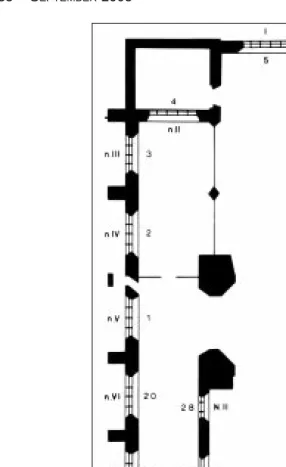
Fig. 4. Plan of the church.
side of the church, immediately west of the Lady chapel screen. It is a book dedicated to the Virgin Mary, to whom the church is dedicated, and window 1 (nV) acts as a preface, depicting the temptation of Eve, Moses and the burning Bush (fig. 5), Gideon and the Golden Fleece and Sheba before Solomon – all typological precursors of the Marian scenes depicted immediately to the east in the windows of the Lady chapel. Indeed, throughout
the entire narrative of the eastern arm, the key role of the Blessed Virgin is consistently emphasised in what amounts to an extended version of the Joys and the Sorrows of the Virgin Mary.17Even in
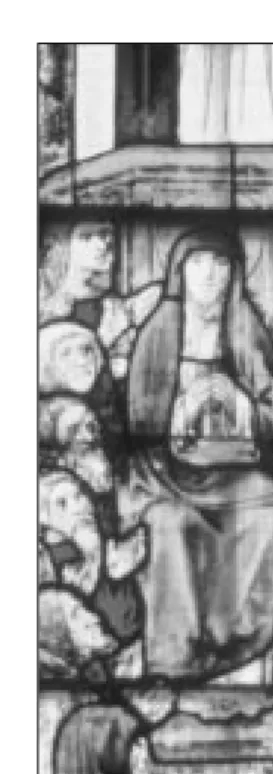
those scenes in which the Virgin is not the key protagonist, she is often given physical pride of place, and the designer of the windows has chosen to depict a number of incidents from the Virgin Mary’s psychological perspective. This is nowhere more apparent than in the depiction of Pentecost (window 9, sV, fig.6), where the Virgin Mary is seated centre stage. At a number of points, the narrative sequence is adjusted to accommodate scenes that reinforce Mary’s special role in the sacred drama, suggesting that in common with countless other English parishes, devotion to the Virgin Mother was particularly strong in the late medieval parish of Fairford. Indeed, Englishmen were encouraged to believe in their nation’s special relationship with the Blessed Virgin, in which England was represented as the Virgin’s dowry.18
There can be little doubt that both John and Edmund Tame shared this devotion, for in their choice of burial place they put themselves under the Virgin’s eternal protection. John’s tomb was incorporated into the parclose between the chancel and the Lady chapel, in a location traditionally associated with founders. He bequeathed £250 for the foundation of a chantry, presumably associated with the Lady chapel altar.19 Edmund lies in a vault
immediately before the Lady chapel altar, marked with a brass depicting himself (fig. 7), and his two wives, Agnes (Greville, d. 1506) and Elizabeth (Tyringham), who survived him. The inscription makes it clear that it was installed during Elizabeth’s lifetime and reads ‘Of youre charite pray [for the soul of Edmund Tame] Knyght here under buried which decessid the fyrst day of October in the yere of oure Lorde God MCCCCCxxxiiij [1534] and for the soul of Agnes his first wife which decessid the xxvj day of July .... The prosperite of Dame Elizabeth his last wife [?frend]es and all Christian soules Jesu have mercy. Amen’. The wall brass on the north wall of the chapel must have been installed only after Dame Elizabeth’s death in 1545, its Latin inscription reading in translation ‘Here lie Edmund Tame, Knight, and Agnes and Elizabeth his two wives; Edmund died on the first day of October, A.D. 1534, and in the twenty-sixth year of the reign of King Henry VIII, on whose souls may God have mercy. Amen’. Edmund, his wives and children, kneel before the three persons of the Trinity, their prayers expressed on brass ribbons in English: ‘Jesu Lord that made us’, ‘and with Thy blood us bought’ and ‘Forgive us our trespass’.20Edmund also made bequests to support
a chantry priest ‘for ever to sing for the sowles of my father and mother and for the sowles of me & my wife and other frendes’.21 ECCLESIOLOGYTODAY35 · SEPTEMBER2005
Fig. 6.Window 9: Pentecost.
The dedication of the north chapel to the Blessed Virgin is made explicit in the iconography of the windows, which develops an extended infancy narrative, drawn from a mixture of Biblical and well-known Apocryphal sources. Her conception, nativity, education in the Temple and betrothal to Joseph are depicted in the first of the chapel’s north wall windows (window 2, nIV), followed by the Annunciation, the Nativity of Christ, the Adoration of the Magi and Shepherds and the Purification (window 3, nII).The window directly above the Lady chapel altar (window 4, nII), its lights shorter than its neighbours in order to accommodate the sacristy further east, comprises five lights rather than the four that is otherwise the standard. The chronological
Infancy narrative is continued in the window’s outer lights, with the Flight into Egypt, with Apocryphal embellishments, and Christ disputing with the doctors. This scene is ‘freeze-framed’ at the moment at which the anxious Virgin finally finds her lost Son. This smooth chronology is, however, interrupted, so to speak, by the subject of the central light of the chapel’s east window, depicting the Assumption of the Virgin and her Coronation by angels (fig. 8). This is an image concerned with elevation and would be seen by those lifting their eyes to witness the elevation of the Host during the Mass. Photographs taken before the installation of the Geoffrey Webb English altar in 1912-13 show that in common with the east wall of the Corpus Christi chapel on the south side, no sculpted stone reredos had been provided, so it is not perhaps fanciful to see the east window as fulfilling this role.22
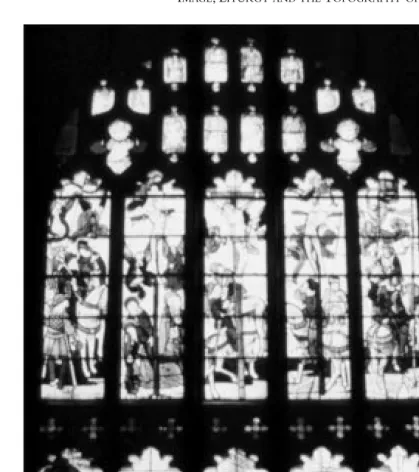
The chancel is dominated by the great five-light east window (fig. 9). Here we have jumped from infancy to Passion, with a narrative unfolding in two registers. At the bottom left of the window, Christ triumphantly enters into Jerusalem on Palm Sunday, while bottom right he leaves the city on the way to Calvary, his tortured way impeded by the spiked wooden blocks tied to his girdle (fig. 10). The narrative thus unfolds in the window in both time and space, culminating in the Crucifixion that fills all five lights of the upper register. The crowded composition is reminiscent of carved Netherlandish altarpieces of this subject and indeed the spiked blocks are a detail found in several Antwerp pieces of the 1490s.23 It is, however, a dramatic
detail that seems to have originated in the art of Rogier van der Weyden in the 1440s.24 The central light depicts another
elevation, of Christ’s broken body on the cross, damaged by iconoclasts in the sixteenth or seventeenth century and restored by Barley Studio in response to the specific request of Fairford’s contemporary parishioners, for whom the windows continue to be an integral part of their devotional life.
Immediately south of the east window, Christ’s deposition and entombment are depicted, together with the harrowing of Hell in window 6 (sII).The Deposition is one of Fairford’s most affecting images (fig. 11), with a power to move the onlooker from beyond the great devotional divide created by the Reformation. The normally rather worldly seventeenth-century Oxford poet and dramatist William Strode (1602-45) was inspired to write:
See where he suffers for thee: see His body taken from the tree: Had ever death such life before? The limber corpse, besullyed ore With meagre paleness, doth display ECCLESIOLOGYTODAY35 · SEPTEMBER2005
Fig. 8.Window 4:The Assumption and Coronation of the Virgin Mary. NMR© Crown Copyright
A middle state twixt Flesh and Clay: His armes and leggs, his head and crowne, Like a true Lambskinne dangling downe, Who can forbear, the Grave being nigh, To bring fresh oyntment to his eye?25
Strode’s reference to the proximity of the grave may have been suggested by the tomb-like impression conveyed by the shallow tripartite tabernacle forming a sedilia immediately beneath the window (fig. 12).There is no architectural provision made for the
Fig. 9.Above left: The East Window: The Passion of Christ.
Fig. 10. Above: The East Window: The way of the Cross
Easter Sepulchre into which Christ’s body was symbolically entombed between Good Friday and Easter Sunday. The most usual position for an Easter sepulchre, in the wall to the north of the altar, is cramped, occupied by the door into the sacristy. Despite its southern location, could the sedilia recess ever have actually functioned as Christ’s symbolic tomb?
The chapel to the south of the chancel is dedicated to the Corpus Christi. Like the Lady chapel, it was never provided with a stone reredos and in common with the Lady chapel east wall, its
ECCLESIOLOGYTODAY35 · SEPTEMBER2005
Fig. 11. Above:
Window 6:The Deposition.
Fig. 12. Right:
The south-east corner of the chancel.
east window (window 7, sIII) is also of five lights, not four, providing the space for a single central image. The four outer lights depict appearances of the resurrected Christ. The Resurrection itself is nowhere depicted and it is telling that the first image in which it is implicit is transformed into another celebration of the special status of the Virgin – Christ’s first Resurrected appearance to her known as ‘Et prima vidit’.26The
scene strongly echoes the standard late medieval Annunciation composition, with the Virgin taken unawares at her private devotions (fig. 13). Christ greets his mother with words that would have been familiar from the opening of the Mass of the Virgin – Salve Sancte Parens (Hail, Holy Parent). This is no accident, as St Ambrose had compared Christ’s resurrection from an unused tomb with his birth from the womb of an unsullied Virgin. The subject was popularised in Pseudo-Bonaventura’s
Meditations on the Life of Christ and from the early
fifteenth-century in Nicholas Love’s English translation, The Mirrour of the
Blessed Lyf of Jesu Christ.27 In the centre light, the chronology of
narration is yet again confounded. The desire to provide an elevation image directly above the altar presented the designers with a problem. The Eucharistic image of the Last Supper most
appropriate to the Corpus Christi altar had already been overtaken in the chronology of the Passion narrative. The Ascension is yet to come. The subject chosen was the Transfiguration of Christ, an inspired iconographic compromise, given explicit Eucharistic emphasis by the depiction of a golden host radiating from Christ’s breast (fig. 14).
In the adjoining windows (windows 8 and 9, sIV and sV) the Gospel narrative is resumed, with the supper at Emmaus, the appearance of the resurrected Christ to the apostles and doubting Thomas, the miraculous draught of fishes, the Ascension and Pentecost, in both of which the Virgin Mary appears in the foreground.
Authorship Of The Scheme
Who planned this scheme, with its sophisticated iconography so cleverly adapted to its architectural setting? We can only speculate. Local clerical advice cannot be discounted. John Tame’s younger son, Thomas, was a priest at Castle Eaton and William Skynner, vicar of Fairford, was a witness to John Tames’ will. However, neither received generous posthumous gifts and neither seems to be a very likely source of such sophisticated iconographic inspiration. Edmund Tame, who, as we have seen, was probably the man responsible for funding the glazing, was a successful courtier and his father’s wealth had given him access to a more cosmopolitan sphere of life outside the parish. Between 26 August and 2 September 1520, for example, Edmund entertained Henry VIII at his house to the north of the church and his young son was knighted on this occasion.28Both Edmund and his father
are represented on their funerary monuments not as Gloucestershire wool merchants in secular dress, but as armigerous gentlemen dressed in armour. Edmund’s will suggests that he was on good terms with the abbots of Augustinian Cirencester and Benedictine Winchcombe.29 The input of the worldly and
experienced glaziers themselves cannot be discounted. Whoever had a hand in the scheme had access to up-to-date pictorial sources. In both window 1 and in the west windows of the nave aisles, the blockbook Biblia Pauperum, a late fifteenth-century Netherlandish product, was the principal pictorial source.
Access And Audience
Very little is known of the devotional life of the late medieval parishioners of Fairford, although by the 1480s it is known that there were Fraternities dedicated to the Virgin Mary, the Holy Trinity and St Cross active in the parish.30 We do know that
Fairford church had separate altars with accompanying windows perfectly suited to the weekly celebration of three of the most
ECCLESIOLOGYTODAY35 · SEPTEMBER 2005
Fig. 14.Window 7: The Transfiguration.
popular late medieval votive masses: Thursday, Corpus Christi, Friday, the Holy Cross and Saturday to the Blessed Virgin.31 How
and when were the windows viewed by the laity? The evidence at Fairford is intriguing.The prefatory window of typological scenes situated immediately to the west of the north screen seems to imply that the viewer is to proceed to ‘read’ the subsequent windows beyond it rather like the turning pages of a book. The depiction of the Purification of the Virgin and the Presentation of Christ in the Temple in window 3 (nIII), immediately to the left of the Lady chapel altar, would have been an excellent location for celebration of Candlemas, and part of the service for the churching of women.32 For the most part, however, the ‘reading’
of the glass presumably took place outside service times, so that Fairford’s parishioners were very familiar with their windows even if they could only glimpse them through the screens during the celebration of the Mass. Indeed, William Strode’s poem suggests that a practice alive and well in Fairford in the nineteenth century, had a seventeenth- and - could it be? - even a sixteenth-century precedent, when he describes the didactic use of the parish clerk’s fishing rod to point out particular details in the glass.
When with a fishing rodde the clark Saint Peter’s draught of fish doth marke, Such is the scale, the eye, the finne, You’d think they strive and leape within, But if the nett, which holds them breake, Hee with his angle some would take.33
It is possibly the didactic use of the windows, complemented by limited but quite specific iconoclasm designed to render dangerous images spiritually impotent, including the figures of Christ and the two thieves in the east window, the transfigured Christ in window 7, that accounts for the otherwise almost miraculous preservation of the windows.34
While the Tames, principal funders of the enterprise, may have successfully appropriated the sacred space of the Lady Chapel, they had certainly not privatised it and do not seem to have had more privileged access to the altars and their windows than any other layperson. In the north wall of the church is a small doorway neatly tucked under one of the buttresses (fig. 15). It has been plausibly suggested that this door was designed to provide convenient access to the church for the Tames, whose house stood to the north and west, between the churchyard and river Coln (fig. 16), or in Leland’s words, ‘a fair mansion place hard by the chirchyarde, buildid thoroughly by John Tame and Edmund Tame. The backside of whereof goith to the very bridg of Fairford’.35
and its vestiges were only finally demolished in the mid-eighteenth century when the churchyard was extended.36 The
door was not provided for the convenience of the vicar, whose house was to the south of the church, on what is now the Lechlade to Cirencester road.37 Nor does it appear to have been
for the benefit of the two Tame chantry priests, who are said to have lived in a house in the Market Place.38 Tame investment in
the church and particularly in the Lady chapel, would certainly seem to have been sufficient to warrant this provision of a ‘private’
ECCLESIOLOGYTODAY35 · SEPTEMBER2005
Fig. 15.The north doorway.
entrance. However, the doorway is cut diagonally through the thickness of the wall, and the angle means that the door opens not into the north chapel, effectively the family’s funerary chapel, but immediately west of its screen. The Tames therefore entered the church in the nave, not the chancel, and in this respect they were like every other lay parishioner.
The altars of the chancel and the two side chapels were not the only foci for devotion, however. The evidence for their location will be summarised briefly. It is once again John Tame’s will that provides valuable evidence for his generous bequests to the church included the gift of seven pounds to the seven lights of Fairford church and provision of eight great ‘torchis’, to the value of four pounds. It can be assumed that in addition to lights at the three principal altars, at least one light burned before the rood.The rood was displayed against the dramatic backdrop of the central tower, the west face of which is decorated with niches that once accommodated the sculpted figures of the Crucified Christ, the sorrowing Virgin and St John (fig. 17). The sculpture was complemented by figures of painted angels holding Passion instruments, which survive.The Rood was reached from a gallery that once ran around the interior of the tower, accessed from a staircase in the south-east tower pier.The rood beam rested on the upper corbels, the lower ones being modern insertions to support an eighteenth-century singing gallery (since removed).The tower, which on the one hand, must have affected the view into the
chancel, was clearly a significant site of devotion. Its interior retains extensive traces of painting, some of it figurative and as yet inadequately studied. The painted decoration of the church was obscured by lime wash, probably in the seventeenth century, and the somewhat careless uncovering of this decoration in the nineteenth century caused loss. The figure of St Christopher facing the south door was covered up again, although a faint outline can still be seen. The decoration of the tower is more legible: The north-east tower pier depicts a vested archbishop, possibly St Thomas of Canterbury. A figure identified as St Edmund decorates the south-east pier, while the north-west tower pier retains traces of an unidentified robed figure. Niches facing into the south nave aisle have been decorated with painted imitations of richly damascened cloths of honour. These must once have contained devotional statuary, perhaps illuminated by the lights paid for by John Tame’s posthumous munificence.
ECCLESIOLOGYTODAY35 · SEPTEMBER2005
Fig. 17.The west face of the central tower.
NMR © Crown Copyright.
APPENDIX:Extract from the will of John Tame of Fairford, d.1500
‘First, I bequeath my sowle to Almyghty God and to our blissid Lady and to alle the blissid Saints in hevin and my body to be buried in the Northe Chapell of the Church of our Lady in Fayreford.
Item, I bequeath to the moder Chirch of Worcester vis viiid [6s 8d]. Itm, I bequeath to the chirch of Fayreford a sute of fine vestiments, pr. lxxx li [£80]. Itm, a sute of blake vestiments with the apparelling of the Aultar, pr. l li [£50]. Itm, ij censuers of silver, w’t a ship of frank and sence, pr. xiiij li [£14]. Itm, a grete iiij th belle, pr.xxxv li [£35]. Itm, a pax of silver, pr vi li xiijs viijd [£6 13s 8d].Itm, a crosse of silver, pr. xl li [£40]. Itm, to the vii lightes of the said Chirch, pr. vii li [£7]. Itm, ij candlesticks of silver w’t cruets, pr. X li [£10]. Itm, a masses book, pr. viij li [£8]. Itm, viij grete torches for the said Church, pr. iiij li [£4]. Itm, for the other ornaments about the Chirch to the value of x li [£10].
Itm, for the fundacion for a Chantry within the said Chirch of Fayreford, ccxxxxx li [£250] [Smaller bequests to other local churches follow]
Itm, for all manner of charges aboute my burying cxxxx li [£140]. Itm, and over that, for cxx score [2400] prests masses, xxd eyther of them, xxli [£20]. Itm, xii [12] large gownes w’t hodis for them that shall hold the torchies, pr. iiij li [£4]. Itm, towards the marriage of xxx poore maydenes within iiij myle of Fayreford or else in the town of Cicetter (Cirencester], xl li [£40].
From J G Joyce, The Fairford Windows (London 1872), appendix A.
FURTHER READING
Sarah Brown and Lindsay MacDonald (eds), Life, Death and Art.The Medieval Stained
Glass of Fairford Parish Church (Stroud 1997)
Hilary Wayment, The Stained Glass of the Church of St Mary, Fairford, Gloucestershire (London 1984)
ENDNOTES
1. J.A.W. Bennett and H.R. Trevor-Roper (eds), The Poems of Richard Corbett (Oxford 1955), pp.56-7; B. Dobell (ed), The Poetical Works of William Strode (London 1907), pp. 25-7.
2. R. Bigland, An Account of the Parish of Fairford (London 1791), p.10. 3. Simon Jenkins, England’s Thousand Best Churches (London 1999), p. 215 4. Wayment 1984, p.1 and Eavis in Brown and MacDonald 1997 p.30 5. Eavis in Brown & MacDonald pp. 30-48.
6. Lucy Toulmin-Smith (ed), The Itinerary of John Leland, 5 vols., (London 1961), I, p.127
7. The Tame arms also appear in the south porch (to the east of the door), in the north-west corner of the Corpus Christi chapel and on the tomb brasses of both John and Edmund Tame the Elder.
8. Wayment 1984, p.1.
9. Toulmin Smith 1961, I, p. 127. 10. Wayment 1984, pp.94-9.
11. This hypothesis was first explored by Hilary Wayment in 1984, and was discussed in detail by Kenneth Munn in Brown and MacDonald 1997, pp. 78-86. 12. Hilary Wayment, “The Windows of King’s College, Cambridge”, Corpus Vitrearum
Medii Aevi, Great Britain, Supplementary Volume 1 (London1972), pp.1-4.
13. The glass has not been published. For the church, see David Verey & Alan Brooks, The Buildings of England: Gloucestershire I:The Cotswolds (London 1999), p. 573.
14. London, Public Record Office Prob/11/30.
15. Miri Rubin, Coprus Chrsti. The Eucharist in Late Medieval Cutlure (Cambridge 1991), pp. 199-204; Eamon Duffy, The Stripping of the Altars. Traditional Religion
16. The windows of the west wall were badly damaged in the ferocious storm of 26-27 November 1703. The west window survived relatively unscathed, but almost all of the upper register of the west window was copied and replaced by Chance Brothers in 1861, although comparison of the restoration with antiquarian drawing made prior to this event, reveal that the Victorian glass is a close copy of the medieval original. See Brown and MacDonald 1997, fig. 63. 17. Duffy 1992, p. 257ff.
18. Duffy 1992, p.256. This concept is vividly expressed in the Wilton diptych. See Nigel Morgan, ‘The significance of the banner in the Wilton Diptych’, in D.Gordon, L. Monas and C. Elam (eds) The Regal Image of Richard II and the
Wilton Diptych (London 1997) pp.179-188.
19. See Appendix.
20. The brass image of the Trinity was stolen from the church in 1999. 21. See Brown and McDonald 1997, p.139.
22. For the Webb altar see O. G. Farmer, Fairford Church and its Stained Glass Windows (4th Ed., Fairford 1933) p.41. See also Brown & MacDonald 1997, fig. 27. 23. See Hans Nieuwdorp (ed), Antwerp Altarpieces (Antwerp 1993)
24. It appears in the painted frame of the altarpiece painted for the Capilla Real in Granada.
25. Brown and MacDonald 1997, p.142.
26. James D. Breckenridge,‘”Et Prima Vidit”:The iconography of the appearance of Christ to his Mother’, The Art Bulletin, March 1957, pp.9-32.
27. I. Ragusa and R.B. Green (trans and eds), Meditations on the Life of Christ (Princeton 1961), p.359; Michael G. Sargeant (trans and ed), Nicholas Love. The
Mirror of the Blessed Life of Christ (Exeter 2004), pp.194-5.
28. Brown and MacDonald 1997, p.19. 29. Brown and MacDonald 1997, p.138.
30. Victoria County History, County of Gloucestershire vol. 1 (Oxford 1981), p.82. 31. Andrew Hughes, Medieval Manuscripts for Mass and Office (Toronto 1982), p.157 32. Duffy 1992, pp. 15-16.
33. A drawing of the parish clerk of c.1840, pointing to the windows with a fishing rod, is preserved in the church. Illustrated in Brown & McDonald 1997, fig. 40. 34. There is some evidence that the windows may have been whitewashed at some
time in their past, Brown & MacDonald 1997, p.112. 35. Toulmin Smith 1964, I, p.127.
36. VCH 1981, 1, p.75. 37. VCH 1981, I p.81.
38. Brown and MacDonald 1997, p.14. ECCLESIOLOGYTODAY35 · SEPTEMBER2005
Introduction
St Mary Magdalene at Tixover and St Mary at Morcott (Rutland) are interesting examples of regional Romanesque ecclesiastical architecture that incorporate some remarkably ambitious details, especially in the arches between the nave and the west tower in both churches. They are studied here in the context of English Romanesque architecture with the view to establishing aspects of their use, their date and patronage.
Description
OF THE ROMANESQUE FABRIC of the churches at Tixover and Morcott just the west tower remains in each case, although it seems likely that the original nave of both churches is preserved, albeit cut by the later arcades.1The three-storey tower at Tixover
is built mainly of rubble, with ashlar reserved for the stepped, chamfered plinth, the quoins, decorated string courses, the windows and belfry openings (Fig. 1). There is a simple, round-headed window in the centre of the ground storey of the west wall, and an elaborate window in the first storey on the south side (Fig. 2). The inner order of the latter has a continuous roll moulding and lateral chevron on the face with angle wedges.The second order has a plain roll moulding in the arch carried on unusual cushion capitals with raised shields that do not completely fill the sides of the capital.The capitals sit atop detached shafts.The outer order is plain but has a sort of emphasized keystone deflected to the left, above which there projects a worn, three-dimensional head. The triple belfry openings are quite plain (Fig. 1). The tower is entered only from within the church through a massive arch of three moulded orders with richly carved capitals on shafts and moulded bases on tall, four-step, chamfered plinths (Fig. 3).The shafts are coursed and sit on steep bases, moulded with horizontal rolls and hollows on the left (Fig. 4), and with convex flutes on the right. The capitals are enriched variants of the cushion type on the south window of the tower (Figs 2, 5 and 6). In each case the raised shield of the cushion is further diminished and, on the north, the undersides of the capitals are carved with simple foliage trails with spiral or lobed terminations (Fig. 5). On the south, the upper parts of the cushions are ornamented with raised, chip-carved lozenges and the shield of the central capital is carved with half a stylized daisy-like flower (Fig. 6). The undersides are variously ornamented;
The Romanesque Churches Of St Mary Magdalene
At Tixover and St Mary At Morcott (Rutland)
ECCLESIOLOGYTODAY35 · SEPTEMBER2005
lobed leaves on the outer capital, interlace in the middle and an all-over pattern of encircled beads for the inner capital. In the arch the mouldings are symmetrical to east and west. There is a large soffit roll flanked by single rolls one step back, and two further rolls each separated by steps (Figs 3 and 5).There follows a broad, unornamented outer order towards the nave framed by a chamfered hood mould. Above and off-centre to the south of the tower arch at the level of the first floor of the tower, is a narrow, round-headed doorway with a plain arch set on chamfered imposts (Fig. 3). Immediately beneath this is a string course ornamented with chip-carved lozenges on the upper upright face and crosses with a horizontal line through them on the chamfered face below.
The two lower stages of the Morcott west tower are Romanesque and are surmounted with a later belfry (Fig. 7).The tower is rubble built, and ashlar is reserved for the quoins, and the window and door frames. The rubble surfaces are rendered. The
original west doorway was reworked in the fourteenth century when a new head was built complete with a two-light traceried window immediately above (Fig. 7).The jambs have two orders of shafts, the outer plain while the inner is ornamented on the left with beaded spirals, and on the right with a lozenge pattern (Figs 8 and 9). They rest on steep, moulded bases that are now very worn. The outer left and inner right capitals are cushions with diminished raised shields as at Tixover, while the inner left capital is carved with simple foliage sprays, and the outer right with loose interlace.
The round west window is richly moulded (Fig. 10). From the inside working out there is the worn frame of the window itself,
ECCLESIOLOGYTODAY35 · SEPTEMBER2005
Fig. 3.Tixover, St Mary Magdalene, arch to W tower, from E
a thin soffit roll, an angle fillet, and angle roll, another angle fillet, a roll and thinner roll and a chamfered hood. The mouldings in the head of the tower south window are carved on the face of a single stone.
The tower arch is of two richly moulded orders on shafted jambs (Fig. 11). The bases sit on plinths that are a more complex version of those at Tixover (Fig. 12). The capitals for the outer order to both east and west are cushions with diminished raised shields and incisions on the underside reminiscent of a multi-scalloped capital (Fig. 13).The undersides of the capitals that carry the soffit of the arch are also treated in this manner and like the capitals of the outer orders they have cable necking. On the south capital there are chip-carved motifs to the tops of the sides while on the main flat face are two serpents whose bodies loop once near the tail and they bite each other’s tail (Fig. 13). At the angles are two superposed pairs of framed, raised roundels that look like stylized owl’s heads.The top of the north capital has an elaborate version of the Tixover cross chip-carved motif with filled interstices; on the flat face there are loosely patterned hollowed lobes and small clustered spheres at the lower angles.The arch has a thick soffit roll and then mouldings to both sides that repeat east and west (Figs 11 and 13). To either side of the soffit roll there is
a right-angled fillet then a shallow roll and narrow flat section. The second order has a flat underside, two angle rolls to either side of an angle fillet, and a flat face.The hood mould has radial convex flutes on the chamfer and raised lozenges on the front.There is a string course above the tower arch and a triangular-headed doorway – only completely visible from within the tower - which is offset to the north like the doorway above the tower arch at Tixover (Figs 3 and 11).
The use of the towers
The richly articulated tower arches at Tixover and Morcott suggest that the space within the tower had some liturgical significance. For Tixover, an illustration in the Victoria County
History shows the font located in the tower, although today it is in
the west bay of the north nave arcade.2 The Romanesque west
towers at Market Weighton (Yorks. E.R.) and Great Shefford (Berks.) house contemporary fonts, a placement that probably reflects a tradition established in Carolingian westworks, as at St Riquier at Centula.3
The off-centre placement of the arch between the first floor of the tower and the nave at both Tixover and Morcott is unusual but is paralleled at Hovingham (Yorks. N.R.) and Marr (Yorks.W.R.)
ECCLESIOLOGYTODAY35 · SEPTEMBER2005
Fig. 5.Tixover, St Mary Magdalene, arch to W tower, N capitals.
(Figs 3, 11 and 14). It is possible that this was to facilitate the position of an altar against the east wall of the tower at first-floor level.There is an altar niche in the east wall of the first floor of the west tower at Skipwith (Yorks.W.R), although the accompanying door towards the nave there is set centrally.4 On the ground floor
of the west tower at Sompting (Sussex), the arch from the nave is offset to the south and there is a window towards the eastern angle of the north wall of the tower to light the altar.5 However, there
is no sign of an altar in either the Tixover or Morcott tower, nor even a neatly rendered wall. An alternative explanation for the offset placement of an upper doorway between the tower and the nave is that a centrally placed king post of a nave roof which would preclude the central placement of the doorway.6 The
ECCLESIOLOGYTODAY35 · SEPTEMBER2005
Fig. 7. Morcott, St Mary,W tower, from SW.
theory is an attractive one and may be supported by the juxtaposition of the upper doorway between the tower and the nave at Marr where there is a king-post roof over the nave (Fig. 14). Appealing as this theory might seem, it is not problem-free. At Tixover the sill of the doorway is significantly below the top of the wall, a level at which a king post on a tie beam seems unlikely (Fig. 3). Instead, it seems more plausible to suggest that that the arch at Tixover led from the first floor of the tower to a gallery at the west end of the nave on which there was a centrally placed altar. The existence of such a gallery for liturgical use in a parish church is verified Toft Monks (Norfolk) (Fig. 15).7 At Toft
Monks an arch leads from the western tower as at Tixover and Morcott, although not off-centre, and there is a niche to the north of the doorway and two west windows to the extreme left and right to either side of the doorway.The Toft Monks gallery is also set significantly below the top of the nave north and south walls as would have been the case with the putative galleries at Tixover and Morcott. Parenthetically, it should be observed that at Morcott there is a reduction in the thickness of the nave wall above the present nave arcades.The change occurs well below the
Left: Fig. 8. Morcott, St Mary,W doorway, N jamb.
stringcourse at the level of the sill of the upper doorway from the tower.There is no change in the masonry of the upper section of wall, which suggests that either it belongs to the original fabric or that it was rebuilt with the introduction of the Gothic clerestory. At Daglingworth (Glos.) there is evidence for a western gallery with an altar although the gallery there was not entered from a western tower.8
Within the tower at Toft Monks there is a ringers’ chamber which implies that the ground floor would have served another purpose, possibly a baptistery.9 This would have left no room in
the ground floor of the tower for a stair to the ringing chamber and therefore access to the latter would have been from the
ECCLESIOLOGYTODAY35 · SEPTEMBER2005
Fig. 10. Morcott, St Mary,W tower,W window..
gallery. Such an arrangement would also suit the evidence at Tixover and Morcott.
Associations
The stepped external plinth of the Tixover tower may be compared with those at Barrow (Salop), Stow (Lincs.), Lusby and Barholm,10 while the tall, stepped plinths of the tower arches at
Tixover and Morcott recall the crossing piers at Stow (Lincs.) and Hadstock (Essex), and the easternmost piers of the nave at Selby abbey.11
The north bases of the Tixover tower arch with convex flutes share a family resemblance with the capitals of the tower arch at Carlton-in-Lindrick (Notts.), and the capitals of the north and east belfry openings in the west tower at Great Hale (Lincs.).12
The heavy soffit rolls of the Tixover and Morcott tower arches recall the chancel arch at Wittering (Northants.). Here Morcott is especially close in that the rolls that flank the soffit are set at right angles to the soffit roll exactly as on the Wittering arch. Furthermore, the same principle is followed on the second order of the arch where the two rolls are placed on the front and the underside of the arch. This contrasts with a Norman tradition in which smaller roll mouldings are generally placed on the angle
ECCLESIOLOGYTODAY35 · SEPTEMBER2005
Fig. 12. Morcott, St Mary, arch to W tower, N plinth.
rather than on the face or underside of the arch. Be that as it may, the heavy soffit roll remains popular in the Peterborough region at the abbey (now cathedral) itself, in the crossing arches at Castor, the chancel arch at Haddon, Seaton (Rutland), Stibbington (Hunts), in the nave galleries at Thorney abbey, and in the north nave arcades at Allexton and Duddington. Of these, the Thorney nave dates between 1100 and 1108, and Peterborough was commenced in 1118.13 Castor belonged to Peterborough abbey
and is dated by inscription to 1124.14 Stibbington was granted to
Thorney abbey by Henry de March between 1154 and 1158.15
The elaboration of the Tixover and Morcott tower arch mouldings is akin to the crossing arches at Stow.16 The latter may
be attributed to the remodeling undertaken by Remigius, Bishop
ECCLESIOLOGYTODAY35 · SEPTEMBER2005
Fig. 14. Marr, St Helen, nave, interior to W.
of Lincoln, ca 1091.17 There are also richly moulded tower arches
at Carlton-in-Lindrick (Notts.) and Corringham (Lincs.), and a very wide, three-order tower arch at Chedworth (Glos.). At Tixover, the broad, flat face of outer order of tower arch framed by a hood seems to reflect a pre-Conquest tradition as on the west doorway at Earls Barton (Northants.), the north doorway at Hadstock, and the chancel arch at Wittering.18
The mouldings in the head of the tower south window at Morcott are carved on the face of a single stone in the manner of the belfry openings on the pre-Conquest tower at Earls Barton.
The deflected emphasized keystone on the south window of the tower at Tixover is a bastardized derivative of a Roman motif, as used on triumphal arches.Temporally and geographically closer to Tixover, there are examples on the chancel arch at St Mary-in-Castro at Dover (Kent), and at Wittering.19 On the west side of
the Porte de Mars at Reims the keystones project above the extrados of the arch as three-dimensional heads and this seems to be the ultimate inspiration for the head above the south window of the Tixover tower. More immediately, there are the prokrossoi inside the north transept terminal wall of Norwich Cathedral, and above the belfry openings of the west tower at Haddiscoe (Norfolk).20
The chevron with angle wedges on the south window of the Tixover tower is an important factor in dating. The introduction of chevron in Norman architecture is traditionally associated with Durham Cathedral between 1110 and 1115.21 However, it now
generally accepted that it should be placed earlier than this. The abbey church of Cerisy-la-Forêt (Manche) former apse arch and the east face of the former eastern crossing arch as early as 1080.22
An early example (ca 1090) appears on the west face of the arch from the south nave aisle to the south transept at Great Malvern priory. Chevron is used at Hereford Cathedral, commenced between 1107-15, and in the so-called Dymock (Glos.) school of sculpture.23 The chevron on the arch of the south doorway at
Dymock has angle wedges like those of the Tixover window.24
This is significant for dating because Dymock church may be attributed to Miles of Gloucester after 1126 when he had succeeded his father as royal constable, sheriff of Gloucestershire and as constable of Gloucester castle.25
Decorated string courses as at Tixover occur in Hereford cathedral and Dymock and, geographically closer to Rutland, on the crossing tower at Castor and the west tower at Maxey (Northants.). The crossing tower at Castor also supplies a parallel for the ornamented shafts of Morcott west doorway, as do the south doorway and chancel arch at Egleton (Rutland).26 The
ECCLESIOLOGYTODAY35 · SEPTEMBER2005
Egleton south doorway also has angle wedges like the south window of the west tower at Tixover.And, although not paralleled at either Tixover or Morcott, it is interesting that the abaci of the south doorway and the chancel arch at Egleton created of huge single stones in a pre-Conquest tradition. Thus, like Tixover and Morcott, Egleton fuses Anglo-Norman motifs with traditional Anglo-Saxon elements.
I do not know of any parallels for the capitals with diminished raised shields at Tixover and Morcott. However, it is possible to read these capitals as a fusion of cushion and scalloped capitals with raised shields, as in the choir aisle dado arcades at Durham Cathedral, and carved cushion capitals as in the crypt of Canterbury Cathedral.
The triangular head of the upper arch of the Morcott tower is a motif frequently associated with Anglo-Saxon architecture but, as with many motifs from the pre-Conquest, it continues in use well after the Conquest. Taylor lists 27 examples of upper doorways with gabled heads.27 Of these Clapham (Beds.), Gayton
Thorpe (Norfolk), Hales (Norfolk), Jarrow (Co. Durham) are certainly post-Conquest, and the one from the first floor of the tower to the nave at Thurlby (Lincs.) should be associated with the church that was consecrated in 1112.28 At Warkworth
(Northumberland) a triangular-headed enclosing arch is used above the north doorway of the nave in a church that depends for certain detail on the 1128-1133 work at Durham Cathedral.
The parallels cited for motifs at Tixover and Morcott range in date from around the year 1000 at Earls Barton to the second and third decades of the twelfth century for the chevron on the Tixover tower window and around 1124 for decorated string courses at Castor.Tixover and Morcott should not be dated before the before the earliest occurrence of the latest motif. In other words, in spite of the many parallels with Anglo-Saxon features, they are unlikely to be before the third decade of the twelfth century. Reference to documentary sources helps to refine these dates.
Documentation
There are no documents that relate directly to the building of the churches at Tixover and Morcott. However, other historical records provide a context in which the churches may be placed. At Domesday Tixover was part of the king's manor of Ketton.29
Between 1104 and 1106 Henry I granted it to Robert, Bishop of Lincoln (d. 1123) probably for life as between 1130 and 1133 he gave it with half the manor of Manton to the abbey of Cluny.30
would accord happily with the form of the chevron on the south window of the tower.
At Domesday Morcott formed part of the King's manor of Barrowden.31 Some land at Morcott, eventually the manor to
which the advowson of the church belonged, was apparently granted by Henry I to his crossbowman, Ernisius Balistarius, who was pardoned 4s 4d in 1130 by Henry I.32 It is tempting to
associate this pardon with expenditure on building the church.
Conclusion
Eric Fernie included the tower of Tixover with buildings with Saxo-Norman ‘overlap’ features which he grouped ca 1050-ca 1125.33 Our study of Tixover and Morcott confirms the
continuity of Anglo-Saxon motifs in minor church architecture even sixty or seventy years after the Conquest.34
References
1. For a discussion of this phenomenon with reference to churches in Northamptonshire, see P.S. Barnwell,‘Churches Built for Priests? The Evolution of Parish Churches in Northamptonshire from the Gregorian Reform to the Fourth Lateran Council’, Ecclesiology Today, 32 (January 2004), pp. 7-23. 2. VCH Rutland, II, ill. opp. p. 229.
3. Carol Heitz, Recherches sur les rapports entre architecture et liturgie à l’epoque
carolingienne (Paris, 1963), pp. 79-80 and 98.
4. The altar niche in the Skipwith tower is illustrated in G. Baldwin Brown, The
Arts in Early England: Anglo-Saxon Architecture (London, 1925), p. 333.
5. H.M.Taylor and Joan Taylor, Anglo-Saxon Architecture, 2 vols (Cambridge, 1965), p. 562.
6. David Parsons, ‘St Mary, Ketton, and some other Rutland Churches’,
Archaeological Journal, 136 (1979), pp. 118-124 at pp. 122-23.
7. Stephen Heywood, ‘Minor Church Building in East Anglia During the Eleventh and Early Twelfth Centuries’, unpublished MA Thesis, University of East Anglia (1977), p. 24.
8. Taylor and Taylor, Anglo-Saxon Architecture, pp. 187-190, fig. 80. 9. Ibid, p. 23.
10. Taylor, Anglo-Saxon Architecture, III, p. 966.
11. For the Stow plinths, see Taylor and Taylor, Anglo-Saxon Architecture, fig. 292; for Hadstock, Eric Fernie, ‘The Responds and Dating of St Botolph’s, Hadstock’,
Journal of the British Archaeological Association, 136 (1983), pp. 62-73; and for Selby,
Stuart Harrison and Malcolm Thurlby, ‘Observations on the Transepts, Crossing and Nave Aisles of Selby Abbey’, in Yorkshire Monasticism: Archaeology, Art and
Architecture: British Archaeological Association Conference Transactions, XVI, ed.
Lawrence R. Hoey (Leeds 1995), pp. 50-61 at pp. 57-58, pls IV and VIA. 12. Taylor and Taylor, Anglo-Saxon Architecture, figs 121 and 423.
13. Eric Fernie, The Architecture of Norman England (Oxford, 2000), pp. 148-152 and p. 176.
14. Thomas Rickman, An Attempt to Discriminate the Styles of Architecture in England
from the Conquest to the Reformation, 7th edn (London, 1881), p. 93.
15. Cambridge University Library, Add. MSS 3020-1 (Red Book of Thorney), fols. 150v, 421r, cited in B.R. Kemp, ‘Monastic Possession of Parish Churches in England in the Twelfth Century’, Journal of Ecclesiastical History, 31, no. 2 (1980), pp. 133-160 at p. 137.
16. Eric Fernie, The Architecture of the Anglo-Saxons (London, 1983), figs 70 and 89. ECCLESIOLOGYTODAY35 · SEPTEMBER2005
17. Fernie, Architecture of the Anglo-Saxons, pp. 124-127; Richard Gem, ‘The English Parish Church in the 11th and Early 12th Centuries: a Great Rebuilding?’, in
Minsters and Parish Churches: The Local Church in Transition 950-1200, ed. John
Blair (Oxford, 1988), pp.21-30 at p. 26.
18. Fernie, Architecture of the Anglo-Saxons, fig. 87 (Earls Barton); Fernie, Architecture
of Norman England, figs 159 (Wittering) and 160 (Hadstock).
19. For the Dover, St Mary-in-Castro, chancel arch, see Malcolm Thurlby, ‘Anglo-Saxon Architecture beyond the Millennium: Its Continuity in Norman Building’, in Nigel Hiscock (ed.), The White Mantle of Churches: Architecture,
Liturgy and Art Around the Millennium (Turnhout [Belgium], 2003), pp. 119-137,
fig. 50.
20. Jill A. Franklin,‘The Romanesque Sculpture’, in Norwich Cathedral: Church, City
and Diocese 1096-1996, ed. Ian Atherton, Eric Fernie, Christopher Harper-Bill
and Hassell Smith (London and Rio Grande, 1996), pp. 116-135, fig. 49. 21. Alfred Clapham, English Romanesque Architecture after the Conquest (Oxford,
1934), p. 128.
22. Fernie, Architecture of Norman England, p. 276.
23. Malcolm Thurlby, ‘Hereford Cathedral: The Romanesque Fabric’, in Medieval
Art, Architecture and Archaeology in Hereford: British Archaeological Association Conference Transactions, XIV, ed. David Whitehead (Leeds, 1995), pp. 15-28; Eric
Gethyn-Jones, The Dymock School of Sculpture (Chichester, 1979). 24. Gethyn-Jones, Dymock School, pl. 19b.
25. David Walker, ‘Miles of Gloucester, Earl of Hereford’, Transactions of the Bristol
and Gloucestershire Archaeological Society, LXXVII (1958), pp. 66-84 at p. 68.
26. The Egleton south doorway is illustrated in Nikolaus Pevsner, The Buildings of
England, Leicestershire and Rutland, 2nd edn, rev. by Elizabeth Williamson
(Harmondsworth, 1984), pl. 84.
27. Taylor, Anglo-Saxon Architecture, III, pp. 805, 810.
28. Dorothy Owen, ‘Documentary Evidence: Sources for the Building History of Churches in the Middle Ages’, in Peter Addyman and Richard Morris (eds), The
Archaeological Study of Churches, CBA Report, 13 (London, 1976), pp. 21-27.
29. VCH Rutland, I, p. 140; VCH Rutland, II (1935), p. 228.
30. VCH Rutland, II, p. 228.
31. VCH Rutland, I, p.140.
32. VCH Rutland, II, pp. 207-208, with reference to Pipe Roll, 31 Henry I, p.134.
33. Fernie, Architecture of Norman England, p. 218.
ECCLESIOLOGYTODAY35 · SEPTEMBER2005
AS FAR AS CAN BE KNOWN, there was nothing exceptional about Blisworth in the later middle ages. An agricultural parish of nearly 2,000 acres, some five miles south west of Northampton, it was, in 1548, home to 200 houseling folk, people who might receive Communion.1 As for most such rural parishes, there is
little documentary evidence to reveal the religious life of the place: a handful of early sixteenth-century wills and, in 1505, a royal licence to the executors of Roger Wake, late lord of the manor, to found a school and a perpetual chantry in the parish church.2 That church, which stands on rising ground across the
road from the site of the manor, is as unexceptional as the rest of Blisworth both in terms of its architectural qualities and of the survival of pre-Reformation furnishings, fixtures and fittings. A combination of the evidence of bequests to the church with
Dr Paul Barnwell is Head of Rural Research Policy at English Heritage, and is based in York. This paper is as delivered at the Society’s Annual Conference, on 2 October 2004.
The Use of the Church: Blisworth, Northamptonshire,
on the Eve of the Reformation
P S Barnwell
physical evidence contained within the building itself does, however, make it possible to create an impression of how the church was arranged shortly before the Reformation and, from that understanding, to pose some questions concerning the way in which it was used, and the kind of religious practice and experience of those who worshipped there.
As it now stands, the church, dedicated to St John the Baptist, is, like almost every parish church in Northamptonshire, which lay in the medieval diocese of Lincoln, almost certainly the product of gradual evolution from a core built in the twelfth century or earlier.3 It is slightly irregular in plan (Fig. 1), for its position to
the south of the road means that the main entrance, facing the street, is to the north rather than in the more usual position at the south. In addition, the south aisle does not extend the full length
ECCLESIOLOGYTODAY35 · SEPTEMBER2005
Fig. 1.
of the nave, ending two bays short at the west. With the possible exception of the north porch, which is dated 1607 and may or may not have had a predecessor, the basic plan of the building has not changed since the Reformation, though there have been some other alterations to the fabric. In the third quarter of the nineteenth century, two sets of works were carried out, leading to the raising of the sanctuary on three steps in line with prevailing ecclesiological fashion, accounting for the uncomfortable lowness of the thirteenth-century piscina to the south of the altar, and to the rebuilding of the nave roof at a steeper pitch than that of the roof erected in the fifteenth century when the clerestory was added; in 1926, the south aisle was restored and re-faced.4
Several fixtures have survived both the destruction of the Reformation and what are likely to have been several subsequent re-orderings, including one which saw the creation of a gallery at the west of the nave, and some other fittings can be understood from clues in the fabric. Starting in the chancel, the piscina, already noted, is of thirteenth-century date. The north windows contain stained glass of the early fifteenth century which depicts the twelve apostles,5 and the carved mouldings of the rear
portions of the choir stalls indicate that they were installed later in the same century, suggesting that, by the end of the middle ages, there may have been a small male choir.The same mouldings are found on the chancel screen, which is an adapted version of the medieval rood screen, from which the loft has been removed, though the elaborate stairs to it are still open at the north side of the nave. Behind the stairs, at the east end of the north aisle, was a chapel, indicated by a piscina and by a blocked squint which enabled the priest to see the high altar. There is a similar squint opposite, at the east end of the south aisle, serving the Lady Chapel, identifiable both because it contains the tomb of Roger Wake, whose will specified that his chantry, and therefore his burial, should be in the chapel of Our Lady,6 and because of the
iconography of the now-lost medieval glazing of the principal window, of which there is a seventeenth-century description.7
The tomb, which is large enough considerably to cramp the space within the chapel, was until recently aligned east-west, placed in front of the recess of an earlier wall monument, but offset to the west to allow sufficient room for a priest to move around the altar. Set into the Purbeck marble top is a brass comprising effigies of Roger Wake, his seven sons and three daughters, and his wife, Elizabeth Catesby, as well as a border inscription asking Jesus to have mercy on his soul.8 The chapel may once have been
the four evangelists now hangs on the east wall, and there are some fragments of late-medieval decorated floor tiles. By contrast, the font, which is tucked in behind the west side of the western pier of the north nave arcade, is a plain cylinder.
Almost all medieval wills, which were made shortly before death, contain bequests to the testator’s parish church. Not everyone made a written will, poorer folk not finding it worthwhile, and not all those that were made have survived. Nevertheless, the few documents which exist for Blisworth show that there were many images and lights in the church by the start of the sixteenth century, and to them, in this agricultural parish, people typically left a sheep or a measure (a strike) of barley, in one case a pound of beeswax, or occasionally small sums of money ranging from a penny or two to a noble (3s. 4d.). In 1526, for example, William Water requested that after he had been buried the tapers which burned at his funeral should be set before four of the images, those of the Holy Trinity, St Margaret, Our Lady in the Chapel, and Our Lady on a pillar off the north side of the church, and that his wife should, for the rest of her life, ensure that a light burned before the last during services on Sundays and feast days.9 Other wills show that there were further images: of Our
Lady and St John the Baptist, which would have flanked the high altar in accordance with canon law, of Saints Christopher, Francis, Katherine, Michael the Archangel, Roch, Sith and Sunday (a figure of Christ assailed by the tools of weekday work), as well as of the Father of Heaven.There were, in addition, lights at the foot of the rood, in honour of the reserved Sacrament and, at Easter, for the Easter Sepulchre in which the Sacrament was symbolically buried during Passiontide.10The location of most of the images
apart from those of Saints Mary and John can only be conjectured: scars in the two eastern piers of the south nave arcade suggest that they once supported images, and two corbels above the western arch of the Lady chapel bear the heads of Roman-looking women, suggesting that they carried figures of the Roman virgin martyrs Katherine and Margaret, who were often venerated together and might, perhaps, have been joint patrons of the altar in the north aisle.
While the evidence does not permit an accurate reconstruction of the interior of the church in the early sixteenth century, a combination of what can be learned from the building itself with the written sources may make it possible to create a notion of the appearance of the interior and to begin to understand its atmosphere (Fig. 2). An initial impression might be of quite a constricted and potentially dark, or shadowy, space in the nave, particularly as all the windows other than those of the clerestory would have had coloured glass, while the presence of
ECCLESIOLOGYTODAY35 · SEPTEMBER2005
wall paintings, colourful statues and pricks of candle light would have given a feeling of clutter perhaps greater than warranted given that the nave may not have been fully pewed: bequests to other churches in the county indicate that pews were being introduced, sometimes piecemeal, into rural churches in the early sixteenth century, a pattern known from other parts of the country.11 The rood, with its flanking figures of Mary and John,
set against a depiction of the Last Judgement, provides a dominating image from which there is no escape: Judgement was both inevitable and terrible, and the only hope lay in the crucified Christ, seen above his actual bodily presence in the reserved Sacrament, which hung in the pyx above the altar and could be seen through the rood screen. More subtle but, at least in this church, visible from wherever one stood, were the four images of Mary –– five if the figure at the foot of the rood is counted –– who, with Christ, was the most powerful intercessor with God the