Interval Valued Intuitionistic Triangular Hesitant Fuzzy Focal Elements
And Their Corresponding Basic Probability Assignments Using Four
New Operators
R. Irene Hepzibah
a,
A. Nagoorgani
band G. Geethalakshmi
c,∗aDepartment of Mathematics, AVC College of Engineering, Mayiladuthurai, Tamil Nadu, India. bPG & Research Department of Mathematics, Jamal Mohamed College (Autonomous), Trichy-20, Tamil Nadu, India .
cDepartment of Mathematics, K.S.K College of Engineering and Technology, Kumbakonam, Tamil Nadu, India.
Abstract
Hesitant fuzzy sets, permitting the membership of an element to be a set of several possible values can be used as an efficient mathematical tool for modeling peoples hesitancy in day to day life. The aim of this paper is to present the notion of interval-valued intuitionistic hesitant fuzzy set, which extends the hesitant fuzzy set to interval valued intuitionistic fuzzy environments and permits the membership of an element to be a set of several possible interval-valued intuitionistic fuzzy numbers and its application in Evidence Theory. In this paper, the Interval Valued Intuitionistic Hesitant Fuzzy Focal Elements (IVIHFFE) is extended to Interval Valued Intuitionistic Triangular Hesitant Fuzzy Focal Elements (IVITHFFE) and their corresponding Basic Probability Assignments (BPA) in Evidence theory. A series of aggregation operators for Interval Valued Intuitionistic Triangular Hesitant Fuzzy Focal Elements (IVITHFFE) are developed and the results with Interval Valued Intuitionistic Hesitant Fuzzy Focal Elements (IVIHFFE) are compared in this research work. Finally, a numerical example is provided to illustrate the application of the developed approach.
Keywords: Interval Valued Intuitionistic Hesitant Fuzzy Focal Elements (IVIHFFE), Interval Valued Intuitionistic Triangular Hesitant Fuzzy Focal Elements (IVITHFFE), Modified operators, Basic Probability Assignments (BPA).
c
2012 MJM. All rights reserved.
1
Introduction
Hesitant Fuzzy Information Collection based on several types of sets such as Fuzzy sets, Fuzzy multi sets, Intuitionistic fuzzy sets, Interval Valued sets, Interval Valued Intuitionistic fuzzy sets, Type-2 Fuzzy sets, Type-n fuzzy sets. Hesitant fuzzy sets, in particular, Interval Valued Intuitionistic Hesitant fuzzy set, is a very useful tool to deal with the situations in which the experts hesitate between several possible interval-valued intuitionistic fuzzy numbers to assess the degree to which an alternative satisfies an attribute. Some set theoretic operations such as Union, intersection and complement on hesitant fuzzy sets have also been proposed by Torra [5]. Xia and Xu [6] made an investigation of hesitant fuzzy information techniques and their applications in decision Making. Zhiming Zhang [7] have recently proposed the concept of interval
∗
Corresponding author.
Valued Intuitionistic triangular Hesitant Fuzzy sets, some basic properties and improved the operators for interval Valued Intuitionistic triangular Hesitant Fuzzy sets to solve multi-attribute group decision making. Dempster-Shafter Theory (DST) is a branch of mathematics that concerns Combination of empirical evidence in an alternative to traditional representation of uncertainty. In DST, the information given by sensors, observes or experts can be described by the focal elements on a frame of discernment and the corresponding Basic Probability Assignments (BPA).The determination of BPA is an important problem in the multi source information fusion. In this paper, the Interval Valued Intuitionistic Hesitant Fuzzy Focal Elements (IVIHFFE) is extended to Interval Valued Intuitionistic Triangular Hesitant Fuzzy Focal Elements (IVITHFFE) and their corresponding Basic Probability Assignments (BPA) in Evidence theory. The aim of this paper is to develop a series of aggregation operators for Interval Valued Intuitionistic Triangular Hesitant Fuzzy Focal Elements (IVITHFFE) and to compare the results with Interval Valued Intuitionistic Hesitant Fuzzy Focal Elements (IVIHFFE).
2
Preliminaries
2.1
Dempster-Shafter Theory (DST) [3]
Some basic concepts of D-S theory are briefly introduced as follows
2.1.1
Frame of Discernment
LetΘ ={θ1, θ2, . . . , θn}be a set called frame of discernment, if it contains mutually exclusive and exhaustive
events.
2.1.2
Basic Probability Assignment (BPA)
A functionm: 2Θ→[0,1]is called a Basic Probability Assignment(BPA) onΘif it satisfies the following three
properties (i)m(Θ) = 0(ii)m(A) ≥ 0(iii) P
A⊆Θ
m(A) = 1, A ∈ 2Θ is called a focal element of0m0 satisfies
m(A)≥0.
2.1.3 Belief Function
From the BPA, a functionBel(A) : 2Θ→[0,1]is defined asBel(A) = P
B⊆A
m(B).
2.1.4 Plausibility Function
From the BPA, a functionP ls(A) : 2Θ→[0,1]is defined asP ls(A) = P
B∩A6=φ
m(B).
2.1.5 Dempster Rule of Combination
Letm1andm2be two mass functions defined on the same frame of discernment,Θand then a combined BPA
can be obtained by using Dempster’s combination rule, the combined BPA is defined as follows
m=
P
B∩=A
m1(B)m2(C)
1− P
B∩C
m1(B)m2(C)
,∀φ⊆Θ
0 ,otehrwise
2.2
Interval Valued Intuitioninistic Hesitant Fuzzy Sets [3]
Definition 2.2.1. [1] Given a fixed setX = {x1, x2, . . . , xn} , an intuitionistic fuzzy set (IFS) is defined asA˜I =
(hxi, µA˜I(xi), νA˜I(xi)i/xi∈X)which assigns to each elementxi, a membership degreeµA˜I(xi)and a non-membership
Definition 2.2.2. [4] LetD[0,1]be the set of all closed subintervals of the interval[0,1]andX(=φ)be a given set. An IFS A inX is defined asA˜I = (hxi, µA˜I(xi), νA˜I(xi)i/xi ∈X), whereµA˜I :X →D[0,1], νA˜I :X →D[0,1]with the condition0≤sup(µA˜I(xi)) + sup(νA˜I(xi))≤1for anyx∈X.
Definition 2.2.3. [8] A triangular intuitionistic fuzzy number (TIFN)A˜I is an intuitionistic fuzzy set inRwith the
following membership functionµA˜I(x)and non-membership functionνA˜I(x)
µA˜I(x) =
x−a1
a2−a1
, a1≤x≤a2
x−a3
a2−a3
, a2≤x≤a3 0 ,otherwise
and νA˜I(x) =
a2−x
a2−a1
, a01≤x≤a2
x−a2
a3−a2
, a2≤x≤a03 1 ,otherwise
where anda01 ≤ a1 ≤ a2 ≤a3 ≤a03 andµA˜I(x) +νA˜I(x)≤ 1orµA˜I(x) = νA˜I(x), for allx∈ R. This TIFN is denoted byA˜I ={(a
1, a2, a3),(a01, a2, a03)}
Definition 2.2.4. [8] A trapezoidal intuitionistic fuzzy number (TRIFN)A˜Iis an intuitionistic fuzzy set inRwith the
following membership functionµA˜I(x)and non-membership functionνA˜I(x)
µA˜I(x) =
0 , x < a1
x−a1
a2−a1
, a1≤x≤a2 1 , a2≤x≤a3
x−a4
a3−a4
, a3≤x≤a4
0 , a4≤x
and νA˜I(x) =
0 , x < a01 x−a01
a02−a01 , a
0
1≤x≤a02 1 , a02≤x≤a03
x−a0
4
a03−a04 , a
0
3≤x≤a04
0 , a0
4≤x
where and a01 ≤ a1 ≤ a02 ≤ a2 ≤ a3 ≤ a03 ≤ a4 ≤ a04. This TRIFN is denoted by ˜
AI ={(a1, a2, a3, a4),(a01, a02, a03, a04)}
Definition 2.2.5. [1] A(α, β)- cut set of a intuitionistic fuzzy number is defined asAIα,β{x/µA˜I(x)≥α, νA˜I(x)≤
β}, where0≤α≤1; 0≤β≤1and0≤α+β+ 1.
Definition 2.2.6 (Set Operations on intuitionistic Fuzzy Sets (IFS)). [4] Let IFS (X) denotes the family of IFS defined on the universe X, and let α, β ∈ IFS (X) be given as
α= (µα, γα), β= (µβ, γβ)then four set operations are defined as follows:
(i) α@β =
µα+µβ 2 , γα+γβ 2
(ii) α$β= √µαµβ,
√
γαγβ
(iii) α6=β =
2µ
αµβ
µα+µβ
, 2γαγβ γα+γβ
(iv) α∗β=
µ
α+µβ
2(µαµβ+ 1)
, γα+γβ
2(γαγβ+ 1)
Definition 2.2.7 (Internal Valued intuitionistic Fuzzy Sets). [1] An Interval Valued Intuitionistic Fuzzy Sets (IVIFS) α in the finite universe X is expressed by the form α = {hx, µα(x), γα(x)i/x ∈ X} where µα(x) =
µL
α(x), µRα(x)
∈ [I] is called membership interval of element to IVIFSα, where γα(x) = γαL(x), γαR(x)
∈ [I] is called non-membership interval of that element to IVIFS with the condition0 ≤ µRα(x) +γαR(x) ≤ 1 must hold for anyx ∈ X. For convenience, the lower and upper bounds ofµα(x) and γα(x)are denoted by, γαL(x), γRα(x)
respectively. Thus, the IVIFSαmay be concisely expressed asα = (µα, γα) =
hx,
µL α, µRα
,
γL α, γαR
i/x∈X , where0≤µR
α+γαR≤1.
Definition 2.2.8(Hesitant Fuzzy Set). LetX be a fixed set. A Hesitant Fuzzy Sets (HFS) onX is in terms of a function that when applied that to X returns a subset of[0,1]the Hesitant fuzzy set is expressed by mathematical symbolk = {hx, hk(x)i/x∈}where hk(x)is a set of some values in[0,1]denoting the possible membership degree
of the elementx∈ X to the set0k0. For convenience ’Said Bromi’ and ’Florentin Smarandache’ calledh= hk(x). A
Definition 2.2.9 (Interval Valued Intuitionistic Hesitant Fuzzy Sets). Let X be a fixed set, an Interval Valued Intuitionistic Hesitant Fuzzy Sets (IVIHFS) on X is given in terms of a function that when applied toX returns a subset ofΩ. The IVIHFS is expressed by a mathematical symbolk={hx, hk(x)i/x∈}. Whereh˜k(x)is a set of some IVIFNs inx, denoting the possible membership degree intervals and non membership degree intervals of the element
x∈X to the set˜k. An interval valued intuitionistic hesitant fuzzy element (IVIHFE) is denoted byh˜ =hk˜(x)andh˜ be the set of all IVIHFEs. Ifα∈˜hthen and IVIF can be denoted byα= (µα, γα) =
µL α, µRα
,
γL α, γαR
for anyα∈h˜
ifαis a real number in[0,1]then˜hreduces to a hesitant fuzzy element (HFE) [4].
Definition 2.2.10(Interval Valued Intuitionistic Triangular Hesitant Fuzzy Sets). LetXbe a fixed set, an Interval Valued Intuitionistic triangular Hesitant Fuzzy Sets (IVITHFS) onX is given in terms of a function that when applied toX returns a subset ofΩ. The IVITHFS is expressed by a mathematical symbol˜k=
hx, h˜k(x)i/x∈ . Whereh˜k(x) is a set of some IVIFNs inx, denoting the possible membership degree intervals and non membership degree intervals of the element x∈ X to the set˜k. An interval valued intuitionistic triangular hesitant fuzzy element (IVITHFE) is denoted by˜h = hk˜(x)and˜hbe the set of all IVIHFEs. Ifα ∈ ˜hthen and IVIF can be denoted byα= (µα, γα) =
µL α, µRα
,
γL α, γRα
for anyα∈˜hifαifαis a real number in[0,1]then˜hreduces to a hesitant fuzzy element (HFE) [4].
3
Four New Operators on IVITHFEs
Leth˜1andh˜2∈IVITHFEs(x)we propose the following operators on IVITHFES as follows
(i) ˜h1@˜h2=
µL α1+µ
L α2
2 ,
µR α1+µ
R α2 2 , γL α1+γ
L α2
2 ,
γR α1+γ
R α2 2
α1∈˜h1, α2∈˜h2
(ii) ˜h1$˜h2= nhq
µL α1µ
L α2,
q
µR α1µ
R α2
i
,hqγL α1γ
L α2,
q
γR α1γ
R α2
i
α1∈˜h1, α2∈˜h2 o
(iii) ˜h16= ˜h2=
2µL α1µ
L α2
µL α1+µ
L α2
, 2µ
R α1µ
R α2
µR α1+µ
R α2
,
2γL α1γ
L α2
γL α1+γ
L α2
, 2γ
R α1γ
R α2
γR α1+γ
R α2
α1∈˜h1, α2∈h˜2
(iv) ˜h1∗h˜2=
µL
α1+µ L α2 2(µL
α1µ L α2+ 1)
, µ
R α1+µ
R α2 2(µR
α1µ R α2+ 1)
,
γL α1+γ
L α2 2(γL
α1γ L α2+ 1)
, γ
R α1+γ
R α2 2(γR
α1γ R α2+ 1)
α1∈h˜1, α2∈˜h2
4
Algebraic Combination of Focal Elements [2]
Let X1 and X2 be two variables whose values are represented by Dempster- Shafer structure with focal
elements A1, A2, A3, . . . , An and B1, B2, B3. . . , Bm which are considered as intervals and their
corresponding Basic Probability Assignments (BPA) are as follows:
m(Ai) =ai and m(Bi) =bj, i= 1,2,3, . . . , n & j= 1,2,3, . . . , m
where
n
P
i=1
ai= 1and m
P
i=1
bj = 1
Initially we combine all the fuzzy focal elements using fuzzy arithmetic which will producenmnumber of fuzzy focal elements and there after the corresponding basic probability assignments of resulting fuzzy focal elements will be calculated as follows
4.1
Addition of Fuzzy Focal Elements
m(Cij) =m(Ai+Bj) =
m(Ai) +m(Bj)
P
i
P
j
(m(Ai) +m(Bj))
(4.1)
4.2
Subtraction of Fuzzy Focal Elements
m(Cij) =m(Ai−Bj) =
m(Ai)(1−m(Bj))
P
i
P
j
(m(Ai)(1−m(Bj)))
4.3
Multiplication of Fuzzy Focal Elements
m(Cij) =m(Ai·Bj) =
m(Ai)·m(Bj)
P
i
P
j
(m(Ai)·m(Bj))
(4.3)
4.4
Division of Fuzzy Focal Elements
m(Cij) =m(Ai/Bj) =
m(Ai)/m(Bj)
P
i
P
j
(m(Ai)/m(Bj))
(4.4)
Finally, we arrange all the focal elements in increasing order of the left end point.
5
Numerical Example
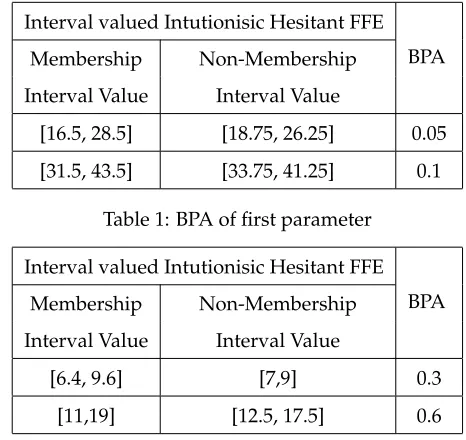
Suppose Basic Probability Assignment of two parameters is assigned by an expert and are given in the following tables.
Interval valued Intutionisic Hesitant FFE
BPA
Membership Non-Membership
Interval Value Interval Value
[16.5, 28.5] [18.75, 26.25] 0.05
[31.5, 43.5] [33.75, 41.25] 0.1
Table 1: BPA of first parameter
Interval valued Intutionisic Hesitant FFE
BPA
Membership Non-Membership
Interval Value Interval Value
[6.4, 9.6] [7,9] 0.3
[11,19] [12.5, 17.5] 0.6
Table 2: BPA of second parameter
6
Addition of Focal Elements
Addition of focal elements using IVITHFE arithmetic gives four focal elements. The corresponding BPA of resulting focal elements are calculated using (4.1) and arranging all the focal elements in increasing order of the left end point are given in the following table.
Hesitant Operators
BPA
S.No ˜h1@˜h2 ˜h1$˜h2 ˜h16= ˜h2 ˜h1∗˜h2
1 [11.45, 19.1] [12.9, 17.6] [10.3, 16.5] [11.5, 15.4] [20.9, 14.4] [10.2, 13.4] [0.1, 0,06] [0.09,0.07] 0.0864
2 [13.8, 23.8] [15.6, 21.9] [13.5, 23.3] [15.3, 21.4] [3.2, 22.8] [15, 21] [0.08, 0,04] [0.07,0.05] 0.1605
3 [19, 26.6] [20.4,25.1] [14.2, 20.4] [15.4, 19.3] [10.6, 15.7] [11.6, 14.8] [0.09, 0,06] [0.08,0.07] 0.0988
4 [21.3, 31.3] [23.1, 29.4] [18.6, 28.7] [20.5,26.9] [16.3, 26.4] [18.2, 24.6] [0.06, 0,04] [0.05,0.04] 0.1728
6.1
Subtraction of Focal Elements
Subtraction of focal elements using IVITHFE arithmetic gives four focal elements. The corresponding BPA of resulting focal elements are calculated using (4.2) and arranging all the focal elements in increasing order of the left end point are given in the following table
Hesitant Operators
BPA
S.No ˜h1@˜h2 ˜h1$˜h2 ˜h16= ˜h2 ˜h1∗˜h2
1 [11.45, 19.1] [12.9, 17.6] [10.3, 16.5] [11.5, 15.4] [20.9, 14.4] [10.2, 13.4] [0.1, 0,06] [0.09,0.07] 0.05
2 [13.8, 23.8] [15.6, 21.9] [13.5, 23.3] [15.3, 21.4] [3.2, 22.8] [15, 21] [0.08, 0,04] [0.07,0.05] 0.0286
3 [19, 26.6] [20.4,25.1] [14.2, 20.4] [15.4, 19.3] [10.6, 15.7] [11.6, 14.8] [0.09, 0,06] [0.08,0.07] 0.1
4 [21.3, 31.3] [23.1, 29.4] [18.6, 28.7] [20.5,26.9] [16.3, 26.4] [18.2, 24.6] [0.06, 0,04] [0.05,0.04] 0.0571
Table 4: BPA of resulting focal elements using algebraic subtraction
6.2
Multiplication of Focal Elements
Multiplication of focal elements using IVITHFE arithmetic gives four focal elements. The corresponding BPA of resulting focal elements are calculated using (4.3) and arranging all the focal elements in increasing order of the left end point are given in the following table
Hesitant Operators
BPA
S.No ˜h1@˜h2 ˜h1$˜h2 ˜h16= ˜h2 ˜h1∗˜h2
1 [11.45, 19.1] [12.9, 17.6] [10.3, 16.5] [11.5, 15.4] [20.9, 14.4] [10.2, 13.4] [0.1, 0,06] [0.09,0.07] 0.0429
2 [13.8, 23.8] [15.6, 21.9] [13.5, 23.3] [15.3, 21.4] [3.2, 22.8] [15, 21] [0.08, 0,04] [0.07,0.05] 0.0857
3 [19, 26.6] [20.4,25.1] [14.2, 20.4] [15.4, 19.3] [10.6, 15.7] [11.6, 14.8] [0.09, 0,06] [0.08,0.07] 0.0857
4 [21.3, 31.3] [23.1, 29.4] [18.6, 28.7] [20.5,26.9] [16.3, 26.4] [18.2, 24.6] [0.06, 0,04] [0.05,0.04] 0.1714
Table 5: BPA of resulting focal elements using algebraic multiplication
6.3
Division of Focal Elements
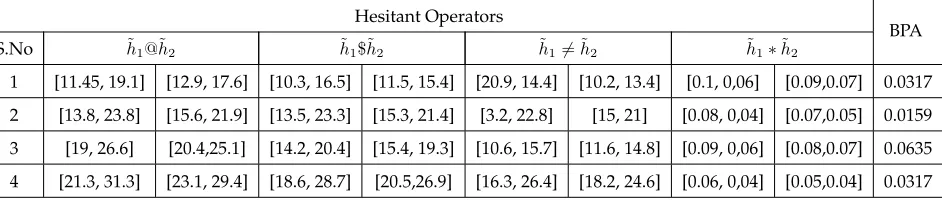
Division of focal elements using IVITHFE arithmetic gives four focal elements. The corresponding BPA of resulting focal elements are calculated using (4.4) and arranging all the focal elements in increasing order of the left end point are given in the following table
Hesitant Operators
BPA
S.No ˜h1@˜h2 ˜h1$˜h2 ˜h16= ˜h2 ˜h1∗˜h2
1 [11.45, 19.1] [12.9, 17.6] [10.3, 16.5] [11.5, 15.4] [20.9, 14.4] [10.2, 13.4] [0.1, 0,06] [0.09,0.07] 0.0317
2 [13.8, 23.8] [15.6, 21.9] [13.5, 23.3] [15.3, 21.4] [3.2, 22.8] [15, 21] [0.08, 0,04] [0.07,0.05] 0.0159
3 [19, 26.6] [20.4,25.1] [14.2, 20.4] [15.4, 19.3] [10.6, 15.7] [11.6, 14.8] [0.09, 0,06] [0.08,0.07] 0.0635
4 [21.3, 31.3] [23.1, 29.4] [18.6, 28.7] [20.5,26.9] [16.3, 26.4] [18.2, 24.6] [0.06, 0,04] [0.05,0.04] 0.0317
Table 6: BPA of resulting focal elements using algebraic division
7
Conclusion
˜
h1∗˜h2 have the significance of simple calculation and high accuracy. Moreover among the four arithmetic
operations on fuzzy focal elements, the more accurate Basic Probability Assignments were obtained under division of fuzzy focal elements using IVITHFFEs.
References
[1] Atanassov K T, Intuitionistic Fuzzy Sets,Fuzzy sets and systems20(1), 1986, pp.87-96.
[2] R.Irene Hebzibah , A.Nagoorgani and G.Geethalakshmi Modified Arithmetic Operations of Focal Elements and their corresponding Basic Probability Assignments in Evidence Theory,Elixir.Appl.Math. 74(2014) 26798-26984.
[3] Said Broumi, Florentin Smarandache, New operations over Interval valued Intuitionistic Hesitant Fuzzy Set,Mathematics and Statistics2(2):62-71,2014.
[4] G.S.Thakur Rekha Thakur Ravi singh, New Hesitant Fuzzy Operators,science Direct, fuzzy inf.Eng.(2014) 6: 379-392.
[5] Torra V, Narukawa Y , On Hesitant Fuzzy Sets and Decision,The 18thIEEE international conference on Fuzzy
Systems, Jeju Island ,Korea,2009,pp. 1378-1382.
[6] Zadeh,L.A., The concept of a Linguistic variable and its applications to approximate Reasoning parts I, II and III,Information sciences, 8 (1975)199-249; 8(1975)301-357; 9(1976),43-80.
[7] Zeshui Xu, Meimei Xia, Distance and similarity measures for hesitant fuzzy sets, ELSEVIER, Information sciences, 181 (2011) 2128-2138.
[8] Zhiming Zhang , Interval Valued Intuitionistic Hesitant Fuzzy Aggregation operators and their
applications in Group Decision Making, Journal of Applied Mathematics 3(2013), Article ID 670285, 33 pages, http://dx.doi.org/10.1155/2013/670285.
Received: July 10, 2015;Accepted: September 13, 2015
UNIVERSITY PRESS