R E S E A R C H A R T I C L E
Open Access
Stem cells in Dentistry: knowledge and attitude
of Nigerian Dentists
Matthew Asizide Sede
1, Ochuwa Audu
2and Clement Chinedu Azodo
3*Abstract
Background:Several controversies exist about the methods of harvesting and eventual utilization of stem cells in Medicine and Dentistry. The objective of the study was to investigate the awareness, attitude and knowledge of the use of stem cells in Dentistry among Nigerian Dentists.
Methods:This descriptive, cross-sectional study was conducted among dentists selected from both private and public health sectors, in some of the major cities in Nigeria.
Results:The majority of the participants were≤35 years in age, male, Pentecostal Christians, possessed a
postgraduate qualification, had practiced for≤5 years and were specialists or specializing. In this study, 153(81.0%) of the participants reported awareness about the use of stem cells in dentistry which was significantly associated with qualification and type of practice. Most of the respondents 114 (60.3%) had a poor knowledge of the use of stem cells in Dentistry. This was significantly associated with type of practice and awareness about stem cell use in dentistry but binary logistic regression showed awareness as the only determinant of knowledge. About three-quarters 142 (75.1%) of the participants exhibited positive attitude towards stem cell use. This had a positive non-significant association with knowledge and reported awareness.
Conclusion:Data from this study revealed a high level of awareness, positive attitude to and poor knowledge of the use of stem cells in Dentistry among a cross section of Nigerian Dentists.
Keywords:Stem cells, Dentistry, Knowledge, Attitude
Background
Stem cells are cells that are capable of self-replication and differentiation into at least two different cell types [1]. The self-renewal characteristics of stem cells enables them to go through numerous cycles of cell division whilst maintaining the undifferentiated state and also the ability to proliferate and differentiate into multiple mature cell types [2]. In theory, stem cells can therefore divide without limit to replenish any other cell type and also function as part of the body’s repair system [3].
There are primarily two types of stem cells namely embryonic stem cells (ESCs) and adult stem cells (ASCs) or somatic stem cells. The embryos from which the hu-man embryonic stem cells are derived are four to five days old - “blastocyst stage” [4] and their use is controversial
due to the need to destroy an embryo to harvest them. Embryonic stem cells are pluripotent and the most versa-tile stem cells with an unlimited capacity to proliferate and differentiate thereby facilitating their attraction as sources of stem cells [5]. However their drawback lies in the likelihood of neoplastic changes, if the proliferation and differentiation of the cells is not carefully controlled. Adult stem cells do not require embryo destruction [6] and are not subject to the ethical controversy that is asso-ciated with embryonic stem cells [7]. Although adult stem cells lack the potency of their embryonic counterparts, they have been used successfully to treat disease. In comparison with embryonic stem cells, adult stem cells possess only multipotent differentiation capacity [8]. Some documented sources of adult stem cells include umbilical cord blood, amniotic fluid, bone marrow, adipose tissue, brain, teeth, skin and urine [9-12].
Stem cells, when directed to differentiate into specific cell types, offer the possibility of a renewable source of * Correspondence:[email protected]
3Department of Periodontics, New Dental Complex, University of Benin
Teaching Hospital, P.M.B. 1111 Ugbowo, Benin-City, Edo State 300001, Nigeria
Full list of author information is available at the end of the article
replacement cells and tissues to treat conditions such as spinal cord injury, stroke, heart disease, diabetes, arth-ritis, radiation-induced tissue damage, Parkinson and Alzheimer’s diseases [13-20]. Stem cells have also shown potentials in reversing the effects of age, offering a pos-sible‘cure’for aging altogether [21]. Stem cells have also been reportedly used to reverse blindness [22] and are currently being investigated for use in the treatment of graft-versus-host disease, Crohn’s and lupus, based on their ability to modulate the immune system [23,24] and in the screening of potential anti-tumor drugs with promising data arising from animal-testing [3].
Dental Stem Cells (DSCs) derived from tooth struc-tures are adult stem cells that have captured the atten-tion of researchers over the past decade [5]. These stem cells are readily accessible and can be obtained and stored for future use through minimally invasive proce-dures [25]. Just as DSCs have the potential for use throughout the body, stem cells from extra-oral sites may be used for regenerating dental tissue [5]. Roots of teeth and periodontal ligaments have been regenerated from dental stem cells [26]. Cells from tooth buds have been differentiated into a small tooth structure and transplanted in vivo [27]. Mesenchymal stem cells from the pulp and the follicle associated with third molars are under investigation for possible dentine [28] and enamel [29] production respectively. Clinical studies have been conducted using stem cells for alveolar ridge augmenta-tion [30,31], reconstrucaugmenta-tion of a resected mandible [32] and generation of a human-shaped temporomandibular joint [33-36].
Despite the well known potentials of stem cell research and therapies in dentistry, several controversies dog the methods of harvesting and eventual utilization of stem cells. Some European Union member states have a restrictive approach on embryonic stem cell research because of religious, cultural and historical reasons [37].
The problems with stem cell use are diverse, including, but not limited to lack of basic knowledge of stem cells, ethical and religious issues concerning their use [37-41] and foremost among them is the moral concern regard-ing embryo destruction [38-41]. Other issues include the possibility of human cloning, the potential exploitation of embryo and egg donors, as well as the questions raised by the new alternative techniques for obtaining stem cells [40].
The field of Dentistry is not spared of these controver-sies and knowledge dearth that envelopes the use of stem cells. A literature search revealed that there is dearth of information relating to the use knowledge of and attitude to the of stem cells in Medicine and Dentistry. A practitioner survey of opinions toward regenerative endodontics in the United States showed that 96% of par-ticipants thought more regenerative therapies should be
incorporated into dental treatments, with findings which suggested that endodontists were supportive and optimis-tic about the future use of regenerative endodonoptimis-tics [42]. The objective of this study was to investigate awareness, attitude and knowledge of the use of stem cells in Dentistry among Nigerian dentists.
Methods
This descriptive, cross-sectional study was conducted among consenting dentists from both private and public health sectors, in randomly selected major cities in the southern part of Nigeria between February and June, 2012. The study protocol was reviewed and approved by the Research and Ethics Committee of University of Benin Teaching Hospital, Benin City, Edo State, Nigeria. Using the Cochran (1977) [43] statistical formula, the mini-mum sample size was calculated, but a 10% was added to amount for non response and incomplete questionnaires giving a total of 191 but 200 dentists were finally recruited for this study.
The survey was carried out using a self-administered, anonymous, twenty nine item, structured, hand and mail-delivered questionnaire. The questionnaire was pretested amongst selected dentists before the study commenced, to identify any problem areas in the questionnaire and to make appropriate alterations, as adjudged necessary. The content validity was confirmed from an in-depth literature search and a review of different questions asked in several continuing dental education end of course assessments which were accessed on the internet. The questionnaire was divided into three broad sections:
Section A
Questions here were close-ended and dealt with socio-demographic variables, awareness and sources of informa-tion of stem cell use in Dentistry. The socio-demographic variables included age, gender, religion, field of practice, number of years in practice, designation and highest professional qualification.
Section B
Here, structured questions were used to assess the gene-ral knowledge of stem cells- their characteristics, types, potency, plasticity, general sources, dental sources and potential uses in dentistry. Two questions were included to elicit the knowledge of ethical problems surrounding stem cell use and stem cell banking respectively.
Section C
This section was made up of twelve items and a four-point Likert scale (“strongly agree”, “agree”, “disagree” and “strongly disagree”) was used to assess the response of the participants as regard their attitude to the use of stem cells in Dentistry. Opinions expressed were drawn from several articles, journals and internet blogs which dealt with the controversial and sensitive issues sur-rounding stem cell collection, utilization and human cloning. These issues revolved around ethics, morality and the moral status of the embryo, religion, motives, trust and fear. The negative opinions were intermingled with the positive ones, to give room for a wide range of attitudes to be expressed.
Data from questionnaires were manually scored and graded, coded and finally entered into Statistical Package for Social Sciences (SPSS) version 16.0 for data analysis. All data collected was subjected to descriptive and infer-ential statistics to generate frequencies, percentages and Chi-square values at a significance of P < 0.05. Logistic regression was also performed on the collated data to ascertain the determinant of knowledge regarding stem cells among the participants.
The knowledge section was graded in the range of zero (0) to thirty three (33), with 0–11 being poor know-ledge, 12–22, being fair knowledge and 23–33 good knowledge. A total of twelve questions measured atti-tude to stem cell use in the questionnaire. Scoring for each question was a maximum score of four (4) and minimum score of one (1) giving a cumulative minimum score of twelve (12) and maximum score of forty-eight (48). A score of 12–30 indicated an overall negative atti-tude while a score of 31–48 indicated an overall positive attitude to stem cell research and therapy.
Results
The majority of the participants were 35 years old or less, male, Pentecostal Christians possessed an additional postgraduate qualification, had practiced for 5 years or less and were specialists or specializing (Table 1). About one-third of the participants were non-specialist. Oral and Maxillofacial Surgery, Orthodontics, Restorative and Oral Pathology were the four leading fields of practice among participants that were specialist or specializing (Table 2).
The leading source of information regarding stem cells was conference/symposium/seminar among 67 (43.8%) of the participants while mass media 14 (9.2%) was the least source of information (Figure 1). Most of the respondents, 114 (60.3%) had poor knowledge about the use of stem cells in dentistry.
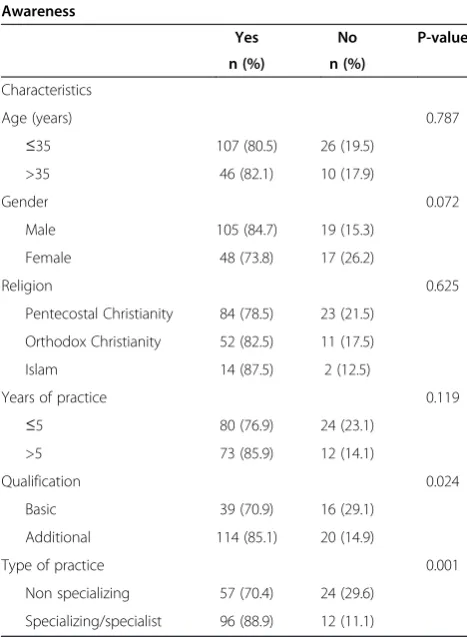
In this study, awareness about stem cell use in dentistry was reported by 153 (81.0%) of the participants. This awareness was found to be higher among older participants
(aged >35 years), muslim, males participants, more experi-enced in terms of years of practice (>5 years), those that possessed postgraduate qualification and those participants who were specialist or specializing. However, it was only qualification (P = 0.024) and type of practice (P = 0.001) that were significantly associated with awareness about stem cell use in dentistry (Table 3).
Table 1 Demographic characteristics of the participants
Characteristics Frequency Percent
Age (years)
≤35 133 70.4
>35 56 29.6
Gender
Male 124 65.6
Female 65 34.4
Religion
Pentecostal Christianity 107 56.6
Orthodox Christianity 63 33.3
Islam 16 8.5
Unspecified 3 1.6
Qualification
Basic 55 29.1
Additional 134 70.9
Years of experience
≤5 104 55.0
>5 85 45.0
Type of practice
Non specializing 81 42.9
Specializing/specialist 108 57.1
Total 189 100.0
Table 2 Field of practice among the participants
Field Frequency Percent
Non specialist 67 35.4
Oral & maxillofacial surgery 37 19.6
Orthodontics 18 9.5
Restorative 15 7.9
Oral pathology 15 7.9
Community dentistry 11 5.8
Prosthodontics 8 4.2
Oral medicine 8 4.2
Pediatric dentistry 7 3.7
Periodontology 3 1.6
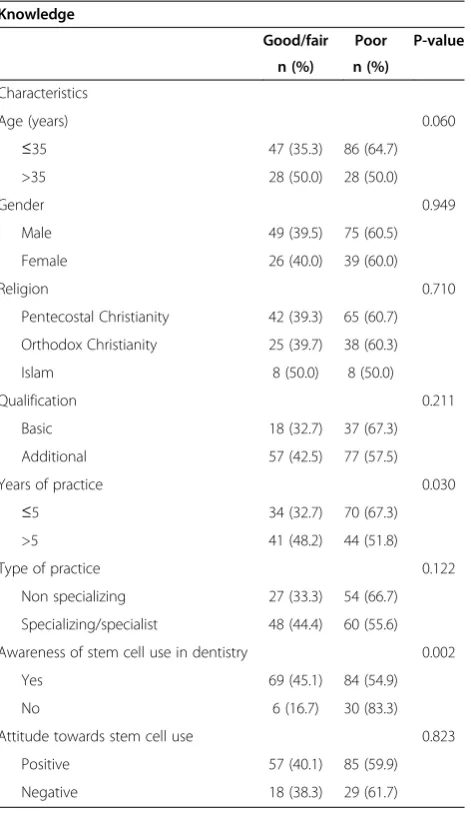
The knowledge about the use of stem cells in dentistry was higher among the older (aged >35 years), muslim, female participants, who were more experienced in terms of years of practice (>5 years). Those who pos-sessed a postgraduate qualification and were specialists or in the process of specializing, reported awareness about the use of stem cells in dentistry and expressed positive attitudes towards the use of stem cells. However, it was the type of practice (P = 0.030) and awareness about the use of stem cells in dentistry (P = 0.002) that were significantly associated with knowledge of the use of stem cells (Table 4).
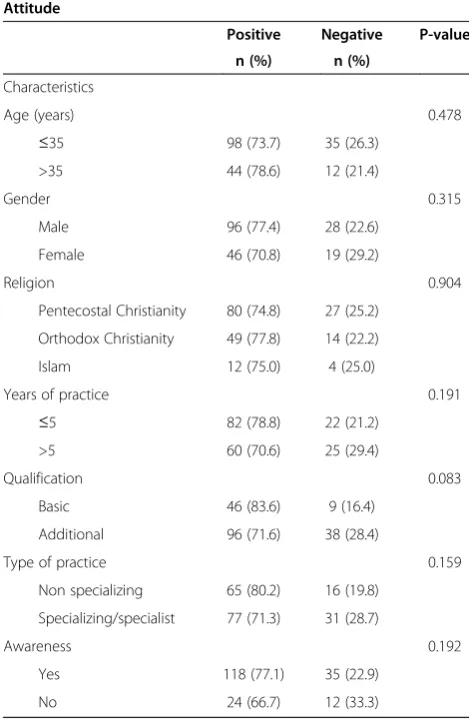
Logistic regression showed that awareness was the only determinant of knowledge about the use of stem cells. The participants who reported awareness about use of stem cells in dentistry had more knowledge about stem cell use (P = 0.003) (Table 5). About three-quarters-142 (75.1%) of the participants exhibited a positive attitude towards stem cell use. There was a non significant associ-ation between attitude towards the use of stem cells with age, gender, religion, years of practice, qualification, type of practice and awareness about the use of stem cells in dentistry (Table 6).
Discussion
In this study, the majority of the participants were aged 35 years or less, male, Pentecostal Christians, possessed additional postgraduate qualification(s), had practiced for 5 years or less and were specialist or specializing which reflected the dominant status of actively prac-ticing dentists in the major cities in the Southern part of
Figure 1Sources of information regarding stem cell among the participants.
Table 3 Awareness concerning stem cell use in dentistry among the participants
Awareness
Yes No P-value
n (%) n (%)
Characteristics
Age (years) 0.787
≤35 107 (80.5) 26 (19.5)
>35 46 (82.1) 10 (17.9)
Gender 0.072
Male 105 (84.7) 19 (15.3)
Female 48 (73.8) 17 (26.2)
Religion 0.625
Pentecostal Christianity 84 (78.5) 23 (21.5)
Orthodox Christianity 52 (82.5) 11 (17.5)
Islam 14 (87.5) 2 (12.5)
Years of practice 0.119
≤5 80 (76.9) 24 (23.1)
>5 73 (85.9) 12 (14.1)
Qualification 0.024
Basic 39 (70.9) 16 (29.1)
Additional 114 (85.1) 20 (14.9)
Type of practice 0.001
Non specializing 57 (70.4) 24 (29.6)
Nigeria. The increased specialist training opportunity due to the opening of new dental schools and the im-provement in the remuneration of specializing doctors in Nigeria in recent times may have been the attraction thereby increasing the number of dental specialists or specializing dentists reported in this study. Oral and Maxillofacial Surgery was the leading field of practice among participants that are specialist or specializing. The leading specialty reported in this study is in tandem with findings of studies on career choices among Nigerian dental students [44].
In Dentistry, stem cells have the potential of providing permanent cures for all lesions of pulpal or periodontal origins. Congenital and acquired intra and extra-oral soft and hard tissue defects could also be effectively managed
or treated with stem-cell based approaches and future tooth replacements in the form of ‘a new natural tooth’ now seem like a possibility.
In this study, awareness of the use of stem cells in dentistry was reported by 153 (81.0%) of the partici-pants. This awareness about the use of stem cells in den-tistry was higher among the older muslim and male participants (aged >35 years), who were more experi-enced in terms of years of practice (>5 years), those that possessed a postgraduate qualification and those partici-pants who were specialist or in the process of specializing. However it was essentially qualification and type of prac-tice that were significantly associated with awareness about stem cell use in dentistry. These findings can be explained by the fact that conference/symposium/seminar, postgraduate training, internet and journals (the leading sources of information regarding stem cells among the participants) are the dominant mode of learning among those participants who are specialist or specializing and had an additional postgraduate qualification. The low con-tribution of undergraduate training to awareness explained why awareness about stem cell use in dentistry was higher
Table 5 Determinants of knowledge about stem cell among the participants
Characteristics O.D 95% C.I P-value
Age (years)
≤35 1 -
->35 0.657 0.289-1.496 0.317
Gender
Male 1 -
-Female 0.852 0.442-1.643 0.633
Religion
Islam 1 -
-Pentecostal Christianity 0.750 0.235- 2.394 0.627
Orthodox Christianity 0.941 0.482-1.837 0.858
Qualification
Basic 1 -
-Additional 0.866 0.370-2.162 0.757
Years of practice
≤5 1 -
->5 0.713 0.347-1.683 0.440
Type of practice
Non specializing 1 -
-Specializing/specialist 1.122 0.448-2.808 0.806
Awareness about stem cell use in dentistry
No 1 -
-Yes 0.235 0.089-0.617 0.003
Table 4 Knowledge about stem cell among the participants
Knowledge
Good/fair Poor P-value
n (%) n (%)
Characteristics
Age (years) 0.060
≤35 47 (35.3) 86 (64.7)
>35 28 (50.0) 28 (50.0)
Gender 0.949
Male 49 (39.5) 75 (60.5)
Female 26 (40.0) 39 (60.0)
Religion 0.710
Pentecostal Christianity 42 (39.3) 65 (60.7)
Orthodox Christianity 25 (39.7) 38 (60.3)
Islam 8 (50.0) 8 (50.0)
Qualification 0.211
Basic 18 (32.7) 37 (67.3)
Additional 57 (42.5) 77 (57.5)
Years of practice 0.030
≤5 34 (32.7) 70 (67.3)
>5 41 (48.2) 44 (51.8)
Type of practice 0.122
Non specializing 27 (33.3) 54 (66.7)
Specializing/specialist 48 (44.4) 60 (55.6)
Awareness of stem cell use in dentistry 0.002
Yes 69 (45.1) 84 (54.9)
No 6 (16.7) 30 (83.3)
Attitude towards stem cell use 0.823
Positive 57 (40.1) 85 (59.9)
among older participants (aged >35 years) and participants more experienced in terms of years of practice (>5 years). The higher awareness about use of stem cells in dentis-try among males may be explained in two folds. Firstly, it may be due to the dominance of males in postgradu-ate training. Secondly, the grepostgradu-ater information seeking ability characteristics of males due to their attribution of success to external causes in comparison to females leads to their conference/symposium/seminar attend-ance [45].
An overall good/fair knowledge about the stem cells in the study was noted among 75 (39.7%) of the partici-pants. This overall good/fair knowledge about the use of stem cells was significantly higher among specialist or those specializing and participants that reported aware-ness about use of stem cell in dentistry; a binary logistic regression showed that awareness was the only deter-minant of knowledge about the use of stem cells. The positive effects of awareness about issues on knowledge
have been consistently reported [46] thereby explaining the effect of awareness on knowledge in this study as variables on higher awareness except for gender were same for knowledge about stem cells. Gender differences were found to be in the knowledge distribution, with females having more fair/good knowledge about stem cells despite lower awareness of the use of stem cells in dentistry may be linked with the fact that female dentists have higher tendencies to accept and pay more attention to details in new trends while males are more likely to resist them thereby lessening their overall knowledge. The reported male preference for rational evaluation and logical learning style compared to female elaborative processing learning style may be a contributory expla-nation [47].
In this study, three-quarters 142 (75.1%) of the partic-ipants exhibited a positive attitude towards stem cell use. Similarly, a recent study [48] among a group of dental residents in the United States of America re-vealed considerable support for stem use in dentistry though with some reservation about the possible health hazards. This high level of positive attitude can be explained by the high level of awareness about stem cell noted in this study. This is based on the fact that expressed positive attitude to stem cell had a positive non-significant association with knowledge about stem cell and reported awareness about stem cell use in dentistry.
Religious reservations concerning stem cell use have been documented in the literature [37,40,41]. However, religion was not a stable and significant factor in this study because a more positive attitude towards stem cell was found among orthodox Christians meanwhile a non-statistically significant higher awareness and an overall fair/good knowledge was found among Muslim participants. The high awareness, poor knowledge and positive attitude towards stem cell use may be respon-sible for this finding. The handling of religious issues with care among professionals in comparison with the general public may be contributory.
Conclusion
Data from this study revealed a high level of awareness, positive attitude to and poor knowledge of the use of stem cells in Dentistry among a cross section of Nigerian Dentists. Awareness about the use of stem cells in dentistry was a significant determinant of knowledge about the use of stem cells in this study. The im-provement of knowledge about the use of stem cells in dentistry is achievable through heightened aware-ness creation on the issue. It can also be concluded that the use of stem cells in dentistry is acceptable to Nigerian Dentists.
Table 6 Attitude towards stem cell application among the participants
Attitude
Positive Negative P-value
n (%) n (%)
Characteristics
Age (years) 0.478
≤35 98 (73.7) 35 (26.3)
>35 44 (78.6) 12 (21.4)
Gender 0.315
Male 96 (77.4) 28 (22.6)
Female 46 (70.8) 19 (29.2)
Religion 0.904
Pentecostal Christianity 80 (74.8) 27 (25.2)
Orthodox Christianity 49 (77.8) 14 (22.2)
Islam 12 (75.0) 4 (25.0)
Years of practice 0.191
≤5 82 (78.8) 22 (21.2)
>5 60 (70.6) 25 (29.4)
Qualification 0.083
Basic 46 (83.6) 9 (16.4)
Additional 96 (71.6) 38 (28.4)
Type of practice 0.159
Non specializing 65 (80.2) 16 (19.8)
Specializing/specialist 77 (71.3) 31 (28.7)
Awareness 0.192
Yes 118 (77.1) 35 (22.9)
Competing interests
The authors declare that they have no competing interests.
Authors’contributions
SMA conceived the study, participated in its design and coordination, and helped to draft the manuscript. OA made substantial contributions to conception and design, acquisition of data and helped to draft the manuscript. ACC contributed substantially to design, data analysis and interpretation and helped to draft the manuscript. All authors read and approved the final manuscript.
Author details
1Department of Restorative Dentistry, University of Benin, Benin-City, Nigeria. 2Department of Restorative Dentistry, University of Benin Teaching Hospital,
Benin-City, Nigeria.3Department of Periodontics, New Dental Complex, University of Benin Teaching Hospital, P.M.B. 1111 Ugbowo, Benin-City, Edo State 300001, Nigeria.
Received: 18 December 2012 Accepted: 7 June 2013 Published: 15 June 2013
References
1. Mao JJ:Stem cells and the future of dental care.NY State Dent J2008, 74(2):20–24.
2. Friedlander LT, Cullinan MP, Love RM:Dental stem cells and their potential role in apexogenesis and apexification.Int Endod J2009,42:955–962. 3. National Institute of Health Resource for Stem Cell Research.http://stemcells.
nih.gov/info/basics/pages/basics1.aspx. Accessed on 8/8/2012. 4. Sandhu SS, Nair M:Stem cells: potential implications for tooth
regeneration and tissue engineering in dental science.People J Sci Res 2009,2(1):41–45.
5. Majeski J:Dental stem cells in research and practice.Access2009, 26:24–26.
6. Schneegans:Teeth will help to shape the future of stem cell research. World Sci2008,6(3):16–17.
7. Mao JJ, Collins FM:Stem cells: Sources, therapies and the dental professional.http:// www.ineedce.com/courses/1486/PDF/StemCells.pdf. Accessed on 8/7/2012. 8. Lin NH, Gronthos S, Bartold PM:Stem cells and periodontal regeneration.
Aust Dent J2008,53:108–121.
9. Gronthos S, Mankani M, Brahim J, Robey PG, Shi S:Postnatal human dental pulp stem cells (DPSCs) in vitro and in vivo.Proc Natl Acad Sci USA2000, 97:13625–13630.
10. Pittenger MF, Mackay AM, Beck SC, Jaiswal RK, Douglas R, Mosca JD, Moorman MA, Simonetti DW, Craig S, Marshak DR:Multilineage potential of adult human mesenchymal stem cells.Sci1999,284:143–147. 11. Avasthi A:Human Skin Cells Given Stem Cell Properties.http://news.
nationalgeographic.com/news/2007/11/071120-stem-cells.html. Accessed on 10/7/2012.
12. Bharadwaj S, Liu G, Shi Y, Markert C, Andersson KE, Atala A, Zhang Y: Characterization of urine-derived stem cells obtained from upper urinary tract for use in cell-based urological tissue engineering.Tissue Eng Part A 2011,17(15-16):2123–32.
13. Perrier AL, Tabar V, Barberi T, Rubio ME, Bruses J, Topf N, Harrison NL, Studer L: Derivation of midbrain dopamine neurons from human embryonic stem cells.Proc Natl Acad Sci USA2004,101(34):125434–125438.
14. Neural stem cells offer potential treatment for Alzheimer's disease.Available from: http://phys.org/news167330309.html. Accessed on 07/08/2012. 15. Nosrat IV, Widenfalk J, Olson L, Nosrat CA:Dental pulp cells produce
neurotrophic factors, interact with trigeminal neurons in vitro, and rescue motorneurons after spinal cord injury.Dev Biol2001,238:120–132. 16. Chopp M, Li Y:Treatment of neural injury with marrow stromal cells.
Lancet Neurol2002,1:92–100.
17. Heng BC, Haider HK, Sim EK, Cao T, Ng SC:Strategies for directing the differentiation of stem cells into cardiomyogenic lineage in vitro. Cardiovasc Res2004,62:34–42.
18. Rosa SB, Voltarelli JC, Chies JA, Pranke P:The use of stem cells for the treatment of autoimmune diseases.Braz J Med Biol Res2007, 40:1579–1597.
19. Burt RK, Oyama Y, Verda L, Quigley K, Brush M, Yaung K, Statkute L, Traynor A, Barr WG:Induction of remission of severe and refractory rheumatoid
arthritis by allogeneic mixed chimerism.Arthritis Rheum2004, 50:2466–2470.
20. Mouiseddine M, François S, Semont A, Sache A, Allenet B, Mathieu N, Frick J, Thierry D, Chapel A:Human mesenchymal stem cells home specifically to radiation-injured tissues in a non-obese diabetes/severe combined immunodeficiency mouse model.Br J Radiol2007,80(1):S49–S55. 21. Pillai P:Advantages and Disadvantages of Stem Cell.Avaiable from: http://
www.buzzle.com/articles/advantages-and-disadvantages-of-stem-cell-research.html. Accessed 12/8/2012.
22. Corradini F, Venturi B, Pellegrini G, De Luca M:Methods for
characterization/manipulation of human corneal stem cells and their applications in regenerative medicine.Methods Mol Biol2012,916:357–372. 23. Barry FP, Murphy JM:Mesenchymal stem cells: clinical applications and
biological characterization.Int J Biochem Cell Biol2004,36(4):568–584. 24. Smith-Berdan S, Gille D, Weissman IL, Christensen JL:Reversal of
autoimmune disease in lupus-prone New Zealand black/New Zealand white mice by non-myeloablative transplantation of purified allogeneic hematopoietic stem cells.Blood2007,110(4):1370–1378.
25. Freund BG:D-Stem Cells and Dentistry: answers to seven questions. Available from: http://www.dentistryiq.com/articles/2011/07/stem-cells-and-dentistry-answers-to-seven-questions.html. Accessed 12/8/2012.
26. Shi S, Chai Y, Slavkin H:Emerging opportunities for the next generation of dental implants?Dent Today2009,28(3):98–99.
27. Duailibi MT, Duailibi SE, Young CS, Bartlett JD, Vacanti JP, Yelick PC: Bioengineered teeth from cultured rat tooth bud cells.J Dent Res2004, 83(7):523–528.
28. Iohara K, Nakashima M, Ito M, Ishikawa M, Nakasima A, Akamire A:Dentin regeneration by dental pulp stem cell therapy with recombinant human bone morphogenetic protein 2.J Dent Res2004,83(8):590–595. 29. Young CS, Terada S, Vacanti JP, Honda M, Bartlett JD,et al:Tissue
engineering of complex tooth structures on biodegradable polymer scaffolds.J Dent2002,81(10):695–700.
30. Ueda M, Yamada Y, Ozawa R, Okazaki Y:Clinical case reports of injectable tissue-engineered bone for alveolar augmentation with simultaneous implant placement.Int J Periodontics Restorative Dent2005,25(2):129–137. 31. Hibi H, Yamada Y, Ueda M, Endo Y:Alveolar cleft osteoplasty using
tissue-engineered osteogenic material.Int J Oral MaxillofacSurg2006, 35:551–555.
32. Mankani MH, Krebsbach PH, Satomura K, Kuznetsov SA, Hoyt R, Robey PG: Pedicled bone flap formation using transplanted bone marrow stromal cells.Arch Surg2001,136:263–270.
33. Marion NW, Mao JJ:Mesenchymal stem cells and tissue engineering. Methods Enzymol2006,420:339–361.
34. Troken A, Marion N, Hollister S, Mao J:Tissue engineering of the synovial joint: the role of cell density.Proc Inst Mech Eng [H]2007,221(5):429–440. 35. Alhadlaq A, Mao JJ:Tissue-engineered neogenesis of human-shaped
mandibular condyle from rat mesenchymal stem cells.J Dent Res2003, 82(12):951–956.
36. Alhadlaq A, Mao JJ:Tissue engineered osteochondral constructs in the shape of an articular condyle.J Bone Jt Surg AM2005,87:936–944. 37. Rare Disease Patients’Perspective on Embryonic Stem Cell Research and
Therapy.September, 2006. Available from: http://www.eurordis.org/ publication/embryonic-stem-cell-research-and-therapy. Accessed on 28/7/2012.
38. Ali KH, Williams DL, Jackson P, Pau HP:Attitudes of the UK ear, nose and throat clinical community to the future potential use of stem cell therapies to treat deafness.Regen Med2012,7(2):179–186.
39. Witherspoon Council on Ethics and the Integrity of Science:Ethical considerations regarding stem cell research.The New Atlantis2012,1(34): 98–113.
40. Lo B, Parham L:Ethical Issues in Stem Cell Research.Endocr Rev2009, 30(3):204–213.
41. Tompkins A, Thomson J:Stem Cell Research- Clinical Decision Making.http:// www.qualitylifemassage.com/userfiles/Ethics-Stem%20Cell%20Research% 281%29.pdf. Accessed on 15/8/2012.
42. Epelman I, Murray PE, Garcia-Godoy F, Kuttler S, Namerow KN:A practitioner survey of opinions toward regenerative endodontics. J Endod2009,9:1204–1210.
43. Cochran WG:Sampling Techniques.3rd edition. New York: John Wiley and Sons; 1977:190–205.
45. Grollino E, Velayo RS:Gender differences in the attribution of internal success among college students.Philadelphia, PA: Annual Convention of the Eastern Psychological Association; 1996:1–12.
46. Prue CE, Hammer HC, Flores AL:Effects of folic acid awareness on knowledge and consumption for the prevention of birth defects among Hispanic women in several U.S Communities.J Womens Health (Larchmt) 2010,19(4):689–89.
47. Lie LY, Angelique L, Cheong E:How do male and female students approach learning at NUS?CDTL Brief2004,7:1–3.
48. Manguno C, Murray PE, Howard C, Madras J, Mangan S, Namerow KN:A survey of dental residents' expectations for regenerative endodontics. J Endod2012,38(2):137–143.
doi:10.1186/1472-6831-13-27
Cite this article as:Sedeet al.:Stem cells in Dentistry: knowledge and attitude of Nigerian Dentists.BMC Oral Health201313:27.
Submit your next manuscript to BioMed Central and take full advantage of:
• Convenient online submission
• Thorough peer review
• No space constraints or color figure charges
• Immediate publication on acceptance
• Inclusion in PubMed, CAS, Scopus and Google Scholar
• Research which is freely available for redistribution