December 7, 2017
Registered Dietitian
Nutritionist Confidence and
Competence to Promote and
Support Breastfeeding:
A Report on Survey Findings
Charlotte J. Zuber
MPH/RD Candidate, Fall 2017
DEPARTMENT OF NUTRITION1
Table of Contents
Introduction ... 2
(Figure 1) AND Breastfeeding Promotion and Support Competencies ... 3
Methods ... 4
Participants and Survey Distribution ... 4
Survey Description ... 5
(Figure 2) AND Competencies and Survey Competency Questions ... 5
Analysis ... 7
Results ... 7
Demographics ... 7
(Table 1) State of Practice ... 8
(Table 2) Area of Practice ... 9
(Table 3) Frequency of Interaction with MCH Population ... 9
(Table 4) Years of Practice ... 10
Overall Confidence ... 10
(Table 5) Confidence to Provide Breastfeeding Education ... 11
(Figure 3) Help with Confidence Bar Graph ... 12
Skill-based Competencies ... 12
(Table 6) Skill-Based Competencies ... 13
(Figure 4) Competency Likert Scale Frequency Bar Graph ... 14
Action-based Competencies ... 14
(Table 7a-c) Action-based ... 15
(Figure 5) RDN Participation in Organization Pie Charts ... 16
Discussion ... 17
Evaluation ... 19
Implications and Recommendations ... 20
Conclusion ... 21
References ... 22
Appendix A: Additional Tables and Figures ... 23
2 Introduction
Breastmilk is widely recognized as the ideal choice for infants because of its tailored nutrient
composition and immunological protection and anti-inflammatory properties1. In comparison, infants who are not breastfed are associated with having excess health risks such as acute ear infection, gastrointestinal infections, Type 2 diabetes mellitus, and sudden infant death syndrome (SIDS).1 Because of the studied benefits for both baby and mother, breastfeeding is also touted as a key strategy to improving overall public health. According to the 2016 CDC Breastfeeding Report Card, 81.1% of infants are breastfed, but this number sharply declines to 22.3% when considering exclusivity of breastfeeding through the recommended timeframe of six months.2 In addition, strong racial
disparities are apparent for breastfeeding. While white mothers report numbers similar to the national average, only 64.3% of African American mothers reported initiation and 14% were exclusively
breastfeeding through six months.3 Hispanic mothers report higher initiation of breastfeeding (81.9%) but those who exclusively breastfed through six months was 18.2%.3 Part of this low success rate is thought to be due to a lack of support in healthcare and in the communities where mothers live.2 Registered Dietitian Nutritionists (RDNs) alongside other healthcare professionals are necessary actors to the protection, promotion, and support of breastfeeding.2
In 2011, the Surgeon General issued a Call to Action to Support Breastfeeding, imploring all healthcare providers who work with women and children to demonstrate competence to support lactation and breastfeeding.1 Suggestions for achieving this included improving breastfeeding content in both undergraduate and graduate level curricula for health professionals, building required breastfeeding competencies into credentialing or licensure processes, and also increasing continuing education options on the topics of lactation and breastfeeding to maintain and update practitioner skills in
breastfeeding support.1 In 2015, the Academy of Nutrition and Dietetics (AND) spoke to the importance of supporting and promoting breastfeeding from the perspective of the nutrition professional in a position statement.4 The AND outlined specific nutrition considerations to the field of breastfeeding such as the composition of human milk and the role of RDs in counseling prenatal women with gestational diabetes. The Position paper also discussed the public health implications of breastfeeding such as the maternal and infant health outcomes of breastfeeding and the risks of choosing not to breastfeed for both mothers and infants. Other important public health considerations included the social determinants to accessing breastfeeding support and self-efficacy in perceived insufficient milk supply in more vulnerable groups.4 The Academy published an accompanying practice paper on
3 promoting and supporting breastfeeding which presents and describes ten competencies that all RDNs should possess as a minimum level of basic knowledge, skills and attitudes to support and promote breastfeeding families and ensure adequate patient care(see Figure 1).5 This list of
competencies was created with the intention to address the Surgeon General Call to Action and was based on the United States Breastfeeding Committee’s Core Competencies in Breastfeeding Care and Services for All Health
Professionals.1,5,6 The practice paper articulates that RDNs are likely to encounter and impact breastfeeding families in many different settings; in both acute and ambulatory settings, public health sectors, and even at the population level with research and policy work.5
Studies from the 1990s suggested that dietitians have interest and tend to strongly support breastfeeding, but are largely unused resources for hospital maternity wards.7, 8 A maternity care survey of 390 nurses in Utah asked participants to indicate which health providers from a list of six would be likely to offer practical breastfeeding advice or assistance.7 Only 2% of surveyed nurses reported that a dietitian may offer advice and 1.6% agreed that dietitians may offer assistance. The participants ranked the staff nurse as the top provider of care for practical breastfeeding assistance.7 A separate study published in 1993 found that RDNs had more knowledge and interest than nurses and doctors when evaluated on a knowledge and attitudes questionnaire.8 289 participating dietitians, nurses and doctors worked in the public health sector and served WIC patients. On a scale of 100, dietitians scored 79.6 on knowledge and 78.6 on attitude while nurses scored 73 and 74.5 and doctors scored 75.5 and 70.2,
respectively.8 The study also found knowledge deficits on the 1) Demonstrate understanding of:
a. anatomy and physiology of the lactating breast and milk production
b. the importance of exclusive breastfeeding for the first 6 months and continued breastfeeding until at least 12 months of age
c. the role of breastfeeding and human milk in maintaining health and disease prevention 2) Assess:
a. infant nutritional status by obtaining a detailed infant nutrition history b. infant growth patterns with an
understanding that normal growth is based on the healthy, breastfed infant
c. maternal nutritional status and health history including pregnancy weight gain and current dietary intake
3) Provide:
a. families with evidence-based information on breastfeeding and human lactation
b. anticipatory guidance for normal infant nutrition including recognizing early infant feeding cues and progression of feeding behavior
c. evidence-based information on maternal nutrition
4) Utilize effective education and counseling skills in a culturally competent manner 5) Evaluate challenges to breastfeeding and
develop strategies for improvement
6) Plan and implement nutrition interventions to support the breastfeeding family
7) Recognize when to refer to an International Board Certified Lactation Consultant for complex breastfeeding problems
8) Participate in professional organizations that support breastfeeding
9) Establish collaborative relationships with other health professionals to support breastfeeding
10) Demonstrate ethical behavior when dealing with companies
FIGURE 1: RECOMMENDED BREASTFEEDING COMPETENCIES BY THE ACADEMY OF NUTRITION AND DIETETICS FOR RDNS AND DTRS OUTLINED IN THE AND PRACTICE PAPER TO SUPPORT AND PROMOTE BREASTFEEDING (REFERENCE 5)
4 subjects of weight loss, birth control during lactation and treatment advice for mastitis between the three groups of professionals.8 Both studies concluded that the knowledge gaps in counseling breastfeeding families can be improved by increasing the education in standard dietetics training programs.7,8 A recent policy insight article detailed the continued absence of lactation education and training in nutrition and dietetics programs in the U.S.9 The article cited that the Accrediting Council for Education in Nutrition and Dietetics (ACEND) does not currently list lactation education in its
competency guidelines for undergraduate or graduate programs in dietetics.9
The current study is needed to assess the confidence and competence levels of RDNs from many diverse areas of practice to see if they feel adequately trained with basic knowledge in lactation and
breastfeeding to support breastfeeding families. To date, no existing study has investigated the
confidence of practicing RDNs and their perceived preparedness to support breastfeeding families based upon the 2015 AND practice paper competencies. It is of great importance to understand whether the nutrition professional workforce is adequately prepared and confident in their abilities to support breastfeeding families. This report will discuss findings from a recent survey and implications for future work in the field of dietetics to build a nutrition professional workforce that is both confident and competent in breastfeeding promotion and support.
Methods
Participants and Survey Distribution
Participants in the survey were practicing Registered Dietitian Nutritionists in the United States. RDNs of any practice area were encouraged to participate in the survey, in an attempt to capture the range of confidence and competence, even for those RDNs who are unaccustomed to counseling women of childbearing age or families with young children. Exclusions included RDNs who indicated that they practice outside of the U.S. and persons without the RDN credential. The survey link was distributed through professional network contacts and social media, and participants were encouraged to share the survey with their own respective networks. The study-initiated routes of recruitment included:
Facebook, LinkedIn, The Carolina Global Breastfeeding Institute quarterly newsletter (September 2017), two regional Dietetic Associations (Raleigh, NC and Jacksonville, FL), two dietetic student alumni
5 nutrition office (NC), one county health department (Wake), and one dietetics hospital staff (WakeMed Hospital in Raleigh, NC).
Survey Description
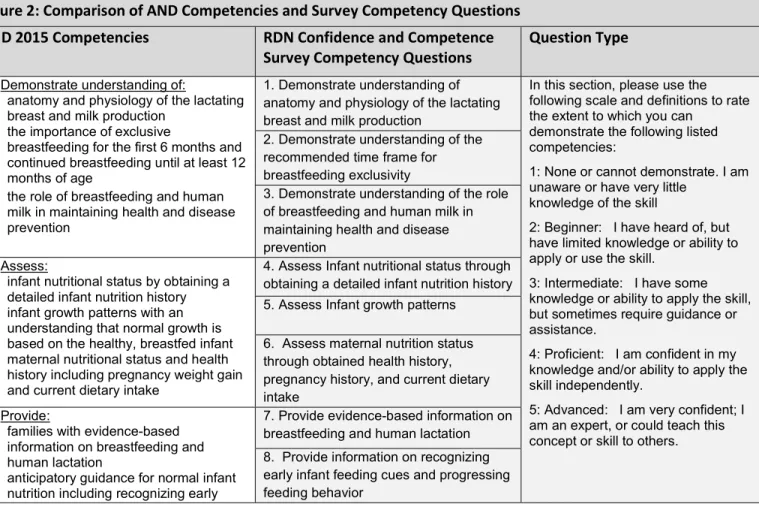
A one-time online survey with both quantitative and qualitative survey questions was developed to assess confidence and competence of RDNs. The survey contained one question on overall confidence in providing breastfeeding education, one question on strategies to help RDNs feel more confident in providing breastfeeding education, and 19 questions on specific breastfeeding competencies, as outlined in the AND position and practice papers. To avoid misunderstandings regarding the scope of practice for RDNs versus credentialed lactation support specialists, such as IBCLCs, confidence was asked in terms of providing “education on breastfeeding” rather than providing “breastfeeding support.” “Confidence” and “Competence” were self-reported by participants. Competency questions were derived from the ten competencies outlined in the 2015 Academy of Nutrition and Dietetics Practice Paper on Promoting and Supporting Breastfeeding. See Figure 2 for a comparison of the AND
competencies and corresponding survey competency questions. For full survey script, see Appendix B. Figure 2: Comparison of AND Competencies and Survey Competency Questions
AND 2015 Competencies RDN Confidence and Competence Survey Competency Questions
Question Type
1) Demonstrate understanding of:
a. anatomy and physiology of the lactating breast and milk production
b. the importance of exclusive
breastfeeding for the first 6 months and continued breastfeeding until at least 12 months of age
c. the role of breastfeeding and human milk in maintaining health and disease prevention
1. Demonstrate understanding of anatomy and physiology of the lactating breast and milk production
In this section, please use the following scale and definitions to rate the extent to which you can
demonstrate the following listed competencies:
1: None or cannot demonstrate. I am unaware or have very little
knowledge of the skill
2: Beginner: I have heard of, but have limited knowledge or ability to apply or use the skill.
3: Intermediate: I have some knowledge or ability to apply the skill, but sometimes require guidance or assistance.
4: Proficient: I am confident in my knowledge and/or ability to apply the skill independently.
5: Advanced: I am very confident; I am an expert, or could teach this concept or skill to others. 2. Demonstrate understanding of the
recommended time frame for breastfeeding exclusivity
3. Demonstrate understanding of the role of breastfeeding and human milk in maintaining health and disease prevention
2) Assess:
a. infant nutritional status by obtaining a detailed infant nutrition history b. infant growth patterns with an
understanding that normal growth is based on the healthy, breastfed infant c. maternal nutritional status and health
history including pregnancy weight gain and current dietary intake
4. Assess Infant nutritional status through obtaining a detailed infant nutrition history 5. Assess Infant growth patterns
6. Assess maternal nutrition status through obtained health history, pregnancy history, and current dietary intake
3) Provide:
a. families with evidence-based information on breastfeeding and human lactation
b. anticipatory guidance for normal infant nutrition including recognizing early
7. Provide evidence-based information on breastfeeding and human lactation 8. Provide information on recognizing early infant feeding cues and progressing feeding behavior
6 .
infant feeding cues and progression of feeding behavior
c. evidence-based information on maternal nutrition
9. Provide evidence-based information on maternal nutrition
7. Utilize effective education and counseling skills in a culturally competent manner
10. Provide culturally appropriate counseling and education 8. Evaluate challenges to breastfeeding
and develop strategies for improvement
11. Evaluate challenges to breastfeeding and develop strategies for improvement 9. Plan and implement nutrition
interventions to support the breastfeeding family
12. Plan and implement nutrition interventions that support breastfeeding families
10. Recognize when to refer to an International Board Certified Lactation Consultant for complex breastfeeding problems
13. Would you know when to refer a patient to an International Board Certified Lactation Consultant (IBCLC) for complex breastfeeding issues?
Multiple Choice Definitely Yes Probably Yes Might or might not Probably Not Definitely Not 14. Have you ever referred a patient to
an IBCLC?
Multiple Choice Yes
Maybe, I am not sure No
11. Participate in professional organizations
that support breastfeeding 15. Do you participate in professional or community organizations that support breastfeeding as a main goal? If yes, check those that apply or include any we missed.
Check all that apply United States Lactation
Consultant Association International Lactation
Consultants of America State Lactation Associations State or regional breastfeeding
coalitions
Women's Health Dietetic Practice Group
Public Health Dietetic Practice Group
Pediatric Dietetic Practice Group Community organizations such
as La Leche League or Breastfeeding USA Other (please specify) 12. Establish collaborative relationships
with other health professionals to support breastfeeding
16. Do you have a network of other health professionals to reach out to who support breastfeeding in your workplace or community?
Multiple Choice Yes No 13. Demonstrate ethical behavior when
dealing with companies 17. Do you distribute free samples of breast-milk substitutes to patients/families?
18. Do you accept money from distributors of breast-milk substitutes, bottles, or teats for presentations? 19. Do you accept funding from distributors of breast-milk substitutes, bottles or teats for research?
7 While no identifying information was collected on participants, demographics on state of
practice, years of practice, and area of practice were collected. Area of practice included: clinical, public health/community, academia, food service/management, industry, research, private practice or other. Public Health and research areas were divided into two options: directly or not directly related to maternal child health. If a participant’s area of practice was clinical, two additional questions asked about their clinical practice setting (inpatient, outpatient, or both) and age of population seen [adults only (no obstetrics patients), adults only (including obstetrics patients), adults and pediatrics, and pediatrics only]. All participants were asked the frequency of their direct interaction with women of childbearing age (15-49 years) or young families. Finally, the survey asked participants to report any additional credentials in lactation or breastfeeding, including IBCLC, CLC, Certified Lactation Educator, WIC Peer Counselor, other, or none. The survey was open between October 6 and October 27, 2017. This study was approved by the University of North Carolina at Chapel Hill Institutional Review Board (#17-2350).
Analysis
Initial data review was conducted via Qualtrics Reports. Further data cleaning and exploration including descriptive statistics and frequencies were conducted using SPSS Statistics 24. Lactation
credential/breastfeeding education responses were later used to help inform descriptive statistics of confidence and competence. All results are stratified by credentialing status.
Results
Demographics
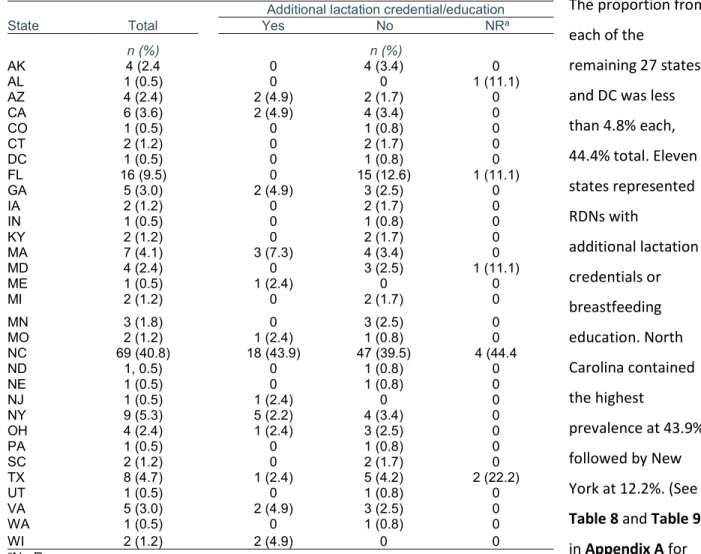
A total of 244 surveys were initiated. Four responders were not RDNs and were excluded from completing the survey after the second question, yielding 240 completed surveys. Two responders practiced outside the United States and were excluded from data analysis, reducing the total analytic sample to 238. Based on data from the RDNs who reported their state of practice [n=169, response rate (RR): 71%) (Table 1), 30 of the 50 states and DC were represented. Not surprisingly, the majority of participants practiced in North Carolina (40.8%), followed by Florida (9.5%) and New York (5.3%).
8 The proportion from each of the
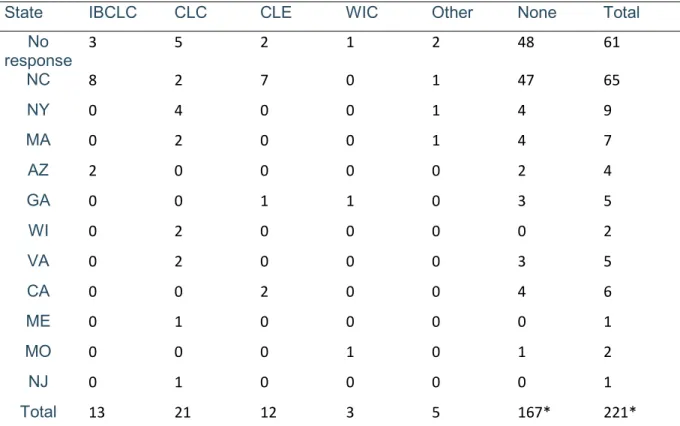
remaining 27 states and DC was less than 4.8% each, 44.4% total. Eleven states represented RDNs with additional lactation credentials or breastfeeding education. North Carolina contained the highest prevalence at 43.9%, followed by New York at 12.2%. (See Table 8 and Table 9 in Appendix A for type of lactation credential by state and overall.)
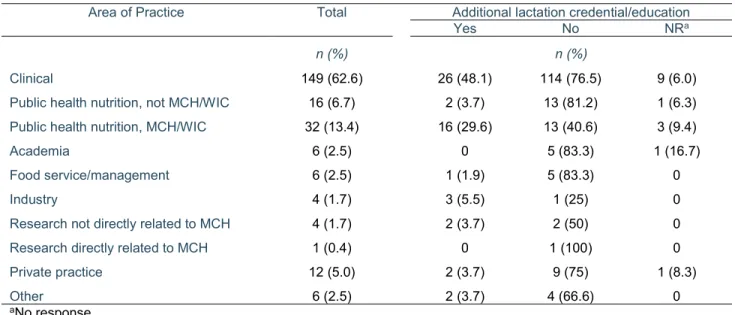
For area of practice (n=236, RR: 99.2%) (Table 2), 63.6% of participants reported working in the clinical setting, of which, 47.5% served only pediatric patients, 36.1% served adult and pediatric patients, and only 10% served only adults. 20.8% of participants worked in public health, and 67% of this group served women of childbearing age and children. 5.5% of participants reported working in private practice. 2.5% of participants worked in academia, food service or management, while less than 2% worked in research, industry or combined settings (commonly public health and clinical). While the highest percent of RDNs with lactation credentials worked in a clinical setting (48.1%), 50% of RDNs who worked in Public Health WIC or maternal child health setting (n=32) also had additional credentials in lactation or breastfeeding education.
Table 1: State of Practice
State Total
Additional lactation credential/education
Yes No NRa n (%) n (%) AK 4 (2.4 0 4 (3.4) 0 AL 1 (0.5) 0 0 1 (11.1) AZ 4 (2.4) 2 (4.9) 2 (1.7) 0 CA 6 (3.6) 2 (4.9) 4 (3.4) 0 CO 1 (0.5) 0 1 (0.8) 0 CT 2 (1.2) 0 2 (1.7) 0 DC 1 (0.5) 0 1 (0.8) 0 FL 16 (9.5) 0 15 (12.6) 1 (11.1) GA 5 (3.0) 2 (4.9) 3 (2.5) 0 IA 2 (1.2) 0 2 (1.7) 0 IN 1 (0.5) 0 1 (0.8) 0 KY 2 (1.2) 0 2 (1.7) 0 MA 7 (4.1) 3 (7.3) 4 (3.4) 0 MD 4 (2.4) 0 3 (2.5) 1 (11.1) ME 1 (0.5) 1 (2.4) 0 0 MI 2 (1.2) 0 2 (1.7) 0 MN 3 (1.8) 0 3 (2.5) 0 MO 2 (1.2) 1 (2.4) 1 (0.8) 0 NC 69 (40.8) 18 (43.9) 47 (39.5) 4 (44.4 ND 1, 0.5) 0 1 (0.8) 0 NE 1 (0.5) 0 1 (0.8) 0 NJ 1 (0.5) 1 (2.4) 0 0 NY 9 (5.3) 5 (2.2) 4 (3.4) 0 OH 4 (2.4) 1 (2.4) 3 (2.5) 0 PA 1 (0.5) 0 1 (0.8) 0 SC 2 (1.2) 0 2 (1.7) 0 TX 8 (4.7) 1 (2.4) 5 (4.2) 2 (22.2) UT 1 (0.5) 0 1 (0.8) 0 VA 5 (3.0) 2 (4.9) 3 (2.5) 0 WA 1 (0.5) 0 1 (0.8) 0 WI 2 (1.2) 2 (4.9) 0 0 aNo Response
9
Table 2. Area of practice, by additional lactation credential or breastfeeding education
Area of Practice Total Additional lactation credential/education
Yes No NRa
n (%) n (%)
Clinical 149 (62.6) 26 (48.1) 114 (76.5) 9 (6.0)
Public health nutrition, not MCH/WIC 16 (6.7) 2 (3.7) 13 (81.2) 1 (6.3) Public health nutrition, MCH/WIC 32 (13.4) 16 (29.6) 13 (40.6) 3 (9.4)
Academia 6 (2.5) 0 5 (83.3) 1 (16.7)
Food service/management 6 (2.5) 1 (1.9) 5 (83.3) 0
Industry 4 (1.7) 3 (5.5) 1 (25) 0
Research not directly related to MCH 4 (1.7) 2 (3.7) 2 (50) 0
Research directly related to MCH 1 (0.4) 0 1 (100) 0
Private practice 12 (5.0) 2 (3.7) 9 (75) 1 (8.3)
Other 6 (2.5) 2 (3.7) 4 (66.6) 0
aNo response
For frequency of direct interaction with women of child-bearing age or young families (n=234, RR: 98.3%) (Table 3), more than one-third of the sample (36.3%) reported daily interaction, with another 27.8% and 20.5% reporting interaction on 3-4 or 1-2 days per week, respectively. There appears to be a
difference between RDNs who hold lactation credentials or have additional breastfeeding education versus those who do not have credentials and the frequency of interaction with the maternal/child population group. 94.5% of RDNs with lactation credentials report interacting with women of childbearing age or families with young children on a weekly basis, while only 5.5% rarely see this population group.
Table 3: Surveyed RDNs’ reported frequency of direct interaction with women of child-bearing age (15-49 years) or families with young children
Direct Interaction Total
Additional lactation credential/education
Yes No NRa
n (%) n (%)
Every day 85 (36.3) 22 (40.7) 58 (34.7) 5 (38.5)
Most days (3 or 4 or more days per week) 65 (27.8) 16 (29.6) 46 (27.5) 3 (23.1)
Some days (1 to 2 days per week) 48 (20.5) 13 (24.1) 32 (19.2) 3 (23.1)
Rarely (1 to 3 days a month) 23 (9.8) 3 (5.5) 19 (11.4) 1 (7.70)
Never 13 (5.6) 0 12 (7.2) 1 (7.70)
10 Of the participants reporting years of practice (n=237, RR: 99.6%) (Table 4), a normal
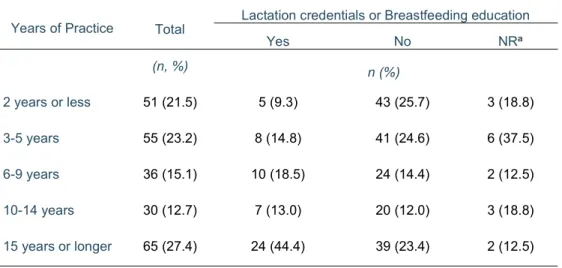
distribution of experience is observed. When combined, 59.8% of RDNs had 9 years or less experience, while 40.1% had 10 years or more experience in the field. The RDNs with lactation credentials or breastfeeding education were more likely to have more years of practice in the field of dietetics. 44.4% of RDNs with lactation credentials or breastfeeding education had 15 or more years experience.
Overall Confidence
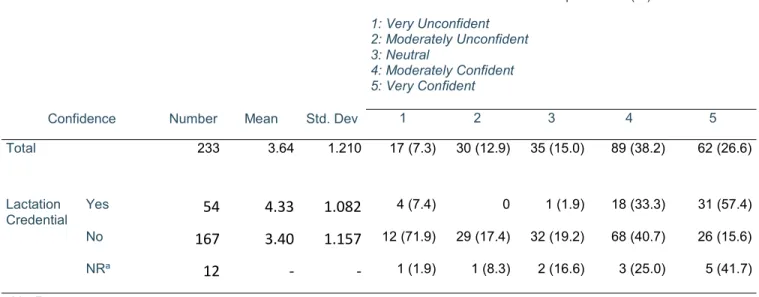
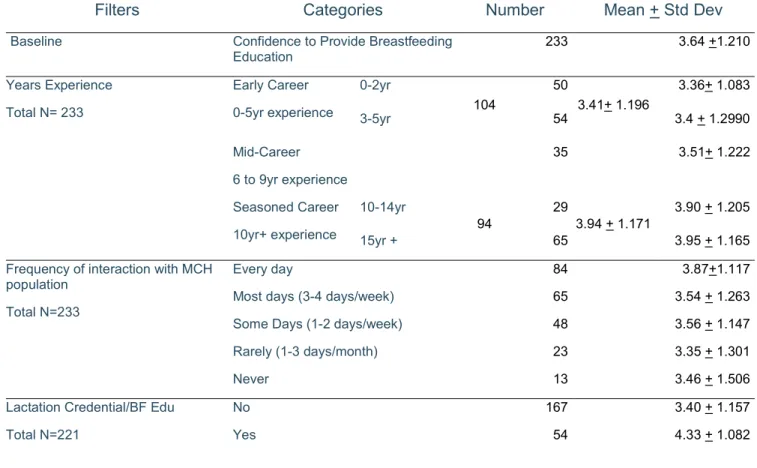
The average rating for overall confidence in providing breastfeeding education was 3.641.210 (n=233; RR:97.9%) (Table 5). Those RDNs without specialty credentialing or additional education in breastfeeding or lactation had a lower confidence score of 3.40 + 1.157, while those that did have lactation credentials or breastfeeding education had a confidence score of 4.33 + 1.082. Moreover, approximately 45% of those with no specialty in breastfeeding ranked their confidence from “very unconfident” to “neutral”. When stratified for years of experience (n=223, RR: 93.7%), confidence was lower (3.36 + 1.083) for those with 2 or less years of experience, and higher (3.95+ 1.165) for those with 15+ years of experience. For those RDNs who are accustomed to working with women of childbearing age and/or breastfeeding families on a daily basis, their confidence averaged 3.87 + 1.117, while those who rarely or never saw these patients had an average confidence of 3.35 + 1.301 and 3.46 + 1.506,
Table 4: Reported Years of Practice for Surveyed RDNs
Years of Practice Total Lactation credentials or Breastfeeding education
Yes No NRa (n, %) n (%) 2 years or less 51 (21.5) 5 (9.3) 43 (25.7) 3 (18.8) 3-5 years 55 (23.2) 8 (14.8) 41 (24.6) 6 (37.5) 6-9 years 36 (15.1) 10 (18.5) 24 (14.4) 2 (12.5) 10-14 years 30 (12.7) 7 (13.0) 20 (12.0) 3 (18.8) 15 years or longer 65 (27.4) 24 (44.4) 39 (23.4) 2 (12.5) aNo response
11 respectively. (See Table 10 and Figure 6 in the Appendix for full stratification table and Likert scale frequency bar graph).
For the question “what would make you feel more confident”, responders were asked to indicate what opportunities may help them to feel more confident to provide information and support to people with breastfeeding needs. 332 responses were recorded, as many participants indicated more than one option. See Figure 3 for a bar graph of these results. 55% agreed that more Continuing Professional Education training in breastfeeding should be offered to improve confidence, while a quarter to a third of responses indicated academic coursework (24.5%), more experience working with the breastfeeding population (26.9%), or a combination of all three approaches (31%) may help confidence. 21 participants (8.7%) offered their own suggestions, ranging from desiring more research in breastfeeding and
lactation field, to 1 on 1 training with IBCLCs, to making the IBCLC credentialing pathway more accessible to RDNs.
Table 5: Self-Perceived Confidence of RDNs to Provide Breastfeeding Education
Confidence Number Mean Std. Dev
Likert Scale frequencies n (%) 1: Very Unconfident 2: Moderately Unconfident 3: Neutral 4: Moderately Confident 5: Very Confident 1 2 3 4 5 Total 233 3.64 1.210 17 (7.3) 30 (12.9) 35 (15.0) 89 (38.2) 62 (26.6) Lactation Credential Yes 54 4.33 1.082 4 (7.4) 0 1 (1.9) 18 (33.3) 31 (57.4) No 167 3.40 1.157 12 (71.9) 29 (17.4) 32 (19.2) 68 (40.7) 26 (15.6) NRa 12 - - 1 (1.9) 1 (8.3) 2 (16.6) 3 (25.0) 5 (41.7) aNo Response
12
FIGURE 3
Competencies
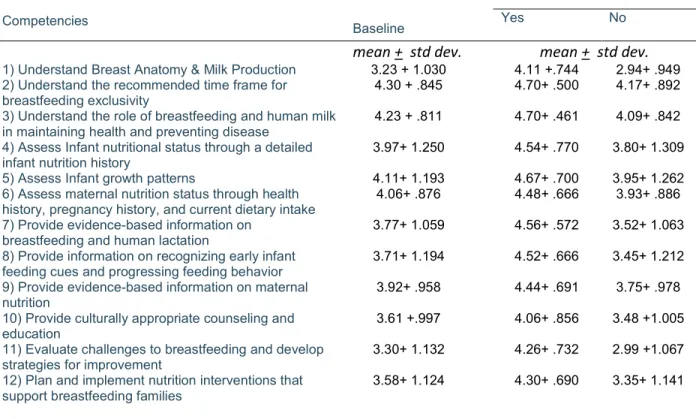
As mentioned in the methods section, twelve questions on competencies were of a 5-five-point Likert scale format. The values were defined in Figure 2. Mean scores and standard deviations were evaluated for each of these twelve competencies (n=221 to 223, RR= 92.8-93.7%) (Table 6). Overall competencies ranged from 3.23-4.30. The competency questions that resulted in highest average perceived
competence were: 2. Demonstrate understanding of the recommended time frame for breastfeeding exclusivity (4.30 +.845); 3. Demonstrate understanding of the role of breastfeeding and human milk in maintaining health and disease prevention (4.23+ .811); and 5. Assess Infant growth patterns (4.11 + 1.193). The lowest perceived competencies were: competence 1. Demonstrate understanding of anatomy and physiology of the lactating breast and milk production (3.23+1.030); 10. Provide culturally appropriate counseling and education (3.61+.997); 11. Evaluate challenges to breastfeeding and develop strategies for improvement (3.30+ 1.132); and 12. Plan and implement nutrition interventions that support breastfeeding families (3.58 + 1.124). When stratified by lactation credential, RDNs with additional credentialing or breastfeeding training reported higher average competencies than baseline; competencies ranged from 4.06 to 4.70. Those without additional lactation credentials had lower average competencies than the baseline (2.94 to 4.17).
0 10 20 30 40 50 60 70 80 90 100 110 120 130 140 More professional training/CPE credits on breastfeeding Academic courses on breastfeeding in nutrition degree programs More experience working with breastfeeding population
All three opportunities are needed
Other opportunity not listed
What would help you feel more confident in providing information and support to patients with breastfeeding needs? Check all that apply.
13 Figure 4 represents bar graphs of the Likert scale response frequencies. As denoted in the bar graphs, the averages for competencies two through five were heavily influenced by RDNs choosing scores of 4 “proficient” or 5 “advanced” on the Likert scale. The opposing low competency scores were skewed more toward 3 “intermediate”, as evident in competency one and eleven. In addition, stratifications for years experience practicing as an RDN and direct interaction with women of childbearing age were briefly examined. The range of competency scores appeared lower than baseline for RDNs with 5 or less years experience (2.95 to 4.21) and higher for RDNs with 15 or more years experience practicing (3.42 to 4.36) Likewise, those RDNs who have daily interaction with women of childbearing age or breastfeeding families reported higher range of competence (3.38 to 4.41) than those with no interaction with the population (2.75 to 4.17). For stratified competency means, see Table 11 in the Appendix A.
Table 6: Average Self-Perceived Competence of RDNs to Promote and Support Breastfeeding
Competencies Baseline
Lactation Credential/Education
Yes No
mean + std dev. mean + std dev. 1) Understand Breast Anatomy & Milk Production 3.23 + 1.030 4.11 +.744 2.94+ .949 2) Understand the recommended time frame for
breastfeeding exclusivity 4.30 + .845 4.70+ .500 4.17+ .892
3) Understand the role of breastfeeding and human milk
in maintaining health and preventing disease 4.23 + .811 4.70+ .461 4.09+ .842 4) Assess Infant nutritional status through a detailed
infant nutrition history 3.97+ 1.250 4.54+ .770 3.80+ 1.309
5) Assess Infant growth patterns 4.11+ 1.193 4.67+ .700 3.95+ 1.262 6) Assess maternal nutrition status through health
history, pregnancy history, and current dietary intake
4.06+ .876 4.48+ .666 3.93+ .886 7) Provide evidence-based information on
breastfeeding and human lactation
3.77+ 1.059 4.56+ .572 3.52+ 1.063 8) Provide information on recognizing early infant
feeding cues and progressing feeding behavior 3.71+ 1.194 4.52+ .666 3.45+ 1.212 9) Provide evidence-based information on maternal
nutrition 3.92+ .958 4.44+ .691 3.75+ .978
10) Provide culturally appropriate counseling and
education 3.61 +.997 4.06+ .856 3.48 +1.005
11) Evaluate challenges to breastfeeding and develop
strategies for improvement 3.30+ 1.132 4.26+ .732 2.99 +1.067
12) Plan and implement nutrition interventions that
14 Referrals, Networks, and Ethics
The four remaining action-based competencies were assessed using different question models than the above twelve competencies. See Figure 2 for these competencies and the corresponding survey
questions. Tables 7a-c report the main results from these competencies.
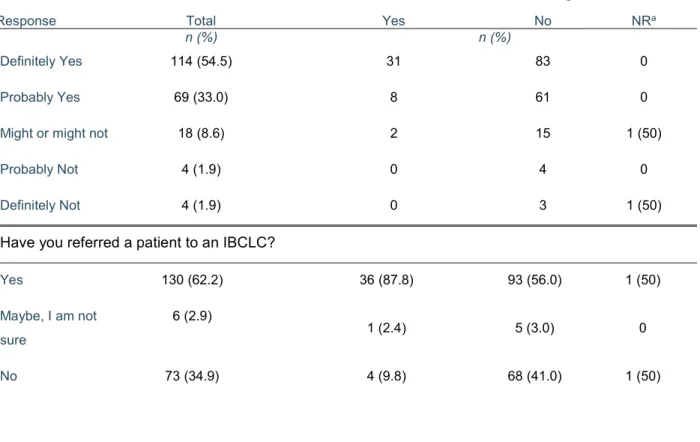
Participants were asked if they would know when to refer a patient to an IBCLC for complex
breastfeeding issues, and then if they have ever referred a patient to an IBCLC [n=209, RR: 87.8%]. The primary hypothetical question results revealed that 87.6% would “probably refer” or “definitely refer” complex patients. However, 35% reported never referring a patient to an IBCLC before. When stratified by additional lactation credentials or breastfeeding education, 42% of those without lactation
credentials reported never referring patients to an IBCLC.
0 20 40 60 80 100 120 140 1 2 3 4 5 6 7 8 9 10 11 12 Fr eq ue nc y Skill-based Competencies
RDN Breastfeeding Skill-based Competency Likert Scale Response Frequencies
1: No knowledge 2: Beginner 3: Intermediate 4: Proficient 5: Advanced
15
Table 7a: Action-Based Competencies Would you refer to IBCLC?
Lactation credential or breastfeeding education
Response Total Yes No NRa
n (%) n (%)
Definitely Yes 114 (54.5) 31 83 0
Probably Yes 69 (33.0) 8 61 0
Might or might not 18 (8.6) 2 15 1 (50)
Probably Not 4 (1.9) 0 4 0
Definitely Not 4 (1.9) 0 3 1 (50)
To address the competency regarding collaborative relationships with other health professionals to support breastfeeding, Participants were asked simply (yes or no) if they have a network of other health professionals to reach out to who support breastfeeding (n=222, 93.3%). 86.9% reported having a
Have you referred a patient to an IBCLC?
Yes 130 (62.2) 36 (87.8) 93 (56.0) 1 (50) Maybe, I am not sure 6 (2.9) 1 (2.4) 5 (3.0) 0 No 73 (34.9) 4 (9.8) 68 (41.0) 1 (50)
Table 7b: Do you have a network of other health professionals to reach out to who support breastfeeding in your workplace or community?
Lactation credential or breastfeeding education
Response Total Yes No NRa
n (%) n (%)
Yes 193 (86.9) 50 (92.6) 142 (85.5) 1 (50)
No 29 (13.1) 4 (7.4) 24 (14.5) 1 (50
16 network of other health professionals to reach out to who support breastfeeding in the workplace or community.
As for the competence question regarding participation in professional organizations that support breastfeeding, the question was framed as a checklist for participants to indicate their involvement in any professional or community organizations that support breastfeeding as a main goal. Figure 5 represents pie charts for overall participation and stratified charts for those with and without lactation credentials/breastfeeding education.
For those that reported participation in the listed organizations (n=134, RR: 56.3%), the spread of involvement included a combined 31% in professional lactation organizations, with the most participation in their State Breastfeeding coalition (13.4%). 12.7% report participating in community organizations such as La Leche League or Breastfeeding USA. By far, the highest participation belonged to the Pediatric Dietetic Practice Group (DPG) at 47% of total responses for this question. Those without
RDNS with Lactation Credentials or Breastfeeding Education
7 5 7 13 1 2 12 7 2 1 2 5 2 4 48 10
RDNS without Lactation Credentials or Breastfeeding
9, 7% 6, 5% 9, 7% 18, 14% 3, 2% 6, 5% 60, 47% 17, 13%
US Lactation Consultant Association (US LCA)
International Lactation Consultant Association (ILCA)
State Lactation Association State Breastfeeding Coalition Women's Health DPG Public Health DPG Pediatric DPG
Community Organizations (La Leche League, Breastfeeding USA)
17 additional lactation credentialing or breastfeeding education reported lower participation for
professional lactation organizations and community organizations (7.5%) and a majority reported involvement in the Pediatric DPG (35.8%). It is estimated that 40% of RDNs who participated in this survey are not members of an organization that support breastfeeding as a main goal.
The final competency (Table 7c) was asked in a series of three questions that were based on the tenants of the International Code of Marketing of Breast-Milk Substitutes (see Figure 2, pg 5). Nearly all of the participants (n= 222, 93.3%) reported accepting money from distributors of breast-milk substitutes for presentations (98.2%) and research (97.7%). 38 participant RDNs (17.2%) reported distributing free samples of breast-milk substitutes to families.
Discussion
RDNs that volunteered to participate in this survey reported midline confidence to provide
breastfeeding education (3.64; “neutral” to “moderately confident”). This number was found to be influenced by factors such as years of experience working as an RDN, frequency of direct interaction with women of child bearing age or young families, and additional lactation credentials or supplemental
Table 7c: Do you distribute free samples of breast-milk substitutes to patients/families?
Lactation credential or breastfeeding education
Response Total Yes No NRa
n (%) n (%)
Yes 38 (17.2) 11 (20.4) 27 (16.4) 0
No 183 (82.8) 43 (79.6) 138 (83.6) 2 (100)
Do you accept money from distributors of breast-milk substitutes, bottles, or teats for presentations?
Yes 4 (1.8) 1 (1.9) 3, (1.8) 0
No 218 (98.2) 53 (98.1) 163 (98.2) 2 (100)
Do you accept money from distributors of breast-milk substitutes, bottles, or teats for research?
Yes 5 (2.3) 1 (1.9) 4 (2.4) 0
No 217 (97.7) 53 (98.1) 162 (97.6) 2 (100)
18 breastfeeding education. With more experience or training, surveyed RDNs reported greater confidence in the realm of breastfeeding education. This has implications for what can be done to further boost confidence in the profession. In as much, a majority of the surveyed RDNs believed additional training in lactation (through continuing education or didactic nutrition program studies) would help them with their confidence in serving the maternal and child population.
Reported RDN competence for the twelve skill-based competencies ranged between “intermediate” and “proficient”. Some skillsets were obviously stronger for RDNs, and this may be due to the overlap of breastfeeding competencies with overall dietetics skillsets such as the knowledge regarding
preventative health, assessment through obtaining nutrition history, and cultural competence. Other skills may be acquired through RDNs’ specific work experiences. For example, competency 12: “Plan and implement nutrition interventions that support breastfeeding families” may better suit the skillsets of a Public Health Nutritionist versus a Clinical Dietitian. Though “area of practice” was not considered as a modifier, the averages for each competency were compared under the same modifiers as confidence, (years of experience, frequency of interaction with MCH patients, and lactation credential). By far, the highest competencies were reported by the RDNs with additional lactation credentials or breastfeeding training), followed by those with more than ten years practicing as RDNs and those who interact with MCH patients on a daily basis. The results of skill-based competencies echo the results from the confidence data and further support the claim that additional education in lactation for RDNs yields greater competence to support breastfeeding families.
Interesting actions and viewpoints of RDNs were captured in the remaining four action-based competencies. RDNs showed discrepancy in their actions on the hypothetical “would you refer to an IBCLC” and actual “have you referred to an IBCLC” referral questions. Explanations for this discrepancy may have to do with an uncertainty of scope of practice for RDNs or whether they have a robust
network of health providers, including IBCLCs, that support breastfeeding. RDNs may feel uncomfortable supporting a patient with problems breastfeeding, but may not have a network of lactation specialists to refer this patient. Indeed, those RDNs who lacked supplemental credentials or training in breastfeeding were less likely to refer out. The low RDN participation in organizations that support breastfeeding may further hinder referral rates. Nearly 40% of RDNs in this study did not report participating in the eight listed organizations or write-in/optional organization. Only 33% of RDNs without lactation credentials reported participation while 67% did not report any participation in professional organizations. Involvement in organizations that support breastfeeding opens RDNs to networking possibilities with
19 other healthcare professionals in their geographical area so that referral and resource lists may be built and patients may be better supported with interdisciplinary care. Though a majority of RDNs responded that they have a collaborative relationship with other health professionals in their organization or community, this was not further investigated with questions that asked the makeup of specialties and roles of these teams or the frequency of collaboration with interdisciplinary team members that could help to better illustrate their competence. The Ethics competency was particularly challenging to develop into a single question that was objective and not leading, thus the reason for three questions. Not surprisingly, a vast majority of RDNs declined accepting money or funding from manufacturers of breastmilk substitutes for research or presentations, but some RDNs admitted to providing free samples of breastmilk substitutes to families. According to the International Code of Marketing of Breast-milk Substitutes, any donation within an organization or free sample of breast-milk substitute to pregnant women or families undermines the superior choice to breastfeed.10 Healthcare workers, which includes RDNs, are responsible for protecting breastfeeding by upholding the tenants of the code.10 The AND practice paper discusses the role of the International Code of Marketing of Breast-milk Substitutes, and overtly states that the choice of RDNs to adhere to the Code directly reflects their commitment to support breastfeeding.3
Evaluation
The survey and subsequent report present a topic that is growing in importance and interest in the field of nutrition for its role in overall preventative health. There is no existing study that examines the Registered Dietitian’s perceptions of confidence and competence in the realm of lactation and breastfeeding. The timing for this investigation could not be more appropriate with the 2011 Surgeon General Call to Action1, 2015 AND Position Paper4, and Practice Paper.5 An aim of this study was to understand the confidence and competence of RDNs from many different backgrounds and areas of practice, regardless of the demographics of their patients. To meet this aim, RDNs from more than ten different areas of nutrition were included. In addition, RDNs from many different states participated, helping to represent different views of breastfeeding among RDNs across the country. The choice to use a survey rather than interviews allowed for anonymity of responders. The arrangement of questions as a “self-evaluation” versus a “test” allowed a glimpse into possible skill or knowledge gaps to address in further discussion. Though the survey had a relatively high completion rate for the short time of data collection, the recruitment method was quasi-convenience sampling. Because the survey was passed between colleague networks, shared opinions and response bias could be present. For example, RDNs
20 who chose to take the survey were more likely more passionate in the topic of breastfeeding and may have more knowledge or skills in breastfeeding than the general RDN population. This was evident in the sample pool heavily representing pediatric RDNs. Finally, though the “self-evaluation” format of the survey could help with inferring knowledge gaps, it is only reflective of perceived competence or skill, not actual competence or skill.
Implications and Recommendations
The survey findings indicated several gaps that are not adequately being addressed in the field of nutrition and dietetics in the realm of breastfeeding support and promotion. RDNs who participated in this study are somewhat confident and competent to perform the breastfeeding support role, but many express interest in increasing their knowledge and skillset to better serve patients that will also build their confidence level. RDNs are in need of a better foundation in the science of lactation in nutrition programs and continued opportunities to improve their understanding through continuing education. Several RDNs reported a desire to pursue a credential in lactation, but feel that the field of nutrition is siloed instead of collaborative with the field of lactation support.
Recommendations for improving the confidence and competencies of RDNs can be made from these survey findings. First, improvement of the partnership between the Academy of Nutrition and Dietetics with the U.S. Lactation Consultants of America (USLCA) will help facilitate interactions between
professionals of both groups. This interaction will increase chances of referrals to IBCLCs and foster a more interdisciplinary route of care. The partnership will also encourage RDNs to join organizations that support breastfeeding as a primary focus. Second, the Commission on Dietetic Registration can accredit and offer more continuing education credits in lactation and breastfeeding for current RDNs. Additional training and knowledge in breastfeeding will help practicing RDNs feel more confident and will arm them with evidence-based information for a more competent and diversified professional workforce. Third, the Accreditation Council for Education in Nutrition and Dietetics (ACEND) can reshape
requirements with the addition of lactation and breastfeeding education competencies into accredited nutrition programs or dietetic internships. This action will ensure that future RDNs have a foundational knowledge of breastfeeding competence and are confidently prepared to support breastfeeding families from the start of their career. Fourth, many RDNs do not know about the 2015 Practice Paper on
Promoting and Supporting Breastfeeding or about the International Code of Marketing of Breast-Milk Substitutes. RDNs who are passionate about lactation support should take it as their responsibility to educate colleagues about the AND recommended competencies and the articles of the Code to support
21 and protect breastfeeding. Finally, more research is needed to determine particular gaps of lactation knowledge within the RDN profession. The author of this report plans to use this experience as a springboard for survey improvement and study replication on a larger scale. This will help improve limitations with a broader scope of practice and opinions to better assess the breastfeeding confidence and competence of the nutrition professional.
Conclusion
The confidence and competence of RDNs in supporting and promoting breastfeeding has room for improvement to best support families. Results revealed that breastfeeding confidence and competence are enhanced with more experience working as an RDN, increased opportunities to work with the maternal and child population, and additional education or credentials in lactation. RDNs surveyed reported a general desire to increase their confidence through supplemental training in breastfeeding education but had low participation in organizations that target breastfeeding as a primary goal. The dietetics profession would benefit from further collaboration with the field of lactation specialists in referring patients in an interdisciplinary care framework, increased education in nutrition student programs and continuing education opportunities.
Reference Section
References
1. Office of the Surgeon General. (2011). The surgeon general’s call to action to support
breastfeeding. In US Department of Health and Human Services (Ed.). Washington DC: Office of the Surgeon General.
2. Centers for Disease Control and Prevention. (2016). Breastfeeding Report Card: Progressing Toward National Breastfeeding Goals, United States, 2016. Atlanta, GA: National Center for Chronic Disease Prevention and Health Promotion. Division of Nutrition, Physical Activity, and Obesity at the Centers for Disease Control and Prevention.
3. Anstey EH, Chen J, Elam-Evans LD, Perrine CG. (2017). Racial and Geographic Differences in Breastfeeding — United States, 2011–2015. MMWR Morb Mortal Wkly Rep 2017; 66: 723–727. DOI: http://dx.doi.org/10.15585/mmwr.mm6627a3.
4. Lessen, R., & Kavanagh, K. (2015). Position of the academy of nutrition and dietetics: promoting and supporting breastfeeding. Journal of the Academy of Nutrition and Dietetics, 115(3), 444-449.
5. Lessen R, Kavanagh K. (2015). Practice paper of the Academy of Nutrition and Dietetics: promoting and supporting breastfeeding. Journal of the Academy of Nutrition and Dietetics, 2015;115(3):450-464.
6. United States Breastfeeding Committee. (2010). Core competencies in breastfeeding care and services for all health professionals. Washington, DC: United States Breastfeeding Committee. 7. Theurich, M., McCool, M. (2016). Moving National Breastfeeding Policies into Practice: A Plea to
Integrate Lactation Education and Training into Nutrition and Dietetics Programs in the United States. Journal of Human Lactation, 32(3) 563-567.
8. Helm, A., Windham, C. T., & Wyse, B. (1997). Dietitians in breastfeeding management: an untapped resource in the hospital. Journal of Human Lactation, 13(3), 221-225.
9. Bagwell, J. E., Kendrick, O. W., Stitt, K. R., & Leeper, J. D. (1993). Knowledge and attitudes toward breast-feeding: Differences among dietitians, nurses, and physicians working with WIC clients. Journal of the American Dietetic Association, 93(7), 801-806.
Appendix A: Additional Tables and Figures
23 Table 8: States with RDNs who have additional lactation credential/breastfeeding education
State IBCLC CLC CLE WIC Other None Total
No response 3 5 2 1 2 48 61 NC 8 2 7 0 1 47 65 NY 0 4 0 0 1 4 9 MA 0 2 0 0 1 4 7 AZ 2 0 0 0 0 2 4 GA 0 0 1 1 0 3 5 WI 0 2 0 0 0 0 2 VA 0 2 0 0 0 3 5 CA 0 0 2 0 0 4 6 ME 0 1 0 0 0 0 1 MO 0 0 0 1 0 1 2 NJ 0 1 0 0 0 0 1 Total 13 21 12 3 5 167* 221*
* THIS IS THE COMBINED TOTAL OF ALL STATES. STATES WITH NO ADDITIONAL CREDENTIALS OR EDUCATION WERE NOT INCLUDED IN THIS TABLE
Table 9: Additional Lactation Credentials or Breastfeeding Training/Education
Credential or Education n (%)
IBCLC 13 (5.9)
CLC 21 (9.5)
Certified Lactation Educator/ Lactation Educator
(CLE or LE) 12 (5.4)
WIC (peer counselor or other training) 3 (1.4)
Other 5 (2.3)
None 167 (75.6)
Appendix A: Additional Tables and Figures
24
Table 10: RDN Confidence to Provide Breastfeeding Education
Filters Categories Number Mean + Std Dev
Baseline Confidence to Provide Breastfeeding Education 233 3.64 +1.210 Years Experience Total N= 233 Early Career 0-5yr experience 0-2yr 104 50 3.41+ 1.196 3.36+ 1.083 3-5yr 54 3.4 + 1.2990 Mid-Career 6 to 9yr experience 35 3.51+ 1.222 Seasoned Career 10yr+ experience 10-14yr 94 29 3.94 + 1.171 3.90 + 1.205 15yr + 65 3.95 + 1.165
Frequency of interaction with MCH population
Total N=233
Every day 84 3.87+1.117
Most days (3-4 days/week) 65 3.54 + 1.263
Some Days (1-2 days/week) 48 3.56 + 1.147
Rarely (1-3 days/month) 23 3.35 + 1.301
Never 13 3.46 + 1.506
Lactation Credential/BF Edu Total N=221 No 167 3.40 + 1.157 Yes 54 4.33 + 1.082 0 10 20 30 40 50 60 70 80 90 100
Overall Confidence RDN with lactation
credential/edu RDN without lactationcredential/edu No response
Fr
eq
ue
nc
y
RDN Confidence to Provide Breastfeeding Education: Likert Scale Frequencies
1 2 3 4 5
Appendix A: Additional Tables and Figures
25 Table 11: Average Self-Perceived Competence of RDNs to Promote and Support Breastfeeding
Competencies Baseline
Years Experience Frequency of Interaction with MCH pop Lactation
Credential/ Education >5yr 6-9yr 10yr+ Every
Day Most Days Some Days Rarely Never No Yes
1) Understand Breast
Anatomy & Milk Production 3.23 3.04 3.26 3.42 3.38 3.16 3.27 3.05 2.75 2.94 4.11 2) Understand the
recommended time frame for breastfeeding exclusivity
4.30 4.21 4.41 4.34 4.32 4.25 4.42 4.14 4.17 4.17 4.70
3) Understand the role of breastfeeding and human milk in maintaining health and preventing disease
4.23 4.11 4.24 4.36 4.26 4.24 4.31 4.23 3.75 4.09 4.70
4) Assess Infant nutritional status through a detailed infant nutrition history
3.97 3.72 4.03 4.21 4.38 3.83 4.02 3.36 2.83 3.80 4.54
5) Assess Infant growth
patterns 4.11 3.88 4.24 4.32 4.41 4.05 4.11 3.59 3.42 3.95 4.67
6) Assess maternal nutrition status through health history, pregnancy history, and current dietary intake
4.06 3.95 4.06 4.18 4.16 4.05 4.13 3.91 3.42 3.93 4.48
7) Provide evidence-based information on
breastfeeding and human lactation
3.77 3.53 3.97 3.97 3.96 3.63 3.89 3.41 3.45 3.52 4.56
8) Provide information on recognizing early infant feeding cues and progressing feeding behavior 3.71 3.32 3.91 4.06 4.05 3.49 3.71 3.18 3.55 3.45 4.52 9) Provide evidence-based information on maternal nutrition 3.92 3.74 4.06 4.07 4.02 3.86 4.13 3.50 3.58 3.75 4.44 10) Provide culturally appropriate counseling and education
3.61 3.52 3.53 3.75 3.70 3.54 3.84 3.32 3.08 3.48 4.06
11) Evaluate challenges to breastfeeding and develop strategies for improvement
3.30 2.95 3.50 3.59 3.49 3.16 3.51 2.73 2.92 2.99 4.26
12) Plan and implement nutrition interventions that support breastfeeding families
3.58 3.30 3.59 3.88 3.80 3.46 3.82 2.86 3.08 3.35 4.30
Average was based on a 5-point Likert scale with the following definitions: 1: None or cannot demonstrate. I am unaware or have very little knowledge of the skill 2: Beginner: I have heard of, but have limited knowledge or ability to apply or use the skill. 3: Intermediate: I have some knowledge or ability to apply the skill, but sometimes require guidance or assistance. 4: Proficient: I am confident in my knowledge and/or ability to apply the skill independently. 5: Advanced: I am very confident; I am an expert, or could teach this concept or skill to others. For N values, please see individual results for each
Appendix B: RDN Confidence and Competence Survey
26 Hello. I am a Public Health Nutrition graduate student (in a MPH/RD coordinated program) and lactation student (CAAHEP Accredited Pathway 2 Lactation Program) at UNC Chapel Hill. Following the Academy of Nutrition and Dietetics Position and Practice Papers on Breastfeeding Promotion and Support (2015), I want to understand the level of confidence Registered Dietitian Nutritionists (RDNs) have in promoting breastfeeding and lactation support and the baseline competency that RDNs in different practice areas possess to perform these roles. The results of this brief survey will help me understand if RDNs feel confident providing breastfeeding
education and if RDNs are adequately trained and prepared to provide basic breastfeeding education or support according to the recommended competencies in the Academy of Nutrition and Dietetics Practice Paper. If you would like to read these papers, please visit:
(http://www.eatrightpro.org/resource/practice/position-and-practice-papers/position-papers/promoting-and-supporting-breastfeeding). This is a voluntary survey as part of a research study, and your responses are completely anonymous with no ties back to your identity. This research project has received exemption status from the University of North Carolina IRB (#17-2350) If you have any questions concerning this survey or research project, please contact Charlotte Zuber at [email protected]. I appreciate your time to complete the survey, and look forward to suggestions you may have. Thank you!
I acknowledge that I have a right to choose not to answer any or all survey questions at any time, as my participation is completely voluntary. After reading the purpose and confidentiality of this survey, I wish to continue with my participation.
o Yes
o No
Skip To: End of Survey If I acknowledge that I have a right to choose not to answer any or all survey questions at any time... = No
End of Block: Information and Informal Consent Start of Block: Demographics
1. What state do you practice in? ________________________________________________ 2. How many years have you worked as a Registered Dietitian Nutritionist (RDN)?
o 2 years or less
o 3-5 years
o 6-9 years
o 10-14 years
o 15 years or longer
o I am not a Registered Dietitian Nutritionist (RDN)
Skip To: End of Survey If How many years have you worked as a Registered Dietitian Nutritionist (RDN)? = I am not a Registered Dietitian Nutritionist (RDN)
Appendix B: RDN Confidence and Competence Survey
27 3. Please select one from the following areas of practice that best describes your work.
o Clinical
o Public Health/ Community Nutrition, not WIC or other maternal or child or family health specialty
o Public Health/Community Nutrition; WIC or another maternal or child or family health specialty
o Academia
o Food Service/ Management
o Industry
o Research that is not directly related to maternal or child health, life-cycle nutrition or breastfeeding
o Research that is directly related to maternal or child health, life-cycle nutrition or breastfeeding
o Private Practice (please list your specialty): ___________________________________
o Other (please specify): ________________________________________________
Skip To: 6 If Please select one from the following areas of practice that best describes your work. 1= Clinical
4. Which setting best describes your clinical work?
o Inpatient
o Outpatient
o Both Inpatient and Outpatient 5. What is the population group you see?
o Adults only (no Obstetrics patients)
o Adults only (including Obstetrics patients)
o Adults and Pediatric patients
Appendix B: RDN Confidence and Competence Survey
28 6. How often do you have direct interaction with women of child-bearing age (15-49 years) or young families?
o Every day
o Most days (3 or 4 or more days per week)
o Some days (1 to 2 days per week)
o Rarely (1 to 3 days a month)
o Never
End of Block: Demographics Start of Block: Confidence Section
7. If someone has a question regarding breastfeeding, do you feel confident providing them education on breastfeeding?
Please use the following scale from 1 to 5 below to indicate your confidence level. 1: Very Unconfident
2: Moderately Unconfident 3: Neutral
4: Moderately Confident 5: Very Confident
8. What would help you feel more confident in providing information and support to patients with breastfeeding needs? Check all that apply.
▢ More professional training in breastfeeding offered as CPE credits
▢ Academic courses integrated into ACEND accredited didactic nutrition degree programs ▢ More experience working with this population group
▢ All of the above is necessary for me to feel more confident
▢ Other (please describe): ________________________________________________
End of Block: Confidence Section Start of Block: Competence Section
Appendix B: RDN Confidence and Competence Survey
29 9. In this section, please use the following scale and definitions to rate the extent to which you can demonstrate the following listed competencies:
1: None or cannot demonstrate. I am unaware or have very little knowledge of the skill 2: Beginner: I have heard of, but have limited knowledge or ability to apply or use the skill. 3: Intermediate: I have some knowledge or ability to apply the skill, but sometimes require guidance or assistance.
4: Proficient: I am confident in my knowledge and/or ability to apply the skill independently. 5: Advanced: I am very confident; I am an expert, or could teach this concept or skill to others.
A. Demonstrate understanding of anatomy and physiology of the lactating breast and milk production
B. Demonstrate understanding of the recommended time frame for breastfeeding exclusivity
C. Demonstrate understanding of the role of breastfeeding and human milk in maintaining health and disease prevention
D. Assess Infant nutritional status through obtaining a detailed infant nutrition history E. Assess Infant growth patterns
F. Assess maternal nutrition status through obtained health history, pregnancy history, and current dietary intake
G. Provide evidence-based information on breastfeeding and human lactation
H. Provide information on recognizing early infant feeding cues and progressing feeding behavior
I. Provide evidence-based information on maternal nutrition J. Provide culturally appropriate counseling and education
K. Evaluate challenges to breastfeeding and develop strategies for improvement L. Plan and implement nutrition interventions that support breastfeeding families
End of Block: Competence Section
Start of Block: Interdisciplinary Collaboration Section
10. Do you have any of the following credentials in lactation or breastfeeding in addition to your RDN?
o IBCLC
o CLC
o Certified Lactation Educator/ Lactation Educator (CLE or LE)
o WIC Peer Counselor
o Other: ________________________________________________
o No, I do not have any credentials in lactation or breastfeeding
Skip To: 13 If Do you have any of the following credentials in lactation or breastfeeding in addition to your RDN? = IBCLC
Appendix B: RDN Confidence and Competence Survey
30 11. Would you know when to refer a patient to an International Board Certified Lactation
Consultant (IBCLC) for complex breastfeeding issues?
o Definitely Yes
o Probably Yes
o Might or might not
o Probably Not
o Definitely Not
12. Have you ever referred a patient to an IBCLC?
o Yes
o Maybe, I am not sure
o No
13. Do you have a network of other health professionals to reach out to who support breastfeeding in your workplace or community?
o Yes
o No
14. Do you participate in professional or community organizations that support breastfeeding as a main goal? If yes, check those that apply or include any we missed.
▢ United States Lactation Consultant Association ▢ International Lactation Consultants of America ▢ State Lactation Associations
▢ State or regional breastfeeding coalitions ▢ Women's Health Dietetic Practice Group ▢ Public Health Dietetic Practice Group ▢ Pediatric Dietetic Practice Group
▢ Community organizations such as La Leche League or Breastfeeding USA
▢ Other (please specify): ________________________________________________
End of Block: Interdisciplinary Collaboration Section Start of Block: Ethics Section
Appendix B: RDN Confidence and Competence Survey
31 15. Do you distribute free samples of breast-milk substitutes to patients/families?
o Yes
o No
16. Do you accept money from distributors of breast-milk substitutes, bottles, or teats for presentations?
o Yes
o No
17. Do you accept funding from distributors of breast-milk substitutes, bottles or teats for research?
o Yes
o No
End of Block: Ethics Section Start of Block: End of survey
18. Feel free to leave any thoughts or comments regarding any questions above or this topic in general. (No names or contact information
please!) ________________________________________________________________