
SEMI-SUPERVISED LEARNING AND FAIRNESS-AWARE LEARNING UNDER CLASS IMBALANCE
Von der Fakultät für Elektrotechnik und Informatik der Gottfried Wilhelm Leibniz Universität Hannover
zur Erlangung des akademischen Grades
DOKTOR DER NATURWISSENSCHAFTEN Dr. rer. nat.
genehmigte Dissertation von
M. Sc. Vasileios Iosifidis
geboren am 28. Februar 1991, in Athens, Griechenland
Korreferent: Prof. Dr. Salvatore Ruggieri Korreferent: Prof. Dr. Ujwal Gadiraju Tag der Promotion: 31.07.2020
ABSTRACT
With the advent of Web 2.0 and the rapid technological advances, there is a plethora of data in every field; however, more data does not necessarily imply more information, rather the quality of data (veracity aspect) plays a key role. Data quality is a major issue, since machine learning algorithms are solely based on historical data to derive novel hypotheses. Data may contain noise, outliers, missing values and/or class labels, and skewed data distri-butions. The latter case, the so-calledclass-imbalance problem, is quite old and still affects dramatically machine learning algorithms. Class-imbalance causes classification models to learn effectively one particular class (majority) while ignoring other classes (minority). In extend to this issue, machine learning models that are applied in domains of high soci-etal impact have become biased towards groups of people or individuals who are not well represented within the data. Direct and indirect discriminatory behavior is prohibited by international laws; thus, there is an urgency of mitigating discriminatory outcomes from machine learning algorithms.
In this thesis, we address the aforementioned issues and propose methods that tackle class imbalance, and mitigate discriminatory outcomes in machine learning algorithms. As part of this thesis, we make the following contributions:
• Tackling class-imbalance in semi-supervised learning – The class-imbalance problem is very often encountered in classification. There is a variety of methods that tackle this problem; however, there is a lack of methods that deal with class-imbalance in the semi-supervised learning. We address this problem by employing data augmen-tation in semi-supervised learning process in order to equalize class distributions. We show that semi-supervised learning coupled with data augmentation methods can overcome class-imbalance propagation and significantly outperform the standard semi-supervised annotation process.
• Mitigating unfairness in supervised models– Fairness in supervised learning has re-ceived a lot of attention over the last years. A growing body of pre-, in- and post-processing approaches has been proposed to mitigate algorithmic bias; however, these methods consider error rate as the performance measure of the machine learning algo-rithm, which causes high error rates on the under-represented class. To deal with this problem, we propose approaches that operate in pre-, in- and post-processing layers while accounting for all classes. Our proposed methods outperform state-of-the-art methods in terms of performance while being able to mitigate unfair outcomes.
Keywords: class-imbalance, fairness-aware learning, semi-supervised learning, supervised learning
Mit dem Aufkommen des Web 2.0 und den rasanten technologischen Fortschritten gibt es in jedem Bereich eine Fülle von Daten; mehr Daten bedeuten jedoch nicht unbedingt mehr In-formationen, vielmehr spielt die Qualität der Daten (Aspekt der Wahrhaftigkeit) eine Schlüs-selrolle. Die Datenqualität ist ein wichtiges Thema, da die Algorithmen des maschinellen Lernens ausschlieSSlich auf historischen Daten basieren, um neue Hypothesen abzuleiten. Die Daten können Rauschen, AusreiSSer, fehlende Werte und/oder Klassenbezeichnungen sowie schiefe Datenverteilungen enthalten. Der letztgenannte Fall, das so genannte Klasse-nungleichgewichtsproblem, ist ziemlich alt und wirkt sich immer noch dramatisch auf die Algorithmen des maschinellen Lernens aus. Das Klassenungleichgewicht führt dazu, dass Klassifikationsmodelle eine bestimmte Klasse (Mehrheit) effektiv lernen, während andere Klassen (Minderheit) ignoriert werden. Was diese Frage betrifft, so sind die Modelle des maschinellen Lernens, die in Bereichen mit hoher gesellschaftlicher Wirkung angewandt wer-den, inzwischen gegenüber Personengruppen oder Einzelpersonen, die in den Daten nicht gut repräsentiert sind, verzerrt. Direktes und indirektes diskriminierendes Verhalten ist nach in-ternationalem Recht verboten; daher besteht die Dringlichkeit, diskriminierende Ergebnisse von Algorithmen des maschinellen Lernens abzuschwächen.
In dieser Arbeit befassen wir uns mit den oben genannten Fragen und schlagen Metho-den vor, die das Klassenungleichgewicht angehen und diskriminierende Ergebnisse in Algo-rithmen des maschinellen Lernens mildern. Als Teil dieser Arbeit leisten wir die folgenden Beiträge:
• Bewältigung des Klassenungleichgewichts beim halbüberwachten Lernen – Das Prob-lem des Klassenungleichgewichts tritt sehr häufig bei der Klassifizierung auf. Es gibt eine Vielzahl von Methoden, mit denen dieses Problem angegangen werden kann; es mangelt jedoch an Methoden, die sich mit dem Klassenungleichgewicht beim teilüberwachten Lernen befassen. Wir gehen dieses Problem an, indem wir beim halbüberwachten Lernprozess eine Datenanreicherung einsetzen, um die Klassen-verteilungen auszugleichen. Wir zeigen, dass halbüberwachtes Lernen in Verbindung mit DatenvergröSSerungsmethoden die Ausbreitung von Klassenungleichgewichten überwinden und den standardmäSSigen halbüberwachten Annotationsprozess deut-lich übertreffen kann.
• Milderung von Ungerechtigkeiten in beaufsichtigten Modellen – Der Fairness beim betreuten Lernen wurde in den letzten Jahren viel Aufmerksamkeit geschenkt. Es wurde eine wachsende Zahl von Vor-, Ein- und Nachbearbeitungsansätzen vorgeschla-gen, um die algorithmische Verzerrung abzuschwächen; diese Methoden betrachten jedoch die Fehlerquote als LeistungsmaSS des Algorithmus des maschinellen Lernens, was zu hohen Fehlerquoten in der unterrepräsentierten Klasse führt. Um dieses Prob-lem zu lösen, schlagen wir Ansätze vor, die in Pre-, In- und Post-Processing-Schichten arbeiten und dabei alle Klassen berücksichtigen. Die von uns vorgeschlagenen Metho-den übertreffen Metho-den Stand der Technik in Bezug auf die Leistung und sind gleichzeitig in der Lage, unfaire Ergebnisse abzuschwächen.
Schlagwörter: Klassenungleichgewicht, Fairness-bewusstes Lernen, halbüberwachtes Ler-nen, überwachtes Lernen
ACKNOWLEDGMENTS
I would like to thank my colleagues, family, and friends who supported me throughout the course of my PhD studies. Special thanks to my advisor Prof. Eirini Ntoutsi who guided me in every step of my PhD studies. Also, I want to specially thank my friends and colleagues: Nikky, Uj, Boubaki and, Mairy for our countless shared moments, and the unlimited hours we spent together at KBS.
Throughout the course of my PhD studies, I have worked, published and co-authored several papers in the areas of class imbalance, online learning, fairness-aware learning, semi-supervised learning, supervised learning, and se-mantic web.
The core contributions of this thesis in the individual chapters have been published in the following venues:
1. The contributions in Chapter 3, which deal with the problem of class imbalance are published in:
• [IN17] Iosifidis, V. and Ntoutsi, E., 2017, August. Large scale senti-ment learning with limited labels. In Proceedings of the 23rd ACM SIGKDD international conference on knowledge discovery and data mining (pp. 1823-1832).
• [IN19b] Iosifidis, V. and Ntoutsi, E., 2019. Sentiment analysis on big sparse data streams with limited labels. Knowledge and Infor-mation Systems, pp.1-40.
2. The contributions in Chapters 4 and 5, which deal with the problem of supervised fairness-aware classification are published in:
• [IFN19] Iosifidis, V., Fetahu, B. and Ntoutsi, E., 2019, December. FAE: A Fairness-Aware Ensemble Framework. In 2019 IEEE In-ternational Conference on Big Data (Big Data) (pp. 1375-1380). IEEE.
• [IN19a] Iosifidis, V. and Ntoutsi, E., 2019, November. AdaFair: Cumulative Fairness Adaptive Boosting. In Proceedings of the 28th ACM International Conference on Information and Knowl-edge Management (pp. 781-790).
The complete list of publications during my PhD is shown below:
1. [IN17] Iosifidis, V. and Ntoutsi, E., 2017, August. Large scale sen-timent learning with limited labels. In Proceedings of the 23rd ACM SIGKDD international conference on knowledge discovery and data min-ing (pp. 1823-1832).
vii 2. [FISN17] Fafalios, P.,Iosifidis, V., Stefanidis, K., & Ntoutsi, E. (2017,
September). Multi-aspect entity-centric analysis of big social media archives. In International Conference on Theory and Practice of Dig-ital Libraries (pp. 261-273). Springer, Cham.
3. [ION17]Iosifidis, V., Oelschlager, A. and Ntoutsi, E., 2017, September. Sentiment classification over opinionated data streams through informed model adaptation. In International conference on theory and practice of digital libraries (pp. 369-381). Springer, Cham.
4. [IN18] Iosifidis, V. and Ntoutsi, E., 2018. Dealing with bias via data augmentation in supervised learning scenarios. Jo Bates Paul D. Clough Robert Jäschke, p.24.
5. [MIE+18] Mohapatra, N.,Iosifidis, V., Ekbal, A., Dietze, S., & Fafalios, P. (2018). Time-aware and corpus-specific entity relatedness. arXiv preprint arXiv:1810.10004.
6. [FISN18] Fafalios, P.,Iosifidis, V., Stefanidis, K., & Ntoutsi, E. (2018). Tracking the history and evolution of entities: entity-centric temporal analysis of large social media archives. International Journal on Digital Libraries, 1-13.
7. [FIND18] Fafalios, P., Iosifidis, V., Ntoutsi, E., & Dietze, S. (2018, June). Tweetskb: A public and large-scale rdf corpus of annotated tweets. In European Semantic Web Conference (pp. 177-190). Springer, Cham.
8. [MCI+18] Melidis, D. P., Campero, A. V., Iosifidis, V., Ntoutsi, E., & Spiliopoulou, M. (2018, June). Enriching Lexicons with Ephemeral Words for Sentiment Analysis in Social Streams. In Proceedings of the 8th International Conference on Web Intelligence, Mining and Semantics (p. 38). ACM.
9. [ITN19] Iosifidis, V., Tran, T. N. H., & Ntoutsi, E. (2019, August). Fairness-enhancing interventions in stream classification. In Interna-tional Conference on Database and Expert Systems Applications (pp. 261-276). Springer, Cham.
10. [IN19b] Iosifidis, V. and Ntoutsi, E., 2019. Sentiment analysis on big sparse data streams with limited labels. Knowledge and Information Systems, pp.1-40.
11. [IFN19]Iosifidis, V., Fetahu, B. and Ntoutsi, E., 2019, December. FAE: A Fairness-Aware Ensemble Framework. In 2019 IEEE International Conference on Big Data (Big Data) (pp. 1375-1380). IEEE.
12. [IN19a] Iosifidis, V. and Ntoutsi, E., 2019, November. AdaFair: Cu-mulative Fairness Adaptive Boosting. In Proceedings of the 28th ACM International Conference on Information and Knowledge Management (pp. 781-790).
13. [GTK+19] Gottschalk, S., Tempelmeier, N., Kniesel, G., Iosifidis, V., Fetahu, B. and Demidova, E., 2019, September. Simple-ML: Towards a Framework for Semantic Data Analytics Workflows. In International Conference on Semantic Systems (pp. 359-366). Springer, Cham. 14. [NFG+20] Ntoutsi, E., Fafalios, P., Gadiraju, U., Iosifidis, V., Nejdl,
W., Vidal, M.E., Ruggieri, S., Turini, F., Papadopoulos, S., Krasanakis, E. and Kompatsiaris, I., 2020. Bias in datadriven artificial intelligence systemsAn introductory survey. Wiley Interdisciplinary Reviews: Data Mining and Knowledge Discovery, p.e1356.
15. [HIL+20] Hu, H., Iosifidis, V., Liao, W., Zhang, H., YingYang, M., Ntoutsi, E. and Rosenhahn, B., 2020. FairNN-Conjoint Learning of Fair Representations for Fair Decisions. In Proceedings of the 23rd Interna-tional Conference on Discovery Science.
16. [IN20]Iosifidis, V.and Ntoutsi, E., 2020. FABBOO - Online Fairness-aware Learning under Class Imbalance. In Proceedings of the 23rd In-ternational Conference on Discovery Science.
Contents
Table of Contents ix
List of Figures xiii
List of Tables xvii
1 Introduction 1
1.1 Motivation . . . 1
1.2 Overview of Contributions . . . 4
1.3 Outline of the Thesis . . . 6
2 Technical Background 9 2.1 Supervised Learning . . . 9 2.1.1 Decision Trees . . . 9 2.1.2 Naïve Bayes . . . 11 2.1.3 Ensembles . . . 11 2.2 Clustering Methods . . . 13 2.2.1 k-Means . . . 14 2.2.2 Expectation-Maximization . . . 15 2.3 Semi-Supervised Learning . . . 16 2.3.1 Self-Learning . . . 18 2.3.2 Co-Training . . . 18 2.4 Class-Imbalance . . . 19
2.4.1 Data level methods . . . 20 ix
2.4.2 Model-based methods. . . 21
2.4.3 Cost-sensitive methods . . . 21
2.5 Fairness-Aware Supervised Machine Learning. . . 22
3 Tackling Class-Imbalance in Semi-Supervised Learning 27 3.1 Introduction . . . 27
3.2 Related Work . . . 29
3.2.1 Sentiment analysis . . . 29
3.2.2 Semi-supervised learning . . . 30
3.2.3 Large scale annotation . . . 31
3.3 Dataset description . . . 32
3.3.1 Data collection and preprocessing . . . 32
3.3.2 Building the ground truth for learning . . . 34
3.3.3 Temporal characteristics . . . 36
3.3.4 Comparing ground truth to SentiStrength and TreeBank . . . 36
3.4 Sentiment learning with limited labels . . . 38
3.4.1 Self-Learning . . . 38
3.4.2 Co-Training . . . 39
3.4.3 Expectation-Maximization (EM) . . . 41
3.4.4 Discussion . . . 42
3.5 Overcoming class imbalance via data augmentation . . . 42
3.5.1 The Data Augmentation Process . . . 43
3.6 Experiments . . . 45
3.6.1 Performance of batch annotation . . . 46
3.6.2 Performance of stream annotation . . . 54
3.6.3 Crowd-Sourcing Evaluation . . . 59
3.6.4 Comparing Self-Learnig and Co-Training to SentiStrength and TreeBank . . . 60
3.6.5 Performance under Redundancy (retweets) . . . 61
3.6.6 Performance of augmentation techniques . . . 63
3.7 Chapter Summary . . . 70
4 Dealing with Class- and Within-Class Imbalance to Prevent Unfair Outcomes 73 4.1 Introduction . . . 73
xi
4.3 Basic concepts. . . 75
4.4 FAE - A Fairness-Aware Ensemble Framework . . . 76
4.4.1 Learning equal representations. . . 77
4.4.2 Fairness-aware decision boundary tuning . . . 78
4.4.3 Hypothesis selection for class-imbalance . . . 79
4.4.4 FAE Classification . . . 80
4.5 Experimental Setup . . . 81
4.5.1 Datasets . . . 81
4.5.2 Baselines and FAE Ablations . . . 81
4.6 Evaluation Results and Discussion. . . 82
4.7 Chapter Summary . . . 84
5 Tackling Class-Imbalance and Unfair Outcomes in Boosting 85 5.1 Introduction . . . 85
5.2 Related Work . . . 87
5.3 Basic concepts and definitions . . . 89
5.4 Cumulative Fairness Adaptive Boosting . . . 90
5.4.1 Cumulative boosting fairness and fairness costs . . . 90
5.4.2 The AdaFair Algorithm . . . 92
5.4.3 Optimizing for class-imbalance and unfair outcomes . . . 92
5.5 Evaluation . . . 93
5.5.1 Experimental setup . . . 93
5.5.2 Predictive and fairness performance . . . 96
5.5.3 Cumulative vs non-cumulative fairness . . . 100
5.5.4 The effect of confidence scores . . . 103
5.5.5 The effect of balanced error . . . 104
5.6 Chapter Summary . . . 106
6 Conclusions and Future Work 109
List of Figures
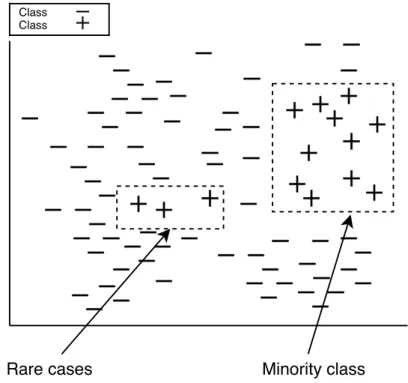
1.1 Example of rare cases in class-imbalanced data . . . 2
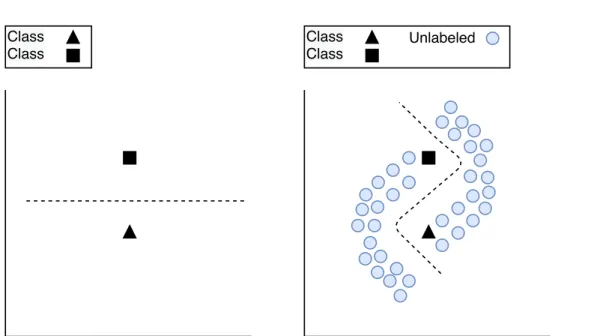
1.2 Example of labeled and unlabeled data. The decision boundary can change significantly with the use of unlabeled data. . . 3
1.3 Original classifier (left) vs fair classifier (right) . . . 4
2.1 Tree structure . . . 10
2.2 Bootstrap aggregating method . . . 12
2.3 Boosting method . . . 13
2.4 K-means example, wherek = 3 (Xs symbolize the centroids) . . . 15
2.5 Expectation maximization method . . . 16
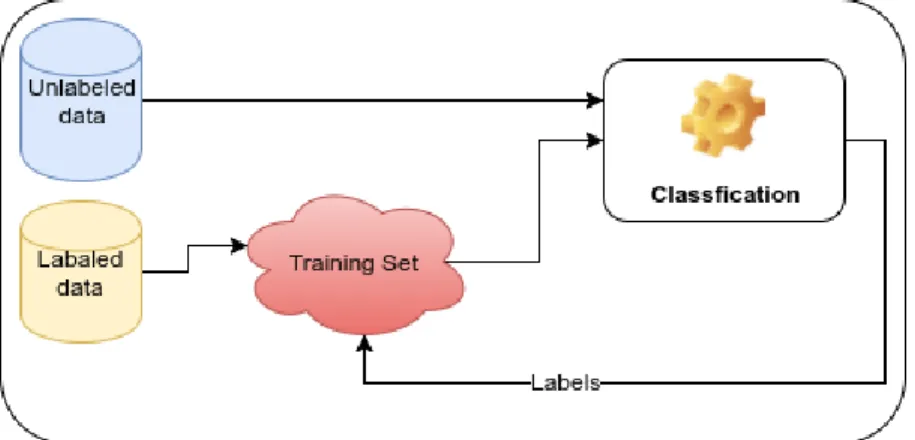
2.6 Self-Learning method . . . 18
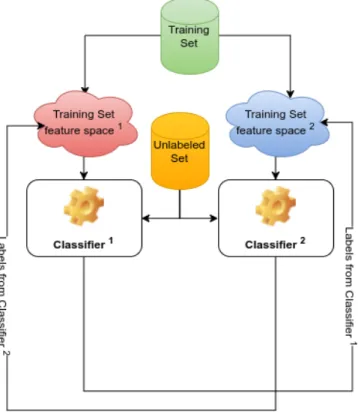
2.7 Co-Training method . . . 19
3.1 Preprocessing effects . . . 33
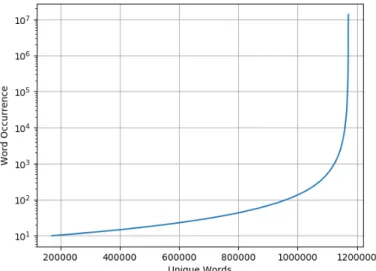
3.2 Frequency distribution of unique words . . . 34
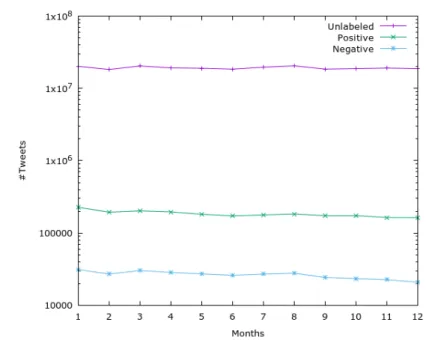
3.3 Dataset distribution on a monthly basis. . . 36
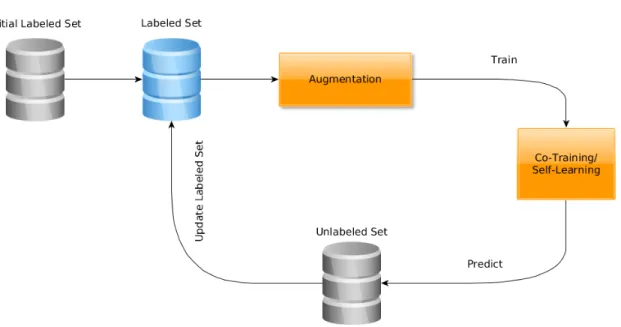
3.4 Augmentation-assisted semi-supervised learning . . . 43
3.5 Batch annotation with Self-Learning: accuracy and labeled set growth under different δ values while the algorithm iterates through the re-maining unlabeled tweets. . . 48
3.6 Batch annotation with Co-Training: accuracy for δ = 65%, δ = 95% while the algorithm iterates through the remaining unlabeled tweets. The accuracy is displayed for each Co-Training classifier-member. . . 49
3.7 Batch annotation with Co-Training: accuracy and labeled set growth under different δ values while the algorithm iterates through the
re-maining unlabeled tweets. . . 51
3.8 Batch: Effect of predicted instances used for dataset expansion (left) and effect of labeled set (right) using Co-Training and Self-Learning, per iteration . . . 53
3.9 Batch: Effect of predicted instances used for dataset expansion (left) and effect of labeled set (right) using EM, per iteration . . . 54
3.10 Stream comparison between Co-Training and Self-Learning . . . 55
3.11 Stream: Sliding (3 months) . . . 56
3.12 Stream: Prequential evaluation - cardinality of labeled, training, test-ing sets. . . 57
3.13 Stream: Class distribution of the annotated tweets over time . . . 58
3.14 Evaluation using Crowdflower platform . . . 59
3.15 Self-Learning original . . . 63
3.16 Self-Learning combined with under-sampling . . . 64
3.17 Self-Learning combined with over-sampling . . . 64
3.18 Self-Learning combined with under-sampling and over-sampling . . . 65
3.19 Self-Learning combined with blankout. . . 65
3.20 Self-Learning combined with word embeddings . . . 66
3.21 Original Co-Training . . . 67
3.22 Co-Training combined with oversampling . . . 67
3.23 Co-Training combined with undersampling . . . 68
3.24 Co-Training combined with over and under sampling . . . 68
3.25 Co-Training combined with blankout . . . 68
3.26 Co-Training combined with embeddings. . . 69
4.1 An overview of our holistic pre- and post-processing FAE framework . 76 5.1 Adult census: Predictive and fairness performance - higher values are better; for Eq.Odds, lower values are better. . . 96
5.2 Bank: Predictive and fairness performance - higher values are better; for Eq.Odds, lower values are better. . . 97
5.3 Compass: Predictive and fairness performance - higher values are bet-ter; for Eq.Odds, lower values are better. . . 98
5.4 KDD census: Predictive and fairness performance - higher values are better; for Eq.Odds, lower values are better. . . 99
LIST OF FIGURES xv 5.6 Costs per boosting round: AdaFair vs AdaFair NoCumul . . . 102 5.7 Effect of confidence scores per dataset. . . 104 5.8 The effect of balanced error (here we report on accuracy and balanced
List of Tables
2.1 Cost Sensitive Boosting Variations . . . 22 3.1 Emoticon-vs SentiWordNet-based labellings. Agreements marked in
boldface. . . 35 3.2 SentiStrength vs Ground Truth labellings. Agreements marked in
bold-face. . . 37 3.3 TreeBank vs Ground Truth labellings. Agreements marked in boldface. 37 3.4 Batch annotations with Self-Learning: Annotated results per class for
different confidence valuesδ. . . 49 3.5 Average accuracy of Co-Training1[unigrams-bigrams] members under
differ-entδ.. . . 50 3.6 Batch annotation with Co-Training: Annotated results per class for
different confidence valuesδ. . . 50 3.7 Batch annotation with EM: annotated results per class over the iterations 52 3.8 Batch: Self-Learning vs Co-Training, average accuracy for differentδ 52 3.9 SentiStrength vs Self-Learning. Agreements among predictions marked
in boldface. . . 60 3.10 SentiStrength vs Co-Training. Agreements among predictions marked
in boldface. . . 60 3.11 TreeBank vs Self-Learning. Agreements among predictions marked in
boldface. . . 60 3.12 TreeBank vs Co-Training. Agreements among predictions marked in
boldface. . . 61 3.13 Batch: Self-Learning vs Co-Training, average accuracy for different δ
(Retweets version) . . . 62 xvii
3.14 Class Ratio (negative:positive) of the predictions for different datasets and methods. . . 62 3.15 Self-Learning: Class Ratio (negative:positive) of the predictions for
different methods . . . 66 3.16 Co-Training Unigrams: Class Ratio (negative:positive) of the
predic-tions for different methods . . . 69 3.17 Co-Training Bigrams: Class Ratio (negative:positive) of the
predic-tions for different methods . . . 69 4.1 Evaluation results for B.ACC. and EQOP. EQOP is in the range of
[-1,1], in this case we show the percentage points. The best results are marked in boldface. . . 83 5.1 An overview of the datasets. . . 94
1
Introduction
1.1
Motivation
The rise of Web 2.0 and the rapid technological advances have caused a data explosion which is beneficial for decision support systems. Such systems rely on historical data in order to derive novel hypotheses to fit the data without being explicitly coded; thus, making such systems applicable in a wide variety of fields. Decision support systems benefit from large amounts of data, which makes the data availability extremely valuable. Nonetheless, more data does not necessarily imply more information, rather the quality of data plays a key role. In many real-world problems, data are incomplete, contain noise and/or outliers, have encoded biases and/or skewed class distributions (class-imbalance), and so on and so forth. It is crucial to deal with such problems, since machine learning algorithms, which are trained on real-world data, are prone to amplify existing errors (garbage in, garbage out) [Par14].
The problem of class-imbalance [HM13] is quite old, and it is frequently observed in all volume ranges of data. Class-imbalance refers to uneven class distributions i.e., when one class (majority) is exceeding by far the other classes (minority classes) w.r.t number of instances. This issue can lead to disproportional error-rates among different classes. Conventional machine learning algorithms do not take this issue into consideration, and propagate it to their outcomes. Another problem which lies in imbalanced datasets, is the problem of rare cases [Ste13] (an example of rare cases can be seen in Figure 1.1). Rare cases (also called within-class imbalance or group-imbalance) are often treated as outliers or noise since they are not very similar to the majority of the instances within a class e.g., a medical dataset which contains healthy and sick patients may contain sick patients that suffer from a very rare disease.
Another common problem with data, is that they are often unlabeled. To obtain qualitative labels for the data, one has to rely on human annotators; however, the task of human annotation is time-consuming and expensive. In addition, nowadays data velocity has surpassed petabytes per day (velocity refers to data generation rates)
Class Class
Rare cases Minority class
Figure 1.1: Example of rare cases in class-imbalanced data
which makes it impossible to annotate all these data by relying on human annotation. In many fields the labeled data are limited, and the unlabeled data are disproportion-ately more than the labeled (an example can be seen in Figure 1.2). A whole field of research in machine learning, called semi-supervised learning [CSZ09], focuses on combining the labeled and unlabeled data to estimate labels for the unlabeled data, which can be used afterwards by conventional decision support systems. Figure1.2is an example that demonstrates how the unlabeled data can help to estimate efficiently the decision boundary.
Tackling class-imbalance in semi-supervised learning. The first aspect of this thesis is to focus on the problem of class-imbalance propagation in the semi-supervised setting. Semi-supervised methods do not take into consideration the uneven class distributions; thus, they are prone to propagate class imbalanced outcomes which can deteriorate the overall performance. By equalizing class distributions, we force these methods to effectively learn all classes to avoid such deterioration.
Finally, in areas of high societal impact, data and machine learning usage raise con-cerns regarding privacy, fairness, legal and ethical guidelines [otPP14]. Over the past few years, many cases have been reported, in which machine learning algorithms pro-duced discriminatory outcomes [DARW+19,ASB+19,VHLY15,IS16,EL14,DTD15]. In Amazon’s case [IS16], the decision support system was deciding which regions of New York City would receive prime services and which would not. Although Ama-zon’s system did not use the protected attributerace, it excluded areas such as Bronx,
1.1 Motivation 3 Class Class Class Class Unlabeled
Figure 1.2: Example of labeled and unlabeled data. The decision boundary can change significantly with the use of unlabeled data.
which were predominantly African-American ZIP codes.
Data often contain proxy-attributes to other attributes such as race or gender
attributes (also calledprotected attributes), which can lead a decision support system to produce discriminatory outcomes. Moreover, data reflect societal biases, and are not representative of the whole population (sample bias). In addition, system bias
might lead to generation of biased data causing models that further reinforce such discriminatory policies like in predictive policing [LI16]. Finally, machine learning models come with their own assumptions and biases (model bias), which clearly affect their generalization performance. Due to the complexity of big data and machine learning algorithms, and their complex interactions, integrating fairness-enhancing interventions into the learning process is essential [FSV+19].
Multiple bias sources can cause machine learning algorithms to discriminate namely:
class imbalance, rare cases, and class overlap. A demonstration of these issues is shown via the toy example of Figure 1.3: the protected and non-protected groups w.r.t. some protected attribute are depicted using different symbols, the class assign-ments are color-coded.
i) rare cases defined w.r.t. some protected attribute(s): the protected group ( , ) is much smaller than the non-protected ( , ). As a real example, women in the STEM workforce are considerably less than men (28% vs 72% in USA1).
ii) class imbalance: the negative class ( , )) dominates the positive class ( , )), which
1https://ngcproject.org/sites/default/files/ngcp_the_state_of_girls_and_women_in_stem_
Negative Class Positive Class
protected group
non-protected group Original Boundary
Fair Boundary
Figure 1.3: Original classifier (left) vs fair classifier (right)
corresponds to granting a benefit (also known astarget class), and
iii) class overlap, esp. for the minority class: the positive instances of the protected group ( ) have similar values (or are closer in thefeature space) with the negative instances of the non-protected group ( ). This is related to the societal biases mentioned before e.g., parental leave is typically longer for mothers compared to fathers.
In the same figure, the decision boundaries of a traditional and a fairness-aware linear classifier are depicted. A traditional learner (left, solid line) optimizes for predictive accuracy - where nearly all protected instances are predicted as negative. A fair-learner (right, dashed line) apart from accuracy, it also considers fairness - where both groups are represented in both classes. It is clear from this example, that a decision support system has to tackle the aforementioned learning challenges.
Mitigating class-imbalance and unfairness in supervised models: The second aspect of this thesis is to focus on the combined problem of class-imbalance and discriminatory outcomes in supervised learning. Although there is a plethora of works which aim to mitigate discriminatory outcomes from supervised models, they do not take into consideration the problem of class-imbalance; thus, these methods reject the vast majority of qualified instances which belong to the minority class due to their inability to learn effectively the minority class.
1.2
Overview of Contributions
Tackling class-imbalance in semi-supervised learning: Semi-supervised meth-ods are widely used to enhance classification performance by leveraging large amounts
1.2 Overview of Contributions 5 of unlabeled data. However, these methods are prone to propagate class-imbalance in case that the data they use, have skewed class distributions.
In this thesis, we extensively evaluate semi-supervised methods such as Co-Training, Expectation Maximization, and Self-Learning on the task of sentiment analysis. We show the impact of the unlabeled data to the overall predictions as well as the impact of different confidence thresholds. In addition, we compare the batch annotation, in which all the data are available in advance, with the stream annotation where data are becoming available over the course of the stream.
Furthermore, we use semi-supervised methods to annotate a large scale corpus of opinionated short texts, called TSentiment15, and make it publicly available2 to the community. TSentiment15 consists of more than 200 million English short texts; thus making it the very first large scale dataset of opinionated short texts. We also provide crowdsource evaluation which was performed on a sample of TSentiment15.
To deal with the class-imbalance propagation, we combine semi-supervised meth-ods with augmentation techniques such as over-sampling, under-sampling, distortion, and semantic-similarity. We show the impact of each method in the overall predic-tions, and analyze the advantages and disadvantages of each method. Our experi-ments indicate that coupling semi-supervised and augmentation methods significantly outperform default semi-supervised methods.
Mitigating class-imbalance and unfairness in supervised models: Direct and indirect discrimination is prohibited by international laws [DIR98], which raises the urgency of mitigating unfair machine learning outcomes. There is a variety of reasons which cause machine learning algorithms to become discriminatory e.g., data might encode societal biases, data can contain feedback loops, data can contain different data distributions for different segments, and so on and so forth.
In this thesis, we mitigate unfair behavior from supervised machine learning mod-els by making pre-, in- and post-processing interventions. In particular, we study how class- and within-class imbalance affect the decisions of a model. We propose a fairness-aware ensemble framework, called FAE, which tackles class- and within-class imbalance to mitigate unfair outcomes. FAE performs two fairness-aware interven-tions: i) the pre-processing step, in which data are partitioned and re-balanced to tackle class- and within-class imbalance and ii) the post-processing step, where the decision boundary of the ensemble is shifted to mitigate unfair outcomes. Our ex-periments show that models which are trained upon data containing disproportional distributions for each segment, are highly discriminatory, in contrast to our approach. Furthermore, we study fairness in sequential models such as AdaBoost [Sch99]. We propose the cumulative fairness notion which is employed by sequential models to mitigate unfair outcomes by modifying the data distributions w.r.t fairness. In addition, our method optimizes for balanced error rate by selecting a sequence of models which minimizes a loss function that combines the balanced error rate and
discriminatory behavior. The cumulative fairness notion assesses the fairness behavior of a sequential model from the beginning up to the current round. We show that by assigning fairness related weights to misclassified instances based on our cumulative fairness notion, the induced model is able to produce fair outcomes. Our proposed model, called AdaFair, is able to mitigate discrimination as well as tackle the problem of class imbalance, and outperform recent state-of-the-art fairness-aware approaches.
1.3
Outline of the Thesis
The rest of the thesis is organized as follows. In Chapter2, we introduce the technical background which is necessary to understand the work of this thesis.
In Chapter 3, we explore the problem of limited labels in big data. Furthermore, we investigate how semi-supervised methods can be coupled with augmentation tech-niques. We show that default semi-supervised methods are prone to propagate class-imbalance in each iteration, and we provide a mechanism that tackles this issue. The work presented in this chapter is contained in the following publications:
• [IN17] Iosifidis, V. and Ntoutsi, E., 2017, August. Large scale sentiment learning with limited labels. In Proceedings of the 23rd ACM SIGKDD international conference on knowledge discovery and data mining (pp. 1823-1832).
• [IN19b] Iosifidis, V. and Ntoutsi, E., 2019. Sentiment analysis on big sparse data streams with limited labels. Knowledge and Information Systems, pp.1-40. In Chapters4and5, we investigate the combined problem of unfair outcomes and class imbalance in supervised models. More analytically, in Chapter 4 we study the impact of class- and within-class imbalance w.r.t discriminatory outcomes. We show that when the data suffer from severe class- and within-class imbalance, the induced machine learning model is producing highly discriminatory outcomes. We present a fairness aware ensemble, called FAE, which combines pre- and post-processing fairness aware interventions to handle class imbalance and unfair outcomes. In Chapter5, we investigate fairness in sequential models such as AdaBoost [Sch99], and introduce the cumulative fairness notion. We show that by assigning fairness related costs in each boosting round based on the cumulative fairness notion, the model is able to produce a strong learner which is able to mitigate discriminatory outcomes.
The works presented in these chapters are contained in the following publications: • [IFN19] Iosifidis, V., Fetahu, B. and Ntoutsi, E., 2019, December. FAE: A Fairness-Aware Ensemble Framework. In 2019 IEEE International Conference on Big Data (Big Data) (pp. 1375-1380). IEEE.
1.3 Outline of the Thesis 7 • [IN19a] Iosifidis, V. and Ntoutsi, E., 2019, November. AdaFair: Cumulative Fairness Adaptive Boosting. In Proceedings of the 28th ACM International Conference on Information and Knowledge Management (pp. 781-790).
Finally, in Chapter 6 we conclude our work, summarize the main contributions, and discuss about future directions.
2
Technical Background
In this chapter, we introduce all the necessary technical background in order to un-derstand the following chapters of the thesis. We begin with introducing the task of supervised learning and all the employed methods in this work. Also, we give a brief overview of ensemble learning which is part of supervised learning, and mention two well-known methods in this category. Afterwards, we highlight two clustering techniques that have been employed in our work. We continue with semi-supervised learning and its two main methods. In addition, we define the problem of class-imbalance. Finally, we provide an overview of the fairness-aware learning task.
2.1
Supervised Learning
In this section, we introduce the task of supervised learning as well as the employed algorithms in this thesis.
We assume a set of historical dataX = ((x1, y1),(x2, y2)...(xn, yn)), that consist of
n i.i.d. examples drawn from a joint distribution P(A, Y). For the ease of simplicity, we consider the binary classification scenario, where y∈ {−1,1} are the class labels,
and A = {A0, ..., Am} being the feature space. The goal of supervised classification
is to find a map function f(X)→y to predict the class labels of unseen instances.
2.1.1
Decision Trees
Decision tree learning [Utg89] is a very popular method, which is used for supervised learning tasks. A decision tree consists of three main components: the root node, the internal nodes and finally the leaf nodes (Figure2.1). Given a labeled set of historical data, the decision tree splits the instances, based on a splitting criterion, into different leaves. The internal nodes contain the decisions of each split. The expansion of the decision tree is affected by two factors: i) the split criterion, and ii) the stop criterion.
Figure 2.1: Tree structure
The splitting criterion can be defined using a specific measure. The most fa-mous ones aregini impurity, information gain, chi-square andvariance reduction. In this work, we employ the information gain measure which is used by ID3 [Qui86], C4.5 [Qui14] and C5.0 [KJ13] decision trees. Information gain is an entropy-based measure. By splitting the nodes based on a feature, decision trees try to decrease the entropy on the node. Entropy is defined as:
H(X) = −∑p(X)logp(X) (2.1) where p(X) is a fraction of instances in a given class. Information gain is defined below as:
IG(Y, X) = H(Y)−H(Y|X) (2.2) where H(Y|X) is the conditional entropy of class Y given X.
Regarding the stopping criterion, a simple but efficient method is to stop the node splitting as soon as the a minimum threshold of instances inside a leaf is reached. Other methods, called pruning methods, have also been proposed and are applied after the construction of the tree. They are bottom-up methods, that cut or merge nodes to simplify the tree and make it more generalizable.
In order to make a prediction, decision trees insert a new instance, which does not contain a class label, into their structure. The instance traverses the tree based on the attribute splits (assuming no missing values, otherwise imputations methods are employed [Twa09]) and ends up in a leaf node m. The estimated probability of the instance to belong to a classk is:
2.1 Supervised Learning 11 pk = 1 Nm ∑ xi∈leafm 1·I[yi =k] (2.3)
where Nm is the number of instances inside leaf m, pk ∈Y, and I is the identity function which results in 1 if the argument is true, else 0. The predicted class label of an instance is based on the class which dominates inside the leaf.
2.1.2
Naïve Bayes
Naïve Bayes [Mar61] is a probabilistic classifier which relies on Bayes theorem; how-ever, it uses a rather naive assumption that the features of an instance, within a given class, are conditionally independent of each other w.r.t the class labels. Naïve Bayes classifier is particularly popular since it can be constructed very efficiently, it is highly scalable and it produces probabilistic predictions.
Bayes theorem can be described as:
P(Y|A1, ..., An) =
P(A1, ..., Am|Y)P(Y)
P(A1, ..., Am)
(2.4) However the assumption of Naive Bayes assumes that the features are condition-ally independent w.r.t the class label; therefore, it can be reformulated as:
P(Y|A1, ..., Am) =
P(A1|Y)...P(Am|Y)P(Y)
P(A1, ..., Am)
P(Y|A1, ..., Am)∝P(Y)
Π
mi=1P(Ai|Y) (2.5)Naïve Bayes classifier performs optimally when the assumption of independence holds. On the other hand, if the assumption of independence does not hold, which may happen in many real-world problems, then the method under-performs.
2.1.3
Ensembles
Ensemble learning combines multiple classifiers (also called weak learners, whose per-formance is barely better than random guessing) of the same type (homogeneous ensemble) or different types (heterogeneous ensemble) to derive a better hypothesis. Bootstrap aggregating [Bre96] (Bagging) and Adaptive Boosting [Sch99] are two very well-known methods in this category.
Bootstrap aggregating
Bootstrap aggregating (Bagging) ensemble [Bre96] is a method which splits the data into multiple different versions (bags), each of which is used to train a weak learner and
afterwards combines these weak learners for an aggregated prediction. The ensemble combines the weak learners by using either majority vote, weighted majority vote, or averaging the estimated probabilities. For the splitting part, the ensemble generates a set ofM bags, given that the original training set of sizen, each of which has the same size n′ (n′ ≤ n). Data from the original training set are sampled with replacement and uniformly. Bagging method is illustrated in Figure 2.2.
Bagging’s main advantage is that it reduces the variance; thus, prevents the final model from overfitting. On the other hand, due to the combination of different and independent weak learners, the model is not easy to interpret.
Original data Bag 1 Bag M Bootstrap Bootstrap Learner 1 Learner M ... ... ... Aggregation
Figure 2.2: Bootstrap aggregating method
Adaptive Boosting
Adaptive Boosting (AdaBoost) [Sch99], is an ensemble of weak learners, where each weak learner is trained upon the errors of its predecessor (Figure 2.3). The idea of AdaBoost is to focus more on the hard-to-learn instances which are misclassified more often than others, by assigning higher weights to them. After each iteration, misclassified instances receive higher weights so that on the next iteration (boosting round), the weak learner will be forced to focus on the hard-to-learn instances. This iterative learning process will result in a strong learner which will use a weighted majority vote for prediction tasks. The pseudo-code of AdaBoost is shown in Alg.1. More analytically, the error rate of weak learner ht in the tth boosting round, is
2.2 Clustering Methods 13
Figure 2.3: Boosting method
measured as follows: errt= 1 N N ∑ i=1 I[yi ̸=ht(xi)] (2.6) whereI is the identity function which returns 1 if the condition within is true, other-wise 0. The error rate of each weak learner can be better or worse but never equal to random guessing, i.e., 50% error rate. For the re-weighting, a special parameterαt is used: αt= 1 2ln ( 1−errt errt ) (2.7) and the new instance weights for the next round t+ 1, are calculated as:
wit+1 =wtiexp(αtyiht(xi)) (2.8) In the extreme case that err = 50% then α = 0, which means that the data distributions will not change in the following boosting rounds.
AdaBoost improves the overall accuracy by combining many weak learners that produce a strong learner. It has been proved based on the margin theory that Ad-aBoost does not overfit [SS99]. However, AdAd-aBoost is sensitive to noise and outliers, since it tries to fit all the data.
2.2
Clustering Methods
In this section, we introduce the employed clustering methods which will be used in this work.
Clustering is the task of separating instances into groups based on their similar-ity. Clustering methods are used in a wide variety of areas e.g., marketing, fraud detection, bio-medical, and so on. Clustering methods can be classified into different
Algorithm 1: AdaBoost
Input: D= (xi, yi)N1 , T Output: EnsembleH
1. Initializewi = 1/N fori= 1,2, . . . , N 2. Forj= 1 to T:
(a) Train a classifier hj to the training data using weights wi. (b) Compute the error rate errj =
∑N
i=1I(yi̸=hj(xi)) ∑N
i=1wi
(c) Compute the weight αj = 12 ·ln(1−errerrjj) (d) Update the distribution as
wji+1 ← w j
i·exp(−αjyihj(xi))
Zj //Zj is normalization factor
3. Output H(x) =∑Tj=1αihj(x)
categories: i) density-based methods, ii) hierarchical based methods, iii) distribution-based methods, iv) grid-distribution-based methods, and v) centroid distribution-based methods.
In this work, we employ k-Means (centroid-based) and Expectation-Maximization (distribution-based) methods that are described below.
2.2.1
k-Means
K-Means [M+67] is a very popular centroid-based clustering method. The algorithm tries to partition the data by iteratively minimizing the sum of squared distances of the instances inside a cluster.
K-means takes in the parameter k which defines the number of clusters to be estimated. It begins by assigning random points to the centroids of each cluster (Figure 2.4). Afterwards, it assigns instances to the clusters based on a distance function e.g., euclidean, manhattan, etc. The sum of squared distance among the instances and the centroids of the clusters is minimized in each iteration. The less variation a cluster has, the more homogeneous are the instances inside that cluster. More formally, k-Means’ goal is:
arg min k ∑ i=1 ∑ x∈Ki ||x−µi||2 (2.9)
2.2 Clustering Methods 15
Figure 2.4: K-means example, where k = 3 (Xs symbolize the centroids)
K-means is a well-known clustering method, since it is a simple, efficient, and easy to interpret; however, it comes with some limitations. It is sensitive to outliers and
k is a user parameter which has to be selected carefully. There are methods that can help with parameter selection, such as elbow,silhouette, andgap statistic methods.
2.2.2
Expectation-Maximization
Expectation-Maximization (EM) [DLR77] is similar to K-means. EM assigns in-stances to clusters by computing the probabilities of the inin-stances to belong to a cluster, based on probability distributions (Figure2.5). K-means’ objective is to min-imize the sum of square distances, while EM’s goal is to maxmin-imize the likelihood of the data.
EM has two basic operations: i) expectation step (E) in which it generates an expectation of the log-likelihood of the data which is evaluated by the current esti-mate of the parameters, and ii) maximization step (M) in which the parameters that maximize the expected log-likelihood are calculated. These two steps are repeated until the log-likelihood of the data has converged, or a maximum number of iterations has been reached. More formally, the objective of EM is to maximize data likelihood as follows:
p(X|Θ) =∑
z
Figure 2.5: Expectation maximization method
where Θare the unknown parameters which are calculated in each iteration, and
Z is a set of unobserved latent variables.
EM is a powerful clustering method. One of its main advantages is that the data likelihood is guaranteed to increase in each iteration. However, it can fall into the pitfall of a local maximum. To avoid that, EM can be initialized multiple times with different initial points. Finally, EM may converge slowly.
2.3
Semi-Supervised Learning
In this section, we introduce the task of semi-supervised learning as well as the em-ployed methods in this work, namelyCo-Training and Self-Learning.
Nowadays, data are generated at tremendous speeds; however, these data suffer from label scarcity. In order to obtain labels, human annotation process has to take place; however, the human annotation process is expensive and slow, thus it is pro-hibitively expensive. Semi-supervised learning aims to solve this issue by combining a few labeled data with large amounts of unlabeled data during the learning process. Semi-supervised methods assume that instances which are in the same neighborhood (close to each other) probably have the same class label. Such methods can increase classification performance by exploiting the structure of unlabeled data and incorpo-rate them into the classification process. By propagating class labels to the unlabeled data, semi-supervised methods improve their hypotheses.
2.3 Semi-Supervised Learning 17 Semi-supervised methods can be separated into three different categories: i) gen-erative models, ii)) low-density separation, and iii) graph-based models. We briefly review works in each of these categories below.
Generative models: These methods try to estimate the data distribution of points that correspond to each class i.e., P(X|Y). They assume that the data distributions can be expressed as P(X|Y, θ), where θ is a vector of parameters which they try to estimate. If this assumption holds, the unlabeled data can improve the perfor-mance [RV95]. To estimate θ, the models try to maximize the log-likelihood of the labeled and unlabeled data:
arg max θ ( ∑ i log(P(xi|yi, θ)P(yi|θ)) + ∑ i ∑ y P(y|x′i, θ)log(P(x′i, y|θ)P(y|θ)) ) (2.11) Popular works in this category are [NMTM00] in which authors used expectation-maximization combined with Naïve Bayes to classify textual data, [MLH04] that used two classifiers (Self-Learning) to classify textual data with binary labels, [BM98] that employed two models (Co-Training) to classify website domains and so on.
Low-density separation: Low-density separation methods try to set boundaries in regions using limited amounts of data. A very popular method is the transductive SVM (TSVM), which tries to maximize the margin over all data by labeling the unlabeled data. For the maximization of the margin on both labeled and unlabeled points, TSVM minimizes the function below:
min w,b w 2+c∑L(y i(wxi+b)) +C′ ∑ L′(wx′i+b) (2.12) where w is the regularizer, L and L′ are the loss functions for labeled and unlabeled data. TSVM was introduced in [Vap99] and has been investigated and extended by a plethora of works e.g., [Joa99, BD99, DB01, FM01, CZ05], and so on.
Graph-based methods: These type of methods are based on graph representa-tions of the data, where each node depicts a labeled or unlabeled data point. The graph can be generated using instance similarity or domain knowledge. A very com-mon method to generate the graph is the nearest neighbor weighted graph, which aims to minimize the function below:
∑
i
∑
j
Popular works in this category are [ZCP05] in which authors constructed graphs by tweaking or removing edges, [BLRR04] where authors used random noise to the weights of the edges for regularization to perturbate the graph, [PL04] in which they used themincut method to improved textual classification under the assumption that instances close to each other have the same class and so on.
2.3.1
Self-Learning
Self-Learning [Fra67] is the earliest semi-supervised method. It works iteratively by labeling the unlabeled data which uses afterwards to enhance its confidence (Fig-ure 2.6). This method usually employs a threshold that is used as a confidence level for the unlabeled predictions. In the beginning, a supervised classifier is trained upon the small training set. Afterwards, the classifier is applied to the unlabeled data to generate labels. Predictions which exceed the threshold are selected to expand the training set, and this process is repeated until all the unlabeled data are labeled, or a number of iterations is reached.
Self-Learning is a simple and efficient method to leverage the unlabeled data; however, it has a serious flaw. If the unlabeled data contain noise or outliers, the method will learn and propagate errors to the upcoming iterations, which can corrupt the overall predictions.
Figure 2.6: Self-Learning method
2.3.2
Co-Training
Co-Training [BM98] has been proposed to tackle the problem of error propagation that takes place in Self-Learning. This method relies on the assumption that the data can be described by two different and conditionally independent sets of features (also called views).
2.4 Class-Imbalance 19 Based on these two different views, this method trains a supervised classifier on each view, and uses them to train each other (Figure 2.7). Iteratively, Co-Training trains these two classifiers on the different views, and the most confident predictions of the unlabeled data will be used to train the opposite classifier. Hence, each classifier will not amplify its own errors; rather, each classifier trains the other classifier. In order for this method to work efficiently, the two views have to describe the data adequately.
Figure 2.7: Co-Training method
2.4
Class-Imbalance
In this section, we introduce the problem of class imbalance, and categorize the related literature.
The problem of class imbalance is quite challenging and affects a wide variety of fields which rely on machine learning tasks. Class imbalance [HM13] refers to the skewed label distributions within data (between-classes), where one class, called ma-jority class, dominates the other classes, called minority classes, w.r.t the amount of instances. For ease of simplicity, we assume the binary classification setting. The class-imbalance problem affects classification models by making them learn effectively one class (majority) while under-perform on the other class (minority) e.g., given a
dataset that contains 95 negative (majority class) and 5 positive (minority class) in-stances, a classifier predicts all the instances as part of the majority class, and achieves 95% accuracy; however, it is not able to identify not even one positive instance.
There exists also another type of class-imbalance, called within-class imbalance, which refers to the existence of rare cases. Rare cases can correspond to sub-concepts, which can reside in any class (majority or minority) e.g., in a medical dataset that contains healthy and ill patients, an ill patient may suffer from a rare disease. Rare cases are hard to learn, while they correspond to sub-concepts, which are far less than the common concept of a class. An example of rare cases can be seen in Figure 1.1.
According to [HM13], literature can be separated into three broad categories: i) data level methods, ii) model-based methods, and iii) cost-sensitive methods. For a detailed analysis of each category, the reader is encouraged to see [HM13].
2.4.1
Data level methods
Data augmentation methods operate on the data level i.e., they modify the data dis-tribution before the training phase of a model; thus, making these methods useful for skew-insensitive classifiers. In [JS02], authors investigate the problem of class-imbalance and the impact of re-sampling methods under the inter-dependencies of i) class distribution skewness ii) data’ complexities iii) data’ volume and iv) classifica-tion models. In [LL98], authors propose a combinaclassifica-tion of standard under-sampling and over-sampling to equalize class distributions, and measure the model’s perfor-mance using lift analysis. In [IN19b], authors investigate a variety of augmentation methods, for textual data, such as distortionand semantic-similarity to augment mi-nority class. The distortion method, in this scenario, refers to adding noise to the text by removing terms (words), and the semantic-similarity method refers to swapping terms with terms which are closer in a vector space projection. In [DH+03], au-thors examine the impact of over-sampling and under-sampling under the cost curve performance metrics and come to the conclusion that under-sampling is significantly more effective than over-sampling in case of decision tree classifiers. In [CBHK02], authors proposedSMOTE method, which augments the minority class by taking into consideration the instances’ neighborhood, using the k-NN algorithm. SMOTE first locates neighborhoods of minority instances, and then it generates pseudo-instances by combining the attribute values of the neighborhood; thus, pseudo-instances are similar to the instances in the neighborhood.
A different class of approaches which operates on the data level are the generative adversarial networks (GANs). GANs use two neural networks, thegenerative network
and thediscriminative network. The generative network generates data by learning a mapping function from a latent space to the target data distribution and the discrim-inative network evaluates the generated data w.r.t the original data. A large body of work has been proposed over the recent years for applications like image classi-fication [FAKA+18, Ino18, STR+18], speech recognition [KPP+17, CGK15, SG15],
2.4 Class-Imbalance 21 etc.
2.4.2
Model-based methods
Such methods aim to tackle class-imbalance during training, by employing a mecha-nism which aims to identify rare patterns. In [CLHB03], authors introduce SMOTE-Boost which combines SMOTE and AdaBoost [Sch99] to deal with class-imbalance by augmenting the minority class instances which are misclassified in each boosting round. In a similar line of work [SKVHN09], authors present RUSBoost which com-bines AdaBoost and random under-sampling of the majority class instances which are correctly classified in each boosting round. In [GV04], authors introduce DataBoost-IM, which locates the hard-to-learn examples from both positive and negative classes during the training phase of AdaBoost, and based on these instances it generates synthetic data at the end of each boosting round. In [Qui91], authors tweak the deci-sion boundary of a decideci-sion tree by adjusting the probabilistic estimates of the tree’s leaves, while in [ZE01], they propose a class-imbalance sensitive pruning method for decision trees. In [WC03], authors tweak the decision boundary of an SVM based on kernel-alignment ideal. Finally, a class posterior re-balancing framework is proposed in [KSXPK17] to reduce imbalance while retaining classification certainty.
2.4.3
Cost-sensitive methods
These methods do not optimize for standard accuracy, rather try to minimize the overall misclassification costs which have been assigned beforehand. For the cost estimation, a grid search has to be performed w.r.t a given metric such as gmean, f1-score, balanced accuracy, etc. The misclassification cost of minority class is higher than that of the majority class. This category of algorithms is divided into three sub-categories [SKWW07]: i) weighting the data space, ii) making a specific clas-sifier cost-sensitive, and iii) using the Bayes risk theory to assign each instance to a class with the lowest risk. The first sub-category of algorithms aim to alter the data distributions w.r.t a misclassification cost matrix so that the data distribution is biased towards the minority class. The very first method in this line of work is AdaCost [FSZC99]. Afterwards many other variations of AdaCost have been in-troduced over the years such as CSB1 [Tin00], CSB2 [Tin00], RareBoost [JKA01],
AdaC1 [SKWW07],AdaC2 [SKWW07], andAdaC3 [SKWW07]. These methods dif-fer in three main parts: i) error estimation, ii) instance weight assignment, and iii) decision voting schema. An overview of these methods can be seen in Table 2.1. Ex-cept for the RareBoost, all the aforementioned methods in this category require a user parameter for the misclassification costs. The second sub-category of algorithms aims to make a specific classifier cost-sensitive. In [NEK+16], authors propose AdaMEC, a boosting classifier that uses the misclassification costs only to set thresholds to the decision boundary of AdaBoost, in contrast to the previous methods which use
Method InitialD1 Dt+1update a t+1update Decision H(x) AdaBoost [Sch99] 1/N Dtexp (−a thtyi) 12log ∑ i,ht(xi)=yi Dt(i) ∑ i,ht(xi)̸=yi Dt(i) sign( ∑ tatht(x))
AdaMEC [NEK+16] ” ” ” sign( ∑
y∈{−,+} c(y) ∑ t:ht=y atht(x)) CSB1 [Tin00] ∑Ci N iCi DtC iexp (−htyi) ” ” CSB2 [Tin00] ” DtC iexp (−athtyi) ” ” AdaCost [FSZC99] ” Dtexp (−a thtyiβi) 12log 1+∑iDt(i) exp (−athtyiβi) 1−∑iDt(i) exp (−athtyiβi) ” AdaC1 [SKWW07] ” Dtexp (−C iathtyi) 12log 1+ ∑ i,yi=ht(xi) CiDt(i)− ∑ i,yi̸=ht(xi) CiDt(i) 1− ∑ i,yi=ht(xi) CiDt(i)+ ∑ i,yi̸=ht(xi) CiDt(i) ” AdaC2 [SKWW07] ” DtC iexp (−athtyi) 12log ∑ i,ht(xi)=yi CiDt(i) ∑ i,ht(xi)̸=yi CiDt(i) ” AdaC3 [SKWW07] ” DtC iexp (−Ciathtyi) 12log ∑ iCiDt(i)+ ∑ i,ht(xi)=yi C2 iDt(i)− ∑ i,ht(xi)̸=yi C2 iDt(i) ∑ iCiDt(i)− ∑ i,ht(xi)=yi C2 iDt(i)+ ∑ i,ht(xi)̸=yi C2 iDt(i) ”
RareBoost [JKA01] 1/N Dtexp (−ap,n
t htyi) a p t=12ln T Pt F Pt,a n t= 1 2ln T Nt F Nt sign( ∑ t:ht(x)≥0 aptht(x) + ∑ t:ht(x)<0 an tht(x))
Table 2.1: Cost Sensitive Boosting Variations
the misclassification costs to change the data distribution in each boosting round. In [QWZZ13], authors introduce a cost-sensitive k-NN classifier, which aims to tackle class-imbalance by using a modified distance function which takes into consideration the misclassification cost matrix. In [LYWZ04], authors use the misclassification cost matrix to define a cost-sensitive splitting criterion in decision trees, while in [BKK+98] they take into account the misclassification costs to determine the pruning criterion of a decision tree. The third sub-category uses the Bayes risk theory to assign each instance to a class with the lowest risk. Few works have been proposed in this di-rection e.g., in [Dom] the authors swap the class labels of the leaves to minimize the misclassification cost.
2.5
Fairness-Aware Supervised Machine Learning
In this section, we introduce the task of fairness-aware learning and also the most frequently used fairness notions.We begin by giving the definition of discrimination. Discrimination [Wik] is treat-ment or consideration of, or making a distinction towards, a person based on a pro-tected attribute to which the person is perceived to belong. Propro-tected attributes considered by the law include: age, disability, race, religion, sex, sexual orientation, etc.
In recent years, it has been observed that machine learning models produce dis-criminatory outcomes towards individuals or groups of people who share specific char-acteristics. The task of fairness-aware supervised machine learning extends the su-pervised learning task by not only considering to find a map function f(·)→y that minimizes the error rate, but also mitigates discriminatory outcomes.
Same as in Section 2.1 we consider binary classification with Y = {+,−} and
A = {A0, ..., Am} the feature space. We also assume a set of historical data X =
distri-2.5 Fairness-Aware Supervised Machine Learning 23 bution P(A, Y). Let S ∈A be a binary protected feature S ={z, z¯ }, where z¯is the non-protected group and z is the protected group e.g., S = gender, z¯ = male, and
z =f emale. We refer to the positive class as the target class e.g., loan approval. We
want to find a map function f(X) → y, as well as mitigate unfair outcomes at the same time.
A plethora of fairness notions has been proposed to measure discriminatory out-comes. In this work, we present the most frequently used notions of fairness (the interested reader is referred to [RR14, VR18] for a detailed description of the pro-posed fairness notions).
One of the earliest fairness notions is the Statistical Parity (also called demo-graphic parity) [KC09]. It can be formalized as:
SP =P(+|z¯)−P(+|z) (2.14) Statistical parity measures the difference between the percentages of non-protected and protected group w.r.t the target class. However, this notion may allow instances from the protected group that may not be qualified to be labeled as positive and reject instances from the non-protected group that may be qualified in order to minimize this difference [DHP+12]. Another fairness notion, called Equal Opportunity [HPS+16], has been introduced to overcome this issue, described as follows:
Eq.Op.=P(+|z,¯ +)−P(+|z,+) (2.15)
Equal opportunity tries to balance the classified difference of the non-protected and protected groups w.r.t the target class. Both statistical parity and equal op-portunity focus solely on the target (positive) class. Another fairness notion called EqualizedOdds (or disparate mistreatment) [HPS+16, ZVGRG17] extends equal op-portunity by also forcing equal classification percentages w.r.t the negative class:
δT P R =P(+|z,¯ +)−P(+|z,+)
δT N R =P(−|z,¯ −)−P(+|z,−) (2.16)
During the last decade, a variety of fairness-aware supervised and unsupervised methods have been proposed. These methods can be separated into four main cate-gories: i) pre-processing, ii) in-processing, iii) post-processing, and iv) fair represen-tations. We describe each of these categories below.
Pre-processing methods. Methods in this category [RPT10, LRT11, CWV+17, KC09, CKP09,IN18,KC12], work under the assumption that in order to learn a fair classifier, the training data should be discrimination-free. To this end, they try to i) balance the representation of the different segments in the population, and/or ii) move encoded societal biases which may exist inside the data. Population segments
re-fer to protected positive/negative and non-protected positive/negative groups. Meth-ods that are balancing the population segments force the model to learn all segments effectively while methods which remove the encoded biases try to eliminate exist-ing discriminatory patterns which occur within a dataset, thus makexist-ing the model learnnon-discriminatory patterns. Among the most popular pre-processing methods are class-label swapping (called massaging), instance re-weighting, and preferential sampling that are employed to achieve statistical parity [KC12]. Massaging locates instances which reside near the decision boundary of a classifier, and swaps their class label in order to shift the decision boundary towards a fairer boundary. Re-weighting, on the other hand, generates a fair weight distribution associated to the instances in order to give more weight to population segments which are under-represented. Finally, preferential sampling performs under-sampling and over-sampling to the instances in different population segments based on their distance to the decision boundary of a classifier. Similarly, [IN18] propose augmenting the protected group via semi-synthetically generated instances which reside near the decision boundary of a classifier. In [LRT11], authors propose a k-NN approach which locates and removes instances which have been treated significantly different among their neighborhood instances. Finally, the probabilistic framework of [CWV+17] modifies the instance values such that the instance label is less dependent on the protected attribute(s). In-processing methods. In-processing methods modify the learning algorithm to eliminate discriminatory behavior. These interventions are typically learner-specific. For instance, [ZVGRG17] add fairness-related constraints in the objective function of a logistic regression model to account for fairness. Their fairness measure aims at minimizing the group differences w.r.t. FPR (false positive rate), FNR (false nega-tive rate), or both. In [KXPK18], authors consider the problem of biased class labels, and assume the existence of an unbiased latent distribution. To learn its param-eters, they propose an iterative training approach that re-adjusts instance weights in order to minimize discrimination. In [KCP10], authors propose a discrimination-aware decision tree model by tweaking the splitting attribute criterion to consider not only information gain w.r.t the class attribute but also heterogeneity w.r.t sensitive attribute. The model is optimized for statistical parity w.r.t. ground truth labels. In [DIKL18], authors include sensitive attributes in the learning process by utilizing a joint loss function that makes an explicit trade-off between fairness and accuracy. Post-processing fairness-aware methods Post-processing methods either mod-ify the results of a trained classifier to ensure the chosen fairness criterion is met, or alter the decision boundary of a classifier to mitigate unfair outcomes. In [KCP10], authors investigate how to force a decision tree to make fair predictions by modifying the leaf labels of the tree to opt for statistical parity. In [PRT09a], authors change the confidence values of CPAR classification rules, while in [CV10] authors alter the probabilities in Naïve Bayes models to account for fairness. In [FKL16] authors


![Table 3.5: Average accuracy of Co-Training 1 [unigrams-bigrams] members under different δ.](https://thumb-us.123doks.com/thumbv2/123dok_us/9833733.2475980/68.918.290.582.140.390/table-average-accuracy-training-unigrams-bigrams-members-different.webp)
