Test driven development (Koskela)
Chapter 9: Acceptance TDD Explained
Brittany Johnson
SWE 437
Overview
“In the spacecraft business no design can survive
the review process without first answering the
question—how are we going to test this thing?”
—Glen Alleman
User stories
From user stories to acceptance tests
The overall process
Format of a story
- free form- or structured: As a (role) I want (functionality) so that (benefit) - often written on index cards
Card, conversation, confirmation (CCC)
Power of storytelling
- User view of what is needed, but now how it is provided
A user story
represents
a requirement, and creates a
promise
to
communicate with the customer later
“Storytelling reveals meaning without defining it”
– Hannah Arendt
Example user stories
4
Support technician sees
customer’s history
on-screen at the start of a call
Application authenticates
with the HTTP proxy
server
The system prevents user
from running multiple
instances of the application
simultaneously
State what,
NOT
how
Enabling value
: A user story is
valuable
because it
Create tests based on user stories
Properties of acceptance tests
- Owned by customer
- Written together with the customer, developer, and tester - Focus on the what, not the how
- Expressed in language of the problem domain – user’s vocabulary - Concise, precise, and unambiguous
In-class discussion
-
Consider the 3 user stories on previous slide (pg. 326)
-
Discuss whether and how they satisfy these properties
9.2 Acceptance Tests
Acceptance tests – example tests
6
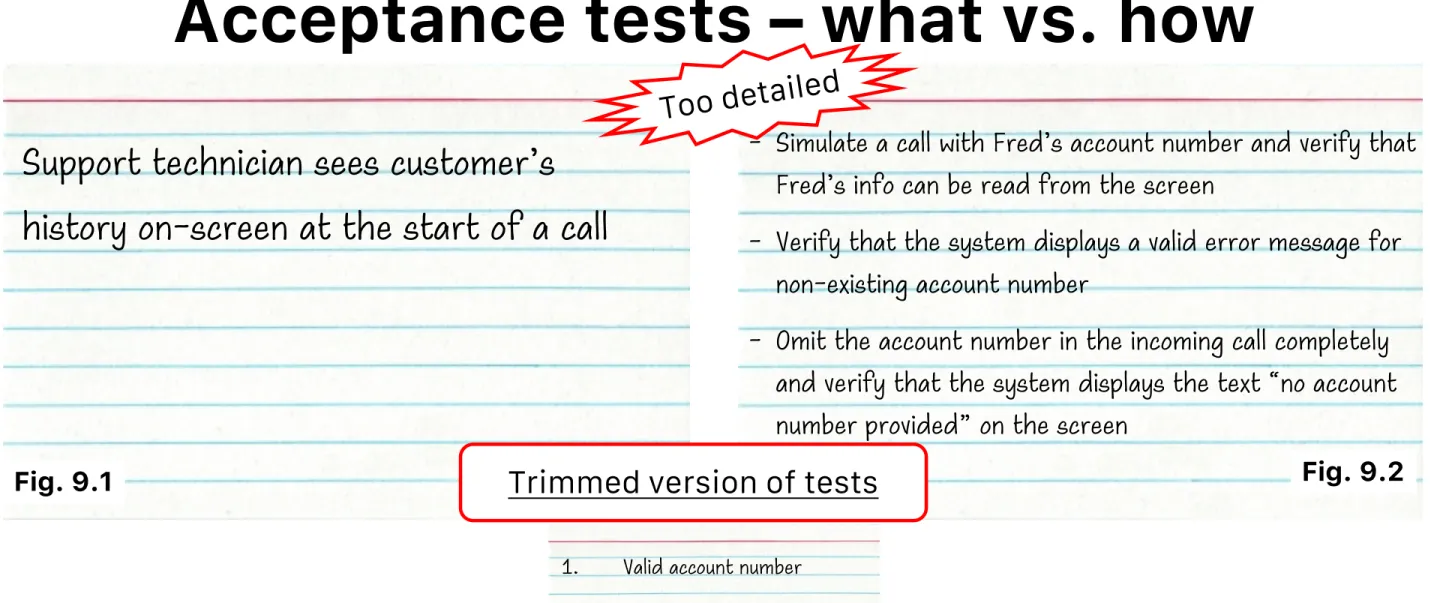
Support technician sees customer’s
history on-screen at the start of a call
- Simulate a call with Fred’s account number and verify that
Fred’s info can be read from the screen
- Verify that the system displays a valid error message for
non-existing account number
- Omit the account number in the incoming call completely
and verify that the system displays the text “no account
number provided” on the screen
Fig. 9.1
Acceptance tests – what vs. how
7
1.
Go to the “new transaction” screen, fill in the required
details, and save the entry; verify that the transaction
shows up on the list
2. Select the “delete” checkbox for the newly created entry,
click “delete all marked transactions,” and verify they’re all
gone
3. Create multiple transactions, check several of them and
delete; verify that all selected transactions were indeed
deleted
Fig. 9.3
In-class discussion:
What is wrong with these tests?
- Too much HOW for users - Not in users’ vocabulary
Trimmed to focus on WHAT
Fig. 9.4 1. Try creating new order
2. Try deleting an order
Acceptance tests – what vs. how
8
Support technician sees customer’s
history on-screen at the start of a call
- Simulate a call with Fred’s account number and verify that
Fred’s info can be read from the screen
- Verify that the system displays a valid error message for
non-existing account number
- Omit the account number in the incoming call completely
and verify that the system displays the text “no account
number provided” on the screen
Fig. 9.1 Fig. 9.2
Too detailed
Trimmed version of tests
Fig. 9.5 1. Valid account number
2. Non-existing account number 3. No account number provided
The acceptance TDD cycle
1. Pick a story2. Write tests for the story 3. Automate the tests
4. Implement the functionality
9.3 Understanding the process
Pick a user story Write tests Automate tests Implement
The acceptance TDD cycle
1. Pick a story (which story?)- Most important - Business value - Technical risk
- Amount of programming 2. Write tests for the story 3. Automate the tests
4. Implement the functionality
A TDD Process – Step 1
The acceptance TDD cycle
1. Pick a story2. Write tests for the story - Involve the customer - Iterate
- Keep abstract as long as possible - Get ahead of refactoring
3. Automate the tests
4. Implement the functionality
The acceptance TDD cycle
1. Pick a story2. Write tests for the story 3. Automate the tests
- Start with a table format
- Translate to implementation/ - Postpone use of tools – tools steal focus from the topic
4. Implement the functionality
A TDD Process – Step 3
12
Action
Parameters
Place call
555-1234, account 123456
Accept call
555-1234
Verify text
123456
Verify text
Cory Customer
The acceptance TDD cycle
1. Pick a story2. Write tests for the story 3. Automate the tests
4. Implement the functionality - This is done using TDD
- Each A-TDD test leads to multiple small tests
- As we get small tests to pass, we’re closer to A-test passing
Acceptance tests in agile methods
14 Acceptance test fails User story TDD test Add functionality Acceptance test passes Refactor RefactorCustomer must
approve
acceptance test
passing
In-class exercise
Customer orders
lunch at a kiosk
Write two or three acceptance tests for the following user story
Follow the guidelines in Chapter 9
Defining the customer role
- Representative of end users - Possible several people
Characteristics of customer role
- Shared interest in success - Authority to make decisions
- Ability to understand implications - Ability to explain domain
Key is to verify against target domain
9.4 Acceptance testing as a team activity
Who writes tests with the customer?
- Tester?
- Developer?
- Requirements expert? - Everybody?
How many testers do we need?
- One or two developers per tester - Tester is a role, not a job title
- All developers should be testers
More contributors is better
Definition of “done”
- Customer must agree it’s done - Knowing where we are
- Knowing when to stop - Test criteria satisfied
Cooperative work
Trust and commitment
Specification by example
- This is a big one!
Filling the gap
- Unit tests are not the same as acceptance tests
Both unit and acceptance tests are needed!
9.5 Benefits of acceptance testing
Should we test against the UI?
- Do whatever is easier long term - UIs are often in the way
- Good tools can automate tests through and around the UI - Performance might matter
Should we stub our system?
- Sufficiently close to the real thing - Sometimes stubs are necessary
Should we test business logic directly?
- Of course – it’s what the customer cares about