Students Career Maturity Scale: Construct
Validity And Reliability Study
Edo Lestari, Fatwa Tentama
Abstract: This study aimed to analyze the construct validity and reliability and to discover the aspects and indicators that formed car eer maturity variables. The career maturity was measured by five aspects, namely; career planning, career exploration, career decision making, w orld of work information, knowledge of preferred occupational group, and realization. The subjects of this study were 65 students of class XII from Senior High School "X" Yogyakarta that were taken by simple random sampling technique. Data collection method was done by using a career maturit y scale. The research data were analyzed by using Structural Equation Modeling (SEM) Smart PLS 3.2.8 with reflective constructs through CFA 2nd Order. Based on the analysis of the outer model, the aspects and indicators that form the career maturity construct were declared valid and relia ble. The most dominant aspect to reflect career maturity was the career decision making aspect, while the lowest aspect to reflect career maturity was the aspect of realization. The results showed that all aspects and indicators were able to reflect and to form the career maturity construct. Therefore the measurement model could be accepted because the theory that described the construct of career maturity was appropriate to the empirical data wh ich was obtained from the subjects.
Keywords: Career Maturity, Career Planning, Career Exploration, Career Decision Making, Knowledge of Preferred Occupational Group, Realization, World of Work Information Student
—————————— ——————————
1.
INTRODUCTION
Adolescence is a period of development that begins at the age of 13 years to 16 years and ends at the age of 16 or 17 years to 18 years old [1]. During the very short development, adolescents have various developmental tasks that must be achieved, one of which is achieving career maturity [2]. Related to this developmental task [3] states that many adolescents experience difficulties, especially in integrating their interests, skills and abilities, and they cannot focus on specific career goals. Even though in adolescence period, individuals should have readiness to make the right career decisions [4]. Career maturity in the guidance and counseling service program is one of the themes in the field of career services that is highly considered by counselor. Based on Herr dan Cramer [5] it is happened because career maturity is a key point in the career development. Career career also influences students in the future life. Super and Overstreet [6] state that students who have career maturity will be able to plan the utilization of resources (self-potential), accept and be responsible for their choices, have awareness of preferred jobs, and have competence in decision making. In addition, students who have career maturity will also be able to make career planning, be willing to assume responsibilities, and be able to use a variety of considerations (internal and external) in making career decisions [7]. Based on these reasons, schools should optimize programs to improve student career maturity. However, the implementation of counseling teachers in schools apparently has a constraint that is the absence of data or information that is accurate and objective about students' career maturity [8]. Herr and Cramer [6] state that career maturity data is important to be revealed so that it can assess students' readiness in making career decisions, as a basis for developing or determining treatment to be carried out, and for evaluating guidance and counseling in the career field. In addition, career maturity data according to Crites [6] also serves as a diagnosis of the pace and progress of individuals which can be used as a basis for developing
intervention strategies to improve career maturity. Nurihsan and Yusuf [9] also explain that the data on career maturity is also important for the preparation of the counseling program so that the services provided can be more effective and efficient. Career maturity was first sparked by Donald E. Super in the 1950s [2]. Career maturity is defined as the readiness of individuals to deal with tasks related to career decision making [10]. This readiness includes affective readiness and cognitive readiness and refers to the suitability between individual career behavior and expected career behavior at a certain age level. In addition, this readiness also refers to compatibility with age and stage of development and specific tasks of the developmental transition [3]. Individuals are said to reach their career maturity if they already have the readiness to make decisions about their career choices appropriately and wisely [11], individuals must also be responsible for the consequences of those decisions [12]. In the last decade empirical studies of career maturity show that career maturity influences students' self-efficacy [13], work commitment and knowledge about career maturity [14], self-concept [15], [16], and self-advocacy [17]. Patton, Creed, and Muller [14] also find that individuals with higher levels of career maturity can make healthier career choices and experience less career uncertainty [18],[19]. Studies on the scale of career maturity have been conducted by Widyatmoko, Ayriza, and Purwandika [20] who have found that career confidence, uncertainty about career choices, and career knowledge can form the variables of career maturity.
Career maturity has six aspects, namely career planning, career exploration, career decision making, world of work information, knowledge of preferred occupational groups, and realization [21]. The first aspect, career planning is the ability of students to learn career information. Career planning is described by discussing career behaviors with adults, attending additional education or courses to increase knowledge about career decisions, participating in extracurricular activities, attending various training related to the desired job, knowing the desired working conditions, knowing the educational requirements for employment desired, being able to plan what to do after graduating from school, knowing the way and the opportunities to enter the desired workforce, and being able to manage free time ————————————————
Edo Lestari, Master in Psychology, Ahmad Dahlan
University,Yogyakarta, PH: 083840524722. E-mail:
effectively. The second aspect, career exploration is the desire of individuals to search for information on career information sources. The third aspect, knowledge about making career decisions is individual knowledge about ways to make career decisions, making steps and making career decisions especially the preparation of career plans, learning how others make career decisions, and using knowledge and in making career decisions. The fourth aspect, knowledge of the world of work information that is knowledge relating to the task of development when individuals must know their interests and abilities. This aspect is illustrated by students who know how other people learn things related to work, and know the reasons for other people changing jobs, as well as knowledge of work assignments in a vocational and behaviors at work. The fifth aspect, knowledge of preferred occupational groups is knowledge of the tasks of the desired job, the means required of the desired job, the physical and psychological requirements of the desired job, the interests and the right reasons for choosing a job. The sixth aspect, the realization of career decisions is a good understanding of the strengths and weaknesses of the self-associated with desired career choices, the ability to see the factors that will support or hinder the desired career, the ability to see opportunities that are associated with desired career choices, the ability to choose one alternative job from the various types of work available, and the ability to develop learning and working effectively. The aspect of career maturity in this research variable refers to the opinion of Watkins and Campbell [21], namely aspect of career planning, career exploration, career decision making, world of work information, knowledge of preferred occupational groups, and realization
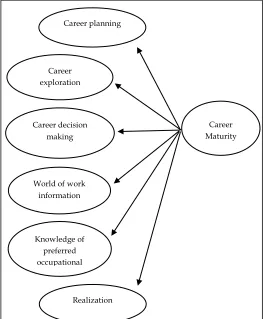
Based on Figure 1, the research is arranged with the following hypothesis.
H: Aspects of career planning, career exploration, career decision making, world of work information, knowledge of preferred occupational groups, and realization are able to shape career maturity.
Second Order Confirmatory Factor Analysis (2nd Order CFA) The approach that can be used in testing this measurement instrument construct is the Confirmatory Factor Analysis (CFA). CFA is one of the main approaches in factor analysis. CFA can be used to test the dimensionality of a construct. This test is used to measure the model (model measurement) so that it can describe aspects and indicators of behavior in reflecting latent variables, namely career observer by looking at the factor loading of each aspect that forms a construct. CFA is also used to test the construct validity and construct reliability of the indicators (items) forming latent constructs [22]. The CFA used in this study is a second order confirmatory factor analysis (2nd Order CFA), a measurement model that consists of two levels. The first level of analysis is carried out from the latent construct of the aspect to its indicators and the second analysis is carried out from the latent construct to the construct of the aspect [22].Based on the description above, the formulation of the problems in this study are: 1) Is the construct of career maturity valid and reliable?, and 2) Are the aspects of career planning, career exploration, knowledge about making career decisions, knowledge about the world of work, knowledge about work groups which is preferred, and the realization of career decisions able to form the construct of career maturity? The purposes of this study are to: 1) Test the validity and reliability of career maturity constructs, 2) Analyze the aspects and indicators that can form career maturity variables.
2 METHOD
2.1 Research Subjects
The subjects in this study were students of sciences class XII of Senior High School "X" Yogyakarta who were teenagers between 17-18 years old that consisted of male and female. The research subjects in this study were 65 students.
2.2 Research Design
The design of this study was semi-construction. The scale design was done by using theoretical collaborative studies with information directly which was obtained from the field data. The advantage of using this semi-construction design was that it reinforced existing theories and reproduces as many behavioral indicators as possible. Then it was done by testing the psychometric properties, including content validity analysis, discriminating power, confirmatory factor analysis, and external concurrent validity testing [23].
2.3 Instrument
Data collection methods in this study were carried out using career maturity scale. This career maturity scale was developed by researchers by referring to the opinion of Watkins and Campbell [21] which states that career maturity consists of six aspects, namely career planning, career exploration, career decision making, world of work information, knowledge of preferred occupational groups, and realization. The examples of the item from the aspect of career planning are "I am still confused by the activities that I will do after
Career exploration
Career Maturity Career planning
Knowledge of preferred occupational
group World of work
information Career decision
making
Realization
graduating from senior high school" and "I don't have much preparation for my further study plans". The examples of the item from the aspect of career exploration are "I am still confused by the interests and talents that I have" and "I already know the majors that match to my interests and talents." The examples of the item from the aspect of career decision making are "I don't understand how to make the right career decisions" and "I don't know how successful people make the right career decisions‖. The examples of the item from the aspect of the world of work information are "I know what I will do after I become a student collage" and "I have learned from others how I should learn for my success‖. The examples of the item from the aspect of knowledge of preferred occupational groups are "I know all the requirements that I need to prepare to register for college" and "I don't know the requirements that I need to prepare for applying to university‖. The examples of the item from the aspect of realization are "I can choose the best university for myself" and "I can choose the best university for myself". The aspects and indicators of career maturity scale can be seen in table 1.
TABLE 1
BLUE PRINT FROM CAREER MATURITY
Domain Indicator Item Total
Favo Unfavo Career
planning
a. Planning what to do after graduating school b. Talking about careers
with adults
c. Taking additional education or courses to increase knowledge about career decisions
1,2,5 3,4,7 6
Career Exploration
a. Trying to find career information from various sources
b. Having enough career information
c. Using knowledge in making career decisions
6,9, 10
8,11,12 6
Career decision making
a. Knowing the ways to make a career decision b. Learning how others
make career decisions c. Using knowledge in
making career decisions 13, 14,1 7
15,16,1 9
6
World of work information
a. Knowing how other people learn things related to work
b. Finding out why other people change the job. c. Relating the knowledge
of work task in a vocational and behaviors at work
18, 21,2 2
20,23,2 4
6
Knowledge of preferred occupation al group
a. Understan- ding the tasks of the desired job b. Knowing the facilities
needed from the desired job
c. Knowing the physical and psychological requirements of the desired job
25, 26,2 9
27,28,3 1
6
Realization a. Having a good understanding of your strenghts and weaknesses is related to desired career choices b. Being able to see the
30, 33,3 4
32,35,3 6
6
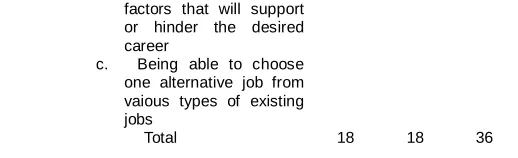
factors that will support or hinder the desired career
c. Being able to choose one alternative job from vaious types of existing jobs
Total 18 18 36
2.4 Construction Validity and Reliability
The validity and reliability test in this study was carried out by using the smartPLS 3.2.8 program with the aim of testing the outer model. Outer model is a measurement model to test the validity and reliability of measuring instruments. Validity testing consists of tests of convergent validity and discriminant validity. Convergent validity is done by looking at the loading factor value> 0.5 and the average variance extracted value > 5. The discriminant validity test is done by comparing the root average variance extracted (AVE) between aspects must be higher than the correlation with other aspects [24]. Reliability test by looking at Cronbach's alpha and composite reliability> 0.7 but 0, 6 is still acceptable [24]. The test of construct validity and reliability produced valid and reliable items that were able to reflect some aspects of career maturity, namely items in numbers 3, 4, 7, 8, 9, 10, 11, 12, 13, 14, 15, 16, 16 18, 19, 20, 22, 29, 31, 34, and 36. While the items that were not able to reflect career maturity were the items in numbers 1, 2, 5, 6, 17, 21, 23, 24, 25, 26 , 27, 28, 30, 32, 33 and 35.
2.5 Data Analysis
The data in this study were analyzed by using the SmartPLS 3.2.8 program with reflective constructs through the 2nd Order CFA. According to Abdillah and Hartono [25], PLS is a variance-based structural equation analysis (SEM) that can simultaneously test measurement models to test the validity and reliability.
3 RESULT
Based on the results of the test analysis of the outer model which aere conducted on the career maturity construct, these are obtined the following results:
3.1 Convergent Validity
Based on the explanation above, it can be seen that the loading factor value from aspects to indicators has fulfilled > 0.5, so it can called to be valid. The results can be seen in table 2.
TABLE 2
LOADING FACTOR (VARIABLE-ASPECT)
Aspect Loading Factor Information
Career planning (P) 0.746 Valid
Career exploration (E) 0.758 Valid
Career decision making (DM) 0.804 Valid
World of work information (WI) 0.660 Valid
Realization (R) 0.542 Valid
Furthermore, the loading factor value from the aspect to a valid item can be seen in table 3:
TABLE 3
LOADING FACTOR (ASPECT-ITEM)
Item Loading Factor Information
PK3 0.825 Valid
PK4 0.642 Valid
PK7 0.859 Valid
EK8 0.703 Valid
EK9 0.572 Valid
EK10 0.758 Valid
EK11 0.693 Valid
EK12 0.850 Valid
PMK13 0.600 Valid
PMK14 0.643 Valid
PMK15 0.838 Valid
PMK16 0.829 Valid
PMK19 0.607 Valid
PDK18 0.753 Valid
PDK20 0.870 Valid
PDK22 0.747 Valid
PKK29 0.800 Valid
PKK31 0.936 Valid
RK34 0.638 Valid
RK36 0.869 Valid
Furthermore, the construct of career maturity can be called to be valid. This is based on the fulfillment of convergent validity test results that were seen from the average variance extracted (AVE) value > 0.5. The details can be seen in table 4.
TABLE 4
THE VALUE OF AVERAGE VARIANCE EXTRACTED (AVE) CAREER MATURITY
Domain AVE Information
Career planning (P) 0.611 Valid
Career exploration (E) 0.520 Valid
Career decision making (DM) 0.506 Valid World of work information (WI) 0.627 Valid Knowledge of preferred occupational group
(KOG)
0.757 Valid
Realization (R) 0.581 Valid
3.2 Discriminant Validity
Discriminant validity test can be said to be valid because the fulfillment of the AVE root value among aspects is higher than the AVE root value. The details can be seen in table 5.
TABLE 5
ROOT VALUE AVERAGE VARIANCE EXTRACTED (AVE) CAREER MATURITY
Aspect P E DM WI KOG R
P 0.721 0.534 0.686 0.524 0.613 0.383 E 0.534 0.792 0.501 0.432 0.460 0.489 DM 0.686 0.501 0.781 0.529 0.556 0.314 WI 0.524 0.432 0529 0.870 0.519 0.469 KOG 0.613 0.460 0,.556 0.619 0.712 0.327 R 0.383 0.489 0.314 0.469 0.327 0.762
Validity Construct in SEM (Confirmatory Factor Analysis or CFA) shows that all four indicators are valid with a loading factor value (λ) ≥ 0.5.
3.3 Construction Reliability Test
Based on the results of the reliability test that has been done, the reliability of the career maturity construct has been reliable. This is by fulfilling the value of composite reliability and Cronbach's alpha > 0.7. The balance sheet can clearly be seen in table 6.
TABLE 6
VALUE COMPOSITE RELIABILITY AND CRONBACH’S ALPHA CONSTRUCT CAREER MATURITY
Variable
Composite Reliability
Cronbach‘s
Alpha Information Career Maturity 0.874 0.830 Reliable
The results of construct reliability testing with Confirmatory Factor Analysis 2nd Order in table 6 above showed that constructs had good reliability and gave meaning that the dimensions that measure constructs/latent variables of career maturity fulfilled uni-dimensional criteria [26]. This was indicated by the value of Composite Reliability 0.874 and Cronbach‘s Alpha 0.830. Based on the processing and analysis of research data on aspects of career maturity construct which were formed by using the 2nd Order Confirmatory Factor Analysis, the results showed that the model was acceptable, because all aspects and indicators were able to reflect on the construct formed
4
DISCUSS
indicators that exist are able to reflect and form the career maturity construct. The studies on the aspects that build career maturity have also been conducted by Widyatmoko, Ayriza, and Purwandika [21] who have found that confidence in career, uncertainty in career choice, and knowledge of career can form the variables of career maturity. The most dominant aspect that is able to reflect career maturity is career decision making (DM) with the factor loading of 0.804. It means that the main indicator is knowing the ways of making career decisions. According to Super [4] this aspect is intended to see the ability of students to use their knowledge and thoughts in making career planning. Some examples of behavior found in the field relating to this aspect, for example, discussing careers with counselor, attending tutoring activities or tutoring, participating in self-development activities in extracurricular programs, and trying to increase career information. The lowest aspect that reflects career maturity is the realization (R) with the loading factor of 0.542. It means that the main indicator is being able to choose an alternative job from various types of existing jobs. According to Super [4] this aspect is a comparison between the ability of individuals and realistic job choices. Some examples of behavior found in the field relate to this aspect are confusion in knowing interests and talents and confusion in making career choices. The results of this study are expected to be used by educators especially counselors to reveal the students' career maturity. Hopefully, with the objective disclosure of the data, the treatment design will be developed more effectively.
5 CONCLUSION
Based on the results of the analysis and discussion, it can be concluded that the career maturity construct has fulfilled good validity and reliability. All aspects can form the construct of career maturity, where aspects that have a dominant influence on career maturity are career decision making (DM) with a loading factor of 0.804. Thus, the findings of this study are able to provide theoretical implications in the development and practical implications of the career maturity of the Guidance Counseling teachers. For advanced researchers, it can be used to test the career maturity model of its relationship with other variables and to expand different research so that the research results can be generalized
ACKNOWLEDGMENT
The author would like to thank Ahmad Dahlan University and the Master of Psychology Programe University of Ahmad Dahlan for supporting the implementation of this research
REFERENCES
[1] Harlock, Psychological Development (in Indonesia). Jakarta: Erlangga, 2007.
[2] U. Suherman, Career Counseling and Counseling: Throughout the Range of Life (in Indonesia). Bandung: Rizqi Press, 2013.
[3] D. Brown, Steven And W.L. Robert, Career Development and Counseling; Putting Theory and Reseach to Work. New Jersey: Jhon Wiley & Sons, 2005.
[4] R.S. Sharf, Applying Career Development Theory to Counselling (6thed.). Belmont: Brooks / Colecengege Learning, 2013.
[5] J.B.A. Thalib, Z. Mohamad, and N.A. Wahab, ‗‘Career Self Efficacy and Career Maturity Constribution on Career
Planning Abillities among Youths,‘‘ The Social Science. vol. 11, no. 22. pp. 5482-5487, 2016.
[6] M.T. Manrihu, Study of Several Factors Affecting the Career Maturity of High School Students in South Sulawesi. Disertasi, UPI, Bandung, 1986.
[7] W.S. Winkel, and Hastuti. Guidance and Counseling in Educational Institutions (in Indonesia). Yogyakarta: Media Abadi, 2011.
[8] A.R. Riyadi, ―Development of Career Maturity Measuring Instruments for High School Students (in Indonesia),‘‘ Jurnal Ilmiah Psikologi Terapan. vol. 5, no. 2. pp. 60-79, 2017).
[9] J. Nurihsan, and S. Yusuf, ‗‘Application of Measuring Task Development and Analysis of Development Tasks in the Development of Guidance and Counseling Programs in High Schools (in Indonesia),‘‘ Jurnal Psikologi Pendidikan Dan Bimbingan. vol. 2, no. 4, pp. 267–280, 2002.
[10] D.E. Super, A Life-Span: Life-Space Approach to Career Development. D. Brown, L. Brooks, and Associates, Career Choice and Development: Applying Contemporary Theories to Practice (2nd Ed.). San Francisco: Jossey-Bass, 1990.
[11] M.L. Savickas, ‗‘A Developmental Perspective on Vocational Behavior: Career Pattern, Salience, and Themes,‘‘ International Journal for Educational and Vocational Guidance, vol. 1, pp. 49–57, 2001.
[12] J.O. Crites,Career Maturity Inventory Sourcebook. Clayton, N.Y.: Careerware, Ibm Company, 1996.
[13] P. Singh, Kumar and R.P. Shukla, ‗‘Relationship Between Career Maturity and Self-Efficacy among Male and Female Senior Secondary Students,‘‘ Mier Journal of Educational Studies, Trend and Practises, vol. 5. no. 2, pp. 164 -179, 2015.
[14] W. Patton, P.A. Creed, and J. Muller, ‗‘Career Maturity and Well-Being as Determinants of Occupational Status of Recent School Leavers: A Brief Report of An Australian Study,‘‘ Journal Of Adolescent Research, vol. 17, no. 4, pp. 425-435, 2002.
[15] J.M. Dillard, ‗‘Relationship Between Career Maturity and Selfconcepts of Suburban and Urban Middle- and Urban Lower-Class Preadolescent Black Males,‘‘ Journal of Vocation Behavior, vol. 9, pp. 311-320, 1976.
[16] S.T. Zahra, and A.A. Malik, ‗‘Relationship Between Self-Concept and Career Maturity in Pakistani High School Students,‘‘ Bahria Journal of Professional Psychology, vol. 17, no, 1, pp. 01-16, 2018.
[17] Q.D. Walker. An Investigation of The Relationship Between Career Maturity, Career Decision Self-Efficacy, and Self-Advocacy of College Students with and Without Disabilities. Phd (Doctor of Philosophy) Thesis. University of Lowa.
[18] W. Patton, and P. Creed, ‗‘The Relationship Between Career Variables and Occupational Aspirations and Expectations for Australian High School Adolescents,‘‘ Journal of Career Development, vol. 34, no. 2, pp. 127-148, 2007.
[19] W. Patton, and P.A. Creed, ‗‘The Relationship Between Career Maturity and Work Comitment in Sample of Australian High School Students,‘‘ Journal of Career Development, vol. 22, no. 2, pp. 66–85, 2015.
Counselia; Jurnal Bimbingan dan Konseling. vol. 9, no. 1, pp. 27-38, 2019.
[21] C.E. Watkins, and V.L. Campbell, Testing And Assessment in Counseling Practice (2 Ed.). Mahwah, Nj: Lawewnce Erlbaum Associates, 2000.
[22] H. Latan, Structural Equation Modeling Concepts and Applications Using Lisrel 8,80 (In Indonesia). Bandung: Alfabeta, 2012.
[23] T.R. Hinkin, J.B. Tracey, C.A. Enz, And J.B. Tracey, ―Scale Construction: Developing Relaible and Valid Measurement Instruments,‖ Journal of Hospitality & Tourism Research, Vol. 21, No. 100, 1997.
[24] H.M. Jogiyanto, Concept and Application Structural Equation Modeling Based on Variants in Business Research (In Indonesia). Yogyakarta: Upp Stim Ykpn, 2011.
[25] J. Hartono And W. Abdillah, Concept and Application of PLS (Partial Least Square) for Empirical Research (In Indonesia). Yogyakarta: Bpfe, 2009.