QoS Based Energy Efficient Routing in Wireless Sensor Network STATUS OF THESIS
Title of thesis:
I, BABAR NAZIR___________________________ hereby allow my thesis to be placed at the Information Resource Center (IRC) of Universiti Teknologi PETRONAS (UTP) with the following conditions:
1. The thesis becomes the property of UTP
2. The IRC of UTP may make copies of the thesis for academic purposes only. 3. This thesis is classified as
If this thesis is confidential, please state the reason:
_____________________________________________________________________ _____________________________________________________________________ The contents of the thesis will remain confidential for _______ years.
Remarks on disclosure:
_____________________________________________________________________ _____________________________________________________________________
Endorsed by
_____________________________ ________________________________ Signature of Author Signature of Supervisor
Permanent Address: Name of Supervisor
Banda Sinjilian Dr. Halabi Bin Hasbullah Abbottabad, Pakistan
Date :________________________ Date :___________________________ Confidential
UNIVERSITI TEKNOLOGI PETRONAS
QoS BASED ENERGY EFFICIENT ROUTING IN WIRELESS SENSOR NETWORK
by BABAR NAZIR
The undersigned certify that they have read, and recommend to the Postgraduate Studies Programme for acceptance this thesis for the fullfilment of the requirements for the degree stated.
Signature:
Main Supervisor: Dr. Halabi Bin Hasbullah
Signature:
Head of Department: Dr. Mohd Fadzil Bin Hassan
QoS BASED ENERGY EFFICIENT ROUTING IN WIRELESS SENSOR NETWORK
by
BABAR NAZIR
A Thesis
Submitted to the Postgraduate Studies Programme As a requirement for the degree of
DOCTOR OF PHILOSOPHY INFORMATION TECHNOLOGY UNIVERSITI TEKNOLOGI PETRONAS
BANDAR SERI ISKANDAR, PERAK,
MALAYSIA
DECLARATION OF THESIS
Title of thesis QoS Based Energy Efficient Routing In Wireless Sensor Network
I, BABAR NAZIR___________________________ hereby declare that the thesis is based on my original work except for quotations and citations, which have been duly acknowledged. I also declare that it has not been previously or concurrently submitted for any other degree at UTP or other institutions.
Witnessed by
__________________________ __________________________
Signature of Author Signature of Supervisor
Permanent address: Name of Supervisor
Banda Sinjilian Dr. Halabi Bin Hasbullah Abbottabad, Pakistan Date : ____________________ Date : _____________________
ACKNOWLEDGEMENT
I would like to begin, thanking Allah SWT, for giving me strength and courage for the successful completion of this work.
It brings me immense pleasure to express my deepest sense of gratitude and appreciation to my thesis supervisor Dr. Halabi Bin Hasbullah for his encouragement, support and guidance throughout this work. I owe my most sincere gratitude to him for generously sharing his time and knowledge during my candidature. His ever-encouraging attitude and constant facilitation, has always been source of motivation and guidance for me, to remain focused on achieving my goals.
I would like to express my gratefulness to Universiti Teknologi PETRONAS, Malaysia for providing financial support under the Graduation Assistantship Scheme, to complete my degree. I also appreciate efforts and cooperation of management of Universiti Teknologi PETRONAS, Malaysia and Computer & Information Sciences department for their support and help during my candidature.
I wish to convey my heartfelt thanks to my parents, brothers, sister and everyone in my family. They gave me endless support and love, and provided me with the opportunity to reach this far with my studies. They stood by me at all times and are always source of constant support, encouragement and love. There is nothing, I could have accomplished without them by my side.
I owe my sincere gratitude to all my friends and colleagues in UTP, especially Sheikh Tahir Bukhsh, Tadiwa Elisha and Irshad Sumra. I shall always cherish the help and support received from them.
Last, but not least I would like to thank all those researchers, academicians and anonymous reviewers, who review this work and generously helped me during course of this research. Their expert opinion and valuable suggestions have helped me to improve the quality of this research work
ABSTRACT
A Wireless Sensor Networks (WSN) is composed of a large number of low-powered sensor nodes that are randomly deployed to collect environmental data. In a WSN, because of energy scarceness, energy efficient gathering of sensed information is one of the most critical issues. Thus, most of the WSN routing protocols found in the literature have considered energy awareness as a key design issue. Factors like throughput, latency and delay are not considered as critical issues in these protocols. However, emerging WSN applications that involve multimedia and imagining sensors require end-to-end delay within acceptable limits. Hence, in addition to energy efficiency, the parameters (delay, packet loss ratio, throughput and coverage) have now become issues of primary concern. Such performance metrics are usually referred to as the Quality of Service (QoS) in communication systems. Therefore, to have efficient use of a sensor node’s energy, and the ability to transmit the imaging and multimedia data in a timely manner, requires both a QoS based and energy efficient routing protocol. In this research work, a QoS based energy efficient routing protocol for WSN is proposed. To achieve QoS based energy efficient routing, three protocols are proposed, namely the QoS based Energy Efficient Clustering (QoSEC) for a WSN, the QoS based Energy Efficient Sleep/Wake Scheduling (QoSES) for a WSN, and the QoS based Energy Efficient Mobile Sink (QoSEM) based Routing for a Clustered WSN.
Firstly, in the QoSEC, to achieve energy efficiency and to prolong network/coverage lifetime, some nodes with additional energy resources, termed as super-nodes, in addition to normal capability nodes, are deployed. Multi-hierarchy clustering is done by having super-nodes (acting as a local sink) at the top tier, cluster head (normal node) at the middle tier, and cluster member (normal node) at the lowest tier in the hierarchy. Clustering within normal sensor nodes is done by optimizing the network/coverage lifetime through a cluster-head-selection algorithm and a sleep/wake scheduling algorithm. QoSEC resolves the hot spot problem and prolongs network/coverage lifetime.
Secondly, the QoSES addressed the delay-minimization problem in sleep/wake scheduling for event-driven sensor networks for delay-sensitive applications. For this purpose, QoSES assigns different sleep/wake intervals (longer wake interval) to potential overloaded nodes, according to their varied traffic load requirement defined a) by node position in the network, b) by node topological importance, and c) by handling burst traffic in the proximity of the event occurrence node. Using these heuristics, QoSES minimizes the congestion at nodes having heavy traffic loads and ultimately reduces end-to-end delay while maximizing the throughput.
Lastly, the QoSEM addresses hot spot problem, delay minimization, and QoS assurance. To address hot-spot problem, mobile sink is used, that move in the network to gather data by virtue of which nodes near to the mobile sink changes with each movement, consequently hot spot problem is minimized. To achieve delay minimization, static sink is used in addition to the mobile sink. Delay sensitive data is forwarded to the static sink, while the delay tolerant data is sent through the mobile sink. For QoS assurance, incoming traffic is divided into different traffic classes and each traffic class is assigned different priority based on their QoS requirement (bandwidth, delay) determine by its message type and content. Furthermore, to minimize delay in mobile sink data gathering, the mobile sink is moved throughout the network based on the priority messages at the nodes. Using these heuristics, QoSEM incur less end-to-end delay, is energy efficient, as well as being able to ensure QoS.
Simulations are carried out to evaluate the performance of the proposed protocols of QoSEC, QoSES and QoSEM, by comparing their performance with the established contemporary protocols. Simulation results have demonstrated that when compared with contemporary protocols, each of the proposed protocol significantly prolong the network and coverage lifetime, as well as improve the other QoS routing parameters, such as delay, packet loss ratio, and throughput.
ABSTRAK
Rangkaian Penderia Tanpa-wayar (Wireless Sensor Network, WSN) adalah terdiri daripada sejumlah besar nod-nod penderia berkuasa-rendah yang ditempatkan secara rawak untuk mengumpulkan data persekitaran. Di dalam WSN, disebabkan oleh keterbatasan tenaganya, kecekapan tenaga dalam pengumpulan maklumat yang dideriakan merupakan suatu isu yang kritikal. Oleh itu, kebanyakan protocol-protokol peroutan WSN yang terdapat di dalam kepustakaan telah mempertimbangkan peka-tenaga sebagai kunci isu reka-bentuk. Bagaimanapun, factor-faktor celusan, masa pendam, dan lengah telah tidak dipertimbangkan sebagai isu kritikal di dalam protokol-protokol tersebut. Hari ini, aplikasi-aplikasi WSN baru muncul melibatkan deriaan multimedia dan pengimejan yang memerlukan lengah hujung-ke-hujung di dalam batasan boleh-terima. Oleh itu, sebagai tambahan kepada kecekapan tenaga, parameter-parameter yang telah dikenalpasti, iaitu celusan, masa pendam dan lengah, sekarang menjadi isu pertimbangan yang utama. Metrik prestasi ini selalunya dirujuk sebagai kualiti perkhidmatan (Quality of Service - QoS) di dalam sistem komunikasi. Oleh yang demikian, untuk mencapai kecekapan tenaga oleh nod-nod penderia and kebolehan untuk menghantar data multimedia dan pengimejan dalam masa yang ditetapkan, ianya memerlukan protokol-protokol yang peka-QoS dan cekap-tenaga. Di dalam kerja penyelidikan ini, protokol peroutan untuk WSN yang peka-QoS dan cekap tenaga telah dicadangkan. Untuk mencapai matlamat tersebut, tiga protokol telah dicadangkan, yang dinamakan masing-masingnya sebagai QoS-aware Energy Efficient Clustering (QoSEC), QoS-aware Energy Efficient Sleep/wake Scheduling (QoSES), dan QoS-aware Energy Efficient Mobile Sink (QoSEM).
Pertama, di dalam QoSEC, untuk mencapai kecekapan tenaga dan memanjangkan jangkahayat rangkaian/liputan, beberapa nod dengan punca tenaga berlebihan, dipanggil super-nodes, sebagai tambahan kepada nod-nod berkeupayaan biasa, adalah ditempatkan. Pengklusteran berbagai-peringkat dilakukan dengan super-node (bertindak sebagai sink tempatan) berada pada tingkat atas, kepala kluster (nod biasa) berada pada tingkat tengah, dan ahli kluster (nod biasa) berada pada tingkat bawah di
dalam susunan hiraki. Pengklusteran dalaman untuk nod-nod penderia biasa dibuat dengan mengoptimumkan jangkahayat rangkaian/liputan melalui algoritma cluster-head-selection dan algoritma sleep/wake scheduling. QoSEC dapat menyelesaikan masalah titik-panas dan memanjangkan jangkahayat rangkaian/liputan.
Kedua, QoSES menyelesaikan masalah meminimumkan-lengah di dalam penjadualan sleep/wake untuk rangkaian penderia dipacu-kejadian ke atas aplikasi-aplikasi sensitif-lengah. Untuk tujuan ini, QoSES memberikan sleep/wake berbeza kepada nod-nod yang mungkin terbeban, mengikut keperluan beban trafik yang berubah yang ditentukan a) oleh kedudukan nod di dalam rangkaian, b) oleh kepentingan topologi nod, dan c) oleh keupayaan mengendalikan letusan trafik di dalam kawasan kejadian berdekatan nod. Dengan heuristik ini, QoSES meminimumkan kesesakan pada nod-nod yang mempunyai beban trafik tinggi, dan akhirnya mengurangkan lengah hujung-ke-hujung dan memaksimumkan celusan.
Ketiga, QoSEM menyelesaikan masalah titik-panas, meminimumkan lengah, dan jaminan QoS. Untuk masalah titik-panas, sink bergerak digunakan yang bergerak di dalam rangkaian untuk mengumpul data dengan keupayaan bahawa non-nod berdekatan sink bergerak akan berubah mengikut setiap pergerakan, dan seterusnya masalah titik-panas diminimumkan. Untuk meminimumkan lengah, sink statik digunakan sebagai tambahan kepada sink bergerak, di mana data sensitif-lengah dimajukan kepada sink static, sementara data hadterima-lengah dihantar melalui sink bergerak. Untuk jaminan QoS, trafik masukan dibahagikan kepada beberapa kelas berbeza, dan setiap kelas trafik diberikan keutamaan berbeza berdasarkan kepada keperluan QoS (umpamanya jalurlebar dan lengah) yang ditentukan oleh jenis mesej dan kandungan mesejnya. Seterusnya, untuk meminimumkan lengah di dalam pengumpulan data sink bergerak, sink bergerak tersebut digerakkkan di dalam rangkaian berdasarkan kepada keutamaan mesej-mesej pada non-nod. Dengan menggunakan heuristik ini, QoSEM melibatkan lengah hujung-ke-hujung yang kurang, cekap tenaga, serta berupaya menjamin QoS.
Simulasian telah dilakukan untuk menilai prestasi protokol-protokol yang dicadangkan, iaitu QoSEC, QoSES dan QoSEM, dengan membandingkan prestasi mereka dengan protocol kontemporari yang tersedia wujud. Keputusan-keputusan simulasian telah menunjukkan bahawa setiap protokol yang dicadangkan telah dengan
signifikannya memanjangkan jangkahayat rangkaian dan jangkahayat liputan, serta juga telah memperbaikki prestasi parameter-parameter peroutan QoS lainnya, iaitu celusan, masa pendam, lengah, dan kadar kehilangan paket.
In compliance with the terms of the Copyright Act 1987 and the IP Policy of the university, the copyright of this thesis has been reassigned by the author to the legal entity of the university,
Institute of Technology PETRONAS Sdn Bhd.
Due acknowledgement shall always be made of the use of any material contained in, or derived from, this thesis.
©
Babar Nazir, 2011Institute of Technology PETRONAS Sdn Bhd All rights reserved.
TABLE OF CONTENT STATUS OF THESIS ... i DECLARATION OF THESIS ... iv ACKNOWLEDGEMENT ... vi ABSTRACT ... vii ABSTRAK ... ix
TABLE OF CONTENT ... xiii
TABLE OF FIGURES ... xx
LIST OF TABLES ... xxiii
LIST OF ABBREVIATIONS ... xxiv
1 INTRODUCTION ... 1
1.1 Introduction to the Wireless Sensor Network ... 1
1.2 QoS Based Energy Efficient Routing in the WSN ... 2
1.2.1 Clustering Approach ... 3
1.2.2 Sleep/wake Scheduling Approach ... 3
1.2.3 Mobile Sink Approach ... 5
1.3 Problem Statement ... 6
1.3.1 Clustering Approach ... 6
1.3.2 Sleep/wake scheduling approach ... 7
1.3.3 Mobile Sink Approach ... 8
1.4 Motivation ... 8
1.5 Objectives ... 10
1.6 Scope and Limitations ... 10
1.8 Research Approach ... 12
1.9 Research Activities ... 13
1.10 Research Contributions ... 14
1.11 Thesis Organization ... 16
1.12 Summary ... 17
2 BACKGROUND KNOWLEDGE AND LITERATURE REVIEW ... 19
2.1 Overview of Wireless Sensor Network ... 20
2.1.1 Typical WSN ... 21
2.1.2 Sensor Node ... 21
2.1.2.1 Basic Components of typical sensor node ... 22
2.1.2.2 Energy consumption of sensor node ... 24
2.1.2.3 Typical sensor node hardware configuration ... 25
2.2 Applications of WSN ... 25
2.2.1 Medicine and health care ... 25
2.2.2 Automobiles ... 26
2.2.3 Smart buildings ... 26
2.2.4 Precision agriculture ... 26
2.2.5 Environmental Monitoring ... 27
2.2.6 Military Applications ... 27
2.2.7 Disaster relief applications ... 28
2.2.8 Inventory Tracking ... 28
2.2.9 Wild Life Tracking ... 28
2.2.10 Transport and logistics ... 29
2.2.11 Urban terrain tracking and civil structure monitoring ... 29
2.2.12 Security Applications ... 29
2.3 Wireless Sensor Network Challenges ... 30
2.3.1 Limited Physical Resources ... 30
2.3.2 No Infrastructure ... 31
2.3.3 Fault Tolerance ... 31
2.3.4 Scalability ... 31
2.3.5 Network Lifetime ... 32
2.3.6 Quality of Service ... 32
2.3.7 Maintainability and Self Healing ... 32
2.3.8 Remotely Managed ... 33
2.3.9 Unreliable Communication ... 33
2.3.10 Collisions and Latency ... 33
2.4 QoS Based Energy Efficient Routing in the WSN ... 34
2.4.1 Clustering Approach ... 34
2.4.1.1 Clustering objectives ... 36
2.4.1.2 Clustering Protocols ... 38
2.4.2 Sleep/wake scheduling schemes ... 47
2.4.2.1 On-demand Schemes ... 48
2.4.2.2 Scheduled rendezvous schemes ... 50
2.4.2.3 Asynchronous Schemes ... 53
2.4.3 Mobile Sink based Approach ... 58
2.4.3.1 Mechanisms using mobile sinks ... 59
2.4.3.2 Mechanisms using mobile sensors redeployment ... 67
2.4.3.3 Mechanisms using mobile relays ... 69
2.5 Summary ... 72
3 METHODOLOGY ... 75
3.1.1 Problem Description and Overview of Proposed Solution ... 76
3.1.2 Network Model and Assumptions ... 78
3.1.3 Preliminaries for QoSEC ... 81
3.1.3.1 Data structure at a sensor node ... 81
3.1.4 Description of the QoSEC Proposed Protocol ... 82
3.1.4.1 Setup Phase ... 82
3.1.4.2 Steady Phase ... 91
3.1.5 QoSEC: Summary ... 94
3.2 QoS based Energy Efficient Sleep/wake (QoSES) Scheduling Protocol for WSNs ... 95
3.2.1 Problem Description and Overview of Proposed Solution ... 96
3.2.2 Network Model and Assumptions ... 100
3.2.3 Preliminaries for QoSES ... 101
3.2.3.1 Data Structures at sensor nodes ... 101
3.2.4 Description of the Proposed QoSES Protocol ... 102
3.2.4.1 Setup Phase: ... 104
3.2.4.2 Operation Phase ... 106
3.2.5 QoSES: Summary ... 113
3.3 QoS based Energy Efficient Mobile Sink (QoSEM) based Routing Protocol for Clustered WSNs ... 113
3.3.1 Problem Description and Proposed Solution Overview ... 114
3.3.2 Network Model and Assumptions ... 119
3.3.3 Preliminaries of QoSEM ... 120
3.3.3.1 Data structure at a sensor node ... 120
3.3.4 Description of the Proposed QoSEM Protocol ... 120
3.3.4.1 Setup Phase ... 120
3.3.4.3 Steady Phase ... 124
3.3.5 QoSEM: Summary ... 138
3.4 Summary ... 139
4 SIMULATION RESULTS, ANALYSIS AND DISCUSSION ... 141
4.1 Network Simulator ... 141
4.1.1 Discrete Event Simulator ... 141
4.1.2 Continuous Time Simulator ... 142
4.2 WSN Simulators/Emulator/Testbed ... 142
4.3 Selection of WSN Simulator ... 143
4.3.1 Reusability and availability ... 143
4.3.2 Performance and Scalability ... 144
4.3.3 Support for rich-semantics scripting languages to define experiments and process results ... 144
4.3.4 Graphical, debug and trace support ... 144
4.4 Modeling and Simulation using OMNeT++ ... 145
4.4.1 OMNeT ++ overview ... 145
4.4.2 OMNeT++ Framework... 146
4.4.2.1 Messages, gates, links ... 147
4.4.2.2 Modeling of packet transmissions ... 148
4.4.2.3 Programming the algorithms ... 148
4.4.2.4 Building and running simulations ... 149
4.4.3 Simulation Design ... 150
4.4.3.1 Coordinator Module ... 151
4.4.3.2 Hardware Model ... 151
4.4.3.3 Wireless Channel Model ... 153
4.5 Results and Analysis ... 154
4.5.1 QoS based Energy Efficient Clustering (QoSEC) Protocol for Wireless Sensor Networks: Result and Analysis ... 154
4.5.1.1 Simulation Setup ... 155
4.5.1.2 Event Summary for QoSEC ... 157
4.5.1.3 Energy Model ... 157
4.5.1.4 Results and Discussion ... 158
4.5.1.5 QoSEC: Summary of results ... 166
4.5.2 QoS based Energy Efficient Sleep/wake (QoSES) Scheduling Protocol for Wireless Sensor Networks: Result and Analysis ... 166
4.5.2.1 Simulation Setup ... 167
4.5.2.2 Event Summary for QoSES ... 168
4.5.2.3 Energy Model ... 168
4.5.2.4 Results and Discussion ... 169
4.5.2.5 QoSES: Summary of results ... 176
4.5.3 Energy Efficient and QoS based Mobile (QoSEM) Sink based Routing Protocol for Clustered Wireless Sensor Networks: Result and Analysis ... 176
4.5.3.1 Simulation Setup ... 177
4.5.3.2 Event Summary for QoSEM ... 177
4.5.3.3 Energy Model ... 179
4.5.3.4 Results and Discussion ... 179
4.5.3.5 QoSEM: Summary of results ... 189
4.6 Summary ... 190
5 CONCLUSION AND FUTURE WORK ... 191
5.1 Thesis Summary ... 191
5.3 Research Contributions ... 195
5.4 Future Work ... 196
REFERENCES ... 198
TABLE OF FIGURES
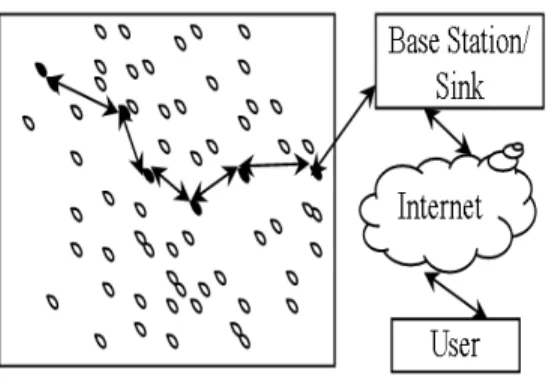
Figure 1.1 A typical WSN Setup with sensor nodes and Base Station/Sink ... 2
Figure 2.1 Components of a typical Wireless Sensor Node ... 22
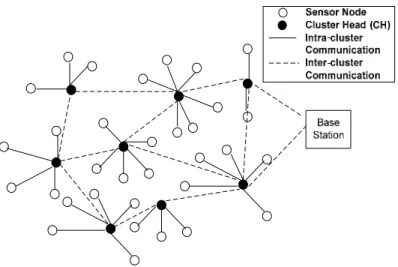
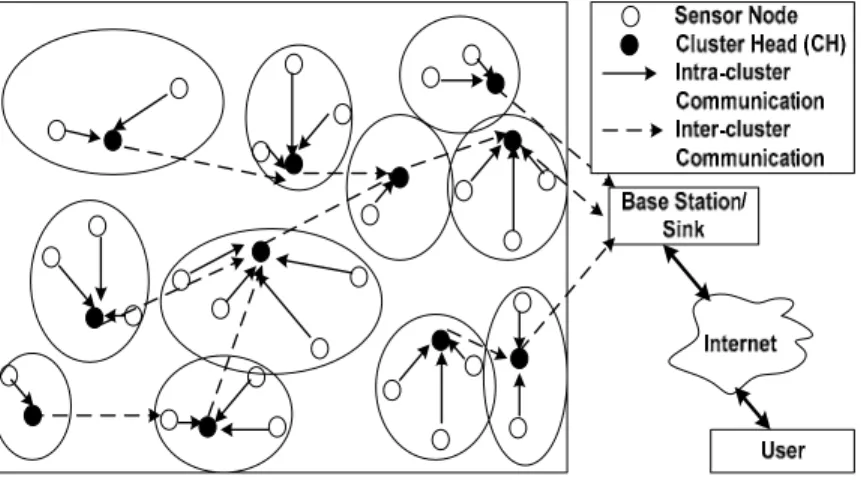
Figure 2.2 A typical Clustering based data gathering in a Wireless Sensor Network... 36
Figure 2.3 Generic Periodic sleep and listen schedule for network nodes ... 57
Figure 2.4 Joint mobility and routing strategy ... 61
Figure 2.5 Corona division and sink trajectories ... 63
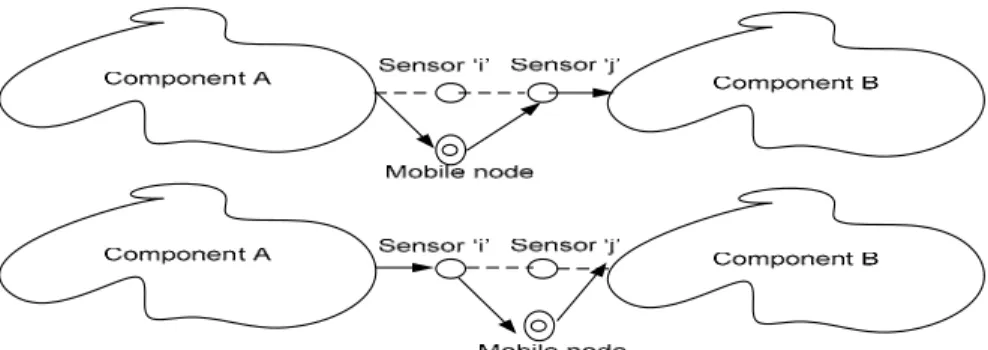
Figure 2.6 An example of using mobile relay nodes to prolong the network lifetime. ... 70
Figure 3.1 A typical Clustering based data gathering in a Wireless Sensor Network... 77
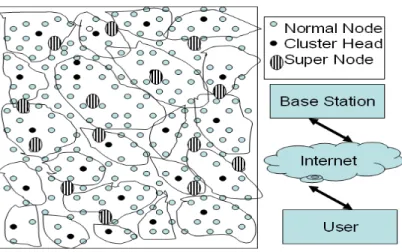
Figure 3.2 A typical QoSEC based data gathering in Wireless Sensor Network ... 80
Figure 3.3 Round of sensor network operations in QoSEC protocol ... 82
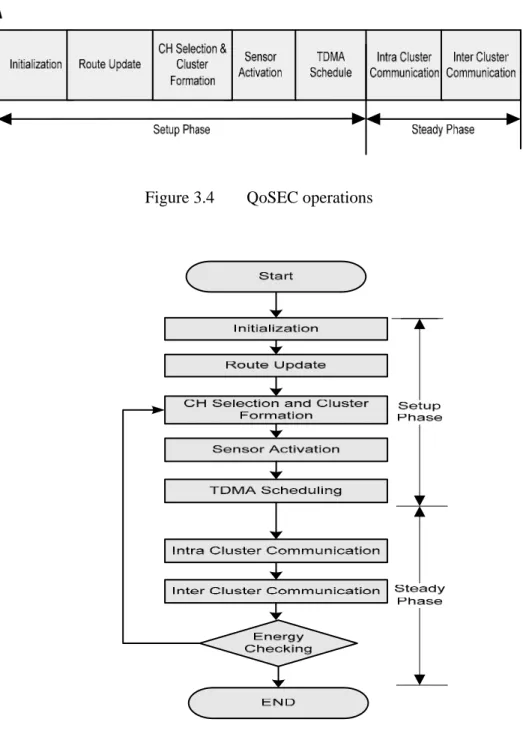
Figure 3.4 QoSEC operations ... 83
Figure 3.5 Flow chart of major phases and their interaction in QoSEC protocol .. 83
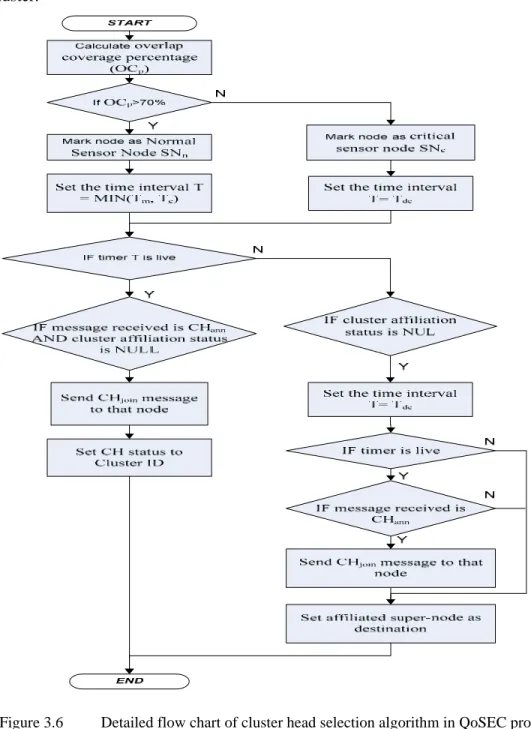
Figure 3.6 Detailed flow chart of cluster head selection algorithm in QoSEC protocol ... 86
Figure 3.7 Overlapping coverage percentage of two sensor nodes ... 89
Figure 3.8 An event diagram for the interaction between sensor nodes, CH and BS during simulation ... 94
Figure 3.9 Life cycle of sensor network operations in the QoSES protocol ... 102
Figure 3.10 Detailed flow chart of the QoSES protocol. ... 103
Figure 3.11 QoSES operations ... 104
Figure 3.12 Flow chart of major phases and their interaction in the QoSES protocol ... 104
Figure 3.13 Dividing a WSN in to three regions. ... 105
Figure 3.14 State transition in QoSES operations ... 107
Figure 3.15 Assignment of different sleep/wake schedules to nodes according to their distance from the BS. ... 108
Figure 3.16 The path wakeup pattern of nodes in three regions. ... 108
Figure 3.17 An event diagram for the interaction between sensor node and base station during simulation. ... 112
Figure 3.18 A typical QoSEM based data gathering in Wireless Sensor Network 119 Figure 3.19 Round of sensor network operations in QoSEM protocol ... 121
Figure 3.20 QoSEM operations ... 121
Figure 3.21 Flow chart of major phases and their interaction in the QoSEM protocol ... 122
Figure 3.22 Detailed flow chart of cluster head selection algorithm in the QoSEM protocol ... 130
Figure 3.23 An event diagram for the interaction between sensor nodes, CH and BS during simulation ... 136
Figure 4.1 Simple and compound modules ... 147
Figure 4.2 Sensor node’s simulation model ... 151
Figure 4.3 Average energy per packet for different number of sensor nodes ... 159
Figure 4.4 Network Lifetime ... 160
Figure 4.5 Average delay per packet for different number of sensor nodes ... 161
Figure 4.6 Packet loss ratio for different number of sensor nodes ... 162
Figure 4.7 Throughput (packet per second) for different number of sensor nodes ... 163
Figure 4.8 Coverage lifetime for different numbers of sensor nodes: (a) 100% coverage and (b) 90% coverage ... 165
Figure 4.10 Average energy per packet for different numbers of sensor nodes .... 171 Figure 4.11 Packet loss ratio for different number of sensor nodes ... 172 Figure 4.12 Throughput (packet per second) for different numbers of sensor
nodes ... 173 Figure 4.13 Coverage lifetime for different number of sensor nodes: (a) 100%
coverage and (b) 90% coverage ... 175 Figure 4.14 Average Energy Per Packet under different numbers of sensor nodes180 Figure 4.15 Network Lifetime ... 182 Figure 4.16 Throughput (packet per second) under different numbers of sensor
nodes ... 183 Figure 4.17 Average delay per packet for different number of sensor nodes ... 185 Figure 4.18 Packet loss ratio for different number of sensor nodes ... 187 Figure 4.19 Coverage lifetime for different numbers of sensor nodes: a) 100%
LIST OF TABLES
Table 4.1. Simulation parameters for QoSEC... 155 Table 4.2. Events summary for QoSEC ... 157 Table 4.3. Summary of performance comparison between LEACH, CPCP,
EEMC and QoSEC ... 166 Table 4.4. Simulation parameters for QoSES protocol ... 167 Table 4.5. Events summary for QoSES ... 168 Table 4.6. Summary of performance comparison between QoSES, S-MAC,
and Anycast protocol ... 176 Table 4.7. Events summary for QoSEM ... 177 Table 4.8. Summary of performance comparison between static sink, mobile
LIST OF ABBREVIATIONS ADV Advertisement ANN Announcement BS Base Station CH Cluster Head CLS Clear to send
CPCP Coverage Preserving Clustering Protocol
EEMC Energy Efficient Multilevel Clustering
GUI Graphical User Interface
LEACH Low Energy Adaptive Clustering Hierarchy
MAC Medium Access Control
MANET Mobile Adhoc Network
MEMS Micro-Electro-Mechanical-System
OMNeT++ Objective Modular Network Testbed in C++
QoS Quality of Service
RAM Random Access Memory
RFID Radio Frequency Identification
ROM Read Only Memory
RTS Request to Send
S-MAC Sensor Medium Access Control
TDMA Time Division Multiple Access
WI Wake Interval
1 INTRODUCTION
Chaptertableheading 1. ChapterTableHeading
CHAPTER 1 INTRODUCTION
This chapter presents a general overview of a Wireless Sensor Network (WSN). A brief description of QoS based energy efficient routing in a WSN in the perspective of the clustering approach, sleep/wake scheduling approach and mobile sink approach are presented. Next to follow is the statement of the problem, motivation to carry out this research work, and objectives to be accomplished during the research work. The balance of the chapter covers the scope, assumptions and limitations of the research work, research approach adopted and the research activities followed during this work. Finally, the chapter is concluded with the contributions and organization of the thesis.
1.1 Introduction to the Wireless Sensor Network
Recent development in Micro-Electro-Mechanical Systems (MEMS) has made the deployment of small sized sensor nodes possible and inexpensive (Akyildiz et al. 2002; Jennifer et al. 2008). The deployment of these sensor nodes for monitoring different events in a targeted environment is termed as a Wireless Sensor Network (WSN); this is illustrated in Figure 1.1. In a typical WSN setup, the sensors are randomly deployed in a region of interest. Placed near to these nodes is a Base Station (BS) or Sink, which is ultimately connected to the Internet. The primary task of the BS is to give commands to these nodes and to gather sensed data from the sensor nodes. Data is then accessible to end users through the Internet. To avoid redundancy in the gathered data, the sensor nodes sense the physical phenomenon and perform local data aggregation, before further transmitting the sensed data to the BS
Figure 1.1 A typical WSN Setup with sensor nodes and Base Station/Sink
1.2 QoS Based Energy Efficient Routing in the WSN
Quality of Serivce (QoS) refers to the ability of communication system to give different priorities to various traffics, based on their requirements to guarantee certain level of performance in the network, by controlling the resource sharing. QoS assures to provide certain level of service attributed by performance metrircs such as delay, packet loss ratio, throughput and coverage. Such performance metrics are usually known as the Quality of Service (QoS) of the communication network.
In typical WSN, sensor nodes are generally equipped with low processing power, low sensing power, less memory, and short-range communication, and most importantly have very limited battery power (Edgar and Callaway 2003). Randomly deployed in difficult terrain makes it almost impossible to recharge or replace the dead battery. Therefore, battery power in WSNs is considered a scarce resource and should be used efficiently. The terrm energy efficiency refers to the economical and efficient use of battery/energy of sensor node in WSN communication/routing protocols that can lead to prolong network lifetime.
Recently, routing protocols for the WSN proposed in literature, mostly consider energy efficiency as a key design issue. However, the advent of imaging sensors and multimedia applications of the WSN has defined new challenges in WSN protocol design. In such applications, in addition to energy efficiency, other issues of primary concern are delay, packet loss ratio, throughput and coverage. Such performance
Sensor node Reporting data
metrics are usually referred to as the Quality of Service (QoS) of the communication network. Thus, routing multimedia data needs careful handling to have energy efficiency as well as timely delivery of data within an acceptable delay range. In this thesis, a QoS based energy efficient routing protocol in a WSN is considered. To achieve QoS and energy efficiency in this thesis, three potential prospects are targeted, namely the clustering protocol, sleep/wake protocol and mobile sink based protocol. The brief descriptions of clustering approach, sleep/wake approach, and mobile sink approach are shown below:
1.2.1 Clustering Approach
In the cluster-based approach, the whole WSN is divided into a number of small regions known as clusters. In each cluster, one node is elected as the Cluster Head (CH). The elected CH is responsible for aggregating the sensed data from its cluster member nodes and forwarding it to a BS or to the next CH. As the CH has to relay the data of all member nodes, and if it is continuously selected as CH for a longer period, its energy will be depleted earlier than the other cluster member nodes. Ultimately, these nodes die, which leads to the emergence of energy holes in the WSN. To solve this problem, the task of CH is periodically assigned in a round fashion to other nodes. In each round, responsibility of the CH is alternately taken by a different cluster member node in a cluster. A new CH is selected randomly or based on parameters such as residual energy, distance from BS, connected nodes, and topology structure. To forward data to a BS, multi-hop CH communication is performed, where every CH sends sensed data to the other CH in its neighborhood, which is near to the BS.
1.2.2 Sleep/wake Scheduling Approach
Sleep/wake scheduling is an effective energy-conservation mechanism. The breakup of the energy expenditure has shown that radio components consume much more energy than sensing and processing sub-systems. The radio transceiver of a sensor node performs two tasks: transmitting and receiving data. It has three states/modes:
active state, idle state and sleep state. In the active (transmit) state, the transmit part of the transceiver is active and the antenna radiates energy. In the active (receive) state the receive part is active. A transceiver that is ready to receive but not receiving is said to be in an idle state. In the idle state, many parts of the receive circuitry are active. When a sensor node is in the low power state and significant parts of the transceiver are switched off, it said to be in the sleep state.
Generally WSNs operate for a long time in idle mode and only occasionally send data. Energy consumption when listening to the idle channel is equivalent to its energy consumption when sending or receiving, and much higher than the energy consumption while in the sleep mode (Akyildiz et al. 2002). This fact is exploited by sleep/wake scheduling techniques and effort is made to reduce this energy wastage in the idle mode. The mechanism of alternately switching between the sleep and wakeup mode to avoid energy wastage is termed as sleep/wake scheduling or the duty cycling scheme. Sleep/wake scheduling is regarded as the most effective mechanism for energy conservation and significantly prolongs the network lifetime in a WSN. To achieve the minimum energy consumption, the transceiver should be mostly in the sleep state and be activated (wakeup state) only when required. Clearly, the best scenario is that a sensor node wakes up once and finishes all operations continuously, but practically it is not possible to have such an ideal coordinated and synchronized environment. Thus, the main objective of sleep/wake scheduling is to put the transceiver in the sleep state during idle periods (when there are no events). Significant energy savings can be accomplished by designing sleep/wake schemes that can let the sensor’s transceivers remain in sleep mode for as long as possible, and at the same time retain network connectivity and coverage.
A variety of sleep/wake scheduling protocols has been proposed in the literature. Most of them use periodic sleep/wake intervals and provide effective energy conservation at the cost of delay and throughput. For example, for a source node to transmit data, it has to know the sleep/wakeup schedule of the neighbor node and has to wait for the neighbor to come to the active state. The same is repeated until the data reaches the final destination thus resulting in unprecedented delays. This increase in delay is equal to the product of the number of intermediate forwarders times the
length of the wakeup interval (Lee et al. 2008). Such increase in end-to-end delay incurred due to the latency-energy trade off has the potential to become a major problem in many emerging delay-sensitive WSN applications, which require a fast response and real-time control.
1.2.3 Mobile Sink Approach
In this section, QoS based energy efficient routing in the WSN is achieved by introducing mobility in the network. It could be done by introducing mobile sensor nodes, a mobile relay or a mobile sink.
Routing data from source sensor nodes to a sink is a common and challenging task in most of WSN applications. In a typical WSN architecture, the sink is static and sensor nodes use multi-hop communication to forward their data to the sink. Each sensor node sends data to neighboring sensor nodes, and so on until the data reaches the BS. Ultimately, nodes nearest to a BS send data directly to the BS. However, the potential disadvantage of this technique is that the sensor nearest to the BS may over utilize their energy, resulting in depletion of the sensor node’s energy nearest to the BS. This problem is termed as a hot spot or energy-hole problem. A hot spot problem refers to the phenomenon when the nodes near the sink quickly drain their energy on account of relaying the data of the nodes farther from the sink. As a result, although the nodes farther from the sink have significant energy left, their energy cannot be utilized as the nodes near to the sink have depleted their energy. Hence, data cannot be sent to the sink across the hot spot or energy hole near the sink. Consequently, they cannot forward their data to the BS and it limits the network lifetime. The hot spot problem is an inherent phenomenon in WSNs with a static sink, and can significantly decrease the lifetime of the overall network. The static nature of the sink is the main reason behind the hot spot problem, as the same nodes near the sink have to forward the data all the time. The main advantage, though, of the static sink approach is that it involves less end-to-end delay.
In recent years, contrary to the static sink, the mobile sink approach has attracted much research interest because of an increase in its potential with WSN applications
and its potential to improve network performance such as energy efficiency and throughput. However, the main disadvantage of the mobile sink approach is that it encounters long end-to-end delay.
1.3 Problem Statement
In this thesis, the QoS based energy efficient routing protocol for the WSN is presented, which can extend the network lifetime as well as be able to full fill the QoS requirement of the data. The proposed protocols consider energy efficiency as well as QoS as primary design objectives. To achieve QoS and energy efficiency in this thesis, the main problem is divided in to three sub-problems namely: clustering, sleep/wake and mobile sink protocols. A brief description of the problems addressed in these three issues is as follows:
1.3.1 Clustering Approach
Clustering has been identified to be an energy-efficient routing technique in WSNs. With the clustering approach, data forwarding to the sink/BS is performed by using multi-hop communication; in this way, each CH sends data to its neighboring CH, and this continues until the data finally reaches the BS. Ultimately, the BS receives data from the nodes nearest to it directly. However, a possible disadvantage of this technique is that, the CH nearest to the BS may utilize too much of its energy, which results in depletion of the sensor node’s energy nearest to the BS. This situation is called a hot spot or energy-hole problem and it is an inherent phenomenon in WSNs, and can cause a significant decrease the lifetime of the overall network. As in this scenario, though the nodes which are a farther distance away from the BS still have a significant amount of energy left, but their energy cannot be utilized as the nodes nearer to the BS have already died. As a result, they cannot forward their data to the BS. The other problem is that, in most of the algorithms presently available for CH selection, the optimization is done on a single parameter; this could be residual energy, distance from the BS, connected nodes, coverage lifetime, and so forth. Moreover, the optimization of this single parameter has resulted in performance
degradation for the other parameters. For instance, if residual energy is considered as the optimization parameter, it may optimize the lifetime of the network, but the coverage of the network will be the trade-off and vice versa.
To address these two problems, a QoS based energy efficient clustering protocol for the WSN has been proposed. (Section 3.1.1 contains the detailed problem statement of the proposed protocol).
1.3.2 Sleep/wake scheduling approach
Sleep/wake scheduling has been used to save energy and extend the network lifetime. Energy efficiency has an inherent tradeoff with delay; thus, generally in such sleep/wake scheduling strategies, maximization of network lifetime is achieved at the expense of increase in delay. This delay is unacceptable for many delay-sensitive applications, which requires the event reporting delay to be small; such situations would be in military surveillance, tsunami warnings, seismic detection, biomedical health monitoring, hazardous environment sensing, and fire detection. In most sleep/wake schemes found in literature, all nodes have the same generic sleep/wake schedule and each node takes autonomous wake up decisions without considering their neighbors in order to save energy. However, as WSNs use multi-hop communication, every node has one designated next-hop forwarding node in the neighborhood and to do the transmission, the sender node has to wait for the arrival of the wakeup time of the next hop forwarding node. Similarly, the next relay nodes have to wait for the wakeup interval of its next hop and so on, until the message reaches the BS. Consequently, due to the different wakeup intervals, additional delays are added at each hop as the packet is forwarded along the path to the sink; this is because each node has to wait for its next-hop node to wake up before it can transmit the packet. All these delays at each hop contribute to the final end-to-end delay of the packet. The previous studies in sleep/wake scheduling are able to achieve energy efficiency, but do not consider these delays, which occur during sleep/wake scheduling.
To address the delay minimization problem, a QoS based energy efficient sleep/wake scheduling protocol for the WSN have been proposed. (Section 3.2.1 contains the detailed problem statement of the proposed protocol).
1.3.3 Mobile Sink Approach
In WSNs, sensors near the static sink have to relay the data of the nodes away from the sink and as a result they drain their energy very quickly. It results in network partitioning and can significantly limit the network lifetime; this problem is termed as a hot spot problem. Contrary to the static sink, in recent years, the mobile sink approach has been used to address the hot spot problem but it increases end-to-end delay which is not acceptable for delay sensitive applications. Additionally, recently with an increase in multimedia WSN applications, QoS in routing has emerged as a critical issue. Sensor nodes generate different types of traffic which has differentiated forwarding requirements based on their bandwidth and delay.
To address three issues namely, the hot spot problem, delay minimization and QoS assurance, a QoS based energy efficient mobile sink based routing protocol for the WSN have been proposed. (Section 3.3.1 contains the detailed problem statement of the proposed protocol).
1.4 Motivation
Sensor nodes have limited energy and low bandwidth constraints. These constraints are added to by large scale deployment made energy aware as core design issues at different layers of the network protocol stack including the network layer. Due to the large scale, random deployment, limited hardware resources, un-rechargeable battery power, hostile environment and failure prone nature routing in WSNs has been made a challenging area in WSNs. In routing, most of the protocols found in literature have considered energy awareness as a key design issue in order to maximize the network (Chalermek et al. 2000; Estrin et al. 1999; Heinzelman 2000; Shah and Rabaey 2002; Sohrabi et al. 2000; Wendi Rabiner et al. 1999; Younis et al. 2002). Factors like
throughput, latency and delay are not issues of primary concern in these protocols and the approach is acceptable, since they are mostly dealing with a small amount of data flowing in low rates. However, with the emergence of new WSN applications that involve multimedia and imagining sensors, routing in WSNs has come across new challenges. Reporting of data in these multimedia and imaging WSN applications, requires minimum end-to-end delay within acceptable limits. In such applications, in addition to energy efficiency; latency, throughput and delay also become issues of primary concern. Such performance metrics are usually referred to as the quality of service (QoS) of the communication network.
Therefore, to have efficient use of sensor node energy and ability to report the imaging and multimedia data in a timely manner within an acceptable range, requires both energy and a QoS based routing protocol. Thus, there is need for a paradigm shift from conventional energy efficient protocols to the recent QoS based energy efficient protocols. WSN applications which benefit from QoS based protocols include military surveillance, real time target tracking in battle environments, tsunami alarms, smart hospitals, seismic detection, biomedical health monitoring, hazardous environment sensing, fire detection, intrusion detection, disaster monitoring, and real-time control. Generally, these applications deal with real real-time data and need a certain bandwidth with the minimum possible delay. In such scenarios, to guarantee the reliable delivery of real-time data, a service differentiation mechanism is needed. QoS based energy efficient routing in WSNs will provide the energy efficient path as well as guarantee certain bandwidth with the minimum possible delay. The need for QoS based energy efficient schemes that can prolong the network lifetime as well as guarantee QoS motivated this research. The main motivation behind this work is to study various issues and strategies of QoS based energy efficient data gathering and propose a QoS based energy efficient routing protocol for wireless sensor networks. The proposed protocols consider energy efficiency as well as QoS as primary design objectives and can be applied to emerging delay constrained WSN applications. To achieve QoS and energy efficiency in this thesis, three heuristics namely: clustering, sleep/wake and mobile sink protocols are proposed.
1.5 Objectives
This work is focused on routing that can provide energy efficiency as well as guarantee QoS, while reporting the data from sensor nodes to the BS. The main objective of this thesis is to provide QoS based energy efficient routing for WSNs at three levels: clustering approach, sleep/scheduling approach and mobile sink approach. In this perceptive the primary objectives of this thesis are the following. 1.5.1 To study and analyze the QoS and energy efficiency problems in clustering. To
design, develop and evaluate a clustering protocol for WSNs that can extend network lifetime as well guarantee QoS.
1.5.2 To study and analyze the QoS and energy efficiency problems in the sleep/wake scheduling approach. To design, develop and evaluate a sleep/wake scheduling algorithm for WSNs that can that can extend network lifetime as well guarantee QoS.
1.5.3 To study and analyze the QoS and energy efficiency problems in mobile sink based routing in WSNs. To design, develop and evaluate a mobiles sink based routing protocol for WSNs that can extend network lifetime as well guarantee QoS.
1.5.4 To verify through extensive simulation the performance of the proposed protocols with the established and state of the art contemporary protocols.
1.6 Scope and Limitations
The solutions proposed in this study provide WSNs routing, which can increase network lifetime as well as guarantee QoS with low delay, high throughput, low packet loss and better coverage. This research studies the QoS based energy efficient routing in WSNs. It considers solutions to the QoS based energy efficient routing at three levels: clustering approach, sleep/wake scheduling approach, and mobile sink based approach. It develops protocols for QoS based energy efficient clustering (QoSEC) protocol, QoS based energy efficient sleep/wake (QoSES) scheduling
protocol and QoS based energy efficient mobile sink (QoSEM) based routing protocol for WSNs. Afterwards, simulations are carried out to evaluate the performance of the proposed protocols in comparison with contemporary protocols. The proposed protocols deals with QoS based routing considering the above three issues; issue like network deployment, data aggregation, data fusion and security issues, are out of scope of this research. The proposed protocols also deal with static sensor nodes; how routing is done in sensor nodes with mobility is out of the scope of this work. The proposed protocols work at the network layer and use available protocols for other layers. In-sight details on how data is handled and communication takes place at other layers are also not in the scope of this thesis.
1.7 Assumptions
This section outlines the assumptions that were made in this thesis. Supported by literature review and evident from most of emerging WSN applications, it is assumed that the WSNs considered in this research deal with static sensor nodes with non-rechargeable limited batteries. Nodes are randomly deployed across a sensing field, nodes cannot communicate directly with the BS, and use multi-hop communication to propagate the data to the BS, which is located away from sensing field. Supported by the majority of WSN applications, it is assumed that the BS is rich in resources with a constant power supply and can directly communicate with all the nodes in the network. The focus of this research work is on the network layer; operations at other layers are assumed to be working appropriately. It is important to note that in proposed model, no assumptions are made about 1) the homogeneity of node dispersion in the field, 2) the network density or diameter, 3) the distribution of energy consumption among sensor nodes, 4) the proximity of querying observers, 5) the ability to communicate with the BS, and 6) each node having a fixed communication range.
1.8 Research Approach
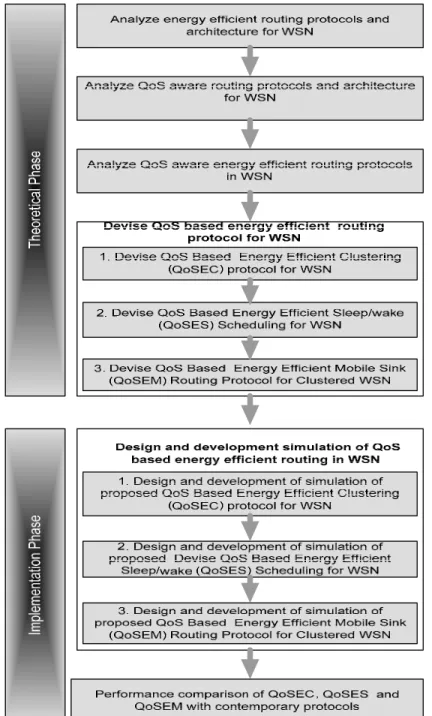
In order to develop a QoS based energy efficient routing protocol for WSNs, the steps followed are described below:
a. Study and analyze the different types of QoS based energy efficient routing protocols in WSNs. Analyze the potential issues and problems in exiting QoS based energy efficient routing protocols.
i. QoS based energy efficient clustering protocol for WSNs.
ii. QoS based energy efficient sleep/wake scheduling protocol for WSNs. iii. QoS based energy efficient mobile sink based routing protocol for
WSNs.
b. Design the QoS based energy efficient clustering protocol for WSNs to achieve maximum energy efficiency and guarantee QoS.
c. Design the QoS based energy efficient sleep/wake scheduling protocol for WSNs to achieve maximum energy efficiency and guarantee QoS.
d. Design the QoS based energy efficient mobile sink based protocol for WSNs to achieve maximum energy efficiency and guarantee QoS.
e. Implement, prototype and simulate the architecture of the three proposed protocols. The protocols are implemented using OMNet++, which is a well known discrete event simulator. Extensive simulations are carried out for the performance comparison of the proposed protocols with contemporary protocols.
1.9 Research Activities
The overall approach or methodology of the thesis can be described as follows (see Figure 1.2):
1.10 Research Contributions
This thesis makes the following research contributions to the current state-of-the-art in the field of QoS based energy efficient routing in WSNs. The main contributions of this thesis work are as follows.
1.10.1 Propose, develop and analyze a new QoS based energy efficient clustering (QoSEC) protocol for WSNs to achieve QoS and energy efficiency by guaranteeing minimum end-to-end delay and maximum energy efficiency (Section 3.1 contains the detailed discussion of the proposed QoSEC protocol). There are two (2) main contributions of this protocol.
1.10.1.1 Firstly, a QoS based energy efficient clustering protocol for WSNs is proposed, which addresses two major problems: a) To address the hot spot problem, extra capability nodes in addition to normal nodes are introduced in the WSN. These nodes act as local sinks and collect data from the CH in their vicinity. Thereby, significantly decreasing traffic flow towards the BS and ultimately minimizing the hot spot problem. b) Two algorithms for CH selection and sleep/wake scheduling are proposed. These algorithms use coverage as well as energy, as selection parameters in CH selection and in sleep/wake scheduling. The objective is to increase network lifetime without affecting coverage.
1.10.1.1 Secondly, extensive simulations are carried out that have shown that the performance of the proposed QoSEC protocol is better than the performance of other contemporary protocols like LEACH, CPCP and EEMC. This is because QoSEC prolongs the network and coverage lifetime, as well as improves the other QoS routing parameters, such as delay, packet loss ratio, and throughput.
1.10.2 Propose, develop and analyze a new QoS based energy efficient sleep/wake (QoSES) protocol for WSNs to achieve QoS and energy efficiency by guaranteeing minimum end-to-end delay and maximum energy efficiency (Section 3.2 contains the detailed discussion of the proposed QoSES protocol). The main contributions of QoSES can be summarized as follows:
1.10.2.1 Firstly, the QoS based energy efficient sleep/wake protocol for WSNs has been introduced to address the delay minimization problem. In order to reduce delay, QoSES identifies nodes for different sleep/wake intervals based on their traffic load at three levels: a) Bbased on their distance from the BS. b) Based on their topological importance in the network. c) Based on handling burst traffic in the vicinity of the specific node where the event occurs. It then assigns different active intervals to the nodes, according to their variable traffic load requirement. Using these heuristics the proposed protocol reduces end-to-end delay and maximizes the throughput by minimizing the congestion at nodes with heavy traffic loads.
1.10.2.2 Lastly, extensive simulations are carried out to evaluate the performance of the QoSES, by comparing its performance with Anycast and S-MAC protocols. The results demonstrate that QoSES has successfully minimized the end-to-end delay, as well as has improved the other QoS routing parameters like average energy per packet, packet loss ratio, throughput and coverage lifetime.
1.10.3 Propose, develop and analyze a new QoS based energy efficient mobile sink (QoSEM) based protocol for Clustered WSNs to achieve QoS and energy efficiency by guaranteeing minimum end-to-end delay and maximum energy efficiency (Section 3.3 contains the detailed discussion of the proposed QoSEM protocol). The main contributions of QoSEM can be summarized as follows:
1.10.3.1 Firstly, the QoS based energy efficient mobile sink based protocol for Clustered WSNs is proposed, which addresses three major problems (hot-spot problem, delay minimization and QoS assurance): a) To address the hot-spot problem, a mobile sink is used, which moves across the network to gather data. b) To address delay minimization in the mobile sink approach, a static sink is used in addition to the mobile sink. Delay sensitive data is forwarded to the static sink while the delay tolerant data is sent through the mobile sink. c) For QoS assurance, incoming traffic is prioritized and divided into different
classes based on the message type and content. The objective is to increase network lifetime and provide QoS.
1.10.3.2 Lastly, extensive simulations are carried out to evaluate the performance of the QoSEM, by comparing its performance with static sink and mobile sink approaches. The results demonstrate that QoSEM has successfully minimized the end-to-end delay, as well as improved the other QoS routing parameters like average energy per packet, packet loss ratio, and throughput.
1.11 Thesis Organization
The rest of this thesis is organized as follows:
• Chapter 2 provides the overall background knowledge, and discusses the related work relevant to this research work that forms the core of this thesis. It includes an overview of WSNs, parts, type and hardware configuration of a typical sensor node, applications of WSNs and challenges encountered in protocol design for WSNs communication protocol. Furthermore, it discusses the literature review in the context of three prospects: clustering approach, sleep/wake scheduling approach, and mobile sink based approach. The clustering approach sub-section outlines the clustering objectives, discusses the detailed literature review of clustering protocols (Variable convergence time algorithms, Constant convergence time algorithms), and ends the sub-section with a brief description of the problem statement. Next to follow is the sleep/scheduling approach sub-section which discusses the detailed literature review of sleep/scheduling schemes (On-demand Schemes, Scheduled rendezvous schemes, Asynchronous Schemes) and concludes the sub-section with a brief description of the problem statement. Lastly, the mobile sink based approach sub-section discusses the existing literature on mobile sink based approaches (Mechanisms using mobile sinks, Mechanisms using mobile sensors redeployment, Mechanisms using mobile relays) and contains a brief description of the problem statement at the end of sub-section.
• Chapter 3 discusses the three proposed protocols in detail, namely: QoS based Energy Efficient Clustering (QoSEC) for WSNs, QoS based Energy Efficient Sleep/wake (QoSES) Scheduling for WSNs, and QoS based Energy Efficient Mobile Sink (QoSEM) based Routing Protocol for Clustered WSNs. Each protocol discussion starts with the detailed problem description, network model and assumptions, preliminaries (proposed protocol overview, data structures used at sensor node), and a description of the workings of the proposed protocols.
• Chapter 4 starts with the Network Simulator types (Discrete Event Simulator, Continuous Time Simulator), overview of OMNeT++, Selection of the WSN Simulator, Modeling and Simulation using OMNeT++, (OMNeT ++ overview, OMNeT++ Framework and Simulation Design (hardware, radio, network)). The chapter is concluded with a detailed discussion of simulation results (Simulation setup, Event Summary, energy model and simulation results/discussion) for the three proposed protocols: QoSEC, QoSES and QoSEM.
• Chapter 5 presents the conclusion of this research, followed by the key contribution of this research and the chapter is concluded with the highlights of some of the recommendations for future work.
• Lastly, a list of our publications during this research work is provided.
1.12 Summary
In this chapter, a basic overview of the thesis has been presented, covering the fundamentals, like: general overview, statement of problem, motivation, objectives, scope, assumptions and limitations, research approach adopted, research activities, and contributions of the thesis.
Tip 2. ChapterFigure Heading
Chaptertableheading 2. ChapterTableHeading
2 BACKGROUND KNOWLEDGE AND LITERATURE REVIEW
CHAPTER 2
BACKGROUND KNOWLEDGE AND LITERATURE REVIEW
Chapter 2 hapter 2 provides the overall background knowledge, and discusses the related work relevant to this research work that forms the core of this thesis. It includes an overview of WSNs, parts, type and hardware configuration of a typical sensor node, applications of WSNs and challenges encountered in protocol design for WSNs communication protocol. A systematic review of the related work and issues in the existing QoS aware energy efficient approaches is presented. Related work on QoS aware routing in WSNs is presented in the perspective of the clustering approach, sleep/wake scheduling, and mobile sink approach. This chapter discusses in detail the clustering approach and the important review of the literature under two major clustering categories: variable convergence time and constant convergence time clustering algorithms. Next to follow is a detailed discussion of different sleep/wake scheduling algorithms, including the important Sleep/wake scheduling scheme under three major categories: On-demand Schemes, Scheduled rendezvous schemes and Asynchronous Schemes. Lastly, the chapter presents a detailed discussion of related work on the mobile sink approach including three main categories: Mechanisms using mobile sinks (Algorithms with pre-determined sink mobility path, Algorithms with autonomous sink movement), Mechanisms using mobile sensors redeployment and Mechanisms using mobile relays are discussed. At the end of each of these three related work sections, potential problem statements are briefly discussed and supported, and proposed solutions are overviewed.
2.1 Overview of Wireless Sensor Network
Recent development in Micro-Electro-Mechanical Systems (MEMS) has made the deployment of small sized sensor nodes possible and inexpensive (Akyildiz et al. 2002; Jennifer et al. 2008). The deployment of these sensor nodes for monitoring different events in a targeted environment is termed as a Wireless Sensor Network (WSN). Karl and Willig (2005).define WSNs as follows:
“These networks consist of individual nodes that are able to interact with their environment by sensing or controlling physical parameters; these nodes have to collaborate to fulfill their tasks as, usually, a single node is incapable of doing so; and they use wireless communication to enable this collaboration.”
Olariu (2006) defined a WSN as follows:
“A sensor network is a deployment of massive numbers of small, inexpensive, self-powered devices that can sense, compute and communicate with other devices for the purpose of gathering local information to make global decisions about a physical environment.”
In the WSN, tiny sensor nodes equipped with sensors (such as temperature sensors, pressure sensors, and light sensors) are randomly or deterministically deployed over a region of interest (termed as a sensing field) to detect physical phenomenon. Sensor nodes monitor the sensing field for the occurrence of the required physical phenomenon. They send the sensed data to the Base Station (BS), either directly or using multi-hop communication. The WSN design significantly depends on the type of application, and is subject to change depending upon the sensor nodes’ hardware resources, environment, cost, and other system constraints (Jennifer et al. 2008).
2.1.1 Typical WSN
In a typical WSN setup, the sensors are randomly deployed in a region of interest or sensing field. Placed near to these nodes is a Base Station (BS) or Sink, which is ultimately connected to the Internet. The primary task of the BS is to give commands to these nodes and to gather sensed data from the sensor nodes. Data is then accessible to end users through the Internet. To avoid redundancy in the gathered data, the sensor nodes sense the physical phenomenon and perform local data aggregation, before further transmitting the sensed data to the BS.
A typical WSN consists of a sensor node, relay or router node, base station, and sink. Sensor nodes do the actual task of sensing the environment and reporting the sensed data to the network. A relay node or router node is responsible for forwarding the sensed data from the sensor node to the BS. Depending upon the application, the relay/router node can be an ordinary sensor node that forwards the sensed data received from its neighbors to the BS using multi-hop communication or it can be other specialized resource rich nodes responsible for collecting data from the sensor node and relaying it to the BS. In this thesis, the first case is considered, and thus terms node, relay node, and forwarding nodes are interchangeably used. A base station (BS), access point or gateway is responsible for sending the command/query to all the sensor nodes in the network and collecting the sensed data from the sensor nodes. The BS is always a sink and all the traffic to be reported by the sensor nodes draws to it. It is generally a resource rich device and has no resource constraints as compared to the sensor node and can be connected to another network, for example, the Internet. Using the Internet, the user can access and analyze the sensed data gathered at the BS.
2.1.2 Sensor Node
A sensor node in a WSN is an entity that performs the actual task of sensing the environment. It monitors the environment for occurrence of physical phenomenon within its sensing field, and passes the sensed data to the neighboring sensor node. Each sensor node also acts as a relay node or router node and forwards the packets
from their neighboring sensor nodes, until the packet reaches the BS. A typical sensor node consists of processor, memory, sensing, power supply, and transceiver; sometimes it may even include mobility, location, and actuator module. Generally, a sensor node is composed of a low-power CPU, tiny memory (RAM/ROM), RF module, many kinds of sensor devices, and low-power batteries. Four basic components: a sensing unit, a processing unit, a transceiver unit and a power unit, comprise the basic sensor node and are depicted in Figure 2.1 redrawn from (Akyildiz et al. 2002).
2.1.2.1 Basic Components of typical sensor node
The following is a brief discussion about the basic components of a typical sensor node (see Figure 2.1).
Figure 2.1 Components of a typical Wireless Sensor Node
a) Sensing units
The sensing unit is responsible for sensing the required physical phenomenon and makes it available to other units for further processing. The sensing unit is generally composed of two components, namely: the sensor and the analog to digital converters (ADCs). The sensor is responsible for sensing the environment for any occurrence of the required physical phenomenon, which is in the form of an analog signal. ADCs convert the analog signals produced by the sensors into digital signals, which are then fed into the processing unit. They serve as the actual interface to the physical world; they are devices that can observe or control the physical parameters of the
environment. Although application dependent, a sensing unit can be composed of a single sensor or a group of sensors to sense the phenomenon like temperature or humidity. A group of sensors may include mechanical sensors, thermal sensors, acoustic sensors, optical sensors, and electromagnetic sensors (Lewis 2004).
b) The processing unit
The processing unit contains a micro-controller, small memory unit, and storage unit to store and buffer sensed data during processing (Vieira et al. 2003). It is the controller that processes all the relevant data, capable of executing an arbitrary code. The processing unit is responsible for processing the sensed information which may involve executing arbitrary codes, processing all the relevant data (checking the observed data against required information, aggregation of observed data) and other processing involved at different layers. It runs algorithms and protocols. It contains some memory to store programs and intermediate data; usually, different types of memory are used for programs and data.
c) A transceiver unit
A transceiver unit is responsible for sending /receiving the sensed data over a wireless channel. It connects the node to the network. A transceiver could use a radio frequency, infrared, or a laser for communication (Vieira et al. 2003).
d) Power units
A power unit is used to supply power with battery or energy scavenging techniques (Muruganathan et al. 2005). Considering the ad hoc nature of WSN deployment, no tethered power supply is available for sensor nodes and thus batteries are necessary to provide energy. It makes the power unit one of the most important components of a sensor node. This unit is responsible for providing the power necessary to work the senor node unit. Although, like other sub-units of sensor nodes, it is application
dependent, generally sensor nodes have very low non-rechargeable battery power. For some applications, sensor nodes are provided with a power scavenging unit such as solar cells and other forms of recharging which obtain energy from the environment.
2.1.2.2 Energy consumption of sensor node
A typical sensor node consists of a processor, memory, sensing module, power supply, and transceiver. A sensor node consumes its battery in the following four operations: sensing data, receiving data, sending data, and processing data. Generally, the most energy-consuming component is the RF module that provides wireless communications. Consequently, out of all the sensor node operations, sending/receiving data consumes more energy than any other operation. The energy consumption for transmitting 1 bit of data on the wireless channel is equivalent to the energy required to execute thousands of cycles of CPU instructions (Jennifer et al. 2008). The breakup of the energy expenditure has shown that the radio component consumes much more energy than sensing and processing sub-systems. A radio transceiver of a sensor node performs two tasks: transmitting and receiving data. It has three states/modes: active state, idle state and sleep state. In the active (transmit) state, the transmit part of the transceiver is active and the antenna radiates energy. In the active (receive) state the receive part is active. A transceiver that is ready to receive but not receiving is said to be in an idle state. In the idle state, many parts of the receive circuitry are active. When a sensor node is in thelow power state and significant parts of the transceiver are switched off, it said to be in the sleep state. There can be different types/levels of sleep state, depending upon the amount of circuitry switched off, associated recovery times and startup energy (Wang et al. 2001). Interested readers may check out (Myers et al. 2000) for types and explanations of the different sleep states for IEEE 802.11 transceivers. In general, in the sleep state, transceiver circuitry is turned completely off and nodes wake up again with the use timers. In conclusion, the transceiver’s energy consumption in different states shows that the transceiver in idle mode consumes the same amount of energy as when the in transmitting or receiving mode. Conversely, the transceiver consumes
significantly less energy in the lower power sleep mode as compared to the idle, sending or receiving mode (Akyildiz et al. 2002).
Efficient use of energy in WSN communication protocols largely affects the network lifetime of the WSN and could lead to a longer network lifetime if the energy is used efficiently in the communication protocols. Hence, any MAC, network, and transport layer protocols designed for WSNs should make sure of efficient use of the RF module by minimizing MAC collision, control message overhead in routing, efficient sleep/wake scheduling and so on.
2.1.2.3 Typical sensor node hardware configuration
A typical sensor node consists of a processor, memory, sensing, power supply, and transceiver, and may even include mobility, location, and actuator module. Generally, a sensor node is composed of a low-power CPU, tiny memory (RAM/ROM), RF module, many types of sensor devices, and low-power batteries (Jennifer et al. 2008). For instance, Berkeley’s MICA motes only have an 8-bit CPU, 4KB RAM, and only two AA-Alkaline batteries (Akyildiz et al. 2002).
2.2 Applications of WSN
WSNs have facilitated many application areas over the years and triggered the emergence of entirely new applications. Some of the important WSN application areas are as follows, the list is not exhaustive and only mentions important classes of applications:
2.2.1 Medicine and health care
The WSN is considered as a key area in health science applications (Alemdar and Ersoy 2010) and hence, is able to find diverse applications. Use of WSNs in medicine and health care could assist in the healthcare services from emergency response, in-hospital communications, out-of-in-hospital monitoring, environmental monitoring,