RESEARCH PAPER
No 30
Quantifying skill needs
in Europe
Occupational skills profiles:
methodology and application
Quantifying skill needs
in Europe
Occupational skills profiles:
methodology and application
A great deal of additional information on the European Union is available on the Internet.
It can be accessed through the Europa server (http://europa.eu). Cataloguing data can be found at the end of this publication. Luxembourg: Publications Office of the European Union, 2013
ISBN 978-92-896-1155-8 ISSN 1831-5860
doi: 10.2801/13390
The European Centre for the Development of Vocational Training (Cedefop) is the European Union’s reference centre for vocational education and training. We provide information on and analyses of vocational education and
training systems, policies, research and practice. Cedefop was established in 1975 by Council Regulation (EEC) No 337/75.
Europe 123, 570 01 Thessaloniki (Pylea), GREECE PO Box 22427, 551 02 Thessaloniki, GREECE Tel. +30 2310490111, Fax +30 2310490020 E-mail: [email protected] www.cedefop.europa.eu
Christian F. Lettmayr, Acting Director
Foreword
How are skills profiles in different jobs evolving in response to technological progress and the shift to a knowledge economy? Should qualifications profiles be adapted to reflect changes in the demand for skills? Is it possible to anticipate and quantify trends in the supply and demand for specific skills?
Addressing these questions demands comprehensive information on workers’ occupational skills profiles and job requirements.
Analysing skill needs in Europe is currently constrained by lack of data and appropriate classifications. The European statistical information system provides information on occupations and qualifications, which can only act as proxies for skill demand and supply. The European skills, competences and occupations taxonomy (ESCO) will be a valuable tool to link qualifications to skills and competences to occupations. It will bridge the information gap between the worlds of work and education and training. However, ESCO is only under development.
In the meanwhile, it is possible to develop skills profiles by making the most of available statistical sources at national, European and international levels. For this, Cedefop has set up an experimental methodology to define occupational skills profiles suitable for analysing the European labour market. This has been done by largely using the European social survey and the O*NET – the US primary description of knowledge, skills and abilities in occupations – as well as information drawn from German, Italian and Czech skills surveys. Cedefop’s approach is consistent with the European qualifications framework.
The occupational skills profiles developed by Cedefop can be used to summarise the most essential characteristics of a given occupation: not only the level and field of education and training required, but also requirements in terms of knowledge, skills, abilities and attitudes. They allow deeper analysis of skills requirements by sector and occupation across countries and over time. Their area of application extends to skill needs forecasting and the investigation of skill mismatch between qualifications and job requirements.
I trust that this methodological report will open avenues for further research and analysis on skill needs in Europe and complement the efforts made to develop Europe’s own taxonomy of skills, competences and occupations.
Christian F. Lettmayr Acting Director
Acknowledgements
This report is the result of a team effort, with contributions from Cedefop colleagues Antonio Ranieri, who edited the study, Vladimir Kvetan and Alena Zuckersteinova, who ensured overall coordination and management under the supervision of Pascaline Descy (Head of Research and Policy Analysis). Valuable contributions were also made by Nicholas Sofroniou who commented on and reviewed this publication.
This report summarises results from the Cedefop project on Forecasting skill supply and demand in Europe. Many thanks go to all those working on it, including: Ilias Livanos and Derek Bosworth from the Institute for Employment Research; Terry Ward and Robert Stehrer from Alphametrics; Anthony Barker, Hector Pollitt, Unnada Chewpreecha and Jennifer Barton from Cambridge Econometrics; and Ben Kriechel and Jan Suerman from Researchcentrum voor Onderwijs en Arbeidsmarkt [Research Centre for education and the labour market]. Important input was also made by the country group experts (Pekka Tiainen, Catalin Ghinaru, Tim Grebe, Matthias Kirbach, Simonas Gausas, Haroldas Brozaitis).
Cedefop is particularly grateful to Jan Koucký, Jan Kovařovic, and Martin Lepič who were responsible for the development of the methodology under the supervision of the project team leader Rob Wilson.
We would also like to thank to Roula Panagiotou for her valuable assistance in the project.
In part delivery of framework agreement on forecasting skill supply and demand in Europe (in response to open invitation to tender No AO/RPA/AZU-TODUN/European-skills-forecasts/009/08), task 10.
This project is supported financially from the progress programme, European community programme for employment and social solidarity (2007-13). This programme is managed by the Directorate General for Employment, Social Affairs and Equal Opportunities of the European Commission.
Table of contents
Foreword ... 1
Acknowledgements ... 2
Executive summary ... 7
CHAPTER 1. Concept of occupational skills profiles ... 12
1.1. Definition ... 12
1.2. Appropriate level of classification and availability of data ... 14
1.3. Finding suitable sources ... 18
1.3.1. European social survey (ESS) ... 22
1.3.2. O*NET ... 23
1.3.3. US BLS education and training requirements categories ... 26
1.3.4. BIBB/BAuA Erwerbstätigenbefragung (Germany) ... 28
1.3.5. Indagine sulle professioni (Italy) ... 29
1.3.6. Kvalifikace (Czech Republic) ... 29
1.3.7. EURES database and further potential sources ... 30
1.4. Consistency of OSP with other European classifications ... 31
CHAPTER 2. Structure and contents of occupational skills profiles ... 33
2.1. Coordinating characteristics ... 35
2.1.1. Dimension I: level of qualification requirements... 35
2.1.2. Dimension II: field of education/training ... 46
2.2. Main characteristics ... 48
2.2.1. Dimension III: knowledge ... 49
2.2.2. Dimension IV: skills ... 50
2.2.3. Dimension V: competence ... 52
2.3. Supplementary characteristics ... 54
2.3.1. Dimension VI: occupational interests ... 54
2.3.2. Dimension VII: work values ... 56
CHAPTER 3. Data mapping and integration ... 60
3.1. Benefits and pitfalls of the approach ... 60
3.2. Mapping US data to European classifications ... 68
3.3. Constructing a sector-specific profile ... 71
3.4. Justifying using US data to calculate OSPs in Europe ... 75
CHAPTER 4. Examples of results obtained ... 78
4.1. Change of OSP dimensions over time at EU level ... 78
4.1.1. Dimensions I and II: coordinating characteristics ... 80
4.1.3. Dimensions VI and VII: supplementary characteristics ... 82
4.2. Differences in qualification requirements by sector and by occupation ... 82
4.2.1. Analyses by sector ... 83
4.2.2. Analyses by occupation ... 90
4.3. Why occupational structures differ across countries ... 96
4.3.1. Agriculture ... 96
4.3.2. Motor vehicles ... 97
4.3.3. Health and social work ... 100
CHAPTER 5. Conclusion ... 103
5.1. Advantages of the approach ... 103
5.2. Critical points and limits of applicability ... 103
5.3. Possible future application and development ... 104
List of abbreviations ... 106
References ... 107
Annex 1 How occupational skills profiles have been generated ... 111
Annex 2 Assigning variables from O*NET ... 118
Annex 3 Level scale anchors ... 122
List of tables, figures and boxes
Tables 1 International and national classification of occupations: number of occupations or their group in the different level of classification ... 162 Surveys examined and analysed ... 21
3 Highest level of education, ESS-ISCED ... 23
4 O*NET release history ... 25
5 Relationship between education and qualification required ... 39
6 Qualification requirement and group of occupation (ISCO-88) ... 40
7 Number of occupations by education and training category, 1996-2010 ... 41
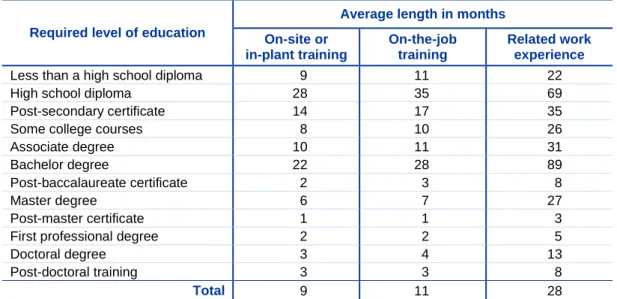
8 Average length of practical training/experience by required level of education ... 42
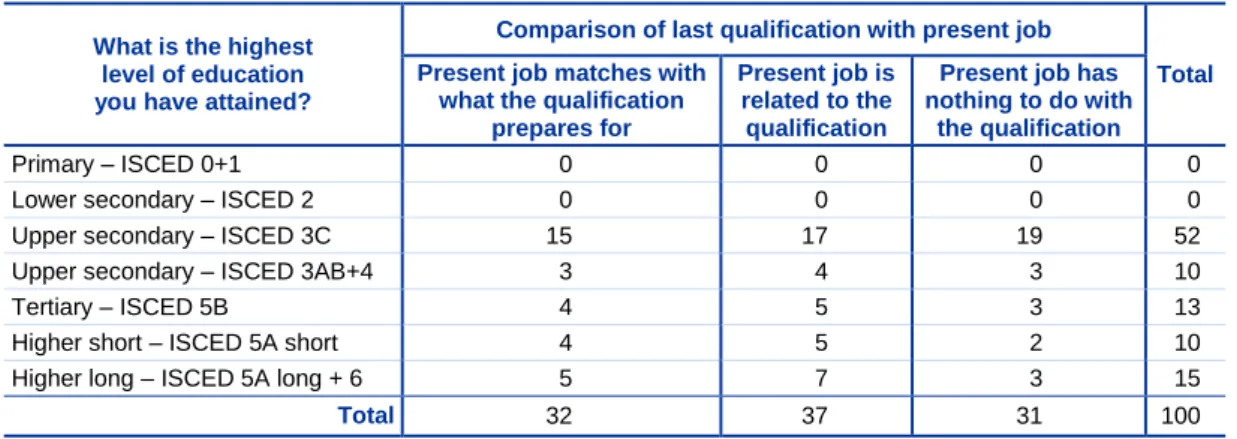
9 Relationship between qualification required and achieved BIBB/BAuA Erwebstätigenbefragung ... 43
10 Relationship between education required and its length (Kvalifikace 2007/08, Czech Republic) ... 44
11 Relationship between the six personality and work environment (occupation) types ... 55
12 Years of education beyond compulsory needed ... 63
13 Highest level of education... 64
14 BLS employment matrix by occupation and education and training ... 66
15 O*NET requirements by occupation ... 67
16 Mapping data to European classifications ... 69
17 An example of a sector-specific profile ... 73
18 Correlation with the O*NET data ... 76
19 Level of qualification requirements ... 80
20 Field of study ... 80
21 Knowledge (average score up to a max of 100%) ... 81
22 Skills (average score up to a max of 100%) ... 81
23 Competences (average score up to a max of 100%) ... 82
24 Occupational interests (average score up to a max of 100%) ... 82
25 Working values (average score up to a max of 100%) ... 82
26 Total qualification requirements ... 83
27 Maximal differences in total level of qualification requirements of jobs... 85
28 Standard deviation of total level of qualification requirements of jobs ... 85
29 Differences in total level of qualification requirements of jobs ... 87
30 Total level of qualification requirements of jobs by sector ... 88
31 Total level of qualification requirements of jobs by country ... 88
32 Occupational inter-country differences... 90
33 Standard deviation of total level of job qualification requirements ... 92
34 Occupation with maximum and minimum total level of job qualification requirements ... 93
35 Total level of qualification requirements of jobs in EU-27 ... 94
Figures 1 Labour market, job structures and qualification requirements: conceptual framework ... 13
2 The O*NET content model ... 26
3 Occupational skills profile: main dimensions ... 34
4 OSPs and the core projections of supply of and demand for qualifications ... 34
5 Relationship between education and experience required ... 38
6 Level of qualification requirements ... 46
8 Dimension II, field of education/training (EU-27, 2010) ... 47
9 Dimension III, level of knowledge (EU-27, 2010) ... 50
10 Dimension III, importance of knowledge (EU-27, 2010) ... 51
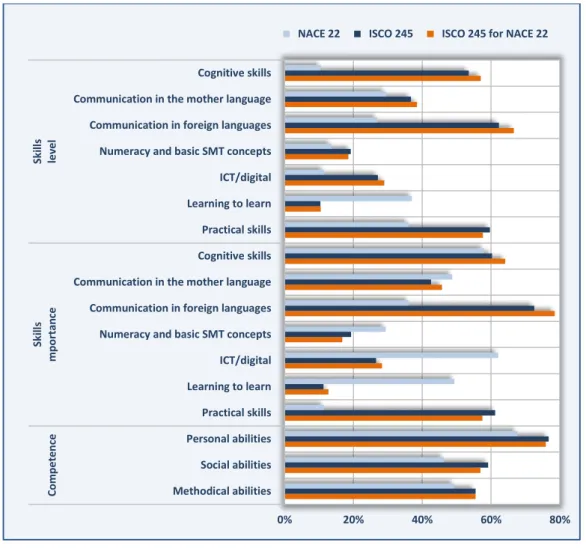
11 Dimension IV, skills, and dimension V, competence (EU-27, 2010) ... 53
12 Dimension VI, occupational interests (EU-27, 2010) ... 55
13 Dimension VII, work values (EU-27, 2010) ... 59
14 Total level of qualification requirements of jobs by sector 2010; E3ME sectors; EU-27+... 84
15 Relative total level of qualification requirements of jobs by sector; 2010;
E3ME sectors; EU-27+; ratio to country total ... 89
16 Total level of qualification requirements of jobs by occupation; 2010; EU-27+ 91 17 Relative total level of qualification requirements of jobs by occupation; 2010; EU-27+; ratio to country total ... 95
18 Occupational structure of agriculture sector 2010; Ireland, the Netherlands and sum of other countries (EU-27+) ... 97
19 Total level qualification requirements of jobs and R&D spending by sector, 2010, EU-27; only sectors with share to total R&D spending > 1% ... 98
20 Total level of qualification requirements of jobs and R&D intensity by country (motor vehicles sector) ... 98
21 Occupational structure of the motor vehicles sector... 99
22 GDP per capita and share of social work activities in the health and social work sector by country ... 101
23 Occupational structure of subsectors in health and social work sector... 101
24 Total level of qualification requirements of jobs in health and social work sector and GDP per capita by country ... 102
Boxes 1 Job/occupation ... 15
2 ISCO-88 ... 16
3 NACE ... 18
4 European qualifications framework ... 32
5 Fields of education/training ... 48
6 Dimension III, knowledge, eight main areas and 32 subareas ... 49
7 Key competences for lifelong learning ... 51
8 Examples of EQF descriptors defining eight levels of competence ... 53
9 Six personality and work environment (occupation) types... 57
10 Work value: need reinforcer and associated statements ... 58
Executive summary
Statistical information on skill and qualification requirements for occupations is fragmented, inconsistent, difficult to compare across European countries, and usually not detailed enough to reflect the specific characteristics of a given occupation. The occupational skills profile approach aims at integrating several available European sources and supplementing them with data gathered from EU and US surveys. This has been made possible by developing specific methods of data mapping, matching and integration. As a result, the skill requirements of occupations can be not only defined at a detailed level and further aggregated at higher levels as required, but also compared across sectors, countries and over time.
What is an occupational skills profile?
An OSP summarises essential characteristics required for a given job: the level of education and training required (and hence the complexity of the occupation); the field of education and training required; and other requirements in terms of knowledge, skills, competence, occupational interests, and work values.
The approach developed in this study allows aggregation of OSPs of specific occupations into OSPs of occupational groups, of sectors, of national economies, and up to the pan-European level. As they are focused on job requirements, OSPs represent the demand side of skill needs and can be compared with the supply side focused on the number and qualification of job holders.
Possible use of OSPs
OSPs have been developed for several purposes: analysing, projecting and forecasting skill needs; determining and measuring education/skills matches and mismatches in different countries, sectors or occupations; and comparing and monitoring differences among European countries, including determining change over time, identifying past and future developments.
Construction of individual OSP
Given their purpose, OSPs have to be defined at a level of occupational classification that allows both identification of distinct, occupation-specific
features, and transposition to other classification levels/systems. They have to be not only measurable and quantifiable, but also are regularly measured with available statistics and data sets, allowing the creation of time series and identification of changes over time. OSPs have to be consistent as far as possible with concepts, classifications, and instruments used in Europe, in particular with the international standard classification of occupations (ISCO), the NACE classification of industry, and the European qualifications framework (EQF).
For all these reasons, OSPs should be determined at the lowest level possible, where the job structure and characteristics are sufficiently detailed and specific to identify important differences between groups of jobs. At the same time they have to be supported by empirical data, covered by statistics and handled in a comparable way across Europe.
OSPs aggregation throughout the occupational
structure
It is necessary not only to establish OSPs at a detailed level of individual occupations (occupational units) but also to make it possible to aggregate them to higher levels as needed. However, aggregation to higher levels of classification and mapping to sectors cannot be realised by simply adding together the values determined at a lower, more detailed level of individual occupations. Their specificity would be lost, as a range of different values would be substituted by their average, and considerable differences in their distribution across sectors would not be respected.
A way to maintain specific features of OSPs even after their aggregation to a considerably higher level, and to overcome limitations and lack of comparable statistical data, has been found by considering the sector-specific occupational structure (that is the different proportional representations of individual occupations in different sectors). The aggregation of OSPs determined at a more detailed level of occupations has to be sector-specific: it is necessary to carry it out for each sector separately rather than across all sectors.
The reason is obvious: at higher levels of aggregation occupational groups contain several different occupations, and the mix of occupations (their proportion, prevalence or domination) is different in each sector. Consequently there has to be a different sector-specific OSP for each sector where the occupational group in question is represented. In this way, two crucial criteria can be met: sufficiently detailed level of analysis and consistency with data availability.
Statistics and data sources
More than 20 surveys in Europe and beyond (especially in the US) have been examined. However, only six surveys remained after assessing availability, usability, accessibility and suitability, and have been included into the model developed for the construction of OSPs the European social survey, ESS 1-5, (conducted in 2002-11 in about 30 European countries); the O*NET 2000-11 (the US occupational information network); the US Bureau of Labour Statistics (BLS) education and training requirements categories 1996-2012 (the US); the BIBB/BAuA Erwerbstätigenbefragung 2006 (Germany); the Indagine sulle professioni 2007 (Italy), and the Kvalifikace 2008 (the Czech Republic).
OSPs have been constructed making use of both European (the European social survey) and US (the O*NET) sources. The use of US data for constructing OSPs for European countries has been justified by a correlation analysis. Information from other surveys has been included whenever possible.
Structure of OSPs
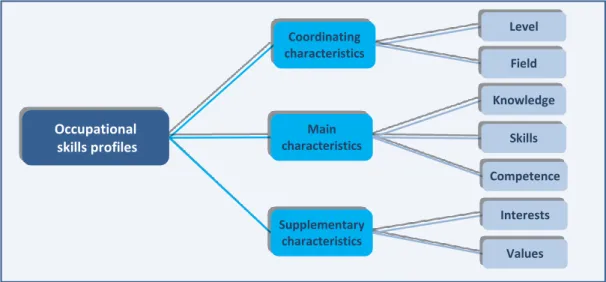
The structure of OSPs is consistent with the European qualifications framework, with seven dimensions forming three main groups.
The first group, called ‘coordinating characteristics’ contains two basic dimensions:
(a) the level of qualification requirements.
Its structure, with eight levels of work complexity, was initially taken from the EQF, where the levels are described by generally applicable descriptors, but it has been aggregated into a three-level scale used by Cedefop to forecast skill needs. Descriptors are taken mainly from the European social survey, but carefully balanced with other sources and approaches: employee surveys, employer requirements (e.g. the European job mobility portal (EURES)) and expert analyses;
(b) the field of education/training which contains 14 groups defined according to the international standard classification of education (ISCED).
The second group, called ‘main characteristics’, contains three dimensions based on learning outcomes, describing what the worker should know, understand and be able to do:
(a) knowledge is structured according the O*NET model, which has been adapted to the ISCED structure;
(b) skills, which follows the EQF distinction between cognitive and practical skills, but is more detailed and includes generic skills (communication, both
in mother and foreign languages, numeracy and ICT skills, and learning to learn);
(c) competence, defined according to the EQF in terms of responsibility and autonomy, and further structured into three areas: personal, social, and methodological abilities.
The third group, called ‘supplementary characteristics', focuses on the match between the job and the job holder and uses two dimensions which are important for choosing a job:
(a) occupational interests, linking work environment preferences to six distinct personality types. It can be used to describe both persons and work environment;
(b) work values, which is important both for the satisfaction of the job-holder and for his satisfactory performance.
Illustrative results
OSPs have been used within the project Forecasting of skill supply and demand in Europe to 2020. OSPs have been calculated for each of 33 European countries included in the forecast (1) as well as for the EU-27 as a whole, for each of 38 sectors and 37 occupations, and for the three years 2000, 2010 and 2020.
At the aggregate level – that is for all jobs in the whole EU-27 economy – all seven dimensions of OSPs have been projected from 2010 to 2020. The results show that average length of education required is expected to increase by 0.12 years. The highest growth of the employed is expected in economics, commerce, business and administration. The highest increases are expected for knowledge in engineering, technology, production and processing, and health services; the highest skills increases are expected in numeracy plus basic SMT (science, mathematics, and technology) concepts and ICT/digital, and for competence in methodological abilities. For occupational interests the personality type ‘enterprising’ will experience the highest increase, together with working values ‘recognition’ and ‘achievement’.
Analyses of three selected sectors (agriculture, motor vehicles, health and social work) showed that occupational structures and qualification requirements can differ much among and within European countries.
(1) EU-27 Member States and Croatia, FYROM, Iceland, Norway, Switzerland and
Future development
To enable a more precise and usable international comparison of changes in skills structures, it is necessary to modify the existing OSPs to be country-specific as well. Current work on a European standard classification for skills and competences (ESCO) will provide a valuable tool linking skills and competences to occupations and will contribute to bridging the existing information gap across countries. Also, data collected for the Organisation for Economic Cooperation and Development (OECD) project programme for the international assessment of adult competences (PIAAC) can be used to validate and improve the methods for generating OSPs, including the generation of country-specific coefficients in the models.
By adopting a job requirement approach, PIAAC attempts to assess the level and distribution of adult skills in a coherent and consistent way across 23 countries. It focuses on the key cognitive and workplace skills that are needed for successful participation in the economy and society and required in a specific job identified by sector and occupation. The size of the PIAAC database, with more than 100 000 respondents in employment, ensures a rich source of information about country differences (around 5 000 cases in each country). Results from the study will be available in autumn 2013.
The PIAAC data could contribute to further development of OSPs, especially for their quantification and validity at the individual country level (all sectors and occupations for a given country). They may also bring a deeper understanding of mismatches between labour market requirements and actual qualification of employment. Equally important is that PIAAC will be conducted in the US as well. Its data may also serve to verify further the suitability of US data sources (particularly the O*NET) for determining qualification requirements in European countries, thus making OSPs even more robust.
CHAPTER 1.
Concept of occupational skills profiles
This first chapter defines OSPs, explains the underlying concepts of job and occupation, presents an overview of international and national classifications of occupations and of international classifications of economic activities (sectors or industries). Basic requirements for data sources are defined: according to their availability, usability, accessibility, and suitability; six international or national data sources that crucial for the development of occupational skills profiles are described. Finally, the degree of their consistency and comparability with other European classifications (as the European qualifications framework) is examined.
1.1.
Definition
An OSP summarises essential characteristics required for a given job: the level of education and training (and hence the complexity of the occupation); the field of education and training; and other main and supplementary requirements concerning knowledge, skills, competence, interests and values.
In this study OSPs have been developed for analysing, projecting and forecasting skill needs, for defining and measuring education/skills matches and mismatches in different countries, sectors or occupations, and for comparing and monitoring differences among European countries. They also determine change over time, identifying past and future developments(2).
To do this, a complex process of transition has been developed from the macro-level of a national economy down to the level of individual jobs, where OSPs are defined, and then up to the macro-level again: that is of disaggregation followed by aggregation (Figure 1). It begins by clarifying general economic relationships and factors of labour market development, based on analysing industry and occupational job structures and their mutual relationship. It goes on by defining vertical and horizontal dimensions of qualification requirements which characterise each job (as opposed to education which characterises the labour force). Then occupational skills profiles of specific occupations are determined by (2) Details about OSP structure and relationship to the projections produced in the core project Forecasting of skill supply and demand in Europe to 2020 are described in Chapter 2. The technical process of how they have been generated is described in the Annex.
combining quantitative and qualitative approaches and assessments. Finally, they can be aggregated into OSPs of occupational groups, further into OSPs of sectors, then into OPSs of national economies, and up to pan-European level. Figure 1 Labour market, job structures and qualification requirements:
conceptual framework
Source: Author.
To serve their key purpose at both European and national levels, OSPs have simultaneously to meet certain specific requirements, which make them quite unique:
(a) they are defined at such a level of occupational classification that allows identification of distinct, occupation-specific features adequately, yet they can be transposed both to other classification levels and to other classification systems as necessary;
(b) their characteristics are not only quantifiable and measurable, but also regularly measured with available statistics and data sets, allowing the creation of time series and identification of changes over time;
(c) they are consistent, as far as possible, with other relevant concepts, classifications and instruments used in Europe, in particular with the international standard classification of occupations, the NACE classification of industry, and the European qualifications framework.
To meet all the requirements at the same time is not simple. Many problems have to be dealt with including how to define the appropriate level of classification, how to find suitable data, how to transpose safely from one level
and/or system of classification to another, and how to achieve reasonable consistency between conceptual frameworks and data sources coming from different sources.
1.2.
Appropriate level of classification and availability
of data
An OSP of an individual occupation (sometimes the term occupational unit is used) sums up the characteristics of all similar jobs, classified under the given occupation. At higher levels of classification, individual occupations are aggregated into corresponding occupational groups, thus representing all occupations with a certain degree of similarity.
An OSP makes sense only on condition that the respective occupational unit is not too broad or, in other words, it is still possible to take it as an individual occupation or a relatively homogenous group of occupations. Otherwise it would be ‘contaminated’ by other occupations and the resulting skill needs would come too close to the average. OSPs have to be elaborated at a level where the job structure and job characteristics are sufficiently detailed and specific to identify important differences between groups of jobs and to make them sufficiently visible; they must also be supported by empirical data. It is obvious that both aspects are mutually limiting – the more one is respected, the less the other one is met – and that a best possible trade-off has to be sought. Both aspects are vital: the choice of the most suitable level of classification and the availability of empirical data at European level. This difficult proposition is central to the approach applied.
When choosing the level of the most suitable classification, we have to consider the varying relationships between a job, an occupation and an occupational group, at different levels of aggregation (Box 1).
For example, in the US about 150 million jobs in the labour market are classified. These jobs are described by 12 000 occupational titles and clustered into about 1 000 individual occupations classified by the US standard occupation classification system (SOC); their exact number is changes over the time. Individual occupations are further clustered at several levels into still broader occupational groups (e.g. US Department of Labour, 2010). The number of jobs and employed in all individual occupations classified by the SOC is monitored by the occupational employment statistics (OES).
Box 1 Job/occupation
A job (a work place) represents a basic unit covering a certain set of work activities performed by one working person. Strictly taken, each job has a specific, slightly different OSP. Nevertheless, there exist jobs with very or quite similar OSPs and negligible differences. Those jobs then make up individual occupation.
An occupation (sometimes the term ‘a profession’ is used) is then defined as a group of jobs with sufficiently similar characteristics to have one OSP. Classifications of occupations are thus a means for grouping jobs by their similarity. Definitions of occupations vary in different countries, and classification systems are different.
The new German classification KldB introduced in 2010 (Bundesagentur für Arbeit, 2010) contains five levels, the most detailed one having more than 1 000 occupations, and identifying almost 3 000 concrete jobs (Berufs).
The Polish classification of occupations and specialisations for labour market needs (KZiS) is a national adaptation of the ISCO-08, introduced by the Minister of Labour and Social Policy in April 2010 (MPiPS, 2010). KZiS is a hierarchical classification comprising five levels. To avoid losing comparability with ISCO-08, the ambition has been to minimise changes on the three highest levels.
The Czech classification of occupations (KZAM) was established in 1991 by adopting almost without change all four levels of the ISCO-88, with about 500 groups of occupation. The Czech classification has gone beyond the fourth level of ISCO, supplementing it by the fifth more detailed national level consisting of about 3 200 individual occupations. The CZ-ISCO, a quite recent classification of occupations in the Czech Republic introduced in 2010, also follows the same principles, taking over the four levels of ISCO-08 and adding to them the fifth one (ČSÚ, 2010).
The Italian classification of occupations, developed during the last decade as a part of the project Indagine sulle professioni, contains, at the fifth classification level, more than 800 basic (individual) occupations, all having their own OSPs (ISTAT, 2009). After five years the survey was repeated by ISFOL and ISTAT (Franceschetti, 2012).
Table 1 contains the overview of international and some national classifications, indicating the number of groups of occupation and occupational units at different levels of the classification hierarchy.
Table 1 International and national classification of occupations: number of occupations or their group in the different level of classification
ISCO-88 ISCO-08 German y KldB 2010 Poland KZiS 2010 Italy 2006 CZ 2010 US SOC 2010 1 level 10 10 10 10 9 10 23 2 level 28 43 37 43 37 43 97 3 level 116 130 144 132 121 130 461 4 level 390 436 700 444 519 434 840 5 level – – 1 286 2 360 811 1 362 1 110 Source: Author.
A decisive role is played by the classification system employed. The Eurostat database on occupations – as well as most comparisons of occupational structures among individual European countries – is based on ISCO (Box 2). As the ISCO-88 was used by Eurostat till end 2010, and all available data have been based on it since the beginning of the 1990s, it was adopted in this study for the construction of OSPs.
Box 2 ISCO-88
The international standard classification of occupations 1988 (ISCO-88) is based on two main concepts: the concept of the kind of work performed or job, and the concept of skill.
Job – defined as a set of tasks and duties executed, or meant to be executed, by one person – is the statistical unit classified by ISCO-88. A set of jobs whose main tasks and duties are characterised by a high degree of similarity constitutes an occupation. Persons are classified by occupation through their relationship to a past, present or future job.
Skill – defined as the ability to carry out the tasks and duties of a given job – has, for the purposes of ISCO-88 the two following dimensions:
skill level, which is a function of the complexity and range of the tasks and duties involved;
skill specialisation, defined by the field of knowledge, the tools and machinery used, the materials worked on or with, as well as the kinds of goods and services produced.
On the basis of the skill concept thus defined, ISCO-88 occupational groups were delineated and further aggregated at four levels:
1st ISCO level: major groups with 10 occupation group titles, 2nd ISCO level: submajor groups with 27 occupation group titles, 3rd ISCO level: minor groups with about 110 occupation group titles, 4th ISCO level: unit groups with about 500 occupation group titles.
The ISCO-88 also contains a complete list of more than 5 000 occupational titles grouped under corresponding unit groups (at the 4th ISCO level).
Nevertheless, ISCO is limited to the four-digit level with only about 500 occupational groups. Only about a third of European countries provides data at this level, while comparable data for most European countries are available only at the ISCO three-digit level which defines rather broad occupational groups. It is not surprising, therefore, that their OSPs are not clear-cut, as they include some quite similar but also some quite different occupations.
ISCO-08 was introduced in 2008. Since 2011 it has been used for labour force surveys in European countries. It is based on the same principles and constructed in the same way as ISCO-88. A new list of occupational titles for ISCO-88 is under preparation. However, the project Forecasting of skills supply and demand in Europe has been naturally based on ISCO-88. The transition of OSP from ISCO-88 to the ISCO-08 will be an important objective to be achieved in the next stage of our work.
Very important, however, is the fact that when adopting ISCO-08, many countries have also adopted and further applied its fifth level (and sometimes even the sixth national level). Some countries – although not adopting ISCO-88 – have constructed their new national classification so as to maintain the transferability of both classifications; among them is the new British classification SOC 2010. This justifies our hope that the comparability of data coming from national classifications – so far quite limited – will markedly increase.
An example is a new Polish classification KZiS, which like the ISCO-08 is based on two main concepts. These are the kind of work performed – defined as a set of tasks or duties designed to be executed by one person – and skill, defined as the skill level – the degree of complexity of constituent tasks – and skill specialisation, the field of knowledge required for competent performance of the constituent tasks.
Four skill levels are defined at the most aggregate level, the major groups, and are made operational in terms of the educational categories and levels of the international standard classification of education (ISCED 97). The use of the ISCED categories to define skill levels does not imply that the skills necessary to perform the tasks and duties of a given job can be acquired only through formal education. The skills may be, and often are, acquired through informal training and experience.
It is very important to consider that European labour force surveys (EU-LFS) identify each job not only by ISCO occupation, but also by sector (or industry). The Eurostat database uses NACE (Box 3) to identify sectors.
Box 3 NACE
The statistical classification of economic activities in the European Community (NACE) Rev. 1.1 is the classification of economic activities corresponding to the international standard industry classification (ISIC) Rev.3 at European level, though it is more disaggregated.
NACE Rev 1.1 is structured at four levels:
Level 1: 17 sections identified by alphabetical letters A to Q;
(an intermediate level: 31 subsections identified by two-character alphabetical codes);
Level 2: 62 divisions identified by two-digit numerical codes (01 to 99); Level 3: 224 groups identified by three-digit numerical codes (01.1 to 99.0); Level 4: 514 classes identified by four-digit numerical codes (01.11 to 99.00).
As the outcome of a major revision work of the international integrated system of economic classifications which took place between 2000 and 2007, the present NACE Rev. 2 (which is the new revised version of the NACE Rev. 1.1) has been introduced.
NACE Rev. 2 is based on ISIC Rev. 4 and adapted to the European context by a working group of experts on statistical classifications from the Member States, candidate countries and EFTA countries, with the support and guidance of the classification section at Eurostat (European Commission, 2008b).
The transition from NACE Rev. 1 to NACE Rev. 2 will be another major objective in the next stage of our work.
In Cedefop forecasting, the E3ME-CE model is based on the second level of classification NACE Rev. 1.1, and the number of sectors has been reduced by different aggregations from 62 to 41. In this study we use the same classification but the number of sectors has been reduced to 38 due to data limitations. Aggregation concerns pharmaceuticals (10) and chemicals (11), electricity (22) and gas supply (23), and professional services (36) and other business services (37).
1.3.
Finding suitable sources
The next stage analysed the main conceptual, methodological and empirical ways of determining skill needs in various countries. This stage is important from three aspects: theoretical background and conceptual approaches to define elements of skill needs, grouping them into dimensions and links, and acknowledging the impact of external factors; methodological approaches to make operational concepts (dimensions, elements) used for definition of skill
needs; and assessing data availability, suitability and usability for the new concept of OSPs.
Data sources (surveys) have to meet certain stringent stipulations to be used for constructing OSPs. First, data from the survey have to be structured both by sector and by occupation. Second, occupations must be defined on the basis of the ISCO or any classification convertible to the ISCO; sectors must be defined on the basis of the NACE or any classification convertible to the NACE. Third, data from the survey must be robust and cover the bulk of the labour market.
Defining and quantifying OSPs started with more than 20 surveys in Europe, the US and OECD. Many proved to have no, or only a limited, potential for use, and only few surveys have passed the selection process consisting of the following four steps:
(a) availability. All available documents, studies and other information (e.g. webpages) concerning the concept, methodology and survey in question have been thoroughly studied to find all necessary characteristics: what is its framework or conceptual model; its main focus and scope; how the survey is conducted; whether it is periodic and at what interval it is repeated; and how the information gathered generally fits into our conceptual framework. Only where the result of the first step proved positive, was the second step taken; (b) usability. Data from the survey were analysed to determine how they would
enlarge the empirical database of our project, whether and to what degree they can be mapped into a common European database; particular important is what level of classification is used and whether it can be transposed to required levels of classifications used by Eurostat, NACE and ISCO (national classifications often cause problems). Again, only if results have been positive, has the next step been followed;
(c) accessibility. Communication with experts on the country in question (or directly of the institution conducting the survey) was established. Its objective was to find out whether and under what conditions it is possible to obtain their data (sometimes they have been paid for) and also whether it is possible that those who had carried out the survey could assist us in solving problems mentioned in previous steps. Again, only if our negotiations resulted in gaining access to the data, sometimes with advice and recommendations, was it possible to proceed to the final step;
(d) suitability. The final step consisted in thorough analyses of data obtained: the statistical behaviour of variables and of their role in the overall concept; transforming national classifications to Eurostat ones; and including new data to the final empirical model. During this stage the survey in question could have been abandoned should its previous positive assessments have
proved to be too optimistic. Table 2 lists all selected surveys that have been examined and analysed.
The large and periodic German surveys (BIBB-IAB-BAuA Erwerbstäti-genbefragung, 1978-2006, 2012), with about 20 000 respondents, can only partly be used as their time series is not quite consistent due to changes in the questionnaires so that only some characteristics (and some occupations too) are comparable and can be used. Currently, only the latest survey of 2006 can be fully exploited(3).
The British skills survey (periodically conducted since the mid-1980s) is beset with even more problems: matching the British SOC to the ISCO is difficult, its consistency and hence comparability over time is not clear, and the survey comprising only about 6 000 respondents is not sufficiently robust for the ISCO 3-digit level. Surveys similar to those conducted in the UK up to 2006 will probably not be repeated. On the other hand, it is important that some concepts used in British surveys have been applied also in the OECD project PIAAC, to be conducted in about 30 countries in 2011-12 with international data available in the autumn of 2013.
When the selection process described above had been completed (Table 2), only the following six surveys met all criteria and were included into the model serving for the construction of OSPs:
European social survey, ESS 1-5, conducted in 2002-11 (international);
O*NET 2000-11 (the US);
US BLS education and training requirements categories 1996-2012 (the US);
BIBB/BAuA Erwerbstätigenbefragung 2006 (Germany);
indagine sulle professioni 2007 (Italy);
Kvalifikace 2008 (Czech Republic).
The six surveys are briefly characterised in the following sections. Although it has not been considered suitable for the purposes of this study, the potential of the EURES database is also described.
(3) Data of the new 2012 survey will become available probably in 2014.
Table 2 Surveys examined and analysed
Name of the survey Years Coordinator/country Availability Usability Accessibility Suitability
International projects
IALS 1993
OECD
Yes No
SIALS 1998 Yes No
ALL 2005 Yes Yes No
PIAAC 2011-12 Yes Yes Only 2013
European social survey, ESS 1-5 2002-11 City University London Yes Yes Yes Yes CHEERS 1998 UNI Kassel Yes Yes Partly
Reflex 2005-06
UNI Maastricht Yes Yes Partly
HEGESCO 2008-09 Yes Yes Partly
Reflex 2010 2010 Charles Uni. Yes Yes Partly Advertisements for job vacancies (annually) 2007-12 EURES Yes Partly
National projects
Skill survey 1997
Great Britain Yes No
Skill survey 2006 Yes No
BIBB/IAB-Erhebung 1999
Germany
Yes No
BIBB/BAuA – Erwerbstätigenbefragung 2006 Yes Yes Partly Yes BIBB/BAuA – Erwerbstätigenbefragung 2012 Yes Yes Only 2012
Kooperationsprojekt Absolventenstudien – KOAB 2010 Yes Yes Partly Absolventenstudie – ARUFA 2010 Austria Yes Yes Partly
Indagine sulle professioni 2006-07 Italy Yes Yes Yes Yes Advertisements for job vacancies (NIVE) 1999-10
Czech Republic
Yes Yes Partly
Kvalifikace (EPC) 2007-08 Yes Yes Yes Yes Uplatnění (NIVE) 2002-03 Yes Yes Partly
Složitost práce (CAS) 2000-05 Yes Yes Partly Tarify (Trexima) 2008-12 Yes Yes Partly
DOT 1950-96
US
Yes Yes No
O*NET 2000-12 Yes Yes Yes Yes
BLS 1996-2012 Yes Yes Yes Yes
1.3.1. European social survey (ESS)
The European social survey has been an important source for defining some of the main dimensions of occupational skills profiles, the level and the field of education.
The ESS is a research programme of the European Science Foundation focused particularly on value orientation and the social structure of current European societies. Although the ESS is not primarily focused on skill needs and job holder qualifications, it contains relevant information in this respect. Its major advantage is its continuing nature and opportunity to obtain data for relatively extensive samples of the adult population across a wide age span; it has almost 200 000 respondents in about 30 European countries. The ESS surveys take place every two years, with five rounds implemented so far: the ESS-1 in 2002/03, the ESS-2 in 2004-05, the ESS-3 in 2006-07, the ESS-4 in 2008-09 and the ESS-5 in 2010-11.
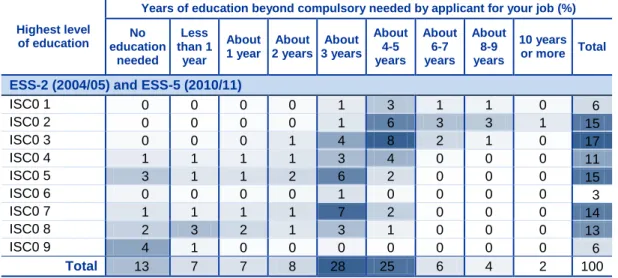
The most interesting stages in identifying skill needs were the ESS-2 and ESS-5; both contain an additional special module, focused on education, qualification, work and employment. Only data coming from countries participating in the project as well as in the ESS-2 and ESS-5 have been used for the analysis. The ESS-2 and ESS-5 data sets developed and analysed for the purpose of this study cover nearly 100 000 respondents from 20 European countries (Austria, Belgium, the Czech Republic, Denmark, Finland, Germany, Greece, Hungary, Ireland, Italy, the Netherlands, Norway, Poland, Portugal, Slovakia, Slovenia, Spain, Sweden, Switzerland and the UK).
The characteristics of the respondents (job holders) also include identification of the sector where they work, in line with the 2-digit NACE/ISIC, and identification of the occupation performed according to the 4-digit ISCO. It also carries the level of educational attainment (in most countries it is possible to define 6-8 comparable levels of education, though some countries do not have all the levels), and the field of education (the ESSs distinguish 14 fields of education and training defined on the basis of ISCED).
In 2010, however, a new classification was prepared which amalgamated existing distinct systems and defined new common educational levels. It was carefully constructed using an elaborate methodology (Schneider, 2009) in cooperation with experts on individual countries. The new classification, applied in the ESS-5 and also used for reclassifying data gathered in all previous surveys forming the ESS database, defines educational levels in various ways depending on how detailed they are (compare the three columns in Table 3).
The ESS-ISCED classification (second column of Table 3) has been adopted in this study. However, the seven levels as defined were supplemented with the eighth doctoral level (ISCED 6) indicated in the more detailed classification ESS-ISCED subgroups (see the third column). Our new eight-level classification is closer to the new ISCED 2011. In some countries where the new classification has not been used, exceptionally all levels – that is the entire classification of education – have been re-calculated.
Table 3 Highest level of education, ESS-ISCED
EU-LFS ESS-ISCED ESS-ISCED subgroups (for ESS-5 only)
Low ESS-ISCED I, less
than lower secondary
Not completed ISCED 1
ISCED 1, completed primary education
Vocational ISCED 2C < 2 years, no access ISCED 3 ESS-ISCED II, lower
secondary
General/pre-vocational ISCED 2A/2B, access ISCED3 vocational General ISCED 2A, access ISCED 3A general/all 3
Vocational ISCED 2C ≥ 2 years, no access ISCED 3
Vocational ISCED 2A/2B, access ISCED 3 vocational Vocational ISCED 3C < 2 years, no access ISCED 5
Middle ESS-ISCED IIIb,
upper secondary, vocational or no access V1
General ISCED 3 ≥ 2 years, no access ISCED 5
Vocational ISCED 3C ≥ 2 years, no access ISCED 5
Vocational ISCED 3A/3B, access 5B/lower tier 5A ESS-ISCED IIIa,
upper secondary, general and/or access to V1
General ISCED 3A/3B, access ISCED 5B/lower tier 5A General ISCED 3A, access upper tier ISCED 5A/all 5 Vocational ISCED 3A, access upper tier ISCED 5A/all 5 ESS-ISCED IV,
advanced vocational, subdegree
General ISCED 4A/4B, access ISCED 5B/lower tier 5A General ISCED 4A, access upper tier ISCED 5A/all 5 ISCED 4 programmes without access ISCED 5
Vocational ISCED 4A/4B, access ISCED 5B/lower tier 5A Vocational ISCED 4A, access upper tier ISCED 5A/all 5
High ISCED 5A short, intermediate/academic/general tertiary below
ISCED 5B short, advanced vocational qualifications ESS-ISCED V1,
lower tertiary education, BA level
ISCED 5A medium, bachelor/equivalent from lower tier tertiary ISCED 5A medium, bachelor/equivalent from upper/single tier ESS-ISCED V2,
higher tertiary education, >= MA level
ISCED 5A long, master/equivalent from lower tier tertiary ISCED 5A long, master/equivalent from upper/single tier tertiary ISCED 6, doctoral degree
Source: ESS.
1.3.2. O*NET
Analyses of available sources have shown that the most suitable information about qualification and other skill needs is to be found in the US occupational information network.
O*NET is a comprehensive online system for collecting, organising and disseminating occupational data. It was launched in 1998 by the US Department
of Labour, replacing the dictionary of occupational titles (DOT), developed more than 50 years ago and existing in a printed form up to the mid-1990s. O*NET data inform of important activities in workforce development, economic development, career development, academic and policy research, and human resource management.
A new version of the O*NET database is usually published annually in late June. After some structural changes and the introduction of version 5.0 in April 2005, data have been consistent, the characteristics of about 750 individual occupations have remained quite stable, and they every year 100-120 occupations have been updated. Thus it is possible to monitor and analyse their development and change. The O*NET 17.0 database, published in July 2012, represents the most recent update of the data collection programme.
The two O*NET core elements are a content model and an electronic database fed by a data collecting programme.
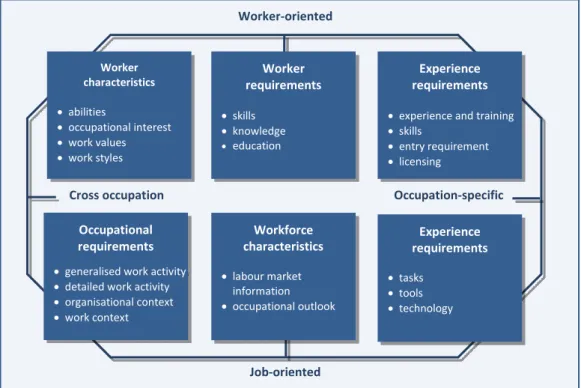
The content model (4) provides a framework for more than 400 variables describing about 1 100 occupations based on the SOC. The descriptors are organised into six major domains, which enable the user to focus on areas of information that specify the key attributes and characteristics of workers (the first three domains) and of jobs (the last three domains), and are either cross-occupational or occupation-specific:
(a) worker characteristics, comprising enduring characteristics that may influence both work performance and the capacity to acquire knowledge and skills, such as abilities, occupational interests, work values and work styles; (b) worker requirements, representing attributes developed and/or acquired
through experience and education, such as work-related knowledge and skills, which are divided into basic skills and cross-functional skills;
(c) experience requirements, including information about the typical experiential background of workers including certification, licensure, and training data; (d) occupational requirements, describing typical activities required across
occupations, as generalised and detailed work activities occurring on multiple jobs, plus contextual variables (factors physical, social and organisational);
(e) labour market characteristics, linking descriptive occupational information to statistical market information (including compensation and wage data, employment outlook and industry size information);
(4) More details at http://www.onetcenter.org/content.html [accessed 24.10.2012].
(f) occupation-specific information, applying to a single occupation or a narrowly defined job family.
Table 4 O*NET release history
O*NET 98 October 1998 Release of the original 'analyst database' based on the
occupational employment statistical (OES) classification O*NET
3.0/3.1
August 2000/ June 2001
Database classification converted to conform to the new standard occupational classification system (SOC)
O*NET 4.0 June 2002 Release of the final 'analyst database' with a revised database
structure consistent with the OMB-approved data collection programme
O*NET 5.0 April 2003 First update of database from data collection programme with a
comprehensive update of 54 occupations
O*NET 5.1 November 2003 Occupational- and item-level metadata added to the O*NET
database
O*NET 6.0 July 2004 Second update of database from data collection programme
with a comprehensive update of 126 occupations
O*NET 7.0 December 2004 Third update of database from data collection programme with a
comprehensive update of 100 occupations
O*NET 8.0 June 2005 Fourth update of database from data collection programme with
a comprehensive update of 100 occupations
O*NET 9.0 December 2005 Fifth update of database from data collection programme with a
comprehensive update of 100 occupations
O*NET 10.0 June 2006 Sixth update of database from data collection programme with a
comprehensive update of 100 occupations; release of the updated O*NET taxonomy – O*NET-SOC 2006
O*NET 11.0 December 2006 Seventh update of database from data collection programme
with a comprehensive update of 101 occupations
O*NET 12.0 June 2007 Eighth update of database from data collection programme with
a comprehensive update of 100 occupations
O*NET 13.0 June 2008 Ninth update of database from data collection programme with a
comprehensive update of 108 occupations
O*NET 14.0 June 2009 10th update of database from data collection programme with a
comprehensive update of 117 occupations; release of the updated O*NET taxonomy – O*NET-SOC 2009
O*NET 15.0 June 2010 11th update of database from data collection programme with a
comprehensive update of 120 occupations
O*NET 15.1 February 2011 Release of the updated O*NET taxonomy – O*NET-SOC 2010,
based on the SOC 2010
O*NET 16.0 July 2011 12th update of database from data collection programme with a
comprehensive update of 107 occupations
O*NET 17.0 July 2012 13th update of database from data collection programme with a
comprehensive update of 108 occupations
Source: Bureau of Labour Statistics (BLS).
Although the O*NET has been used as a prime source for several characteristics, other sources have been used whenever possible. Among them, two European surveys on occupation have closely followed the O*NET approach: the Italian survey Indagine sulle professioni and the Czech survey Kvalifikace 2008.
Figure 2 The O*NET content model
Source: O*NET resource center, http://www.onetcenter.org/content.html [accessed 13.11.2012]. Prepared by the National center for O*NET development for the US Department of Labour.
1.3.3. US BLS education and training requirements categories
The Occupational outlook handbook (5), produced by the Office of Occupational Statistics and Employment Projections of the Bureau of Labour Statistics, gives detailed descriptions of the education and training requirements of about 750 occupations of the SOC 2000. Each of them is classified by education and training categories, enabling estimates of the education and training needs for the population as a whole and of the outlook for workers with various types of educational and training attainment. Since 1994, this classification system has been used for all employment projections that are carried out by the BLS every second year, always following the publication of a new US BLS projection.
Up to the projection published at the end of 2009, the BLS identified 11 education and training categories defined as the most significant source of education or training needed to become qualified in an occupation, also including non-educational paths of entry, such as on-the-job training and work experience. By construction, these categories were intended to be mutually exclusive and (5) http://www.bls.gov/ooh/ [accessed 8.11.2012]. Worker characteristics abilities occupational interest work values work styles Worker requirements skills knowledge education Experience requirements
experience and training
skills
entry requirement
licensing
Occupational requirements
generalised work activity
detailed work activity
organisational context work context Workforce characteristics labour market information occupational outlook Experience requirements tasks tools technology Worker-oriented
Cross occupation Occupation-specific
exhaustive, and BLS economists and other relevant experts were asked to assign each occupation to one of these categories based on their knowledge and judgment. In consequence, the system did not show that an occupation might have multiple entry requirements, both on-the-job training and education.
This system has proved confusing, as it combines different dimensions of education, training, and work experience in a related occupation into one classification system. For example, in some occupations both post-secondary education and a long-term on-the-job training are important, but in the existing system these are two distinct and mutually exclusive categories. Other examples are occupations where both education and work experience in a related occupation are important. Also, the system does not include any category for education below secondary level(6).
At the end of 2011 a new system was published, eliminating the problems and presenting a more complete picture of the education and training needed for entry into a given occupation. All occupations are assigned an education category, a training category, and a related work experience category, and the education categories include both high school leveland below (7):
(a) entry level education; this represents the typical education level needed to enter an occupation. There are eight possible assignments for this category. (i) doctoral or professional degree,
(ii) master degree, (iii) bachelor degree, (iv) associate degree,
(v) post-secondary non-degree award, (vi) some college, no degree,
(vii) high school diploma or equivalent, (viii) less than high school,
(b) work experience in a related occupation; this indicates if work experience in a related occupation is commonly considered necessary by employers for entry into the occupation, or is a commonly accepted substitute for formal types of training. Assignments for this category will be more than five years, one to five years, less than one year, or none;
(6) At the same time we have to be aware of the fact that American high schools are very different and have different goals from various types of secondary education institutions in Europe.
(7) Detailed definitions for the categories are available at
(c) typical on-the-job training; this indicates the typical on-the-job training needed to attain competence in the occupation. Assignments for this category include internship/residency, apprenticeship, long-term, moderate-term, or short-term on-the-job training, or none.
Under the new system an education assignment for several occupations could be naturally different from the prior system. The new system assigns a typical entry level education, while the prior system assigned the most significant source of education or training, so some occupations will have a different education level assigned than previously.
Some occupations could have more than one way to enter. The assignments under the new system describe the typical education needed to enter, and the typical type of on-the-job training required to be competent. The work experience in a related occupation assignment represents what is commonly considered necessary by employers or is a commonly accepted substitute for formal training. The three assignments complement each other in that they would represent a typical path of entry into the occupation, but they are not necessarily equal in importance for entry into the occupation.
1.3.4. BIBB/BAuA Erwerbstätigenbefragung (Germany)
Periodic employment surveys on qualification and working conditions have been conducted in Germany every five to seven years since 1979 by the Federal Institute for Vocational Education and Training (BIBB). The last (2006) survey was conducted by the BIBB in cooperation with the Federal Institute for Occupational Safety and Health (BAuA). A new survey BIBB/BAuA-Erwerbstätigenbefragung 2012 is under preparation but data will not be available before 2013 and most probably not even before 2014.
It was possible to have access to the database of the last survey – BIBB/BAuA Erwerbstätigenbefragung 2006 – that was focused both on the job and on the match between current job skill requirements and respondent qualification. The representative sample of 20 000 respondents was selected from employed persons over 15 years of age having paid work for more than 10 hours weekly (this definition covers 96% of the active labour force). The size of the sample allowed differentiation by occupational groups and the identification of diverse target groups (such as old age, female, non-formally qualified workers).
The 2006 survey had four main research themes: activities and requirements of, and access to, jobs; changing a job and job flexibility; use of qualification attained, job satisfaction and success; and participation in lifelong learning., The questionnaire was structured into four corresponding parts: job characteristics (job tasks, job skills requirements, other specific requirements,
work load, working conditions, health, employment status, wage, changes and innovation); job holder characteristics (e.g. educational and career history); match between the job and the job holder characteristics (i.e. to what degree does the job holder meet job requirements); and supplementary questions relating to the respondent and the firm.
1.3.5. Indagine sulle professioni (Italy)
The Italian survey on occupations was conducted in 2006-07, and involved interviews with a sample of 16 000 respondents from the Italian population in employment. Its final objective was to construct an information system capable of describing the characteristics of all existing occupations in the Italian labour market. A great advantage of the Italian survey lies in the fact that it was modelled on the O*NET system, thus making it possible to test the degree of similarity between the American O*NET and the Italian system (and, to a lesser degree, the Czech survey Kvalifikace) and to verify the suitability of using the O*NET database for dimensions three to seven in the European context.
The survey is focused on measuring the importance and complexity level of about 400 variables for 810 individual occupations of a new occupational classification (derived from the official classification of the Italian Statistics Office) that can be mapped onto the third level of ISCO. The questionnaire is divided into 10 sections covering what is required of the worker to perform the job (education and training, occupation, knowledge, skills, abilities), what would affect his performance (aptitudes, values, work styles), and further characteristics of the job (transversal activities common to many different occupations, environmental conditions, specific activities not adequately represented in the questionnaire).
A new survey Indagine sulle professioni 2012, again organised by ISTAT together with ISFOL, will be carried out in 2012-13.
1.3.6. Kvalifikace (Czech Republic)
An extensive survey on qualification was also conducted in the Czech Republic at the turn of 2007-08 with a sample of nearly 6 000 working active respondents. It followed a similar survey carried out in 2002-03 and research into the employment situation of graduates implemented in 1997-98 and again in 2011. It was informed by indicators used as part of the US O*NET and the British skills survey, and took account of questions used in the ESS-2 as well as three EQF dimensions (knowledge, skills, competence). In the Czech Republic both regular surveys (e.g. the Czech LFS) and one-off research projects (e.g. the Kvalifikace project) use the valid ISCO classification of occupation to identify the respondent’s job.
A substantial part of the survey Kvalifikace was concerned with qualification requirements for each job, the qualification of each job holder and the extent to which school education and other skills contributed to the acquisition of the qualification. The information about various aspects or dimensions of qualification requirements for a job includes some 30 characteristics and about 50 indicators. This is why it has been possible to use the survey Kvalifikace not only for constructing dimensions one and two of OSPs, but also – together with the Italian survey Indagine sulle professioni – for testing the degree of similarity between the outcomes of the US O*NET and both European surveys; this was able to verify the suitability of the O*NET database for constructing dimensions three to seven in the European context.
1.3.7. EURES database and further potential sources
Along with sources classified as employee surveys and/or expert surveys, EURES data sets, which indicate employer requirements, have also been analysed.
The European job mobility portal EURES (European employment services) was established by the European Commission in 1993. Its partnership includes public employment services, trade unions, and employer organisations. Its main function is to advertise vacancies entered into the system by employers; its main objectives are to inform, guide and provide advice to potentially mobile workers on job opportunities and living and working conditions in the European Economic Area (EEA), to assist employers wishing to recruit workers from other countries, and to provide advice and guidance to workers and employers in cross-border regions. In recent years the EEA has made between 600 000 and 800 000 vacancies available from more than 20 000 employers. Data has been gathered from the EU