SINGLE-TARGET TRACKING OF ARBITRARY
OBJECTS USING MULTI-LAYERED FEATURES
AND CONTEXTUAL INFORMATION
by
JINGJING XIAO
A thesis submitted to
The University of Birmingham
for the degree of
DOCTOR OF PHILOSOPHY
Department of Electronic, Electrical and Systems Engineering
College of Engineering and Physical Sciences
The University of Birmingham
March 2016
University of Birmingham Research Archive
e-theses repository
This unpublished thesis/dissertation is copyright of the author and/or third parties. The intellectual property rights of the author or third parties in respect of this work are as defined by The Copyright Designs and Patents Act 1988 or as modified by any successor legislation.
Any use made of information contained in this thesis/dissertation must be in accordance with that legislation and must be properly acknowledged. Further distribution or reproduction in any format is prohibited without the permission of the copyright holder.
ABSTRACT
This thesis investigated single-target tracking of arbitrary objects. Tracking is a difficult problem due to a variety of challenges such as significant deformations of the target, occlu-sions, illumination variations, background clutter and camouflage. To achieve robust tracking performance under these severe conditions, this thesis proposed firstly a novel RGB single-target tracker which models the single-target with multi-layered features and contextual information. The proposed algorithm was tested on two different tracking benchmarks, i.e., VTB and VOT, where it demonstrated significantly more robust performance than other state-of-the-art RGB trackers. Proposed secondly was an extension of the designed RGB tracker to handle RGB-D images using both temporal and spatial constraints to exploit depth information more robustly. For evaluation, the thesis introduced a new RGB-D benchmark dataset with per-frame anno-tated attributes and extensive bias analysis, on which the proposed tracker achieved the best results. Proposed thirdly was a new tracking approach to handle camouflage problems in highly cluttered scenes exploiting global dynamic constraints from the context. To evaluate the tracker, a benchmark dataset was augmented with a new set of clutter sub-attributes. Using this dataset, it was demonstrated that the proposed method outperforms other state-of-the-art single target trackers on highly cluttered scenes.
Declarations
The author confirms that the work presented in this thesis is her own work. The contents of this thesis are original and have not been submitted in whole or in part for consideration for any other degree or qualification in this, or any other universities. This thesis is author’s own work and appropriate credit has been given where the references are provided to others’ work.
Jingjing Xiao March 2016
Acknowledgements
Life can be especially hard for those academics. I very often feel like a little coal miner, who has to work in this dark world while still trying to dig out a little “treasure” under the ground of science. Luckily, there are so many great people coming to my life as bright lamps lightening this world. Things that has happened in the past and present will inevitably help define my future and mould me into someone more complete.
As an international student, the first one I should thank is my country — China, who gives me everything. All the imperfections there become my essential motivation of hard working. During three and half years PhD study, my knowledge about research is like a canvas furnished by the unreserved dedication from my supervisors, Ales Leonardis, Rustam Stolkin, Robert Stone and Mourad Oussalah. There are so many things that I still want to learn, discover and share with them, which leads to the mixed feelings about my graduation today. I always expected that one day I could wear the graduation outfit while I was also so scared of the day coming and I have to leave them. However, if we want the blue sky, we have to fly. No matter how far I travel, I know there is always an inner power supporting me to overcome every difficult period.
Special thanks also go to all my family members, friends, and everyone that I met in my life, as they taught me how to percept and love this world. Their unconditional help and love contributes all of me. From Chongqing (China) to Changsha (China), from Changsha (China) to Birmingham (U.K.), I am such a lucky girl that has a chance to experience this colourful world. Now, it is my time to give back and paint the world.
CONTENTS
1 Introduction 1
1.1 Motivation . . . 1
1.2 Objectives . . . 3
1.3 Contributions . . . 4
1.4 Publications arising from this work . . . 7
1.5 Overview of the dissertation . . . 8
2 Literature Review 10 2.1 RGB trackers . . . 10
2.2 RGB-D trackers . . . 18
2.3 Tracking by exploiting scene distractors . . . 21
2.4 Dataset construction and annotation . . . 25
3 RGB tracker 30 3.1 Proposed method . . . 31
3.1.1 Multi-layer target representation . . . 31
3.1.2 Tracker propagation and matching . . . 36
3.2 Experimental results and analysis . . . 44
3.2.1 Implementation . . . 45
3.2.2 Performance evaluation on RGB benchmark data sets . . . 47
3.2.3 Performance contributions of tracker sub-components . . . 51
4 RGB-D tracker 56
4.1 Proposed method . . . 57
4.1.1 Top layer tracking based on temporal consistency . . . 57
4.1.2 Parts-based tracking with spatial context . . . 60
4.1.3 Model updating . . . 65
4.2 Dataset construction and bias analysis . . . 66
4.2.1 Dataset construction . . . 66
4.2.2 Bias analysis . . . 70
4.3 Experiments . . . 73
4.3.1 VTB evaluation protocol . . . 73
4.3.2 VOT evaluation protocol . . . 74
4.3.3 Overall tracker evaluation: VTBvsVOT . . . 75
4.4 Summary . . . 76
5 Tracking by exploiting scene distractors 78 5.1 Proposed method . . . 79
5.1.1 Coarse-to-fine multi-level clustering . . . 79
5.1.2 Global dynamic constraint . . . 84
5.2 Experiments . . . 87
5.2.1 Single target tracker comparison . . . 88
5.2.2 Multi-target tracker comparison . . . 91
5.3 Summary . . . 93 6 Conclusion 96 6.1 Summary . . . 96 6.2 Contributions . . . 97 6.3 Future work . . . 98 References 101
ABBREVIATIONS
LBP . . . Local binary pattern HOG . . . Histogram of gradients
SIFT . . . Scale invariant feature transform CNN . . . Convolutional neural networks LR . . . Logistic regression
SVM . . . Support vector machines
SLIC . . . Simple linear iterative clustering AUC . . . Area under curve
VTB . . . Visual tracking benchmark [2] VOT . . . Visual object tracking challenges [3]
ALOV . . . Amsterdam library of ordinary videos for tracking [4] PTB . . . Princeton tracking benchmark [5]
LGT . . . Robust Visual Tracking using an Adaptive Coupled-layer Visual Model [6] SCM . . . Robust object tracking via sparsity based collaborative model [7]
KCF . . . High-speed tracking with kernelised correlation filters [9] SD-KCF . . . Depth scaling kernelised correlation filters [10]
OAPF . . . Occlusion aware particle filter tracker [11] TINF . . . Target identity-aware network flow [12]
CHAPTER 1
INTRODUCTION
1.1
Motivation
Tracking is a fundamental task in computer vision with numerous applications, e.g. motion analysis, event detection, scene understanding, human-computer interaction, augmented real-ity and robot navigation. This has motivated extensive research in recent years to improve the efficiency of automatic target tracking from video sequences [14]. Despite the publication of numerous tracking algorithms over the last three to four decades [2, 3], visual object track-ing remains an open and active research area with several remaintrack-ing unsolved problems, e.g. significant target deformation, field of view change, illumination variation, background clut-ter, camouflage and occlusion, which motivates the work of tackling the single-target tracking problems for arbitrary objects. In the following three subsections, we will present detailed mo-tivations in three demanding scenarios: tracking arbitrary objects in RGB images; extension to tracking in RGB-D images; and tracking in scenes where many other objects or image regions share similar appearance with the target.
1.1.1. A single target tracker in RGB images.
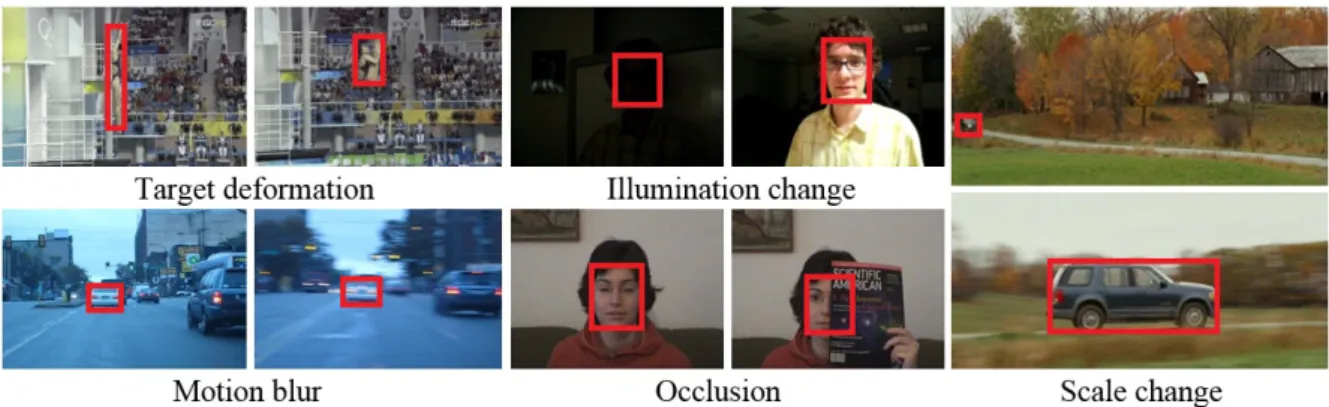
After several decades of visual tracking research, even the most sophisticated trackers are still prone to failure in challenging scenarios, including clutter and camouflage in one or more feature modalities, rapid and erratic target motion, occlusions, and targets which change their shape and appearance over time [1], shown in figure 1.1. These severe tracking conditions
predominantly result in failures in three fundamental aspects of the tracking algorithms [15]: 1) the algorithm’s model of the appearance of the target; 2) the mechanisms for matching model parts to image regions; 3) the mechanism for automatic model adaptation, when the target changes its appearance over time. Therefore, to tackle such problems in RGB images, it is important to design a tracker while keeping these three key aspects in mind.
Figure 1.1: Tracking challenges including target significant deformation, illumination change, motion blur, scale change and occlusion.
1.1.2. A single target tracker in RGB-D images.
To further improve tracking performance, recent work has tried to incorporate additional features [16, 17]. Due to the proliferation of the affordable depth sensors, like Microsoft Kinect, Asus Xtion and PrimeSense etc., depth information is attracting growing interest [5]. However, while RGB features can be comparatively invariant to target motion, depth information can vary rapidly during target motion. For this reason, many state-of-the-art RGB-D methods [18, 19, 11] rely mainly on RGB data for target tracking, and reserve depth information primarily for occlusion reasoning. However, in such methods, rapid target motion towards the camera can be easily mistaken for an occlusion, leading to tracking failure, shown in figure 1.2. Therefore, how to exploit the depth information in a robust way is an essential but unsolved problem for a RGB-D tracker.
1.1.3. A single target tracker with scene distractors
Using previously mentioned tracking components (target model, matching method and model adaptation), a properly designed single target tracker can overcome many conventional chal-lenges, e.g. significant deformation, illumination change, fast movement etc. However, to
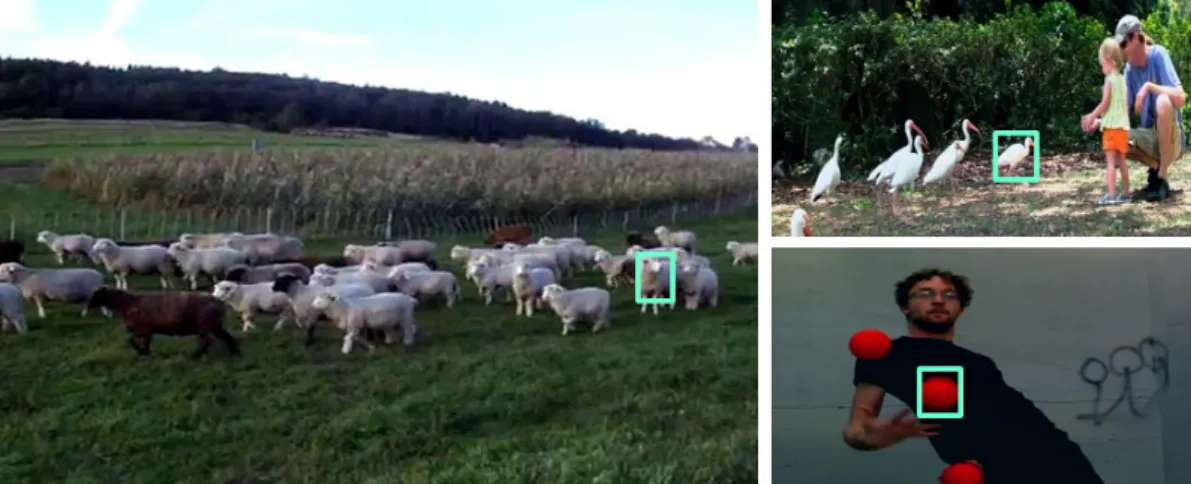
Figure 1.2: RGB-D tracking of target with large depth variation. Red, blue, green bounding boxes represent our proposed tracker and the state-of-the-art trackers DS-KCF [10] and PT [20] respectively. In frame 80, following rapid target depth change, PT [20] falsely reports “occluded” status (bounding box disappears). In frame 159, DS-KCF [10] falsely reports “oc-cluded” status, while PT [20] has completely failed and drifted onto background clutter because of rapid depth change. It is essential to exploit the depth information in a more robust way. robustly handle occlusion, ambiguity and camouflage problems in highly cluttered scenes, the tracker should “interact” with contextual information to help differentiate the target from the background. A particularly difficult problem is how to track a target which moves through scenes featuring several other very similar objects, or which moves past extremely cluttered or camouflaged image regions, shown in figure 1.3. In these situations, it is difficult to distinguish the target using the appearance information solely obtained from the target bounding box. Ad-ditional information, such as dynamic models of the target and nearby distracting image regions in the scene, may be useful to support robust tracking.
1.2
Objectives
To tackle the above mentioned problems, we aim at: 1) designing a robust tracker in RGB im-ages which could adaptively fuse and update multiple features to overcome a variety of difficult tracking problems, e.g significant target deformation, rapid and erratic target motion, illumina-tion change and viewpoint change; 2) extending the proposed RGB tracker to handle RGB-D
Figure 1.3: Sequences with many distractor objects, used in our experiments. Bounding box is the single target we want to track. It is extremely difficult to distinguish one true target out of many identical contextual regions.
images by showing how depth information can be robustly combined with RGB information during tracking; 3) exploiting the contextual information which could handle camouflage prob-lems in the highly cluttered scenes and providing a deeper analysis of the tracking performance under those severe situations.
1.3
Contributions
In the light of the objectives in section 1.2, we propose three novel methods which address these problems: 1) we build multi-layer appearance models, and combine them with clustered deci-sion trees to tackle the single target tracking problem in RGB images; 2) we extend this RGB tracking approach to also handle RGB-D data, by exploiting the depth feature with embedded common-sense knowledge to handle highly dynamic depth feature variation; 3) we show how to exploit contextual information, by detecting, learning and tracking distractors, to support single target tracking in extremely cluttered scenes.
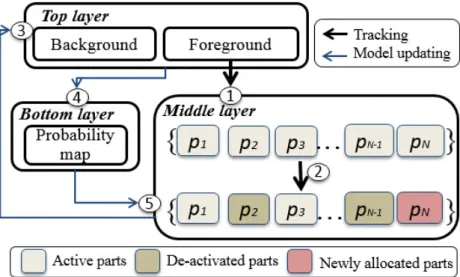
We first build a single target tracking algorithm, which achieves state-of-the-art robustness by addressing the problems in three fundamental areas: target representation, matching method-ology, and model adaptation. The target is represented at three different layers: pixel layer, local-parts layer and target layer, shown in figure 1.4. A novel “Adaptive Clustered Decision
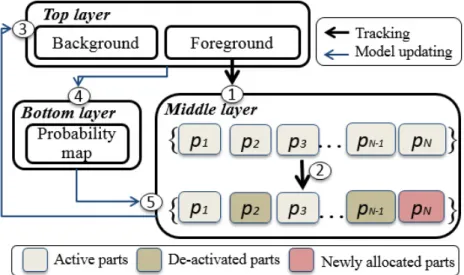
Figure 1.4: Block diagram of the proposed tracking process. 1- tracker propagation by the top layer foreground information matching; 2- middle layer (target part) matching with clustered decision tree; 3- update the top layer model; 4- feed back the bottom layer (pixel) feature; 5-re-sample drifting parts at the middle layer model [1].
Tree” method is proposed to enable robust matching between successive frames by dynami-cally selecting the minimum combination of necessary features, thereby providing robustness with computational efficiency. The target model isupdated through a closed loop with cross-constraints between different model layers. We test the tracker using two different tracking benchmarks [2, 3], based on two different test methodologies, and show it to be more robust than all other state-of-the-art methods from those tracking challenges while also demonstrating competitive tracking precision [1].
We extend the proposed 2D RGB tracker to 3D RGB-D images exploring a more robust way of applying the depth information. Note that the depth information encodes the latent physical constraints of the object layout which can provide a unique feature for RGB-D tracking, which is unavailable for RGB tracking. Therefore, a physical constraint of the target with respect to other objects in the depth context is exploited, to adaptively estimate the range interval occupied by the target. This physical constraint encodes common-sense knowledge that the target parts cannot move behind background regions or in front of occluder. Despite the availability of sev-eral high quality benchmark datasets for RGB tracker evaluation [3, 21, 22, 23], those available for RGB-D tracker evaluation are far more limited. Therefore, we also construct a new RGB-D
dataset with extensive bias analysis to facilitate the evaluation in RGB-D images.
We exploit contextual information to solve the problem of tracking a single target which is camouflaged against scenes containing a large number of similar non-target entities, which we call distractors. We first propose a multi-level clustering method for online detection and learning of multiple distractors. To distinguish the target from these distractors, we use global dynamic constraints (derived from target and distractor information) to optimize the estimated target trajectory. To gain a deeper understanding of tracker performance on cluttered scenes, we propose a new set of sub-attributes to describe different kinds of cluttered scenes, and augment publicly available benchmark data by per-frame annotating all frames of all sequences with all sub-attributes. Using this dataset, we show that our proposed method outperforms the best ranked state-of-the-art single target trackers on highly cluttered scenes. We also show that the proposed method outperforms state-of-the-art multi-target trackers, in scenes where the true target moves among many other similar objects, even though the multi-target methods are given significant additional a-priori information about distractors.
For clarity, we itemise the contributions in terms of the tracking algorithms and datasets below:
A. Tracking algorithms
• An RGB tracker using adaptive clustered decision trees and dynamic multi-layer appearance models (chapter 3).
• An RGB-D tracker exploiting multi-feature local-global spatio-temporal consistency (chapter 4).
• Distractor-supported single target tracking under extremely cluttered scenes (chapter 5). B. Tracking datasets
• A new RGB-D benchmark dataset with extensive bias analysis (chapter 4).
• An augmented RGB tracking benchmark dataset with proposed sub-attributes for the clut-tered scenes (chapter 5).
1.4
Publications arising from this work
A. Peer-reviewed full-length papers(first-author)
• J. Xiao, R. Stolkin, M. Oussalah, A. Leonardis. Context based model adaptation for tracking with online weighted color and shape feature. IEEE sensors journal, 2016. (related to chapter 3)
• J. Xiao, M. Oussalah. Performance Evaluation of Particle Filter Based Visual Tracking. Journal of Intelligent and Fuzzy Systems, 2016. (related to chapter 3)
• J. Xiao, R. Stolkin, A. Leonardis. Single target tracking using adaptive clustered decision trees and dynamic multi-level appearance models. CVPR , Boston, U.S.A, 2015. (related to chapter 3)
• J. Xiao, M. Oussalah. Collaborative Tracking for Multiple Objects in the Presence of Inter-occlusions. IEEE Transactions on Circuits and Systems for Video Technology, 2015. (related to chapter 5)
• J. Xiao, R. Stolkin, A. Leonardis. Multi-target tracking in team-sports videos via multi-level context-conditioned latent behaviour models. BMVC , U.K., 2014. (related to chapter 5)
• J. Xiao, M. Oussalah, Robust model adaptation for tracking with online weighted color and shape feature, 4th IEEE International Conference on Image Processing Theory, Tools and Applications, France, 2014. Best poster award in BMVA summer school. (related to chapter 3)
• J. Xiao, R. Stolkin and A. Leonardis, An enhanced adaptive coupled-layer LGTracker ++, ICCV Visual Object Tracking Workshop. 1-8 December, Sydney, Australia, 2013.IEEE PAMI TC Conference Travel Award. (related to chapter 3)
• J. Xiao, M. Oussalah, Scale Modification through Particle Distribution in Colour Based Tracking, The 10th European Conference on Visual Media Production. 6-7, November, London, UK, 2013. (related to chapter 3)
B. Peer-reviewed full-length papers(co-author)
• N. Marturi, V. Ortenzi,J. Xiao, M. Adjigble, R. Stolkin and A. Leonardis, A real-time track-ing and optimised gaze control for a redundant humanoid robot head, IEEE-RAS Inter-national Conference on Humanoid Robots, 2015. (related to chapter 3)
• H. Haggag, M. Hossny, S. Haggag, J. Xiao, S. Nahavandi, D. Creighton, LGT/VOT track-ing performance evaluation of depth images. 9th International Conference on System of Systems Engineering, 2014. (related to chapter 4)
• M. Kristan et al, The visual object tracking VOT2013 challenge results, ICCV workshop, 2013. (related to chapter 3)
1.5
Overview of the dissertation
The organisation of the thesis is as follows:
Chapter 2 presents a literature survey, covering RGB tracking algorithms, RGB-D tracking algorithms, tracking benchmark datasets and dataset bias analysis. This chapter reviews RGB trackers first in terms of target representation, matching methodology, and model adaptation. For RGB-D trackers, we mainly analyse the different ways of utilizing depth information in the literature. The representative tracking benchmark datasets are also summarized here, while bias analysis is provided since it can significantly effect conclusions drawn from performance evaluation of tracking methods.
Chapter 3 presents a new single target tracker with multi-layer appearance model. An adap-tive clustered decision tree method is proposed to select the minimum combination of features necessary to sufficiently represent each target part, thereby providing robustness with computa-tional efficiency. Based on two different evaluation protocols, we have tested the tracker using two different tracking benchmarks [2, 3] with total 70 sequences and comparing against more than 50 other trackers from the literature. The proposed tracker is demonstrated to be signif-icantly more robust than the state-of-the-art methods, while also offering competitive tracking
precision [1].
Chapter 4 focuses on single target tracking in RGB-D images, where an adaptive multi-feature local-global target model with both temporal and spatial constraints is proposed. In the bounding box layer, temporal consistency is used to adaptively fuse information from both RGB and depth images to find a candidate target region. In frames where one or more features are temporally inconsistent, this global candidate region is further split into local candidate regions for matching to target parts. We derive a physical constraint from the depth context, which ro-bustly accommodates large target depth variation, while still enabling accurate reasoning about occlusions. For evaluation, we introduce a new RGB-D benchmark dataset with per-frame annotated attributes and extensive bias analysis. Our tracker is evaluated using two different methodologies [2, 3] and in both cases it outperforms other state-of-the-art RGB-D trackers.
Chapter 5 shows how distracting contextual regions can be detected, learned and explicitly exploited to support the single target tracker under conditions of extreme clutter and camou-flage, including frequent occlusions by objects with similar appearance to the target. A multi-level clustering method is proposed for online detection and learning of multiple target-like regions, called distractors, when they appear near to the true target. To distinguish the target from these distractors, we use global dynamic constraints (derived from target and distractor information) to optimize the estimated target trajectory. To evaluate our tracker, we have aug-mented publicly available benchmark videos, by proposing a new set of clutter sub-attributes, and annotating these sub-attributes for all frames in all sequences. Using this dataset, we show that our proposed method outperforms other state-of-the-art single target trackers on highly clut-tered scenes. We also show that our proposed method outperforms state-of-the-art multi-target trackers, in scenes where the true target moves among several other similar objects.
Chapter 6 summarizes the contributions of this thesis, points out the problems of existing methods and discusses the potential avenues for future work.
CHAPTER 2
LITERATURE REVIEW
Single target tracking, as an important component in the tasks of motion-based recognition, au-tomotive surveillance and vehicle navigation, has been extensively studied in recent decades [24]. Even though great effort has been paid in this area, visual object tracking is still a challenging task, because of background clutter, occlusion, fast movement, illumination changes, object scale change and deformation. Therefore, this chapter provides a survey of the research that has already been published in relation to the single target tracking in RGB images (section 2.1), RGB-D images (section 2.2), and highly cluttered scenes where need proper context understand-ing (section 2.3). The state-of-the-art trackunderstand-ing benchmark datasets for algorithm evaluation are also reviewed (section 2.4).
2.1
RGB trackers
Based on the prior information about the target category, the tracking algorithms are usually classified as category-free methods, like KCF [9], Struck [25], LGT [6], and category-based methods, like pedestrian tracking [26], vehicle tracking [27], hand tracking [28]. Category-free tracking methods are usually initialized using a single bounding box/ellipse in the first frame without any other pre-trained information, while the category-based tracking methods usually require a training process for one particular object category. As the category-free tracking methods are acknowledged for the simple initialization and easy generalization among different
object categories, our work also focuses on tackling the problems in this particular tracking research branch - category-free tracking methods.
Although significant progress has been made in this area [2, 3], the most sophisticated track-ers are still prone to failure in challenging scenarios, including environmental clutter and cam-ouflage in one or more feature modalities, rapid and erratic target motion, occlusions, significant appearance changes and shape deformation over time. In general, a robust tracking system con-sists the following three parts [1]: 1) the appearance model of the target; 2) the mechanism for matching model parts to image regions at each frame; 3) the mechanism for continuously relearning or updating models of targets which change their appearance over time. Therefore, we review the related works with respect to the target representation, matching methodology and model updating method accordingly.
A. Target representation
A crucial component of a tracker is the target model that represents the object status during tracking, i.e. position, scale, and speed etc. Based on the different representations, tracking methods are usually categorized as:pointtracking,kerneltracking, andsilhouettetracking [29], shown in figure 2.1.
Figure 2.1: Different representations of a target: a) point tracking; b) kernel tracking; c) silhou-ette tracking.
Forpoint tracking [30, 31, 32, 33], a moving object is represented by some feature points detected across consecutive frames during the tracking. The problem here is formulated as matching the point correspondence between each frame. Usually, the point tracking methods are quite sensitive to noise and are easily distracted under conditions of background clutter. To achieve better performance, kinematic constraints are often imposed in some particular applica-tions [34]. Although this enables good performance in particular condiapplica-tions, such trackers have
difficulties to be generalised to other tracking conditions, e.g. the kinematics built for a human cannot be used for a snake.
Silhouette [35, 36, 37, 38, 39] tracking provides the accurate shape description (contour) for the target in each frame. Usually, those methods iteratively evolve the initial contour by minimizing the contour energy using gradient descent, which is applied to track the deformable targets including animals and human hands etc.
Kernel[40, 41, 42, 43, 44] is a region-based representation, which can be a rectangular or an elliptical template with an associated histogram, usually referring to the target shape and appearance. Kernel based tracking is conducted by computing the motion of the kernel that explicitly defines the target region in the next frame.
In this thesis, we utilize a bounding box to represent the target and focus on solving the prior information free tracking problems. Therefore, we mainly review the related works of kernel based tracking methods. Based on the image data inside the target kernel, the algorithm converts the raw data into some more informative features for tracking [15], which can include:
• Colour features. The colour of an object is a widely used descriptor for target represen-tation, which can be defined differently according to the various colour spaces, namely RGB, Log-RGB, Lab, HSV and HSL [45]. As the colour is influenced by spectral power distribution of the illumination and the surface of reflectance properties of the object, these colour spaces are sensitive to stray light and are also vulnerable to the changes of the lighting conditions [29].
• Haar-like features. A Haar-like feature [46, 47], i.e. edge feature, line feature and center-surrounded feature, encodes the existence of oriented contrasts between adjacent rectan-gular regions at a specific location in a detection window. It sums up the pixel intensities inside each region, where these sums are used to calculate the difference between re-gions. Haar-like features are acknowledged for their good trade-off between speed and accuracy [48].
operator which utilizes a non-parametric kernel (3*3 kernel) to summarize the spatial structure of an image [49, 50]. LBP operator utilizes the greyscale of the central pixel to label its neighbourhood pixels with 0 or 1, where that central pixel is represented by a binary string from its neighbours, which provides both computational simplicity and discriminative power (robustness) to monotonic gray-scale changes caused, for example, by illumination changes [51, 52].
• HOG features. The histogram of gradients (HOG) feature, proposed by [53], uses a distri-bution of gradient intensities in terms of edge directions to represent object shape. The candidate region is divided into small connected cells (regions) with the following steps: gradient computation, orientation binning, and descriptor blocks. Since HOG feature operates on the local cells, it is invariant to geometric and photometric transformations.
• SIFT features. Scale Invariant Feature Transform (SIFT) feature is composed of the follow-ing four steps: 1) convolve the image with Gaussian filters at different scales, where the candidate interest points are selected from the minima and maxima of the Difference-of-Gaussians (DoG) images across scales; 2) update the candidate location by interpolating the color information of neighbourhood pixels; 3) eliminate low contrast candidate points; 4) assign orientations to the remaining interest points due to the peaks in the histograms of gradients.
• Bag of words features. Bage of words (BoW) model is a sparse vector of occurrence counts of independent image features (words) [54]. Extracting the BoW features from images usually includes the following steps: 1) detect key point based features, i.e. SIFT fea-tures; 2) compute local descriptors over those key point based feafea-tures; 3) quantize the descriptors into words to generate the visual vocabulary, and 4) construct a histogram of word occurrences in the image (codebook), which contains the presence or absence information of each visual word.
• Sparse features. The goal of sparse coding is to approximate input signals by a linear com-bination of weighted bases(atoms), which is applied to learning over-complete dictionary
of atoms which captures high-level patterns in the input data [55, 56]. However, to learn the over-complete dictionary and solve the corresponding optimization problems is still a significant challenge with respect to the computational cost [57, 58].
• CNNs features. A Convolutional Neural Networks (CNNs) is comprised of small neuron collections across multiple layers [59, 60], where those neuron collections are tiled in each layer with the shared weights to better represent the original image. As the same filter is used for each pixel in the layer, the CNNs features can tolerate image translation. Some ways to train CNNs include filter shape, the number of filters, and max pooling shape.
The above features are extracted from the particular kernel for matching during track-ing. In terms of the kernel scale, the target representation methods are categorized into three groups:holistic[61, 62, 63, 64, 65, 66],local[67, 68, 40, 69, 70], andhybrid[6, 71, 72, 7, 73, 74, 75]. A holistic representation reflects the overall statistical characteristics of the target in a simple and computationally efficient model. However, the holistic template based trackers have difficulty in handling significant appearance changes and deformations of the target. In con-trast, a local feature representation provides more flexibility for deforming target matching but usually with increased computational cost. Recent works use both holistic and local templates to represent the target in a hybrid way which compensates the disadvantages of holistic or local representations.
B. Matching methodology
To estimate the state of the target, the algorithm must match observations from a candidate image region to the target representation model [1]. Here, we denote the candidate feature vector asqcan while the reference feature vector asqref. The common methods of comparing
the candidate feature to the reference feature are reviewed below:
• Bhattacharyya distance. The Bhattacharyya distance measures the dissimilarity of two probability distributions (feature vector or histogram) bin-by-bin [76, 77]. The distance DB(qcan, qref) is computed by: DB(qcan, qref) =
q
1−Pm
ξ=1 p
mis the number of the bins inside the corresponding feature vector.
• Euclidean distance. The Euclidean distanceDE(qcan, qref)between candidate featureqcan
and the reference feature qref is the length of the line segment connecting them [78]. A
generalized term for the Euclidean norm is the L2 norm or L2 distance, computed by DE(qcan, qref) =
q Pm
ξ=1(qcan(ξ)−qref(ξ))2.
• Earth movers distance. Earth Movers distance (EMD) was defined by Rubner et al. [79] as the minimal cost that must be paid to transform one feature vector into the other feature vector, which is cross-bin similarity measurement computed by: DEM D(qcan, qref) =
Pm ξ1=1 Pm ξ2=1d(ξ1,ξ2)f(ξ1,ξ2) Pm ξ1=1 Pm
ξ2=1f(ξ1,ξ2) , wheref(ξ1, ξ2)denotes the flows. Eachf(ξ1, ξ2)represents the amount transported from bin ξ1 supply to the bin ξ2 demand, f(ξ1, ξ2) = |qcan(ξ1)− qref(ξ2)|. d(ξ1, ξ2)is called the ground distance between different bins,d(ξ1, ξ2) =|ξ1−
ξ2|. All above,ξ1,ξ2 ranges from[1, m], whilemis the number of bins.
• Correlation filters. Correlation filters measure the similarity between the image template and the image candidate region to produce the correlation peaks for the target regions while low response for the background [80]. Correlation filters take advantage of the fact that the correlation operations of two image regions could be conducted by element-wise multiplications using Discrete Fourier Transform, and have proved to be competitively ef-ficient at hundreds of frames-per-second [81]. Correlation output is transformed back into the spatial domain as a spatial confidence map using the inverse Fast Fourier Transform, where the region with the maximum value indicates the position of the target.
• Logistic regression. Logistic regression (LR) [82] is a statistical method to analyse a (train-ing) dataset and find the best fitting model with independent variables that determine an outcome (matching probability). During tracking, given the features of a candidate region, LR computes the region’s probability of being a target according to the logit transformation (trained fitting model).
classi-fier, and recursively adding the opinions of additional weak classifiers, with confidence weights for each successive classifier being chosen to minimise the overall error with respect to ground-truthed training data. [84, 85] use individual bins of a feature vector as “weak classifier” and employ Adaboost as a way of creating a weighted combination of these classifiers which best discriminates between target and surrounding background regions at each frame.
• Decision tree classifiers.Probabilistic Boosting Trees [86] have been used for classification, recognition, tracking and clustering problems, which are binary discriminative classifiers. Each node of the tree combines weaker classifiers (lower nodes), yielding a top node which outputs an overall posterior probability (of matching) by integrating the conditional probabilities gathered from its sub-trees.
• Support vector machine. Mapping the original finite dimensional space into a higher di-mensional space makes the data classification easier. Support Vector Machines (SVM) try to find a hyperplane that has the largest distance (functional margin) to the nearest training-data point. The vectors that define the hyperplanes are linear combinations with parameters of images feature vectors [87]. Given the training data, an SVM algorithm builds the model to determine whether the candidate region contains the target.
In the early tracking literature, tracking was often conducted using only a single feature [64, 64, 88, 66], which was not sufficient to handle large appearance variations. More recent works [89, 90, 91, 74] increasingly exploited combinations of multiple features. Based on the method of feature fusion, matching methods can be divided into two categories:generative
methods [92, 93, 94, 95, 96] and discriminative methods [97, 98, 61, 99, 100, 90, 91]. The generative methods treat the features in a homogeneous way. Simplistic approaches of merely multiplying the contributions of each feature modality, i.e. as a product of probabilities (or a product of experts [101]) will be prone to failure in scenes where one or more of the feature modalities is challenged by clutter of similar appearance to the target. This is for the simple reason that multiplication of feature weights can cause a false negative detection by a poorly
performing feature. In contrast, the discriminative methods aim at distinguishing highly in-formative features and maximising the separability between the object and background with a weighted combination of multiple features, which often improves the tracking efficiency and robustness.
C. Model adaptation
For robust tracking, it is essential to continuously update or relearn the target model to cope with appearance changes. An appropriate target model should enable the tracker to overcome errors in the relearning process which might corrupt the target model, and support long term tracking without drifting [1, 63]. In general, the model adaptation methods can be categorized asautoregressive adaptationandtemplate replacement.
• Autoregressive adaptation. Works such as [64, 67, 7, 71] updated the model as a simple linear combination of the previous model and the most recent estimation of the target region in the current image.
• Template replacement. For those classifier based tracking algorithms [40, 25, 73], the pos-itive or negative samples used in the training stage are replaced by the new observations, where those observations are often chosen in terms of matching probability or discrim-inability.
In early work [64], the model adaptation was solely based on the target observation. Without additional methods for precise delineation of the target parts or background, if a few background pixels are erroneously learned into the target model, then tracking will deteriorate, resulting in even more erroneously relearned pixels, and exponentially increasing tracking instability [1]. In MIL [102] and other trackers such as OB [103] and SB [84] updating of the target model is performed by an evolving boosting classifier that tracks image patches and learns the ob-ject appearance. Interestingly, OB [103] can be regarded as a non-Bayesian approximation to the simpler Bayesian ABC method [66] but which enables continuous relearning of the target model. However, online boosting requires that the data be independent and identically dis-tributed, which is a condition not satisfied in most real video sequences, where data is often
temporally correlated [89]. A more robust updating mechanism is achieved by [6], which forms a cross constraint paradigm to stably constrain the relearning of a two-layer target model - global (bounding region) and local (parts based) models are used to constrain (and thereby stabilise) each others’ online relearning. However, this method (and most earlier methods e.g. [64]) up-dates target appearance models at a fixed rate, regardless of the confidence (or lack of) in current target observations. We summarize the most recent published representative tracking work in table 2.1.
Based on the literature study, we have proposed a novel method for RGB target tracking in chapter 3, comprising a multi-layer target model and an adaptive clustered decision tree method for both matching and relearning middle layer target parts at successive image frames.
2.2
RGB-D trackers
To further improve tracking performance, recent works have tried to incorporate additional features [16, 73] , with depth information attracting growing interest [5]. While RGB features can be comparatively invariant to target motion, depth information can vary rapidly. To exploit the depth information in a robust way, prior information about the target model is employed for category-based tracking [113, 114, 115, 116, 117]. However, such methods still have difficulty in robustly modelling the depth information for deformable targets, i.e. deformable objects, which limits its popularity for the category-free tracking research.
Chen et al. [19] proposed an RGB-D object tracking algorithm by applying kernel partial least squares analysis to learn the discriminative appearance model of the target. The depth information was used to detect occlusion during tracking. They first assumed that the object depth dominated the bounding box. Then, the occlusion was confirmed when the mean depth of the detected bounding box exhibits a sudden change. Intuitively, the tracker fails when the target scale is not precisely estimated or the target rapidly moves towards or away from the camera.
Table 2.1: Functional comparison of tracking algorithms.Features: IH: intensity histogram; OP: optical flow; CE: convex envelope; BP: binary pattern; HOG: Histogram of oriented gra-dients; SR: sparse representation; BRISK: Binary robust invariant scalable keypoints; CNN: convolutional neural networks.Matching: BC: bhattacharyya coefficient; BI: bayesian infer-ence; EMD: earth movers distance; CF: correlation filter; NNC: nearest neighbour classifier; SSVM: structure output SVM.Model adaptation:TR: Template replacement; AU: autoregres-sive update; IU: incremental update; EM: error minimization.
Template Tracker Features Matching Model adaptation
Local
Frag [69] IH EMD N/A
BHMC [67] IH BI AU
SOWP [40] IH,HOG SSVM TR (budget based)
DLR [98] SR L0regularization TR (time based)
RANSAC [104] BRISK, OP ED AU
OLF [89] SIFT NNC TR (ranking based)
RPT [105] HOG, motion BI TR (distribution,
computation, likelihood) PACF [106] HOG CF AU Holistic KCF [9] HOG CF AU MKCF [107] HOG,IH CF AU LKCF [108] HOG,IH CF AU CPF [88] IH BC AU
IVT [109] covariance matrix BI IU
Struck [25] Haar SSVM TR (budget based)
TLD [110] BP NNC P-N learning
DCMT [111] IH BI AU
L1 [112] SR L1regularization TR (ranking based)
Hybrid
LGT [6] IH, OP, CE BI Lobal-glocal interaction
SCM [7] SR L1regularization TR (ranking based),AU
FCNT [72] CNN L1regularization EM
HCNT [71] CNN CF AU
designed a robust estimator to fuse the votes from the local patches (for target location) by fil-tering the most similar and dissimilar candidate patches. As their method simply partitioned the holistic template by fix grid to form the local patches, it has difficulty handling the object with significant deformation. Additionally, their method relied on RGB data for target estimation, while using depth information solely for reasoning about occlusions. The target can become mislabelled as an occluding object if it moves rapidly towards the camera.
Sophisticated RGB-D work was carried out by Song et al. [20]. They proposed several different RGB-D trackers, using both 2D and 3D models, to evaluate the extent to which the addition of depth information could improve overall tracking performance. In their work, the best tracking performance was achieved by using an RGB-D HOG feature detector and a point cloud feature detector. The detection results of each feature are summed and adjusted with 3D iterative closest point tracking for the final tracker estimation. [20] propose that occlusions be detected when the target region depth histogram develops a newly rising peak with a smaller depth value than the target. Similar to the problems of [19, 18], this heuristic only holds true when the target estimation is highly accurate and the depth information is relatively stable.
Due to the success of Kernelized Correlation Filters (KCF [9]) in RGB tracking with re-spect to high accuracy and processing speed, Camplani et al. [10] applied kernel correlation filters to RGB and depth maps respectively. They modelled the target depth distribution with a Gaussian distribution, where changes in depth were utilised to adapt the scale and infer occlu-sion. This holistic template based tracker has difficulty handling significant target deformations. Moreover, relying solely on depth data for occlusion reasoning can cause failures.
Meshgia et al. [11] proposed an “occlusion aware” particle filter in a probabilistic frame-work to handle complex and persistent occlusions in RGB-D images, which employs a latent variable representing an occlusion flag for each particle. Seven features were fused to measure the similarity between the candidate and the target model. However, it uses a pre-defined depth threshold which has difficulty tracking targets which exhibit significant depth variation. Also, they fused all the features in a homogeneous way, where one poorly performing feature can damage the overall tracking performance.
The common problem of mentioned works such as [19, 18, 10, 11, 20] is that they rely on the depth information solely for occlusion reasoning in a simple way, either by measuring depth changes in mean value or in Gaussian distribution of the target depth. Intuitively, rapid motion of the target towards or away from the camera can easily lead to failure. Therefore, it is essential to exploit depth feature in a robust way.
Note that rather than just treating depth information as animage feature, it also reflects the
physicalconstraint (layout) in the spatial world. Instead of the heuristic assumptions about sta-bility of depth information, the method proposed in chapter 4 encodes common-sense knowl-edge that target parts cannot be located behind background regions or in front of occluding objects, which robustly accommodates large target depth variation while still enabling accurate reasoning about occlusions.
2.3
Tracking by exploiting scene distractors
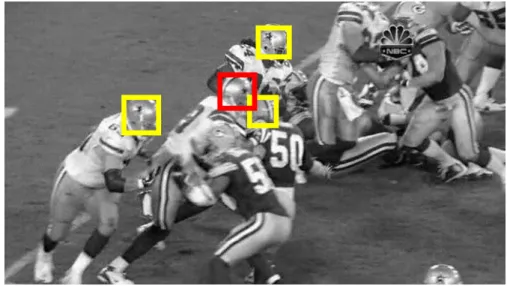
Figure 2.2: Target moves past extremely cluttered or camouflaged image regions, called “dis-tractors”. Target and the distractors have identical appearance, where it is hard to distinguish the target solely based on the appearance. Red bounding box: the real target; yellow bounding boxes: distractors.
Based on the initialized bounding box and later target observation, a well designed tracker can overcome some conventional challenges, like significant target deformation, illumination change and fast motion. A particularly difficult problem is how to track a target which moves
through scenes featuring several other very similar objects, or which moves past extremely cluttered or camouflaged image regions, shown in figure 2.2. In these situations, it is difficult to distinguish the target using only target appearance information [13], since the background regions of the image may share similar appearance information. To achieve successful tracking, the tracking algorithm needs to go beyond the target information and “interact” with the context in a sophisticated way, understanding where is the potential distraction in the scene, which we call “distractors”. Note that detecting distracting image regions before they come close and distract the tracker can actually support robust tracking by modelling the dynamic behaviour of such regions. Therefore, in this thesis, we try to exploit additional contextual information to solve the problem of tracking a single target which is camouflaged against scenes containing a large number of similar non-target entities.
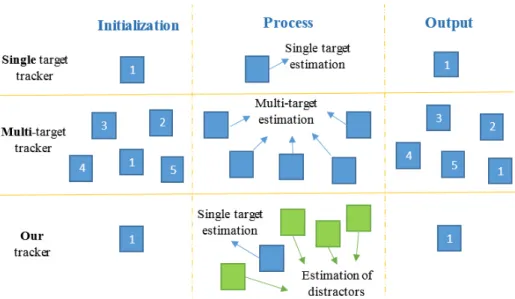
In scenes with clutter and camouflage, the method proposed in this thesis detects multiple target-like regions and explicitly associates one region to the target, which may at first sight appear analogous to the data association approach in multi-target tracking. However, note that our proposed method isnota multi-target tracker (figure 2.3): i) it only identifies the location of a single target at each frame; ii) it does not assign individual IDs to multiple other objects; iii) it is initialised with only a single target bounding box, and must automatically detect and learn any other target-like objects (distractors) on-the-fly.
We first review work on single-target tracking in highly cluttered scenes, which explicitly exploit the contextual information. We also review somemulti-target tracking literature, since our proposed method (global dynamic constraints) for handling distractors, is somewhat related to the data association methods used in multi-target tracking.
• Context based single-target tracker. To track a single target robustly against clutter, the tracker should learn and exploit contextual information. [118, 119] observed that non-target objects, known assupporters, may sometimes be associated with a target and can be used to help infer its position. However, in highly cluttered scenes, it may not be possible to find supporters that persistently move around the target with strong motion correlation. [120, 121, 122] detected distractor regions with similar appearance to the
tar-Figure 2.3: Relationship between single target trackers, multi-target trackers and our proposed tracker. Single target trackers do not explicitly model information about distractor objects. Multi-target trackers model and identify multiple target regions, exploiting additional initialized prior knowledge. In contrast, our tracker is initialised the same as single-target trackers, while detecting and tracking other distractor objects on-the-fly.
get. However, their tracking accuracy heavily depends on the pre-defined spatial density of samples, where sparse sampling cannot adequately distinguish adjacent objects, and dense sampling is computationally expensive. Even with dense sampling, such ods can still fail to distinguish adjacent or overlapping objects. Note that such meth-ods [120, 121, 122] maintain multiple image regions as target candidates, but do not specifically decide which region is the target at each frame. [8] tried to distinguish the target from distractors by using an appearance matching score. However, such algorithms are prone to failures when the target is camouflaged, occluded or undergoing deforma-tion, when appearance matching methods can cause the tracker to erroneously fixate on clutter. [111] recently proposed a distractor-aware target model to select salient colours in single target tracking. In contrast, our work addresses video sequences that are so ex-treme that target and distractors may haveidenticalappearance (illustrated in figure 2.2), and cannot be disambiguated by any appearance features. Moreover, [111] distinguishes the target from distractors based on spatial distance between the current observations (k frame) and the previous target estimate (k−1frame). This spatial distance method can fail when the camera itself undergoes significant motion. In contrast, we propose a global
dynamics model for the target and nearby distractors, and show that this enables robust tracking even in sequences filmed from moving cameras.
• Data association in multi-target tracker. Our proposed global dynamics model is related to, but distinct from, the problem of data association discussed in the multi-target tracking literature. Berclaz et al. [123] reformulated the data association problem as a constrained flow optimization convex problem, solved using a k-shortest paths algorithm. However, the computational cost of generating k paths is quite high, especially for our problem of finding a single target at each frame. Moreover, this method first obtains detections for every frame throughout an entire video sequence, and then mutually optimises the target IDs over all frames. Such post-processing methods cannot be used for online tar-get tracking. Shitrit et al. [124] also relaxed the data association problem as a convex optimization problem which explicitly exploited image appearance cues to prevent erro-neous identity switch. However, appearance cues are not sufficiently discriminating to distinguish between the target and distractors in the extremely challenging videos, i.e. a target moves through scenes featuring several other very similar objects, or which moves past extremely cluttered or camouflaged image regions, which we aim to tackle in this work. [13] utilized motion dynamics to distinguish targets with similar appearance, in or-der to reduce instances of target mislabelling and recover missing (occluded) data. How-ever, their algorithm requires the number of targets to be known a-priori. In contrast, our method handles the situation where the number of distractors is unknown and has to be learned on the fly during tracking. [125] proposed a constrained sequential labelling to solve the multi-target data association problem, which utilized learned cost functions and constraint propagation from captured complex dependencies. However, their approach is only designed to handle the case of piece-wise linear motion. [12] developed an online multi-target tracker which extended the single target tracker of [25] by using global data association. However, their proposed candidate regions must be densely sampled which can be extremely computationally expensive. Moreover, their global identity-aware net-work flow graph depends heavily on target appearance models, which have difficulty in
handling highly cluttered scenes, especially where both target and distractors share iden-tical appearance. Our early work [126] learned and exploited the global movement of sports players to inform strong motion priors for key individual players. Information from the global team-level context dynamics enabled the tracker to overcome severe situ-ations such as inter-player occlusions. However, this context-conditioned latent behavior model do not readily generalise to non-sports tracking situations.
In this work, we further encode the contextual information in chapter 5 to support the single-tracker that goes beyond the target itself, which perceives distractors and models (understands) their dynamics in the scene, shown in figure 2.4.
Figure 2.4: The proposed framework using contextual information. The red bounding box/dot represents the target while the green colour indicates the distractors. The algorithm simulta-neously track the target and distractors, where the information is built in the global dynamic constraint to further improve the single target tracker.
2.4
Dataset construction and annotation
Benchmark datasets have played a leading role in advancing tracking research by facilitating the evaluation process. For persuasive comparisons of visual tracking algorithms, constructing test data should consider two questions: which situations should be included and how should the algorithms be tested to reach a convincing conclusion [127]. After several decades of efforts,
several benchmark datasets have been created for category-free trackers. Here, we first review the related work with respect to the dataset construction and attributes annotation. Since the bias of the dataset significantly affects the algorithm evaluation, we also analyse the existing methods for bias analysis.
2.4.1. Dataset construction and attributes annotation.
To build a test dataset for category-free single-target trackers, it is essential to include scenes broadly and comprehensively that represent the world. One representative work is that of Smeulders et al. [128] who constructed an RGB tracking dataset ALOV++ with 314 sequences and evaluated the algorithms by survival curves, Kaplan Meier statistics, and Grubs testing, with the evaluation metrics F-score and object tracking accuracy (OTA) score. Since ALOV++ has no attributes annotations, it cannot explain tracker strength or weakness for particular functional conditions, such as occlusion, illumination change etc. A landmark RGB benchmark, VTB, ini-tially contained 50 videos [23], later extended to 100 videos [129] with per-sequence binary attributes labels according to the intuition of human annotators. They proposed to test the al-gorithms in terms of temporal robustness (initialize trackers from different frames) and spatial robustness (initialize trackers with varying degrees of added spatial error). The performance was compared according to the Area Under Curve (AUC) score of the two trade-off plots, i.e. success ratio versus overlap threshold and success ratio versus center error threshold. Later, Li [22] constructed an even larger RGB dataset NUS-PRO, featuring 365 videos of pedestrians and rigid objects. They followed the evaluation metrics used in [23, 129]. For RGB-D tracking, Song et al. [20] generated a dataset with 100 sequences. However, a common problem of these large datasets is that their attributes areper-sequenceannotated rather thanper-frame an-notated, and all attributes are assigned based on the intuition of human annotators. This makes it hard to accurately categorise the tracker performance within different attributes. For example, per-sequence annotated attributes (e.g. “occlusion”) do not last throughout the entire sequence [21]. It is preferable to evaluate each tracker with respect to attributes annotated on a per-frame basis, for a more accurate and meaningful analysis. Note that constructing a very large dataset does not guarantee diversity in its visual attributes, while it significantly slows down the
Table 2.2: Comparison of benchmark datasets. BL: binary label (human intuition based anno-tation).
Type Name Num. Attributes
Unit Tag
RGB
ALOV++ 314 N/A N/A
VTB1.0 50 per-sequence BL VTB2.0 100 per-sequence BL NUS-PRO 365 per-sequence BL VOT2013 16 per-frame BL VOT2014 25 per-frame BL VOT2015 70 per-frame BL
Infrared VOT2015TIR 20 per-frame BL
RGB-D PTB 100 per-sequence BL
process of evaluation (by increasing the computational burden of each tracker trial). A better approach is to annotate each sequence with the visual attributes occurring in that sequence, and then perform clustering to reduce the size of the dataset, while still maintaining its diversity [130]. Based on this approach, Kristan et al. [3] organised the Visual Object Tracking (VOT) workshop associated with the ICCV/ECCV conferences. Note that based on the previous pro-posed evaluation protocol [23, 129, 20, 22], if a tracker fails early in a sequence, it will show a low success ratio, but if it fails late in a sequence, it may show high success ratio. Therefore, the VOT evaluation protocol re-initializes trackers when failure is detected, which avoids the sequential position of failure will eventually damage the evaluation among different trackers. However, their work annotated all attributes using human annotators which almost unavoidably constains some subjective errors. We summarize some recent benchmark datasets in table 2.2.
Despite the availability of several high quality benchmark datasets for RGB tracker evalua-tion [3, 21, 22, 23], those available for RGB-D tracker evaluaevalua-tion are far more limited, viewed in table 2.2. The benchmark dataset PTB, created by Song et al. [20], contains 100 sequences. However, we observe many sequences where the RGB and depth image pairs are significantly un-synchronised, shown in figure 2.5. This can cause ambiguities in annotated ground-truth, and performance evaluation. Therefore, this thesis presents a new RGB-D dataset with cor-rectly synchronised RGB and D channels to test our approach in a consistent and unbiased way.
Figure 2.5: Some examples from Princeton RGB-D benchmark tracking dataset [20] which clearly show that RGB images and depth images are not synchronized.
2.4.2. Bias analysis.
Torralba et al [131] has proposed a fundamental question about “whether the datasets are measuring the right thing”. Unlike datasets in machine learning, where the datasetisthe world, computer vision datasets are supposed torepresent the world [131]. Therefore, the bias inside the dataset can significantly affect the evaluation results. Good tracking performance might just indicate that the algorithm better fits the dataset bias. Ponce et al [132] pointed out that (i) some algorithms exploit some restrictions, but will fail when the restrictions do not apply; and, related to this, (ii) the images are not sufficiently challenging for the benefits of more sophisticated algorithms (e.g., scale invariance) to make a difference. Note that over half the PTB dataset [20] is devoted to pedestrian tracking and the camera is almost always stationary, which can bias the results of evaluating generic target trackers, see figure 2.6. To test a category-free tracker, it is important to build a dataset consisting of various object categories. Additionally, since motion of the RGB-D camera often causes significant depth variation, it is essential to evaluate how the tracker performs with camera motion.
Figure 2.6: Different images representing different testing sequences, which actually captured the same or very similar scenes. A large dataset (100 test sequences) does not have a meaningful impact on diversity if many of those sequences are the same or very similar.
the datasets and the real world. Torralba et al [131] suggested the potential sources of the bias are selection bias, capture bias and negative bias. Khosla et al [133] proposed a discriminative framework that directly exploits dataset bias, where the model learns two sets of weights: (1) bias vectors associated with each individual dataset, and (2) visual world weights that are com-mon to all datasets, which are learned by undoing the associated bias from each dataset. Based on the study of dataset bias, we establish some criteria that could better guide the unbiased dataset construction, which is presented in this thesis (chapter 4).
CHAPTER 3
RGB TRACKER
This chapter proposes a new single target tracker for 2D RGB image sequences, under various kinds of difficult tracking conditions. The proposed method achieves state-of-the-art robustness by addressing the problems in three fundamental areas: target representation, matching method-ology, and model adaptation [1]. The target isrepresentedat three different layers: pixel layer, local-parts layer and target (bounding box) layer. A novel “Adaptive Clustered Decision Tree” method is proposed to enable robust matching at the part layer between successive frames, which dynamically selects the minimum combination of necessary features, thereby providing robustness with computational efficiency. The target model isupdated through a closed loop with cross-constraints between different model layers. We test the tracker using two differ-ent tracking benchmarks [2, 3], based on two differdiffer-ent test methodologies, and show it to be more robust than all other state-of-the-art methods from those tracking challenges while also demonstrating competitive tracking precision.
This chapter is organized as follows. The proposed method is described in section 3.1, where the model representation is first introduced, followed by the work of model matching and adaptation. Section 3.2 evaluates the proposed method using two benchmark datasets and demonstrates state-of-the-art performance. Additionally, the contribution of each key com-ponent of the tracker to overall performance is also evaluated. The chapter is concluded in section 3.3.
3.1
Proposed method
Following the conventions of [3] and [23], our method initialises its target model using only a given bounding box in the first frame, without any prior information about the target category.
3.1.1
Multi-layer target representation
The target is modelled hierarchically at three different layers: the pixel (bottom) layer, parts (middle layer, constructed from super-pixel) layer, and the target (top or overall representa-tion) layer [1], see figure 3.1. Following the logic of the model construction and the order of model updating, this section first introduces the middle layer model, since the initial features are extracted from this layer. Later, we introduce the top layer followed by the bottom layer.
Figure 3.1: 1-use top layer propagation to find a candidate image region, and segment it into super-pixels; 2-match middle layer parts, update old parts, learn new parts, use updated parts to relearn top layer; 3-use new top layer to assign likelihoods to bottom layer pixels in the new frame.
3.1.1.A. Notation
We precede the model descriptions with a brief overview of notation. In principle, our method can be used with any combination of features:
Fk={f1k, ...,f i k, ...,f
Nf
k } (3.1)
whereFkdenotes a set ofNf feature modalities exploited by the tracker at thekth video frame.
different, andfik denotes a particular kind of feature, provided that all such features,fik, satisfy
the following conditions.
Firstly, it should be possible to associate any image pixel with a feature value:
Ik(x)7→f i(x)
k (3.2)
where Ik(x) denotes the pixel at location x in the kth image, Ik. Clearly, certain kinds of
features, e.g. texture, must be calculated from a region surrounding an individual pixel, but such feature values can still be associated with the central pixel’s location.
Secondly, in theith feature modality, the set of feature valuesfi(x∈R q k)
k of any image region, Rqk, can be used to create a model:
Rkq 7→Mki(q) ≡Mi(x∈R q k)
k (3.3)
whereMik(q)is a model of theqth region’s pixels’ feature values, which could for example be a
probability distribution or some other kind of collective representation.
Thirdly, for theith feature modality, a suitable likelihood functionLˆik(p,q)exists for compar-ing the similarity of any pair of models, Mik(p),Mik(q), representing any pair of image regions,
RpkandRqk:
{Mik(p),Mki(q)} 7→Lˆik(p,q) (3.4)
Where such feature models are in the form of distributions, then corresponding likelihood functions are typically based on divergence measures, such as [77, 134, 135, 79]. However, in general, other kinds of useful likelihood functions can be formed for other kinds of models.
Fourthly, for each kind of feature modelMik(q), another likelihood functionL˜i(x,q)exists for evaluating the consistency of any pixel’s feature value,fik(x), with the model. Intuitively, we can
regard the set of such likelihoods:
˜
as the set of opinions of each feature modality as to the likelihood of such a pixel value belong-ing to the part of the target object projected as theqth image region, Rqk, in thekth frame. In
cases where the feature models are in the form of distributions, then such likelihoods may be conveniently posed in the form of conditional probabilities.
3.1.1.B. Middle layer target representation
The middle layer consists of a set of feature models (in the sense of equation 3.3), extracted from the image regions corresponding to parts of the target, which we detect as super-pixels. Using super-pixels as the basis for middle layer model extraction offers several advantages over randomly selecting square “patches” as in previous methods [6, 136]. Firstly, a super-pixel is much more likely to correspond to a distinct and homogeneous part of the target. In contrast, randomly (or uniformly) selected patches are likely to contain pixels from two or more dissimi-lar (e.g. in terms of colour) parts of the target, which can lead to matching ambiguity. Secondly, when patches are randomly (or uniformly) selected from an initial bounding box, many patches are likely to contain information about both target and background pixels, and this also can negatively impact tracking performance. In contrast, due to the homogeneous nature of super-pixels, the pixel models extracted from these regions are much more likely to include either purely target pixels, or purely background pixels. Once tracking begins, those super-pixels which erroneously correspond to background regions are rapidly detected and eliminated from the middle layer target representation, leaving only those super-pixels which truly belong to target parts [1]. We use the Simple Linear Iterative Clustering (SLIC) super-pixel segmentation method [137], because it offers the following advantages: the number of super-pixels can be known in advance; the super-pixels have uniform size; the compactness can be defined, which enables us to use squares representing the superpixels; and the algorithm has high computa-tional efficiency. Then, the middle layer target representation, ζmid
k , consists of Nmid feature
models (of the form equation 3.3), for each of Ns super-pixels, representing Ns target parts,
ζmid k ={{M 1mid(1) k ...M imid(1) k ...M Nmid(1) k }, ...,{M1mid(q) k ...M imid(q) k ...M Nmid(q) k }, ...,{M1mid(Ns) k ...M imid(Ns) k ...M Nmid(Ns) k }} (3.6) whereMimid(q)
k is a feature model in theith feature modality for theqth super-pixel, representing
theqth target part, at framek.
3.1.1.C. Top layer target representation
The top layer of the target representation is denoted asζktopwhich includes overall information
about the target’s bounding box region,RTk, and also a ring-shaped local contextual region,RCk,
which surrounds the target region (see figure 3.2), in the form of a set of models for each region in each feature modality:
ζktop={Mitop(T)
k ,M itop(C)
k }itop=1...Ntop (3.7)
where T and C indicate a target region and a contextual region, respectively. The top layer target models, {M1top(T)
k ... M itop(T)
k ... M Ntop(T)
k }, are computed from the middle layer target
parts models as:
Mitop(T) k = 1 Ns Ns X q=1 Mimid(q) k (3.8) where{Mimid(q)
k }q=1...Ns are the middle layer feature models for each ofNstarget parts, as de-fined in equation 3.6. The top layer local contextual models,{M1top(C)
k ...M itop(C)
k ...M Ntop(C)
k },
are computed directly from the pixels occupying the ring-shaped local contextual region sur-rounding the target:
Mitop(C)
k ≡M
itop(x∈RCk)
whereRCk is determined by enlarging the target’s bounding box area by multiplying both width
and height by a scale factor,λ(value 1.2) , as shown in figure 3.2.
Figure 3.2: Target,RTk, and ring-shaped local contextual,RCk, region.handωis the height and width of the bounding box, respectively. The scaling factor isλ.
3.1.1.D. Bottom layer target representation The bottom layer representation,ζbot
k , comprises individual pixels, each associated with a set
of likelihoods, according to each feature modality, that the pixel belongs to the target object:
ζkbot={l1bot(k x)..., lkibot(x)..., lkNbot(x)}x∈(RT
k∪RCk) (3.10)
where lkibot(x) denotes the discriminative likelihood of a pixel x belonging to the target with
respect to theibotth feature modality, computed as:
likbot(x) = λ topL˜itop(x,T) k λtopL˜itop(x,T) k + (1−λtop)˜L itop(x,C) k (3.11)
where L˜iktop(x,T) denotes the likelihood of a pixel value, Ik(x), with respect to the top layer
model, Mitop(T)
k , of the target region, R T k; L˜
itop(x,C)
k denotes the likelihood of the pixel value
with respect to the top layer model,Mitop(C)
k , of the target’s local contextual region,R C k;λ
top
is the expected ratio of the top layer target area to the top layer contextual area. For simplification, it is computed as:λtop
3.1.2
Tracker propagation and matching
An overall schematic for the tracker is shown in figure 3.3. The tracker is first propagated by information matching at the top layer, which generates a candidate image region for the middle l
![Figure 1.2: RGB-D tracking of target with large depth variation. Red, blue, green bounding boxes represent our proposed tracker and the state-of-the-art trackers DS-KCF [10] and PT [20] respectively](https://thumb-us.123doks.com/thumbv2/123dok_us/39557.2505523/11.892.195.758.117.409/figure-tracking-variation-bounding-represent-proposed-trackers-respectively.webp)
![Figure 2.5: Some examples from Princeton RGB-D benchmark tracking dataset [20] which clearly show that RGB images and depth images are not synchronized.](https://thumb-us.123doks.com/thumbv2/123dok_us/39557.2505523/36.892.178.751.145.513/figure-examples-princeton-benchmark-tracking-dataset-clearly-synchronized.webp)