Pollcy Research
WORKING PAPERS
Debt and International Finance International Economics Department
The World Bank January 1993
WPS 1073
Fiscal
Aspects
of Developing
Country
Debt Problems
and Debt and Debt-Service
Reduction
Operations
A Conceptual Framework
Peter J. Montiel
The quality of fiscal adjustment programs must improve if Brady Plan programs are to improve fiscal solvency.
Te Policy Resarch Woking Papers disseminate the findings ofwok in progress and encourage th exchangeofideas among Bank staff
and all others interested in developmentissuess Tbese papers, distributed by the Rescasbh Advisory Staff carry the names of the authors, refleot nlytheirviews,and shouldbeused and cted accordingly.Thefindings, intpretation. and conclusions aretheauthors'own.Tey
should not be attnouted to the Wodd Bank, its Board of Di,ctor its managanat, or any of its manber countries
Public Disclosure Authorized
Public Disclosure Authorized
Public Disclosure Authorized
Policy Research
Debt and International Finance
WPS 1073
This paper - a product of the Debt and Intemational Finance Division, Intemational Economics
Department- is part of a larger effort in the department to understand the costs and benefits to countries of debt relief arrangements. Copies of the paper are available free from the World Bank, 1818 H Street NW, Washington, DC 20433. Please contact Rose Vo, room S8-042, extension 31047 (January 1993,29 pages).
The causes and implications of the developing The debt and debt-service reduction (DDSR) country debt crisis - as well as its solution- programs implemented so far under the Brady
all have an important fiscal dimension. plan have provided only partial solutions, closing without eliminating the gap between the face The crisis was triggered by the widespread value of the extemal debt and the present value perception that the public sectors in many of prospective public sector debt service. They heavily indebted countries were effectively have done so partly by reducing the former and insolvent m the international environment of the partly by increasing the latter.
early l10s. The actual fiscal response to the
resulting liquidity crisis involved increased Their contribution toward easing the imme-reliance on domesiic financing, the inflation tax, diate liquidity problems of the debtors has not and the curtailment of public investment. This been encouraging. The amount of debt relief created adverse adjustment incentives for embodied in Brady Plan programs enacted so far policymakers and resulted in credit rationing, has not in itself been sufficient to restore fiscal capital flight, assumption of private external solvency. Better-quality fiscal adjustment could claims by the public sector, and poor domestic greatly help improve the situation.
investment performance.
The most important potential contribution of Solutions involve restoring fiscal health such programs, then, may have been the reduc-through a combination of debt relief and efficien. tion - through the policy conditionality
associ-fiscal adjustment, aimed at mitigating the burden ated with resources provided by the intemational associated with public sector debt service and financial institutions - of the secondary burden
minimizing the liquidity problems facing the associated with the intemal transfer of resources
indebted public sector. to the public sector.
ThePolicy ResearchWorking Producediby Research therPolicy DisOf work under wCy in theBank Anobjectiveofthe senes is to get these findings out quickly, even if presentations are less than fully polished. The findings, interpretations. and
conclusions in these papers do not necessarily represent of ficial Bank policy.
FISCAL ASPECTS OF DEVELOPING-COUNTRY DEBT PROBLEMS AND DDSR OPERATIONS: A CONCEPTUAL FRAMEWORK'
Peter J. Montiel Oberlin College
I would like to thank, without implicating, the participants in an IECDI workshop at the World Bank for their comments on an earlier draft. The careful comments provided by Eduardo Fernandez-Arias are also gratefully acknowledged.
TABLE OF CONTENTS
Summary
I. Introduction 1
II. The Debt Crisis as a Fiscal Phenomenon 1
III. Origin of the Debt Crisis in Insolvency of the Public
Sector 3
a. The Solvency Condition of the Public Sector 4
b. Why a Debt Crisis? 6
IV. The Nature of the Fiscal Response 9
V. The Brady Plan and Fiscal Policy 12
VI. Summary and Conclusions 23
Appendix: Sources for Fiscal Data 25
I. INTRODUCTION
Since the outbreak of the international debt crisis in 1982, analysis of debt issues has largely been conducted from a perspective that considers external debt as a liability of the debtor country as a whole. This approach pays little attention to sectoral disaggregation within the debtor country itself. The problem of adjustment is interpreted as a balance of payments issue, and the policy focus is on conventional short-run
macroeconomic stabilization, "getting prices right", and
undertaking longer-term structural measures designed to promote economic growth.
An important empirical observation, however, is that the overwhelming majority of the external debt outstanding in the heavily-indebted developing countries at the time of the outbreak of the international debt crisis was owed by these countries' public sectors. As Table 1 indicates, about three quarters of the total medium and long term gross external debt owed by the highly indebted countries (HICs) as a group in 1982 either repiesented a direct liability of the public sector or bore a public sector guarantee. This suggests that approaching the crisis from a fiscal perspective may yield insights that would tend to be obscured by treating the debtor country as a single agent. This paper argues that fiscal phenomena have indeed played a key role in determining the timing, breadth, and macroeconomic implications of the crisis. Moreover, fiscal adjustment has a more fundamental role to play in resolving the macroeconomic problems associated with external debt than would be inferred solely from its contribution to short-run macroeconomic stabilization. Specifically, the longer-term fiscal implications of debt and debt-service reduction (DDSR) operations under the Brady plan will be a primary determinant of the success of these operations.
II. THE DEBT CRISIS AS A FISCAL PHENOMENON
It is helpful to begin by sorting out some conceptual issues. The debt crisis resulted in a cutoff of private lending to all agents in the developing countries experiencing debt problems. Suppose that we disaggregate such economies into public and private sectors, both of which engage in financial transactions with external agents. If we adopt the perspective of Krugman (1988), a liquidity problem cannot arise for a domestic borrower in the absence of a crisis of solvency. In other words, as long as each sector is perceived as able to repay, it would be able to attract the foreign lending required to finance current account deficits. In the absence of interactions between the domestic sectors, the emergence of severe financial difficulties for either the public sector or the private sector would result in a "fiscal crisis" or a "private financial crisis", in which one or the other sector would be denied further access to borrowing by its private creditors, but would not result in a "debt crisis" for the country
Table 1 : Heavily-Indebted Countries: Share of Public and rublicly-Guaranteed Debt in Total Debt l/
1982 1988
Public Total Share Pgblic Total Share
Argentina 15.9 27.1 58.6 47.5 49.3 96.4 Bolivia 2.8 3.0 95.7 4.1 -- 4.3 95.9 Brazil 51.7 74.8 69.1 89.9 101.4 88.6 Chile 5.2 14.0 37.5 13.7 16.1 85.3 Colombia 6.0 7.2 83.4 13.8 15.4 90.0 Cote d'Ivoire 5.1 ,6.2 81.4 7.9 11.6 68.2 Ecuador 3.9 5.5 70.5 9.0 9.1 98.7 Mexico 51.6 59.7 86.4 80.6 86.5 93.1 Morocco 10.2 10.5 97.6 19.4 19.6 99.0 Nigeria 9.1 10.4 87.4 29.3 29.9 98.2 Peru 7.0 8.6 80.7 12.5 13.9 89.8 Philippines 8.9 12.1 73.3 23.0 24.0 95.9 Uruguay 1.7 1.9 89.2 3.0 3.0 97.2 Venezuela 12.4 17.4 71.3 24.6 28.9 85.2 Yugoslavia 5.5 16.3 33.4 14.0 18.6 74.8 Total HICs 196.9 274.8 71.7 392.5 431.9 90.9
1/ Totals are in millions of US S; shares are in percent.
as a whole.
In practice, however, interactions between the two domestii sectors will ensure that a sufficiently severe crisis of solvency in one sector will spread to the other, reducing the profitability of lending to all agents in the country. More importantly, I argue below that whether financial crises originate in the public or private sector, they are likely to manifest themselves in the form of perceired public sector insolvency, implying that fiscal correction must play a key role in the resolution of the crisis.
A financial crisis may directly originate in the public sector through a change of circumstances that calls into question the sector's future ability to service its debt. However, insolvency of the public sector is also likely to contaminate the private
sector through fairly obvious mechanisms. A fiscal crisis will
create the need for additional revenues and/or spending cuts, and may even result in default on the domestic obligations of the
public sector. All of these may have adverse effects on the
financial pos-tion of the private sector, and the anticipation of such adverse effects may jeopardize its solvency from the perspective of external creditors.
However, the financial health of the public sector may also be threatened by crises that originate in the private sector, through
several mechanisms. First, to the extent that a private sector
financial crisis results in a slowdown in private economic activity, public revenues (e.g., tax receipts or sales revenue of
public enterprises) will be adve-sely affected. Second, though
standard commercial risk implies that individual cases of bankruptcy will occur in the private sector, generalized insolvency (i.e., a widespread financial crisis) is unlikely in the absence of
major policy mistakes or particularly severe external shocks.2 A
crisis of insolvency in the private sector brought about by inappropriate public policies is likely to result in strong political pressures for relief on the part of the most affected private agents. Finally, a widespread private crisis may engulf the public sector less directly through the macro stabilization
channel. Countercyclical spending or tax relief, transfers to
distressed private concerns, foreign exchange guarantees, or "nationalization" of private external debts, all undertaken in the pursuit of macroeconomic stabilization, may ultimately threaten the financial solvency of the public sector.
It is worth noting in this connection that, due to the "nationalization" of private external debt, the share of public sector debt in the external debt of the heavily-indebted countries increased markedly over the period between the outbreak of the debt
2 Calvo (1989), for example, has documented how "incredible
reforms" can lead to overborrowing by the private sector. 2
crisis and the adoption of the Brady plan. As Table 1 indicates, by 1988 (the year immediately preceding the announcement of the Brady plan) the share of public and publicly-guaranteed debt in the total gross external debt of the HICs exceeded 90 percent. Though the extent to which this assumption of external liabilities by the public sector represented a net transfer to the private sector
depends on the terms on -'hich these liabilities were acquired, it
seems likely that in some co-rtries this transfer of liabilities av.ided widespread bankruptcy in the private sector.
Whether the crisis originates in the public or private sector, then, it is likely to eventually be internalized by the public sector and to manifest itself in the form of public sector
financial difficulties. In effect, the political system ensures
that the losses associated with a financial crisis are allocated through the public sector, and public sector insolvency is a
symptom indicating that the allocation issue is unresolved. Since
the government has coercive power over private assets, the country
as a whole will be unable to attract external funds as long as the
solvency of the public sector remains in question. Moreover,
domestic residents will seek to avoid the burden of contributing to the resolution of the country's fiscal problems by moving assets abroad. In this context, the restoration of public sector solvency becomes the sine qua non for resolving the country's financial crisis.
This means that overall current account adjustment is neither necessary nor sufficient to resolve the debt problem. It is not sufficient, because if adjustment takes the form of an improvement in the private sector's current account in the context of sustained public sector insolvency, the public sector can service its external debt only by borrowing from the domestic private sector. Unless credible fiscal adjustment takes place, however, domestic creditors will be no more willing to finance the public sector than will external creditors. Thus, current account adjustment without fiscal adjustment cannot solve a public sector debt problem. Current account adjustment is also not necessary, because as long as successful fiscal adjus-ment follows the nationalization of a debt problem and the public sector is perceived as solvent by external creditors, such creditors should be willing to finance
short-run current account deficits -- i.e., a "foreign exchange
gap" would not emerge. In short, when the debt to bE serviced is public, the adjustment must ultimately be fiscal.
III. ORIGINS OF THE DEBT CRISIS IN INSOLVENCY OF THE PUBLIC SECTOR This section will make the empirical argument that the cutoff in the flow of net lending from external creditors to the HICs in the early eighties reflected a sharp reversal in the perceived ability of the public sectors in the HICs to service their debts on
market terms -- i.e., as argued in the previous section, from the
perspective of creditors the public sectors in several of these
countries indeed became insolvent. This led to a situation in
which economic agents, both foreign and domestic, became reluctant to acquire claims on the economi-s (not just the public sectors) of the HICs. In turn, this reluctance manifested itself, among other ways, in the cutoff of external private funding.
a. The Solvency Condition for the Public Sector
From the perspective of risk-neutral creditors, a debtor will be perceived to be solvent when the present value of its expected future debt service payments, discounted at the safe rate of
interest, is equal to the face value of the debtor's total debt3.
Only in this case are the expected returns from lending to this particular economic agent equal to the opportunity cost of funds, and only in this case, therefore, will both new and existing
creditors voluntarily continue to finance the debtor. This
condition can be related to the status of the debtor's
comprehensive balance sheet4. The comprehensive balance sheet
includes not only all currently-existing marketable assets and liabilities (which take the form of stocks), but also the present value (discounted at the safe interest rate) of all anticipated future flows of receipts and payment obligations. The capitalized value of the former represents a current asset of the debtor, while that of the latter is a current liability. The difference between the value of the debtor's assets and liabilities, with both defined in this comprehensive fashion, is the debtor's comprehensive net worth. As long as net worth defined in this manner is nonnegative, the debtor will be solvent, in the sense that the capitalized value of its resources is sufficient to liquidate its liabilities.
In the case of the public sector of a highly-indebted country, straightforward manipulation of the sector's budget identity can be used to show (see Buiter (1985)) that the resources devoted by the public sector each period to the service of debt (both interest and amortization) are equal to the sum of the its primary budget
surplus and its seignorage revenue5. To see this, let D, denote the
3 The term "safe rate of interest" refers to the rate of
interest applicable to assets that are free of default risk, such as US Treasury bills.
4 See Buiter (1983), as well as Guidotti and Kumar (1991).
5 The equations that follow can be expressed in a number of
ways, depending on whether the income from public sector real and financial assets is capitalized and thereby treated as the value of a stock, or as a flow. Due to the absence of comprehensive data on stocks of public sector assets, the flow option is exercised below.
total gross (external and domestic) debt of the consolidated public sector at time t, it the "safe" nominal interest rate, PSt the
public sector primary (i.e., non-interest) surplus, and IV the stock
of base money6. The public sector's flow budget constraint can then
be written as:
bt+kt=-PSt+i4t (1)
That is, the overall deficit of the public sector (consisting of
the noninterest component -PSt plus interest payments i,D,) must be
financed either .y issuing debt (D,) or printing money (M). Th-.
can be rearranged as:
it Dt-DtPSt+Mt (2)
The left-hand side of this equation expresses total debt service as
the sum of interest payments itpt and debt amortization (-D,).
Equation (2) shows that this must be equal to the sum of the primary surplus PSt and seignorage revenue Mt. It follows that public sector solvency holds at time t when the present value of the expected primary surplus plus the expected seignorage revenue
over all future periods s is greater than or equal to the face
value of the gross public sector debt:
PDV( P5,+k,; i8R, t)
2Dt
3For present purposes, it is useful to rewrite these expressions in slightly different form. Letting lower-case letters denote ratios to nominal GDP (i.e., d=D/Py, m=M/Py, and ps=PS/Py, where y is real GDP and P is the domestic price level), the public sector budget constraint (2) becomes:
( rt-n.) dt-d,=PSt+M_,t 4
where rt is the real interest rate at time t and n, is the rate of growth of real GDP. Similarly, the solvency condition can now be written as:
6 For reasons described in footnote 2, PS includes interest
receipts on public sector financial assets, but excludes interest on gross public debt.
Pv(ps:+l@em ;rt@nt, t) 2dt
where the effective discount rate is now r,-n1, the difference
between the real interest rate and the rate of growth of real GDP. Given constant values of the ratio of the primary surplus and seignorage to GDP, the preceding result implies that the present
value of debt service payments will be infinite whenever the rate
of growth of real GDP exceeds the real rate of interest. This is
so because receipts from the issue of new debt would always be more than sufficient to service existing debt at the market rate of
interest without increasing the debt/GDP ratio. In this case,
solvency is guaranteed for any initial finite stock of debt,
regardless of the value taken by the sum of the primary surplus and
seignorage revenue. In other words, when the rate of growth of
real GDP exceeds the real rate of interest, the solvency requirement does not impose a constraint on the future values of the sum of the public sector's primary surplus and seignorage revenue, essentially because the existing debt can be serviced by the sale of new debt, rather than out of the public sector's own resources. On the other hand, when the rate of interest exceeds the rate of growth of real GDP, the proceeds from the sale of new debt at a constant debt/GDP ratio are not sufficient to service the old debt, and the public sector must service the debt using its own
resources -- i.e., by generating sufficiently large primary
surpluses and seignorage revenue. The solvency condition described previously determines just how large the magnitudes of the future resources raised by these means must be, and thus acts as a constraint on the Fresent value of future primary surpluses and seignorage revenue.
b. Why a Debt Crisis ?
The immediate trigger for the debt crisis was a reversal in the relationship between the "safe" real interest rate in international capital markets and the rate of growth of real GDP in
the HICs8. During most of the decade of the seventies, the real
long-term rate of interest in the industrial countries fell well short of the rate of real GDP growth registered by the HICs as a
7 See Cohen (1985) for a detailed discussion of the roles of
the real interest rate and the growth rate in imposing a solvency constraint on sovereign borrowers.
8 See Sachs (1985).
group, as indicated in Chart 19. Under these circumstances the public sectors in these economies could service their existing debt through new borrowing, without the need to generate their own
fiscal resources for the purpose. The absence of solvency
constraints on fiscal policy in these countries was manifest in large fiscal deficits in many of them during this period (Table 2). This suggests that, for a large subset of the HICs, the origin of the crisis is to be found in the public sector. Based on Table 2, obvious exceptions are Chile and Venezuela, though Colombia also experienced relatively small fiscal deficits, at least through the end of the seventies.
At the beginning of the new decade, tight monetary policies in many industrial countries, designed to combat the inflationary consequences of the second oil shock, combined with expansionary fiscal policies in the United States, reversed the relationship between the real interest rate and the rate of growth of the HICs. As shown in Chart 1, real long-term interest rates began to rise substantially above the trend real rates of growth registered by these countries. Under these circumstances, servicing the existing debt through new borrowing would have become a Ponzi scheme, in which the debt/GDP ratio would have prospectively risen without
bound. Creditors could not be expected to acquiesce in such a
scheme, since it would imply that the present value of the net resource transfers that they would receive in return for their new loans would fall short of the face value of such loans. Thus the public sector debtors in the HICs found it necessary to begin to service debt with their own resources. This meant that the previous fiscal performance could not be sustained. To maintain the solvency of the public-sector borrowers in these countries, a credible fiscal adjustment was called for that offered the prospect of
generating sufficient resources via primary surpluses and
seignorage revenue to service the large stock of debt that had been accumulated during the previous decade.
The severity of the adjustment problem confronting the public sector in the HICs was magnified because in many of these countries the public sector had also acquired a substantial amount of domestic debt. Table 3 indicates that in several of the highly-indebted countries, including the major external debtors Argentina, Brazil, Mexico, and the Philippines, domestic debt contributed more than 10 percentage points of GDP to the total debt burden of the public sector by 1982. The relationship between the magnitude of the adjustment burden and the size of the total outstanding gross
9 The real interest rate depicted in Chart 1 is the annual
average of the monthly series of real ex post annual yields on 30-year US government bonds (IFS line 61), deflated by the US wholesale price index. The average growth rates for the HICs are
from the IMF World Economic Outlook. 7
Chart 1 World Real Interest Rate
and Growth in the HICs
15
10--.1973 1975 1977 1979 1981 1983 1985 1987 1974 1976 1978 1980 1982 1984 1986
Years
Table 2 Highly-Indebted Countries: Public Sector Deficit as a Percent of GDP, 1974-1982 1974 1975 1976 1977 1978 1979 1980 1981 1982 Average Argentina 8.1 15.1 11.7 4.7 6.5 6.5 7.5 13.3 15.1 9.8 Bolivia -0.7 7.8 10.8 11.5 10.2 8.4 8.7 7.4 5.9 7.8 Brazil 1.0 4.1 5.3 3.9 7.2 13.3 12.2 3.9 5.9 6.3 Chile 5.5 2.1 -4.0 -0.4 -1.3 -4.6 -5.4 -0.3 3.9 -0.5 Colombia 0.9 -0.9 1.9 2.7 1.2 4.0 5.8 6.8 8.9 3.5 Cote d'lvoire 0.9 2.3 12.4 3.6 8.4 10.3 12.2 11.8 15.9 8.6 Ecuador -0.8 2.2 3.3 8.3 6.2 2.0 4.6 5.6 6.7 4.2 Mexico 5.9 8.7 8.2 5.4 5.4 6.3 6.8 13.6 16.3 8.5 Morocco 3.9 9.5 18.1 15.8 11.3 10.1 9.0 13.6 9.2 11.2 Peru 6.9 9.8 10.1 9.7 6.1 1.1 4.7 8.4 9.3 7.3 Philippines n.a n.a n.a n.a n.a n.a n.a 7.5 6.5 1.6 Venezuela -20.3 -10.0 -6.3 1.6 3.3 -3.8 -4.4 -3.6 5.6 -4.2 Source: See Appendix
Table 3: Heavily -ndebted Countries: Ratio of Public Debt to GOP
1976 1982 1988
Foreign Domestic Total Foreign Domestic Total Foreign Domestic Total Argentina 21.0 4.8 25.8 52.1 14.0 66.1 55.9 17.4 73.3 Bolivia 56.0 0.0 56.0 102.2 0.0 102.2 104.4 0.0 104.4 Brazil 19.3 8.2 27.5 27.7 16.2 43.9 30.1 18.9 49.0 Chile 45.9 0.6 46.6 61.9 1.6 63.5 79.6 6.8 86.4 Colombia 19.2 1.4 20.6 18.7 1.9 20.6 40.9 10.0 50.9 Cote d' Ivoire Ecuador 30.2 3.2 33.3 88.1 3.2 91.3 123.5 6.4 129.8 16.9 0.1 17.0 47.9 0.0 47.9 98.1 0.0 98.1 Mexico 22.0 5.1 27.1 37.0 14.9 52.0 51.8 22.4 74.2 Morocco 25.5 21.6 47.1 71.1 23.1 94.2 93.2 31.2 124.4 Nigeria 1.8 1.8 3.6 11.4 12.0 23.4 107.2 20.6 127.8 Peru 40.2 8.8 49.1 34.9 2.4 37.3 76.5 3.1 79.6 Philippines 22.4 17.7 40.1 30.8 16.2 47.0 61.6 26.6 88.2 Uruguay 21.1 4.2 25.3 21.3 5.4 26.7 41.8 23.5 65.3 Venezuela 8.8 0.9 9.7 22.4 4.6 27.1 50.6 7.5 58.1 Yugoslavia 19.2 2.6 21.8 25.9 0.9 26.7 31.1 0.0 31.1 Source: Guidotti and Kumar (1991), and World Debt Tables, 1991-92.
debt can be given a more precise definition. Let ps denote the
"permanent" primary surplus -- i.e., a constant value of the
primary surplus equal in present value to a given stream of future primary surpluses. Then, from equation (5), solvency requires that the permanent primary surplus be given by:
ps*=(r-n)dt-(phat+n)m* (6)
where r and n are respectively the long-term real interest rate and the economy's long-run real growth rate, phat is the "equilibrium" rate of inflation chosen by policymakers, and m* is the inverse of base-money velocity corresponding to the inflation rate phat. Table 4 presents estimates of the permanent primary surplus as of 1982 for the fifteen HICs, together with the average level of the primary surplus in each country during the period preceding the
outbreak of the debt crisis.10 The required permanent surplus
was in excess of six percent of GDP in five cases: Argentina,
Bolivia, Chile, Cote d'Ivoire, and Morocco. In the cases of
Bolivia, Cote d'Ivoire, and Morocco, this is due to a very large stock of total debt relative to GDP. For Argentina and Chile, it reflects a combination of large debt (in excess of 60 percent of GDP) and slow average growth registered over the period (1968 to 1982) used to estimate the long-run growth rate. Clearly, with the exception of Venezuela, a substantial fiscal adjustment became necessary in all of these countries to preserve public sector solvency when international interest rates rose in the early eighties.
The debt crisis essentially reflected the market's judgment that the necessary fiscal adjustment was not forthcoming in many of
the HICs. Consider what happens when conditions change (in some
unspecified manner) such that the solvency condition (5), though
previously satisfied, now becomes violated ex ante. Suppose, in
particular, that the prospective permanent primary surplus falls
short of the value indicated by equation (6). Under the new
conditions, the public sector will be insolvent in an ex ante sense
-- i.e., its comprehensive net worth will be negative. The market,
however, will ensure that net worth will not be negative ex post.
Adjustment can take several forms. If the prospective fiscal
program is unchanged, the public sector may be able to repudiate enough of its domestic debt so as to leave the face value of its remaining total debt equal to what it can expect to service in
10 For the purpose of these estimates, the inflation rate was
taken as the lowest sustainable rate of inflation experienced by these countries during 1968-82, and the estimate of base money velocity was derived from that associated with these rates of
inflation.
Table 4 Heavily-indebted Countries: Actual and Sustainable Values of the Primary Surplus, 1982
(Percent of GDP) Actual 1/ Sustainable Argentina -7.6 7.3 Bolivia -6.5 8.3 Brazil -5.5 1.9 Chile 1.9 6.9 Colombia -3.4 1.0 Cote d'lvoire -7.3 6.7 Ecuador -4.5 1.8 Mexico -4.7 2.7 Morocco -8.6 6.3 Nigeria n.a. 2.2 Peru -5.2 3.1 Philippines -4.7 3.6 Uruguay n.a. 2.6 Venezuela 2.6 1.9 Yugoslavia n.a. 1.5
1/ For Argentina, Chile, Mexico, and Peru these are averages for 1974-82. For the Philippines, the average is for 1981-82 only. All remaining countries use averages for the period 1976-82. Sources of fiscal data are given in the appendix.
present value terms under that program.' Failing this, the market will simply value the debt at an amount equal to the discounted value of the prospective debt service. Since by assumption this is less than the face value of the debt, the debt will sell at a
discount. The discount is precisely the shortfall between the
present value of future primary surpluses plus seignorage revenues and the face value of the debt.
When existing debt is selling at a discount, the public sector will be denied fresh funds. To the extent that new loans cannot be credibly assured a senior status relative to existing debt, new credits would immediately be discounted on a par with existing debt. Thus, new lenders would not voluntarily enter the market. While there may be incentives for existing creditors to increase
their exposure, they would not do so individually.'2 Thus the
absence of fiscal adjustment resulted in the drying up of voluntary lending -- i.e., the debt crisis.
IV. THE NATURE OF THE FISCAL RESPONSE
The substantial discounts that have applied to developing-country external debt since the secondary market in these claims arose in the mid-eighties thus suggests that the degree of fiscal adjustment in response to the reversal in the relationship between the external real interest rate and the long-term growth rate in the indebted countries has indeed not been sufficient to restore
the solvency of the public sector in these countries. In
prin-ciple, the fiscal response can take many forms. In the face of a crisis, adjustment can be postponed as long as a class of creditors can be found who can be induced (or forced) to supply financing. Alternatively, if adjustment is not postponed, primary public
sector deficits can be reduced through different types of spending cuts and revenue increases, or debt service can be financed by increased reliance on the inflation tax. Because these alternative responses to the need for fiscal adjustment have very different macroeconomic implications, the macroeconomic consequences of the debt crisis for the debtor countries have largely been a function of the nature of the fiscal response'.
As shown in Table 5, the net external resource transfer became negative in many of the HICs after the onset of the debt crisis.
" This could take the form of a once-for-all capital levy. The repudiation option is only available for domestic debt, of course, since the domestic government has no legal means to compel external creditors to surrender their claims.
12 See Krugman (1988).
13 A recent exposition of this view can be found in Easterly
(1989).
Tabie 5: Highly-.lndebt@d Countries: Response. to the Debt Crisis Avg. 1970 1962 19S3 1984 1985 gs ls 1987 198t Argentna Resource Transfer 0.9 4.3 -0.2 -2.6 -1.0 -2.9 . -2.0 -2.3 PrimaryDeficit 6.3 8.8 11.7 9.0 3.1 2.4 3.7 6.3 Public Inv. 11.1 8.1 0.5 7.6 6.8 7.0 7.4 Inflatlon 193.4 164.8 343.8 626.7 672.1 90.1 131.3 343.0 Bolivia ResourceTransfr 4.4 -0.7 -2.3 -1.4 -1.7 3.7 1.9 1.4 Primary Deflit 8.2 5.4 4.6 3.0 4.9 11.0 9.4 -1.2 Public Inv. 10.1 6.S 4.6 3.1 3.5 4.7 5.4 Inflaion 19.7 133.3 269.0 1281.4 11748.0 276.3 14.6 16.0 ResourceTransfer 1.3 0.2 0.3 0.9 -2.0 -1.6 -1.8 -2.3 Primary Defioit 6.0 2.9 2.1 3.2 8.5 -2.8 -2.7 -4.0 Public Inv. 10.4 8.7 6.4 6.0 6.2 6.2 6.9 Infladon 60.0 97.8 142.1 197.0 226.9 145.2 229.7 682.3 Chile Resource Transfer -1.1 1.1 4.4 1.9 0.8 -3.1 -3.3 -0.4 Prlmary Deflcit -4.0 3.4 1.7 2.1 -0.3 -0.2 -2.8 -6.8 Publie Inv. 6.2 4.8 4.9 6.3 6.9 7.0 6.9 7.5 Inflation 72.0 9.9 27.3 19.9 30.7 19.6 19.9 14.7 Colombia Resource Transfer 0.7 0.9 1.1 1.7 1.2 2.1 -3.2 -1.4 Primary Deflcit 2.8 7.3 7.0 4.0 0.9 -2.7 -3.0 -3.4 Public Inv. 7.2 9.4 8.9 9.0 9.0 8.6 7.9 Inflation 25.0 24.5 19.8 16.1 24.0 18.9 23.3 28.1 Cote dtvolri
Resource Transfr 6.6 6.4 -1.7 -1.6 -4.2 -6.0 ERR ERR
Primary Deflcit 7.0 9.6 5.2 -4.7 8.5 -3.6 ERR ERR
Inflation 15.4 7.3 5.9 4.3 1.8 7.3 0.4 7.0 Ecuador Resource Transfer 3.7 -0.2 -2.0 -1.2 -1.8 1.0 0.9 0.2 Primary Doflcit 3.1 2.2 -3.6 -0.2 -7.0 -0.8 7.2 2.2 Public fnv. 9.7 9.0 7.9 6.4 6.6 8.6 8.4 Infladon 12.5 16.3 48.4 31.2 28.0 23.0 29.5 68.2 Mexico Resource Transfer 2.1 1.5 -3.0 -3.6 -3.7 -4.1 -1.2 -3.1 Primary Deflcit 4.0 7.7 -4.4 -4.9 -3.9 Public Inv. 9.8 10.4 7.6 4 7.1 7.0 6.1 5.4 Inflation 22.5 58.9 101.8 65.5 57.7 8a.2 131.8 114.2 Morocco Resource Transer 0.0 5.5 -0.4 3.7 0.5 0.9 1.1 -0.3 Primay Deflcit 9.3 4.2 6.2 2.6 3.4 0.6 1.2 0.2 Infladon 10.2 10.5 6.2 12.4 7.7 8.7 2.7 2.4 Nigetia Resource Trandse 0.9 2.8 1.0 -1.7 -2.9 -0.9 1.6 -3.2 PrimeryDeflict 0.3 1.0 1.2 1.4 1.0 1.2 1.9 4.5 Publi Inv. 16.4 10.0 8.1 4.3 5.9 7.4 8.0 8.8 Inflaton 17.1 7.7 23.2 39.6 5.5 5.3 10.3 38.3 Peru Resource Trasfer 1.3 2.4 5.2 4.2 -0.1 0.1 0.6 0.4 PrimaryDeflcit 4.0 6.4 8o 1.8 -2.3 -0.0 -0.1 -0.2 Public Inv. 7.0 10.4 10.4 9.5 7.3 8.3 6.0 Inflation 55.1 64.4 111.2 110.2 163.4 77.9 8t.8 667.0 Philippinee Resource Transhr 2.8 2.6 3.4 0.8 0.7 -1.7 -3.8 -3.8 Primay Deficit 0.0 4.2 1.8 -0.0 -1.5 0.3 -2.3 -2.2 Public Inv. 7.3 7.5 6.4 4.5 3.0 3.2 3.1 3.7 Inflaton 12.5 10.2 10.0 50.3 23.1 0.8 3.8 8.8 Uruguay Resoue Transfer 0.5 2.2 3.7 -42 -3.6 -2.0 -1.8 -2.9 Prlmary Deflic" Public Inv. 6.4 7.2 4.1 4.1 3.0 2.9 3.1 Inflaton 53.0 19.0 492 55.3 72.2 76.4 63.6 62.2 Venezuela Resource Transdr 2.4 -1.4 -0.4 -3.5 -3.4 -4.4 -4.9 -2.5 Primary Deflcit -3.5 2.9 -3.3 -11.5 -7.7 -3.4 -3.9 -3.i
Public Inv. 14.4 10.5 14.6 7.7 9.0 12.4 12.6
Inflation 12.1 9.6 0.3 12.2 11.4 11.5 2a.1 20.5
Yugosiavia
Resource Transr 0.4 -0.4 0.8 -0.9 -1.9 -3.0 -2.7 -2.1
Inflation 21.9 31.5 40.2 4.7 72.3 80.8 120.8 194.1
Source: Oata on the resource transe are from the World debt Tables. 101-92. pubilc Investment data ur taken from Pbefferman and Madarassy (1990), and infladon refrs to changes in the CPI (IFS line 64). Sources of fll data are given in the appendix.
Keeping in mind that the external debt of these countries was largely public, this suggests that the public sectors in the HICs may have begun to service external debt partly out of their own resources. Indeed, as also shown in Table 5, increases in primary public sector surpluses were widespread in these countries after
1982. However, as indicated above, this adjustment was
insufficient to maintain the solvency of the public sector in most cases. There are at least two reasons for this. First, though the
resource transfer became negative in many cases, debt service
nevertheless fell short of the contracted amount, so that arrears
and reschedulings became common. Second, the financing of the
resource transfer may have led to the perception on the part of creditors that even such transfers as were achieved were unsustainable.
In particular, many countries relied on the inflation tax, rather than the primary surplus, to finance debt service payments. Table 5 indicates that the rate of inflation accelerated after 1982 in the majority of the heavily-indebted countries, particularly those in Latin America (notable Latin American exceptions are Chile and Colombia). Creditors may have been justifiably skeptical that debtors were resigned to living with the assooiated high levels of
inflation forever
Moreover, to the extent that the primary surplus was indeed increased, the brunt of the adjustment was often disproportionately borne by public investment"5. Among the heavily-indebted countries for which the data was available, public investment fell during the eighties -- sometimes drastically -- in all but Chile and Colombia
(Table 5). Notice that, from the perspective of creditors, what matters is the present value of all future primary surpluses, not
the value of the surplus in a given year. Reducing public
investment will indeed increase the surplus in a given year, but can only increase the relevant present value measure to the extent that the cash rate of return on investment is expected to fall
short of the discount rate -- i.e., to the extent that the
potential investment does not meet a market test. While many
potential projects in indebted countries undoubtedly fit this description, it remains true that, as long as the canceled investment projects are not pure consumption, the short-run increase in the primary surplus exceeds its permanent increase under this mode of adjustment.
Finally, in several heavily-indebted countries, the shortfall in external funding was partly replaced by domestic borrowing. Easterly (1989) documents the importance of this response in the
14 Further, a number of mechanisms exist through which the
yield of the inflation tax may be eroded over time.
15 See Easterly (1989).
cases of Argentina, Brazil, Chile, Mexico, Morocco, and Yugoslavia. This reliance on domestic borrowing partly accounts for the increase reported in Table 2 of the share of domestic debt in total public sector debt for these countries between 1982 and 1988. Notice that, to the extent that such debt was voluntarily acquired by domestic residents, it must either have been regarded as senior to foreign debt or have been sold at a sufficiently high interest
rate as to offset the immediate discount on its face value. 16 In
either case, the service of this debt aggravates the perceived insolvency of the public sector from the standpoint of external creditors.
When fiscal adjustment is not complete and claims on the public sector sell at a discount under their original face value, it becomes a matter of macroeconomic importance how creditors handle their legal claims. If creditors do not relinquish these claims (that is, if debt is not written down), then the difference between the face value of the debt and its current market value remains as an unresolved claim on the public sector, to be apportioned in an uncertain way among the sector's financial creditors (external and domestic) and domestic agents under the government's jurisdiction. This means, in particular, that further fiscal adjustment, higher levels of inflation tax, and/or future capital levies cannot be ruled out as a way to deal with this "debt
overhang". In this setting, any assets within the reach of the
fiscal authority in the indebted country are at risk of future confiscation (e.g., through taxation or through a capital levy),
and all such assets consequently become impaired17. As a result,
investors will demand high rates of return in order to be induced to hold claims -- financial or real -- on the affected economy. This implies that private investment will be low, domestic market-determined real interest rates will be high, and, unless effective capital controls are in place, capital flight can be expected to be
substantial. 18
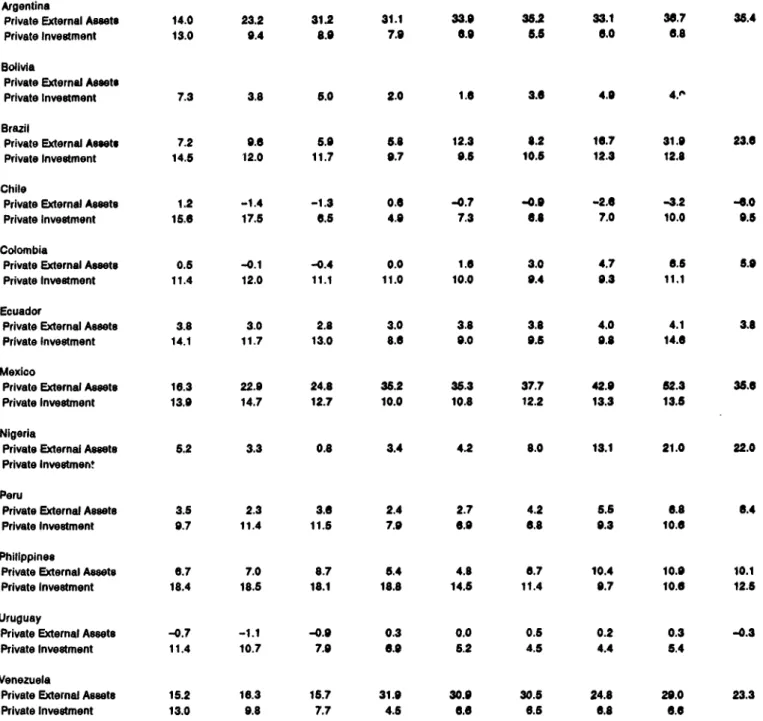
Table 6 suggests that these consequences have indeed materialized in the heavily-indebted countries in the period
16 See Dooley (1986). In many countries, however, the
acquisition of domestic debt may have been involuntary, in the form of required reserves held by private financial institutions. In this case, of course, the degree of fiscal "adjustment" is understated, since such reserve requirements amount to disguised taxation of the financial system.
17 See Sachs (1985) and Dooley (1986).
18 The scope for effective capital controls in developing
countries is open to question. Haque and Montiel (1991) present
evidence that such controls have been largely ineffe-.tive in a large group of developing countries.
following the outbreak of the debt crisis. Since the early eighties, the HICs have undergone a prolonged experience of low private investment coupled with the substantial accumulation of external assets by domestic residents. With the single exception of Colombia, where the slowdown was milder, private investment fell sharply in all the heavily-indebted countries for which data were
available after 1982. The measure of private capital flight
employed in Table 6 is that which is suggested by the emphasis here on the fiscal dimensions of the debt problem. Taken from Dooley and Stone (1991), and based on Dooley (1988), it measures as flight capital only those private capital outflows which do not remit earnings, thus taking as motivation for the flight of capital the desire to evade prospective domestic taxation. By this measure, only Chile, Ecuador, and Uruguay escaped substantial episodes of
capital flight during this period.
V. THE BRADY PLAN AND FISCAL POLICY
These distortionary effects on the domestic economy, and their implications for economic growth in the HICs, provide the motivation for the debt and debt service reduction operations (DDSR) embedded in the Brady Plan. An evaluation of the likely macroeconomic implications of DDSR operations thus requires
understanding how these effects come about. Three conceptually
distinct mechanisms can be identified through which a large stock of public debt could exert such effects on the domestic economy. All of them, of course, are transmitted through the public sector's budget. In other words, they are all fiscal phenomena.
To clarify these channels of transmission, it is useful to first introduce some notation. Let V, denote the market value of the public sector's external debt. On the simplifying assumption that domestic debt is zero, V, is the present value of the public
sector's expected future primary surpluses plus seignorage
revenue:
19 The role of domestic debt in what follows depends on
whether external debt or domestic debt is treated as senior to the
other. If domestic debt were senior, then the present value of
expected payments to domestic creditors would have to be subtracted from the right-hand side of equation (7) below. If both types of
debt were of equal seniority, then the right-hand side of (7) would
be multiplied by the share of external debt in total debt. As it stands, (7) is equivalent to treating external debt as senior. To avoid the straightforward, but tiresome, consideration of each of these cases below, it is simplest to assume that domestic debt is nonexistent.
V,=PV(Ps, +M^'m,, ;rt-n'e, t) (7)
The face value of the debt can then be decomposed into the portion
that corresponds to its market value and the "shortfall" D1-V,:
Dt= (Dt-Vt) +Vt (8)
Thus S,=D,-V, is the present value of the "unallocated tax LIrden"
(Dooley (1986)) associated with the debt, while Vt corresponds to the portion of the repayment burden that domestic agents expect to bear.
The first channel of transmission operates through V,. A large value of V,, regardless of the size of St, implies the expectation of substantial future primary surpluses and/or seignorage revenues. To the extent that these are generated through distortionary taxation or reduced levels of productive public expenditure the expected rate of return on domestic private asset accumulation will fall, and the efficiency of domestic resource allocation will be
impaired.21 Notice that this effect is present even when it is
confidently expected that the debt will be serviced fully (i.e.,
when St = 0). In fact, in this case the effect appears precisely
because full debt service is anticipated, but is expected to be
achieved through distortionary means. It is worth noting that,
since lump-sum taxes do not exist, any service of preexisting debt must be expected to be achieved through more or less distortionary
20 No attempt is made here to explain why the public sector
chooses to repay --i.e., why V, is not zero. The debt literature contains extensive discussion of this issue, involving sanctions available to external creditors permitting them to appropriate a share of domestic income (see Sachs (1984)). It is assumed that, to the extent that such sanctions fall on the private sector, the political system ensures that they are internalized by the government.
21 The observation that an increase in the stock of public
sector debt implies future distortionary taxation is, in fact, a commonly-made argument against Ricardian equivalence.
Table 6 Heavily Indebted Countries: Private Invedtment and Private Externl Meets. 1-1988 Il
1980 1981 1ea 19U 1984 1906 19s 1987 188
Argentina
Private External Aserte 14.0 23.2 31.2 31.1 33.0 35.2 33.1 30.7 36.4
Private Investment 13.0 9.4 8.9 7.9 6.9 8.8 0.0 6.8
Bolivia
Private External Assets
Private Investment 7.3 3.8 5.0 2.0 1.0 3.0 4.0 4."
Brazil
Private External Assets 7.2 9.6 6.9 5.8 12.3 8.2 16.7 31.9 23.0
Private Investment 14.5 12.0 11.7 9.7 O.5 10.5 12.3 12.8
Chile
Private Extemal Assets 1.2 -1.4 -1.3 0.0 -0.7 -0.9 -2.0 -3.2 -0.0
Private Investment 15.6 17.5 6.5 4.9 7.3 0.8 7.0 10.0 9.5
Colombia
Private External Assets 0.5 -0.1 -0.4 0.0 1.6 3.0 4.7 6.6 8.9
Private Investment 11.4 12.0 11.1 11.0 10.0 9.4 0.3 11.1
Ecuador
Private External Assets 3.8 3.0 2.8 3.0 3.8 3.8 4.0 4.1 3.8
Private Investment 14.1 11.7 13.0 8.6 9.0 9.5 9.8 14.0
Mexico
Private External Aeets 16.3 22.9 24.8 36.2 36.3 37.7 42.0 52.3 35.6
Private Investment 13.9 14.7 12.7 10.0 10.8 12.2 13.3 13.5
Nigeria
Private Extemal Assets 6.2 3.3 0.8 3.4 4.2 8.0 13.1 21.0 22.0
Private Investmen'
Peru
Private External Assots 3.5 2.3 3.6 2.4 2.7 4.2 5.5 0.8 6.4
Private Investment 9.7 11.4 11.6 7.0 6.9 6.8 0.3 10.0
Philippines
Private External Assets 0.7 7.0 8.7 5.4 4.8 6.7 10.4 10.9 10.1
Private Investment 18.4 18.5 18.1 18.8 14.5 11.4 9.7 10.6 12.5
Uruguay
Private External Assets -0.7 -1.1 -0.9 0.3 0.0 0.5 0.2 0.3 -0.3
Private Investment 11.4 10.7 7.9 6.0 5.2 4.5 4.4 5.4
Venezuela
Private External Assets 15.2 16.3 15.7 31.9 30.9 30.5 24.8 20.0 23.3
Private Investment 13.0 9.8 7.7 4.5 6.6 0.6 6.8 6.6
I/Private external assots are in millions of US dollars, while private investment is the share of GOP.
Source: Data on private extemal assets are from Dooley and Stone (1901). Private mivestment data are from Pfefferman and Madarasy (1990).
means.2 2 The objective of public policy should be to minimize t17 distortionary effects associated with a given level of V,. This is a standard problem in public finance.
When the public sector is not solvent, these effects are attached only to the portion of the debt that is expected to be
serviced. The remaining, "debt overhang' component, does not
generate such effects, because the public sector is not expected to raise domestic resources to service it.
The preceding mechanism operates through the present value of the anticipated future debt service associated with a large stock of debt, and would be present even if no debt service payments were
currently being made. More generally, it is independent of the
time profile of actual debt service payments. The second mechanism depends on the timing of such payments. For a given value of V,
when the public sector is insolvent (i.e., when S, > 0) the cost
imposed on the domestic economy of achieving the transfer V, will be greater the sooner the payments are made. This is so because when the public sector is insolvent, it will be unable to obtain voluntary loans from individual creditors on market terms. In this credit-rationed situation, the intertemporal discount rate used by the public sector will exceed the risk-free market interest rate. Thus any current debt service payments made by the public sector will carry a high intertemporal opportunity cost --i.e., will be more costly to the economy in terms of foregone public investment opportunities or distortionary taxation than payments of equal present value (discounted at creditors' costs of funds) made later on. This separate liquidity effect arises, then, when insolvency leads to credit rationing and is present even when debt service is financed efficiently (in the least distortionary fashion) by the public sector.
As with the first mechanism described above, these liquidity effects are aggravated when political or other constraints impede the efficient financing of debt service payments. The actual service of the debt requires the mobilization of resources, and
this can be achieved in more or less distortionary fashion -- for
example, by curtailing inefficient taxes or subsidies on the one hand, versus levying high tax rates on a narrow base, on the other. As indicated previously, reliance on inefficient modes of financing negative net resource transfers after 1982, such as the curtailment
22 Notice, in passing, that these arguments do not imply that
all public debt accumulation is harmful for growth. To the extent that public borrowing finances investment that meets a market test, or is used for public consumption smoothing in response to a transitory negative income shock, the means to service the debt will be available in the future without the necessity of increasing the distortionary burden of taxation.
of public investment and recourse to the inflation tax, may have exerted an independent effect contributing to the harmful macroeconomic consequences of the debt crisis in the majority of
the HICs during the eighties.
A third and conceptually separate mechanism also becomes operative when the public sector is insolvent, and is associated with the "debt overhang" component St. Notice that this component
of the debt does not, unlike V,, exert distortionary macroeconomic
effects by increasing the expected value of future taxes. These are already included in V,. To see this at an intuitive level, suppose that the government could precommit its future fiscal program, so private agents face no uncertainty about their future
tax obligations. In this setting, the level of expected future
taxes and the debt overhang are inversely related-- i.e., the higher the level of expected future taxes the lower the discount on debt in the secondary market. This is so because higher taxes on domestic residents increase the primary surplus, thereby enhancing the solvency of the public sector. Under these circumstances, a
large debt overhang -- a substantial discount on debt in the
secondary market -- suggests precisely that the anticipated future
tax burden is low. Implicitly, domestic agents are treated as
senior claimants on public sector resources, and the burden of distortionary domestic taxes is eased by "taxing" external creditors.
Instead, the existence of a "shortfall" component of the debt affects the domestic economy through two other channels. The first is familiar from the now rather extensive literature on the debt overhang, and is related to the incentives facing policymakers
under such circumstances. For a given value of expected future
debt service vt, the effects on the domestic economy depend on whether Vt arises from the service of a small stock of debt on contractual terms (so that Dt = V,) or from the expectation that a larger stock of debt will only be serviced partially in some states
of nature (so Dt > Vt). Specifically, in the presence of a
shortfall (St > 0), the actual value of future debt service is
uncertain. Since the resources that creditors will be able to
extract from the domestic public sector are likely to increase when domestic macroeconomic outcomes are favorable, creditors will capture some fraction of the payoff to good macroeconomic policies, and this possibility acts as a tax on the returns to such policies, thereby providing a disincentive discouraging policymakers from undertaking them. In terms of our notation, the expected value of
this tax is already captured in Vt, but the role of St > 0 is to
introduce a distribution for the actual value of future debt service around V,. The disincentive effect arises from the fact that actual debt service is likely to increase under "good policies", to a maximum of Dt.
Some simple calculations suggest, however, that the maximum
value of the potential "additional debt overhang tax" on the dcmestic economy in the aggregate is likely to be small. Letting St= V/D, denote the secondary market price of a dollar of debt, and expressing the ratio of the primary surplus plus seignorage to GDP as ps+Mm =(t-g), where t is the ratio of the present value of net tax revenues plus seignorage to the present value of GDP and g is the ratio of the present value of "exhaustive" (consumption plus investment) public-sector spending to the present value of GDP, we can now write equation (7) as:
scDt;= ( tt-gt;) Yt: 9
where Y is the present value of GDP. This can be expressed as:
gtYt+Dc= ttYt+ (1 -st) Dt (10)
The left-hand side of this expression represents the present value
of the public sector's "uses of funds" (payment obligations), consisting of the present value of its exhaustive spending program and the face value of its debt. The right-hand side represents its "sources of funds," consisting of net taxes (including seignorage) on domestic residents and its "taxation" of creditors, in the form
of debt-service shortfalls. Notice that, given the sector's
payment obligations, an increase in the tax rate t on domestic agents reduces the shortfall (1-s) and vice versa, as previously
indicated.
Finally, factoring out Y, from the right-hand side of (10) yields:
gtYt+Dt;= [ tt+ (I-St) yt] yt (11)
. t
The second term inside the square brackets on the right-hand side represents the potential "additional debt overhang tax rate" on
domestic residents. It is the portion of the public sector's
payment obligation that is currently expected to fall on external
creditors. It would do so, however, only if the portion (1-st) of
the debt is forgiven. As long as this "shortfall" remains on the books, it represents an unallocated tax, and in particular a potential tax on domestic economic activities. Its size, however,
is not large. Using fairly conservative estimates, including a
discount rate of 5 percent (corresponding to r-n) for GDP, a debt/GDP ratio of 0.6 (see Table 2), and a secondary market price of 40 cents on the dollar, yields a representative potential "debt overhang tax" on domestic residents amounting to less than 2 percent of the present value of GDP.
Detailed estimates of this tax for alternative values of r-n are presented in Table 7 for all the HICs with available data. The;se estimates are based on end-1988 values of the secondary
market price s, and of the external debt to GDP ratio. The
effective tax rate increases with the real interest rate, which reduces the present value of future domestic resources, and it decreases with the growth rate of GDP. Even with the relatively high value of 7 percent for r-n, however, the tax rate reaches maximum values amounting to about 6 1/2 percent of GDP only for the extreme cases of small countries (Bolivia and Cote d'Ivoire) where the debt to GDP ratio is extremely high and debt is considered to
be almost worthless on the secondary market. For the largest
debtors (Brazil and Mexico) the maximum "debt overhang" tax rate is in the range of 1-2 percent of GDP.
The extent to which a maximum additional loss of this magnitude could provide a serious disincentive for the adoption of otherwise desirable policies is certainly open to question. However, the fact that the maximum additional tax is small by no means rules out disincentive effects on policymakers. Among other things, what ultimately matters is the marginal tax that creditors are able to impose on potential in-reases in domestic income. While the maximum additional tax may amount to a small fraction of the present value of GDP, it may represent a large fraction of any additions to GDP that could be secured through improved policies. The existence of a potential additional debt overhang tax may
affect not just the incentives facing policyrnakers, but also those
facing private individuals. Would the marginal tax that creditors may impose on the economy in the aggregate -- and thus the marginal
tax rate that may confront policymakers -- discourage the
undertaking of new income-producing activities by private
individuals ? The answer to this question is probably not. New activities are unlikely to be taxed differentially from old ones at the margin, and thus can be expected to face the economywide average tax rate. While creditors may extract a high proportion of the economy's increase in income, resulting in a high marginal tax rate as perceived by policymakers, this burden would be borne by new and old private activities alike through an increase in the average tax rate applicable to both. Even with a high marginal tax rate extracted by creditors on increases in domestic income, the change in the economywide average tax rate associated with any single domestic project is likely to prove infinitesimal, and thus would not be internalized by private agents contemplating new activities. It follows that the "additional debt overhang tax" is
Table 7 Heavily Indebted Countries: Implicit Debt Overhang Tax Rate (in percent) Values of (r-n) 7.00 5.00 3.00 1.00 Argentina 3.09 2.21 1.32 0.44 Bolivia 6.57 4.70 2.82 0.94 Brazil 1.26 0.90 0.54 0.18 Chile 2.40 1.71 1.03 0.34 Cote d' Ivoire 6.65 4.75 2.85 0.95 Ecuador 5.97 4.27 2.56 0.85 Mexico 2.07 1.48 0.89 0.30 Morocco 3.39 2.42 1.45 0.48 Peru 5.09 3.63 2.18 0.73 Philippines 2.20 1.57 0.94 0.31 Uruguay 1.17 0.84 0.50 0.17 Venezuela 2.09 1.49 0.90 0.30
Source: Underlying data were provided by the World Bank. Calculations are described in the text.
unlikely to prove a major direct source of disincentive for
individual agents. Thus the standard "debt overhang" argument
applies to the behavior of policymakers, rather than to that of individual agents.
While the marginal tax rate applicable to new private economic activities may not be made to differ from the economywide average tax rate by the potential "additional debt overhang tax", the future value of this average domestic tax rate will be subject to uncertainty an long as a "shortfall" exists, and uncertainty about future taxes can itself discourage new private economic activities. The figures in Table 7 suggest that the range of prospective variation in the average tax rate associated with servicing the "shortfall" may not be large, but these numbers may understate the degree of uncertainty involved for private agents, for several reasons. First, in the event of a breakdown in negotiations with external creditors, the costs of sanctions to the domestic economy may exceed the "shortfall". Second, to the extent that a transfer to external creditors is financed inefficiently by the public sector, costs to domestic residents will exceed the value of the
transfer. Finally, the "micro" uncertainty associated with tax
incidence on individual activities may exceed the uncertainty attached to the average tax rate. This is so because, since the shortfall is not expected to be serviced under the current policy regime, the servicing of this debt may signal a regime switch, involving new taxes, for example, as part of a fiscal reform. Since the distribution of distortionary taxation in the new tax policy regime would be difficult to foresee, the potential is created for large individual losses, even when the change in the average burden of taxation is not itself large.
The additional uncertainty about future taxes for private domestic agents associated with the shortfall St represents a
separate channel through which S, may adversely affect the domestic
economy, over and above any disincentive effects on policymakers. In the presence of such uncertainty, irreversible private activities such as investing in physical capital and acquiring claims on the domestic financial system (that may later be subjected to capital controls) are likely to be postponed until the uncertainty is resolved. This effect may account for the behavior of private investment and capital flight in the HICs during the
early eighties." Evidence has now accumulated that uncertainty
3 To attribute all of these dislocations to the "uncertainty
effect" would, however, undoubtedly be an overstatement, because it would fail to take into account the possible role of the auality of (partial) fiscal adjustment undertaken by the HICs after 1982. As suggested previously, the mode of fiscal adjustment may have played an independent role in generating unfavorable macroeconomic outcomes. Disentangling the direct debt overhang effects on the
of this type can deter private economic activities that have an irreversible aspect.>
On this reasoning, the costs of ex ante public sector
insolvency per se (as opposed to those arising from the anticipated
servicing of the debt) arise from credit rationing as well as from the distortions introduced into the decisions of both policymakers and individual economic agents by the uncertainty associated with the shortfall (in a present value sense) between the public sector's resources and its obligations.
In this setting, DDSR operations, broadly defined to include not just the financial operations associated with debt conversion, but also the full range of macroeconomic conditions attached to
"Brady plan"-type operations, can make several contributions: a. From the point of view of the debtor country, the first and most obvious contribution would be to reduce the present value of anticipated future debt service payments, Vt. This would spare the country not only the burden of effecting the external resource transfer, but also the "secondary burden" associated with distortionary taxation. Since doing so would benefit the residents of the country concerned at the expense of external creditors, DDSR operations of a voluntary nature are unlikely to produce this
result. It is possible, indeed, that the fiscal conditions
attached to the negotiated adjustment programs that precondition "Brady plan" DDSR operations could increase the value of V,. Notice that the effect of the operation on Vt cannot be inferred from secondary market prices alone (since such prices depend on both V, and the face value of the debt D,), nor from the immediate post-operation market value of the debt (since a portion of the payments received by creditors may come from third-party grants or concessional loans). The effect on V, must be extracted from the
post-operation value of the debt (including any up-front payments),
net of the grant element (if any) in third party contributions. b. Given V,, a second potential contribution of DDSR operations would be to restrict the excess "secondary burden" associated with the financing of the transfer of V, to the public sector's
economies of the highly-indebted countries from the indirect effects transmitted through the mode of fiscal adjustment remains an unfinished research task.
2 For the effects of potential taxation on capital flight
from developing countries, see Dooley (1988). A theoretical
analysis of the negative effects of uncertainty on private investment in developing countries is presented in Rodrik (1991). Bizer and Sichel (1988) present empirical evidence on the existence of irreversibility in private investment for the United States.
creditors. This could be accomplished through the fiscal conditions attached to the adjustment program. In particular, such conditions should seek to ensure that the transfer is effected at minimum distortionary cost. No single indicator would suffice to measure the degree of success in this regard, but the relevant broad public finance principles are well known --e.g., promotion of a tax system that relies on a broad base as well as low and uniform tax rates, replacement of import quotas by low and uniform tariffs, protection of public investment that meets a market test, etc. c. The ultimate goal of DDSR operations should be, of course, to remove the debt overhang. This removes distortions associated with credit rationing, as well as disincentive effects on both
policymakers and individual agents. In fact, the most important
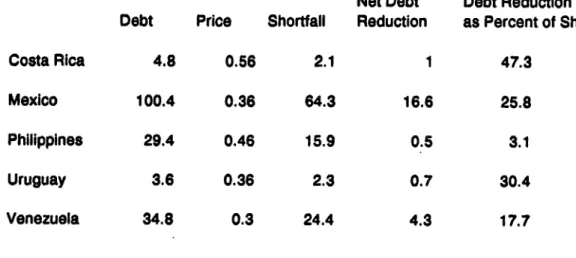
potential contribution of DDSR operations may be to resolve the allocational issue associated with the "unallocated tax burden" and to the greatest possible extent remove this source of uncertainty. A reasonable single indicator of the success of such operations in this regard, based on the reasoning above, may be the percentage reduction in the shortfall (secondary market discount times the stock of outstanding debt) as a result of DDSR.
d. Finally, to the extent that a shortfall is expected to remain at the conclusion of a DDSR operation, the positive effects of the operation from the standpoint of the debtor country will depend on its cash-flow implications.
At the present time, five DDSR deals have been concluded under
the aegis of the Brady plan, involving Costa Rica , Mexico, the
Philippines, Uruguay, and Venezuela." Among the four ways listed above that such operations could have contributed to easing the macroeconomic problems confronting these countries, the extent to which three of them have been accomplished can be directly
quantified. These are the change in V,, the reduction in the
shortfall, and the change in the time profile of debt service payments. The extent to which the fiscal conditions attached to the macroeconomic adjustment programs associated with DDSR operations may offer the prospect of reducing the secondary burden arising from the financing of Vt is much more difficult to
ascertain. It requires the determination of a fiscal
counterfactual in each case, as well as both a detailed examination of the fiscal conditions attached to each program and an assessment of the likely effectiveness of conditionality in bringing these desired outcomes about.
Conceptually, the change in Vt can be measured as the change in the market value of the total external debt plus any up-front
5 For information on the details of the individual deals see
Claessens, Diwan, and Fernandez-Arias (1992). 20