POUR L'OBTENTION DU GRADE DE DOCTEUR ÈS SCIENCES
acceptée sur proposition du jury: Prof. E. Bugnion, président du jury Prof. A. Ailamaki, directrice de thèse
Prof. G. Alonso, rapporteur Dr G. Swart, rapporteur Prof. R. Guerraoui, rapporteur
High Performance Transaction Processing on Non-Uniform
Hardware Topologies
THÈSE N
O7023 (2016)
ÉCOLE POLYTECHNIQUE FÉDÉRALE DE LAUSANNE
PRÉSENTÉE LE 7 JUILLET 2016À LA FACULTÉ INFORMATIQUE ET COMMUNICATIONS
LABORATOIRE DE SYSTÈMES ET APPLICATIONS DE TRAITEMENT DE DONNÉES MASSIVES PROGRAMME DOCTORAL EN INFORMATIQUE ET COMMUNICATIONS
Suisse 2016 PAR
Curiosity is the lust of the mind. — Thomas Hobbes
To my family Nada, Milan and Nikola
Acknowledgements
This manuscript is singed with one name, but the pursuit of knowledge is never the work of one person. My PhD journey was no different and through it I was very fortunate to be surrounded by many amazing people to whom I owe a debt of gratitude.
....
First and foremost, I would like to thank my awesome advisor, Natassa Ailamaki. Throughout my PhD that often felt like a roller coaster ride, she was always there to tell me what I needed to hear. For years, I walked away from every one of our meetings energized and inspired, usually with a long TODO list. I really appreciate all the opportunities she gave me during my PhD and especially the encouragement to always aim higher. She is a truly inspiring researcher, teacher and leader, and I hope to continue learning from her in the future.
....
I am very grateful to Rachid Guerraoui, Gustavo Alonso and Garret Swart for finding the time to serve on my thesis committee. They have greatly improved this work through many insightful discussions and constructive feedback. I would also like to thank Ed Bugnion for accepting the role of my thesis jury president. In my opinion, one the biggest strengths of EPFL is a very diverse and thriving community of systems researchers that supports many fruitful interactions among its faculty and students as well as with industry through many events that allow us to present our research and get feedback. I am also very grateful to Eric Sedlar and the Oracle Labs researchers for many insightful discussions over the years, especially during my internship at Oracle Labs. That summer convinced me that my PhD years were not wasted and restored my confidence in my research. Finally, I would like to thank Wolfgang Lehner and his team from TU Dresden for the fruitful collaboration on the energy efficiency project. ....
I have been very fortunate to be a member of the DIAS team together with: Adrian, Angelos, Ben, Cesar, Darius, Dimitra, Eleni, Erietta, Farhan, Georgios, Ippokratis, Iraklis, Lionel, Manos, Manos, Matt, Miguel, Mira, Odysseas, Pinar, Radu, Raja, Renata, Satya, Snow, Stella, Tahir, Thomas, Utku, Yannis, and many students and interns. They are the most amazing group of people who are always there to provide support and feedback, brainstorm about research ideas (or pretty much anything else) and be perfect travel companions. Renata has been a source of invaluable support from the time we both started at EPFL as we tackled in parallel all steps of our academic journeys. Pinar has been a great office mate for many years as well as my big little academic sister, great collaborator and conference buddy, as well as a perfect host during my recent trips to the Bay Area. I had a pleasure to learn a lot early in my thesis from
Ippokratis who kept giving me great feedback and looking out for me during the later stages of my career. Erietta made me question all assumptions about the problem we are solving and taught me a lot about doing rigorous research. I also learned a lot from my collaboration with Miguel and have enjoyed many insightful discussions with him that always inspired me to think bigger. I really enjoyed many discussions about different systems topics with Raja who always has great ideas. I had a pleasure to collaborate with and be a mentor to Iraklis and Utku. I would like to thank Utku for being very patient with my attempts at mentoring and for being a great office mate. I am very grateful to Mira and Manos for listening to my daily complaints and always having great and useful feedback. I owe special thanks to Erika and Dimitra for having answers for all administrative questions and for ensuring that lab functions smoothly. Finally, I thank Dimitra and Lionel for translating my thesis abstract to French. ....
The life in Lausanne would be far less enjoyable if I didn’t have so many great friends. I was very fortunate to always have great neighbors. When I came to Lausanne, Bilja, Nataša, Laza and Zlatko welcomed me as a part of their household and made the first few months much less stressful. Sean and Giorgia tipped me off to a place in their building and were the perfect neighbors. When Maja and Petar moved in across the street, we spent countless enjoyable hours on their sofa, balcony and in the kitchen. Marija has been my go-to "sports buddy" and we enjoyed many hours skiing, rollerblading and ice skating. Even though our "social calendar" appeared crowded at times, I really enjoyed all the birthdays, barbecues, ski days, concerts and parties with the awesome ex-yu crew: Adrian, Aleksandar, Ana, Andrej, Azra, Baki, Bilja, Darko, Dražen, Edit, Ilija, Irena, Ivan, Laza, Lenka, Maja, Maja, Mara, Marija, Mia, Mica, Milenko, Milica, Miloš, Miloš, Mima, Mira, Mirko, Nataša, Pedja, Pedja, Petar, Renata, Sara, Sonja, Sloba, Stanko, Vojin, Zlatko, and many others. I will never forget the memorable weekends in Amsterdam, Madrid, Milano, Paris, and on the shores of Lago Maggiore.
....
Finally, I am eternally grateful to my parents, Nada and Milan, for their infinite patience and support throughout my education. From an early age, they have encouraged my curiosity, and supported my academic pursuits and career ambitions, even when they didn’t agree with my choices. My brother Nikola has been my biggest cheerleader who believes his sister can accomplish anything. Finally, I am blessed to have the support of my uncle Miroslav, aunt Gordana and her family, and my late grandparents, who are always there for me.
....
This research has been supported by grants from Dotation (DIAS Lab), Oracle Labs, and the Swiss National Science Foundation (Grant No. 200021-146407/1).
Abstract
Transaction processing is a mission critical enterprise application that runs on high-end servers. Traditionally, transaction processing systems have been designed for uniform core-to-core communication latencies. In the past decade, with the emergence of multisocket multicores, for the first time we haveIslands, i.e., groups of cores that communicate fast among themselves and slower with other groups. In current mainstream servers, each multicore processor corresponds to an Island. As the number of cores on a chip increases, however, we expect that multiple Islands will form within a single processor in the nearby future. In addition, the access latencies to the local memory and to the memory of another server over fast interconnect are converging, thus creating a hierarchy of Islands within a group of servers. ....
Non-uniform hardware topologies pose a significant challenge to the scalability and the predictability of performance of transaction processing systems. Distributed transaction processing systems can alleviate this problem; however, no single deployment configuration is optimal for all workloads and hardware topologies. In order to fully utilize the available processing power, a transaction processing system needs to adapt to the underlying hardware topology and tune its configuration to the current workload. More specifically, the system should be able to detect any changes to the workload and hardware topology, and adapt accordingly without disrupting the processing.
....
In this thesis, we first systematically quantify the impact of hardware Islands on deployment configurations of distributed transaction processing systems. We show that none of these configurations is optimal for all workloads, and the choice of the optimal configuration depends on the combination of the workload and hardware topology. In the cluster setting, on the other hand, the choice of optimal configuration additionally depends on the properties of the communication channel between the servers. We address this challenge by designing a dynamic shared-everything system that adapts its data structures automatically to hardware Islands. To ensure good performance in the presence of shifting workload patterns, we use a lightweight partitioning and placement mechanism to balance the load and minimize the synchronization overheads across Islands.
....
Overall, we show that masking the non-uniformity of inter-core communication is critical for achieving predictably high performance for latency-sensitive applications, such as
trans-action processing. With clusters of a handful of multicore chips with large main memories replacing high-end many-socket servers, the deployment rules of thumb identified in our analysis have a potential to significantly reduce the synchronization and communication costs of transaction processing. As workloads become more dynamic and diverse, while still running on partitioned infrastructure, the lightweight monitoring and adaptive repartitioning mechanisms proposed in this thesis will be applicable to a wide range of designs for which traditional offline schemes are impractical.
....
Keywords: Database management systems, Transaction processing systems, Multisocket mul-ticore hardware, Hardware Islands, Non-uniform hardware topologies, Distributed transaction processing systems
Résumé
Le traitement de transactions est une application d’entreprise critique qui fonctionne sur des serveurs haut de gamme. Traditionnellement, les systèmes de traitement de transactions ont été conçus pour des latences de communication core-to-core uniformes. Ces dix dernières années, avec l’émergence de systèmes multi-sockets multi-cores, pour la première fois nous avons des Îles (Islands), à savoir, des groupes de cores qui communiquent rapidement entre eux et plus lentement avec d’autres groupes. Dans les serveurs traditionnels actuels, chaque processeur multi-cores correspond à une Île. Avec le nombre de cores par puce qui augmente, nous nous attendons à ce que plusieurs Îles soient formées au sein d’un seul processeur dans un futur proche. En outre, les latences d’accès à la mémoire locale et à la mémoire d’un autre serveur sur interconnexion rapide convergent, créant ainsi une hiérarchie d’Îles au sein d’un groupe de serveurs connectés sur un réseau à grande vitesse.
....
Les topologies matérielles non uniformes constituent un défi important pour l’évolutivité et la prévisibilité des performances des systèmes de traitement de transactions. Les systèmes de traitement de transactions distribués peuvent atténuer ce problème ; cependant, aucune configuration de déploiement n’est optimale pour toutes les charges de travail et les topologies matérielles. Afin d’utiliser pleinement la puissance de traitement disponible, un système de traitement de transactions doit s’adapter à la topologie du matériel sous-jacent et doit adapter sa configuration à la charge de travail courante. Autrement dit, le système devrait être capable de détecter toute modification de la charge de travail et de la topologie du matériel, et s’adapter sans perturber le traitement.
....
Dans cette thèse, premièrement nous quantifions systématiquement l’impact des latences de communication non uniformes sur les configurations de déploiement de systèmes de traitement de transactions distribués. Nous montrons qu’aucune de ces configurations n’est optimale pour toutes les charges de travail, et le choix de la configuration optimale dépend de la combinaison de la charge de travail et de la topologie matérielle. Dans le cadre d’un cluster, le choix de la configuration optimale dépend en plus des propriétés du mécanisme de communication entre les serveurs. Nous abordons ce défi en concevant un système dynamique shared-everything qui adapte automatiquement ses structures de données aux Îles matérielles. Pour assurer une bonne performance en présence de charges de travail changeantes, nous utilisons un mécanisme de partitionnement et de placement léger pour équilibrer la charge et réduire l’overhead de synchronisation à travers les Îles.
....
Dans l’ensemble, nous montrons que le masquage de la non-uniformité de la communication inter-core est essentiel pour l’obtention prévisible de hautes performances pour les applica-tions sensibles à la latence, tels que le traitement de transacapplica-tions. Avec des clusters composés d’une poignée de systèmes comportant des puces multi-core avec de grandes mémoires principales qui remplacent les serveurs haut de gamme, embarquant de nombreux proces-seurs, les principes de déploiement, identifiées dans notre analyse ont le potentiel de réduire considérablement les coûts de synchronisation et de communication lors du traitement des transactions. Comme les charges de travail deviennent plus dynamiques et diversifiées, tout en fonctionnant sur une infrastructure partitionnée, le monitoring léger et les mécanismes de repartitionnement adaptatifs proposés dans cette thèse seront applicables à un large éventail de modèles pour lesquels les systèmes hors ligne traditionnels sont inadéquats.
....
Mots clefs : Système de gestion de base de données, Les systèmes de traitement de transac-tions, Systèmes multi-sockets multi-cores, Îles matérielles, Les topologies matérielles non uniformes, Les systèmes de traitement de transactions distribués
Contents
Acknowledgements i
Abstract (English/Français) iii
Table of Contents vii
List of Figures xi
List of Tables xiii
1 Introduction 1
1.1 Modern Servers . . . 2
1.2 Rack-Scale Computing Platforms. . . 3
1.3 Transaction Processing. . . 3
1.4 Thesis Statement and Contributions. . . 4
1.5 Thesis Roadmap. . . 6
2 Background 9 2.1 Online Transaction Processing Systems . . . 9
2.2 Hardware Islands . . . 12
2.2.1 Variable Communication Latencies . . . 13
2.2.2 Abundant Hardware Parallelism . . . 14
2.2.3 NUMA-aware System Design . . . 16
2.2.4 Beyond Hardware Islands . . . 17
2.3 Rack-scale Computing Platforms . . . 18
3 OLTP on Hardware Islands 23 3.1 Islands: Hardware Topology-aware Shared-nothing OLTP Deployments. . . 24
3.2 Experimental Setup and Methodology. . . 26
3.2.1 Prototype Systems . . . 28
3.2.2 Microbenchmark Workload and Experimental Methodology . . . 29
3.2.3 Standard Workloads . . . 31
3.3 Impact of Multisite Transactions . . . 32
3.3.1 Distributed Transactions . . . 33
3.3.3 Profiling . . . 36
3.3.4 Impact of the Communication Channel. . . 37
3.3.5 Different Topologies . . . 38
3.3.6 Summary. . . 40
3.4 Sensitivity Analysis with Microbenchmarks. . . 40
3.4.1 Impact of the Size of Transaction . . . 40
3.4.2 Increasing Hardware Parallelism . . . 42
3.4.3 Tolerance to Skew. . . 44
3.4.4 Increasing Database Size . . . 45
3.4.5 Summary. . . 46
3.5 Standard Workloads . . . 46
3.5.1 TPC-B. . . 47
3.5.2 Impact of Distributed Transactions on TPC-B . . . 48
3.5.3 TPC-C . . . 48
3.5.4 Impact of Distributed Transactions on TPC-C . . . 49
3.5.5 Summary. . . 50
3.6 Main-memory optimized system . . . 50
3.6.1 Read-only Transactions . . . 51
3.6.2 Update Transactions . . . 53
3.6.3 Summary. . . 53
3.7 Summary and discussion . . . 53
4 Adaptive Transaction Processing 55 4.1 Design Trade-offs for OLTP on Multisocket Multicores . . . 56
4.1.1 Design Options . . . 56
4.1.2 Perfectly Partitionable Workloads . . . 57
4.1.3 Workloads That Are Less Amenable to Partitioning . . . 58
4.1.4 Accessing Remote Memory . . . 60
4.2 Hardware-aware System Design . . . 60
4.3 Workload-aware Partitioning and Placement. . . 62
4.3.1 Factors Influencing Transaction Processing . . . 62
4.3.2 Cost Model. . . 66
4.3.3 Search Strategy . . . 67
4.4 Adaptive Dynamic OLTP Design . . . 68
4.5 Evaluation . . . 70
4.5.1 Experimental Setup . . . 71
4.5.2 Improving Throughput on Standard Benchmarks with ATraPos . . . 71
4.5.3 Monitoring and Repartitioning Cost . . . 73
4.5.4 Adaptive Behavior of ATraPos . . . 74
Contents
5 Toward Rack-scale OLTP 79
5.1 Setup and Methodology . . . 80
5.1.1 Distributed OLTP Deployments . . . 80
5.1.2 Hardware Platforms . . . 80
5.1.3 Workloads . . . 80
5.2 Scaling Out Across Rack-scale Nodes . . . 81
5.2.1 Distributed Main Memory System . . . 81
5.2.2 Read-only Transactions . . . 81
5.2.3 Update Transactions . . . 82
5.2.4 Sensitivity Analysis . . . 82
5.2.5 Summary and Implications . . . 83
5.3 Scaling Up on Rack-scale Nodes . . . 84
5.3.1 Distributed Deployment Configuration . . . 84
5.3.2 Scaling TPC-C Across Machines . . . 85
5.3.3 Impact of Thread Binding . . . 86
5.3.4 Sensitivity Analysis . . . 86
5.3.5 Summary and Implications . . . 88
5.4 The Impact of Network. . . 88
5.4.1 Main Memory Optimized System . . . 88
5.4.2 TPC-C Transactions . . . 90
5.4.3 Microbenchmarks . . . 91
5.4.4 Summary and Implications . . . 92
5.5 A Step Toward Rack-scale OLTP. . . 93
6 The Big Picture 97 6.1 What We Did. . . 97
6.2 Impact . . . 98
6.3 Looking Ahead . . . 99
Bibliography 113
List of Figures
1.1 Communication latencies in a multisocket multicore. . . 2
2.1 Impact of thread placement on performance for microbenchmark workload. . 13
2.2 Impact of thread placement on performance of TPC-C workload. . . 14
2.3 Impact of the granularity of synchronization for microbenchmark workload.. . 15
2.4 Impact of the granularity of synchronization for TPC-C workload. . . 15
3.1 Different shared-nothing configurations on a four-socket four-core machine. . 24
3.2 Islands performance model.. . . 26
3.3 Topology of the three machines used in the experiments. . . 26
3.4 Performance of different IPC mechanisms. . . 28
3.5 Examples of microbenchmark transactions. . . 30
3.6 Main deployment configurations illustrated on the 4 socket server. . . 32
3.7 Microbenchmark: varying percentage of multisite transactions. . . 34
3.8 Microarchitectural profiling of cache and memory resident datasets. . . 35
3.9 Time breakdowns for cache and memory resident datasets. . . 36
3.10 Impact of fast communication on multisite transactions. . . 37
3.11 Time breakdowns for fast communication. . . 38
3.12 Impact of hardware topology on multisite transactions. . . 39
3.13 Cost of local and multisite read-only transactions. . . 41
3.14 Cost of local and multisite update transactions. . . 42
3.15 Scalability of different configurations as parallelism increases. . . 43
3.16 The impact of skew on multisite transactions. . . 44
3.17 The impact of disk resident datasets on multisite transactions. . . 45
3.18 Performance of standard and local-only deployment of the TPC-B benchmark. 46 3.19 TPC-B: varying percentage of multisite transactions. . . 48
3.20 Performance of standard and local-only deployments of TPC-C benchmarks. . 49
3.21 TPC-C: varying percentage of multisite transactions. . . 50
3.22 Microbenchmark: performance of the main memory system . . . 50
3.23 Time breakdowns for the main memory system.. . . 51
3.24 Cost of microbenchmark transactions in the main memory system. . . 52
3.25 The impact of update multisite transactions on the main memory system . . . 52
4.2 Throughput of the shared-nothing, centralized, and PLP architectures. . . 57
4.3 Throughput of different partitioned configurations.. . . 58
4.4 Time breakdown for Island shared-nothing configuration.. . . 59
4.5 Hardware-awareness improves scalability on Islands.. . . 62
4.6 Simple transaction flow example. . . 63
4.7 Comparison of different partitioning and placement strategies.. . . 64
4.8 Transaction flow graph for the TPC-C NewOrder transaction. . . 65
4.9 Adaptivity mechanism in ATraPos. . . 69
4.10 ATraPos partitioning and placement for TATP . . . 71
4.11 ATraPos partitioning and placement for TPC-C . . . 72
4.12 Scalability of ATraPos repartitioning mechanism. . . 73
4.13 Adapting to workload changes. . . 74
4.14 Adapting to sudden workload skew. . . 75
4.15 Adapting to hardware failures. . . 76
4.16 Adapting to frequent changes. . . 76
5.1 Impact of distributed transactions on Silo. . . 81
5.2 Abort rates of distributed transactions in Silo. . . 82
5.3 Increasing the number of servers for TPC-C transactions. . . 84
5.4 The impact of thread binding on cluster deployments. . . 85
5.5 Costs of distributed read-only transactions in cluster OLTP . . . 86
5.6 Costs of distributed update transactions in cluster OLTP . . . 87
5.7 Impact of network channel on read-only workload in Silo . . . 89
5.8 Impact of network channel on update workload in Silo. . . 89
5.9 Impact of network channel on TPC-C workload.. . . 90
5.10 Impact of network channel on the read-only workload.. . . 91
List of Tables
3.1 Description of the machines used. . . 27
4.1 Impact of memory allocation policy.. . . 59
1
Introduction
Online Transaction Processing (OLTP) is a multi-billion dollar industry [51] and one of the most important and demanding database applications. Innovations in OLTP continue to garner significant attention, advocated by the recent emergence of appliances [116], startups [29,100,105,112,160], hosted cloud solutions [10], and research projects (e.g. [30,71,78, 81,90,118,144,157]). OLTP applications are mission-critical for many enterprises with little margin for compromising either performance or scalability. Thus, it is not surprising that all major OLTP vendors invest considerable effort in developing highly-optimized software releases, often with platform-specific optimizations.
OLTP workloads are characterized by many concurrent requests. Each transactional request typically reads about a dozen and writes a handful of data items in the database. The users of the system expect predictably low response times and high availability regardless of the degree of concurrency or the size of data. Increasing throughput and decreasing latency require-ments, as well as the high cost of licenses for traditional database management systems when deployed in the web-scale scenarios gave rise to eventually consistent key-value stores [159]. Nowadays, OLTP infrastructure at Facebook processes 174 million transactions per second to service a wide variety of applications, including the main Facebook website, messaging and serving advertisements [25]. These transactions generate 12 billion reads and 65 million updates per second.
Increasing demands from the new generation of applications for both larger data sizes and higher throughput require ever more scalable transaction processing system designs. While key-value stores offered low latency and good horizontal scalability, they shift the burden of ensuringACID(atomicity, consistency, isolation, and durability) properties traditionally provided by an OLTP system to the application developers, significantly increasing the appli-cation complexity. Thus, it is not surprising that the web-scale companies have reversed their position in recent years and invested heavily in developing highly scalable geo-distributed transaction processing systems such as Google’s Spanner [30].
The rest of this chapter briefly motivates this work by first providing an overview of the chang-ing hardware landscape and the rise of non-uniform hardware platforms before surveychang-ing recent work on transaction processing systems. Next,Section 1.4summarized the thesis state-ment and outlines intellectual and technological contributions. Finally,Section 1.5outliens the organization of this dissertation.
1.1 Modern Servers
core
core
core
L1
L2
L1
L2
L1
L2
L3
core
L1
L2
memory controller
Inter-socket links
core
core
core
L1
L2
L1
L2
L1
L2
L3
memory controller
core
L1
L2
Inter-socket links
L1inter-socket links
inter-socket links
core
core
core
L1
L2
L1
L2
L1
L2
L3
core
L1
L2
memory controller
inter-socket links
Island
L3socket 0
socket 1
Figure 1.1: A schematic view of a multisocket multicore server. We identify a hardwareIsland: a group of cores that communicate faster with each other than with the cores from another island.
Hardware has long departed from uniprocessors, which have predictable and uniform per-formance. Due to thermal and power limitations, vendors cannot improve the performance of processors by clocking them to higher frequencies or by using more advanced techniques such as increased instruction width and extended out-of-order execution. Instead, vendors rely on two approaches that allow explicit parallelization of tasks to increase the processing capability of a machine. The first approach is to put together multiple processor chips that communicate through shared main memory. For several decades, suchmultisocketdesigns provided the only way to scale performance within a single node and the majority of OLTP systems have historically used such hardware. The second approach places multiple process-ing cores on a sprocess-ingle chip, such that each core is capable of processprocess-ing concurrently several independent instruction streams or hardware contexts. The communication between cores in thesemulticoreprocessors happens through on-chip caches. In recent years, multicore processors have become a commodity.
Multisocket multicore systems are the predominant configuration for database servers today and are expected to remain popular in the future.Figure 1.1shows a simplified diagram of a typical machine that has two sockets with quad-core CPUs. Communication between the numerous cores happens through different mechanisms. For example, two threads running on
1.2. Rack-Scale Computing Platforms
the same core can communicate very fast through the core’s L1 cache. When they’re running on different cores on the same socket, they communicate through the socket’s last-level (L3) cache. Finally, two threads running on different sockets need to use inter-socket links (called
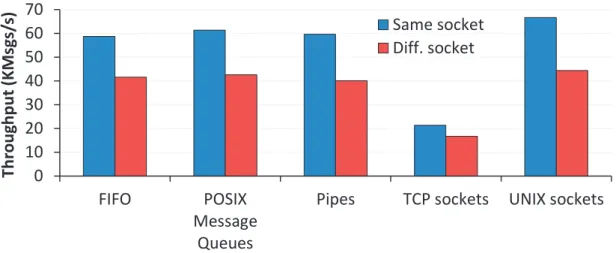
QPIfor Intel processors). The result is that the inter-core communication depends on the placement of communicating threads.
1.2 Rack-Scale Computing Platforms
In parallel with the increase in the number of processor cores, the bandwidth of network interconnects and main memory are converging [46]. Technologies such as Remote Direct Memory Access (RDMA) allow applications to access memory on a remote machine without involving either the operating system or the processor. High speed fabrics that support RDMA, such as Infiniband [63] and converged Ethernet [62], with bandwidths reaching up to 100Gbps, are already standard in supercomputers and high-end appliances.
Modern RDMA technology enables accessing the memory of another server within an order of magnitude of the latency to the local memory [156]. Relative remote access latency using RDMA is comparable to one in the traditional large shared memory machines, whose niche market are the mission-critical OLTP applications [60,137]. Such high-end machines with more than 8 processors require specialized interconnects and controller chips to maintain cache coherence [53,92]. However, maintaining cache coherence comes with high overheads. In the state-of-the-art systems, remote memory access latencies are 5.5x to 10.7x higher than the local memory ones [83].
Abundant parallelism and fast commodity networks are leading to the emerging class of commodity cluster computing platforms that will offer performance comparable to today’s large shared memory machines. Theserack-scale platformsachieve high compute density at low power budget and cost by eliminating unnecessary system components via highly customized system-on-a-chip (SoC) nodes. Individual nodes, which contain only processing cores, memory, and I/O interfaces, communicate using low-latency interconnect fabrics [38].
1.3 Transaction Processing
Efficiently utilizing the processing power available on modern hardware platforms for trans-action processing remains a challenge despite the multitude of efforts from academia and industry. Until recently, shared-everything was the most popular deployment strategy on a single node, and OLTP has been studied extensively on shared-everything databases. It has been shown that shared-everything systems exhibit frequent shared read-write accesses [18,54], which are difficult to predict [142]. Therefore, these systems enter numerous con-tentious critical sections even when executing simple transactions to ensure ACID properties [73]. The presence of critical sections affects single-thread performance, requires frequent inter-core communication, and causes contention among threads [71,118,119]. Recent work
suggests a departure from the traditional transaction-oriented execution model, to adopt a data-oriented one, circumventing the aforementioned properties - and flaws - of traditional shared-everything OLTP [118,119].
Shared-nothing deployments [143], based on fully independent (physically partitioned) database instances that collectively process the workload, are an increasingly appealing design even within a single node [78,136,144]. The main advantage of shared-nothing deployments is the explicit control over the contention within each physical database instance. As a result, shared-nothing systems exhibit high single-thread performance and low contention. In addition, shared-nothing databases typically make better use of the available hardware resources whenever the workload contains transactions touching data on a single database instance. Systems such as H-Store [144] and HyPer [78] apply the shared-nothing design to the extreme, deploying one single-threaded database instance per CPU core.
Shared-nothing systems appear ideal from the hardware utilization perspective, but they are sensitive to the ability to partition the workload. Unfortunately, many workloads are not perfectly partitionable, i.e., it is hardly possible to distribute the data such that every transaction touches a single instance. Whenever multiple instances must collectively process a request, shared-nothing databases require using expensive distributed consensus protocols, such as two-phase commit, which many argue are inherently non-scalable [23,58]. Similarly, handling data and access skew is problematic [151].
The overhead of distributed transactions urged system designers to explore partitioning techniques that reduce the frequency of distributed transactions [32,121], and to explore alternative concurrency control mechanisms, such as speculative locking [74], multiversion-ing [19] and optimistic concurrency control (OCC) [87,90], to reduce the overheads when distributed transactions cannot be avoided. Designers of large-scale systems have circum-vented problems with distributed transactions by using relaxed consistency models such as eventual consistency [159]. Eventual consistency eliminates the need for synchronous distributed transactions, but it makes programming transactional applications harder, with consistency checks left to the application layer. The emergence of the non-uniform hardware platforms adds further complexity to the on-going debate between shared-everything and shared-nothing OLTP designs.
1.4 Thesis Statement and Contributions
The goal of this dissertation is to quantify the challenges posed by the non-uniformity of communication between different cores within a multisocket and across multisockets to transaction processing systems. We identify opportunities and propose techniques to address these challenges by dynamically tuning transaction processing systems to the underlying hardware and current workload properties.
1.4. Thesis Statement and Contributions
Thesis Statement
Transaction processing scalability deteriorates as the number of cores is increased, due to real-time changes in workloads and to non-uniform communication latencies amongst hardware contexts. Using hardware-aware data structures and algorithms inside transaction processing engines is key to sustaining scale-up throughput during
workload execution. Scale-up techniques are necessary but insufficient for scale-out deployments.
We analyze the impact of non-uniformity on transaction processing systems for a wide range of deployment configurations and workloads. We advocate for nimble system designs that dynamically adapt to the workloads and hardware based on the following insights:
• We identifyHardware Islandsas the groups of cores that communicate faster with cores that belong to the same group and much slower with cores from other groups. We can use theIslandsconcept to model the horizontal non-uniformity in communica-tion latencies in multisocket multicore servers and analyze its impact on transaccommunica-tion processing systems.
• Through experimental study, we show that the fine-grained shared-nothing deploy-ments achieve significantly higher throughput than the shared-everything ones on a multisocket multicore when the workload is perfectly partitionable. By contrast, when the workload is not partitionable and/or exhibits skew, a shared-everything deployment has higher performance than a shared-nothing one. Therefore, there is no unique optimal deployment strategy for all workloads. In addition, when the workload or hard-ware topology change, switching to another configuration requires expensive physical repartitioning.
• We demonstrate that scalable transaction processing systems for multisocket servers must avoid modifying any centralized data structure in the critical path. With more cores that communicate less uniformly, any such access eventually becomes a bottleneck. We demonstrate that a shared-everything design can scale as well as a fine-grained shared-nothing one for perfectly partitionable workloads by using Island-aware data structures.
• We show that the scalable transaction processing designs for multicores face significant challenges when deployed in cluster environment due to messaging delays in the critical path of transaction execution. However, for the traditional system designs the messaging delays can be overlapped with other processing and the network is not the dominant factor impacting the throughput of different deployment configurations.
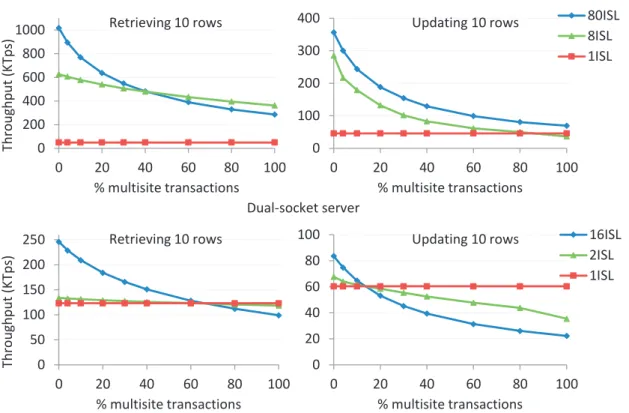
• We quantify the impact of non-uniform core topology on the performance of transaction processing systems and conclude that high performance software has to minimize contention among cores and avoid frequent communication between cores located on different hardware islands. We provide and validate the Islands performance model where we express the performance of an OLTP system as a function of the deployment configuration and the percentage of multipartition transactions on a wide variety of workloads and hardware topologies. The particular cross-over points that make a specific configuration optimal differ depending on the particular scenario. The relative performance trends, however, remain the same in all cases.
• We propose ATraPos, an OLTP system design that is aware of the non-uniform access latencies of multisocket systems. On top of its Island-aware data structures, ATraPos adopts a lightweight monitoring and repartitioning mechanism that adapts the parti-tioning strategy upon workload changes. It relies on the hardware and workload-aware partitioning and placement scheme to achieve balanced load and maximize locality of communication in the critical path.
• We quantify the similarities and differences between OLTP deployments on multisocket multicores and clusters with fast interconnects. We show that different configurations are optimal for different combination of workload and cluster properties. Choosing the right granularity of instances is essential for taking advantage of the fast network, yet, careful placement of threads to cores within an instance can substantially improve throughput.
1.5 Thesis Roadmap
This section outlines the structure of the thesis and summarizes the next chapters.
• Chapter 2provides the background and motivation for this work. We introduce the traditional transaction processing system designs in the single node and distributed deployments. Then we quantify the basic properties ofHardware Islandsusing mi-crobenchmarks, and discuss the major distinguishing characteristics of emerging rack-scale hardware platforms and compare them against other high performance server designs. Finally, we survey the related work.
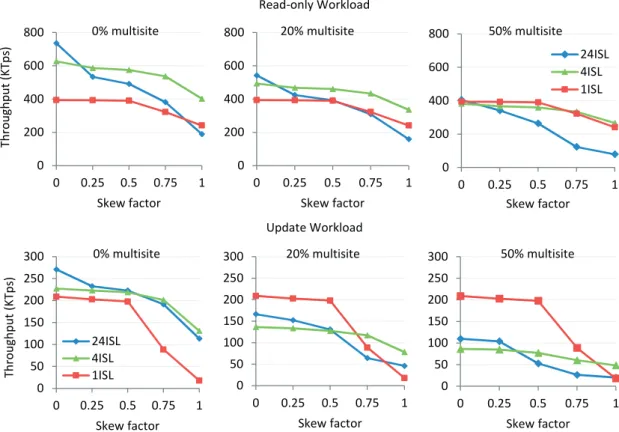
• Chapter 3quantifies the impact ofHardware Islandson a variety of transaction process-ing workloads and distributed deployment configurations. We use both microbench-marks and standard TPC benchmicrobench-marks to explore different dimensions including the impact of distributed transactions, hardware topology, skew, as well as the number and type of operations performed within a transaction. We conclude that no single deployment configuration is optimal for all scenarios and that the best configuration depends on the hardware topology and workload characteristics.
1.5. Thesis Roadmap
• Chapter 4presentsATraPos, a scalable shared-everything system design that minimizes the impact of inter-socket communication in the critical path of transaction execution by utilizing data oriented transaction execution and hardware-aware data structures. In order to adapt to different workloads, ATraPos relies onprecise data partitioning and placementto maximize locality of data accesses and onadaptive repartitioningto maintain data locality when the workload changes.
• Chapter 5expands the analysis to clusters of multisockets connected with fast inter-connects. We analyze different distributed deployments using standard and synthetic benchmarks that include distributed transactions to quantify the challenges and oppor-tunities for OLTP designs on rack-scale platforms.
• Finally,Chapter 6summarized the findings and their impact, and concludes the thesis by discussing possible avenues of future work.
2
Background
This chapter starts with a brief overview of the basic properties of transactions and transaction processing system designs, including a survey of related work. Then we discuss properties of modern multisocket multicore servers and quantify basic trade-offs involved in thread synchronization on these platforms before surveying recent processor trends. We conclude with the discussion of the characteristics of fast interconnects and the data management systems that take advantage of them.
2.1 Online Transaction Processing Systems
According to the popular database systems textbook by Ramakrishnan and Gehrke [130]: ”A
transactionisany one executionof a user program in a DBMS. (Executing the same program several times will generate several transactions.) This is the basic unit of change as seen by the DBMS.“ Each database transaction satisfies the following set of properties (commonly demoted asACID):
• Atomicity:Execution of each transaction is atomic: either all operations are executed and visible to other transactions or none are.
• Consistency:Every transaction run by itself must preserve consistency of the database. Ensuring the consistency is the responsibility of the user while the system ensures that this property is preserved in the presence of concurrent transactions.
• Isolation:Execution of concurrent transactions is isolated, i.e., the effects of incomplete transactions are not visible to other in-progress transactions.
• Durability: Once a transactions completes successfully, its effects are persistent in the database.
In traditional database management systems, ensuring ACID properties is done in the storage manager that typically comprises the following four components [59]: the lock manager in
charge of concurrency control, the log manager in charge of recovery, the buffer pool in charge of caching the data pages in memory, and the access methods used for accessing data stored on the data pages. Concurrency control methods ensure consistency and isolation of transactions, while recovery manager guarantees atomicity and durability. In a traditional storage manager all of these components are centralized and accessed by a worker thread in the critical path of transaction execution. This leads to scalability issues on multicores as threads enter numerous contentious critical sections, e.g., a transaction that updates a single data item requires execution of over 70 critical sections [73].
Shared-everything OLTP.Within a database node,shared-everythingis any deployment where a single database instance manages all the available resources. As database management systems have long been designed to operate on machines with multiple processors, shared-everything deployments assume equally fast communication between all processing cores, since each thread needs to exchange data with all of its peers. Until recently, shared-everything was the most popular deployment strategy for scale-up transactions processing and it is used by all major commercial database systems. OLTP has been studied extensively on shared-everything databases. For instance, the workload characterization studies that analyze micro-architectural behavior of the OLTP workloads demonstrate that shared-everything systems exhibit significant stalls during execution [4,15,54,152]; a result we corroborate inSection 3.3.2. These systems enter numerous contentious critical sections even when executing simple transactions, affecting single-thread performance, requiring frequent inter-core com-munication, and causing contention among threads [73,71]. These characteristics make distributed memories (as those of multisockets), distributed caches (as those of multicores), and prefetchers ineffective.
Many recent techniques aim to improve scalability of individual components of traditional sys-tems, including locking, latching and logging on multicores, by specializing synchronization primitives to a particular component [70,72,76,82]. Alternative to the traditional transaction-oriented execution model is a data-transaction-oriented execution model, that circumvents the aforemen-tioned properties - and flaws - of traditional shared-everything OLTP [83,118,119]. Another promising direction is taking advantage of the hardware transactional memory support avail-able in recent Intel processors to implement efficient concurrency control [91].
The large main memories available in modern servers have sparked a lot of interest in the main-memory optimized transaction processing designs for multisockets. Such systems have been marketed by major vendors for many years, including IBM solidDB [95] and Oracle TimesTen [89], however, only now are they becoming mainstream. Modern multicore optimized main-memory transaction processing systems, such as Hekaton, Silo, Foedus, and Ermia, use multi-versioned latch-free data structures and optimistic concurrency control mechanisms to achieve good scalability by reducing the number of critical sections and their duration [80,81,90,93,157]. Yet, a recent study shows that none of the current concurrency control mechanisms scales to 1000 cores and suggests that extending hardware support is a promising way for overcoming this obstacle [171,172].
2.1. Online Transaction Processing Systems
Scalability concerns in face of increasing parallelism gave rise to a new generation of main memory optimized transaction processing designs, many of which adopt single threaded shared nothing execution model. In the shared-nothing systems, data is partitioned among a number of instances that collectively serve transactional requests.
Shared-nothing OLTP.Shared-nothing deployments [143], based on fully independent (physi-cally partitioned) database instances, are an increasingly appealing design even within a single node [78,136,144]. This is due to the scalability limitations of shared-everything systems, which suffer from contention when concurrent threads attempt to access shared resources [73]. The main advantage of shared-nothing deployments is the explicit control over the con-tention within each physical database instance. As a result, shared-nothing systems exhibit high single-thread performance and low contention for workload that can be partitioned. Systems such as H-Store [144] and HyPer [78] apply the shared-nothing design to the extreme, deploying one single-threaded database instance per CPU core. This enables simplifications or removal of expensive database components such as locking and latching. However, if a trans-action requires data from different instances, it typically executes a distributed transtrans-action that uses a coordination protocol.
Two phase commit.The standard coordination protocol for distributed transactions is the
two-phase commit (2PC)[52,104]. One instance in the system acts as acoordinatorof a dis-tributed transaction while the others areparticipants. During the first phase, the coordinator sends messages containing operation requests to the participants and receives replies con-taining results of requested operations. After completing all operations, the coordinator sends apreparemessage to each participant which replies with avotecontaining an outcome of its part of the transaction. The first phase ends when the coordinator collects all votes. Based on the votes, the coordinator decides whether to commit the transaction (if all participants votedcommitorread-only) or abort it (if at least one participant votedabort). In the second phase, the coordinator sends the decision to all participating instances who complete the transaction fragments locally and send the acknowledgement. When the coordinator collects all acknowledgments, it completes the distributed transaction.
Even a small percentage of distributed transactions in the workload severely harms the scala-bility of systems like H-Store as distributed transactions effectively block all partitions involved in that transaction [74]. An alternative approach is taken by the Multimed project, which views the multisocket multicore system as a cluster of machines [136]. Multimed uses replication techniques and a middleware layer to split database instances into those that process read-only requests and those that process updates. A similar approach is used in HyPer to support OLTP and OLAP in the same system by executing analytical queries on the snapshots of the transactional database [78].
OLTP partitioning mechanisms. One can reduce the negative impact of distributed trans-actions by minimizing the overhead of distributed transtrans-actions either by predicting which distributed transactions are effectively local [121] or by finding a good partitioning scheme
for a specific workload. Schism proposes a graph-based partitioning and replication method for OLTP workloads [32]. The graph is constructed from transaction access traces such that vertices represent tuples and edges connect the tuples used in the same transaction. The parti-tions are selected using the min-cut algorithm. An extension of Schism, Sword [129], proposes a different graph compression approach that allows incremental data movement between two partitioning solutions for different workloads. Another approach for automatic partitioning in shared-nothing OLTP systems is Horticulture [122], which utilizes large neighborhood search (LHS). It uses the database schema, the code of the stored procedures, the workload trace consisting of data items that were accessed, and timestamps. The output of the partitioning strategy is a set of decisions whether to range or hash partition a table or replicate it to all nodes. All these techniques can generate good initial partitioning, however, they are off-line methods that cannot be used to adapt to the workload changes at runtime.
Repartitioning and load balancing.On the other hand, one of the recent proposals for adap-tive repartitioning algorithms targets physiologically partitioned shared-everything systems [151]. The load on each partition is monitored using histograms and work queues. Whenever a load imbalance exceeds the threshold, data is repartitioned. Similar approach can be used in distributed OLTP systems that rely on physiological partitioning [138].
A related set of challenges arise in multitenant shared-nothing deployments in the distributed system setting where load balancing and efficient tenant placement is essential to meet service level objectives (SLOs). ElasTras is a pioneering project that provides elasticity in multi-tenant environment with efficient live migration (repartitioning) in case of load imbalances [33]. Accordion focuses on efficient partitioning placement and minimal data repartitioning cost using mixed integer linear programming for fine-grained shared-nothing OLTP system [139]. E-store is a similar effort aimed at elasticity and load balancing in dynamic fine-grained shared-nothing systems [146].
Stored procedures.Even though transactions in general can contain an arbitrary sequence of SQL statements, in practice, they fall into one of the predefined transaction types and are executed using parametrized stored procedures [144,149]. Furthermore, large majority of transaction types areone-shot, i.e., based on the values of the input parameters, one can determine a set of data items accessed by a transaction. For one-shot transactions, executing the first phase of the 2PC protocol requires a single message exchange: the coordinator sends the prepare message containing the input parameters to the participant who replies with both the result of the execution and the vote. In this work, we primarily consider one-shot distributed transactions.
2.2 Hardware Islands
In step with Moore’s Law, hardware provides increasing opportunities for parallelism rather than faster processors since 2005. Therefore, instead of increasing frequency, we observe an increase in the number of cores on a processor. In addition, multiple such processors
2.2. Hardware Islands
are usually placed in the same server, creatinghardware islands. Hence, there are two main trends in modern server hardware:the variability in communication latenciesandthe abun-dance of parallelism. In the following two subsections we discuss how each trend affects the performance of software systems before surveying related work.
2.2.1 Variable Communication Latencies
The impact of modern processor memory hierarchies on the application performance is signifi-cant because it causes variability in access latency and bandwidth, making the overall software performance unpredictable. Furthermore, it is difficult to implement synchronization mecha-nisms that are globally optimal for different applications and multicores and multisockets with different topologies [35]. Using learning techniques to choose the optimal synchronization mechanism for a specific use case is a promising way to alleviate this problem [40].
0 100 200 300 400 "Spread" threads "Grouped" threads OS Th roughput (Mtps )
Figure 2.1: Results of a counter benchmark where groups of 10 threads increment a shared counter. Allocating threads and memory in a topology-aware manner provides the best performance and lowest variability.
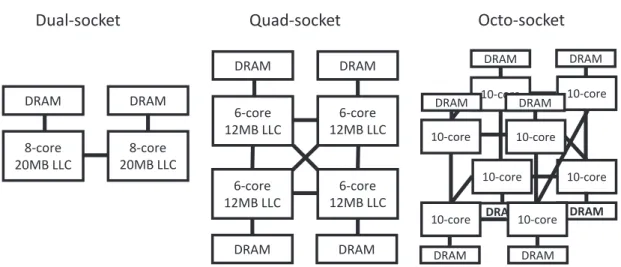
We illustrate the impact of non-uniform topology on the efficiency of synchronization among threads with a simple microbenchmark.Figure 2.1plots the throughput of a program running on a machine that has 8 CPUs with 10 cores each (the “Octo-socket” machine ofTable 3.1). There are 80 threads in the program, divided into groups of 10 threads, where each group increments a counter protected by a lock in a tight loop. There are 8 counters in total, matching the number of sockets in the machine. We vary the allocation of the worker threads and plot the total throughput (million counter increments per second). The first bar (“Spread” threads) spreads worker threads across all sockets. The second bar (“Grouped” threads) allocates all threads in the same socket as the counter. The third bar lets the operating system do the thread allocation. Allocating threads and memory in a manner that maximizes locality results in the best performance and lowest variability. Leaving the allocation to the operating system leads to non-optimal results and higher variability. Although this has been an area of active research in recent years [17,34], general purpose approaches do not work well for database systems due to their dynamic nature. Database-specific thread schedulers and interfaces that
enable the application to hint its requirements to the operating system are a very promising line of research [48]. Ϭ Ϯ ϰ ϲ ϴ ϭϬ ^ƉƌĞĂĚ 'ƌŽƵƉ Dŝdž K^ dŚ ƌŽƵŐŚƉƵƚ; < dƉƐ Ϳ
͍ ͍
͍
͍
Figure 2.2: Throughput of the system when varying placement of 4 worker threads. Running the TPCC-Paymentworkload with all threads on the same socket achieves 20-30% higher performance than other configurations.
We obtain similar results when running OLTP workloads. To demonstrate the impact of non-uniform communication latencies on OLTP, we runTPC-C Paymenttransactions on a machine that has 4 CPUs with 6 cores each (“Quad-socket” inTable 3.1).Figure 2.2plots the average throughput and standard deviation across multiple executions on a database with 4 worker threads. In each configuration we vary the allocation of individual worker threads to cores. The first configuration (“Spread”) assigns each thread to a core in a different socket. The second configuration (“Group”) assigns all threads to the same socket. The configuration
“Mix”assigns two cores per socket. In the“OS”configuration, we let the operating system do the scheduling. This experiment corroborates the previous observations ofFigure 2.1: the OS does not optimally allocate work to cores, and a topology-aware configuration achieves 20-30% better performance and less variability. The absolute difference in performance is much lower than in the case of counter incrementing because executing a transaction has significant start-up and finish costs, and during transaction execution a large fraction of the time is spent on operations other than accessing data. For instance, studies show that around 20% of the total instructions executed during OLTP are data loads or stores (e.g., [15,54]).
2.2.2 Abundant Hardware Parallelism
Another major trend is the abundant hardware parallelism available in modern database servers. Higher hardware parallelism potentially causes additional contention in multisocket multicore systems, as a higher number of cores compete for shared data accesses.Figure 2.3
plots the results obtained on the octo-socket machine when varying the number of worker threads accessing a set of counters, each protected by a lock. An exclusive counter per core
2.2. Hardware Islands 1 10 100 1000 10000 Counter per core Counter per socket Single counter Th roughput (Mtps ) log scale
Figure 2.3: Results of a counter benchmark where we always use 80 threads and change the number of counters they increment. Improving locality of communication improves the performance by an order of magnitude.
achieves lower variability and 18x higher throughput than a counter per socket, and 517x higher throughput than a single counter for the entire machine. In both cases, this is a super-linear speedup. Shared-nothing deployments are better suited to handle contention, since they provide explicit control by physically partitioning data, leading to higher performance.
Ϭ ϱϬ ϭϬϬ ϭϱϬ &ŝŶĞͲŐƌĂŝŶĞĚ ^ŚĂƌĞĚEŽƚŚŝŶŐ ^ŚĂƌĞĚǀĞƌLJƚŚŝŶŐ dŚ ƌŽƵŐŚƉƵƚ; < ƚƉƐ Ϳ
Figure 2.4: Running theTPC-Cbenchmark with only local transactions. Fine-grained shared-nothing deployment configuration is 4.5x faster than shared-everything.
Similarly, when the OLTP workload is perfectly partitionable, the fine-grained shared-nothing configuration provides better performance. As an example, we compare the performance of the shared-everything version of Shore-MT with the fine-grained shared-nothing version with 24 instances on the quad-socket machine. Both systems run a modified version of the
TPC-Cbenchmark [154] Payment transaction, where all the requests are local and, hence, the workload is perfectly partitionable onWarehouses. We plot the results onFigure 2.4. The fine-grained shared-nothing configuration outperforms shared-everything by 4.5x, due in large part to contention on the Warehouse table in the shared-everything case.
2.2.3 NUMA-aware System Design
NUMA-aware operating systems.Adapting operating systems to non-uniform hardware is an area of active research. Some operating system kernels such as the Mach [2] and exokernel [43], or, more recently, Barrelfish [17], employ the message-passing paradigm. Message-passing potentially facilitates the development of NUMA-aware systems since the communication between threads is done explicitly through messages, which the operating system can schedule in a NUMA-aware way. Other proposals include the development of schedulers that detect contention and react in a NUMA-aware manner [22,34,147]. Such schedulers have recently been adapted to task-oriented analytical database engines [48,126], however, they likely require extensive changes to a traditional database engine.
Synchronization. Adapting software systems to today’s non-uniform hardware primarily requires efficient synchronization primitives [35]. Scalable synchronization structures typi-cally rely on efficient inter-core communication using atomic operations. Since an atomic operation becomes much slower over inter-socket links, proposals for scalable NUMA-aware locks rely on hierarchically partitioned structures to maximize access locality [24,39]. On the system level, a recent study on the performance of garbage collectors on multisocket multicores analyzes synchronization patterns and systematically removes bottlenecks without completely redesigning the system [49]. We take inspiration from these efforts as we redesign our storage manager for multisockets.
NUMA-aware data management systems.A lot of past work focuses on adapting databases for SMP systems. For instance, commercial database systems provide configuration options to enable NUMA support, but this setting is often optimized for legacy hardware where each individual CPU is assumed to contain a single core. With newer multisocket servers, enabling NUMA support might lead to high CPU usage and degraded performance [28,165]. Similarly, modern operating systems offer better support for NUMA arhitectures, however, they do not improve application performance out-of-the-box. Tuning existing database systems to multisocket multicores is still a very challenging task [60,161].
The majority of the proposals that target building NUMA-aware data management systems focus on removing memory bandwidth bottlenecks for analytical applications [127] and specifically devising efficient join and sorting algorithms that minimize data movement [5, 14,94,123]. However, OLTP workloads cannot saturate memory bandwidths and their main problem is ensuring efficient synchronization among threads [125]. Statistical analysis is another challenging data management task and a recent study explores different trade-offs in the design space to conclude that hardware topology-awareness can improve performance by an order of magnitude compared to the state-of-the-art systems [174].
2.2. Hardware Islands
2.2.4 Beyond Hardware Islands
Manycore designs.While hardware islands capture well the topology of today’s mainstream servers, many other designs are more complex. Contemporary low power multicores have dozens of cores on the same chip: some of them have shared last level caches [27,36,164], while proposals for others argue for independent Islands on the same die [97]. However, with manycore designs, we cannot expect core-to-core latencies to be uniform. For example, the latest generation of low power chips from Tilera family [164] have cores that are organized in the form of a mesh. In this case, communication latency depends on the number of hops between two cores, e.g., for the 36 core chip, it ranges from 45 to 65 cycles [35].
Hierarchy of Islands.We expect that multicore chips with a large number of cores will have less uniform core-to-core communication latencies. For example, Oracle’s latest M7 32-core chip [141], which is specifically designed for database appliances, features eight 4-core clusters with dynamically shared last level cache and data analytics accelerators. Each core in a cluster has private L1 data and instruction caches. The L2 instruction cache is shared by all the cores in a cluster, while each of the two L2 data caches is shared by a pair of cores, thus creating a hierarchy of inter-core latencies within a chip. Another interesting example is the latest generation of Intel’s Xeon E5 chips [65]. In high core count configurations with 14 to 18 cores, it features three different cache coherence modes, including the new ”cluster-on-die(COD)“ setting. In this mode, two cache coherence rings on the same chip are completely independent which decreases the communication latency among the cores on the same ring. Practically, two rings form islands on the same chip and can increase performance for application that are island-aware. ARM server processor designs typically place a cluster of smartphone-optimized cores and add a shared last level cache and a memory controller. The resulting designs can have very complex topology and unpredictable latencies, e.g, cache hit latency on a Mars 64-core chip ranges from 2 to 70 cycles depending on the location of the cache line [175].
Dark silicon.A major challenge to continued scalability of multicore chips is the significant increase in power density that leads to dark silicon - the inability to power all cores simulta-neously [55]. Limited number of pins and off-chip bandwidth pose additional challenges for future high performance chips. A promising way to overcome off-chip bandwidth issues is to stack multiple memory chips on top of the processor chip [21]. Silicon photonic interconnects between multiple smaller multicores offer a practical design for energy-efficient 1000-core systems [37,85,88].
Accelerators.As a consequence of dark silicon, heterogeneous chips containing specialized logic are becoming more appealing. Recent proposals range from custom chips that accelerate individual operations such as partitioning [167] and hashing [84], to query task accelerators [141], to designs that specialize chips to complete analytical queries [168]. These proposals are generally targeted at accelerating specific software codepaths. The more general approach is using reconfigurable chips, such as field programmable gate arrays (FPGAs), for offloading selected data processing paths [69,166], or adding a layer of security through encryption [11].
This idea is already used in practice to accelerate parts of processing pipeline for Microsoft’s Bing search engine [128]. Furthermore, Intel is already offering FPGAs integrated with its Xeon processor in the same coherent package that is socket-compatible with other Xeon processors [67].
Takeaways. In summary, modern hardware poses significant new challenges to software systems. Contention and topology have a significant impact on the performance and its predictability. Predictably fast transaction processing systems have to take advantage of the
hardware islandsin the system. They need to (a) avoid frequent communication between “distant” cores in the processor topology and (b) keep the contention among cores low. With ever more complex processor designs as well as heterogeneity within a core, making software aware of the underlying hardware is essential for sustaining high performance.
2.3 Rack-scale Computing Platforms
In addition to abundant parallelism, another major hardware trend is the decreasing distance between servers through fast interconnects. In this section, we discuss advances in networking in both datacenters and database appliances and forecast their impact on the general purpose transaction processing systems.
Fast network. Low latency interconnects are becoming mainstream [20, 135]. High-performance interconnect fabrics such as Infiniband, with bandwidths up to 100Gbps, are already standard in supercomputers and are making inroads into enterprise datacenters and database appliances [116,101,137].
Traditionally, commodity clusters use the TCP/IP software stack that poses a high overhead limiting the potential improvements of the faster interconnects. RDMA enables faster commu-nication by allowing applications to access the main memory of a remote machine without involving an operating system or even a processor on a remote machine. With the growing popularity of Converged Enhanced Ethernet [62], RDMA capabilities are becoming available at lower price point in commodity datacenters. RDMA can enable access to the remote memory of another server in a rack at around 10x latency of the local memory node [156].
The impact of fast network on data analytics.As today’s applications store more and more data, distributed data processing architectures are proliferating. They are typically deployed on commodity machines in datacenters and are using commodity Ethernet networks. Even though the the conventional wisdom is that network is the bottleneck in distributed data ana-lytics, a recent study demonstrates that the CPU is the bottleneck and that optimizing network performance can only improve median job completion time by 2% [117]. One recent proposal has demonstrated significant improvements in performance by focusing on improving CPU efficiency instead of network and disk I/O [31].
2.3. Rack-scale Computing Platforms
Large shared memory servers.Traditional large shared memory machines with more than 8 processors use specialized interconnects and controller chips to maintain cache coherence [53,92,115]. However, such complex designs add significant overheads: for example, remote memory access latencies on a modern 64 processor SGI UV 2000 machine, marketed as a database machine, are 5.5x to 10.7x higher compared to local memory accesses [83]. With the high latency overheads of maintaining cache coherence, software designers need to optimize their code for locality to achieve good performance on large shared memory machines, which in addition to high price limits them to niche applications [120].
Futhermore, the coherence overheads increase with the number of cores and in the near future high performance systems will consist of coherence domains connected by low-latency incoherent interconnect [57]. Each coherence domain will host independent operating system instances similar to commodity clusters today. However, the fast interconnects will decrease the gap between accessing local and remote memory by facilitating access to the remote memory without involving the operating system and with minimal CPU overhead.
Cluster consolidation.From the earliest days of computer clusters, system designers strove to provide an illusion of a single system by using shared file systems and peripheral devices [162,169]. Server vendors have long embraced consolidation using blade server designs to improve energy efficiency and eliminate redundancies in datacenters. In the near future, rack-scale datacenter designs such as cluster-in-a-box with low power system-on-a-chip (SoC) multicore designs that integrate fast interconnect interfaces will further increase density and reduce energy consumption [38]. Integrating memory and network controllers is already becoming standard in low power server designs for highly parallel workloads [107,158]. Global shared memory has been an appealing abstraction for decades, especially in the super-computing domain [8]. A number of recent proposals offer mechanism for achieving such functionality at lower cost. For instance, memscale design [106] allows dynamic sharing of memory among servers in a cluster through an add-on card that leverages existing processor interconnect such as HyPerTransport for accessing remote memory. Scale-out NUMA [111] goes a step further by introducing specialized chips and protocols that can bring remote mem-ory to 4x latency of the local memmem-ory within a rack. BlueDBM uses custom network interfaces in addition to FPGA interface to flash arrays to improve performance of data analytics on flash by an order of magnitude [75]. Data processing in general is a very appealing target for specialized hardware/software co-design due to many data parallel tasks that are amenable to acceleration [7,114].
Scaling out scale-up OLTP.Modern scale-up shared-everything designs optimized for mul-ticores cannot be used directly on rack-scale hardware since they take advantage of cache coherent global shared memory. Their latch-free data structures and algorithms for concur-rency control are optimized for short transactions and even shorter critical sections. Dis-tributed transactions involve network delays that are significantly longer than the individual transactions and can introduce imbalances in the system. For example, Microsoft’s Hekaton,
the state-of-the-art commercial in-memory transaction processing engine, does not support distributed transactions in SQL Server 2014 [102] which hints at the challenges of supporting this scenario.
Distributed transaction protocols.Any distributed transaction in a shared-nothing system needs to use a consensus protocol, such as two-phase commit (2PC) [104], to ensure ACID properties. Many have argued that two-phase commit is inherently unscalable [23,58] and designers of many large-scale distributed systems have avoided these issues by using weaker consistency like eventual consistency [159]. While relaxed models remove the need for a synchronous consensus protocol, they significantly increase the complexity since consistency needs to be ensured in the application. One way to remove the need for agreement protocol at commit time in a transaction processing system is using a deterministic transaction execution protocol [148,149]. Calvin deterministicaly schedules all incoming transactions to ensure conflict-free execution and achieve high throughput in a distributed system deployed in a datacenter [149].
An alternative to determinism for improving efficiency of transactions in distributed environ-ment is using semantic information about the workload to avoid unnecessary coordination [13,47]. The RAMP model [12] proposes atomic visibility as a weaker alternative to serializ-ability to scale much better than the two-phase commit and satisfy requirements of web-scale companies whose systems typically use eventual consistency for better performance. MDCC is a recent commit protocol optimized for long roundtrip latencies in data centers [86] that improves upon 2PC by requiring only one round of communication when concurrent transac-tions are conflict-free. With a few additional assumptransac-tions, it is possible to design a one-phase commit protocol for general transactions [1]. It is an interesting avenue of future work to optimize such a protocol for modern scale-out clusters. However, all of these recent proposals are targeting datacenter deployments and thus utilize complex conflict detection algorithms that introduce too much overhead to be practical for low latency rack-scale deployments.
RDMA key-values stores. Many projects have explored network-specific optimizations for distributed data management systems, including Hadoop, HBase and memcached [61,68,145]. Simply using faster network significantly decreases time spent on network-related tasks, however, further improvements require optimization of the whole communication stack around RDMA. Several projects have gone a step further in designing distributed key-value stores specifically for RDMA using user level networking. Pilaf [103] uses one-sided RDMA reads to achieve high throughput and low CPU usage. FaRM [41] is a distributed computing platform that exposes memory of a cluster of machines as a shared address space which can be used for designing systems on top of it. HERD [77] is a recent desig