Durham Research Online
Deposited in DRO:01 August 2016
Version of attached le: Accepted Version
Peer-review status of attached le: Peer-reviewed
Citation for published item:
Coolen, F.P.A. and Coolen-Maturi, T. (2016) 'On the structure function and survival signature for system reliability.', Safety and reliability., 36 (2). pp. 77-87.
Further information on publisher's website:
https://doi.org/10.1080/09617353.2016.1219936
Publisher's copyright statement:
This is an Accepted Manuscript of an article published by Taylor Francis Group in Safety and Reliability on 17/10/2016, available online at: http://www.tandfonline.com/10.1080/09617353.2016.1219936.
Additional information:
Use policy
The full-text may be used and/or reproduced, and given to third parties in any format or medium, without prior permission or charge, for personal research or study, educational, or not-for-prot purposes provided that:
• a full bibliographic reference is made to the original source • alinkis made to the metadata record in DRO
• the full-text is not changed in any way
The full-text must not be sold in any format or medium without the formal permission of the copyright holders. Please consult thefull DRO policyfor further details.
On the structure function and survival
signature for system reliability
Frank P.A. Coolen
∗Tahani Coolen-Maturi
†Durham University, UK
Abstract
Quantification of reliability of systems has, for decades, been based on the struc-ture function, which expresses functioning of a system given the states of its com-ponents. One problem of the structure function is that, in its simplest form, for a system withm components it must be specified for 2m combinations of component states, which is impossible for most practical systems and networks. Recently, the authors have introduced the survival signature, which is a summary of the structure function that is meaningful if the system’s components can be divided into groups with exchangeable failure times. The survival signature takes all the aspects of the system lay-out into account and is sufficient for a range of inferences, in particular to derive the system’s failure time distribution given the components’ failure time distributions.
In this paper, we provide a brief introductory overview of the survival signature, including recent advances. We then suggest a fundamental change to the nature of the structure function, namely from being a binary function to a probability, or even an imprecise probability. This provides a generalized tool for realistic quantification of system reliability and can straightforwardly be incorporated into the survival signature. We discuss opportunities these concepts provide for practical reliability assessment, and challenges for their application to real-world systems.
1
Introduction
Quantification of reliability of systems and networks is crucial in many application areas, indeed most of modern life depends on systems which are known to be reliable.
Mathe-∗[email protected] (corresponding author) †[email protected]
matical and statistical theory of system reliability has been established over many decades and led to a large literature. At the heart of this theory is the ‘structure function’, which reflects if a system is functioning or not given the states, functioning or not, of its compo-nents. While there are generalizations of the structure function to multi-state scenarios, already in this simplest form it requires specification for 2m inputs for a system
con-sisting of m components. Textbook examples of applications typically focus on systems with either very few components, or specific structures which facilitate specification of the structure function. However, practical systems of interest may consist of hundreds or thousands of components, making direct specification of the structure function and its use mostly impossible. The good news is that, for several inferences, it is possible to use a sufficient summary of the structure function which has recently been introduced by the authors [7] and which is called the ‘survival signature’. This is useful if the components of a system contain groups of components with exchangeable random failure times. One can think of such components as being ‘identical’, both with regard to the features of the components themselves and the functioning in the system.
This paper provides an introductory overview to the survival signature and a discus-sion of related opportunities and challenges for application and research. Furthermore, we consider the basic structure function and argue that a simple generalization from binary function to a probability has substantial advantages for realistic system reliability quan-tification. Section 2 of this paper provides an overview of the survival signature, while the generalization of the structure function is discussed in Section 3, where it is also shown that this fits well with the concept of the survival signature. Section 4 contains discussion of a range of opportunities and challenges related to these two fundamental concepts.
2
Survival signature: an overview
For a system withmcomponents, the state vectorx= (x1, x2, . . . , xm)∈ {0,1}mis defined
such that xi = 1 if the ith component functions and xi = 0 if not. The labelling of the
components is arbitrary but must be fixed to define x. Central to the established theory of system reliability is thestructure function φ:{0,1}m → {0,1}, defined for all possible
x, withφ(x) = 1 if the system functions and φ(x) = 0 if the system does not function for state vector x. Throughout this paper, we restrict attention to coherent systems, which means that φ(x) is not decreasing in any of the components of x, so system functioning cannot be improved by worse performance of one or more of its components. We further assume that φ(0) = 0 and φ(1) = 1, so the system fails if all its components fail and it functions if all its components function. These last two assumptions could be relaxed
but are reasonable for most practical systems, and they simplify the presentation in this paper.
For general systems with a substantial number of components, specification of the structure function is an enormous, or even practically impossible task, as it needs to be specified for 2m different values of the vector x. Recently, Coolen and Coolen-Maturi [7]
presented a summary of the structure function, called thesurvival signature, which can be used if the components of the system can be divided into groups, with the random failure times of components in the same group exchangeable [11]. This can be interpreted such that, on the basis of the information available, one would not distinguish these failure times. An alternative explanation of ‘exchangeable’ is that, if one failure time was given, one would think it equally likely to be the failure time corresponding to any component in the same group. Clearly, this assumption must be based on information about the specific component types and their functioning in the system. However, exchangeability is a modelling assumption and does not necessarily have to reflect very strong knowledge of similarity of the components and their role in the system, it just reflects absence of knowledge or assumptions about lack of similarity being included in the model.
Let us consider a system with m components which can be divided into K ≥ 2
groups of components with exchangeable failure times, we will further refer to such groups as different types of components. Assume that there are mk ≥ 1 components of type
k ∈ {1,2, . . . , K}, so PK
k=1mk =m. Due to the arbitrary ordering of the components in
the state vector x, components of the same type can be grouped together and the state vector can be written as x= (x1, x2, . . . , xK), with xk = (xk
1, xk2, . . . , xkmk) the sub-vector representing the states of the components of type k. The survival signature for such a system [7] is denoted by Φ(l1, l2, . . . , lK), for lk = 0,1, . . . , mk, and is defined as the
probability that the system functions given that preciselylk of itsmk components of type
k function, for each k ∈ {1,2, . . . , K}. There are mk
lk
state vectors xk with precisely l k
of its mk components xki equal to 1, so with
Pmk
i=1x
k
i =lk; letSlk denote the set of these
state vectors for components of type k. Furthermore, let Sl1,...,lK denote the set of all state vectors for the whole system for which Pmk
i=1x
k
i = lk, k = 1,2, . . . , K. Due to the
exchangeability assumption for the failure times of the mk components of type k, all the
state vectors xk∈Sk
l are equally likely to occur, hence
Φ(l1, . . . , lK) = " K Y k=1 mk lk −1# × X x∈Sl1,...,lK φ(x) (1)
The survival signature needs to be specified for QK
k=1(mk + 1) values of the vector
of the same type. Note that, if no components are assumed to be of the same type, then the survival signature is just equal to the structure function and no reduced-size sufficient summary of the structure function is available for the following inference of interest.
Let Ck
t ∈ {0,1, . . . , mk} denote the number of components of type k in the system
that function at time t > 0 and let TS denote the system failure time. The probability
that the system functions at time t >0 is equal to
P(TS > t) = m1 X l1=0 · · · mK X lK=0 Φ(l1, . . . , lK)P( K \ k=1 {Ctk=lk}) (2)
This equation shows the essential benefit of the use of the survival signature, namely that it contains the full information about the system structure required to derive the system survival function. It further shows that this information about the system structure is now fully separated from information about the component failure times, which is included in the function through the second factor within the summation. This separation is useful in a variety of manners, including for the use of statistical methods for the system survival function based on component failure data and for comparison of different system lay-outs. For equation (2) only exchangeability of the failure times of components of the same type is assumed, so components of different types may have dependent failure times. Of course, any such dependence would need to be modelled, it can for example occur due to common-cause failures [8]. Some common modelling assumptions may be reasonable, and they may further simplify the expression for the system survival function. In particular, if one assumes that the failure times of components of different types are independent, then we have P( \ k=1,...,K {Ctk =lk}) = K Y k=1 P(Ctk=lk)
If, in addition, one assumes for all k = 1, . . . , K, that the failure times of components of type k are conditionally independent and identically distributed (ciid) with cumulative distribution function Fk(t), which is a stronger assumption than exchangeability, then
P( \ k=1,...,K {Ctk =lk}) = K Y k=1 mk lk [Fk(t)]mk−lk[1−Fk(t)]lk
This enables e.g. quite straightforward application of Bayesian statistical methods, where Fk(t) may be assumed to belong to a parametric family but where also nonparametric
ap-proaches are possible, both are illustrated by Aslett et al. [2]. Coolen et al. [10] illustrate nonparametric predictive inference [3, 6] for the system survival function using equation
(2), where the ciid assumption is not made and with the generalization to imprecise prob-abilities [4]. Feng et al. [12] illustrate the use of the survival signature combined with known sets of probability distributions for the failure times of the components of different types, so also within theory of imprecise probability [4], and they also discuss computation of importance measures for components in the systems using the survival signature. To get further insight into the system survival function for complex systems, when analytical derivations are not feasible anymore, the ability to perform simulations efficiently is cru-cial. Patelli et al. [14] show that the survival function is sufficient for such simulations, where different algorithms can be used depending on whether one aims explicitly at sim-ulating system failure times or at learning the system survival function. In particular for the latter scenario the survival signature allows extremely efficient simulation.
If the system consists of a single type of component, so the failure types of the m components are all assumed to be exchangeable, then the survival signature is effectively identical to the system signature introduced by Samaniego [16], that is, there is a one-to-one relation between these two concepts. While the signature has proven to be a popular concept to gain insight into qualitative aspects of system design, leading to a substantial literature during the last decade, few real life systems consist of a single type of components hence the survival signature provides a crucial generalization of the signature, leading Samaniego and Navarro [17] to describe it as a ‘breakthrough’ for system reliability and using the concept for comparison of different systems.
While the survival signature may provide a substantially reduced representation of the system structure compared to the full structure function, its derivation may still be an extremely complicated task. Of course, it only needs to be calculated once for a system, so if reliability of the system is really important this may not be too problematic. Aslett [1] provided a package in the statistical software R which enables computation of the survival signature, as well as Samaniego’s signature. Recently, Reed [15] presented a vast improvement on computation time by using binary decision diagrams and dynamic programming to compute the survival signature, it is expected that this approach will soon be available in the R package by Aslett. Currently it looks feasible to calculate the survival signature for systems with quite a reasonable number of components, of course it depends on the actual system structure and the number of different component types, but systems with in the order of 100 components should be feasible and we expect that exact calculation methods for larger systems will become available soon. It should be noticed that the survival signature for a system that consists of two subsystems in either series or parallel configuration can be derived from the survival signatures of the subsystems, as shown by Coolen et al. [10], using a similar method as presented by Gaofeng et al. [13] for
Samaniego’s signature. Furthermore, the fact that the survival signature Φ(l1, . . . , lK) is a
monotonously increasing funtion of eachlk, for coherent systems, makes it straightforward
to find bounds if it is only calculated for some of the vectors (l1, . . . , lK), this is also
presented by Coolen et al. [10]. There may be further ways to learn the survival signature for large systems, for example through simulations, this is an important topic for future research.
Coolen et al. [10] also discuss the important situation that occurs if a component is replaced. If the failure time of this component is age dependent and it is replaced by a new component, then upon its replacement its future failure time will not be exchangeable with the failure times of components that were of the same type. Hence this must be modelled as an additional component type. The computations involved do not require the full new survival signature to be calculated from scratch, one can reduce the effort to computing it only under the assumption that this new component functions, Coolen et al. [10] show how this can then be combined with the original survival signature to deduce the values corresponding to this new component failing. Of course, if one assumes no ageing effect, so an exponential distribution for the component’s failure time, then after replacement it can still be assumed to be of the same type as before.
Example 1.
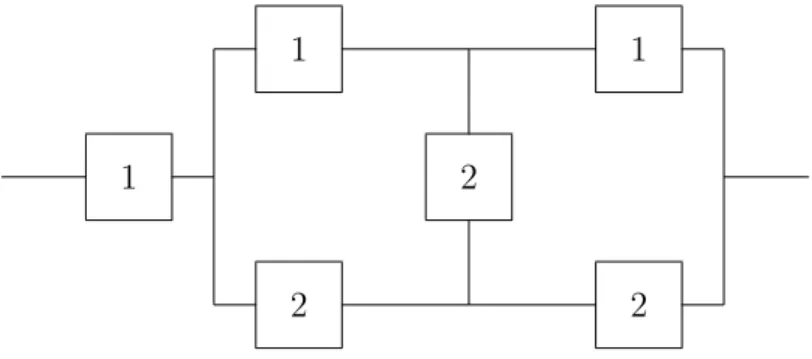
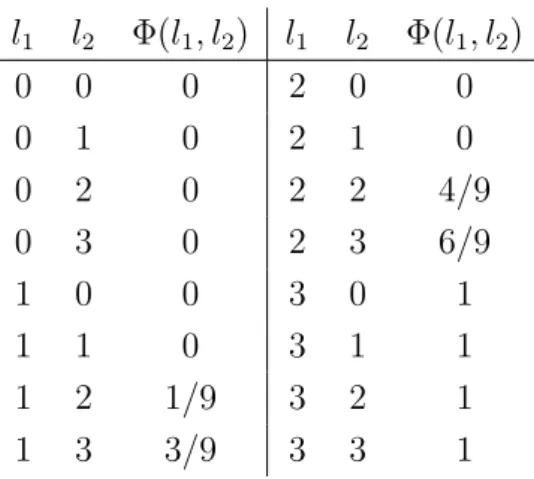
As a small example of the survival signature, consider the system in Figure 1 involving a system with K = 2 types of components [7]. The survival signature for this system is presented in Table 1, these values are easy to verify.
1
1 1
2 2
2
l1 l2 Φ(l1, l2) l1 l2 Φ(l1, l2) 0 0 0 2 0 0 0 1 0 2 1 0 0 2 0 2 2 4/9 0 3 0 2 3 6/9 1 0 0 3 0 1 1 1 0 3 1 1 1 2 1/9 3 2 1 1 3 3/9 3 3 1
Table 1: Survival signature of the system in Figure 1
3
The structure function as probability
As mentioned before, in mathematical theory of reliability the main focus is on the func-tioning of a system given the funcfunc-tioning, or not, of its components and the structure of the system. The mathematical concept which is central to this theory is the structure function, as introduced in the previous section. This concept is undisputed in the litera-ture and the start to every course and textbook on system reliability. However, when we think about its practical use, it may perhaps be somewhat restricted as will be discussed below. We propose a quite straightforward generalization which provides enormously en-hanced flexibility in its use: consider the structure function as a probability, hence taking on values in [0,1] instead of {0,1}. Of course, this generalization completely embeds the traditional structure function, we will refer to the generalized version as probabilistic structure function. There are many scenarios in which this generalization provides useful modelling flexibility, we discuss this via a simple example.
Suppose we wish to quantify the reliability of a car. We must start describing what we mean with system functioning, then list the components, and finally specify whether the car functions or not given all states of the components. System functioning can have many meanings here: for example it may mean that the car will satisfactorily enable us to travel to our destination today, or function without problems the next week, or any other criterion. Recently, we considered such scenarios and proposed to focus explicitly on a next task, also enabled by the use of a probabilistic structure function [9]. This also makes it possible to consider vaguely specified or unknown tasks, in particular through
the further generalisation of the structure function as an imprecise probability [4]. But returning to the car, let us assume that we define the ability to drive at least a specified distance in a normal manner is considered successful functioning of the system; do we need to list all components of the car and include them all, either individually or as subsystems, in the specification of the structure function? It would be useful if we could limit our attention to key components of interest, for example the engine, transmission system and tyres. Clearly, while these are important for the functioning of the car, their functioning does not provide absolute certainty that the car will function, e.g. there may be something wrong with the braking system or the car may fail to start. Therefore, being able to specify the car’s functioning as a probability will be useful; one could argue that system functioning, considered as function of a set of its components, should always be interpreted as conditional on all other components functioning correctly, taking this view would also be most accurately supported by, and reflected through, the use of conditional probabilities, where one can include the probability of the other components actually functioning correctly.
A further possible advantage of the probabilistic structure function appears if one wishes to quantify a system’s reliability in early design phases, in particular if the ex-act requirements on the system are not yet known or if the final system design is not yet fully known. These are scenarios where the lack of perfect knowledge is best rep-resented through probabilities, or indeed imprecise probabilities if one wishes to reflect indeterminacy as well [4, 18]. Interpreting system functioning, given the state of (a subset of) the system’s components, as random is also natural if one needs to learn about this functioning from experiments, which may include computer simulations for large complex systems. In case of computer simulations there is always some remaining uncertainty about the quality of the link between the computer model and the real world system, this again is best reflected through a probabilistic structure function.
While generalization to a probabilistic structure function is mathematically straight-forward, meaningful implementation requires substantial information or modelling as-sumptions, this leads to many topics for research which are best addressed in direct relation to real-world applications. In relation to the use of the survival signature for quantification of system reliability, as discussed in Section 2, it is important to emphasize that this concept can immediately be used with probabilistic structure functions. The derivation of the survival function may become harder (e.g. the fast approach using binary decision diagrams [15] depends on the binary nature of the structure function), but the main equation (1) remains the same if the structure function is a probability, and even the generalization of the survival signature corresponding to the use of imprecise probabilistic
structure functions is quite straightforward [9].
4
Discussion
While the structure function has been a central concept to the theory of system reliability, there has, until recently, been surprisingly little attention to the two aspects discussed in this paper: the development of summaries of the structure function which are suffi-cient for specific inferences, and its generalization to a probabilistic structure function. The survival signature provides an attractive summary of the structure function which is sufficient to derive the probability distribution of the system’s failure time, given the probability distributions of the failure times of each of the component types. This has thus far only been presented for systems and components with two states, so either func-tioning or not. For many real world systems it is important to take multiple states into account, with time-dependent transitions between the states. For example, there may be an intermediate state between perfect functioning and failing, reflecting that the system functions but some underlying minor fault has appeared or that the system functions with reduced capacity. Such multiple state scenarios, for both the system and its components, can also be reflected through a structure function, which of course becomes more complex as the state of the system for all combinations of the component states must be given. For such cases, there will again be the opportunity to separate structural aspects of the sys-tem from time-dependent transitions for the components via a summary like the survival signature, developing the detailed theory is an interesting topic for future research.
It should be emphasized that the survival signature as discussed in this paper is not sufficient for all possible inferences, for example in order to see the effect of one specific component being replaced on the system reliability one would need to have the detailed structure information required to calculate a new survival signature. But it is a very flexible tool, which offers opportunities for variations to deal with a range of important issues. For example, the recently developed theory of adversarial risk analysis [5] deals with game theoretic aspects when one tries to protect systems from attacks. One could imagine a scenario where an electricity network contains many components of the same type, but where some of these, due to their geographic location, are more vulnerable to attacks than others. In this case, the latter components can be modelled in the survival signature as being of different types than the components which appear to be similar but are deemed to be less risky for attacks, this will enable detailed study of the possible consequences of attacks for the reliability of the system. A similar more detailed grouping of components may be useful to reflect the possibility that common cause failures may
affect some groups of components more than others [8].
It is important for future research in this direction and development of implementable methods, that real-world problems are studied and minimally sufficient summaries of structure functions are developed to enable specific problems to be solved. In particular for large-scale systems and networks there are interesting problems with regard to upscaling methods and required computations. It is likely that the scale of the system will affect the exchangeability assumptions, as for systems or networks with thousands of components it is simply not possible to take individual aspects of all components into account, and this is also usually not necessary to get a suitable overall impression of the system’s reliability, indeed it is natural to focus efforts on modelling of, and collecting information on the most critical components of a system. It is here that acknowledging some remain uncertainties and enabling these to be included in an analysis are important, which can be done using the suggested generalization to probabilistic structure functions. Meaningful models for probabilistic structure functions need to be developed, and again this would best be done in close connection to practical problems.
It will be clear that, with the two concepts discussed in this paper, there is a wide range of new opportunities and related challenges, both for applications and theory. Overall, the aim is to enable more realistic modelling, inference and decision support for large-scale real-world systems and networks than has been possible thus far. Several researchers have already started to work on further theory and methodology of the survival signature, a crucial next step is to start implementing it to real-world problems, which will give important direction to further research. The authors would particularly welcome interest from readers who see opportunities to use these concepts for reliability analyses of their practical systems and networks, as such collaborations are crucial for the future progress of this work.
References
[1] Aslett L.J.M. (2012). ReliabilityTheory: Tools for structural reliability analysis. R package (www.louisaslett.com).
[2] Aslett L.J.M., Coolen F.P.A., Wilson S.P. (2015). Bayesian inference for reliability of systems and networks using the survival signature. Risk Analysis 35, 1640-1651. [3] Augustin T., Coolen, F.P.A. (2004). Nonparametric predictive inference and interval
[4] Augustin T., Coolen F.P.A., de Cooman G., Troffaes M.C.M. (2014).Introduction to Imprecise Probabilities. Wiley, Chichester.
[5] Banks D.L., Rios J., Rios Insua D. (2016). Adversarial Risk Analysis. CRC Press, Boca Raton.
[6] Coolen F.P.A. (2011). Nonparametric predictive inference. In: M. Lovric (Ed.), In-ternational Encyclopedia of Statistical Science, Springer, pp. 968-970.
[7] Coolen F.P.A., Coolen-Maturi T. (2012). On generalizing the signature to systems with multiple types of components. In: W. Zamojski et al (Eds.), Complex Systems and Dependability, Springer, pp. 115-130.
[8] Coolen F.P.A., Coolen-Maturi T. (2015). Predictive inference for system reliability after common-cause component failures. Reliability Engineering and System Safety
135, 27-33.
[9] Coolen F.P.A., Coolen-Maturi T. (2016). The structure function for system reliabil-ity as predictive (imprecise) probabilreliabil-ity. Reliability Engineering and System Safety, invited revision submitted.
[10] Coolen F.P.A., Coolen-Maturi T., Al-nefaiee A.H. (2014). Nonparametric predictive inference for system reliability using the survival signature. Journal of Risk and Reliability 228, 437-448.
[11] De Finetti B. (1974). Theory of Probability. Wiley, New York.
[12] Feng G., Patelli E., Beer M., Coolen, F.P.A. (2016). Imprecise system reliability and component importance based on survival signature. Reliability Engineering and System Safety 150, 116-125.
[13] Gaofeng D., Zheng B., Taizhong H. (2012). On computing signatures of coherent systems. Journal of Multivariate Analysis 103, 142-150.
[14] Patelli E., Feng G., Coolen F.P.A., Coolen-Maturi, T. (2016). Simulation methods for system reliability using the survival signature. In submission.
[15] Reed S. (2016). Algorithm for exact computation of system and survival signatures from binary decision diagrams. Manuscript in preparation.
[16] Samaniego F.J. (2007). System Signatures and their Applications in Engineering Re-liability. Springer, New York.
[17] Samaniego F.J., Navarro J. (2016). On comparing coherent systems with heteroge-neous components. Advances in Applied Probability48, 88-111.
[18] Utkin L.V., Coolen F.P.A. (2007). Imprecise reliability: an introductory overview. In: G. Levitin (ed.), Computational Intelligence in Reliability Engineering, Volume
2: New Metaheuristics, Neural and Fuzzy Techniques in Reliability, pp. 261-306.