University of Wollongong University of Wollongong
Research Online
Research Online
Centre for Statistical & Survey Methodology
Working Paper Series Faculty of Engineering and Information Sciences
2009
Gaussian Variational Approximate Inference for Generalized Linear Mixed
Gaussian Variational Approximate Inference for Generalized Linear Mixed
Models
Models
J. T. OrmerodUniversity of Wollongong, [email protected] M. P. Wand
University of Wollongong, [email protected]
Follow this and additional works at: https://ro.uow.edu.au/cssmwp
Recommended Citation Recommended Citation
Ormerod, J. T. and Wand, M. P., Gaussian Variational Approximate Inference for Generalized Linear Mixed Models, Centre for Statistical and Survey Methodology, University of Wollongong, Working Paper 04-09, 2009, 31p.
https://ro.uow.edu.au/cssmwp/24
Copyright © 2008 by the Centre for Statistical & Survey Methodology, UOW. Work in progress, no part of this paper may be reproduced without permission from the Centre.
Centre for Statistical and Survey Methodology
The University of Wollongong
Working Paper
04-09
Gaussian Variational Approximate Inference for Generalized
Linear Mixed Models.
Gaussian Variational Approximate Inference for Generalized
Linear Mixed Models
BYJ.T. ORMEROD AND M.P. WAND
Centre for Statistical and Survey Methodology, School of Mathematics and Applied Statistics, University of Wollongong, Wollongong 2522, Australia.
7th July, 2009
Abstract:
Variational approximation methods have become a mainstay of contemporary Machine Learn-ing methodology, but currently have little presence in Statistics. We devise an effective vari-ational approximation strategy for fitting generalized linear mixed models (GLMM) appro-priate for grouped data. It involves Gaussian approximation to the distributions of random effects vectors, conditional on the responses. We show thatGaussian variational approximationis a relatively simple and natural alternative to Laplace approximation for fast, non-Monte Carlo, GLMM analysis. Numerical studies show Gaussian variational approximation to be very accu-rate in grouped data GLMM contexts. Finally, we point to some recent theory on consistency of Gaussian variational approximation in this context.
Key Words: Best prediction; Longitudinal data analysis; Likelihood-based inference; Machine learning; Variance components.
1
Introduction
Statistical and probabilistic models continue to grow in complexity in response to the demands of modern applications. Fitting and inference for such models is an ongoing issue and new sectors of research have emerged to meet this challenge. In Statistics, the most prominent of these is Markov chain Monte Carlo (MCMC), which is continually being tailored to handle
dif-ficult inferential questions arising in, for example, Bayesian models (e.g. Gelman, Carlin, Stern & Rubin, 2004; Marin & Robert, 2007, Carlin & Louis, 2008), mixed and latent variable models (e.g. Skrondal & Rabe-Hesketh, 2004; McCulloch, Searle & Neuhaus, 2008) and missing data models (e.g. Little & Rubin, 2002). The main difficulty addressed by MCMC is the presence of intractable multivariate integrals in likelihood and posterior density expressions.
In parallel to these developments in Statistics, the Machine Learning community has been developing approximate solutions to inferential problems using the notion of variational bounds. Thesevariational approximationssacrifice some of the accuracy of MCMC by solving perturbed versions of the problems at hand, but offer vast improvements in terms of computational speed. Motivating settings include probabilistic graphical models, hidden Markov models and phylo-genetic trees. Summaries of recent variational approximation research may be found in Jordan et al. (1999), Jordan (2004) and Bishop (2006). An introduction to variational approximation from a statistical perspective is provided by Ormerod & Wand (2009).
In this article we help bring variational approximation into mainstream Statistics by tailor-ing it to the most popular current setttailor-ing for which integration difficulties arise: generalized linear mixed models (GLMM). In the interest of conciseness, we focus on the commonest type of GLMM – that arising in the analysis of grouped data with Gaussian random effects. General design GLMMs, as described in Zhao, Coull, Staudenmayer & Wand (2006), are not treated here. We identify a particular type of variational approximation that is well-suited to grouped data GLMMs. It involves approximation of the distributions of random effects vectors, given the responses, by Gaussian distributions. The resultingGaussian variational approximation (GVA) approach emerges as a new alternative to Laplace approximation for fast, deterministic fitting of grouped data GLMMs. Conceptually, the approach is very simple: its derivation requires application of Jensen’s inequality to the log-likelihood to obtain a variational lower bound. Maximization is then carried out over the original parameters and the introducedvariational pa-rameters. GVA involves a little more algebra and calculus to implement compared with some of the simpler versions of Laplace approximation such as penalized quasi-likelihood (PQL) (Breslow & Clayton, 1993). However, with the aid of the formulae presented in Appendix A, effective computation can be achieved in ordermoperations, wheremis the number of groups. For some GLMMs, such as Poisson GLMMs, the GVA completely eradicates the need for
inte-gration. In others, such as logistic GLMMs, onlyunivariatenumerical integration is required on well-behaved integrands.
Standard errors for fixed effect and covariance parameter estimates are a by-product of the fitting algorithm. Approximate best predictions for the random effects, along with predic-tion variances, also arise quite simply from the Gaussian approximapredic-tion. Moreover, numerical studies show GVA to be very accurate; often almost as good as MCMC and a significant im-provement on PQL. Other varieties of Laplace approximation (e.g. Raudenbush, Yang & Yosef, 2000; Lee & Nelder, 1996; Rue, Martino & Chopin, 2009), also offer accuracy improvements over PQL but, like GVA, have their own costs in terms of implementability.
Recently, Hall, Ormerod & Wand (2009) investigated the theoretical properties of GVA for a simple special case of the grouped data GLMMs considered here. They established root-m con-sistency of Gaussian variational approximate maximum likelihood estimators under relatively mild assumptions.
A significant portion of variational approximation methodology is based on the notion of factorized density approximations to key conditional densities with respect to Kullback-Liebler distance (e.g. Bishop, 2006, Section 10.1). This general strategy is sometimes calledmean field approximation, and has its roots in 1980s Statistical Physics research (Parisi, 1988). However, mean field approximation is not well-suited to GLMMs since they lack the conjugacy that nor-mally give rise to explicit updating formulae. In addition, mean field approximation has a tendency to markedly underestimate the variability of parameter estimates (Wang & Tittering-ton, 2005; Rueet al., 2009).
Another variant of variational approximations is the tangent transform approach of Jaakkola & Jordan (2000). It may be applied to logistic GLMMs (Ormerod, 2008) but does not ex-tend to other situations such as Poisson response models. We have also encountered variance under-estimation problems with the Jaakkola and Jordan variational approximation (Ormerod & Wand, 2008).
The use of Gaussian densities in variational approximation has a small and recent litera-ture in Machine Learning. Gaussian variational approximations have been considered in the context of neural networks (Barber & Bishop, 1998; Honkela & Valpola, 2004), Support Vec-tor Machines (Seeger, 2000), stochastic differential equations (Archambeah, Cornford, Opper &
Shawe-Taylor, 2007) and robust regression (Opper & Archambeau, 2009). None of this research is directly connected with GLMMs.
Section 2 describes the type of data and the types GLMMs that we consider. In Section 3 we explain the use of Gaussian variational approximation for avoiding multivariate intractable integrals when making inference about model parameters. Connections with Kullback-Liebler divergence theory are described in Section 4. Section 5 deals with the problem of prediction of random effects and explains how Gaussian variational approximation provides an attrac-tive solution. Theoretical properties of Gaussian variational approximations for grouped data GLMMs are the subject of Section 6. Examples are given in Section 7 and concluding remarks are made in Section 8.
2
Data and Model
We consider regression-type data collected repeatedly within m groups. Examples of groups in applications are humans in a medical study, counties in a sample survey and animals in a breeding experiment. Thejth predictor/response pair for theith group is denoted by
(xij, yij), 1≤j ≤ni, 1≤i≤m.
Here the entries of the predictor vectorsxij are unrestricted, while theyij are subject to
restric-tions such as being binary or non-negative integers. A specific example is provided by Figure 1. The response data are disease indicators from a clinical trial involving longitudinal checks on the participants.
For each1≤i≤mdefine theni×1vectors:
yi ≡ yi1 .. . yini and 1i ≡ 1 .. . 1 .
The first of these is the vector of responses for theith group. It is reasonable to assume that the vectorsy1, . . . ,ym are independent of each other. However, within-group measurements may be dependent and we use random effects to model this dependence. Specifically, we consider one-parameter exponential family models of the form
yi|ui
ind.
∼exp{yTi (Xiβ+Ziui)−1Ti b(Xiβ+Ziui) +1Ti c(yi)}, ui
ind.
week number presence of H . in fl u e n z a e 0.0 0.5 1.0 0 2 4 6 8 10 ● ● ● ● ● ● ● ● ● ● 0 2 4 6 8 10 ● ● ● ● ● ● ● ● ● ● 0 2 4 6 8 10 ● ● ● ● ● ● ● ● ● ● ● ● ● ● ● ● ● 0.00.5 1.0 ● ● ● ● ● 0.0 0.5 1.0 ● ● ● ● ● ● ● ● ● ● ● ● ● ● ● ● ● ● ● ● ● ● ● ● ● ● ● ● ● ● ● ● ● ● ● ● ● 0.0 0.5 1.0 ● ● ● 0.0 0.5 1.0 ● ● ● ● ● ● ● ● ● ● ● ● ● ● ● ● ● ● ● ● ● ● ● ● ● ● ● ● ● ● ● ● ● ● ● ● ● ● ● ● ● ● 0.0 0.5 1.0 ● ● ● ● ● 0.0 0.5 1.0 ● ● ● ● ● ● ● ● ● ● ● ● ● ● ● ● ● ● ● ● ● ● ● ● ● ● ● ● ● ● ● ● ● ● ● ● ● ● ● 0.0 0.5 1.0 ● ● ● ● ● 0.0 0.5 1.0 ● ● ● ● ● ● ● ● ● ● ● ● ● ● ● ● ● ● ● ● ● ● ● ● ● ● ● ● 0 2 4 6 8 10 ● ● ● ● ● ● ● ● ● ● 0 2 4 6 8 10 ● ● ● ● ● 0.0 0.5 1.0 ● ● ● ●
placebo drug (low compliance) drug (high compliance)
Figure 1: Example of binary response grouped regression data. Each panel corresponds to longitudinal measurements on a child with a history of otitis media who participated in a clinical trial in Northern Territory, Australia. The horizontal axis (x) is week number since the start of the trial. The vertical axis (y) is presence (y= 1) or absence (y= 0) of H. influenzae (source: Leach, 2000).
where ui, 1 ≤ i ≤ m, are K × 1 random effects vectors and Σ (K × K) is their common
covariance matrix. The functions b and c are specific to members of the family. The most common examples are Bernoulli for which b(x) = log(1 + ex) and c(x) = 0 and Poisson for
element-wise. For example, b 3 8 = b(3) b(8) .
The matricesXiandZi are design matrices dependent on thexij, and are assumed to be fixed.
Digestion of the design structure is aided by the following two examples:
EXAMPLE 1. Suppose (Xiβ+ Ziui)j = β0 +ui +β1xij where ui ∼ N(0, σu2). In this case β = [β0, β1]T,ui =ui,K = 1andΣ=σ2, The design matrices are
Xi = [1xij]1≤j≤ni and Zi = [1]1≤j≤ni for1≤i≤m.
EXAMPLE2. Suppose(Xiβ+Ziui)j =β0+u0i+ (β1+u1i)x1ij+β2x2ij where u0i u1i ∼N 0 0 , σ2 0 ρσ0σ1 ρσ0σ1 σ21
In this caseβ = [β0, β1, β2]T,ui = [u0i, u1i]T,K = 2and
Σ= σ2 0 ρσ0σ1 ρσ0σ1 σ12 .
The design matrices are
Xi = [1, x1ij, x2ij]1≤j≤ni and Zi = [1, x1ij]1≤j≤ni for1≤i≤m.
Model (1) is a generalized linear mixed model (GLMM) suited to grouped data. In many applications of interest, the data are collected longitudinally in which case (1) might be called alongitudinal dataGLMM. But to cater for other areas of application, such as complex sample surveys, we will simply call (1) agrouped dataGLMM.
The class of GLMMs is much more general than (1), as explained in Zhao et al. (2006). Staying within the one-parameter exponential family, a more general class of models is
where the design matricesX andZ and covariance matrixGare quite general. In the special case of (1) we have y= y1 .. . ym , X = X1 .. . Xm , u = u1 .. . um , Z =blockdiag 1≤i≤m (Zi)andG=Im⊗Σ.
We return to general design GLMMs in Section 4 since connections with variational approxi-mation theory are better elucidated at that level of generality.
3
Gaussian Variational Approximate Inference
The parameters in model (1) are the fixed effects vector β and the random effects covariance matrixΣ. Their log-likelihood is
`(β,Σ) = m X i=1 {yTi Xiβ+1Ti c(yi)} − m 2 log|Σ| − mK 2 log(2π) + m X i=1 log Z RK exp yTi Ziu−1Ti b(Xiβ+Ziu)− 1 2u TΣ−1u du
and the maximum likelihood estimators ofβandΣare
(βb,Σb) =argmax
β,Σ
`(β,Σ). (3)
Evaluation of (3) and associated standard error calculations are hindered by the fact that the
K-dimensional integral in `(β,Σ) cannot be solved analytically. We can get around this by introducing a pair ofvariationalparameters(µi,Λi)for each1≤i≤m, where theµiareK×1
of the logarithm function: `(β,Σ) = m X i=1 {yTi Xiβ+1Ti c(yi)} − m 2 log|Σ| − mK 2 log(2π) + m X i=1 log Z RK exp yTi Ziu−1Ti b(Xiβ+Ziu)− 1 2u T Σ−1u ×(2π) −m/2|Λ i|−1/2exp{−12(u−µi)TΛ −1 i (u−µi)} (2π)−m/2|Λ i|−1/2exp{−12(u−µi)TΛ −1 i (u−µi)} du = m X i=1 {yTi Xiβ+1Ti c(yi)} − m 2 log|Σ| − mK 2 log(2π) + m X i=1 logEu∼N(µi,Λi) " expyT i Ziu−1Ti b(Xiβ+Ziu)− 12uTΣ−1u (2π)−m/2|Λ i|−1/2exp{−12(u−µi)TΛ −1 i (u−µi)} # ≥ m X i=1 {yTi Xiβ+1Ti c(yi)} − m 2 log|Σ| − mK 2 log(2π) + m X i=1 Eu∼N(µi,Λi) log " expyT i Ziu−1Ti b(Xiβ+Ziu)− 12uTΣ−1u (2π)−m/2|Λ i|−1/2exp{−12(u−µi)TΛ −1 i (u−µi)} #! ≡ `(β,Σ,µ,Λ) where (µ,Λ)≡(µ1,Λ1, . . . ,µm,Λm).
Thevariational lower boundon the log-likelihood simplifies to:
`(β,Σ,µ,Λ) = mK 2 + Pm i=11 T i c(yi)−m2 log|Σ| +Pm i=1[yTi (Xiβ+Ziµi)−1Ti B(Xiβ+Ziµi,diagonal(ZiΛiZTi )) +12{log|Λi| −µTi Σ −1µ i−tr(Σ −1Λ i)}] (4) where B(µ, σ2)≡ Z ∞ −∞ b(σx+µ)φ(x)dx,
φ is theN(0,1)density function and, for a square matrixA, diagonal(A)is the column vector containing the diagonal entries ofA. As with b andc, evaluations ofB for vector arguments are applied in an element-wise fashion. An explicit example is:
B 3 5 1 , 6 7 4 = B(3,6) B(5,7) B(1,4) .
The advantage of`(β,Σ,µ,Λ)over`(β,Σ)is that the former no longer involvesK-dimensional integration. For Poisson mixed models all integrals in the lower bound expression disappear sinceB(µ, σ2) = exp(µ+ 12σ2). In the Bernoulli case
B(µ, σ2) =
Z ∞
−∞
log{1 + exp(σx+µ)}φ(x)dx,
which does not have an analytic solution. However, adaptive Gauss-Hermite quadrature (Liu & Pearce, 1994) is well-suited to efficient and very accurate evaluation ofB(µ, σ2)in this case. The details are given in Appendix A.2.
Given the lower-bound result,
`(β,Σ)≥`(β,Σ,µ,Λ) for all (µ,Λ)
it is clear that maximizing over the variational parameters (µ,Λ) narrows the gap between
`(β,Σ,µ,Λ)and`(β,Σ). This leads to theGaussian variational approximatemaximum likelihood estimators:
(βb,Σb) = (β,Σ)component of argmax
β,Σ,µ,Λ
`(β,Σ,µ,Λ). (5) Appendix A provides efficient computational formulas for solving this maximization problem.
3.1 Approximate Standard Errors Define θ ≡ β vech(Σ) and ξ ≡ µ1 vech(Λ1) .. . µm vech(Λm) (6)
to be the vectors containing the unique model and variational parameters, respectively. If
`(β,Σ,µ,Λ) is treated as a log-likelihood function and ξ is treated as a set of nuisance pa-rameters then, according to standard likelihood theory, the asymptotic covariance matrix ofθb
is
\
where
I(β,Σ,µ,Λ)≡E{−H`(β,Σ,µ,Λ)}
is thevariational approximate Fisher informationmatrix andHis the Hessian matrix operator with respect to (β,ξ). Approximate standard errors are given by the square-roots of the diagonal entries ofAsy. Cov\ (bθ), with all parameters set to their converged values.
Efficient calculation ofAsy. Cov\ (θb)is described in Appendix A.6.
4
Relationship with Kullback-Liebler Divergence
The lower bound expression can also be derived using the ideas of Kullback-Leibler diver-gence, which underpins much of variational approximation methodology (e.g. Titterington, 2004; Bishop, 2006, Chapter 10). In this section, we first work with the general form of the GLMM given by (2). We also usepto denote density or probability mass functions of random vectors according to the model. For example, p(u|y) is the conditional density function of u
giveny. The log-likelihood can be written in terms of the joint density ofy:
`(β,Σ) = logp(y;β,Σ) = logp(y).
LetM be the dimension of theuvector. For an arbitrary density functionsqonRM
`(β,Σ) = logp(y) Z RM q(u)du= Z RM logp(y)q(u)du = Z RM log p(y,u)/q(u) p(u|y)/q(u) q(u)du = Z RM q(u) log p(y,u) q(u) du+ Z RM q(u) log q(u) p(u|y) du.
The second term is the Kullback-Leibler distance betweenq(u)andp(u|y). Since this is always non-negative (Kullback & Leibler, 1951) we get
`(β,Σ)≥ Z RM q(u) log p(y,u) q(u) du. (8)
Substitution of q(u) ∼ N(µ,Λ) into this expression gives a closed form lower bound on the log-likelihood.
THEOREM 1. Consider the family of lower bounds on`(β,Σ)obtained by takingqin (8) to be aN(µ,Λ)density. For the special case of (2) corresponding to (1) the optimalΛis of the form blockdiag1≤i≤m(Λi), where eachΛi is aK ×K positive definite matrix, and the lower bound reduces to (4).
A proof of Theorem 1 is given in Appendix B. It tells us that, in the case of grouped data GLMMs (Section 2), there is nothing to be gained from takingΛto be a general(mK)×(mK)
positive definite matrix. Rather, one can work with the smaller class of block-diagonal matrices, where the blocks are of dimension K ×K. Such a result is in keeping with the fact that, for grouped data GLMMs, the log-likelihood reduces to a set ofK×K integrals.
5
Approximate Best Prediction of Random Effects
Prediction of the random effects vectorsu1, . . . ,umis often of interest. For example, it is needed
for residual-based model diagnostics. As before, let
u= u1 .. . um
be the full vector of random effects. Thebest predictorofuis BP(u) =E(u|y) =
Z
RmK
up(u|y)du.
This integral is also intractable for the class of GLMMs being considered in this article. How-ever, maximizing over the variational parameters coincides with minimizing the Kullback-Leibler distance betweenq(u)andp(u|y). For Gaussian variational approximationq=q(·;µ,Λ)
is theN(µ,Λ)density function, so an appropriate approximation to BP(u)is BP(u) = Z RmK uq(u;µb,Λb)du = b µ where (µb,Λb) = (µ,Λ)component of argmax β,Σ,µ,Λ `(β,Σ,µ,Λ).
Next we address the question of variability of BP(u). From best prediction theory (e.g. Chapter 13 of McCullochet al. 2008) we have the result
Cov{BP(u)−u}=Ey{Cov(u|y)}.
Replacement ofp(u|y)byq(u;µb,Λb)then leads to the estimated asymptotic covariance matrix: \
Asy. Cov{BP(u)−u}=Λb.
So, in summary, the maximizing variational parameters,µbandΛb, can be used for prediction of
the random effects and measuring their variability.
6
Theoretical Properties
Hall, Ormerod & Wand (2009) studied the theoretical properties of GVA in the Poisson case with(Xiβ+Ziui)j =β0+ui+β1xij(the design structure of Example 1 in Section 2) andni =n
for all1≤i≤m. For this special case only, they proved that, asm, n→ ∞and under relatively mild regularity assumptions,
b
β=β0+Op(m−1/2 +n−1) and Σb =Σ0 +Op(m−1/2 +n−1)
where β0 and Σ0 are the true parameters. This suggests that GVA is root-m consistent for the general grouped data GLMM setting of Section 2 (provided number of repeated measurements to be at least as large as the square root of m). We have performed some heuristic arguments that support such a result although we do not yet have a rigorous proof.
7
Examples
We will examine the effectiveness of GVA based on the well-examinedEpilepsydataset first pre-sented by Thall & Vail (1990), theBacteriadataset (Leach, 2000), theToenaildataset (De Backer, De Vroey, Lesaffre, Scheys & De Keyser, 1998; Lesaffre & Spiessens, 2001) and a simulation study similar to one used by Zeger & Karim (1991) and Breslow & Clayton (1993).
We compared the fits obtained using GVA with several alternative approximations imple-mented in R (R Core Development Team, 2009). These approximations include PQL as im-plemented in theVRbundle (Venables & Ripley, 2009) via the functionglmmPQL(), Adaptive
Gauss-Hermite Quadrature (AGHQ) (Liu & Pierce, 1994; see also Pinheiro & Bates, 1995) in the package lme4 (Bates & Maechler, 2009) via the function glmer(). AGHQ can be made
arbitrarily accurate by increasing the number of quadrature points. We adopted the strategy of doubling the number of quadrature points until there was negligible difference in the values of the estimators. This means that the AGHQ results are exact, and hence AGHQ is the “gold standard” against which GVA and PQL may be compared. Note that thelme4 package does
not report standard errors for variance components.
7.1
Simulated Data
We conducted a simulation study similar to that described in Zeger & Karim (1991). We gener-ated data according to:
logit{P(yij = 1)}=βTxij +ui and ui ∼N(0, σ2) (9)
with β = [−2.5,1,−1,0.5]T, σ = 1, x
ij = [1, ti, xj, tixj]T for 1 ≤ i ≤ 100, 1 ≤ j ≤ 7. The tis
take the value 0 for 1 ≤ i ≤ 50 and 1 otherwise and the xjs take the values −3,−2, . . . ,2,3.
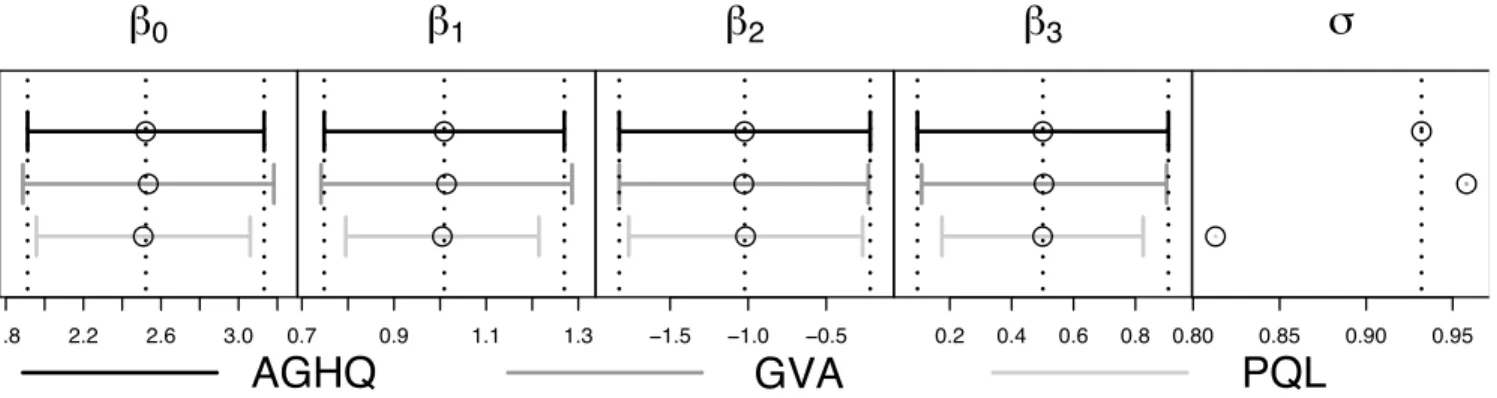
We simulated200datasets based on (9). The results are summarized in Figure 2 where we see that the estimates forβ are almost identical for each method, but that PQL underestimatesσ. In addition, with the exception ofβ0, the approximate 95% confidence intervals for theβj are
overly narrow for PQL, but close to exact for GVA.
7.2
Epilepsy Dataset
TheEpilepsydataset represents data collected from a clinical trial of 59 epileptics. Each patient was randomly selected to either be administered a new drug (trti = 1) or a placebo (trti = 0).
The number of seizures in the 8 weeks before the trial period was recorded as basei as well
as the age of the patient, recorded asagei. Counts for the number of seizures were recorded during the two weeks before each clinical visit. Visits are recorded as visit1 = −3, visit2 = −1,visit3 = 1andvisit4 = 3. Finally, previous analyses (Thall & Vail, 1990) have shown that
the mean number of seizure counts was substantially lower for the fourth visit.
Using theEpilepsydataset we first considered the Poisson random intercept model (9) with
!
0 .8 2.2 2.6 3.0AGHQ
GVA
PQL
!
1 0.7 0.9 1.1 1.3!
2 !1.5 !1.0 !0.5!
3 0.2 0.4 0.6 0.8"
0.80 0.85 0.90 0.95Figure 2: Point estimates and approximate 95% confidence intervals based on each of AGHQ, GVA and PQL for the simulated logistic dataset. The vertical dotted lines correspond to the AGHQ values. Note that confidence intervals forσare not available for AGHQ inR, so are not compared for this parameter.
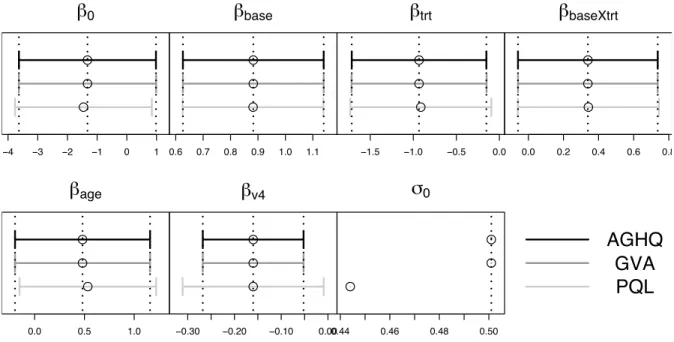
1≤j ≤4; whereI(P)is an indicator ofP being true. This corresponds to Model II of Breslow & Clayton (1993). The parameter estimates and approximate standard errors for this model are summarized in Figure 3.
We also considered the Poisson random intercept and slope models of the form
yij|u0i, u1i ∼ Poisson[exp{(β0+u0i) + (βvisit+u1i)visitj +βbase log(basei/4)
+βtrttrti+βbaseXtrt log(basei/4)×trti+βage log(agei)}]
where u0i u1i i.i.d.N 0 0 , σ2 0 ρσ0σ1 ρσ0σ1 σ12 .
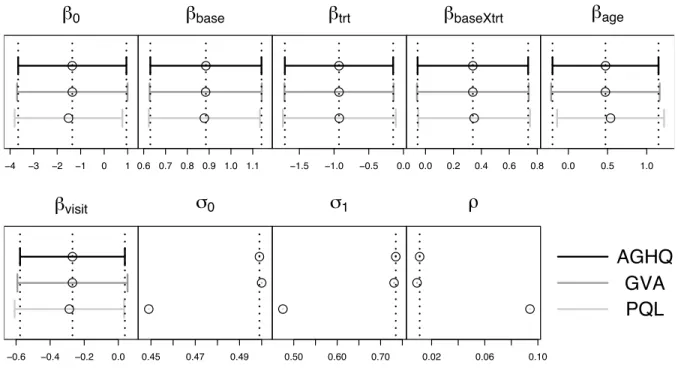
This corresponds to Model IV of Breslow & Clayton (1993). The parameter estimates and ap-proximate standard errors for this model are summarized in Figure 4.
From Figures 3 and 4 we see that all of the approximation methods compare favourably with AGHQ, although the estimate of the variance component for PQL is slightly too small and the estimated correlation parameterρis too large.
7.3
Bacteria Dataset
Thebacteriadatasets records tests of the presence of the bacteria H. influenzae in children with a history of otitis media in Northern Territory, Australia (Leach, 2000). The children were
!
0 !4 !3 !2 !1 0 1!
&'(e 0.+ 0., 0.- 0.. 1.0 1.1!
/r/ !1.5 !1.0 !0.5 0.0!
&'(e2/r/ 0.0 0.2 0.4 0.+0.-!
'ge 0.0 0.5 1.0!
44 !0.30 !0.20 !0.10 0.00"
0 0.44 0.4+ 0.4- 0.50AGHQ
GVA
PQL
Figure 3: Point estimates and approximate 95% confidence intervals based on each of AGHQ, GVA and PQL for the Epilepsy data random intercept model. The vertical dotted lines correspond to the AGHQ values. Note that confidence intervals for σ0 are not available for AGHQ inR, so are not compared for this parameter.
randomized into three groups: placebo, drug, and drug with active encouragement to comply. The presence of H. influenzae was checked at weeks 0, 2, 4, 6 and 11 to 30 and recorded as
weekij. If a particular check was missed no data was recorded for that week. High or low
compliance of the patient in taking the treatment are indicated by the variables drugHiij and
drugLoij respectively. The data are shown in Figure 1. Using theBacteriadataset we first considered the model
logit{P(yij = 1)}=β0+βdrugLodrugLoij +βdrugHidrugHiij +βweekweekij+ui
where ui ∼ N(0, σ20)for1 ≤ i ≤ 50andni takes values from 2 to 5. The parameter estimates
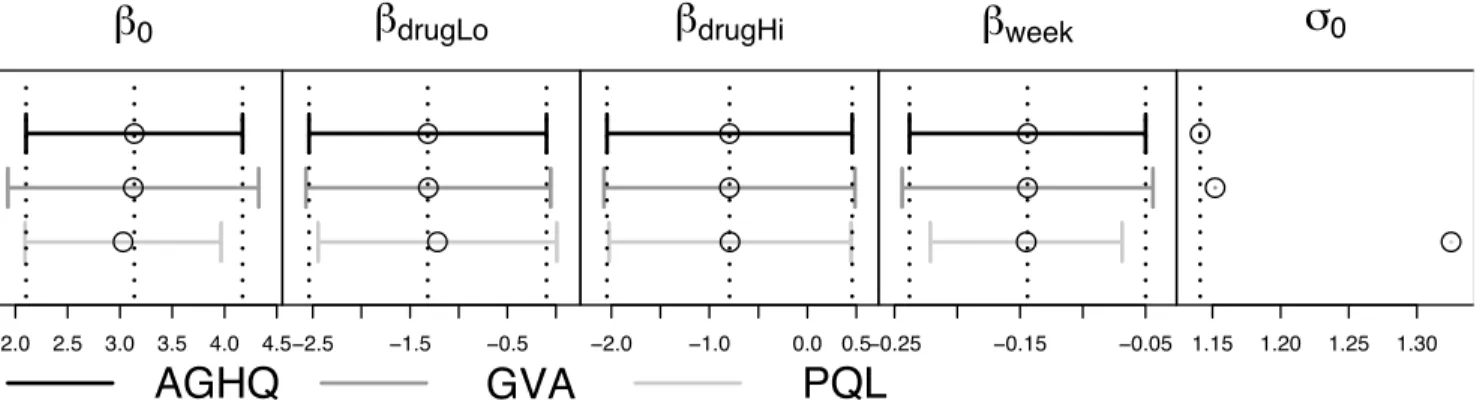
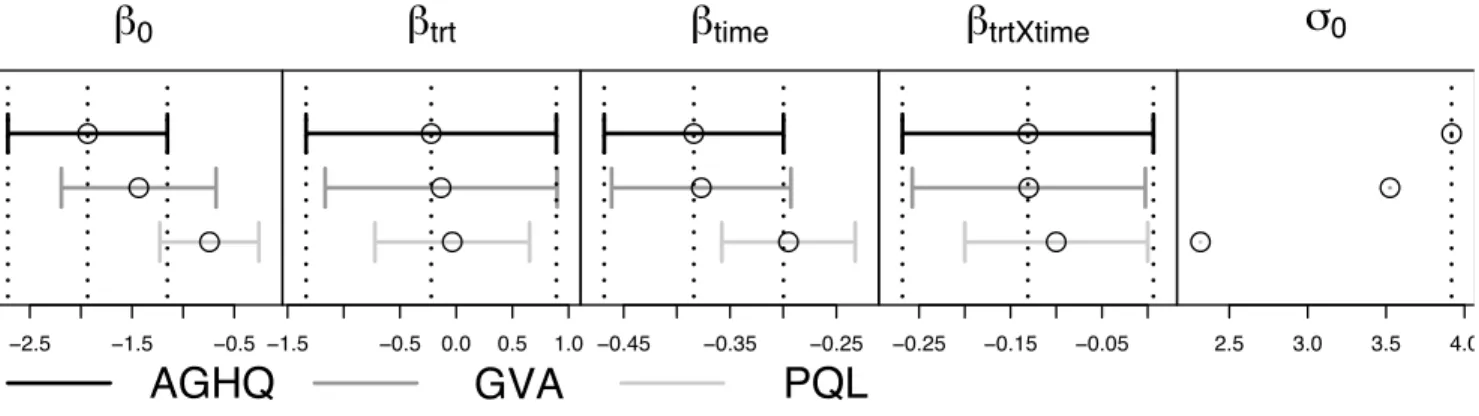
and approximate standard errors for these models are summarized in Figure 5. Here we see that the estimates forβare quite similar for each method, although PQL underestimatesσ0. In
addition, the approximate 95% confidence intervals for the βs are overly narrow for PQL, but close to exact for GVA.
!
0 !4 !3 !2 !1 0 1!
&'(e 0.+ 0., 0.- 0.. 1.0 1.1!
trt !1.5 !1.0 !0.5 0.0!
&'(eXtrt 0.0 0.2 0.4 0.+0.-!
'3e 0.0 0.5 1.0!
4i(it !0.+ !0.4 !0.2 0.0"
0 0.45 0.4, 0.4."
1 0.50 0.+0 0.,0#
0.02 0.0+ 0.10AGHQ
GVA
PQL
Figure 4: Point estimates and approximate 95% confidence intervals based on each of AGHQ, GVA and PQL for the Epilepsy data random intercept and slope model. The vertical dotted lines correspond to the AGHQ values. Note that confidence intervals forσ0, σ1 andρare not available for AGHQ inR, so are not compared for these parameters.
7.4
Toenail Dataset
This data set considers information gathered from a longitudinal dermatological clinical trial. The aim of the trials was to compare the effectiveness of two oral treatments for a particular type of toenail infection (De Backeret al., 1998). In total, 1908 measurements from 294 patients are recorded in the dataset. Each participant in the trail was randomly either administered a treatmenttrtij = 1or a placebotrtij = 0and was evaluated at seven visits (approximately on
weekstimeij = 0,4,8,12,24,36and48). The degree of separation of the nail plate from the
nail-bed (0, absent; 1, mild; 2, moderate; 3, severe) at each visit was recorded. In this dataset, only a dichotomized response of onycholysis (0, absent or mild; 1, moderate or severe) is available.
We considered the logistic random intercept model (9) withtrtij,timeij andtrtij ×timeij
as covariates for 1 ≤ i ≤ 294 and ni taking values from 1 to7. The results for each GLMM
!
0 2.0 2.5 3.0 3.5 4.0 4.5AGHQ
GVA
PQL
!
drugLo !2.5 !1.5 !0.5!
drugHi !2.0 !1.0 0.0 0.5!
week !0.25 !0.15 !0.05"
0 1.15 1.20 1.25 1.30Figure 5: Point estimates and approximate 95% confidence intervals based on each of AGHQ, GVA and PQL for the model fitted to the Bacteria dataset. The vertical dotted lines correspond to the AGHQ values. Note that confidence intervals for σ0 are not available for AGHQ inR, so are not compared for this parameter.
all parameters are better than those based on PQL. For this example we see severe bias of PQL for the parametersβ0,βtimeandσ0. The GVA method shows some bias for estimation ofβ0 and
σ0 but is less severe than that of PQL.
7.5
Approximating
p
(u
|
y)
The analysis of Lesaffre & Spiessens (2001) on the Toenail dataset found that parameter esti-mates could vary significantly even amongst several Gauss-Hermite quadrature approxima-tions. Hence it is not surprising that there are large discrepancies between AGHQ, GVA and PQL approximations for this dataset. On the other hand PQL and GVA approximations for the bacteria data are, in comparison, reasonable. Both PQL and GVA methods are based on Gaussian approximations of p(u|y). In particular for fixed β and σ0 PQL is equivalent to the
Laplace approximation whereE(u|y)is approximated by the mode ofp(y,u)and the covari-ance is approximated by the inverse negative Hessian oflogp(y,u)with respect tou. We will now illustrate that when p(u|y) is not Gaussian, as occurs for the Toenail dataset, then both PQL and GVA methods have reduced accuracy.
!
0 !2.5 !1.5 !0.5AGHQ
GVA
PQL
!
trt !1.5 !0.5 0.0 0.5 1.0!
time !0.45 !0.35 !0.25!
trtXtime !0.25 !0.15 !0.05"
0 2.5 3.0 3.5 4.0Figure 6: Point estimates and approximate 95% confidence intervals based on each of AGHQ, GVA and PQL for the model fitted to the Toenail dataset. The vertical dotted lines correspond to the AGHQ values. Note that confidence intervals for σ0 are not available for AGHQ inR, so are not compared for this parameter. is Skew(ui|y) = R∞ −∞{ui−E(ui|y)} 3p(u i|y)dui h R∞
−∞{ui−E(ui|y)}2p(ui|y)dui i3/2
where E(ui|y) =
R∞
−∞uip(ui|y)dui. Each of the integrals is analytically intractable and so we
approximate them using numerical quadrature.
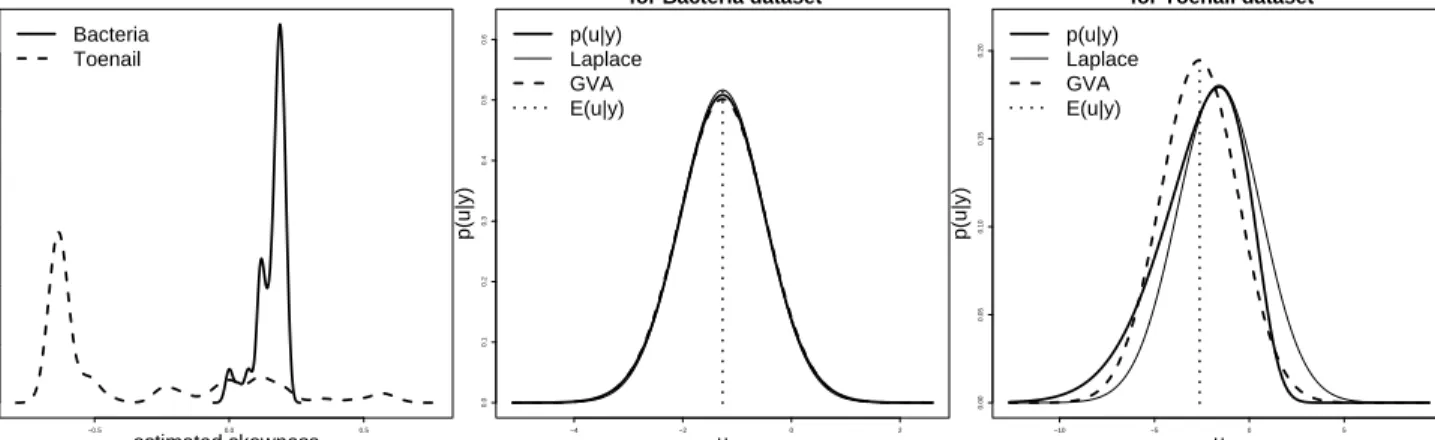
Figure 7 illustrates the kernel density estimates of the approximate Skew(ui|y)values and
density approximations of thep(ui|y)along with thep(ui|y)with largest absolute skewness for
the Bacteria and Toenail datasets. We note that for the Bacteria dataset almost no skewness is evident for each of the p(ui|y)s and that even the most skewed p(ui|y) is nearly Gaussian.
However, for the Toenail dataset many of the p(ui|y)s have large negative values Skew(ui|y)
values and thep(ui|y)s are clearly non-Gaussian for these cases.
Based on the rightmost panel in Figure 7 GVA appears to approximate theE(ui|y)better
than the Laplace approximation. Let µLaplace,i andµGVA,i be the Laplace and GVA
approxima-tions ofE(ui|y)respectively. For theBacteriadataset
Pm
i=1(µLaplace,i−E(ui|y)) 2
Pm
i=1(µGVA,i−E(ui|y))2
−0.5 0.0 0.5 0 2 4 6 8 10 12 skewnesses of p(ui|y) estimated skewness approximate density Bacteria Toenail −4 −2 0 2 0.0 0.1 0.2 0.3 0.4 0.5 0.6
p(u|y) for patient 25 for Bacteria dataset
u p(u|y) p(u|y) Laplace GVA E(u|y) −10 −5 0 5 10 0.00 0.05 0.10 0.15 0.20
p(u|y) for patient 283 for Toenail dataset
u p(u|y) p(u|y) Laplace GVA E(u|y)
Figure 7: Left panel: Kernel density estimates of approximated skewnesses for each p(ui|y) for the Bacteria and Toenail datasets. Middle panel: Approximations of the most skewedp(ui|y)for the Bacteria dataset. Right panel: Approximations of the most skewedp(ui|y)for the Toenail dataset.
and for theToenaildataset
Pm
i=1(µLaplace,i−E(ui|y))2
Pm
i=1(µGVA,i−E(ui|y))2
≈3029.3
and so we speculate that GVA is a better approximation ofE(ui|y)than the Laplace
approxima-tion since it attempts to approximateE(u|y)more directly. While we do not have theoretical evidence to support this we believe that this is a matter for further investigation.
8
Concluding Remarks
As data become cheaper to collect and store, both the number and size of data analyses will continue to grow. Therefore, it is important that statistical methodology adapts accordingly. MCMC provides an effective means of analysis for many grouped data GLMM applications. However, there are numerous situations where faster approximate methods are desirable. One example is model selection in the presence of a high number of candidate predictors. In such a situation, it is often too expensive to fit several models via MCMC. Gaussian variational approximation offers itself as an attractive alternative to PQL for fast GLMM approximate in-ference. In this paper we have focussed on the grouped data version of GLMMs and mostly resolved issues regarding their implementation. A future challenge is to handle more general
GLMMs, such as those with spatial correlation structures or containing spline basis functions in the random effects design matrix.
Appendix A: Computational Details
A.1 Notation Useful for Derivative and Hessian Expressions
Letf be a real-valued function in thed×1vectorx= [x1, . . . , xd]T. Then the derivative vector Dxf(x), is the 1×d with ith entry∂f(x)/∂xi. The corresponding Hessian matrix is given by Hxf(x) =Dx{Dxf(x)}T.
We extend theB notation to higher derivatives as follows:
B(r)(µ, σ2)≡ Z ∞ −∞ b(r)(σx+µ)φ(x)dx. Define Q(A)≡(A⊗1T)(1T ⊗A)
where AB is the element-wise product of two equi-sized matricesAand B. Next, we let
Dpdenote theduplication matrixof orderp. This matrix is defined through the relationship
vec(A) =Dpvech(A)
for a symmetricp×pmatrixA. Lastly, for each1≤i≤m, let
B(r)(β,µi,Λi)≡B(r)(Xiβ+Ziµi,diagonal(ZiΛiZTi )).
A.2 Gauss-Hermite Quadrature for Evaluation of
B
(r)Here we briefly describe numerical evaluation ofB(r)using the adaptive Gauss-Hermite
quadra-ture procedure developed by Liu & Pierce (1994) for approximating positive Gaussian integrals. Forr= 1,2, . . .we have B(r)(µ, σ) = R−∞∞ b(rφ)(µ+σx)φ(x) σ∗(x−µ∗) φσ ∗(x−µ∗)dx =R−∞∞ h√2σ∗b(r)(µ+σ(µ∗+√2σ∗x))φ(µ∗+√2σ∗x)ex2i e−x2 dx
for anyµ∗ andσ∗. We chooseµ∗ andσ∗ so that the integrand ofB(µ, σ)is “most Gaussian” in shape so that µ∗ =argmaxx{b(µ+σx)φ(x)} and σ∗ =− h d2 dx2 log{b(µ+σx)φ(x)} i x=µ∗ −1/2
We use the values of µ∗ and σ∗ corresponding to r = 0 because it is both computationally cheaper to evaluate µ∗ and σ∗ once and because b(r) may not be positive everywhere
(poten-tially making the corresponding evaluation ofσ∗ problematic). We then apply Gauss-Hermite quadrature which uses
Z ∞ −∞ g(x)e−x2dx= N X k=1 wkg(xk) + √ πN! 2N(2N)!g (2N)(ξ), for some − ∞ ≤ξ≤ ∞.
for some integerNand is exact for polynomials of degree less than2N. Hence we may approx-imateB(r)(µ, σ)by B(r)(µ, σ)≈ N X k=1 wk∗b(r)(µ+σx∗k)φ(x∗k) where w∗k = √2σ∗wkex 2 k and x∗ k = µ ∗ +√2σ∗x
k and thewk and xk values are the weights and
abscissae of standard (or non-adaptive) Gauss-Hermite quadrature respectively.
There are several ways of obtaining wj and xj in practice. Tables for these values can be
obtained form Abramowitz & Stegun (1972, Chapter 25). Computational details for calculating these values be found form Golub & Welsch (1969) or Press, Teukolsky, Vetterling & Flannery (2007). In theRpackagestatmod(Smyth, 2009) the functiongauss.quad()implements the method outlined in Golub & Welsch (1969) and may also be used to findwj andxj.
Finally, it is worth noting the number of quadrature points needed to calculate`(β,Σ)and
`(β,Σ,µ,Λ) using adaptive Gauss-Hermite quadrature. Suppose that N points are used in each dimension via a tensor product method then the calculation `(β,Σ) and its derivatives uses O(mNK) points. In comparison the calculation of `(β,Σ,µ,Λ) and its derivative uses
O(NP
i=1ni)points if we useN quadrature points to evaluate the B(r)s. Since the number of
quadrature points for GVA is independent ofK the relative computational efficiency of GVA over adaptive Gauss-Hermite quadrature can be substantial whenK is large.
A.3 Derivative Vector of Lower Bound on Log-Likelihood
The derivative vector of`≡`(β,Σ,µ,Λ)
with respect to
(β,vech(Σ),µ1,vech(Λ1), . . . ,µm,vech(Λm))
is
D`= [Dβ`, Dvech(Σ)`, Dµ1`, Dvech(Λ1)` ,· · ·,Dµm`, Dvech(Λm)`].
We now give matrix algebraic expressions for each of these components: Dβ` = m X i=1 {yi− B(1)(β,µ i,Λi)}TXi, Dvech(Σ)` = 1 2 m X i=1 vec{Σ−1(µiµTi +Λi)Σ−1 −Σ−1}TDK, and, for1≤i≤m, Dµi` = {yi− B (1) (β,µi,Λi)}TZi −µTi Σ −1 , Dvech(Λ i)` = 1 2vec[Λ −1 i −Σ −1− ZTi diag{B(2)(β,µi,Λi)}Zi]TDK.
A.4 Hessian Matrix of Lower Bound on Log-Likelihood
The Hessian matrix of`≡`(β,Σ,µ,Λ)
with respect to
is H`= Hββ` 0 Hβµ1` Hβvech(Λ1)` · · · Hβµm` Hβvech(Λm)`
0 Hvech(Σ)vech(Σ)` Hvech(Σ)µ
1` Hvech(Σ)vech(Λ1)` · · · Hvech(Σ)µm` Hvech(Σ)vech(Λm)` Hµ1β` Hµ1vech(Σ)` Hµ1µ1` Hµ1vech(Λ1)` · · · 0 0
Hvech(Λ
1)β` Hvech(Λ1)vech(Σ)` Hvech(Λ1)µ1` Hvech(Λ1)vech(Λ1)` · · · 0 0
..
. ... ... ... . .. ... ...
Hµmβ` Hµ
mvech(Σ)` 0 0 · · · Hµmµm` Hµmvech(Λm)`
Hvech(Λ
m)β` Hvech(Λm)vech(Σ)` 0 0 · · · Hvech(Λm)µm` Hvech(Λm)vech(Λm)`
where Hββ` = − m X i=1 XTi diag{B(2)(β,µi,Λi)}Xi, Hvech(Σ)vech(Σ)` = 12DTK m(Σ−1⊗Σ−1)− m X i=1 [Σ−1 ⊗ {Σ−1(µiµTi +Λi)Σ−1} +{Σ−1(µiµTi +Λi)Σ−1} ⊗Σ−1] DK, and, for1≤i≤m, Hβµi` = −X T i diag{B (2)(β,µ i,Λi)}Zi, Hβvech(Λ i)` = − 1 2X T i diag{B (3)(β,µ i,Λi)}Q(Zi)DK, Hvech(Σ)µ i` = D T K{(Σ −1µ i)⊗Σ −1}, Hvech(Σ)vech(Λ i)` = − 1 2D T K(Σ −1⊗Σ−1)D K, Hµiµi` = −Z T i diag{B (2)(β,µ i,Λi)}Zi−Σ−1, Hµ ivech(Λi)` = − 1 2Z T i diag{B (3)(β,µ i,Λi)}Q(Zi)DK, Hvech(Λ i)vech(Λi)` = − 1 4D T K[Q(Zi)Tdiag{B(4)(β,µi,Λi)}Q(Zi) + 2(Λ−i 1⊗Λ −1 i )]DK.
A.5 Newton-Raphson Scheme
We are a now in a position to describe an efficient Newton-Raphson scheme for solving the maximization problem (5). In particular, we make use of the block-diagonal structure in the
Recall the notation given in (6) for theβ and ξ. In keeping with this notation, define the gradient vectors gθ≡ (Dβ`)T {Dvech(Σ)`}T and gξ i≡ (Dµi`) T {Dvech(Λ i)`} T
and the Hessian matrix components
Hθθ≡ Hθθ` 0 0 Hvech(Σ)vech(Σ)` , Hξ iξi≡ Hµiµi` Hµivech(Λi)` Hvech(Λ i)µi` Hvech(Λi)vech(Λi)` , and Hθξ i≡ Hβµi` Hβvech(Λ i)` Hvech(Σ)µ i` Hvech(Σ)vech(Λi)`
for1≤i≤m. Finally, define
sθξ ≡ Hθθ− m X i=1 HθξiH −1 ξiξiH T θξi !−1 gθ− m X i=1 HθξiH −1 ξiξigξ ! . Let β vech(Σ) (0) and ξi vech(Λi) (0) , 1≤i≤m,
be starting values of the relevant parameter vectors and let a superscript of(t)denote the same vectors aftertiterations of the Newton-Raphson algorithm. Then the updates are given by:
β vech(Σ) (t+1) = β vech(Σ) (t) −s(t)θξ (10) and ξi vech(Λi) (t+1) = ξi vech(Λi) (t) −(H(t)ξ iξi) −1 (g(t)ξ i −H (t) ξiθs (t) θξ) (11)
Note that these updates involves inversion of ‘small’ matrices – i.e. those of dimension similar toβand theui. The Newton-Raphson scheme then involves cycling through (10) and (11) until
convergence.
To increase the robustness of the Newton-Raphson algorithm we: incorporated step-halving to ensure that Σ and Λis remained positive definite and that the approximate likelihood
in-creased at each step of the algorithm. Laplace approximation was used to choose, for fixed β
A.6 Asymptotic Covariance Matrix
Results used in Section A.5 that take advantage of diagonal structure inH`(β,Σ,µ,Λ)can also be used to obtain a streamlined expression for the asymptotic covariance matrix of the model parameters. These lead to
\ Asy. Cov(bθ) = Hθθ− m X i=1 HθξiH −1 ξiξiH T θξi !−1
and allow standard errors to be computed withO(m)operations.
Appendix B: Proof of Theorem 1
The proof relies on straightforward algebra and the following lemmas:
LEMMA 1: Let Abe a positive definite matrix andB be a positive semidefinite matrix of the same dimensions asA. Then
|A+B| ≥ |A| with equality if and only ifB =0.
Proof of Lemma 1.
Lemma 1 corresponds to Theorem 22 of Magnus & Neudecker (1988) and a prove is given there.
LEMMA2. Let the symmetric matrixAbe partitioned as
A11 A12 AT12 A22
where A11 is square and invertible. Then A is positive definite if any only if both A11 and A22−AT12A
−1
11A12are positive definite. Proof of Lemma 2.
LEMMA3. LetΨbe a symmetric, positive definitemK ×mK matrix. Given theK×K blocks Ψi, 1 ≤ i ≤ m, down the main diagonal ofΨ, the determinant|Ψ|is uniquely maximized by setting all other entries ofΨequal to zero.
Proof of Lemma 3.
Consider the partition ofΨ:
Ψ= e Ψ C CT D .
where Ψe is anm(K−1)×m(K−1)matrix,C is anm(K −1)×K matrix andDis aK ×K
matrix. Then, from a standard result on determinants of partitioned matrices, |Ψ|=|Ψe||D−CTΨe
−1 C|.
Since Ψ is positive definite then, from Lemma 2, the matrices Ψe, D −CTΨe −1
C must also be positive definite. Also Ψ−1 is positive definite, which implies that CTΨe
−1
C is positive semidefinite.
We shall prove the lemma by induction overm. The lemma holds trivially when m = 1. By the induction hypothesis, we may assume that |Ψe| is uniquely maximized by taking the
off block-diagonal components of Ψe to vanish. ForΨe and Dfixed, we can use Lemma 1 with
A = D−CTΨe
−1
C andB = CTΨe
−1
C to show that|D−CTΨeC|is uniquely maximized by
takingC =0. The lemma then follows by induction.
The right-hand side of (8), withqset to theN(µ,Σ)density andp(y|u)given by (2), is
`(β,Σ,µ,Λ) = mK2 +yT(Xβ+Zµ)−1T B(Xβ+Zµ,diagonal(ZΛZT)) +1Tc(y) −1 2{µ TG−1µ+ tr(G−1Λ)}+1 2 log|G −1Λ|.
XiandZi given in Section 2 and settingZ =blockdiag1≤i≤m(Zi)andG=I⊗Σwe obtain `(β,Σ,µ,Λ) = mK2 +Pm i=11 T i c(yi)− m 2 log|Σ|+ 1 2 log|Λ| +Pm i=1[y T i (Xiβ+Ziµi)−1Ti B(Xiβ+Ziµi,diagonal(ZiΛiZTi )) −1 2{µ T i Σ −1µ i+tr(Σ −1Λ i)}].
By Lemma 3,|Λ|is maximal forΛ= blockdiag1≤i≤m(Λi). Hence there is no loss from
replace-ment of 12 log|Λ| by 12Pm
i=1log(Λi), and this leads to the expression for `(β,Σ,µ,Λ) given at
(4).
Acknowledgement
This research was partially supported by Australian Research Council Discovery Project DP0877055.
References
Abramowitz, M. & Stegun, I. (1972). Handbook of Mathematical Functions, with Formulas, Graphs, and Mathematical Tables. New York: Dover Publications.
Archambeau, C., Cornford, D., Opper, M. & Shawe-Taylor, J. (2007). Gaussian process approxi-mations of stochastic differential equations.Journal of Machine Learning Research: Workshop and Conference Proceedings,1, 1–16.
Bates, D. & Maechler, M. (2009). lme4 0.999375. Linear mixed-effects models using S4
classes. R package.http://cran.r-project.org.
Bishop, C.M. (2006). Pattern Recognition and Machine Learning. New York: Springer.
Barber, D. & Bishop, C. M. (1998) Ensemble learning for multi-layer networks. In Jordan, M. I. Kearns, K. J. and Solla, S. A. (Eds.), Advances in Neural Information Processing Systems,
10, 395-401.
Breslow, N.E. & Clayton, D.G. (1993). Approximate inference in generalized linear mixed mod-els.Journal of the American Statistical Association,88, 9–25.
Carlin,B. P. & Louis, T.A. (2008). Bayes and Empirical Bayes Methods for Data Analysis (Third Edition). New York: Chapman and Hall.
De Backer, M., De Vroey, C., Lesaffre, E., Scheys, I. & De Keyser, P. (1998). Twelve weeks of con-tinuous oral therapy for toenail onychomycosis caused by dermatophytes: a double-blind comparative trial of terbinafine 250 mg/day versus itraconazole 200 mg/day. Journal of the American Academy of Dermatology,38(5), S57–63.
Gelman, A., Carlin, J.B., Stern, H.S. & Rubin, D.B. (2004). Bayesian Data Analysis. Boca Raton, Florida: Chapman and Hall.
Golub, G.H. & Welsch, J.H. (1969). Calculation of Gauss quadrature rules. Mathematics of Com-putation,23, 221–230.
Hall, P., Ormerod, J.T. & Wand, M.P. (2009). Theory of Gaussian variational approximation for a generalised linear mixed model. Submitted toStatistica Sinica.
Honkela, A. & Valpola, H. (2005). Unsupervised variational Bayesian learning of nonlinear models. Advances in Neural Information Processing Systems 17, 593–600.
Horn, R.A. & Johnson, C.R. (1985). Matrix Analysis, Cambridge, UK:Cambridge University Press.
Jaakkola, T.S. & Jordan, M.I. (2000). Bayesian parameter estimation via variational methods. Statistics and Computing,10, 25–37.
Jordan, M.I. (2004). Graphical models. Statistical Science,19, 140–155.
Jordan, M.I., Ghahramani, Z., Jaakkola, T.S. & Saul, L.K. (1999). An introduction to variational methods for graphical models. Machine Learning,37, 183–233.
Kullback, S. & Leibler, R.A. (1951). On information and sufficiency. The Annals of Mathematical Statistics,22, 79–86.
Lee, Y. & Nelder, J.A. (1996). Hierarchical generalized linear models. Journal of the Royal Statis-tical Society, Series B,58, 619–656.
Lesaffre, E. & Spiessens, B. (2001). On the effect of the number of quadrature points in a logistic random-effects model: an example.Applied Statistics,50, 325–335.
Little, R.J. & Rubin, D.B. (2002). Statistical Analysis with Missing Data, Second Edition. New York: John Wiley & Sons.
Liu, Q. & Pierce, D.A. (1994). A note on Gauss-Hermite quadrature. Biometrika,81, 624–629. Magnus, J.R. & Neudecker, H. (1988). Matrix Differential Calculus with Applications in Statistics
and Econometrics. Chichester: John Wiley & Sons.
Marin, J.-M. & Robert, C.P. (2007). Bayesian Core: A Practical Approach to Computational Bayesian Statistics, New York: Springer.
McCulloch, C.E., Searle, S.R. & Neuhaus, J.M. (2008). Generalized, Linear, and Mixed Models, Second Edition. New York: John Wiley & Sons.
Opper, M. & Archambeau, C. (2009). Variational Gaussian approximation revisited. Unpub-lished manuscript.
Ormerod, J.T. (2008). On Semiparametric Regression and Data Mining. PhD Thesis. School of Mathematics and Statistics, The University of New South Wales, Sydney, Australia. Ormerod, J.T. & Wand, M.P. (2008). Variational approximations for logistic mixed models.
Proceedings of the Ninth Iranian Statistics Conference, Department of Statistics, University of Isfahan, Isfahan, Iran, pp. 450–467.
Ormerod, J.T. & Wand, M.P. (2009). Explaining variational approximation. Submitted to The American Statistician.
Parisi, G. (1988). Statistical Field Theory. Redwood City, California: Addison-Wesley.
non-linear mixed-effects model. Journal of Computational and Graphical Statistics,4, 12–35. Press, W.H, Teukolsky, S.A., Vetterling, W.T. & Flannery, B.P. (2007). Numerical Recipes: The Art
of Scientific Computing (Third Edition), New York: Cambridge University Press.
Raudenbush, S.W., Yang, M.-L. & Yosef, M. (2000). Maximum likelihood for generalized linear models with nested random effects via high-order, multivariate Laplace approximation. Journal of Computational and Graphical Statistics,9, 141–157.
Rue, H., Martino, S. & Chopin, N. (2009). Approximate Bayesian inference for latent Gaussian models by using integrated nested Laplace approximations. Journal of the Royal Statistical Society, Series B,7, 319–392.
Seeger, M. (2000) Bayesian Model Selection for Support Vector Machines, Gaussian Processes and Other Kernel Classifiers.Neural Information Processing Systems 12, 603–609.
Skrondal, A. & Rabe-Hesketh, S. (2004). Generalized Latent Variable Modeling: Multilevel, Longi-tudinal and Structural Equation Models.Boca Raton, Florida: Chapman & Hall.
Titterington, D.M. (2004). Bayesian methods for neural networks and related models. Statistical Science19, 128–139.
R Development Core Team (2009). R: A language and environment for statistical computing. R
Foundation for Statistical Computing, Vienna, Austria. ISBN 3-900051-07-0.www.R-project.org.
Smyth, G. (2009). statmod 1.4.0Statistical modeling. R package.
http://cran.r-project.org.
Thall, P.F. & Vail, S.C. (1990). Some covariance models for longitudinal count data with overdis-persion.Biometrics,46, 657–671.
Venables, W.N. & Ripley, B.D.VR 7.2Functions and datasets to support Venables and Ripley
‘Modern Applied Statistics with S’ (4th Edition). R package.
Wang, B. & Titterington, D.M. (2005). Inadequacy of interval estimates corresponding to vari-ational Bayesian approximations. InProceedings of the 10th International Workshop on Arti-ficial Intelligence(eds R.G. Cowell and Z. Ghahramani), pp. 373–380. Society for Artificial Intelligence and Statistics.
Zhao, Y., Staudenmayer, J., Coull, B.A. & Wand, M.P. (2006). General design Bayesian general-ized linear mixed models.Statistical Science,21, 35–51.
Zeger, S.L. & Karim, M.R. (1991). Generalized linear models with random effects: a Gibbs sampling approach. Journal of the American Statistical Association,86, 79–86.