MOHAMMAD AFIFUDDIN BIN ABD RAZAK
Thesis submitted in fulfillment of the requirements for the award of the degree of
Bachelor of Mechanical Engineering.
Faculty of Mechanical Engineering UNIVERSITI MALAYSIA PAHANG
ABSTRACT
DFMA is a combination between DFM and DFA. Design for manufacture (DFM) is a systematic procedure to maximize the use of manufacturing processes in the design of components and design for assembly (DFA) is a systematic procedure to maximize the use of components in the design of a product. While, the term DFMA is defined as a set of guidelines developed to ensure that a product is designed so that it can be easily and efficiently manufactured and assembled with a minimum laborious effort, assemble time, and cost to manufacture the product. The purpose of this project is to reduce part count and minimize the product cost. Many of the companies outside there were successfully used this technique for product design improvement and product cost reduction. The aim is to propose a new design of computer desktop chassis that is better in design efficiency, total assembly time and cost. The analysis is done by using Boothroyd Dewhurst DFA method. For the result done by using Boothroyd-Dewhurst DFA method, the design efficiency of original design is 6.4% while the improved design is 15.5%. Total reduction of part from 48 parts to 16 parts after has been redesign. The percentage of part reduction is about 66.67% from old chassis to new chassis. The total assembly time has reduced from 462.11s to 154.5s in manual assembly.
ABSTRAK
DFMA adalah penggabungan perkataan dari DFM dan DFA. DFM adalah prosedur untuk memaksimakan penggunaan proses pembuatan untuk menghasilkan produk dan DFA adalah untuk memaksimakan penggunaan komponen dalam sesuatu produk. Manakala istilah DFMA adalah satu set garis panduan yang memastikan produk dapat dihasilkan dengan berkesan dan mudah. Tujuan projek ini adalah untuk mengurangkan jumlah komponen dan kos sesuatu produk.Sudah banyak syarikat yang telah mengamalkan analisis Boothroyd untuk meningkatkan tahap kualiti produk dan mengurangkan kos produk. Tujuan projek ini juga adalah untuk menghasilkan produk baru yang lebih baik dari segi “Design efficiency” dan jumlah masa pemasangan produk. Hasil daripada analisis Boothroyd, keberkesanan reka bentuk “Design efficiency” rangka komputer yang asal adalah sebanyak 6.4 % dan hasil reka bentuk rangka computer yang telah di ubah suai adalah sebanyak 15.5%. Pengurangan jumlah komponen dari rangka asal sebanyak 48 kepada 16 komponen sahaja untuk rangka yang telah diubah suai. Pengurangan komponen ini adalah sebanyak 66.67%. Dalam pada masa yang sama, jumlah masa pemasangan rangka komputer telah berkurang dari 462.11s kepada 154.5s.
TABLE OF CONTENTS
Page
SUPERVISOR’S DECLARATION ii
STUDENT’S DECLARATION iii
ACKNOWLEDGEMENTS iv
ABSTRACT v
ABSTRAK vi
TABLE OF CONTENTS vii
LIST OF TABLES x
LIST OF FIGURES xi
LIST OF SYMBOLS xiii
LIST OF ABBREVIATIONS xiv
LIST OF APPENDICES xv CHAPTER I INTRODUCTION 1.0 Introduction 1 1.1 Project Background 2 1.2 Problem Statement 3 1.3 Objectives 3 1.4 Scopes of Study 4 1.5 Expected Result 4
CHAPTER II LITERATURE REVIEW
2.1 Introduction 5
2.2 Design for Manufacture and Assembly (DFMA) 5
2.2.1 DFM and DFA Benefits 6
2.3 Product Design Process 8
2.3.1 The Traditional Process 8
2.3.2 Concurrent Engineering 10
2.4.1 General Design Guidelines for Manual Assembly 12 2.4.2 Design Guidelines for Part Handling 13 2.4.3 Designs Guidelines for Part Insertion 15
2.5 Designs for Manufacturing (DFM) 20
2.6 Design for Assembly (DFA) 21 2.6.1 Design for Assembly Methods 22 2.6.2 Boothroyd-Dewhurst DFA Methodology 22
2.7 Previous Research 26 2.7.1 Electric Wok 26 2.7.2 Nail Puncher 26 2.7.3 Pressure Vessel 26 2.7.4 Bicycle 27 2.7.5 Price tagger 27
CHAPTER III METHODOLOGY
3.1 Introduction 28
3.2 Design of Project Study 29
3.2.1 Flow Chart 31
3.3 Identifying and Selecting of Product 32
3.4 Parts Disassembly 32
3.5 Current Design Review 32
3.6 Boothroyd-Dewhurst DFA Manual Evaluation 33 3.7 Procedure for the Analysis of
Manually Assembled Products 35
CHAPTER IV RESULT AND DISCUSSION
4.0 Introduction 36
4.1 Written Critique of Each Part 36
4.2 Comparison between Current and New Chassis 38
4.3 Parts Modification 39
4.4 Parts Quantity and Specification of Old Design 40 4.4.1 Current Design Manual Worksheet 42 4.4.2 Calculation of Total Assembly time and Design
4.5 Parts Quantity and Specification of New Design 44 4.5.1 New Design Manual Worksheet 45 4.5.2 Calculation of Total Assembly time and Design
Efficiency for New Chassis 47 4.6 Boothroyd-Dewhurst DFMA Software Analysis. 48 4.7 Design Efficiency and Assembly Time Comparison
between Old Design and Redesign 51 4.8 Cost estimation of Current and New Design of Computer
Desktop Chassis 53
4.9 Simulation Analysis of Stress and Displacement 56
CHAPTER V CONCLUSION AND RECOMMENDATION
5.0 Conclusion 61
5.1 Recommendation 62
REFERENCES 63
APPENDICES 64
A Gantt chart for semester 1 64
B Gantt chart for semester 2 65
C Boothroyd Manual Handling Table 66
LIST OF TABLE
Table No. Page
4.1 Parts Critique for Each Component 37
4.2 The Manual Worksheet of Boothroyd DFA Analysis 42 4.3 The Manual Worksheet of Boothroyd DFA Analysis 46
4.4 Comparison of Old Design and Redesign 51
4.5 Part Counts and Total Cost per Product 53 4.6 Material Properties of Galvanized Steel 57 4.7 The Result of Simulation of Displacement and Stress Study 60
LIST OF FIGURES
Figure No. Page
2.1 Typical Stages in a DFMA Procedure 7
2.2 Traditional Engineering Approach 8
2.3 The “over the wall” design method 9
2.4 Concurrent Engineering Approaches 10
2.5 Designs Guidelines for Part Handling 14
2.6 Designs Guidelines for Part Insertion and Fastening 16
2.7 Boothroyd and Dewhurst DFA Analysis 23
3.1 Flow chart 31
3.2 Worksheet for Computation of Design Efficiency 33 3.3 Alpha and Beta Rotational Symmetries for Various Parts 34
4.1 Projected View of Current Design 38
4.2 Projected View of New Design 38
4.3 Parts Modification and Description 39
4.4 Parts Specification in Old Design 40
4.5 Parts specification in New Design 44
4.6 Product Worksheet for Current Design 48
4.7 Product Worksheet for Improved Design 49
4.8 Executive Summary for Current Design 50
4.9 Executive Summary for New Design 51
4.10 Estimation Cost for Current Design 54
4.11 Estimation Cost for New Design 55
4.13 The Pressure and Fixture Applied on the Current Design Model 58 4.14 The Stress and Displacement Simulation of the Old Design 58 4.15 The Pressure and Fixture Applied on the New Design Model 59 4.16 The Stress and Displacement Simulation of the New Design 59
LIST OF SYMBOLS P Pressure F Force A Area Handling Time Insertion Time N Number of Operation Design Efficiency
Theoretical Minimum Number of Parts Basic Assembly Time
Estimated time to Complete the Assembly of the Product m Mass
LIST OF ABBREVIATIONS
DFA Design for assembly DFM Design for manufacture
DFMA Design for manufacture and assembly CE Concurrent Engineering
LIST OF APPENDICES
APPENDIX TITLE PAGE
A Gantt chart for semester 1 64 B Gantt chart for semester 2 65 C Boothroyd Manual Handling Table 66 D Boothroyd Manual Insertion Table 67
INTRODUCTION
1.0 Introduction
Design for manufacturing and assembly (DFMA) method has been introduced by Geoffrey Boothroyd since the 1960s on automatic handling. DFMA is a word that combines from DFM and DFA. Design for manufacture (DFM) is a systematic procedure to maximize the use of manufacturing processes in the design of components and design for assembly (DFA) is a systematic procedure to maximize the use of components in the design of a product.
According to Boothroyd, DFA is a methodology for evaluating part designs and the overall design of an assembly. It is crucial to identify unnecessary parts in an assembly and to determine assembly times and achieve cost optimization. To be effective in product design, the procedures are often combined as Design for Manufacture and Assembly (DFMA).
The purpose of DFMA is to maximize the use of manufacturing processes and minimize the number of components in an assembly or product. DFMA is a systematic procedure for analyzing proposed designs from the perspective of assembly processes. To obtain the maximum benefit from DFMA, the procedure is applied as early as possible in the design process. In consequences, if a design is easier to produce and assemble it can be done in less time, so it is less expensive.
The objective of this project is to redesign an existing product for a better design that contributes to lower assembly time. Hence, the DFMA method has been applied to improve the original product (Desktop Computer Chassis) for better assembly time, manufacturing cost and design efficiency.
1.1 Project Background
Design for manufacture and assembly (DFMA) is a combination of design for assembly (DFA) and design for manufacture (DFM). The term DFMA is defined as a set of guidelines developed to ensure that a product is designed so that it can be easily and efficiently manufactured and assembled with a minimum laborious effort, assemble time, and cost to manufacture the product. During a product development, DFMA method ensures that the transition from the design phase to the production phase is smooth and rapid as possible. Generally, there are three types of DFA methods used to reduce the cost of the product. The main methods are Boothroyd-Dewhurst DFA method, Lucas-Hull DFA method, and Hitachi Assembly Evaluation Method (AEM). The chosen method for this study is Boothroyd-Dewhurst. This method is used to redesign the current design. This case study is focused on redesigning the desktop chassis in order to improve the design efficiency.
1.2 Problem Statement
Computer desktop is a common use in our daily life. Most of company outside there provides computer desktop chassis in a variety of style, size and price. The solution such as the uses of DFMA in making the computer desktop chassis is becoming an attractive prospect in satisfying the basic need for human that search for a better product and less price. The computer desktop chassis is chosen because to reduce the price of the market outside as the parts count is reduced by DFMA method. However in order to implement a new design, some drawback will be encountered such as a problem with design reliability.
1.3 Objectives
The objectives of this project are:
i. To propose a new design for computer chassis.
ii. To reduce the part counts in computer desktop chassis. iii. To evaluate the design efficiency for computer chassis.
1.4 Scopes of Study
The scopes of this project are:
i. The chosen product for design improvement is computer desktop chassis.
ii. Boothroyd-Dewhurst DFMA manual assembly and DFA software is selected as the DFMA tool.
iii. Design modeling by applying Solidwork 2012 for current design and improve design.
iv. The strength analysis simulation by Solidwork software.
1.5 Expected Result
The design efficiency of the original product is calculated so that comparison can be made with the improved design. It is expected that the design efficiency of improved design will be increase with total assembly time and cost also will be reduced accordingly.
LITERATURE REVIEW
2.1 Introduction
This chapter provides an overview of design for manufacturing and assembly, concurrent engineering, review of previous case studies and perspective approach such as DFMA guidelines. Some of the information in this chapter can give extra information which can be useful during this project.
2.2 Designs for Manufacture and Assembly (DFMA)
Design for manufacture and assembly is a combination between DFM and DFA. Design for manufacturing (DFM) is design based on reducing the cost of production and/or time to market for a product, while maintaining an appropriate level of quality and Design for Assembly (DFA) is a systematic procedure to maximize the use of components in the design of a product. (Boothroyd, 2002) To be effective in product design, the procedures are often combined as Design for Manufacture and Assembly (DFMA). The aim of DFMA is to maximize the use of manufacturing processes and minimize the count of components in an assembly or product. DFMA is a systematic procedure for analyzing proposed designs from the perspective of assembly processes. To obtain the maximum benefit from DFMA, the procedure is applied as early as possible in the design process and used within a concurrent engineering teamwork environment. Applying design for manufacturing and assembly methodologies in early stages of product design can reduce the total count of parts in a product and thus reduce the costs. (Steven Ashley, 1995)
2.2.1 DFM and DFA Benefits
i. It reduces part count thereby reducing cost. If a design is easier to produce and assemble, it can be done in less time, so it is less expensive. Design for manufacturing and assembly should be used for that reason if no other.
ii. It increases reliability, because if the production process is simplified, then there is less opportunity for errors.
iii. It generally increases the quality of the product for the same reason as why it increases the reliability.
Figure 2.1:
Typical Stages in a DFMA Procedure (courtesy of Boothroyd And Dewhurst)
Source: (K.L. Edwards., 2002)
The DFMA procedure can typically be broken down into two stages as shown in Fig 2.1 Initially, Design for assembly is conducted, leading to a simplification of the product structure and economic selection of materials and processes. After iterating the process, the better design concept is taken forward to Design for Manufacture, leading to detailed design of the components for minimum manufacturing costs. The procedure is cost driven and importantly depends on the product design already existing. The procedure outlined, and there are many variations, optimizes the original product design to produce new and improved design. Most of the DFMA procedures today are computerized and DFMA can be done very quickly.
2.3 Product Design Process
2.3.1 The Traditional Process of Producing a Product.
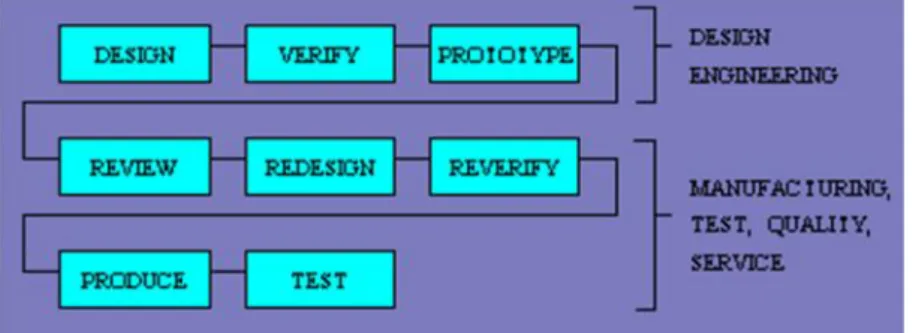
Traditional Engineering approach [Fig2.2]; also known as “Serial Engineering", towards development had been largely sequential in nature. Each discipline performs its own individual works and passed the results to the next discipline in the serial chain. Typically, there is very few or no interaction at all between various disciplines. Thus this leads to problems later in the development cycle.
The traditional process of producing a product in manufacturing lead to the phrase "we design it you build it." This attitude has now become known as "over-the-wall" design meaning that the designer throws the drawings over the ""over-the-wall" that separates design and manufacture so that the manufacturing engineer must struggle with the problems created by the designer. (Boothroyd, 2002)
Figure 2.3:The “over the wall” Design Method. Source: (Boothroyd, 2002)
Traditionally, designers developed a new product without any input from manufacturing, and then turned over the design to manufacturing, which would then have to develop a process for making the new product. This “over-the-wall” approach created tremendous challenges for manufacturing, generating numerous conflicts and greatly increasing the time needed to successfully produce a new product. It also contributed to an “us versus them” mentality.
To solve this problem, the design engineers and manufacturing engineers have to sit together and this team work can overcome a lot of problems during the manufacturing of the product. This team is called simultaneous engineering or concurrent engineering.
2.3.2 Concurrent Engineering
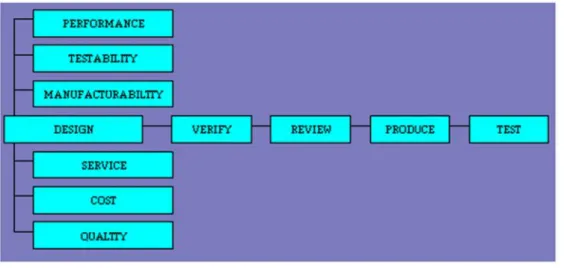
Figure 2.4:Concurrent Engineering Approaches
In an increasingly uncertain marketplace manufacturing organizations are striving to find new ways to meet customer requirements for competitively priced, customized products, delivered in shorter lead times. It is argued that to meet these demands there is a need to integrate the design, development and production functions within a concurrent engineering (CE) environment.
Concurrent engineering is the practice of concurrently developing products and their design and manufacturing processes. If existing processes are to be utilized, then the product must be designed for these processes. If new processes are to be utilized, then the product and the process must be developed concurrently. This requires knowing a lot about manufacturing processes.
Concurrent engineering approach Figure 2.4 encourages teamwork and it harnesses the expertise from all the disciplines that are involved to work closely together in parallel right from the early stage of the product design and development stage. In order for effective teamwork, sharing of ideas and objectives had to go beyond immediate assignments and departmental loyalties. Trade-offs regarding ease of production, testing and servicing are made along with product performance, size,
weight, parts and cost trade-offs. When a design is approved, it is already can be manufacture, testable, serviceable and of high quality.
The main objective of concurrent engineering is to shorten a product development time through a simultaneous timely implementation of the several stages of the engineering activity in parallel and under a concurrent mode offering all information required by all elements of the product life cycle. An early consideration of manufacturing issues shortens product development time, minimizes development cost, and ensures a smooth transition into production for quick time to market. (Alemu Moges Belay, 2009). Among all the reasons, the most important and most concerning by a company is the cost reduction method. Concurrent engineering is an effective way to design a production line, because it used the integrated and simultaneously for the all processes, so that the lead time and assembly time will be reduced. It is focusing on parallel processing rather than sequentially. (Sohlenius, 1992)
Concurrent engineering techniques can be used to compress time in the product development cycle, and business cycles in general. Every business has basic cycles that govern the way that paper is processed, parts are manufactured, and decisions are made. They may be documented in the form of procedures or routings. Examples of business cycles are customer order, product development, production, and procurement.
Cycles are sequences of recurring successions of processes or events. The cycle time is the time from the beginning of the first step of the process until the beginning of the first step of the next process. Processes can be decomposed into smaller activities. Traditionally those activities may be performed in a sequential manner. In this situation each step is completed before the next one begins. The goal in compressing time is not to devise the best way to perform a task, but rather to either eliminate the task altogether or perform it parallel with other tasks so that the overall system response time is reduced.
2.4 The Nature of Design Guidelines in DFMA
DFMA procedures can be supported with guidelines, which are often supplemented by the experience of the designer. In fact, some DFMA is done purely through experience, with little or no support from a systematic procedure or formal guidelines. This approach is highly dependent on the knowledge and experience of the individual designer or collective design knowledge and experience of the company concerned.
Design guidelines are one of the main sources of explicit knowledge of the practice of design. The main sources of design guidelines include the literature, the direct experiences of practicing designers and the established design practices in engineering organizations. Design guidelines are often found where the course of action is not clear but where one particular action has been found to work well in the past. Design guidelines, therefore, are more frequently specific to a particular domain and can represent a wide range of experience in the use of existing technology. In conjunction with the procedure, designers can make use of DFMA guidelines to help manage and reduce the large amount of information involved.
2.4.1 General Design Guidelines for Manual Assembly
There are three methods of assembly such as manual assembly, automatic assembly and robotic assembly (Boothroyd et al., 2002). According to Boothroyd, the manual assembly process can be divided into two, which is part handling and insertion. This set of guidelines would point product designers towards simplicity of design in assembly point of view. DFA guidelines apply to all the assembly operations, such as parts feeding, separating, orienting, handling, and insertion for automatic or manual assembly (Ghosh and Gagnon, 1989).