Harrie Willie Esterhuyse
Dissertation presented for the degree of Doctor of Philosophy in the
Faculty of Arts and Social Sciences at Stellenbosch University
Supervisor: Prof. Nelius Boshoff
Co-supervisor: Prof. Johann Mouton
i
DECLARATION
By submitting this research assignment electronically, I declare that the entirety of the work contained therein is my own, original work, that I am the sole author thereof (save to the extent explicitly otherwise stated), that reproduction and publication thereof by Stellenbosch University will not infringe any third party rights and that I have not previously in its entirety or in part submitted it for obtaining any qualification.
December 2019
Copyright © 2019 Stellenbosch University All rights reserved
ii
Abstract
The study explored the concept of societal impact of research (SoIR) in four agricultural research projects in South Africa, as well as in a survey of the two commodity companies that funded those projects. Three objectives guided the study: (1) to investigate the SoIR by focussing on the productive interactions and effects as identified through the SIAMPI approach; (2) to use the logic of realist evaluation to assign value to productive interactions by using them to build theories of change, impact pathways and indirectly context-mechanism-outcome (CMO) configurations; and (3) to view the productive interactions and effects through the lens of research impact literacy. The study relied on four conceptual underpinnings, namely the SIAMPI approach, realist evaluation, theories of change and impact literacy.
The SIAMPI approach uses productive interactions to understand the effecting of research impact. Realist evaluation is concerned with understanding social programmes through CMO configurations. Theories of change are instruments that visualise the logic of how a programme builds impact. Lastly impact literacy looks at how impact works through the combination of ‘what’ is being aimed for (final impact), ‘how’ it is to be achieved, and ‘who’ will be engaging in activities to achieve ‘what’. The research followed an exploratory sequential mixed methods design, comprising three phases. In the first phase, four agricultural research projects, funded by the two commodity companies, were selected as case studies. As part of the case study execution, semi-structured interviews were conducted with case study participants. Project-specific documents were also collected and analysed. From these productive interactions were identified. The second phase involved the development of a theory of change for each of the four case studies, built from the productive interactions. From the theories of change, research impact pathways were identified. Follow-up semi-structured interviews with the primary investigators were used to validate the accuracy of the theories of change and to explore the impact pathways further. The third phase of the research made use of the theories of change, coupled with the concept of impact literacy, to explore the understanding of SoIR among research funders. A survey was used to assess research funders’ views on SoIR. The findings were used to develop a Classification framework for research impact and to show the viability of building CMO configurations from the data produced through SIAMPI.
It was found that productive interactions can be used to develop coherent visualisations of research processes through theories of change. This showed that it is possible to make use of SIAMPI as a method within realist evaluation, though it is not recommended due to the myriad of possible different productive interactions that would need to be tested. Arguably most importantly the
iii research showed that CMO configurations applicable to research can be constructed based on information gathered through the SIAMPI method. Productive interactions can be used to build an understanding of the context in which research impact is effected (along with the outcomes and impacts) allowing for the development of CMO configurations.
Finally, the research produced the Classification framework for research impact. It provides a novel way of ‘defining’ research impact. The research recommends that, based on the value of productive interactions demonstrated in the dissertation, funders of research should consider including instruments in research reporting that are able to capture research interactions.
iv
Opsomming
Hierdie studie het die begrip, ‘sosiale impak van navorsing’ (SoIN) ondersoek, deur vier landbounavorsingsprojekte in Suid-Afrika te bestudeer en ʼn opname te doen van die twee kommoditeitsorganisasies wat die bestudeerde projekte befonds het. Drie doelstellings het die ondersoek gelei: (1) om die SoIN te ondersoek deur op sogenaamde produktiewe interaksies en effekte, soos geïdentifiseer deur die SIAMPI-benadering, te fokus; (2) om die logika van realistiese evaluering te gebruik om waarde toe te ken aan produktiewe interaksies deur dit te gebruik om teorieë van verandering, impakroetes en indirek ook konteks-meganisme-uitkoms (KMU) konfigurasies te bou; en (3) om die produktiewe interaksies en effekte deur die lens van navorsingsimpakgeletterdheid te bestudeer. Die studie is op vier konseptuele begrippe gegrond, naamlik die SIAMPI-benadering, realistiese evaluering, teorieë van verandering en impakgeletterdheid.
Die SIAMPI-benadering gebruik produktiewe interaksies om die bewerkstelliging van navorsingsimpak te verstaan. Realistiese evaluering probeer van sosiale programme sin maak deur middel van KMU-konfigurasies. Teorieë van verandering is instrumente wat die logika van hoe ’n program tot impak lei, visueel voorstel. Impakgeletterdheid fokus op wat met impak bedoel word, asook hoe dit werk, op grond van ʼn kombinasie van drie kernbegrippe: ‘wat’ bereik moet word (eindimpak), ‘hoe’ dit bereik moet word, en ‘wie’ aan aktiwiteite sal moet deelneem om ‘wat’ te bereik.
Die studie het van ’n ondersoekende opeenvolgende gemengde-metode-ontwerp gebruik gemaak, wat uit drie fases bestaan. In die eerste fase is vier landbounavorsingsprojekte, wat deur die twee kommoditeitsorganisasies gefinansier is, as gevallestudies gekies. Die gevallestudies is uitgevoer deur semi-gestruktureerde onderhoude met belanghebbendes in die gekose gevalle te voer. Projek-spesifieke dokumente is ook ingesamel en ontleed. Die ontleding het tot die identifisering van stelle produktiewe interaksies vir elke projek gelei. Die tweede fase het die ontwikkeling van ’n teorie van verandering vir elk van die vier gevallestudies behels. Hierdie teorieë is uit die produktiewe interaksies gebou. Die teorieë van verandering, op hul beurt, het weer tot die identifisering van impakroetes gelei. Opvolgonderhoude (semi-gestruktureerd) is met die primêre ondersoekers van die gevallestudies gevoer en gebruik om die akkuraatheid van die teorieë van verandering te bekragtig en om die impakroetes verder te ondersoek. Die derde fase van die navorsing het gebruik gemaak van die teorieë van verandering, tesame met die idee van impakgeletterdheid, om die begrip van SoIN onder befondsers van navorsing verder te ondersoek. ’n Opname is gebruik om die
v menings van befondsers oor SoIN te bekom. Die bevindinge is gebruik om ’n Klassifikasieraamwerk vir Navorsingsimpak te ontwikkel en om die lewensvatbaarheid van die bou van KMU-konfigurasies uit die data wat deur SIAMPI gegenereer is, te toon.
Daar is gevind dat produktiewe interaksies gebruik kan word om samehangende visualiserings van navorsingsprosesse te ontwikkel, deur die gebruik van teorieë van verandering. Hierdie bevinding het daarop gedui dat dit moontlik is om SIAMPI as ’n metode binne ’n realistiese evaluering te gebruik. Dit word egter nie aanbeveel nie, as gevolg van die magdom verskillende produktiewe interaksies wat in die proses getoets sal moet word. Van groter belang is die bevinding dat KMU-konfigurasies, wat van belang is vir die bewerkstelliging van navorsingsimpak, saamgestel kan word deur inligting wat deur die SIAMPI-metode gegenereer en versamel word. Produktiewe interaksies kan gebruik word om die verstaan van die konteks waarin navorsingsimpak bewerkstellig word (tesame met die uitkomste en impakte) te versterk, en ook om die ontwikkeling van KMU-konfigurasies binne ’n navorsingskonteks moontlik te maak.
Laastens het die navorsing ’n Klassifikasieraamwerk vir Navorsingsimpak opgelewer. Dit bied ’n unieke manier om navorsingsimpak te ‘definieer’. Op grond van die waarde van produktiewe interaksies soos in die proefskrif gedemonstreer, beveel hierdie studie aan dat die befondsers van navorsing dit moet oorweeg om instrumente wat navorsingsinteraksies vaslê, in hul navorsingsverslagdoening in te sluit.
vi
Acknowledgements
National Research Foundation (NRF): The financial assistance of the NRF towards this research is hereby acknowledged. Opinions expressed and conclusions arrived at, are those of the author and are not necessarily to be attributed to the NRF.
A special word of thanks to the following individuals:
Professor Nelius Boshoff, for his steadfast guidance and quiet optimism through the research process. This dissertation could not have been written without his in-depth understanding of the topic, or without his vision and insight.
Professor Johann Mouton, for his inputs in the writing of the dissertation.
David Bester, for supporting me, staunchly believing in me and helping me keep a clear mind. Family and friends, who encouraged and supported me on this journey during which I could
spend much less time with them than I would have liked.
Colleagues at CREST, for all the words of encouragement and assistance.
A special thanks to those who helped me to keep on dreaming during the last days of the research process.
Ek dra hierdie proefskrif op aan my ma, Annelieze Regel-Esterhuyse.
“Ek bedank u vir u ondersteuning en u krag, maar bo alles vir u liefde”. I dedicate this dissertation to my mother, Annelieze Regel-Esterhuyse.
vii
Table of contents
List of figures ... xv
List of tables ... xvii
List of abbreviations and acronyms ... xix
Chapter 1 Introduction 1.1 Setting the scene: a concise overview of the societal impact of research ... 1
1.2 The study rationale: applying and adding value to the SIAMPI approach ... 4
1.3 Aim and objectives of the study ... 8
1.4 Research questions ... 9
1.4 Outline of the dissertation ... 10
Chapter 2 Historical and current understanding of the societal impact of research 2.1 Introduction ... 13
2.2 Changing expectations between science and society ... 13
2.2.1 Humboldt university model ... 15
2.2.2 Vannevar Bush social contract ... 16
2.2.3 The Cold War ... 18
2.2.4 After the Cold War: moving towards a greater need for societal impact of research ... 19
2.2.5 State of the current revised social contract: The democratisation of science ... 22
2.2.6 The influence of evaluation and new public management ... 26
2.3 Defining societal impact of research... 28
2.3.1 Different definitions of the societal impact of research ... 29
2.3.2 Societal impact of research as a linear and non-linear process ... 33
2.4 How to measure societal impact ... 35
2.4.1 Moving from a purely economic focus in societal impact of research ... 35
viii
2.4.3 Ex ante and ex post assessment of the societal impact of research ... 38
2.5 Developments in the assessment of the impact of agricultural research ... 39
2.6 Obstacles in measuring the societal impact of research ... 41
2.7 Conclusion ... 43
Chapter 3 An overview of the history of agricultural research in South Africa 3.1 Introduction ... 45
3.2 Agricultural research in South Africa from the colonial era to the present ... 46
3.2.1 1806–1910: The second British colonial period ... 48
3.2.2 1910–1958: A new Department of Agriculture for the Union of South Africa ... 51
3.2.3 1958–1984: Establishment of the Department of Agricultural Technical Services ... 54
3.2.4 1985–1992: Towards the end of minority rule in South Africa ... 56
3.2.5 1993–2012: A democratic Department of Agriculture ... 57
3.2.6 2013-current: The Integrated Growth and Development Plan ... 61
3.3 The agricultural industry in South Africa: Facts and figures ... 64
3.3.1 Agricultural producers ... 64
3.3.2 Agricultural production, employment, and government support ... 66
3.4 The SA deciduous fruit industry ... 68
3.4.1 Historical overview of industry organisation and development ... 69
3.4.2 Hortgro Science ... 71
3.5 The SA wine industry... 75
3.5.1 Historical overview of industry organisation and development ... 75
3.5.2 Winetech ... 79
3.6 Conclusion ... 84
Chapter 4 Conceptual underpinnings: Productive interactions, realist evaluation, theories of change and impact literacy 4.1 Introduction ... 86
ix
4.2 The SIAMPI approach ... 87
4.2.1 Productive interactions ... 87
4.2.2 Societal impact as understood by SIAMPI ... 89
4.2.3 Overcoming evaluation obstacles ... 91
4.2.4 Collecting data on productive interactions ... 92
4.3 Realist evaluation ... 93
4.3.1 The theory-based origins of realist evaluation ... 94
4.3.2 Overview of realist evaluation ... 96
4.3.3 Evaluating social programmes in realist evaluation ... 99
4.3.4 Impact as understood by realist evaluation ... 102
4.4 Theories of change and impact pathways ... 104
4.4.1 Theories of change ... 104
4.4.2 Participatory impact pathway analysis (PIPA) ... 107
4.4.3 Importance of networks in PIPA ... 108
4.4.4 Practical application – ImpresS ... 109
4.4.5 Practical application – ASIRPA ... 112
4.6 Impact literacy ... 115
4.7 Logic of the research ... 117
4.8 Conclusion ... 121
Chapter 5 Research design and methodology 5.1 Introduction ... 122
5.2 A mixed methods approach ... 122
5.3 Phase 1 – productive interactions ... 125
5.3.1 Step 1.1 – project identification... 125
x
5.3.1.2 Case study selection criteria ... 126
5.3.2 Step 1.2 – first round of data collection ... 129
5.3.2.1 Identifying interviewees ... 129
5.3.2.2 Developing the interview schedules ... 129
5.3.2.3 Undertaking the interviews ... 130
5.3.2.4 Challenges experienced in the interview process... 132
5.3.3 Step 1.3 – data analysis ... 133
5.3.3.1 Coding categories for productive interactions ... 133
5.3.3.2 Coding categories for impact ... 139
5.3.3.3 Cleaning of codes ... 141
5.3.4 Concluding comments on the first phase of the research ... 141
5.4 Phase 2 – Theories of change ... 141
5.4.1 Step 2.1 – creating unique (productive) interactions ... 142
5.4.2 Step 2.2 – construction of theories of change ... 143
5.4.3 Step 2.3 – identification of impact pathways ... 146
5.4.4 Step 2.4 – second round of data collection ... 146
5.4.5 Step 2.5 – validating theories of change and impact pathways ... 147
5.4.6 Step 2.6 – application of the logic of CMO configurations to case studies ... 147
5.4.7 Concluding comments on the second phase of the research ... 148
5.5 Phase 3 – impact literacy of the funders of the four research projects ... 148
5.5.1 Step 3.1 – development of impact classification scheme ... 149
5.5.2 Step 3.2 – development of survey of funders ... 150
5.5.3 Step 3.3 – third round of data collection ... 152
5.5.4 Step 3.4 – data analysis ... 153
xi
5.5.6 Conclusion of the third phase of the research ... 153
5.6 Ethics ... 153
5.7 Conclusion ... 154
Chapter 6 Results: Productive interactions and theories of change 6.1 Introduction ... 155
6.2 Sources of data on research interactions ... 155
6.3 Types of research interaction ... 157
6.4 Research interactions: commenting on their ‘productive’ and ‘unique’ nature ... 161
6.5 Constructing a theory of change for Project 1 ... 162
6.5.1 The conceptualisation phase ... 165
6.5.2 Operationalisation phase ... 167
6.5.3 Execution phase ... 168
6.5.4 Intermediary formation phase ... 172
6.5.5 Post-research impact-effecting phase (near) ... 172
6.5.6 Post-research impact-effecting phase (distant) ... 174
6.5.7 Impact pathways in Project 1... 177
6.5.7.1 Building skills for the wine industry ... 177
6.5.7.2 Developing new analytical capacity at Stellenbosch University ... 178
6.6 Constructing a theory of change for Project 2 ... 180
6.6.1 The conceptualisation phase ... 182
6.6.2 Operationalisation phase ... 183
6.6.3 Execution phase ... 186
6.6.4 Intermediary formation phase ... 188
6.6.5 Post-research impact-effecting phase (near) ... 188
xii
6.6.7 Impact pathway in Project 2: Developing new techniques for the wine industry... 192
6.7 Constructing a theory of change for Project 3 ... 194
6.7.1 The conceptualisation phase ... 196
6.7.2 Operationalisation phase ... 197
6.7.3 Execution phase ... 198
6.7.4 Intermediary formation phase ... 202
6.7.5 Post-research impact-effecting phase (near) ... 203
6.7.6 Post-research impact-effecting phase (distant) ... 205
6.7.7 Impact pathway in Project 3: Creating an evidence base for a commercial product ... 207
6.8 Constructing a theory of change for Project 4 ... 208
6.8.1 The conceptualisation phase ... 211
6.8.2 Operationalisation phase ... 212
6.8.3 Execution phase ... 213
6.8.4 Intermediary formation phase ... 216
6.8.5 Post-research impact-effecting phase (near) ... 217
6.8.6 Post-research impact-effecting phase (distant) ... 221
6.8.7 Impact pathways in Project 4... 223
6.8.7.1 Protecting market share for South African fruit exports ... 223
6.8.7.2 New markets for South African Forelle ... 225
6.9 Conclusion ... 226
Chapter 7 Results: Research funders’ understanding of the societal impact of research 7.1 Introduction ... 227
7.2 Plotting impact codes on an impact classification scheme... 228
7.3 Results of the survey of research impact literacy of two funders ... 234
xiii
7.3.1.1 Plotting survey funder impact responses on the impact classification scheme ... 249
7.3.1.2 Ideal impacts of research and reasons for failure ... 254
7.3.2 ‘Who’ are the main role players effecting research impact? ... 256
7.4 Conclusion ... 262
Chapter 8 Towards a deeper understanding of the mechanisms that drive the societal impact of research 8.1 Introduction ... 263
8.2 Identifying productive interactions and effects through the SIAMPI approach ... 264
8.2.1 An overview of productive interactions ... 265
8.2.2 Productive interactions as indicators of impact ... 266
8.2.3 Impact at a low level, but building to a nuanced overview ... 269
8.2.4 Contribution and attribution ... 270
8.2.5 Building impact stories from otherwise undocumented interactions ... 270
8.2.6 Summarising the value of productive interactions ... 272
8.3 Using the logic of realist evaluation to assign value to productive interactions ... 273
8.3.1 The logic of realist evaluation applied to cases of productive interactions ... 274
8.3.2 Building theories of change with productive interactions and using the theories in realist evaluation ... 277
8.3.3 Aligning productive interactions with the CMO configurations of realist evaluation ... 279
8.4 Viewing productive interactions through the lens of research impact literacy ... 284
8.5 Recommendations on research evaluation practice and future research ... 290
8.5.1 Research evaluation practice ... 290
8.5.2 Recommendations for future research ... 292
8.7 Conclusion ... 293
xiv
Appendices ... 310
Appendix 1 Researcher interview schedule for productive interactions ... 310
Appendix 2 Stakeholder interview schedule for productive interactions ... 313
Appendix 3 Survey on impact literacy: Hortgro ... 315
xv
List of figures
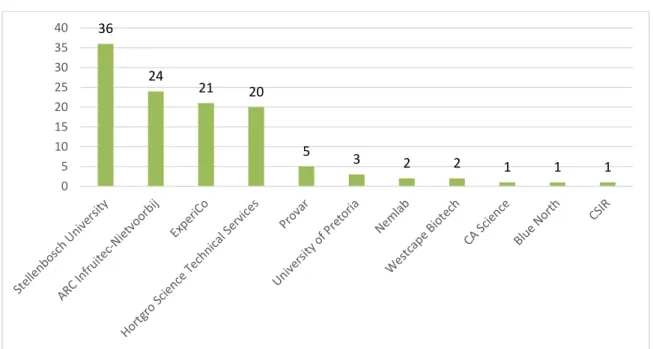
Figure 3.1 Number of Hortgro Science projects per research institute 2015/2016 (N=116) ... 73
Figure 3.2 Hortgro Science percentage spending profiles of pome and stone fruit for 2016/2017 .... 74
Figure 3.3 Percentage breakdown of Hortgro Science income, 2016–2017 ... 75
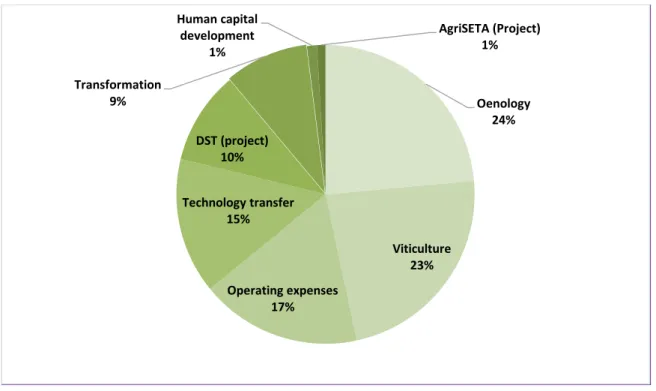
Figure 3.4 Breakdown of Winetech-funded projects per field of focus, 2000 to 2015 ... 82
Figure 3.5 Winetech research expenses 2015 by field (N=R30 738 019/€1 951 620) ... 83
Figure 4.1 Simplified example of a theory of change ... 106
Figure 5.1 Two-dimensional classification of the impacts of productive interactions ... 149
Figure 5.2: Societal impact of research classification scheme ... 150
Figure 6.1 Three broad types of interactions (non-unique), by project ... 158
Figure 6.2 Project 1: Theory of change ... 164
Figure 6.3 Project 1: Conceptualisation and operationalisation phases with supporting interaction codes ... 165
Figure 6.4 Project 1: Execution phase with supporting interaction codes ... 169
Figure 6.5 Project 1: Post-research impact-effecting phases with supporting codes ... 173
Figure 6.6 Project 2: Theory of change ... 181
Figure 6.7 Project 2: Conceptualisation and operationalisation phases with supporting interaction codes ... 182
Figure 6.8 Project 2: Execution phase with supporting interaction codes ... 186
Figure 6.9 Project 2: Post-research impact-effecting phases with supporting interaction codes ... 189
Figure 6.10 Project 3: Theory of change ... 195
Figure 6.11 Project 3: Conceptualisation and operationalisation phases with supporting interaction codes ... 196
Figure 6.12 Project 3: Execution phase with supporting interaction codes ... 199
Figure 6.13 Project 3: Post-research impact-effecting phases with supporting interaction codes .... 203
xvi Figure 6.15 Project 4: Conceptualisation and operationalisation phases with supporting interaction
codes ... 211
Figure 6.16 Project 4: Execution phase with supporting interaction codes ... 213
Figure 6.17 Project 4: Post-research impact-effecting phases with supporting interaction codes .... 218
Figure 7.1 Winetech Project 1 impact classifications scheme ... 229
Figure 7.2 Winetech Project 2 impact classifications scheme ... 231
Figure 7.3 Hortgro Project 3 impact classifications scheme ... 232
Figure 7.4 Hortgro Project 4 impact classifications scheme ... 233
Figure 7.5: Distribution of Hortgro and Winetech respondents according to occupation (Hortgro n=22; Winetech n=35) ... 235
Figure 7.6: Impact according to Winetech technical committee members: mean rating scores (N=42) ... 250
Figure 7.7: Impact according to Winetech technical committee members: percentage ratings of “Very important impact” (N=42) ... 250
Figure 7.8: Impact according to Hortgro technical committee members: mean rating scores (N=23) ... 252
Figure 7.9: Impact according to Hortgro technical committee members: percentage ratings of “very important impact” (N=23) ... 252
Figure 7.10: Impact according to Winetech and Hortgro technical committee members: mean rating scores (N=65) ... 253
Figure 7.11: Impact according to Winetech and Hortgro technical committee members: percentage ratings of “Very important impact” (N=65) ... 253
Figure 7.12 Ideal impacts of research as identified by Winetech and Hortgro ... 254
Figure 7.13 Reasons for research failing to have an impact, as provided by Winetech and Hortgro 255 Figure 8.1 Use of productive interactions in developing research theory and possible CMOs ... 284
Figure 8.2 Classification framework for research impact ... 287
xvii
List of tables
Table 3.1 Number of farming units per annual turnover (2007) ... 66
Table 3.2 Top ten agricultural commodities by production value (2012) ... 67
Table 3.3 Comparison between Hortgro Science and Winetech in terms of key dimensions (2016– 2017) ... 84
Table 5.1 Outline of the steps of the three research phases ... 124
Table 5.2 Summary of case studies ... 128
Table 5.3 Interviewees of first round of data collection ... 131
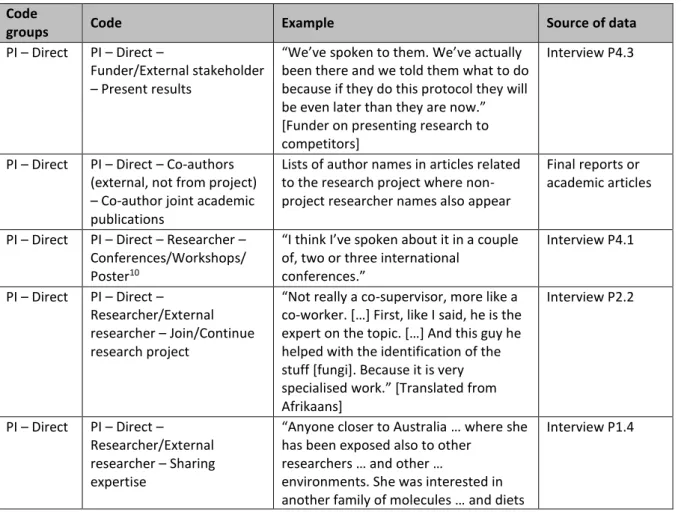
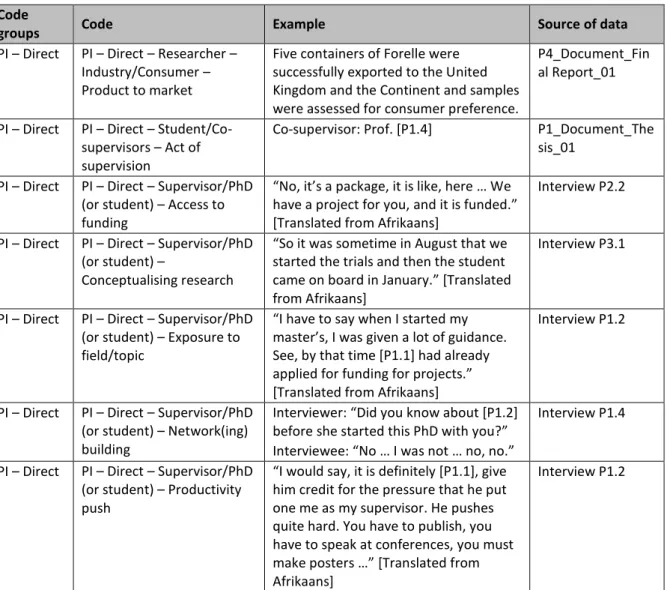
Table 5.4 Direct productive interaction coding categories and examples ... 134
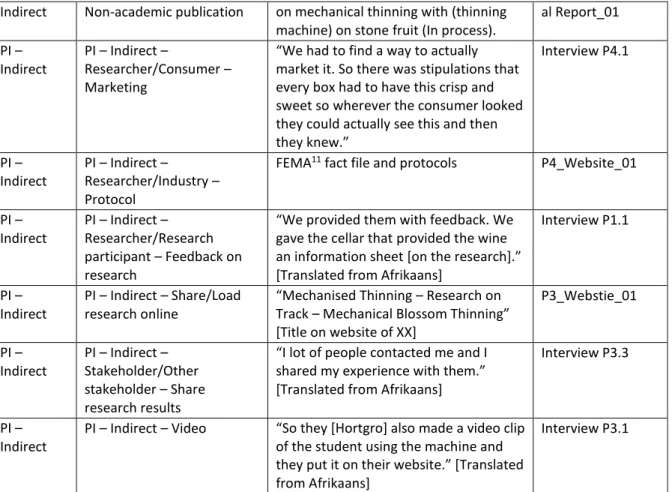
Table 5.5 Indirect productive interaction coding categories and examples ... 136
Table 5.6 Material productive interaction coding categories and examples ... 137
Table 5.7 Impact code categories and examples ... 139
Table 6.1 Sources of data on interactions (non-unique) across all four projects, broken down by the three broad types of interactions ... 156
Table 6.2 Sources of data on interactions (non-unique), by project ... 157
Table 6.3 Ten most common research interactions (in terms of finer coding categories) across all four projects ... 158
Table 6.4 Ten most common interactions (in terms of finer coding categories) across all four projects, by source of data on interactions ... 159
Table 6.5 Ten most common interactions (in terms of finer coding categories), by project ... 160
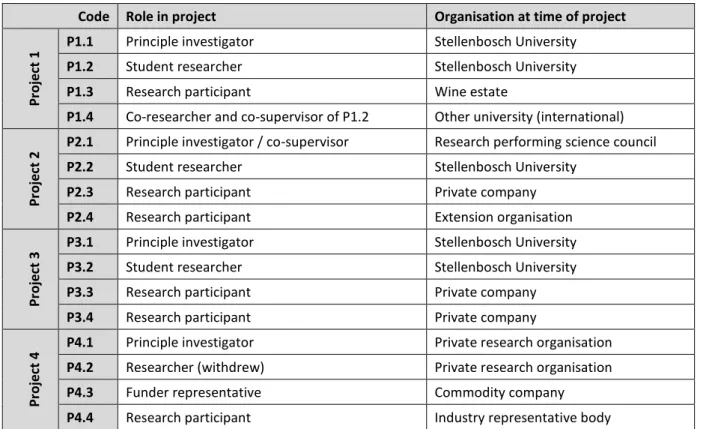
Table 6.6 Researchers and stakeholders interviewed in Project 1 ... 162
Table 6.7 Most common impact codes in Project 1 ... 175
Table 6.8 Researchers and stakeholders interviewed in Project 2 ... 180
Table 6.9 Most common impact codes in Project 2 ... 191
Table 6.10 Researchers and stakeholders interviewed in Project 3 ... 194
xviii
Table 6.12 Researchers and stakeholders interviewed in Project 4 ... 209
Table 6.13 Most common impact codes in Project 4 ... 222
Table 7.1 Project 1: impact codes and descriptions ... 228
Table 7.2 Project 2: impact codes and descriptions ... 230
Table 7.3 Project 3: impact codes and descriptions ... 231
Table 7.4 Project 4: impact codes and descriptions ... 232
Table 7.5 Ratings of 22 scenarios by Winetech in terms of how much each reflects an example of research impact ... 237
Table 7.6 Ratings of 22 scenarios by Hortgro in terms of how much each reflects an example of research impact ... 241
Table 7.7 Funders combined: ratings of 22 scenarios by Winetech and Hortgro in terms of how much each reflects an example of research impact ... 245
Table 7.8 Scenarios of research impact analysed in terms of beneficiaries and types of benefit ... 248
Table 7.9 Most important organisations in effecting research impact, as identified by Winetech ... 257
Table 7.10 Most important organisations in effecting research impact, as identified by Hortgro .... 258
Table 7.11 Most important organisations, roles and employees in effecting research impact in the wine industry, as specified by Winetech ... 260
Table 7.12 Most important organisations, roles and employees in effecting research impact in the deciduous fruit industry, as specified by Hortgro ... 261
xix
List of abbreviations and acronyms
ADI agricultural development Institutes ANT actor network theory
ARC Agricultural Research Council
ASIRPA Socio-economic analysis of the impacts of public agricultural research project CASP Comprehensive Agricultural Support Programme
CGIAR Consultative Group for International Agricultural Research
CIRAD French Agricultural Research Centre for International Development CMO context–mechanism–outcome
CSIR Council for Scientific and Industrial Research DAD Department of Agricultural Development
DAEM Department of Agricultural Economies and Marketing DAFF Department of Agriculture, Fisheries and Forestry DAFS Directorate of Agricultural Field Services
DAR Directorate of Agricultural Research
DATS Department of Agricultural Technical Services DAWS Department of Agriculture and Water Supply DBRI Department-based research institute
DCIS Department of Government Communication and Information Systems DFPT Deciduous Fruit Producers’ Trust
DORA Declaration on Research Assessment ESRC Economic and Social Research Council FEMA Forelle early market access
GA gibberellic acid
xx IGDP 2012 Integrated Growth and Development Plan 2012
IGWS Institute for Grape and Wine Sciences ImpresS IMPact of RESearch in the South
INRA Institut national de la recherche agronomique IST International Sustainability Transitions
IWBM Institute for Wine Biotechnology KVC knowledge value collective
KWV Koöperatiewe Wijnbouwers Vereniging van Zuid-Afrika M&E monitoring and evaluation
MEL monitoring, evaluation and learning NAFU National Agricultural Farmers Union NPM new public management
NRF National Research Foundation
OECD Organisation for Economic Co-operation and Development PIPA participatory impact pathway analysis
PLAAS Poverty, Land and Agrarian Studies Pls principle investigator
PwC PricewaterhouseCoopers
RDC regional development centres REF research excellence framework RIA research impact assessment
SA South Africa
SAAPPA South African Apple and Pear Producers' Association SALS South African Literary Society
xxi SASPA South African Stone Fruit Producers’ Association
SAWB South African Wine and Brandy Company SAWIC South African Wine Industry Council
SAWIS South African Wine Industry Information and Systems SAWIT South Africa Wine Industry Trust
SIAMPI Social Impact Assessment Methods through Productive Interactions SoIR Societal impact of research
SPSAA Strategic Plan for South African Agriculture SROI social return on investment
THRIP Technology and Human Resources for Industry Programme UAE United Arab Emirates
UK United Kingdom
UN United Nations
USSR Union of Soviet Socialist Republics VOC Vereenigde Oostindische Compagnie WCDOA Western Cape Department of Agriculture
1
Chapter 1
Introduction
1.1 Setting the scene: a concise overview of the societal impact of research
The academic study of the societal impact of research (SoIR) aims to understand the ways in which research affects society. Studies of the impact of research have primarily focussed on scientific impact, often relying on bibliometric indicators and the peer-review process to explore aspects of ‘research quality’ (Grant, Brutscher, Kirk, Butler & Wooding, 2009; Lepori & Reale, 2012; Ozor, 2014). SoIR, on the other hand, extends the focus of research assessment to the world beyond science and academia. An exclusive use of bibliometric indicators of impact, informed by journal impact factors and citation counts, risks overlooking the impacts of research on society at large (Campbell & Grayson, 2014).
The Declaration on Research Assessment (DORA), which originated from the December 2012 meeting of the American Society for Cell Biology in San Francisco (see American Society for Cell Biology, 2012), has since become global and underscores the broad consensus that new ways of measuring research impacts are needed. The declaration mentions the limitations of assessments based on journal impact factors, and provides suggestions on how to improve “the ways in which the output of scientific research is evaluated by funding agencies, academic institutions, and other parties” (American Society for Cell Biology, 2012). Although DORA does not focus on SoIR specifically, it includes SoIR assessment as part of its suggestions on how to understand the value of research better. For instance, DORA recommends that funding agencies should consider different “impact measures including qualitative indicators of research impact, such as influence on policy and practice” (American Society for Cell Biology, 2012). The declaration signals a wide-ranging agreement that the current measures used to assign quantitative values to research are too limited and potentially misleading.
The current push for SoIR is not only limited to academics, universities, research institutes and research funders, which are the typical organisations that undersigned DORA. The momentum comes from almost every level of organisation involved in producing research or the effecting of research impact. National governments around the globe are a significant driving force behind
2 assessments and demonstrations of and at times mere reflections on SoIR. From the United Kingdom (UK) and the Netherlands to Australia, the aim of governments has been to make science accountable to the taxpayers who are funding research at public institutions (Demeritt, 2010). Given the diverse organisational interest in SoIR, the term ‘SoIR’ is broad and generic and encapsulates all assessment approaches seeking to assess research impact beyond academia, often involving different units of assessment. The interested entities (for example funders ranging from international to national and sector-specific) all have different ideas of what is meant by ‘societal’ and ‘impact’. Their reasons for being interested in SoIR also vary. Moreover, the concept of what is ‘valued’ differs from entity to entity; yet, the desire to evaluate and understand the broader impact of research in society remains. There are numerous reasons for these entities to be interested in the SoIR, including:
assisting research funders to understand which circumstances promote research impact so that optimal circumstances can be promoted for new projects (Economic and Social Research Council [ESRC], 2009);
assisting research funders to develop ways in which to steer research projects in increasing their impact. This can allow funders to assist active research projects to work towards optimal societal impact (ESRC, 2009);
providing government agencies with the tools needed to evaluate research projects they fund to ensure accountability (Hanney, Packwood & Buxton, 2000);
proving the value of research by expanding the understanding of the interplay between research and society that might expose unknown research impacts (Spaapen et al., 2011); and
increasing the economic competitiveness of a national economy through stimulating scientific and technological breakthroughs (by promoting the production of research with societal impact) required in the modern knowledge-based global economy (Meijer, 2012; Spaapen et al., 2011).
Even though a better understanding of SoIR will potentially benefit individuals, organisations or even national economies, the methods that assess SoIR are not nearly as developed as those that look at scientific impact (Meijer, 2012). There are many reasons for this. A key reason is a lack of data needed to analyse SoIR. In bibliometric analysis, for example, there are databases such as the Web of Science (WoS) or Scopus with information on published research. In SoIR, the question of data is more complex:
3 “Quantitative data are hardly available, monitoring of data is practically non-existent and there is a lack of consensus about what data to gather” (Spaapen & Van Drooge, 2011:211).
In other words, it is very hard to know which data are needed when you do not know exactly what you are measuring in terms of SoIR. Even if there is consensus on what is being measured, the chances are that the data have not been pre-captured in any form of database.
The data challenges are compounded by the problem of attribution, which refers to the problem of how to prove that a specific impact was the consequence of a research result (Meijer, 2012; Spaapen & Van Drooge, 2011). For instance, research impact in the broader society is indirect in nature, which makes it hard to identify impacts explicitly related to specific research. Only part of a research result might be used to build new ideas in conjunction with other research. Research results might also only be used decades after they were published (Morton, 2015). The latter relates to the problem of temporality. With research, the impact might be immediate, or it might be 40 years down the line (Spaapen & Van Drooge, 2011; Spaapen et al., 2011). Temporality presents a challenge for evaluators of research because it does not make sense to evaluate something before it has had an impact, or was supposed to have had an impact.
With different ways of approaching the SoIR, and with varying views on its exact scope, different levels at which it can be studied and diverse opinions on what should be valued, there are numerous points of entry from which to begin a study on SoIR. Previous research looked at the economic benefits of research, but this is not compatible with some fields where possible research impacts (or results) are difficult to quantify. Economic benefits tend to focus on a linear system of research production leading to benefit (Spaapen et al., 2011). As will be discussed later (see 2.2.2-2.2.6), this so-called ‘linear model’ of science (see Bush, 1945), has increasingly lost favour due to its misrepresentation of the complexity involved in research impact.
In agricultural research – which provided the setting for the current study – SoIR has developed in much the same way as in other fields. The focus in assessing the impact of agricultural research has mainly concentrated on economic impacts and the development of new technologies (Weißhuhn, Helming & Ferretti, 2017). Similar to other disciplines or fields, the activities (or interactions) of agricultural research likewise led to impacts that are difficult to capture or quantify. Agricultural research also takes a long time (temporality) before any impacts are realised (Esterhuizen & Liebenberg, 2001). A study by the French Institut national de la recherche agronomique (INRA) found that agricultural research often takes up to 19 years before any impacts begin to appear (INRA, 2017).
4 With all the limitations to studying SoIR, case studies have generally emerged as one of the preferred assessment methods since they allow for impacts to be placed in a context and accommodate the use of qualitative data (Penfield, Baker, Scoble & Wykes, 2014).
“As a method, case studies can capture not only impacts but also roles, routes, processes and lessons learned – thus contributing to understanding and potentially enhancing future processes” (Meagher, 2013:VI).
Case studies are sufficiently flexible to be used within new interaction-oriented approaches to SoIR that prioritise the studying of impact mechanisms. One such approach is SIAMPI which is an abbreviation for the “Social Impact Assessment Methods for research and funding instruments through the study of Productive Interactions between science and society” (Spaapen et al., 2011:1) (also see Spaapen & Van Drooge, 2011).
1.2 The study rationale: applying and adding value to the SIAMPI approach
In 2011, Spaapen et al. published a new approach to SoIR, SIAMPI, which focusses on impact mechanisms and immediate effects (and less on the eventual impacts that could take years to manifest) (Spaapen et al., 2011; Spaapen & Van Drooge, 2011). Productive interactions, whose systematic application and expansion constituted the main focus of the current research, are the impact mechanisms of the approach and are defined as: “[e]xchanges between researchers and societal actors in collaborative settings (networks) in which knowledge is produced and valued that is at the same time scientifically and socially robust and relevant” (Spaapen et al., 2011:4).
Specifically, productive interactions are moments of contact between researchers (or research) and stakeholders, that are made “productive when it leads to efforts by stakeholders to somehow use or apply research results or practical information or experiences” (Spaapen & Van Drooge, 2011:212). The term ‘stakeholder’ is used very broadly and refers to anyone who comes into contact with the research and engages with it. This contact can be facilitated through direct or indirect interactions. A direct interaction can be a conversation, a phone call or an email. Indirect interactions take place through mediums, such as reports, articles and other artefacts. A third type of interaction is also identified, that of material interactions (originally called ‘financial interactions’ [see Spaapen et al., 2011:6]). This is a direct interaction through which a stakeholder provides any form of material or financial assistance or input to the research project (Spaapen & Van Drooge, 2011; Spaapen et al., 2011; Van den Akker & Spaapen, 2017).
5 According to SIAMPI, the three sets of interactions, proximal in relation to the researcher, can more easily be observed and captured than comparable distal connections that cause impact beyond the reach of the researcher and project. Under the influence of SIAMPI, the focus of SoIR shifts from final distant impacts to smaller effects closer in time and space to the researcher (Spaapen & Van Drooge, 2011; Spaapen et al., 2011). In this way, the SIAMPI approach might illuminate impact pathways closer in time and space to the researcher. The focus on effects that occur in time and space close to the research might overcome the problem of attribution since such effects and their associated interactions are suitable candidates for demonstrations of contribution (De Jong, Barker, Cox, Sveinsdottir & Van den Besselaar, 2014).
Even so, productive interactions have not been widely studied (at least not empirically) since publication of the original SIAMPI project report (Spaapen et al., 2011) and the writing up of key insights and cases in a journal article (Spaapen & Van Drooge, 2011). Other articles making use of productive interactions followed, including a study on the use of the SIAMPI method within information and communication technologies research (De Jong et al., 2014), and a study that explored the use of SIAMPI within social sciences (Molas-Gallart & Tang, 2011). Although hundreds of references to productive interactions have emerged in the academic and grey literature since publication of the SIAMPI project and its spin-off articles, little evidence exists of any systematic and empirical applications of the approach. A first rationale for the current research was therefore to address this vacuum by empirically applying the SIAMPI approach with its focus on productive interactions to select cases of agricultural research and, in doing so, expand the body of scholarship on SoIR.
There is, however, a caveat to the SIAMPI approach. A productive interaction is productive when a stakeholder tries to use or apply research (Spaapen et al., 2011). This use or application can be large or small, for example the adoption of a new technique in an entire industry (probably large), or influencing the way someone thinks about a topic with no visible outputs (probably small). An interaction can also be positive (increasing someone’s knowledge on a topic) or negative (for example an adverse reaction to a changed product by consumers). Productive does not imply desired. Although the SIAMPI approach sets out how to identify productive interactions, it is not prescriptive on how to value productive interactions (Spaapen et al., 2011). If productive interactions are to have value to a funder in the monitoring of research, it is important to be able to identify positive and crucially wanted impacts that have an effect on the intended populations served by a research funder. SIAMPI makes the assumption that “quantitative indicators and
6 qualitative data (e.g. narratives, case studies) [of the different productive interactions] can be collected that can be used in assessment procedures”, but it does not provide further guidance (Spaapen & Van Drooge, 2011:213). SIAMPI then, or more correctly productive interactions, by design almost, requires the addition of another approach to provide the structure for the identification and testing of possible impact indicators. SIAMPI presents the idea of productive interactions and explains how to identify them, but leaves open for interpretation any further use and valuing of these productive interactions.
One approach that shares similarities to SIAMPI is realist evaluation. Realist evaluation is one of the most widely used theory-based approaches in programme evaluation and is as a possible natural evaluation ‘home’ for the SIAMPI approach (Blamey & Mackenzie, 2007; Green et al., 2015). The main evaluative question for realist evaluation is not just, ‘what works’ but rather, “what works for whom, in what circumstances, in what respects and how?” (Pawson et al., 2005:21).
Realist evaluation is a brand of theory-based evaluation and predates SIAMPI by 14 years (Wildschut, 2014). Similar to SIAMPI, realist evaluation seeks to understand impact in terms of how it is effected, and not just in terms of what the final impacts are. Realist evaluation wants to look into the ‘black box’ of how a social programme works (Pawson & Tilley, 1997). The idea of the ‘black box’ is often equated to a clock. When looking at a clock, one can tell the time from its face, but one cannot see how the clock works since the mechanisms of the clock are hidden. To understand how the clock works, one will need to look at these mechanisms inside the clock (Pawson & Tilley, 1997). Realist evaluation does this by making use of context–mechanism–outcome (CMO) configurations, or impact mechanisms (SIAMPI makes use of productive interactions). The context comprises the circumstances in which a programme is introduced; the mechanisms are the aspects of a programme that bring about change (providing choices or capacity), and the outcomes (or outcome patterns) are intended and unintended consequences of a programme (Pawson & Tilley, 2004). Similar to SIAMPI, these impact mechanisms (in CMOs) show causality on a smaller scale, which potentially builds up to the impacts of a programme (Shaw, 2010).
Realist evaluation, similar to SIAMPI, is also not prescriptive in its methods, but rather embraces quantitative and qualitative methods to allow for the investigation of processes and impacts as required (Pawson et al., 2005). Realist evaluation is open to new methods that allow the collection of needed data. Realist inquiry and the principles expanded on in realist evaluation are based on realism, which is a “logic of enquiry” rather than a research technique (Pawson & Tilley, 2004:10). It is this logic of enquiry, espoused by realist evaluation, that was applicable to the research on which
7 this dissertation reports. Realist evaluation is more developed and more established than SIAMPI. Realist evaluation works by developing hypotheses of how a programme will work in the form of impact mechanisms called CMO configurations. Through a realist evaluation, the predetermined hypotheses are tested and later adapted. In this way, realist evaluations are built on theory and produce theory (Pawson & Tilley, 1997).
Research projects however work differently from programmes. Research impact is an iterative process that often involves numerous actors, including ones that might not have been linked to the research project in any way, at times making it hard to develop a theory of how the research will produce an impact (Spaapen et al., 2011). However, SIAMPI and its productive interactions might be able to produce the theory needed for a realist evaluation on research. To achieve this, SIAMPI must be able to provide productive interactions that could be used to construct theories of change and impact pathways. In fact, the current research proposed that SAIMPI and its productive interactions are compatible with realist evaluation and that by making explicit the value of productive interactions in theories of change (often part of the initial phase of a realist evaluation), the SIAMPI approach could be considered a method within realist evaluation. A second rationale for conducting the current research was therefore to add value to the SIAMPI approach by exploring its compatibility with realist evaluation. This is an exploration that constitutes a novel focus in the body of scholarship on SoIR. Defining SoIR is however not a straightforward activity.
SIAMPI views SoIR as “measurable effects of the work of a research group or program or a research funding instrument in a relevant social domain” (Spaapen et al., 2011:9). The problem with definitions of SoIR is that “impact fundamentally precludes templating” (or in other words drafting a ‘universal’ or single definition of impact is probably not possible) (Bayley & Phipps, 2017:2). There is however a useful way of looking at SoIR, which provides a broad framework within which to view SoIR, namely by using the concept of ‘impact literacy’. The concept ‘impact literacy’ was developed to “strength[en] [the] core comprehension of impact” (Bayley & Phipps, 2017:3), doing so with the understanding that a definition cannot include all of the thousands of possible ways in which research could lead to societal impact. Impact literacy is not the same as SoIR, but as a concept, its comprehension can be used as a “central principle of impact practice” (Bayley & Phipps, 2017:3). Impact literacy sees impact as a combination of three elements of research impact, namely the ‘how’, ‘what’ and ‘who’. ‘How’ refers to the practices through which impact is effected; ‘what’ is the identification of impact endpoints; and ‘who’ looks at how different stakeholder come together in research impact-effecting networks (Bayley & Phipps, 2017). Through these three elements, one can
8 approach the literacy of research impact (the level to which actors understand what it is), but it also lends itself to being a definition of sorts for the SoIR (or other forms of impact). It is a frame through which to look at the SoIR rather than a definition, and that is exactly what is required when a single understanding has to be created for the countless ‘impact pathways’ (impact stories, ways of achieving impact) that are possible through different disciplines.
With a lack of a single definition of SoIR, the current study needed a different way of understanding research impact to ensure that the concept was explored and expanded on in a nuanced and systematic manner in the research. The concept of impact literacy, which only recently emerged in the academic literature, provided a lens with which to assess the way in which research looks at impact (Bayley & Phipps, 2017). In the current study, impact literacy was used to show that the identified productive interactions and their effects – configured as theories of change and impact pathways – shed light on the ‘who’ and ‘how’ of impact (particularly from a research perspective), but lack a deeper understanding of the ‘what’, especially in terms of what research funders view as SoIR. To overcome this problem, the current research made use of a survey to assess, among others, the way in which the funders of the select cases of agricultural research view the SoIR. A third rationale for conducting the research was therefore to add value to the SIAMPI approach, specifically by investigating the impact literacy of research funders and relating the insights to the productive interactions and effects identified from application of SIAMPI to the funders’ projects. Finally, the current study approached the study of SoIR, using SIAMPI, through agricultural research case studies. Agricultural research is directly related to issues that confront societies around the world, including climate change and food security. These grand societal challenges are, among other agricultural-related issues, for example those mentioned in the United Nations (UN) Sustainable Development Goals (Weißhuhn et al., 2017). Agricultural research, by nature, is connected to societal impact and can change society. In South Africa, agricultural sciences is also a field where researchers are most likely to self-report the aim of their research as “the solving of technical or applied problems” (Boshoff, 2017:57). With a clear relationship between agriculture and society, the proximity of the agricultural research funders and an affinity for ‘research with a visible impact’, agricultural research presented a promising point of departure.
1.3 Aim and objectives of the study
The aim of the current research was to increase the understanding of the SoIR towards the goal of improving research monitoring and evaluation (M&E), by using the SIAMPI approach with productive
9 interactions, influenced by the logic of realist evaluation. The use of SIAMPI allowed the research to overcome the previous obstacles (issues of attribution and temporality) that have hindered the developed of SoIR M&E methods.
The study had three objectives:
objective 1: to study the SoIR by focussing on productive interactions and effects as identified through the SIAMPI approach (Spaapen et al., 2011);
objective 2: to use the logic of realist evaluation to assign value to the productive interactions by using them to build theories of change, impact pathways and indirectly CMO configurations; and
objective 3: to view the productive interactions and effects through the lens of research impact literacy – ‘who’ is responsible for effecting impact, ‘how’ it is effected, and ‘what’ is effected (Bayley & Phipps, 2017).
1.4 Research questions
The three research objectives translated into six research questions that were addressed by this study. There were two research questions for each of the objectives.
Objective 1 Question 1: Which research interactions (possible productive interactions) are identified through application of the SIAMPI approach in four cases of agricultural research in South Africa?
Question 2: What do the identified research interactions reveal about the SIAMPI approach – in other words, what are possible strengths and weaknesses of the approach in capturing and understanding research impact?
Objective 2 Question 3: Which value do the theories of change provide to the research interactions (possible productive interactions) that are identified through application of the SIAMPI approach?
Question 4: What do the identified, if any, productive interactions reveal about impact-generating mechanisms and the associated context(s) in which research takes place as captured by the impact pathways in the theories of change?
Objective 3 Question 5: Based on the ‘what’ element of research impact literacy, which kinds of impact are reflected in the effects as identified through the SIAMPI approach and to which extent are these impacts valued by funders?
10 Question 6: Based on the ‘who’ and ‘how’ elements of research impact literacy, how do the impact pathways developed for the four cases of agricultural research align with the funders’ understanding of how impact is created?
1.4 Outline of the dissertation
The dissertation is divided into eight chapters. This chapter provided an introduction to the dissertation and set out the logic of the research. Below is a brief summary of the structure and contents of the remaining seven chapters.
Chapter 2 – Historical and current understanding of the societal impact of research
This chapter traces the history of SoIR through the processes that gave rise to its current demand. A main focus is the changes in the so-called ‘science–society contract’ over the last 150 years. During this time, the relationship between science and society continued to evolve. The chapter also looks at previous research on the assessment of SoIR and at the different stumbling blocks that have inhibited the study of research impact. The changes in the assessment of the societal impact of agricultural research are covered in detail. The chapter includes an overview of definitions of SoIR. The chapter anchors the concept of the SoIR in a changing context, showing where it comes from, what it is, and illuminating the forces that drive it.
Chapter 3 – An overview of the history of agricultural research in South Africa
In this chapter, the history of agricultural research in South Africa is traced over the last 200 years. Although it might seem like a long period to reference, the current agricultural system and many of the topics with which the industry (research and commercial) struggles have been built from this history. These topics include the elements of race, language, land ownership and the changing power of the state. South Africa’s ‘free’ commodity companies (working outside state control) are relatively new, and are developed out of deregulation of agricultural industries in 1997. Before 1997, these industries and their research were dominated by successive agricultural government departments of the pre-democratic South African state. The commodity companies have been made the custodians of industries that were confronted by a history of dispossession and inequality stemming from the Apartheid system. Today they are professional bodies that aim to increase profits and exports, but they do so through a balancing act of maintaining social responsibility, for example through the protection of farm labour against mechanisation. Understanding the context of agricultural
11 research in South Africa is part of the history, time and place of the research projects this study assessed.
Chapter 4 – Conceptual underpinnings: Productive interactions, realist evaluation, theories of change and impact literacy
Having provided a background to the study of agricultural research in South Africa, this chapter presents the different conceptualisations that were used during the study. These are the approaches of SIAMPI (Spaapen & Van Drooge, 2011; Spaapen et al., 2011), theory-based evaluation (Weiss, 1997; 2004) focussing on realist evaluation (Pawson & Tilley, 1997); methods or tools used within these approaches such as theories of change (Weiss, 1995), and the related participatory impact pathway analysis (PIPA) (Douthwaite et al., 2007); and the concept of impact literacy (Bayley & Phipps, 2017).
Chapter 5 – Research design and methodology
The chapter presents an account of the methods used in the study. The first two phases of the research comprised semi-structured face-to-face in-depth interviews with stakeholders, as well as document analyses. The third phase mainly relied on a survey. The survey explored ‘what’ research funders view as research impact, or as important impact for the research they fund.
Chapter 6 – Results: Productive interactions and theories of change
The chapter presents the results of the interviews with the researchers and different stakeholders who were interviewed during the first two phases of the research. It also includes data based on the document analyses of project documentation. The results focus on the first four research questions, which looked at productive interactions and the use of productive interactions in theories of change (impact pathways of how impacts and outcomes are effected during research).
Chapter 7 – Results: Research funders’ understanding of the societal impact of research
The chapter focusses on the survey responses of the Winetech and Hortgro expert-funding committee members regarding their views on SoIR. The chapter also presents the application of a research impact classification scheme developed during the study. The scheme was developed to provide a way to classify the SoIR as viewed by the different
12 stakeholders or actors in the research process. It expanded the data of how funders view impact and ‘what’ the SoIR is according to them.
Chapter 8 – Towards a deeper understanding of the mechanisms that drive the societal impact of research
The final chapter discusses the results of the previous two chapters. It presents the findings that productive interactions are indeed building blocks of impact, but that these need to be be combined into larger impact mechanisms or impact pathways. These impact mechanisms can be used to study the effecting of impact in various contexts, while CMO configurations can assist in building new theory on the effecting of research impact. Lastly, the chapter presents a final version of the research impact classification scheme, adapted through the results into a classification framework.
13
Chapter 2
Historical and current understanding of the societal impact of research
2.1 Introduction
Societal impact of research (SoIR) is many different things for many different people. In general terms, ‘societal impact’ can probably be seen as the effect of research on the world beyond academia or on society. The part that is not agreed on is who or which sections of society should be affected, or even, what does ‘beyond academia’ mean. Is having an impact on a different research discipline societal impact or scientific impact? This chapter addresses a number of topics directly related to these questions. The aim of the chapter is to provide a nuanced overview of the topic of SoIR and to motivate the use of a preferred definition of SoIR used in the dissertation. To study something one first needs to delineate and define it. This chapter boxes and defines SoIR.
The chapter is divided into five sections. The first section looks at the changes in the so-called ‘science–society contract’ over the last 150 years. The current drive for SoIR is a result of this ‘contract’ changing (Gibbons, 1999). The science–society contract refers to an implicit understanding of the place of science and its role in society. Society provides space for and funds science, and science delivers knowledge to or enlightens society (of course, this is the Vannevar Bush textbook example [Bush, 1945] and not the only or currently even the most popular view). The science– society contract is linked to the rise of research universities and begins with the Humboldt university model (also called the Humboldtian model of higher education) in Germany. The second section of the chapter provides an overview of how SoIR has been defined, followed by a third related section on the development of approaches used to measure SoIR. The fourth section of the chapter reflects the development of the societal impact of agricultural research methods specifically. The final section of the chapter then moves back to the general picture, detailing the pitfalls that have inhibited the development of methods to assess societal impact of research.
2.2 Changing expectations between science and society
For a long time, scientific research held a very secure position in society where it was assumed that scientific research outputs equated to societal and economic impact. For much of the twentieth century, the logic behind national research funding was that governments would provide the funds
14 needed for research, and mainly universities (along with research institutes) would produce research, which would translate into economic growth and societal benefits (Briggle, 2014; Guston & Keniston, 1994; Martin, 2003; Nowotny, Scott & Gibbons, 2003). After World War II and during the Cold War, this trend continued, with the United States (US) government pushing the ‘endless frontier’ of science. Following the end of the Cold War – an event that coincided with shrinking public budgets and an explosion in science which far outpaced available resources – governments down to small funders started coming under pressure to find better ways of distributing the relatively limited resources available for research (Bornmann & Bierman, 2012). The size of non-government funding also increased in making it necessary for research funders, for example a large medical research funder such as the Wellcome Trust, to find ways of understanding how research impact could be improved and measured. By 2014, the Wellcome Trust was awarding more than £530 million per year to medical and biomedical research (Dinsmore, Allen & Dolby, 2014). Such vast sums of money created a need for funders to be able to account for their spending, showing that it was efficient and effective.
The new demand for defining what is relevant knowledge has been studied under different forms, for example Mode 2 (Gibbons, Limoges, Nowotny, Schwartzman, Scott & Trow, 1994), the triple helix (Leydesdorff, 1996), new public management (Lane, 2000) and others. Mode 2 research is concerned with research that is created in collaboration with parts of society and with relevance to a certain application in society. This is in contrast to Mode 1, which refers to research that is of mainly academic interest to the scientific community (Gibbons et al., 1994; Spaapen, Dijstelbloem & Wamelink, 2007). The triple helix sees universities, governments and industry as equal institutional actors in the research network (Leydesdorff, 1996). Collectively this helix produces ‘infrastructure’ through research, each contributing in a unique way. The triple helix allows attention to be focussed on the need to manage expectations and communication between the three actors (i.e. universities, governments and industry) (Leydesdorff, 1996). New public management (NPM) refers to the desire to manage public affairs, including research, in a way similar to business. Some of the principles of NPM are standard and performance measures, increased competition and more efficient use of resources (Lane, 2000). The different perspectives all point to new attempts at understanding the value of scientific research, specifically the SoIR, and/or ways to increase this.
The current changes in what is expected of science are part of a process that has been going on for more than 150 years (as set out below). The ‘understanding’ between science and society is described as social contracts (Martin, 2003). As the national or international context in which
15 research takes place change, so does the relationship between science and society. Events such as the end of the Cold War – or as will be shown later, success for the United States in World War II – could have direct effects on the funding structures of science.
The first example of a science–society contract was known as the Humboldt university model. The Humboldt model was the first ‘contract’ to be widely copied internationally. It was also the only major model that developed outside the United States. The next contract to form, which eventually replaced the Humboldt university model, was the Vannevar Bush social contract (see Martin, 2003), which originated in the United States. After victory in World War II, the United States maintained a position of global hegemony in military and political affairs, and also in terms of innovation. This dominance lasted into the twenty-first century. Some might argue that it still maintains this position today. As a result, much of what is discussed below has an overwhelming focus on the United States from the Vannevar Bush social contract to the present. The discussion is divided into five parts, consecutively looking at the Humboldt university model, the Vannevar Busch Social Contract, the Cold War era, the post-Cold War period and the current state of affairs.
2.2.1 Humboldt university model
The origins of the Humboldt university model (Humboldtisches Bildungsideal in German, or the Humboldtian education ideal) can be traced back to Humboldt University in Germany where it was developed by Alexander von Humboldt in the 1800s. The Humboldt model contained two main elements. Firstly, governments accepted it as their responsibility to fund universities out of public funds, and secondly, universities became dual spaces, where both research and teaching took place (Martin, 2003). With universities seen as both teaching and research spaces, the Humboldt model promoted four ideals. It called for universities to:
1. take on the obligation of knowledge creation, preservation and transmission;
2. provide freedom to lecturers to teach what they think best, and for students to be able to choose what they want to study;
3. become spaces that provide intellectual freedom and separation from the state and, in doing so, accommodate the pursuit of scientific truth; and
4. use seminars as the main medium of instruction (Krull, 2005:99).
During the nineteenth and twentieth centuries, the model was adopted by many other nations, mainly in the northern hemisphere. The funding provided by governments came with very few limitations. University management and individual academics were given the freedom to choose
16 their own research topics and to pursue research as part of their jobs. In general, academics spent between 30 and 50 per cent of their time doing research (Martin, 2003).
France and some Eastern European countries adapted the model. In France, for example, a system was introduced