An efficient and secure attribute based
signcryption scheme with LSSS access structure
Hanshu Hong and Zhixin Sun
*Background
The notion of attribute based encryption (ABE) was first proposed by Sahai and Waters (2005). Since then, many typical ABE (Goyal et al. 2006; Waters 2011; Lewko et al. 2010; Goyal et al. 2008; Tian and Peng 2014) schemes have been proposed. In ABE, user’s access privileges are described by a set of attributes instead of a single identity string. A user can get access to the ciphertext only if his attributes satisfy with the policy which is set by the data owner. Due to its capability of providing fine-grained and flexible access control, ABE appears to be a promising tool for data encryption and data shar-ing between users. Attribute based signature (ABS) has been developed as a primitive to solve the data authentication problem of ABE, which was first introduced (Guo and Zeng 2008) in 2008. In ABS mechanisms (Maji et al. 2011), a signer can sign a message with the private key component corresponds with the attributes he processes. The signa-ture can be verified to a certain set of attributes or an attribute access strucsigna-ture of which the data owner claims.
The notion of signcryption (Zheng 1997; Lim and Lee 1998; Tan 2008; Selvi et al. 2008) can be introduced to attribute based cryptography to present attribute based signcryp-tion schemes. Signcrypsigncryp-tion (Paulo et al. 2005; Li and Khan 2012) is a single logical step to complete the function of both signature and encryption at the same time, thus it achieves better efficiency then the traditional sign-then-encryption method. However, research on attribute based signcryption has not been received much attention from
Abstract
Attribute based encryption (ABE) and attribute based signature (ABS) provide flexible access control with authentication for data sharing between users, but realizing both functions will bring about too much computation burden. In this paper, we combine the advantages of CP-ABE with ABS and propose a ciphertext policy attribute based signcryption scheme. In our scheme, only legal receivers can decrypt the ciphertext and verify the signature signed by data owner. Furthermore, we use linear secret shar-ing scheme instead of tree structure to avoid the frequent calls of recursive algorithm. By security and performance analysis, we prove that our scheme is secure as well as gains higher efficiency.
Keywords: Attribute based, Signcryption, LSSS structure, Security
Open Access
© 2016 The Author(s). This article is distributed under the terms of the Creative Commons Attribution 4.0 International License (http://creativecommons.org/licenses/by/4.0/), which permits unrestricted use, distribution, and reproduction in any medium, provided you give appropriate credit to the original author(s) and the source, provide a link to the Creative Commons license, and indicate if changes were made.
RESEARCH
*Correspondence: [email protected] Key Lab of Broadband Wireless Communication and Sensor Network Technology, Ministry Education, Nanjing University of Posts and Telecommunications, Nanjing, China
academia. Wang and Huang (2011) proposed a signcryption scheme from pairings. Their scheme provides the same functions of encryption and authentication and is proved to be more efficient than the simply combination of “CP-ABE + CP-ABS”. Hu and Zhang (2013) proposed a fuzzy attribute based signcryption and apply it in the BAN (Body area network). Their scheme is a novel security mechanism and achieves outstand perfor-mance. However, the proposed (Wang and Huang 2011; Hu and Zhang 2013) schemes are based on the tree structure (Bethencourt et al. 2007) and threshold structure, which need frequent calls of recursive algorithm for the purpose of recovering the secret encryption component. Thus this will bring about external computation overhead.
To better improve the efficiency of attribute based signcryption scheme, in this paper, we propose an improved ciphertext policy attribute based signcryption scheme. We use LSSS structure (Beimel 1996) instead of access tree structure to avoid the frequent calls of recursive algorithm. By security and performance analysis, we prove that our scheme is secure as well as achieves higher efficiency.
Preliminaries Bilinear pairings
Let G1 and G2 be two cyclic groups of prime order q. Let g be a generator of G1. A bilinear
pairing eˆ: G1×G1→G2, G2 has these features: Bilinearity: for a,b∈Zq, we have eˆ
ga,gb
= ˆe g,gab. Non-degeneracy: for any g∈G1, eˆ
g,g
�=1.
Computability: the value of e(u,ˆ v) can be computed for any u,v∈G1. Hardness assumption
Discrete logarithm assumption (DL)
Given P,Q∈G1, no probabilistic polynomial-time (PPT) algorithm can find an integer n∈Zq∗ such that Q=Pn with non-negligible probability.
Decision bilinear Diffie–Hellman problem (DBDH)
For a,b,c,z∈Zq, given ∗ {g,ga,gb,gc,z}, no probabilistic polynomial-time (PPT) algo-rithm can distinguish the following tuples A=ga,B=gb,C=gc,eˆg,gabc
and
A=ga,B=gb,C=gc,eˆ
g,gz
with non-negligible probability.
Our model and assumptions Formulized definitions of our scheme
Our scheme consists of the following algorithms:
Setup On input security parameter, it returns the system public parameter PK and mas-ter key MK. PK is shared by users while MK is kept private by the private key generator. Private Key generation On input the system public key PK, the master key MK, and an attribute set {Ai}, private key generator (PKG) outputs Di as the user’s attribute private
key. To distinguish the role of signers and receivers, in this paper, we define the private key of signer as Ds while the private key of receiver as Dr.
Signcrypt This algorithm is run by a signer which takes the systems public parameter PK, a plaintext M, signer’s private key Ds and an access structure as input. Then it outputs the ciphertext CT{U,V,E}.
De-signcrypt This algorithm is run by the receiver. The algorithm takes as input the ciphertext CT{U,V,E} and the receiver’s private key Dr, it outputs either the plaintext M or the reject symbol ⊥.
Security model
Definition 1 Our scheme has the essential confidentiality under chosen plaintext attack in selected model if no Adversary has non-negligible advantage in the challenge game. Setup:Adversary claims a challenging attribute set γ. Challenger runs setup algorithm to
obtain PK. It sends PK to Adversary.
Adversary may make the following queries to Challenger.
Private key generation query:Adversary can request the private key of an attribute set (expect for the challenging attribute set).
Challenge:Adversary chooses two plaintexts M0 and M1. Challenger chooses µ∈ {0, 1}
randomly and calculates C∗=Signcrypt
PK,Mµ,Ds
. Then Challenger sends the result
back to Adversary.
Adversary cannot ask Challenger for Private key generation query for the challenging
attribute set γ.
Adversary outputs a value µ∗ as a conjecture of µ. If µ∗=µ then Adversary wins the game. Denote Pr [µ ∗=µ]−1 2
to be the advantage of Adversary.
Definition 2 Our scheme has the existential unforgeability under chosen message attack in the selective model if no Adversary has non-negligible advantage in the challenge game. Setup:Adversary claims a challenging attribute set γ. Challenger takes a security
param-eter and runs setup procedure to obtain the system paramparam-eters. It sends the PK to Adversary.
Private key generation query:Adversary can request the private key of an attribute set (expect for the challenging attribute set).
Signcryptquery:Adversary chooses an attribute set {Ai}, an access structure, a plaintext
M. Challenger calculates Ds and runs the signcrypt procedure to calculate the ciphertext
CT =Signcrypt{PK,M,Di,γ}. After then, Challenger sends CT to Adversary.
Challenge: Adversary computes a 3-tuple CT∗{U,V,E}, while CT∗{U,V,E} was not
from a igncryptquery.
Challenger de-signcrypts the ciphertext by running the De-signcrypt{PK,CT∗,Dr }.
Adversary wins the game if the output of De-signcrypt is not ⊥. Denote Adv(A)=
Pr [Result=M]
Our contributions to attribute based signcryption scheme
Let G1 and G2 be two cyclic groups of prime order p, while g is the generator of G1. Let
ˆ
e:G1×G1→G2 be a bilinear pairing. Define 2 functions: H1,H2. The function H1
asso-ciates attributes to rows of access Matrix (the number of rows ∈Zp). ∗ H2: {0, 1}n→Zp.∗
Setup PKG randomly chooses αi∈Zp for each attribute ∗ i in the system. Besides, PKG
chooses another secret number α∈Zp∗. The system outputs the system master keys gα,α i , public parameters eˆ g,gα ,eˆ g,gαiH1(i), H1,H2,G1,G2,p,g .
Private key generation For signer’s attribute set Aj
, PKG chooses u∈Zp and ∗ calculates its private key
Ds,1,Ds,2,Ds,3
=gu+αjH1(j),gα+u,eˆ g,gu
. Like-wisely, for receiver’s attribute set {Ai} PKG chooses h∈Zp calculates its private key ∗
Dr,1,Dr,2,Dr,3
=gαiH1(i)+h,gα+h,ˆeg,gh
. PKG transfers the private key to each user through secure channels.
Signcrypt Signer firstly picks x∈Zp and a LSSS access structure ∗ Matrix, then chooses random vector �v=(x,vr1,vr2,. . .,vrn)∈Zpn. Let i= �v·Matrixi. (Matrixi stands for the ith row of the corresponding Matrix). Finally, singer randomly picks ri ∈Zp and calcu-∗ lates the signcryption information:
Signer sends CT = {U,V,E} to the receiver. De-signcrypt Let
ω∈Zp
i∈l be a set of constants such that if {i} are valid shares of
secret x according to Matrix, then
i∈lωii =x. Receiver calculates M∗ as follows:
Then, receiver verifies if
If Eq. (3) holds then the algorithm outputs plaintext M with the signature. If not, it
outputs reject “⊥”. Correctness proof: U =eˆ g,gj∈SαjH1(j)·x t=H2(U||M) V : v1=� j∈S Dxs,1+t,v2=� j∈S Dxs,3+t (1) E:C0=Meˆ g,gαx ,C1=gx,C2,i = ˆe g,g−αiH1(j)·i, C3,i=gi (2) M∗= C0 i∈l ˆ e(C3,Dr,1)·C2,i ωi · ˆe(C1,Dr,2) (3) ˆ ev1,g=U·v2· ˆe g,g j∈SαjH1(j)·t
(a) Decryption:
(b) Signature verification:
Security and efficiency analysis Confidentiality
Theorem 1 IfAdversary can break our scheme under chosen plaintext attack in the
selec-tive model, then a simulator can solve the DBDH problem.
Proof In the challenge game, if there exists an Adversary which has advantage ε in
attack-ing our scheme, there exists a simulator solvattack-ing the DBDH problem with an advantage of ε
2.
The simulator is constructed as follows:
Phase 1 Setup:Adversary claims a challenging attribute set γ. Challenger defines a set of
attributes {Ai}. Let G1 and G2 be two cyclic groups of prime order p,while g is the genera-tor of G1. Let ˆe:G1×G1→G2 be a bilinear pairing. Define 2 functions :H1 associates
attributes to rows of access Matrix, H2: {0, 1}∗→Z∗p. Challenger randomly chooses µ∈ {0, 1}, a,b,c∈Zp∗.
The aim of simulator is to output a value µ∗ as a conjecture of µ.
The simulator simulates the role of Challenger and runs Adversary’s algorithm as subprogram.
Phase 2 Queries:
Adversary asks for private key for attributes Ai. Simulator picks u,y,ai∈Zp and makes ∗ the following settings:
(4) M∗= C0 i∈l ˆ e C3,i,Dr,1)·C2,iωi· ˆe(C1,Dr,2) = C0· ˆe(C1,Dr,2) −1 i∈l ˆ e gi,gαiH1(i)+ueˆg,g−αiH1(j)·i ωi = C0· ˆe(C1,Dr,2) −1 i∈l ˆ e g,guiωi = Mˆe g,gαx · ˆe g,gux ˆ e g,gαx · ˆe g,gui∈liωi =M (5) t=H2(U||M) ˆ e v1,g = ˆegj∈S(αjH1(j)+u)·(x+t),g = ˆe g,gj∈SαjH1(j)·(x+t) · ˆe g,gj∈Su(x+t) = ˆe g,gj∈SαjH1(j)·x · ˆe g,gj∈SαjH1(j)·t · ˆe g,gj∈Su(x+t) =U·v2· ˆe g,gj∈SαjH1(j)·t Let (A,B,C,Z)=�ga,gb,gc,ˆe� g,g�abc� ifµ=0 (A,B,C,Z)=�ga,gb,gc,ˆe� g,g�z� ifµ=1
The queries like Phase 2 can be asked by Adversary for a bounded times. Phase 3 Challenge:
Adversary picks plaintext M0, M1 and a challenging LSSS containing attribute set γ.
Simulator chooses µ∈ {0, 1} and calculates CTµ=Signcrypt
PK,Mµ,Ds.
Simulator sends CTσ to Adversary.
Let x=c, accoding to the previous setting in the Setup phase:
Adversary outputs a value µ∗ as a guess of µ. If µ∗=µAdversary wins the game.
Then we will discuss simulator’s advantage in distinguishing the following two tuples A=ga,B=gb,C=gc,eˆ g,gabc and A=ga,B=gb,C=gc,eˆ g,gz .
When µ=1, E is a illegal ciphertext and Adversary cannot acquire useful information of σ.
Since when µ∗�=µ, the simulator outputs µ=1, so:
When µ=0, E is a legal ciphertext. According to the assumption, Adversary has an advantage ε.
Since when µ∗=µ the simulator outputs µ=1, so
As is mentioned above, the advantage of simulator is
(6) Dr,1,Dr,2,Dr,3 = gu+αiH1(i),gab+u,eˆ g,gu, ifAi∈γ gu+αiH1(i),gy+u,eˆ g,gu, if Ai∈/γ CTµ: C0=Mˆe g,gabx ,C1=gx,C2,i= ˆe g,g−αiH1(j)·i, C3,i=gi (7) CTµ= Meˆ g,gabc, ifµ=0 Meˆ g,gz, ifµ=1 (8) Pr µ∗�=µ|µ=1 = 1 2 (9) Pr µ∗=µ|µ=1 = 1 2 (10) Pr µ∗=µ|µ=1 = 1 2 +ε (11) Pr µ∗=µ|µ=0 = 1 2 +ε (12) 1 2Pr µ∗=µ|µ=0 +1 2Pr µ∗=µ|µ=1 −1 2 = 1 2 1 2+ε +1 2 × 1 2− 1 2 = ε 2
Unforgeability
Theorem 2 If anAdversary can break our scheme chosen message attack in the selective
model, then it can be constructed that a simulator with a non- negligible advantage solves the DBDH problem.
Proof In the challenge game, if there exists an Adversary which has advantage ε in
forg-ing a legal ciphertext, there exists a simulator which can solve the DBDH problem with an advantage of ε
2. Phase 1 Setup:
Adversary claims a challenging attribute set γ. Challenger defines a set of attributes {Ai};
Let G1 and G2 be two cyclic groups of prime order p, while g is the generator of G1 . Let
ˆ
e:G1×G1→G2 be a bilinear pairing. Define 2 functions: H1 associates attributes to
rows of access Matrix,H2: {0, 1}∗→Zp∗.
Challenger randomly chooses b∈ {0, 1}, a,b,c∈Zp∗.
The aim of simulator is to output a value µ∗ as a conjecture of µ. Phase 2 Queries:
Private key generation query:Adversary chooses a set of attributes Aj
, a plaintext M
and a LSSS. Simulator picks u,y,ai,bi,yi∈Zp∗ and makes the following settings:
Signcryptquery: Adversary picks a message M for signcrypt query. Simulator runs
algo-rithm Signcrypt{M,Ds,PK} and returns the result CT = {U,V,E} to Adversary.
The queries like Phase 2 can be asked by Adversary for a bounded times. Phase 3 Challenge:
Adversary outputs a ciphertext CT∗{U∗,V∗,E∗}. Adversary makes the forges the illegal ciphertext as the following process:
Let (A,B,C,Z)=�ga,gb,gc,ˆe� g,g�abc� ifµ=0 (A,B,C,Z)=�ga,gb,gc,eˆ� g,g�z� ifµ=1 (13) Ds,1,Ds,2,Ds,3 = gu+αibiH1(i), gab+u,eˆ g,gu , if Aj∈γ gu+yiH1(i),gy+u,ˆeg,gu, if A j ∈/γ U∗= ˆ e g,gaibiH1(j)·x, Aj∈γ ˆ e g,gyiH1(i)·x, Aj∈/γ t=H2 U∗||M V = v∗1,v2∗ = g(αjbjH1(j)+u)∗·(x+t),eˆ g,gu·(x+t), Aj∈γ g(yjH1(j)+u)∗·(x+t),eˆ g,gu·(x+t), Aj∈/γ (14) E∗:C0=Mˆeg,gabx,C1=gx,C2,i= ˆe g,g−αiH1(j)·i,C3,i =gi
Simulator verifies the ciphertext CT∗{U∗,V∗,E∗}. Simulator firstly calculates the legal private key of receivers’ attribute set {Ai}:
Then decrypts and verifies:
Let f = ˆe
g,gαjbjH1(j)·t+u(x+t),
gH1(j)·x=gc, according to the previous setting in the
Setup phase:
When µ=1, eˆ
v∗1,g
is a random number and Adversary fails to forge a legal ciphertext.
When µ=0, E is a legal ciphertext and Adversary successfully forges the ciphertext. According to the assumption, Adversary has an advantage ε.
As is mentioned above, the advantage of simulator is
(15) {Ds,1,Ds,2} = � gajbjH1(j)+u,gab+u,Aj∈γ� � gyjH1(j)+u,gy+u,Aj∈/γ � M∗= C0 i∈l ˆ e(C3,Dr,1)·C2,i ωi · ˆe(C1,Dr,2) , t=H2(U||M) (16) ˆ e� v∗1,g� = ˆ e�g(ajbjH1(j)+u)(x+t),g�, A j∈γ ˆ e � g(yjH1(j)+u)(x+t),g � , Aj∈/γ = � ˆ e� g,g�αjbjH1(j)·x· ˆ e� g,g�αjbjH1(j)·t· ˆ e� g,g�u(x+t) , Aj∈γ ˆ e� g,g�yjH1(j)·x· ˆ e� g,g�yjH1(j)·t· ˆ e� g,g�u(x+t) , Aj∈/γ (17) ˆ e v∗1,g = f ·v∗2· ˆe g,gabc , if u=0 f ·v∗2· ˆe g,gz , if u=1 (18) Pr µ∗=µ|µ=1 = 1 2 (19) Pr µ∗=µ|µ=0 = 1 2 +ε (20) 1 2Pr µ∗=µ|µ=0 +1 2Pr µ∗=µ|µ=1 −1 2 = 1 2 1 2+ε +1 2 × 1 2− 1 2 = ε 2
Efficiency analysis
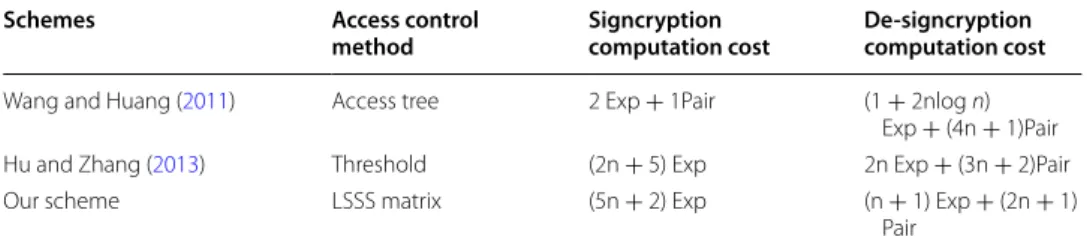
In this paper, we compare the proposed scheme with Wang’s and Hu’s schemes with respect to the computation cost and access control method. Due to the fact that the computation cost of add operation and multiply operation is much smaller than that of exponential operation and bilinear pairing operation, consequently, we mainly compare the number of exponential operation and bilinear pairing operation in different schemes. We denote “Exp” and “Pair” by exponential operation and bilinear pairings. Detailed results are listed in Table 1.
From Table 1, we can figure out that the number of exponential operation in the sign-cryption in our CP-ABSC is more than those in Wang and Huang (2011) and Hu and Zhang (2013), however, the number of bilinear pairing operation in the de-signcryp-tion is decreased greatly. Since the computade-signcryp-tion burden of bilinear pairing operade-signcryp-tion is heavier than that of exponential operation, the total computation cost has been reduced in our scheme. What’s more, our CP-ABSC adopts LSSS to realize data access control, which differs from the access structures in Wang and Huang (2011 and Hu and Zhang (2013). The LSSS access structure not only avoids the frequent calls of recursive algo-rithm used in access tree structure model, but also provides more flexible control man-agement and increases the overall efficiency of the cryptosystem.
Conclusion
In this paper, we propose an optimized attribute based signcryption scheme. By security analysis, we prove that it meets the security demands of confidentiality, unforgeability and non-repudiation. Besides, by introducing LSSS structure to implement the access control function, the flexibility and efficiency of the whole attributed based signcryption system has been improved.
Our future work should focus on the attribute revocation and key refreshing in the attribute based encryption. Since users with the same set of attributes share the same private key, once a single user’s private key has been leaked, a group of users’ privacy and privilege will be damaged. Consequently, protecting users’ privacy and refreshing private keys at a lower cost when private key leakage happens is a problem urgently to be solved and should be taken into our future research direction.
Table 1 Performance comparison
Schemes Access control
method Signcryption computation cost De-signcryption computation cost Wang and Huang (2011) Access tree 2 Exp + 1Pair (1 + 2nlog n)
Exp + (4n + 1)Pair Hu and Zhang (2013) Threshold (2n + 5) Exp 2n Exp + (3n + 2)Pair
Our scheme LSSS matrix (5n + 2) Exp (n + 1) Exp + (2n + 1)
Authors’ contributions
HH: Carried out the attribute based signcryption studies, participated in the design of scheme and drafted the manu-script. ZS: Participated in the performance analysis of the scheme. Both authors read and approved the final manumanu-script.
Authors’ information
Dr. Zhixin Sun is the dean of Internet of Things institute, Nanjing University of Posts and Telecommunications. He has published more than 50 literatures on journals worldwide. His research area includes information security, computer networks, computer science, etc. Dr. Hanshu Hong is a PHD candidate in Nanjing University of Posts and Telecommuni-cations. His research area includes information security, cryptology.
Acknowledgements
This research is supported by the National Natural Science Foundation of China (60973140, 61170276, 61373135). The authors thank the sponsors for their support and the reviewers for helpful comments.
Competing interests
The authors declare that they have no competing financial interests.
Received: 21 February 2016 Accepted: 5 May 2016
References
Beimel A (1996) Secure schemes for secret sharing and key distribution. Ph.D. thesis, Israel Institute of Technology, Tech-nion, Haifa, Israel
Bethencourt J, Sahai A, Waters B (2007) Ciphertext-policy attribute based encryption. In: Proceedings of the 2007 IEEE symposium on security and privacy. Washington: IEEE Computer Society, pp 321–334
Goyal V, Pandey O, Sahai A, Waters B (2006) Attribute based encryption for fine-grained access control of encrypted data. In: ACM conference on computer and communications security, pp 89–98
Goyal V, Jain A, Pandey O, Sahai A (2008) Bounded ciphertext policy attribute based encryption. In: Proceedings of the 35th international colloquium, pp 579–591, Reykjavik, Iceland, 2008
Guo SQ, Zeng YP (2008) Attribute based signature scheme. In: International conference on information security and assurance, pp 509–511
Hu C, Zhang N (2013) Body area network security: a fuzzy attribute based signcryption scheme. IEEE J Sel Areas Commun Suppl 31(9):37–46
Lewko A, Okamoto T, Sahai A, Takashima K, Waters B (2010) Fully secure functional encryption: attribute based encryption and (hierarchical) inner product encryption. In: Advances in cryptology—EUROCRYPT 2010, pp 62–91, Springer, Berlin, Germany, 2010
Li F, Khan MK (2012) A biometric identity-based signcryption scheme. Future Gener Comput Syst 28(1):306–310 Lim CH, Lee PJ (1998) A study on the proposed Korean digital signature algorithm. In: Advanced in
cryptology—ASIA-CRYPT’98, pp 175–185
Maji H, Prabhakaran M, Rosulek M (2011) Attribute based signatures. In: CT-RSA 2011, pp 376–392, Springer
Paulo SLM, Barreto BL, McCullagh N, Quisquater J-J (2005) Efficient and provably-secure identity-based signatures and signcryption from bilinear maps. Adv Cryptol ASIACRYPT LNCS 3788:515–532
Sahai A, Waters B (2005) Fuzzy identity-based encryption. In: Proceedings of the international conference on EUROCRYPT 2005, pp 457–473, Aarhus, Denmark
Selvi S, Vivek S, Shukla D, Chandrasekaran P (2008) Efficient and provably secure certificateless multi-receiver signcryp-tion. ProvSec 5324:52–67
Tan C (2008) On the security of provably secure multi-receiver ID-based signcryption scheme. IEICE transactions on fundamentals of electronics. Commun Comput Sci E91-A(7):1836–1838
Tian Y, Peng Y (2014) An attribute based encryption scheme with revocation for fine-grained access control in wireless body area networks. Int J Distrib Sens Netw 2014:9, Article ID 259798
Wang C, Huang J (2011) Attribute based signcryption with ciphertext policy and claim predicate mechanism. In: CIS, 2011 Seventh international conference, pp 905–909
Waters B (2011) Ciphertext policy attribute based encryption: an expressive, efficient, and provably secure realization. In: Proceedings of International Conference on PKC 2011, pp 53–70, Taormina, Italy, March 2011
Zheng Y (1997) Digital signcryption or how to achieve cost (signature & encryption) ≪ cost (signature) + cost (encryp-tion). In: CRYPTO 1997, pp 165–179, Springer