2
Use Cases and Interactions for Managing Clouds
3
A White Paper from the Open Cloud Standards Incubator
4
Version: 1.0.0
5
Status: DMTF Informational
6
Publication Date: 2010-06-18
7
Document Number: DSP-IS0103
Copyright © 2010 Distributed Management Task Force, Inc. (DMTF). All rights reserved.
9
DMTF is a not-for-profit association of industry members dedicated to promoting enterprise and systems
10
management and interoperability. Members and non-members may reproduce DMTF specifications and
11
documents, provided that correct attribution is given. As DMTF specifications may be revised from time to
12
time, the particular version and release date should always be noted.
13
Implementation of certain elements of this standard or proposed standard may be subject to third party
14
patent rights, including provisional patent rights (herein "patent rights"). DMTF makes no representations
15
to users of the standard as to the existence of such rights, and is not responsible to recognize, disclose,
16
or identify any or all such third party patent right, owners or claimants, nor for any incomplete or
17
inaccurate identification or disclosure of such rights, owners or claimants. DMTF shall have no liability to
18
any party, in any manner or circumstance, under any legal theory whatsoever, for failure to recognize,
19
disclose, or identify any such third party patent rights, or for such party’s reliance on the standard or
20
incorporation thereof in its product, protocols or testing procedures. DMTF shall have no liability to any
21
party implementing such standard, whether such implementation is foreseeable or not, nor to any patent
22
owner or claimant, and shall have no liability or responsibility for costs or losses incurred if a standard is
23
withdrawn or modified after publication, and shall be indemnified and held harmless by any party
24
implementing the standard from any and all claims of infringement by a patent owner for such
25
implementations.
26
For information about patents held by third-parties which have notified the DMTF that, in their opinion,
27
such patent may relate to or impact implementations of DMTF standards, visit
28
29
30
CONTENTS
31
Foreword ... 5
32
1
Scope ... 7
33
2
References ... 7
34
3
Terms and Definitions ... 8
35
4
Symbols and Abbreviated Terms... 11
36
5
Introduction... 12
37
6
Reference Architecture Overview ... 13
38
7
Actors ... 14
39
8
Lifecycle of a Cloud Service ... 16
40
9
Overview of Primary Service Artifacts... 17
41
10
Use Cases ... 18
42
10.1
Establish Relationship... 18
43
10.2
Administer Relationship ... 20
44
10.3
Establish Service Contract... 21
45
10.4
Update Service Contract... 24
46
10.5
Contract Reporting... 26
47
10.6
Contract Billing... 29
48
10.7
Terminate Service Contract ... 31
49
10.8
Provision Resources ... 33
50
10.9
Deploy Service Template... 37
51
10.10
Change Resource Capacity ... 40
52
10.11
Monitor Service Resources... 42
53
10.12
Create Service Template ... 44
54
10.13
Create Service Offering ... 46
55
10.14
Notification of Service Condition or Event ... 50
56
11
Data Artifacts Overview... 52
57
12
Data Artifact Details... 54
58
12.1
Service Template ... 54
59
12.2
Service Offering ... 55
60
12.3
Supported Operation... 56
61
12.4
Service Contract ... 57
62
12.5
Service Request... 58
63
12.6
Service Instance ... 59
64
12.7
Service Topology ... 60
65
12.8
Service Topology Item ... 61
66
12.9
Service Topology Relationship ... 62
67
12.10
Consumer Information ... 64
68
12.11
Developer Information... 64
69
12.12
Provider Information... 65
70
12.13
Relationship (Between Organizations) ... 65
71
12.14
Contact Information... 66
72
12.15
Credentials Token... 66
73
12.16
User Identity Information... 67
74
12.17
Report Definition ... 68
75
12.18
Report ... 69
76
12.19
Service Event Log... 70
77
12.20
Service Notification ... 70
78
12.21
Audit Event Record ... 72
79
13
Future Work... 72
80
13.1
Interface Granularity ... 72
81
13.2
Interface Extendibility... 73
82
13.3
Additional Use Cases... 73
83
13.4
Security and Governance Use Cases... 73
84
13.5
Log Handling... 73
85
13.6
Cloud Service Developer Actor... 74
86
Annex A (informative) Change Log ... 75
87
88
Figures
89
Figure 1 – Scope and Benefits of DMTF Open Cloud Standards Incubator... 13
90
Figure 2 – Cloud Service Reference Architecture ... 14
91
Figure 3 – Cloud Actors ... 14
92
Figure 4 – Cloud Service Lifecycle and Use Cases... 16
93
Figure 5 – Service Artifacts Overview... 17
94
Figure 6 – Establish Relationship ... 19
95
Figure 7 – Administer Relationship ... 21
96
Figure 8 – Establish Service Contract... 23
97
Figure 9 – Update Service Contract... 26
98
Figure 10 – Contract Reporting... 28
99
Figure 11 – Contract Billing... 30
100
Figure 12 – Terminate Service Contract ... 33
101
Figure 13 – Provision Resources... 37
102
Figure 14 – Deploy Service Template... 40
103
Figure 15 – Change Resource Capacity... 42
104
Figure 16 – Monitor Service Resources... 44
105
Figure 17 – Create Service Template ... 46
106
Figure 18 – Create Service Offering ... 49
107
Figure 19 – Notification of Service Condition or Event ... 51
108
Figure 20 – Service Artifacts UML Diagram... 52
109
Figure 21 – Relationship Artifacts UML Diagram... 53
110
Figure 22 – Security-Specific Use Cases ... 73
111
112
Tables
113
Table 1 – Cloud Actor Descriptions ... 15
114
Foreword
116
The Use Cases and Interactions for Managing Clouds white paper was prepared by the Open Cloud
117
Standards Incubator of the DMTF.
118
DMTF is a not-for-profit association of industry members dedicated to promoting enterprise and systems
119
management and interoperability.
120
This living document is specifically targeted to assist the Cloud Incubator in being successful across
121
transitions in leadership, charter adjustments, and membership.
122
Acknowledgments
123
The Open Cloud Standards Incubator wishes to acknowledge contributions from the following people:
124
•
Kane,
Valerie
–
Advanced Micro Devices
125
•
Vancil,
Paul
–
Advanced Micro Devices
126
•
Kowalski,
Vincent
–
BMC Software
127
•
Lipton,
Paul
–
CA, Inc.
128
•
Moscovich,
Efraim
–
CA, Inc.
129
•
Waschke,
Marvin
–
CA, Inc.
130
•
Armstrong,
Joseph
–
Cisco
131
•
Sankar,
Krishna
–
Cisco
132
•
Serr,
Frederick
–
Cisco
133
•
Siefer,
Mike
–
Cisco
134
•
Tomsu,
Peter
–
Cisco
135
•
Wheeler,
Jeff
–
Cisco
136
•
Pardikar,
Shishir
–
Citrix Systems Inc.
137
•
Sirjani,
Abolfazl
–
Citrix Systems Inc.
138
•
Landau,
Richard
–
Dell
139
•
Ericson,
George
–
EMC
140
•
Linn,
John
–
EMC
141
•
Durand,
Jacques
–
Fujitsu
142
•
Song,
Zhexuan
–
Fujitsu
143
•
Aguiar,
Glaucimar
–
Hewlett-Packard Company
144
•
Cook,
Nigel
–
Hewlett-Packard Company
145
•
Maciel,
Fred
–
Hitachi, Ltd.
•
Baskey,
Michael
–
IBM
147
•
Johnson,
Mark
–
IBM
148
•
Pendarakis,
Dimitrios
–
IBM
149
•
Cox,
Billy
–
Intel Corporation
150
•
Li,
Hong
–
Intel Corporation
151
•
Raghu,
Rekha
–
Intel Corporation
152
•
Parchem,
John
–
Microsoft Corporation
153
•
Carter,
Steve
–
Novell
154
•
Jose,
Jaimon
–
Novell
155
•
Carlson,
Mark
–
Oracle
156
•
Vambenepe,
William
–
Oracle
157
•
Yu,
Jack
–
Oracle
158
•
Owens,
Ken
–
Savvis
159
•
Qualls,
Richard
–
Sun Microsystems, Inc.
160
•
Norbeck,
Don
–
SunGard Availability Services
161
•
Ronco,
Enrico
–
Telecom Italia
162
•
Galán Márquez, Fermín
–
Telefónica
163
•
Bumpus,
Winston
–
VMware Inc.
164
•
Lamers,
Lawrence
–
VMware Inc.
165
•
Matthews,
Jeanna
–
VMware Inc.
Use Cases and Interactions for Managing Clouds
167
1 Scope
168
This document is one of two documents that together describe how standardized interfaces and data
169
formats can be used to manage clouds. This document focuses on use cases, interactions, and data
170
formats; the other document focuses on the overall architecture.
171
The scope of this document includes:
172
•
Management use cases across the entire lifecycle of a cloud service. The use cases are
173
examples and not a complete list of all use cases related to managing clouds. For example, use
174
cases for federating and brokering among clouds are not included.
175
•
Interaction sequences between consumers, developers, and providers to implement the use
176
cases
177
•
Data artifacts exchanged in the interaction sequences
178
The following aspects of clouds are specifically outside the scope of this document:
179
•
Prescriptive definition of required use cases
180
•
Formal definition of a data model, or any associated database schema
181
The companion to this document,
Architecture for Managing Clouds
(DSP-IS0102), is a white paper that
182
describes other aspects of managing clouds. That document describes:
183
•
Reference architecture for managing clouds. This reference architecture was first introduced in
184
the DMTF white paper,
Interoperable Clouds
(DSP-IS0101). The concepts are further explored
185
and described in this document.
186
•
Requirements for the architected interfaces in general, including requirements on the protocols,
187
resource model, and security mechanisms
188
•
Role of policies and constraints. Given the focus on the interfaces for managing clouds rather
189
than the internal details of a cloud implementation, a useful abstraction is to define the desired
190
capabilities of the cloud using policies and constraints. These are interpreted to be what the
191
cloud service provider should provide rather than how it offers it.
192
•
Patterns of consumer/provider interactions that repeat across many use cases with different
193
operations and data payloads, depending on the use case
194
•
Example of how a cloud service provider may implement the management interfaces, along with
195
a discussion of design consideration. It should be emphasized that this section is not
196
prescriptive; rather, it is illustrative.
197
2 References
198
DMTF DSP0243, Open Virtualization Format Specification 1.1,
199
200
DMTF DSP-IS0101, Interoperable Clouds, A White Paper from the Open Cloud Standards Incubator 1.0,
201
DMTF DSP-IS0102, Architecture for Managing Clouds, A White Paper from the Open Cloud Standards
203
Incubator 1.0,
204
ITIL® V3 Glossary, Glossary of Terms, Definitions, and Acronyms, v3.1.24, 11 May 2007,
205
206
NIST Definition of Cloud Computing,
207
208
3 Terms and Definitions
209
For the purposes of this document, the following terms and definitions apply.
210
3.1
211
cloud service
212
a publicly available service or a private service that is used within an enterprise
213
3.2
214
cloud service developer
215
designs, implements, and maintains service templates
216
3.3
217
cloud service consumer
218
•
approves business / financial expenditures for consumed services
219
•
accounts for used service instances
220
•
requests service instances and changes to service instances (typically on behalf of the consumer
221
business manager)
222
•
provides access to services for service users
223
3.4
224
cloud service provider
225
an organization that supplies cloud services to one or more internal or external consumers
226
3.5
227
data artifacts
228
as used in this document, the control and status elements exchanged across the provider interface using
229
the Infrastructure
230
3.6
231
deployment
232
the process of creating a service instance in a reserved or prepared environment
233
3.7
234
Infrastructure as a Service
235
IaaS
236
the capability provided to the consumer is to provision processing, storage, networks, and other
237
fundamental computing resources where the consumer is able to deploy and run arbitrary software, which
238
can include operating systems and applications
239
The consumer does not manage or control the underlying cloud infrastructure but has control over
240
operating systems, storage, deployed applications, and possibly limited control of select networking
241
components (for example, host firewalls). (Source:
NIST Definition of Cloud Computing
)
242
3.8
243
notification
244
a signal from the cloud service provider to the cloud service consumer that a condition exists that requires
245
attention
246
A notification can be either polled or sent asynchronously.
247
3.9
248
profile
249
a specification that defines how a set of standards, specifications, or models apply to a specific
250
management domain
251
In the context of this document, a profile may refer to DMTF CIM models and associated behavior and
252
may also refer to other documents as well.
253
3.10
254
provider interface
255
the interface through which cloud service consumers access and monitor their contracted services
256
The interface covers SLA negotiation, service access, service monitoring, and billing. This interface is
257
also the interface through which a cloud service developer interacts with a cloud service provider to
258
create a service template that is added to the service catalog.
259
3.11
260
provisioning
261
the process of selecting, reserving, or creating an instance of a service offering
262
Service offerings are selected from the service provider’s service catalog and are then provisioned into
263
service instances.
264
Provisioning is also the process of selecting or reserving service resources from available pools,
265
assembling them together, and configuring them, based on
a specific request in the contract, in order to
266
fulfill the contract.
267
For example, a server instance can be created from a template; assigned CPU, memory, storage, and
268
network resources; and configured for the consumer to satisfy the contract requirements (apply patches,
269
adjust security, configure firewall, and so on).
270
3.12
271
security manager
272
responsible for managing the credentials and authentication processes as they relate to the operations
273
across the provider interface
274
Security requirements for the cloud include user authentication, identity and access management, data
275
protection, multi-tenancy resource isolation, monitoring and auditing for compliance, incident response,
276
user and customer privacy, as well as the underlying portability and interoperability of security
277
components.
278
3.13
279
service catalog
280
a database of information about the cloud services offered by a service provider
281
The service catalog includes a variety of information about the services, including description of the
282
services, the types of service, cost, supported SLAs, and who can view or use the services. More
283
generally, the service catalog contains information about services through their entire lifecycle. It contains
284
service templates (created by developers), service offerings (created by providers), and deployed service
285
instances.
286
3.14
287
service contract
288
an agreement between the cloud service provider and cloud service consumer to state the terms of the
289
services usage by the cloud service consumer
290
3.15
291
service instance
292
the instantiation of a service request
293
3.16
294
service-level agreement
295
SLA
296
in the context of cloud service providers, including brokers and federators, a negotiated, legally binding
297
contract between the cloud service provider and cloud service consumer
298
The SLA includes agreements about services and responsibilities about service availability, performance,
299
and billing. The SLA must be structured such that it can be propagated to all involved cloud service
300
providers. The consumer contracts services from one cloud service provider who could be a broker,
301
federator, or non-broker/non-federator, and that SLA is used as the basis for the broker or federator to
302
programmatically contract for services from other cloud service providers.
303
3.17
304
service manager
305
responsible for managing the service instance and service topology
306
The service manager provides facilities to administrator to create virtual machine instances and services.
307
The service manager also provides mechanisms for creation, monitoring, control, and reporting of
308
services.
309
3.18
310
service offering
311
a service template combined with SLAs, constraints, costs, billing information and other data necessary to
312
offer the service described in the template to a consumer
313
3.19
314
service request
315
a request by a consumer to instantiate a service offering
316
Requests require service contracts, which may be created prior to or simultaneously with service
317
requests.
318
3.20
319
service template
320
a collection of items (machine images, connectivity definitions, storage, and so on) that are stored in the
321
service catalog and can be provisioned at the cloud service provider
322
3.21
323
service topology item
324
the components of a service instance
325
3.22
326
service topology relationship
327
defines relationships (for example, depends on, hosts) between service topology items
328
3.23
329
template
330
often used as a synonym for service template
331
3.24
332
virtual image
333
an element (often as part of a package using the
Open Virtualization Format
) that encapsulates a
334
workload consisting of all the code necessary to run the workload with the metadata that is necessary to
335
configure the environment in which to run it
336
3.25
337
workload portability
338
provides the capability for the cloud service consumer to create a service package and then provision that
339
package in different cloud service providers without substantial modifications
340
4
Symbols and Abbreviated Terms
341
3.1
342
DoS
343
denial of service
344
3.2
345
IaaS
346
Infrastructure as a Service
347
3.3
348
IDS
349
intrusion-detection system
350
3.4
351
NIST
352
National Institute of Standards and Technology
353
3.5
354
OVF
355
Open Virtualization Format
356
3.6
357
PaaS
358
Platform as a Service
359
3.7
360
QoS
361
quality of service
362
3.8
363
REST
364
Representational State Transfer
365
3.9
366
SLA
367
service-level agreement
368
3.10
369
SLO
370
service-level objective
371
3.11
372
URI
373
Uniform Resource Identifier
374
5 Introduction
375
The definitions of cloud computing — including private and public clouds, Infrastructure as a Service
376
(IaaS), and Platform as a Service (PaaS) — are taken from work by the
National Institute of Standards
377
and Technology
(NIST). In part, NIST defines cloud computing as “… a model for enabling convenient,
378
on-demand network access to a shared pool of configurable computing resources (for example, networks,
379
servers, storage, applications, and services) that can be rapidly provisioned and released with minimal
380
management effort or service provider interaction.”
381
NIST defines four cloud deployment models:
382
•
public clouds (cloud infrastructure made available to the general public or a large industry group)
383
•
private clouds (cloud infrastructure operated solely for an organization)
384
•
community clouds (cloud infrastructure shared by several organizations)
385
•
hybrid clouds (cloud infrastructure that combines two or more clouds)
386
The environment under consideration by the Open Cloud Standards Incubator includes all of these
387
deployment models. The main focus of the Incubator is management aspects of IaaS, with some work
388
involving PaaS. These aspects include service-level agreements (SLAs), quality of service (QoS),
389
workload portability, automated provisioning, and accounting and billing. This scope is described in the
390
white paper,
Interoperable Clouds
.
391
The fundamental IaaS capability made available to cloud consumers is a cloud service. Examples of
392
services are computing systems, storage capacity, and networks that meet specified security and
393
performance constraints. Examples of consumers of cloud services are enterprise datacenters, small
394
businesses, and other clouds.
395
Many existing and emerging standards will be important in cloud computing. Some of these, such as
396
security-related standards, apply generally to distributed computing environments. Others apply directly to
397
virtualization technologies, which are expected to be important building blocks in cloud implementations.
398
(The dynamic infrastructure enabled by virtualization technologies aligns well with the dynamic
on-399
demand nature of clouds.) Examples of standards include SLA management and compliance, federated
400
identities and authentication, and cloud interoperability and portability.
401
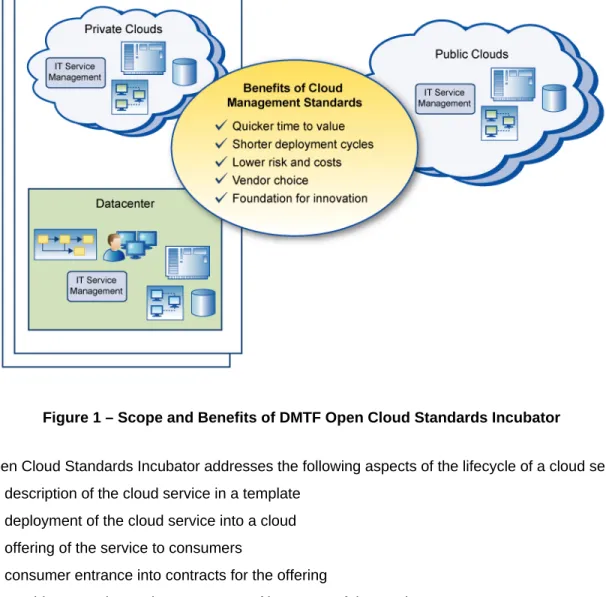
Figure 1 shows the scope of the Open Cloud Standards Incubator and the benefits of extending
402
management and virtualization standards.
403
404
Figure 1 – Scope and Benefits of DMTF Open Cloud Standards Incubator
405
The Open Cloud Standards Incubator addresses the following aspects of the lifecycle of a cloud service:
406
•
description of the cloud service in a template
407
•
deployment of the cloud service into a cloud
408
•
offering of the service to consumers
409
•
consumer entrance into contracts for the offering
410
•
provider operation and management of instances of the service
411
•
removal of the service offering
412
When practical, existing standards (or extensions to them) will be integrated into the recommended
413
solution. Examples of standardization areas include resource management protocols, data artifacts,
414
packaging formats, and security mechanisms to enable interoperability.
415
6 Reference Architecture Overview
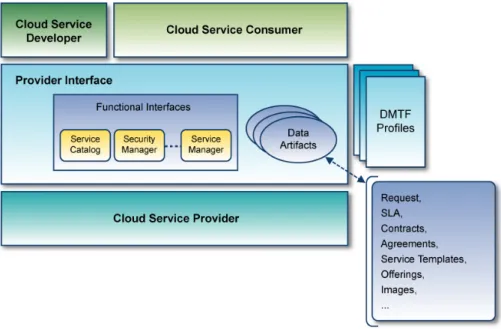
416
This section introduces the conceptual Cloud Service Reference Architecture (Figure 2), which describes
417
key components — such as actors, interfaces, data artifacts, and profiles — and the interrelationships
418
among these components.
419
420
Figure 2 – Cloud Service Reference Architecture
421
7 Actors
422
Figure 3 shows the three actor categories (cloud service consumer, provider, and developer) and the
423
seven detailed actors within the categories. The actor categories are shaded in different colors to aid
424
understanding: consumer (green), provider (pink), and developer (blue).
425
426
Figure 3 – Cloud Actors
427
Table 1 describes each actor in more detail.
428
Table 1 – Cloud Actor Descriptions
429
Actor Category Actor Description
Cloud Service Developer
Service Developer • Designs, implements, and maintains service templates (technical aspect). These templates can be used by providers to create offerings. The person performing this role could be employed by the same organization that is a cloud service provider or cloud service consumer.
Service Operations Manager
• Manages the technical infrastructure required for providing cloud services
• Monitors and measures performance and utilization against SLAs
• Provides reports from monitoring and measurement (used for audit and compliance)
Service Business Manager
• Offers all types of services developed by cloud service developers
• Accounts for services potentially offered by service providers themselves and services offered on behalf of cloud service developers
• Establishes a portfolio of business relationships, and sets up accounts and terms for cloud service consumers (including the master account, which is the master relationship between the consumer and provider)
Cloud Service Provider
Service Transition Manager
• Enables a customer to use the cloud service, including "onboarding", integration, and process adoption
• Defines and creates service offerings based on templates that can be used by cloud service consumers and are populated into the catalog
Consumer Business Manager
• Approves business and financial expenditures for consumed services
• Accounts for used service instances
• Establishes business relationships; sets up accounts, budget, and terms; and so on
Consumer Service Administrator
• Requests service instances and changes to service instances (typically on behalf of the consumer business manager) • Purchaser of services with the business relationship; creates
Service User roles
• Creates users (including policies), allocates resources, such as compute and storage, generates reports (usage); performs actions for a specific set of resources
Cloud Service Consumer
Service User • Uses service instances provided by a cloud service provider. The Service User role is distinct from the Consumer Service Administrator role because it has no responsibility for managing the service.
8 Lifecycle of a Cloud Service
430
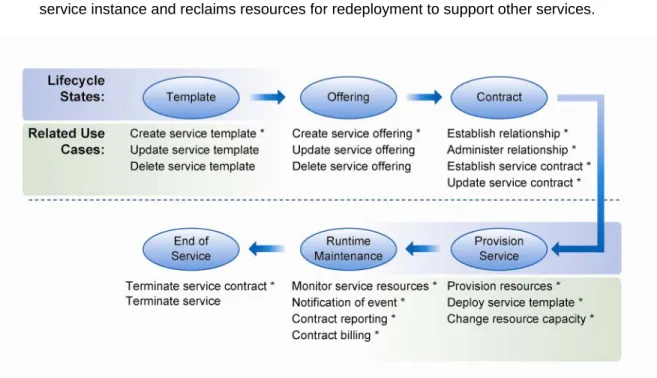
Figure 4 shows the six lifecycle states of a typical cloud service with the use cases that are most relevant
431
to each state. Use cases marked with an asterisk in the figure are described in detail in this document.
432
•
Template – A developer defines the service in a template that describes the content of and
433
interfaces to a service.
434
•
Offering – A provider adds constraints, costs, and policies to a template to create an offering
435
available for request by a consumer.
436
•
Contract – A consumer and provider enter into a contract for services, including agreements on
437
costs, SLAs, SLOs, and specific configuration options.
438
•
Provision Service – A provider deploys (or modifies) a service instance per the contract with the
439
consumer.
440
•
Runtime Maintenance – A provider manages a deployed service and all its resources, including
441
monitoring resources and notifying the consumer of key situations.
442
•
End of Service – A provider and consumer agree to terminate a service. The provider halts a
443
service instance and reclaims resources for redeployment to support other services.
444
445
Figure 4 – Cloud Service Lifecycle and Use Cases
446
9 Overview of Primary Service Artifacts
447
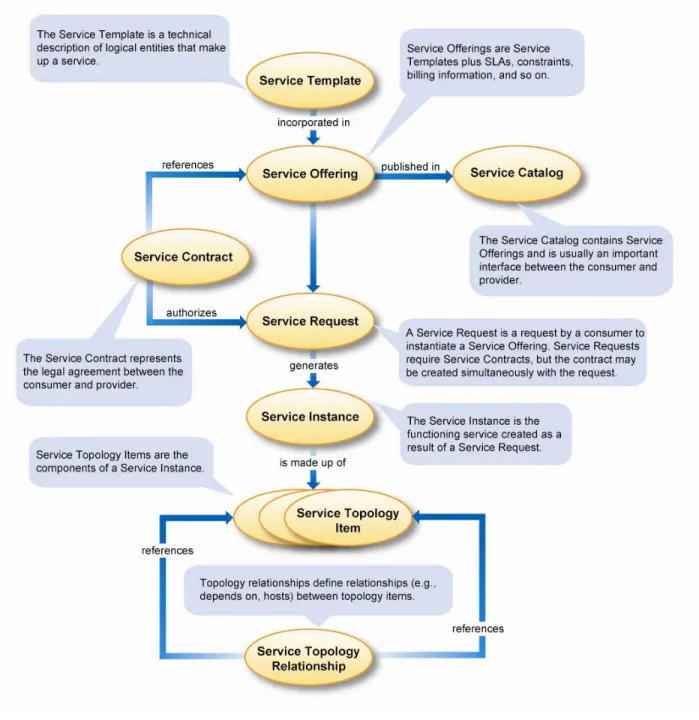
Figure 5 shows some of the most important data artifacts associated with the lifecycle of a service, along
448
with brief descriptions. A more complete picture of service-related objects is shown in Figure 20 on page
449
52.
450
451
Figure 5 – Service Artifacts Overview
452
10 Use Cases
453
This section presents the management use cases for the lifecycle of a cloud service. The information for
454
each use case is presented in a table format, with a figure that illustrates the process flow. See Figure 4
455
for a summary of the use cases and the service lifecycle states to which they apply.
456
10.1 Establish Relationship
457
DMTF-001 Establish Relationship
Description A potential consumer of a cloud-based service establishes their identity with a cloud service provider for use in future transactions.
Desired outcome The cloud service consumer receives some form of token or proof of identification that can be used in a future transaction. The transaction may be in the immediate future, in which case establishment of identity may be combined with requesting a service contract and even service delivery. The token received in this use case may be good for a single use or it may be permanent.
Business events The triggering events for establishing a relationship are basically for the same events that trigger a request for a service contract because the relationship is formed for executing implied or actual service contracts. Following are examples of triggering events:
• A consumer identifies a new need and seeks a service capable of meeting that need at an acceptable cost.
• A service is publicized, and a potential consumer recognizes the service as part of a better solution than an existing solution.
• A service is publicized, and a potential consumer discovers a possible new activity. • An existing service is found to be inadequate in utility, availability, capacity, reliability, cost,
or in other ways, and the cloud service consumer seeks an alternative service. Actors • Service Business Manager or agent
• Consumer Business Manager or agent Involved
components and services
• Cloud service provider identity service
• User ID, email address, token, certificate or other credential Dependencies None
Process assumptions
The cloud service provider has an ITIL-style service catalog, as described in the ITIL Glossary of Terms, Definitions, and Acronyms, which is available to potential cloud service consumers.
Step description Data or data artifact required
1. The Consumer Business Manager (CBM) (or other consumer representative) requests the establishment of a relationship.
None Process flow
2. The Service Business Manager (or other provider representative, which may be an automated agent) requests identifying information.
Data requested of the consumer may include: • Name
• Business name
• Physical mailing address • Telephone numbers • Email addresses • Other identifying data
In some cases, payment information such as credit card numbers is requested at this point.
DMTF-001 Establish Relationship
3. The CBM provides the requested information.
• Consumer information • Contact information 4. The CBM is returned a credential that
may be used in future transactions.
Credentials token
Variations This use case can take various forms. At its core, it unambiguously identifies the consumer and the provider to each other and may provide a means for reusing that identification for many future transactions. In some variations, an actual or implied business contract is established between the consumer and provider. In other variations, no contract is established until the services to be provided are identified.
Additional information
None
Design notes This use case is often combined with use cases that request a service contract and even service delivery. In some real-world situations, a cloud service consumer identifies themselves with a credit card number, selects a service such as the use of a computing service with standard capacity and features for a specified period, pays, and receives access to the service in a single episode that is completed in a few minutes. In other cases, a consumer may register with a provider and receive a user ID and password. Sometime later, perhaps months later, the consumer uses the ID and password to request a contract and then after another interval, requests that the service be provisioned. Finally, after yet another interval, the consumer begins to use the service.
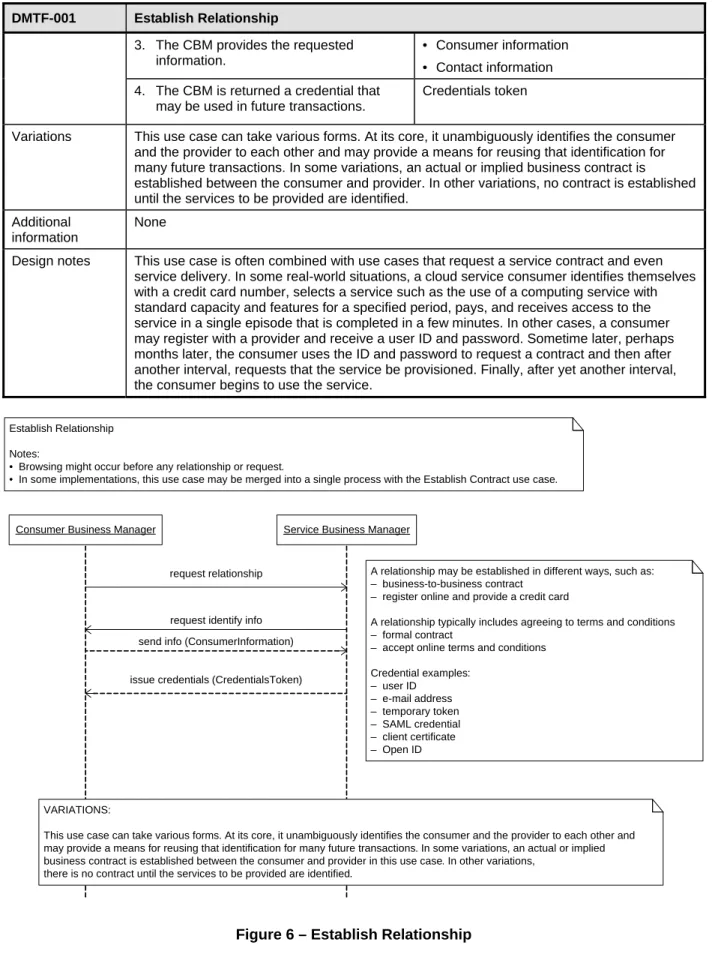
Consumer Business Manager Service Business Manager
request relationship
issue credentials (CredentialsToken) Establish Relationship
Notes:
• Browsing might occur before any relationship or request.
• In some implementations, this use case may be merged into a single process with the Establish Contract use case.
A relationship may be established in different ways, such as: – business-to-business contract
– register online and provide a credit card
A relationship typically includes agreeing to terms and conditions – formal contract
– accept online terms and conditions Credential examples: – user ID – e-mail address – temporary token – SAML credential – client certificate – Open ID request identify info
send info (ConsumerInformation)
VARIATIONS:
This use case can take various forms. At its core, it unambiguously identifies the consumer and the provider to each other and may provide a means for reusing that identification for many future transactions. In some variations, an actual or implied business contract is established between the consumer and provider in this use case. In other variations,
there is no contract until the services to be provided are identified.
458
Figure 6 – Establish Relationship
459
10.2 Administer Relationship
460
DMTF-002 Administer Relationship
Description A potential consumer of a cloud-based service requests administration of a contract. Administration is distinguished from changing a service because administration does not affect the technical delivery of a service. Usually, contract administration involves actions like adding new users or changing user passwords that are associated with an umbrella contract (usually called the “relationship”), not a contract for a specific service.
Desired outcome The service consumer is properly authenticated and is able to make the administrative change.
Business events The triggering event could be as follows:
• A consumer wants to add or remove a user for the services offered by the provider. This may be due to a change in the consumer’s business or the on-boarding or off-boarding of an employee.
• Due to policy or a security issue, a password must be changed, or another runtime event, such as auditing, monitoring, or customer reporting, must be changed. Actors • Service Business Manager (SBM)
• Consumer Business Manager (CBM) Involved components
and services
• Service catalog • Service contract
• External (third party) identity management service
Dependencies • Relationship between consumer and provider has been established
• External identity management service (in case third-party attestation is needed) Process assumptions • The consumer has a relationship with the provider.
• Although it is likely, the consumer need not have a contract for any specific service. • The cloud service provider has federated identity management and standard
authentication mechanisms such as Oauth/OpenID, LDAP/AD, X509 CA, or SAML.
Step description Data or data artifact required
1. CBM logs in. Established account, security profile, and credentials
2. CBM requests administrable aspects from a catalog for browsing.
Consumer security policies
3. Service catalog returns a list of administrable aspects for browsing.
None
4. The CBM chooses an aspect and makes a request.
None
5. The SBM accepts the CBM request, makes the change, and establishes a consumer security profile.
None
6. The CBM accepts the change. None Process flow
Steps 4–6 may be repeated to deal with many administrative changes in the same session.
Variations None Additional information None
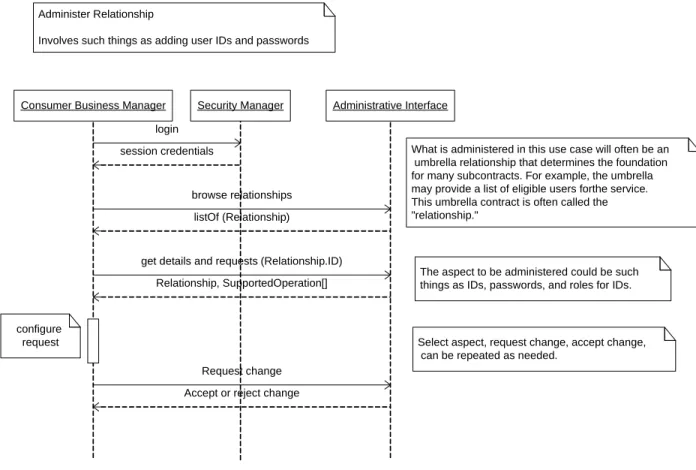
Consumer Business Manager Administer Relationship
Involves such things as adding user IDs and passwords
get details and requests (Relationship.ID) login
session credentials
Administrative Interface
Accept or reject change Relationship, SupportedOperation[]
Request change
The aspect to be administered could be such things as IDs, passwords, and roles for IDs. What is administered in this use case will often be an umbrella relationship that determines the foundation for many subcontracts. For example, the umbrella may provide a list of eligible users forthe service. This umbrella contract is often called the "relationship."
Select aspect, request change, accept change, can be repeated as needed.
browse relationships listOf (Relationship) configure request Security Manager
461
Figure 7 – Administer Relationship
462
10.3 Establish Service Contract
463
DMTF-003 Establish Service Contract
Description A potential consumer of a cloud-based service requests a service contract for a cloud-based service.
Desired outcome The cloud service consumer receives and ratifies in some form, online or offline, a contract that supports a reasonable business and technical decision to subscribe to the delivery of a service. The contract should clearly depict or indicate the business and technical information necessary for the consumer to use the service effectively and in a businesslike fashion. Business events The triggering event could be as follows:
• A consumer identifies a new need and seeks a service capable of meeting that need at an acceptable cost.
• A service is publicized, and a potential consumer recognizes the service as part of a better solution than an existing solution.
• A service is publicized, and a potential consumer discovers a possible new activity. • An existing service is found to be inadequate in utility, availability, capacity, reliability, cost,
or in other ways, and the service consumer seeks an alternative service.
No matter what the triggering event, the potential consumer must evaluate the service contract offered by the cloud service provider and make a decision.
DMTF-003 Establish Service Contract
Actors • Service Business Manager (SBM), who offers the service contract
• Consumer Business Manager (CBM) or executive, who accepts the contract Involved
components and services
• Service catalog • Service contract • The proffered service
Dependencies • Service offering available in the service catalog Process
assumptions
The cloud service provider has an ITIL-style service catalog, as described in the ITIL Glossary of Terms, Definitions, and Acronyms, which is available to potential cloud service consumers. A service offering has already been created and is stored in the service catalog (see the Create Service Offering use case in 10.13).
Step description Data or data artifact required
1. The CBM logs in. Established account, security profile, and credentials
2. The CBM browses available service offerings. Service offering 3. The CBM gets the details about service
offerings, including configurable parameters and supported requests.
• Service offering • Supported operations 4. The CBM chooses options and makes a request. Service request
5. (internal) The SBM analyzes the request and their ability to support it.
None
6. (internal) The SBM authorizes the contract. None 7. The service catalog returns a contract for CBM
acceptance.
Service contract
8. The CBM accepts the contract. Service contract
Process flow
9. The SBM confirms acceptance, providing credentials satisfactory to support non-repudiation requirements.
None
Variations This use case could take place inside a single organization or between organizations. When the use case is within a single organization, the costs and benefits may be tracked in the form of charge backs, or not tracked at all, and the service level agreement and service contract are usually documents, but not legal agreements. The organization determines how closely the agreements and financial tracking conform to the pattern for interorganization
agreements.
In the two-tier variation, the two tiers are the end user of services implemented with cloud services and the cloud service provider. In this variation, the service user is exposed directly to the service provided by the cloud service provider and is most likely aware of the cloud service provider’s presence. The service contract typically is set up by an enterprise manager and made available to the service user. After the initial setup, the service user directly consumes services provided by the cloud service provider.
In the three-tier variation, the three tiers are the end user of services implemented with cloud services, the enterprise data center that uses the cloud services to supply services to the service user, and the cloud service provider. In this scenario, the service user has no exposure to the cloud service provider and likely has no awareness of the cloud service provider’s presence.
DMTF-003 Establish Service Contract
Additional information
None
Design notes None
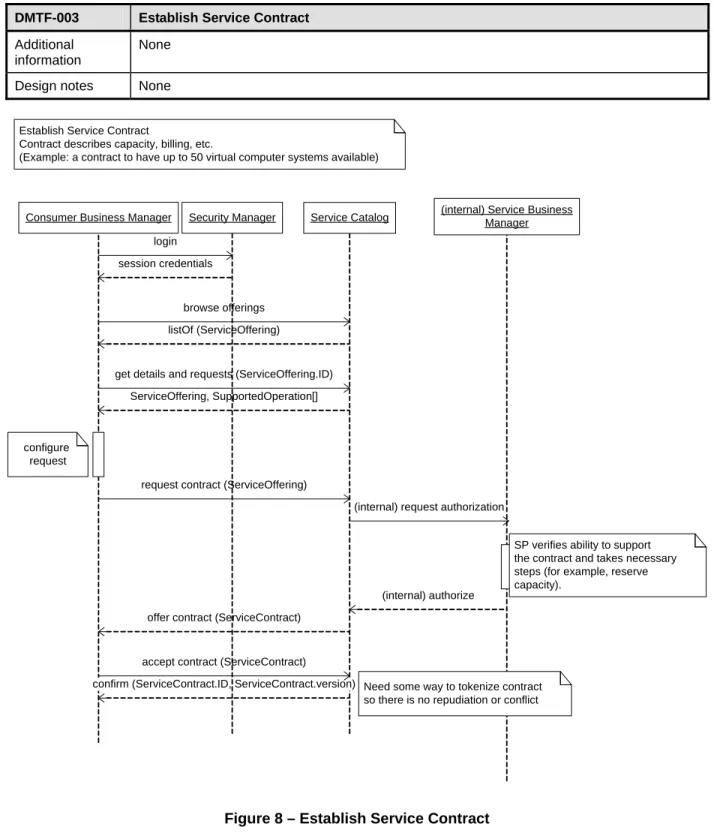
Consumer Business Manager Service Catalog
browse offerings
(internal) Service Business Manager
listOf (ServiceOffering)
request contract (ServiceOffering)
confirm (ServiceContract.ID, ServiceContract.version) offer contract (ServiceContract)
login
session credentials
accept contract (ServiceContract) Establish Service Contract
Contract describes capacity, billing, etc.
(Example: a contract to have up to 50 virtual computer systems available)
SP verifies ability to support the contract and takes necessary steps (for example, reserve capacity).
get details and requests (ServiceOffering.ID)
ServiceOffering, SupportedOperation[]
configure request
Need some way to tokenize contract so there is no repudiation or conflict Security Manager
(internal) request authorization
(internal) authorize
464
Figure 8 – Establish Service Contract
465
10.4 Update Service Contract
466
DMTF-004 Update Service Contract
Description A consumer of a cloud service contract and a provider of a cloud service contract agree to update the contract.
Desired outcome The contract is revised to the mutual satisfaction of the consumer and provider and is ratified by both parties.
Business events The triggering events for updating an existing cloud service contract can come from either the provider or the consumer. Possible consumer triggering events are as follows:
• A consumer identifies a new need and seeks a service capable of meeting that need at an acceptable cost. The consumer then requests that the new service be added to the contract or that greater capacity be added to an existing service.
• Due to changing business circumstances, the consumer may not need contracted services and wants to reduce the capacity or scope of the contract.
• The consumer may want to keep an existing service but change its details (for example, exchange Windows servers for Linux servers) while keeping the service essentially the same.
Possible provider triggering events are as follows:
• The provider may be forced to modify a service offering. For example, a storage provider may replace hardware and consequently change its backup plans. If the backup plan is a detail of a service contract, the contract may have to change.
• A natural disaster or similar event may temporarily change the nature of a service, and a new contract may have to be established.
Actors • Service Business Manager (SBM) or agent • Consumer Business Manager (CBM) or agent Involved
components and services
• User ID, email address, token, certificate or other user credential • Service catalog
Dependencies • Service contract established between the consumer and provider Process
assumptions
• A relationship and contract between the consumer and provider already exist.
• The initial contract is written in such a way that it can be extended or modified rather than terminated and rewritten.
Step description Data or data artifact required
1. The CBM logs in. Established account, security profile, and credentials
2. The CBM browses service contracts. Service contract 3. The CBM gets the details about service
contracts, including configurable parameters and supported requests.
• Service contract • Supported operations 4. The CBM configures the requested changes
based on the configurable parameters and makes a request.
Service contract
5. (internal) The SBM analyzes the request and their ability to support it.
None Process flow
6. (internal) The SBM authorizes the contract change.
DMTF-004 Update Service Contract
7. The service catalog returns a modified contract for acceptance.
Service contract
8. The CBM accepts the contract. Service contract
9. The SBM confirms acceptance, providing credentials satisfactory to support non-repudiation requirements.
None
Variations The transaction can be initiated by either the consumer or provider, but is most frequently initiated by the consumer. Most automated contract modification systems are designed so that consumers can easily adjust the amount of service.
Less often, providers must request that a contract be modified. In such cases, the provider proposes the change.
In both cases, both the consumer and the provider must accept the contract. The SBM could decline to authorize the contract change.
Additional information
None
Design notes The steps in this use case may be combined and shortened in automated situations when contracts are simple and options are few. In its simplest form, the user logs in to the provider’s system and a form is displayed showing the options the consumer has chosen. The consumer clicks on the options to change, clicks Accept, and the transaction is complete. All the steps can be combined because there are few options. On the other hand, a large cloud-based outsourcing contract may be quite complex, involving many iterations of negotiations.
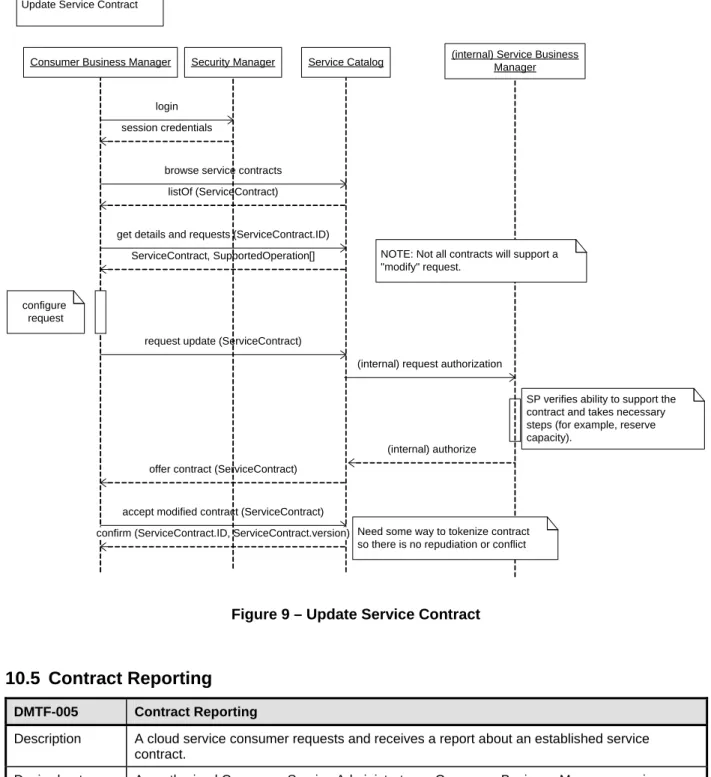
Consumer Business Manager Service Catalog
browse service contracts listOf (ServiceContract)
get details and requests (ServiceContract.ID)
offer contract (ServiceContract) login
session credentials
request update (ServiceContract) Update Service Contract
(internal) Service Business Manager
accept modified contract (ServiceContract) confirm (ServiceContract.ID, ServiceContract.version)
ServiceContract, SupportedOperation[] NOTE: Not all contracts will support a "modify" request.
configure request
Need some way to tokenize contract so there is no repudiation or conflict Security Manager
SP verifies ability to support the contract and takes necessary steps (for example, reserve capacity).
(internal) request authorization
(internal) authorize
467
Figure 9 – Update Service Contract
468
10.5 Contract Reporting
469
DMTF-005 Contract Reporting
Description A cloud service consumer requests and receives a report about an established service contract.
Desired outcome An authorized Consumer Service Administrator or Consumer Business Manager receives reports of actual performance metrics against predefined metrics.
Business events A predefined condition or event for reporting of SLA metrics occurs. Actors • Service Business Manager (SBM)
DMTF-005 Contract Reporting
Involved components and services
• Service catalog • Metering and billing
• Cloud service provider management infrastructure (availability, fault, performance, accounting, and so on)
Dependencies • Service offering is published to service catalog with associated service metrics. • The cloud service provider infrastructure has the capability to record and process SLA
metrics and analytics.
• The CBM or CSA has an access mechanism for or notification of SLA reports. Process
assumptions
• The service catalog contains reporting metrics associated with defined service offerings. • Established format and protocols exist for SLA reporting.
Step description Data or data artifact required
1. The CBM logs in. Established account, security profile, and credentials
2. The CBM browses report definitions. Report definition 3. The CBM gets the details about report
definitions, including configurable parameters and supported requests.
• Report definition • Supported operations 4. The CBM configures the desired report
using the configurable parameters and makes a request.
Report definition
5. The cloud service provider creates a report.
None Process flow
6. The cloud service provider returns the report.
Report definition
Variations Anonymous or delegated, role-based access to performance metrics in SLAs might exist. SLAs for cloud service consumers might be customized or standard.
When cloud service providers are delivering services built on the infrastructure of other cloud service providers, the actor that receives SLA reports may be cloud service consumer management (SLA management and reporting).
Contract reporting may provide for actual performance against defined service level objectives or agreements.
Contract reporting may be temporal in nature (for instance, with a cadence), on demand, or provided via messages when predefined conditions are met.
Additional information
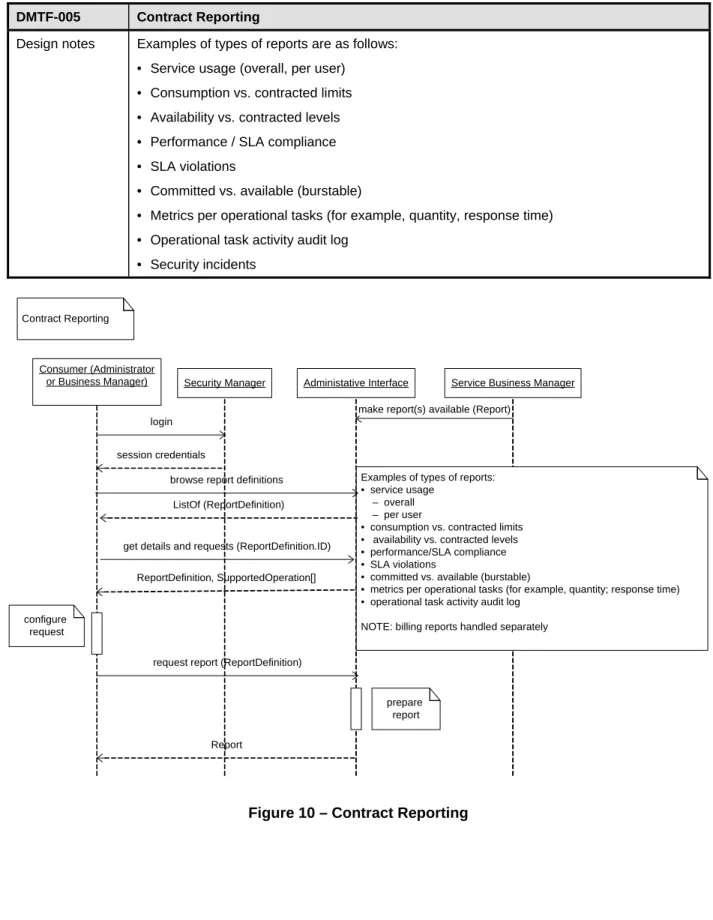
DMTF-005 Contract Reporting
Design notes Examples of types of reports are as follows: • Service usage (overall, per user) • Consumption vs. contracted limits • Availability vs. contracted levels • Performance / SLA compliance • SLA violations
• Committed vs. available (burstable)
• Metrics per operational tasks (for example, quantity, response time) • Operational task activity audit log
• Security incidents
Consumer (Administrator
or Business Manager) Administative Interface Service Business Manager make report(s) available (Report)
Contract Reporting
Examples of types of reports: • service usage
– overall – per user
• consumption vs. contracted limits • availability vs. contracted levels • performance/SLA compliance • SLA violations
• committed vs. available (burstable)
• metrics per operational tasks (for example, quantity; response time) • operational task activity audit log
NOTE: billing reports handled separately request report (ReportDefinition)
Report browse report definitions
ListOf (ReportDefinition) login
session credentials
configure request
get details and requests (ReportDefinition.ID) ReportDefinition, SupportedOperation[]
prepare report Security Manager
470
Figure 10 – Contract Reporting
471
10.6 Contract Billing
472
DMTF-006 Contract Billing
Description A cloud service provider issues an invoice for contracted or consumed services.
Desired outcome The cloud service provider bills the cloud service consumer via an invoice (metering and accounting) for resources consumed.
Business events The triggering event is a periodic or on-demand publication or pull of billing for services consumed (per contract terms and mechanisms).
Actors • Consumer Business Manager (CBM) • Service Business Manager (SBM) Involved components
and services
• Billing system
• Metering system (optional) • Accounting system (optional) • Identity and security • Service catalog Dependencies • A contract is defined.
• A relationship is established.
• Predefined temporal or other event occurs to push or pull contract billing information (that is, an invoice).
Process assumptions • Protocols and formats for transmission and receipt of billing information are established.
• The service catalog contains metrics that enable metering and or billing functions to occur.
• The SBM provides a mechanism to make invoice information available to the CBM. • The service contract contains the definition and process of how invoice metrics are
to be calculated.
Step description Data or data artifact required
1. The SBM provides or makes an invoice available.
Invoice (contents are provider-specific) Process flow
2. The CBM accesses the billing information and invoice.
Invoice (contents are provider-specific) Variations The cloud service provider may use services consumed from another cloud service
provider and must be able to meter and bill for services consumed from that provider. Billing may occur before service consumption (such as purchasing predefined resource quantities) or after consumption (bill for actual consumption, contracted quantities, or metered consumption).
Additional information None
Consumer Business Manager Service Business Manager
invoice
$$$$ Contract Billing
Probably a large variety of billing methods and formats, and payment methods
VARIATIONS
Cloud Service Provider may utilize services consumed from another Cloud Service Provider and must be able to meter and bill for services consumed from that provider.
Billing may occur prior to services consumption (such as purchasing pre-defined resource quantities) or post consumption (bill for actual consumption, contracted quantities, and/or metered consumption).
473
Figure 11 – Contract Billing
474
10.7 Terminate Service Contract
475
DMTF-007 Terminate Service Contract
Description A consumer of a cloud service contract and a provider of a cloud service contract agree to terminate a cloud service contract.
Desired outcome The contract is terminated to the mutual satisfaction of the consumer and provider and is ratified by both parties.
The service instance is removed and resources are released to the pool and are ready for request by another consumer, without compromising any confidential information from the previous consumer.
Business events The triggering events for terminating an existing cloud service contract can come from either the provider or the consumer. Possible consumer triggering events are as follows:
• Due to changing business circumstances, the consumer may not need contracted services and want to terminate the contract.
• The need for the service was temporary, and the service is no longer needed. • The service was unacceptable for some reason, and the consumer decides to end the
relationship.
Possible consumer triggering events are as follows:
• Due to changing business circumstances, the provider can no longer offer the service. • A natural disaster or similar event may force termination of the service.
• The provider may find a consumer to be unacceptable for some reason and want to terminate the service.
Actors • Service Business Manager (SBM) or agent • Consumer Business Manager (CBM) or agent Involved
components and services
• User ID, email address, token, certificate or other user credential, consumer security profile
• Service catalog
Dependencies • Service contract established between a consumer and provider Process
assumptions
• A relationship and contract between the consumer and provider already exist. • The initial contract is written in such a way that it can be terminated without penalty.
Step description Data or data artifact required
1. The CBM logs in. Established account, security profile, and credentials
2. The CBM browses service contracts. Service contract 3. The CBM gets the details about service
contracts, including configurable parameters and supported requests.
• Service contract • Supported operations 4. The CBM configures the terminate request
and submits it.
Service contract (may include terms of termination, such as final billing agreement and penalties) Process flow
5. (internal) The SBM approves the terminate request.
DMTF-007 Terminate Service Contract
6. The SBM confirms the termination to the CBM.
• Possible return data or data
maintained after contract termination • Evidence of storage data disposal • Evidence of consumer profile disposal • Archival information per the original
service contract agreement
• Information about backup and retrieval of data and images
7. (internal) The SBM terminates the service contract, reclaiming resources, etc.
None
Variations The transaction can be initiated by either the consumer or provider, but is most frequently initiated by the consumer. When the contract is terminated by the provider, notification is usually not through the service catalog, although the same steps must take place. Typically, neither party is able to stop the other party from terminating, although there may be penalties for termination. Most automated contract modification systems are designed so that
consumers can easily terminate a service. Additional
information
None
Design notes The steps in this use case can be combined and shortened in automated situations when contracts are simple and options are few. In its simplest form, the user signs on to the provider’s system and a form is displayed showing the options the consumer has chosen. The consumer clicks on an option to terminate, and the transaction is complete. All the steps can be combined because there are few options. On the other hand, a large cloud-based outsourcing contract may be quite complex, involving many iterations of negotiations, even for termination.