Productive Programming Systems for Heterogeneous Supercomputers
by
Max Grossman
The majority of today’s scientific and data analytics workloads are still run on relatively energy inefficient, heavyweight, general-purpose processing cores, often re-ferred to in the literature as latency-oriented architectures. The flexibility of these architectures and the programmer aids included (e.g. large and deep cache hierar-chies, branch prediction logic, pre-fetch logic) makes them flexible enough to run a wide range of applications fast. However, we have started to see growth in the use of lightweight, simpler, energy-efficient, and functionally constrained cores. These architectures are commonly referred to as throughput-oriented.
Within each shared memory node, the computational backbone of future throughput-oriented HPC machines will consist of large pools of lightweight cores. The first wave of throughput-oriented computing came in the mid 2000’s with the use of GPUs for general-purpose and scientific computing. Today we are entering the second wave of throughput-oriented computing, with the introduction of NVIDIA Pascal GPUs, Intel Knights Landing Xeon Phi processors, the Epiphany Co-Processor, the Sunway MPP, and other throughput-oriented architectures that enable pre-exascale comput-ing. However, while the majority of the FLOPS in designs for future HPC sys-tems come from throughput-oriented architectures, they are still commonly paired with latency-oriented cores which handle management functions and
lightweight/un-However, the heterogeneity of future machines will not be limited to the processing elements. Indeed, heterogeneity will also exist in the storage, networking, memory, and software stacks of future supercomputers. As a result, it will be necessary to combine many di↵erent programming models and libraries in a single application. How to do so in a programmable and well-performing manner is an open research question. This thesis addresses this question using two approaches.
First, we explore using managed runtimes on HPC platforms. As a result of their high-level programming models, these managed runtimes have a long history of supporting data analytics workloads on commodity hardware, but often come with overheads which make them less common in the HPC domain. Managed runtimes are also not supported natively on throughput-oriented architectures.
Second, we explore the use of a modular programming model and work-stealing runtime to compose the programming and scheduling of multiple third-party HPC libraries. This approach leverages existing investment in HPC libraries, unifies the scheduling of work on a platform, and is designed to quickly support new programming model and runtime extensions.
In support of these two approaches, this thesis also makes novel contributions in tooling for future supercomputers. We demonstrate the value of checkpoints as a software development tool on current and future HPC machines, and present novel techniques in performance prediction across heterogeneous cores.
First, emphatic thanks have to go to my advisor, Professor Vivek Sarkar. His gen-erosity and mentorship have had a huge impact on me for nearly the past decade. When I decided to return to school to earn a graduate degree as a member of the Ha-banero group, his immediate and unfaltering support of that was all the confirmation I needed that it was the right decision.
Second, I have to thank my mother, father, and extended family. The emphasis on education, happiness, and discipline that was instilled in me from an early age has undoubtedly been invaluable in pursuing this degree.
Third, I would like to thank Professor John Mellor-Crummey and Professor Ray Simar for their questions, feedback, and criticisms throughout my thesis proposal and defense. Their contributions have measurably improved the clarity and content of this dissertation.
Fourth, thank you to the members of the Habanero group, to collaborators outside of it, and to my friends. This accomplishment would not have been possible without the technical support, emotional support, and margaritas you have supplied.
There’s a di↵erence in life between things that are scary and things that are dangerous... There are plenty of things that are scary but not dangerous... Staying
[in industry] was dangerous but not scary. The danger there, the risk of it was continuing to do something that didn’t make me happy, and getting to 65 and looking back and going ”Oh My God, I wasted my life”. That is risk, that is danger.
Abstract ii
Acknowledgments iv
List of Illustrations ix
1 Introduction
1
1.1 The Cost of Hardware Heterogeneity . . . 2
1.2 Our Envisioned User Workflow . . . 5
1.3 Thesis Statement . . . 8
1.4 Contributions . . . 8
1.5 Outline. . . 10
2 Background
11
2.1 Emerging Heterogeneous Architectures . . . 112.1.1 NVIDIA Pascal and Volta . . . 11
2.1.2 Intel Knights Landing Xeon Phi . . . 13
2.1.3 Sunway MPP . . . 15
2.1.4 Epiphany-V . . . 16
2.1.5 FPGAs . . . 17
2.2 Production Programming Models for Emerging Supercomputers . . . 17
2.2.1 OpenMP. . . 18
2.2.2 Kokkos. . . 19
2.2.3 Raja . . . 20
2.2.4 CUDA . . . 21
2.3 Summary . . . 22
3 High-Level Programming Systems for Data Analytics
Work-loads on Heterogeneous HPC Systems
23
3.1 Motivation . . . 233.2 The Challenge of Managed Runtimes on Accelerators . . . 25
3.3 O✏oading Shared-Memory Parallel Java Programs Using HJ-OpenCL 27 3.3.1 HJ-OpenCL Code Generation and Data Serialization . . . 28
3.3.2 HJ-OpenCL Runtime . . . 37
3.3.3 HJ-OpenCL Performance Evaluation . . . 45
3.4 Accelerating Distributed Data Analytics Platforms Using HCL2 and SWAT . . . 56
3.4.1 Background: Hadoop MapReduce and Apache Spark . . . 58
3.4.2 APIs for Accelerated Data Analytics . . . 62
3.4.3 Runtime Code Generation . . . 65
3.4.4 Runtime Accelerator Memory Management. . . 66
3.4.5 Runtime Coordination . . . 70
3.4.6 Performance Prediction in HCL2 . . . 78
3.4.7 Framework-Specific Tooling . . . 84
3.4.8 HCL2 and SWAT Performance Evaluation . . . 86
3.5 Related Work . . . 100
3.5.1 Past Work in Shared-Memory Programming Frameworks . . . 100
3.5.2 MapReduce-based Frameworks . . . 101
3.5.3 Functional, Spark-Based Frameworks . . . 102
3.6 Discussion of Selectively Supporting JVM Features . . . 102
3.7 Summary . . . 103
Com-posability of HPC Libraries on Heterogeneous Systems
106
4.1 Motivation . . . 106
4.2 HiPER Design and Implementation . . . 107
4.2.1 HiPER Platform Model . . . 108
4.2.2 Generalized Work-Stealing Runtime . . . 109
4.2.3 Pluggable Software Modules . . . 113
4.2.4 Example HiPER Usage . . . 119
4.3 HiPER Evaluation . . . 122
4.3.1 Experimental Setup. . . 122
4.3.2 Regular Workloads . . . 123
4.3.3 Irregular Workloads. . . 123
4.4 HiPER Related Works . . . 127
4.4.1 Composable Frameworks . . . 128
4.4.2 Heterogeneous Programming Frameworks. . . 131
4.5 HiPER Discussion and Conclusions . . . 133
5 Supporting HPC Programmers with Novel Tooling
135
5.1 Background: Checkpointing . . . 1355.1.1 Motivation. . . 135
5.1.2 CHIMES Design and Implementation . . . 138
5.1.3 CHIMES Performance Evaluation . . . 152
5.2 Decomposition-Based Performance Prediction . . . 162
5.2.1 Background . . . 162
5.2.2 HYDOSO Design and Implementation . . . 167
5.2.3 HYDOSO Performance Evaluation . . . 180
5.2.4 HYDOSO Discussion and Future Work . . . 192
5.3 Related Work . . . 193
5.3.2 Related Work to Performance Prediction . . . 196 5.4 Conclusions . . . 200
6 Future Work & Conclusions
201
1.1 User workflow . . . 6
3.1 An example HJlib parallel loop . . . 27
3.2 An example HJ-OpenCL accelerated parallel loop . . . 27
3.3 Illustrative code snippet for lambda captures. . . 31
3.4 Illustrative code snippet for singleton objects. . . 32
3.5 Code snippet illustrating the serialization of an Object into a ByteBu↵er. . . 33
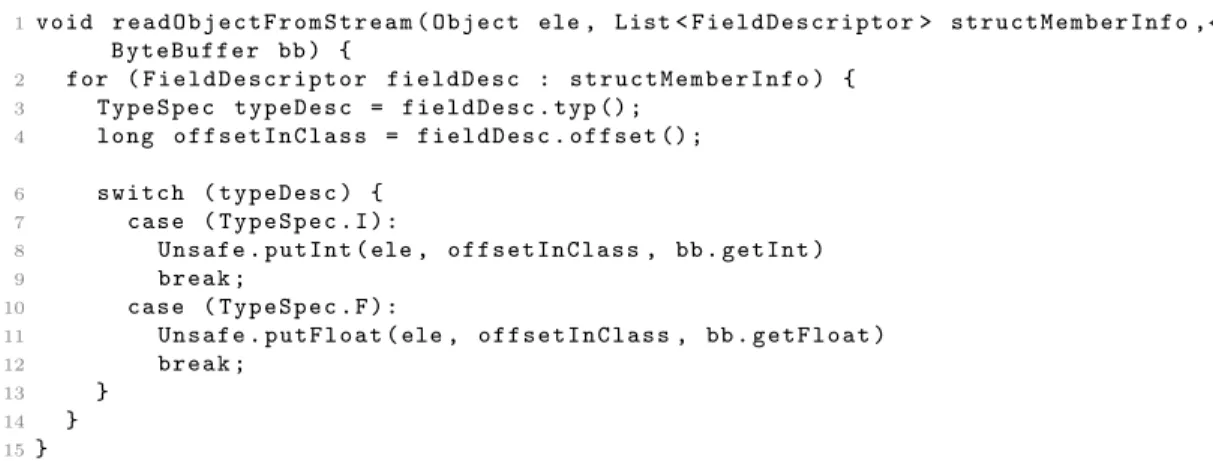
3.6 Code snippet illustrating the deserialization of an Object from a ByteBu↵er. . . 36
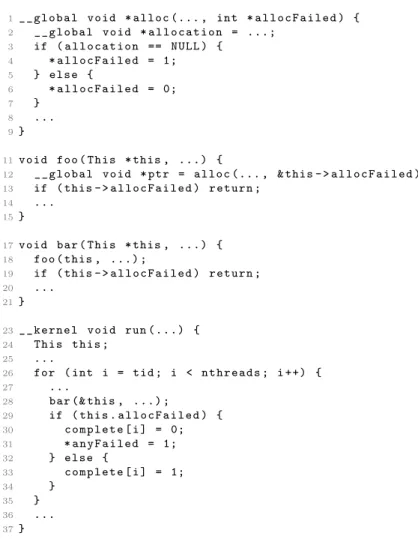
3.7 Code structure used to enable kernel abort on allocation failure. . . . 44
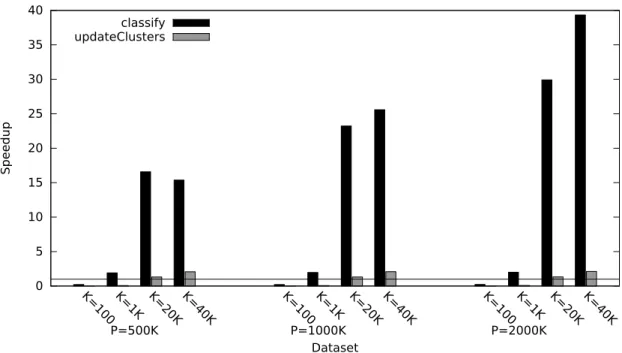
3.8 GPU kernel speedup with redundant copies in the KMeans benchmark, relative to multi-threaded JVM execution. . . 48
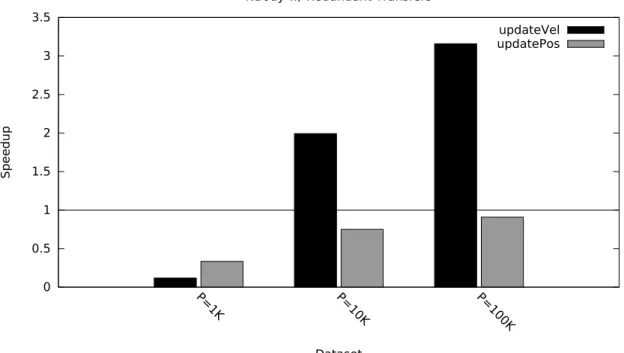
3.9 Kernel speedup with redundant copies in the NBody benchmark, relative to multi-threaded JVM execution. . . 49
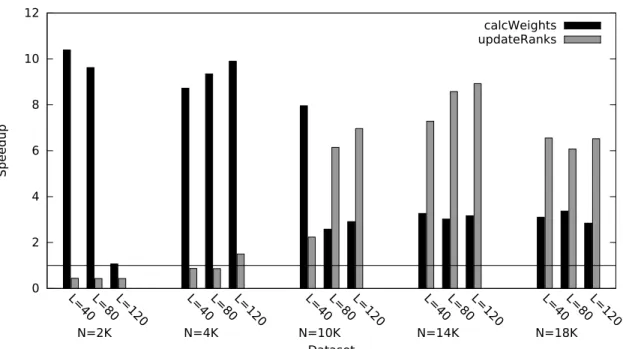
3.10 Kernel speedup with redundant copies in the PageRank benchmark, relative to multi-threaded JVM execution. . . 50
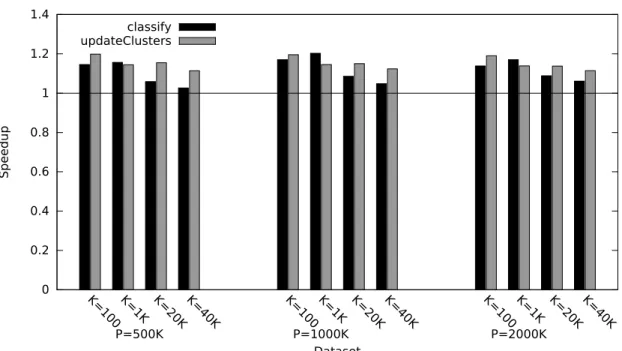
3.11 Kernel speedup with redundant copy elimination in the KMeans benchmark, relative to multi-threaded JVM execution. . . 51
3.12 Kernel speedup with redundant copy elimination in the PageRank benchmark, relative to multi-threaded JVM execution. . . 52
3.14 Example HCL2 Mapper and Reducer implementations extending
type-specific Mapper and Reducer superclasses. . . 63 3.15 Generated OpenCL kernel code for storing and manipulating a Spark
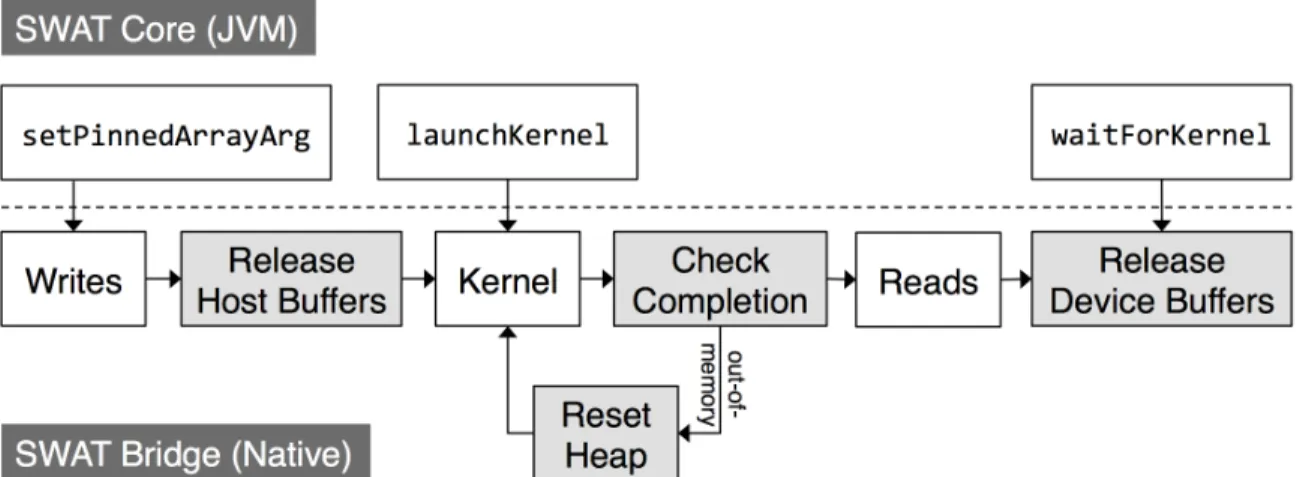
DenseVector object. . . 66 3.16 The flow of event-driven actions in the SWAT Bridge at runtime. . . 74 3.17 Example stack trace of entry point to SWAT Core. . . 75 3.18 Overall speedup of each HCL2 and SWAT benchmark using 1 master
node and 1 worker node. . . 89 3.19 Speedup of Hadoop, HCL2, Spark, and SWAT relative to themselves
when going from 2 to 8 worker nodes. . . 91 3.20 PageRank execution timeline. Light gray indicates input I/O, dark
gray indicates OpenCL operations, and black indicates output I/O. No dark gray is visible at this time scale as little computation is
performed in PageRank. . . 92 3.21 Genetic execution timeline. Light gray indicates input I/O, dark gray
indicates OpenCL operations, and black indicates output I/O. Note that this figure is dominated by dark gray, indicating a large amount
of time in OpenCL operations. . . 93 3.22 Host processor and memory utilization of the PageRank benchmark
running on Spark and SWAT. . . 94 3.23 Host processor and memory utilization of the Genetic benchmark
running on Spark and SWAT. . . 95 3.24 Progression of execution time for auto-scheduled HCL2 Fuzzy
KMeans and Bayes jobs relative to the mean execution time of
manually scheduled HCL2 jobs on Platform A. . . 97 4.1 An example of the HiPER Platform Model. . . 108 4.2 An example of a pop or steal path through the HiPER Platform Model.111
4.3 Total HPGMG solve time on up to 512 Edison nodes. Error bars
indicate a 95% confidence interval. . . 124 4.4 Total ISx execution time. Weak scaling up to 1024 nodes on Titan. . 124 4.5 Total UTS execution time. . . 125 4.6 A trace of OpenSHMEM calls and their elapsed time inside a single
PE from an execution of Concurrent-CRC on 128 nodes. . . 126 4.7 HiPER Overheads for Graph500. . . 127 5.1 The CHIMES compilation workflow. . . 141 5.2 The CHIMES module initfunction is used to pass module-specific
information to the CHIMES runtime before entering main. . . 143 5.3 A simple code example calling checkpoint. . . 145 5.4 An example of the transformed code generated from Figure 5.3. . . . 145 5.5 An example resume of an application using CHIMES. . . 147 5.6 Signature of register checkpoint handler, used to insert custom
information into a CHIMES checkpoint. . . 150 5.7 Signature of register custom init handler, used to register
custom data handlers in CHIMES. . . 150 5.8 Overheads on Platform A during single-threaded tests. . . 155 5.9 Overheads on Platform B during single-threaded tests. . . 156 5.10 Overheads on Platform A during multi-threaded OpenMP tests. . . . 157 5.11 Overheads on Platform B during multi-threaded OpenMP tests. . . . 158 5.12 Median number of checkpoints created on Platforms A and B for each
benchmark. . . 159 5.13 Median checkpoint efficiency on Platforms A and B across all
checkpoints created by test runs of all applications. . . 160 5.14 An example HYDOSO directive added to an OpenMP parallel region,
indicating that the user may request performance predictions for this kernel. . . 172
5.15 An example HYDOSO directive added to a CUDA kernel, indicating
that the user may request performance predictions for this kernel. . . 172 5.16 The signature of hydoso predict, which is used to query for new
performance predictions in HYDOSO.. . . 173 5.17 An example usage of hydoso predict to produce a relative
performance prediction between two kernels. . . 174 5.18 An example usage of hydoso predict to produce a binary
performance prediction.. . . 174 5.19 An example instruction sequence. . . 176 5.20 An example pointer o↵set calculation.. . . 177 5.21 The accuracy of relative performance predictions from HYDOSO,
plotted on a linear scale and with a y-axis limited to 100.00%. The
horizontal line marks 25%. . . 186 5.22 The accuracy of relative performance predictions from HYDOSO,
plotted on a log scale. The horizontal line marks 25%.. . . 187 5.23 The accuracy of absolute performance predictions from HYDOSO
plotted on a linear y-axis. The horizontal line marks 25%. . . 189 5.24 The accuracy of absolute performance predictions from HYDOSO
plotted on a logscale y-axis. The horizontal line marks 25%. . . 189 5.25 The accuracy of relative performance predictions from HYDOSO
Chapter 1
Introduction
According to the June 2016 Top 500 list [1], the top three supercomputers in the world are based on heterogeneous processing cores. Their combined sustained TFlop/s exceeds that of the next thirty machines on the list. Even more surprising, each uses a di↵erent throughput-oriented processor architecture: the Sunway TaihuLight uses the Sunway MPP [2], the Tianhe-2 uses Intel Knights Corner Xeon Phi (KNC) [3], and the Titan supercomputer uses NVIDIA Graphics Processing Units (GPU) [4]. If we look at the Top 500 list from a decade earlier, no machine in the top ten made use of accelerator cores or was heterogeneous in its processing elements. Looking forward, we also know that two of the three upcoming supercomputers funded under the United States Department of Energy’s CORAL program (Summit at ORNL and Sierra at LLNL) are also heterogeneous.
From these observations we can conclude that over the last decade accelerated and heterogeneous supercomputing has demonstrated significant value for the high-performance computing (HPC) and scientific communities. The improved computa-tional performance achievable through heterogeneous computing has enabled more scientific discovery through faster simulation times [5]. This has led to a sustained investment in the design and development of these large, heterogeneous machines by government organizations, academia, and industry. Rather than diminishing over time, that investment instead seems to be accelerating.
1.1
The Cost of Hardware Heterogeneity
The benefits of heterogeneous hardware are not without cost. In particular, program-ming heterogeneous HPC systems is much harder than programprogram-ming homogeneous systems. This increased e↵ort comes from five characteristics of software development on these systems:
1. Composability: Programming a machine with accelerators or with hetero-geneous cores generally requires combining multiple programming models in a single application. For example, when programming a GPU-based supercom-puter it is often necessary to combine CUDA [6] for the GPUs, OpenMP [7] for the CPU cores, and a communication library such as MPI [8] or OpenSH-MEM [9] for communicating between nodes. This adds to the complexity of the code base, degrades application maintainability/portability, and adds an entirely new programming model for HPC programmers to become experts in. 2. Tunability: While HPC programming has always required more knowledge of hardware characteristics than many other domains of Computer Science, the energy efficiency improvements of accelerators and lightweight cores often come at the cost of removing “hardware programmer aids”, e.g. deep and large cache hierarchies, branch prediction logic, pre-fetch logic, etc. With the loss of these programmer aids, an understanding of hardware characteristics becomes more important and has a magnified e↵ect on the performance of applications. Not only that, but the characteristics of novel architectures often di↵er significantly from those that HPC programmers are accustomed to targeting in the past. 3. Coherency: While most HPC applications are designed with distribution in
mind, adding accelerators magnifies the coherency challenges that arise from many discrete and explicitly managed address spaces. For example, using dis-crete GPUs today requires manual management of each GPU’s global memory, constant memory, texture memory, and scratchpad memory.
4. Scheduling: Scheduling irregular workloads across homogeneous processing cores is an open research problem today. Having a heterogeneous mix of cores adds a new dimension to the scheduling problem, as di↵erent kernels may be more or less suited to di↵erent architectures.
5. Tooling: The debugging and profiling toolsets for HPC machines have evolved over decades to fit the needs of HPC programmers, and have naturally been designed to target current homogeneous platforms. As with any paradigm shift, the advent of accelerators and heterogeneous cores requires a re-thinking of techniques for HPC debugging and performance profiling.
In practice on today’s heterogeneous supercomputers, most scientific applications use a combination of hand-coded kernels and high-level libraries to take advantage of all hardware resources. For example, an application might make use of MPI for inter-process communication/parallelism, OpenMP for intra-process parallelism, and CUDA [6], OpenACC [10], or OpenCL [11] for accelerator o✏oad. Each of these models may be partially supplemented or entirely replaced by a library. Rather than write their own linear algebra kernels, a programmer might make use of the CUBLAS [12], CUSPARSE [13], MKL [14], or Trilinos [15] libraries.
On the other hand, distributed data analytics applications running on HPC or cloud platforms commonly forgo these programming systems for higher-level pro-gramming models that execute on managed runtimes. Today, the most common frameworks in use are Hadoop MapReduce [16] and Spark [17]. Both expose high-level, functional, but limited parallel APIs in Java or Scala and execute on the Java Virtual Machine (JVM). Both Hadoop and Spark are also often accessed through high-level, domain-specific libraries such as GraphX [18], MLlib [19], or Mahout [20]. However, efficient native execution of managed runtimes on accelerators would lead to massive performance degradation. Instead, accelerator enablement of these data analytics applications commonly takes the form of either 1) a low-level, hand-coded, labor-intensive, and application-specific integration of accelerators into an
existing data analytics framework, or 2) a high-level, domain-specific library which can be configured to perform accelerator o✏oad under the covers [21]. The hand-coded approach lacks generality and takes away the programmability benefits that data analytics frameworks commonly o↵er, but does enable application-specific, low-level optimizations. The domain-specific library approach lacks flexibility and programmer tunability, but o↵ers ease-of-use.
One commonly proposed solution to productively programming distributed, het-erogeneous machines is to hide this heterogeneity under domain-specific libraries or languages. While this approach may be e↵ective for many use cases, a block-box, fixed-function solution can also be 1) overly restrictive in terms of the user opti-mizations enabled, and 2) the functionality o↵ered. It is also entirely insufficient to enable novel application or algorithm development. Hence, programming heteroge-neous platforms for scientific simulation and data analytics will continue to require:
1. The ability to choose from and combine multiple software components such that the right tool can be used for a given task. For example, the UPC++ [22] implementation of the HPGMG benchmark uses the one-sided, PGAS UPC++ library for sending small messages between distributed processes but also relies on MPI collectives as a more mature and well-performing implementation of collective communication patterns.
2. The ability to express and optimize application logic at the statement level such that novel approaches to real-world problems can explored outside of the constraints of a limited, domain-specific interface.
This thesis focuses on the following three principles as a solution to the problems highlighted above in heterogeneous and multi-tenant computing:
1. Compatibility and composability with existing APIs and models. Fo-cusing on compatibility lowers barriers to adoption, adds interesting constraints
to the research problem, and takes advantage of the decades of development that have gone into existing programming systems. Composability is important be-cause any reasonably complex HPC application will be a multi-tenant system, likely using multiple third-party systems together.
2. Taking advantage of compile-time insights to improve runtime per-formance. Recently, much of the HPC research community has begun shifting away from compiler-based programming systems as a result of 1) the costs asso-ciated with maintaining them, and 2) the introduction of new features in stan-dard programming languages (e.g. C++ and Java lambdas). The creation of the UPC++ library from the UPC language is an example of this trend. This shift towards library-based approaches has placed the burden of efficient scheduling solely on runtime systems. However, compile-time information and source-to-source transformations can often be useful for improving runtime performance. Therefore, the use of static tools to supplement library-based approaches o↵ers a promising path for well-performing programming systems.
3. Integrated scheduling on resource- and workload-aware runtimes. While discrete, disjoint systems are desirable from a software engineering per-spective, their lack of awareness of each other presents challenges for efficient scheduling. Often, overly strict synchronization is used to ensure correctness when algorithmic dependencies cross software component boundaries (e.g. when an MPI message depends on the completion of an OpenMP task). Being aware of the full workload at runtime may enable more efficient scheduling policies as well as improve system inspectability and performance diagnosability.
1.2
Our Envisioned User Workflow
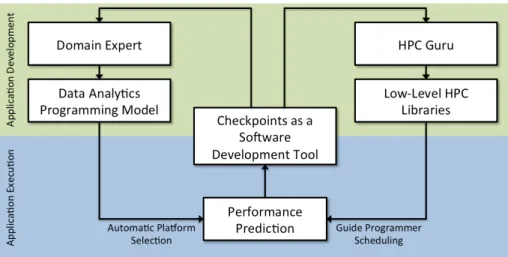
Figure 1.1 shows our envisioned high-level development workflow for two classes of users: domain experts with a limited computational background doing novel
algo-Figure 1.1 : User workflow
rithm development, and HPC Gurus who want the ability to tune and optimize ap-plications at low levels.
Domain experts commonly look for high-level programming languages and models that allow them to focus on algorithm development and avoid thinking about low-level computing challenges, such as vectorization, scheduling, and data layout. In this thesis, we capitalize on work in distributed, data analytics programming systems such as Hadoop MapReduce and Apache Spark to o↵er these domain experts high-level programming models which enable this separation of concerns. Under the covers, we use automatic techniques to efficiently and natively execute these high-level, user-written kernels on heterogeneous HPC hardware.
On the other hand, HPC Gurus are interested in having the ability to tune and op-timize their kernels, scheduling, resource management, and other low-level concerns. Programmer aids that enable quicker development of well-performing applications are important to this set of HPC users, so long as those aids are still incrementally tunable, do not hinder analysis of the application, and do not limit the expressiveness of the overall programming model. HPC Gurus also commonly have significant past experience developing applications using a certain set of HPC libraries or tools. While they are willing to learn new models, anyway that we can capitalize on that existing
knowledge is beneficial. Hence, in this thesis we focus on enabling the composition of popular HPC libraries and languages such as CUDA, MPI, UPC++, and Open-SHMEM. As a result, we reap both performance and programmability improvements over hand-tuned HPC implementations.
However, writing application code is only half the HPC software development process. In general, the initial functionally correct implementation of an HPC appli-cation is not also a well-scaling and well-performing implementation. HPC developers require tools and frameworks for analyzing their applications for correctness and per-formance bugs. In this thesis, we explore the use of checkpoints and perper-formance prediction for software development.
Checkpoints capture the state of an application at an instantaneous point in exe-cution. Historically, they have primarily been used for building resilient applications. However, the ability to capture and replay a point-in-time that may be days into the execution of a long-running simulation can be an invaluable tool for rapid, iterative optimization or debugging of a region of code in an application.
Performance prediction, on the other hand, has obvious benefits for both domain experts and HPC Gurus for scheduling workloads across heterogeneous processors. However, each set of HPC developers would want to use this capability in di↵erent ways. Domain experts need not be exposed to scheduling decisions, and so it would be the responsibility of an underlying runtime to take advantage of performance predictions in scheduling user kernels. On the other hand, HPC Gurus are more likely to want to use performance prediction to inform the scheduling algorithms they write into their applications.
As part of this thesis, we explore all of the topics enumerated in this section: programming models, runtimes, and tools for both domain experts and HPC Gurus. We design these frameworks to fit into the workflow outlined in Figure 1.1. Later in this thesis, we illustrate how each set of HPC users would take advantage of the relevant frameworks.
1.3
Thesis Statement
Productive heterogeneous programming can be enabled by building programming sys-tems that focus on 1) compatibility and composability with other tools and program-ming systems, 2) using compile-time insights to improve runtime performance, and 3) integrated resource- and workload-aware runtimes. Programming systems for het-erogeneous HPC systems must balance high-level programmability with low-level tun-ability.
1.4
Contributions
This dissertation makes the following contributions that support this thesis statement: 1. HCL2, HJ-OpenCL, and SWAT (Spark With Accelerated Tasks) [23][24][25]: Each of these projects tackles heterogeneous programming through managed languages and runtime systems. Managed systems improve the inspectability of an application at runtime. These projects take advantage of that inspectabil-ity to automatically and transparently o✏oad programmer-written parallel ker-nels to accelerators (in particular, GPUs). HJ-OpenCL o✏oads shared memory parallel loops from the HJlib [26] parallel programming library. HCL2 is a framework for o✏oading distributed Hadoop MapReduce applications. SWAT o✏oads distributed Apache Spark transformations. These projects share the same high level approach of using runtime bytecode-to-OpenCL code gener-ation, automated memory management, and automated data serialization to enable transparent o✏oad of JVM computation to accelerators. However, each project di↵ers in the constraints placed on it by the source programming model (MapReduce, parallel loops, and Spark), in the extent to which scheduling and kernels are automatically optimized, in the amount of data transfer optimization possible, and in the flexibility of the code generator and automatic serializer. 2. HiPER (Highly Pluggable, Extensible, and Re-configurable Framework for
HPC) [27][28][29]: HiPER is a C++ runtime system and programming model that focuses on extensibility, pluggability, composability, and compatibility with existing programming models. The core component of HiPER is a task-parallel programming model sitting on top of a shared-memory lightweight work-stealing runtime. HiPER is explicitly designed to be extended with third-party mod-ules. These modules add APIs to the HiPER programming model, and may use the HiPER runtime to achieve unified scheduling of all work in a system. Existing modules include a CUDA module, an MPI module, a UPC++ module, and an OpenSHMEM module. As such, while the core of HiPER is not itself a distributed or heterogeneous programming system, it is built with the flexibility to support future and current distributed and heterogeneous HPC platforms. 3. HYDOSO (HYbrid, Decomposition-based, O✏ine Sequence aligner for Online
performance prediction): Performance prediction is a fundamentally important and challenging problem, particularly for scheduling of kernels and communi-cation on heterogeneous and distributed systems. However, to date, this “Holy Grail” of HPC remains unsolved due the complexity of both hardware architec-tures and kernels. This work explores using techniques from genome alignment to discover similarities between kernels and predict future performance based on past observations. HYDOSO combines compile-time and run-time tech-niques to enable accurate and adaptive performance predictions on di↵erent architectures. HYDOSO is an example of a hybrid compile-time and run-time programmer aid that could support improved runtime performance in HiPER, HCL2, HJ-OpenCL, or SWAT.
4. CHIMES (CHeckpointing In-MEmory State) [30]: CHIMES is a checkpoint-restart framework motivated by the observation that checkpoints are a use-ful software engineering and programming system tool, and not simply useuse-ful for resiliency. Automated checkpointing enables the recall of nearly arbitrary
points in application execution. This recall can be useful for iteratively optimiz-ing parallel regions, for reproducoptimiz-ing faults, or for numerical regression testoptimiz-ing. CHIMES uses a combined compile-time and run-time approach to take advan-tage of high-level semantic information in the application source code so as to minimize runtime overheads. A variant of CHIMES called CHIMES-lite is also used in HYDOSO, proving its usefulness in novel runtime and tool development. Like HYDOSO, CHIMES is also an example of an aid that could be integrated with HiPER, HCL2, HJ-OpenCL, or SWAT to improve programmability.
1.5
Outline
The remainder of this thesis will be structured as follows. Chapter 2briefly summa-rizes emerging heterogeneous architectures and software components in HPC. Chap-ter3describes our work on the HJ-OpenCL, HCL2, and SWAT frameworks to enable managed, data analytics frameworks to exploit distributed, heterogeneous platforms. This work explores how new, high-level programming models might be used on fu-ture heterogeneous supercomputers. Chapter 4 describes our work on the HiPER framework that introduces an extensible programming model and a generalized work-stealing runtime to improve the composability of third-party HPC libraries. This work capitalizes on existing investments into HPC libraries and programmer famil-iarity with them while enabling unified, integrated, and more scalable scheduling on future platforms. Chapter 5 describes the CHIMES and HYDOSO frameworks for tooling to support either of the two approaches to programming future heteroge-neous supercomputers introduced earlier, as well as other existing HPC programming systems. In this chapter, we present checkpoints as a powerful software development tool and make new contributions in heterogeneous performance prediction. Chapter6 summarizes our contributions and discusses future research directions.
Chapter 2
Background
In this chapter, we outline the state of the heterogeneous computing world today in terms of both the hardware and software used.
2.1
Emerging Heterogeneous Architectures
Arguably the first instance of widespread heterogeneous computing in HPC came with the Tesla generation of NVIDIA GPUs released in 2006. O↵ering programmable shaders for the first time, Tesla cards allowed programmers to start to experiment with GPU computational parallelism and bandwidth in areas other than graphics. Since Tesla, the Fermi, Kepler, and Maxwell generations have continued to improve on the computational performance, memory bandwidth, energy efficiency, and flexibility of those early programmable graphics cards.
However, GPUs are no longer the only throughput-oriented architecture being used to build massively parallel HPC systems. In this section, we provide an overview of upcoming processing architectures that future HPC systems are likely to use to provide the majority of their computational performance.
2.1.1 NVIDIA Pascal and Volta
NVIDIA GPUs are organized around streaming multi-processors (SMs). Each SM can be thought of as a separate compute core on the GPU with its own program counter, vector arithmetic unit, scratchpad memory, registers, and other core-local resources. In the first GPU in the Pascal generation of NVIDIA GPUs (the GP100, released in 2016), 60 SMs reside on each GPU [31] each with the ability to issue
two independent vector instructions of 32 single-precision operations. Each Pascal SM also has 32 double-precision units and 8 special-function units. In total, a single Pascal GP100 will be able to deliver up to 5.3 TFLOPS of double-precision arithmetic or 10.6 TFLOPS of single-precision arithmetic.
The GP100 includes 256 KB of registers per SM (4 KB of registers per vector element), a dramatic increase over past GPUs. Each SM also includes 24 KB of L1 cache, 64 KB of programmer-managed scratchpad memory, and 4 MB of L2 cache shared across all SMs. Finally, the GP100 supports 16 GB of high-bandwidth, stacked memory on the GPU with an aggregate memory bandwidth of 720 GB/s.
The Pascal generation of GPUs includes several hardware improvements intended to improve programmability as well. NVLink [32] improves inter-GPU bandwidth relative to the PCIe bus used today, from ⇠30 GB/s to ⇠40 GB/s. In certain hard-ware configurations, NVLink can also connect GPUs to the host CPU. As a result, data transfer patterns that would have previously resulted in high overheads may be feasible on Pascal, enabling new applications to take advantage of GPUs.
The Pascal generation is also the first generation to support page faulting on the GPU and a 512 TB virtual address space. As a result, truly unified memory across CPU and GPU is possible, with all transfers implicitly managed by the NVIDIA runtime and driver.
Of course, any Pascal-based system must also include a management processor, usually an x86 CPU. GPUs do not run a full operating system and so are unable to support essential capabilities like disk I/O, network communication, and access to other devices. Pairing a GPU with either x86 or ARM processors makes GPU-based HPC systems heterogeneous.
The generation of GPUs following Pascal is Volta, and will be used in the CORAL Summit and Sierra supercomputers. While a release date has yet to be announced, Volta is expected to be released sometime between mid-2017 and mid-2018. Details of the Volta architecture are still limited but we can expect 1) continued and improved
use of high-bandwidth memory and NVLink to improve memory access performance, and 2) a re-designed SM architecture. More importantly, because Summit and Sierra will be POWER9-based systems, NVLink will be used as both an inter-GPU and GPU-to-CPU interconnect. This should drastically reduce CPU-GPU transfer over-heads and create a more tightly linked host-device system.
2.1.2 Intel Knights Landing Xeon Phi
Intel’s Knights Landing (KNL) generation of the Xeon Phi product line [33] has recently been deployed in several supercomputer installations, including the Cori supercomputer at NERSC [34]. Computationally, KNL is based around “tiles” each of which contains 2 low-power x86 cores and 4 AVX512 vector units. Each vector unit is capable of simultaneously issuing 32 single-precision operations. A single KNL chip contains 36 tiles. As a result, KNL supports up to⇠3 TFLOPS for double-precision operations and up to⇠6 TFLOPS for single-precision.
Each tile includes 1MB of L2 cache shared by all x86 and vector units on that tile. Tiles on the same chip are connected by a 2D mesh, across which cache coherence is configured using KNL “clustering modes”. KNL supports up to 16 GB of on-chip high-bandwidth memory (MCDRAM) and up to 384 GB of DRAM. At boot, the user can select how to configure these di↵erent memories: 1) in cache mode, MCDRAM serves as a high-bandwidth and automatically managed cache for DRAM, 2) in flat mode, MCDRAM is explicitly exposed to the programmer through special allocation APIs, allowing them to specialize the allocations placed in MCDRAM, and 3) in hybrid mode, some amount of MCDRAM is used as a cache for DRAM and the rest is exposed to the programmer. A single KNL chip is able to achieve ⇠400 GB/s to MCDRAM and ⇠90 GB/s to DRAM.
Intel also supports including an Omni Path chip on-package, enabling the use of a high-performance interconnect for communicating between KNLs.
KNL:
1. The peak FLOPS supported by future GPUs will continue to exceed those on future Xeon Phi processors, though we currently have no understanding of how easy it will be to achieve a significant fraction of that peak on either chip. 2. The KNL will continue to o↵er more hardware performance programmer aids
than GPUs. For example, consider that Pascal o↵ers 1 MB of L2 cache for an entire GPU, but that KNL o↵ers 1 MB per tile.
3. We can extrapolate that Pascal will likely also yield higher efficiency in terms of peak FLOPS per Watt, as fewer transistors will be dedicated to auxiliary functions.
4. The two will be evenly matched in terms of the amount of high-bandwidth memory each has access to, though it seems Pascal will likely be able to achieve higher throughput.
5. The pairing of Atom x86 cores with AVX512 vector units suggests that KNL will lean more heavily on automatic compiler vectorization to achieve peak computational performance, whereas GPUs will rely more on programmers to express their GPU kernels in a way that maps well to the architecture. This conclusion is supported by recent publications from Intel [35].
It is important to note that while the Cori supercomputer will be KNL-based, the larger upcoming Aurora machine at Argonne National Lab will be based on the following generation in the Xeon Phi product line, code named Knights Hill. Unfortunately, little or no information is available on changes in the Knights Hill generation.
KNL represents an odd hybrid of homogeneous and heterogeneous. At the tile granularity a KNL-based system will be homogeneous: each tile will contain the same processing elements. However, within each tile there is significant heterogeneity in the
pairing of Atom x86 processors with vector units. However, if the Intel compilers are able to efficiently and automatically vectorize significant fractions of KNL applications this heterogeneity will never be exposed to the programmer.
2.1.3 Sunway MPP
The Sunway MPP [2] is the building block for the supercomputer currently at the top of the Top 500 list. The MPP is organized into four core groups on a single chip. Each core group consists of a single Management Processing Element (MPE) paired with a single Computer Processing Element (CPE). A CPE consists of an 8x8 mesh of lightweight vector cores. Each MPE supports 256-bit vector instructions but, as indicated by its name, is intended to be used primarily for management operations. Each core in the CPE mesh also supports 256-bit vector instructions, and it is expected that the CPE will handle the bulk of the computational load in an application. The primary di↵erence between MPE and CPE cores noted in [2] is that an MPE core has two floating-point pipelines while CPE cores only have one. With a 1.45 GHz core clock, a single chip with four core groups can achieve a theoretical peak of 3.06 FLOPS of double-precision operations.
Each MPE includes 32 KB of L1 cache and 256 KB of L2 cache. Each CPE tile includes 64 KB of explicitly managed scratchpad memory. Each core group on a chip supports 8 GB of DRAM, leading to a total of 32 GB per chip.
We note a few interesting items in the design of the MPP:
1. The MPP has similar peak double-precision FLOPS to a KNL chip, despite very di↵erent designs.
2. Unlike Pascal, Volta, and KNL, the MPP has no high-bandwidth memory. It also has a relatively constrained amount of memory per chip, with only 32 GB supported compared to KNL’s 384 GB.
notations in source code to achieve high utilization of the vector units in its CPEs.
Therefore, while the MPP is the first chip discussed in this section which is cur-rently deployed in a large-scale, production cluster, it also seems to be lacking in some areas (e.g. peak FLOPS, HBM, etc.) relative to Pascal and KNL.
2.1.4 Epiphany-V
The Epiphany-V [36] is the most experimental of the architectures discussed in this section, with no public planned HPC systems based on it. The Epiphany-V consists of an array of 32⇥32 grid of RISC cores, each with 64 KB of scratchpad memory and connected by a network-on-chip.
No hardware Epiphany-V chips are available as yet so all performance numbers are theoretical, but we can try to make some cautious comparisons. For example, Table 12 in [36] cites 8.55 GFLOPS/mm2 for Epiphany-V, 7.7 for Pascal, and 5.27 for KNL assuming a 500 MHz frequency for the Epiphany. If we keep that assumption, we can estimate ⇠1 TFLOPS double-precision peak for a single Epiphany-V. However, given that it is unclear what the core frequency will be for the final release of the Epiphany-V that is only an estimate.
If we focus on energy efficiency, the Epiphany-V becomes more impressive. The Epiphany-V white paper [36] reports a maximum chip power consumption of 2 Watts. Given ⇠1 TFLOPS of compute, that would yield 500 GFLOPS/Watt. This is an outrageously high number relative to the other architectures discussed in this section (18.8 GFLOPS/Watt for Pascal, 14.69 GFLOPS/Watt for KNL) so it must be taken with a grain of salt. However, it suggests that while the Epiphany-V’s per-chip floating-point performance may not equal its contemporaries, its energy efficiency may far exceed them.
2.1.5 FPGAs
Field Programmable Gate Arrays (FPGAs) are di↵erent from the systems described in this section in that they have no architecture, and are essentially re-programmable hardware. An FPGA program consists of a logic gate design which is flashed to the FPGA.
It is difficult to compare FPGAs to more conventional architectures as there are no cores, caches, or other architectural structures to compare to on an FPGA. However, the top-of-the-line FPGA from Altera [37] lists a peak performance of 10 TFLOPS of peak single-precision performance and 1 TB/s of memory bandwidth to 16 GB of high-bandwidth memory.
While these peak numbers are impressive, in reality, FPGAs often fall short for scientific, floating-point intensive workloads. Because the logic gate layouts neces-sary for floating-point units consume more space on the FPGA, the computational bandwidth for floating-point operations on FPGAs can often be limited relative to the peak. Additionally, FPGA compilation times run on the order of hours, mak-ing FPGA software development a more painstakmak-ing process. However, for integer arithmetic or fixed-point workloads, FPGAs can demonstrate significant efficiency improvements relative to fixed-architecture alternatives.
2.2
Production Programming Models for Emerging
Super-computers
In Chapter 1 we briefly summarized the state-of-the-art in heterogeneous program-ming: namely, that it requires the combination of several disjoint programming mod-els to execute an application across the cores and nodes of a heterogeneous super-computer.
This pain point has been broadly recognized by the HPC community, and di↵erent organizations and committees are taking steps to address it. We discuss related work
before going into more detail on the contributions of this thesis. While many of these techniques are not widely used today, they are likely to become the status quo for heterogeneous programming in the near future. As such, this work cannot be treated as contemporary research (which will be discussed in the related work section of each chapter of this dissertation), but provide a yardstick with which to measure our work. 2.2.1 OpenMP
One of the largest and most promising e↵orts to improve the programmability of production-level heterogeneous programming has been undertaken by the OpenMP Architecture Review Board, primarily in the form of the introduction of OpenMP tasks in OpenMP 3.0 [38] and OpenMP accelerator support in OpenMP 4.0 [39]. With tasks, the flexibility and asynchrony of the OpenMP APIs for irregular applica-tions was significantly improved, making them more amenable to efficient execution on pre-exascale and exascale platforms. Tasks have also been suggested as a possible avenue towards improving OpenMP’s composability with other models and libraries, i.e. by “taskifying” calls to external libraries. With the addition of accelerator sup-port, OpenMP became one of the first high-level programming models which o↵ered parallel APIs for multiple architectures. This improves the maintainability of hetero-geneous codes that use OpenMP, and improves programmability by o↵ering consistent abstractions for programming multiple architectures.
Currently, OpenMP’s accelerator support is a mixed bag of positives and nega-tives. Benchmarking of bleeding edge versions of OpenMP 4.0-compliant implemen-tations show that real application codes running on GPUs using OpenMP are able to achieve a significant fraction of the performance that hand-coded CUDA versions can [40]. Additionally, early experiences show that performance portability is achiev-able to an extent on multiple architectures using OpenMP without modifications to the programmer-written kernel logic [41]. However, at the same time, support for accelerators has been slow to appear across OpenMP implementations, and most are
still in-development. Flexibility built in to the specification of accelerator directives which was originally intended to enable the support of many types of accelerators also means that OpenMP accelerator directives are not usually performance portable across architectures. Additionally, at times, the accelerator directives do not o↵er enough information to the OpenMP compiler to fully optimize kernels in a way that a programmer might be able to. For example, OpenMP support on KNL platforms has met difficulties successfully vectorizing loops using only standard OpenMP di-rectives. There is also no support for explicitly using scratchpad memory or other special-purpose memories, an important optimization for many accelerators. While OpenMP is arguably the most promising heterogeneous programming model for near-future heterogeneous computing, and shows promise in addressing programmability, composability, scheduling, and tooling challenges on future machines, it lacks some key features which limit its tunability and continues to saddle developers with co-herency concerns.
The OMPT Tools API appeared in OpenMP 5.0 preview 1, released in November 2016 [42]. The Tools API will improve the inspectability of OpenMP runtimes by adding APIs to register notifications on specific events and collect traces from target devices. This would allow future performance profiling tools to o↵er deeper insights into the workload scheduled on OpenMP runtimes. In combination with OpenMP’s accelerator APIs, this would conceivably enable much richer toolsets for heterogeneous systems. However, it is important to note that the scope of this API is naturally limited to work scheduled on the OpenMP runtime and that the inspectability of any third-party libraries would not improve.
2.2.2 Kokkos
Closely related to OpenMP, the Kokkos [43] project is an e↵ort by Sandia National Laboratory to use C++ templates and parallel runtimes to produce a highly pro-grammable and efficient parallel programming system that performs well across
archi-tectures. By o↵ering abstractions for mapping application data to di↵erent parts of a heterogeneous platform’s memory hierarchy (something that OpenMP lacks) and ab-stracting away the underlying execution engine, Kokkos is able to target programming models from Intel, AMD, and NVIDIA through a single high-level abstraction. While its programming model is restricted relative to OpenMP and focuses on synchronous loop parallelism, Kokkos has proved useful for many scientific applications [44]. Its integration with the Trilinos [15] scientific and mathematical packages has also made it easy for domain experts to use Kokkos without having to express their algorithm as a parallel computation. On the other hand, limitations in Kokkos’s programming model restrict the domain of applications it is useful for. While Kokkos is used by the Trilinos package, it lacks any significant integration or composability with other programming systems. However, its ability to portably toggle the same parallel loop between architectures is powerful and is not yet supported by most existing parallel programming models.
2.2.3 Raja
The Raja portability layer [45] is similar in abstractions to Kokkos, and focuses on hiding non-portable programming model features from the programmer while enabling experimentation with loop nest ordering and data access patterns. Raja only supports the expression of loop parallelism in C++ and focuses on three abstractions to hide portability issues from programmers:
1. Data type encapsulation: By wrapping application data structures and pointers in Raja types, Raja is able to manage architecture-specific optimizations such as alignment and structure padding for the user.
2. Execution policy: Users may choose di↵erent execution policies to automati-cally toggle between di↵erent types of platforms on which to execute parallel loops. For example, Raja supports targeting OpenMP, OpenMP accelerators, and CUDA using di↵erent execution policies.
3. Index sets: Storing the iteration space of a parallel loop as a Raja object helps Raja enable programmer experimentation and optimization through automatic, compile-time loop transformations based on C++ template specialization. 2.2.4 CUDA
While the CUDA programming model itself has done little to improve its compos-ability with other systems, there have been several new technologies introduced by NVIDIA which should improve the composition of host and device computation.
One of the largest programmability improvements in the accelerator domain is the upcoming introduction of hardware-supported Unified Memory [46] in NVIDIA GPUs. Put simply, Unified Memory on Pascal-generation or later GPUs will reduce the coherence problem for heterogeneous computing by automatically paging virtual pages to and from NVIDIA GPUs. It will still be the programmer’s responsibility to avoid data races on pages shared between the host and device. Additionally, Unified Memory will do nothing to simplify management of the GPU’s on-chip memory hier-archy, and it remains to be seen how Unified Memory will a↵ect tooling, performance, and scheduling problems on GPU-based platforms.
2.2.5 GPU-Aware MPI
A recent development in GPU computing that has found its way into production software packages is GPU-Aware MPI [47]. GPU-Aware MPI enables the direct communication of data from a GPU in one node of a supercomputer to a GPU in another node. This simplifies the API by only requiring a single transfer call to be made, may improve performance if the networking hardware is able to support DMA from one GPU to the other without host intervention, and overall improves the composability of the two systems. However, this e↵ort is too localized. While it improves MPI-CUDA applications, true composability is an all-to-all relationship and requires a more comprehensive approach to the problem.
2.3
Summary
While there are several e↵orts in the heterogeneous computing community to improve the state-of-the-art in production heterogeneous programming, many of these projects address the problem piecemeal by focusing on specific, current programming models and libraries. Most of these approaches do not consider future extensibility to support heterogeneity in other components of future HPC systems.
From this chapter, we can conclude two things. First, that the majority of future HPC systems are likely to include heterogeneous processing units in order to achieve high computational bandwidth without massive energy costs, and that as we enter this second wave of throughput-oriented architectures many chip manufacturers are in tight competition to produce the “best” HPC-oriented architecture. Second, that while some software projects (notably OpenMP) are working to improve the compos-ability of HPC software modules, the next generation of software tools installed on these heterogeneous machines will tackle the problem piece-meal (e.g. by composing accelerator and host parallelism, or MPI communication and accelerator kernels). To support future heterogeneous machines, a more comprehensive solution is required.
Chapter 3
High-Level Programming Systems for Data
Analytics Workloads on Heterogeneous HPC
Systems
3.1
Motivation
Classically, the scientific workloads that HPC systems have been used for were pro-grammed in low-level, prescriptive programming models. Programming models like OpenMP, MPI, and FORTRAN allowed HPC programmers to tune applications for the target platform while remaining sufficiently high-level to enable the develop-ment of reasonably portable large-scale scientific codes. These programming mod-els avoided introducing significant overheads or bottlenecks and meshed well with optimizing and vectorizing compilers. This led to both efficient parallelization and well-performing straight-line code, producing well-scaling applications.
However, more recently, the users of large-scale HPC machines have been exploring the use of alternative programming models, primarily from the data analytics field. Data analytics and HPC share the problem of programming and scaling across large distributed machines in order to process massive datasets. However, while HPC scientific workloads tend to be compute-bound (hence the emphasis on computational performance), data analytics workloads tend to be communication-bound, I/O-bound, or memory-bound. For bandwidth-bound workloads, there is less of a need for a highly optimized execution platform. As a result, the data analytics community has gravitated towards higher level programming models running on managed runtime systems, and reaped productivity benefits. While managed runtimes and the high-level programming languages that accompany them have already been widely adopted
by the scientific community at the desktop scale [48][49], only recently have the HPC and scientific communities begun experimenting with these systems at the cluster scale [50]. This experimentation has partially been driven by new workloads on HPC systems, and partially by the downward trend in memory per processing core causing previously compute-bound workloads to become bandwidth-bound.
On the other hand, as novel algorithms are developed in the data analytics and machine learning communities and as the frameworks used to implement them become more efficient, those communities are likewise seeing a diversification in workloads and an increase in the number of compute-bound problems. One example of this would be the rapid rise in popularity of neural nets for di↵erent image processing problems. As a result of these trends, the data analytics community is increasingly adopting hardware and software techniques from the HPC community. For example, accelerators are now commonly used to accelerate the training of neural nets. Hence, data analytics frameworks are more commonly being run on HPC-esque platforms for compute-bound data analytics problems.
The convergence of the scientific and data analytics communities leads to an open research problem: how can we efficiently execute managed runtimes on accel-erators, without sacrificing the productivity and programmability that makes these data analytics frameworks popular to begin with? In this chapter, we present three pieces of work on this problem: HJ-OpenCL, HCL2, and SWAT. HJ-OpenCL is a shared-memory parallel programming model which we use to introduce foundational techniques in o✏oading data-parallel kernels from managed runtimes to accelerators. HCL2 and SWAT are extensions of the Hadoop and Spark distributed data analytics programming frameworks, and support o✏oading computational kernels to accelera-tors.
3.2
The Challenge of Managed Runtimes on Accelerators
A classical example of a managed system is the Java Virtual Machine (JVM). It of-fers a portable, abstract, stack machine model on which programming languages and programming tools can be constructed. Using a custom bytecode-based instruction set, the JVM natively supports high-level programming constructs such as excep-tions, virtual methods, classes, inheritance, garbage collection, and multi-threaded synchronization. While it is a machine model, the JVM and its instruction set do not map natively down to any commodity hardware platforms. JVM implementers must efficiently support the stack machine model on top of conventional processors through runtime optimization tricks, such as just-in-time compilation. Fortunately, the hardware and software stacks which the JVM executes on can support all of its high-level features relatively efficiently.While one of the strengths of the JVM is its portability, that portability is primar-ily limited to CPU architectures. Supporting the full instruction set and capabilities of the JVM on accelerators such as GPUs and FPGAs would either not be possible or incur large overheads, o↵setting the performance benefit of the accelerator. Hence, as most data analytics frameworks are built on the JVM but native implementation of a full JVM is not feasible on accelerator cores, we must find another approach to running data analytics frameworks on accelerators.
We highlight five main challenges that any such approach must meet:
1. Incompatibilities in instruction set between managed and native sys-tems: The JVM and other managed systems commonly use some intermediate representation for application instructions. Interpreted execution is used to enable portability across hardware platforms. Because these intermediate rep-resentations are not natively executable, we use runtime code generation to convert it to an executable format that is.
sys-tems: Managed systems may use custom data structures to store data inter-nally. The format of those data structures may either be incompatible with accelerators, may not be knowable, or may be wasteful on memory-constrained platforms. In this work, we develop techniques that use reflection to convert JVM objects into a native format supported by accelerators. Our primary contributions are in extending the range of data types supported relative to previous work.
3. Resource management in a multi-tenant system: In general, data analyt-ics platforms are highly parallel and will use several threads or processes within each shared memory node. It is necessary to efficiently share accelerators and other resources among them without causing synchronization overheads, over-subscription, or under-subscription. Adding to the complexity, you generally have resources in three di↵erent address spaces: the automatically managed JVM heap, the explicitly managed host native address space, and the accelera-tor.
4. Scheduling in a multi-tenant system: Scalably scheduling the computation and communication from multiple processes or threads requires an awareness of both the workload and hardware resources available. In this work, we present runtime designs that enable efficient scheduling. Additionally, we present tech-niques in automatic, machine learning-based workload characterization for au-tomatic processor selection.
5. Inspectability: In any multi-tenant system, being able to diagnose perfor-mance and correctness bugs is critical to the usability of the framework. How-ever, gaining insight into a system that combines JVM execution, native exe-cution, and accelerator execution is a difficult problem for the domain experts that are the primary users of these frameworks.
1 forall (0 , niters - 1 , ( iter ) -> {
2 // User - w r i t t e n p a r a l l e l loop body
3 ...
4 }) ;
Figure 3.1 : An example HJlib parallel loop.
1 f o r a l l _ a c c (0 , niters - 1 , ( iter ) -> {
2 // User - w r i t t e n p a r a l l e l loop body
3 ...
4 }) ;
Figure 3.2 : An example HJ-OpenCL accelerated parallel loop.
3.3
O✏oading Shared-Memory Parallel Java Programs
Us-ing HJ-OpenCL
HJlib [51] is a shared-memory, parallel programming library that supports the unifi-cation of a variety of parallel programming patterns, including task-parallelism, loop-parallelism, futures, and actors. HJlib includes the loop-parallel forall API shown in Figure 3.1. The forall loop takes a loop range and user-written loop body as input and executes each loop iteration in parallel across multiple JVM threads. This loop body can contain arbitrary user-written code, and is passed as a Java lambda. There is an implicit synchronization at the return of a forall call that waits for all parallel loop iterations to complete before returning to the calling code.
In this section, we develop techniques for o✏oading HJlib’s parallel forall loop to OpenCL devices, in particular native threads executing on CPUs and GPUs. In this work, called HJ-OpenCL, we introduce a new identical API named forall acc (illustrated in Figure 3.2. The semantics of forall acc are the same as forall, but it supports transparent o✏oad of the user-written parallel loop body to OpenCL devices.
The main functionality di↵erence between forall and forall acc are the limi-tations that forall accplaces on what can be written inside the parallel loop body.
In particular, the data types that can be accessed from the kernel are limited to primitives, arrays of primitives, objects containing only primitive fields, and arrays of those objects. HJ-OpenCL does not currently support exceptions, dynamic method dispatch, or network/file I/O inside of a forall acc loop body.
Efficiently implementing forall acc requires solving several research problems, which mirror the challenges presented in Section 3.2:
1. Code generation of OpenCL kernels from the JVM bytecode storing the logic for user-written kernels. In this work, we primarily rely on re-using the bytecode-to-OpenCL code generator developed as part of the APARAPI framework. We also extend APARAPI to support Java composite objects of primitive fields. (e.g. java.util.ArrayList).
2. Efficient serialization and deserialization of JVM objects at runtime to a format amenable to storage on an OpenCL accelerator. Like code generation, this support is only for Java objects that contain only primitive fields.
3. Automatic management of memory allocations and transfers, using Java re-flection to determine the data in the JVM that must be transported to the accelerator and using inspection of the calling context of a forall acc call to automatically remove redundant, inter-loop transfers.
The following sections elaborate on the implementation and limitations of the solutions to these challenges.
3.3.1 HJ-OpenCL Code Generation and Data Serialization
APARAPI [52] is an open-source tool for o✏oading Java applications to OpenCL accelerators. It includes a code generation module for converting JVM bytecode to OpenCL kernels at runtime as well as a runtime for automatically transferring captured values to the accelerator, launching the kernel, and transferring output back.
In HJ-OpenCL, we extend APARAPI’s existing support for OpenCL code gen-eration from JVM bytecode. While APARAPI’s code gengen-eration module supports a reasonable subset of the JVM bytecode specification, many of the JVM’s most com-monly used features (e.g., object references and theNEWopcode) are not supported in APARAPI kernels. This work removes some of these limitations, while reusing much of the core code generation framework.
Additionally, we use The RetroLambda[53] tool at compile time to convert Java 8 JVM bytecode that uses the new INVOKEDYNAMIC opcode to instead use an inner class to store the closure for a lambda. This is not visible to the programmer, but is necessary for compatibility between APARAPI and HJ-OpenCL.
Storing JVM objects in OpenCL
This work focuses on supporting JVM object references in accelerated parallel regions, but limits the current scope of that work to only support references to primitive fields in those objects, or instance methods which only reference primitive fields. For ex-ample, it would be valid to reference objects of the typePoint defined below so long as those references only used the methods getX,getY,getZ, ordistance. Note that methods with object references as parameters and local variables are supported – the main constraint is that the method is not permitted to access a non-primitive field dur-ing GPU execution. Hence, use of the methodsgetClosestanddistanceToClosest is not supported in accelerated parallel regions.
1 p a c k a g e edu . rice . hj . e xa m p l e . Point ;
3 public class Point {
4 p r i v a t e float x , y , z ;
5 Point c l o s e s t ;
7 public Point ( float x , float y , float z , Point c l o s e s t ) {
8 this . x = x ; this . y = y ; this . z = z ;
9 this . c l o s e s t = c l o se s t ;
12 public float getX () { return x ; }
13 public float getY () { return y ; }
14 public float getZ () { return z ; }
15 public float d i s t a n c e ( Point other ) {
16 return ( float ) Math . sqrt ( Math . pow ( other . x - x , 2) + Math . pow ( other . y - y ,
-2) + Math . pow ( other . z - z , -2) ) ;
17 }
19 public Point g e t C l o s e s t () { return c l o s e st ; }
20 public float d i s t a n c e T o C l o s e s t () {
21 return d i s t a n c e ( c lo s e s t ) ;
22 }
23}
A JVM class referenced from an accelerated parallel region are represented by a corresponding struct in the automatically generated OpenCL kernel definition. For each primitive field in the JVM object, a similarly typed field is created in thestruct definition auto-generated by the modified APARAPI code generator. An example of the struct generated for the Point class above is shown below:
1 t y p e d e f struct _ _ a t t r i b u t e _ _ (( packed ) ) e d u _ r i c e _ h j _ e x a m p l e _ P o i n t _ s {
2 float x ;
3 float y ;
4 float z ;
5} e d u _ r i c e _ h j _ e x a m p l e _ P o i n t ;
Note that this conversion is only carried out for object types which are used in an accelerated parallel region, not for all classes loaded by an HJlib application. If a referenced object has a superclass whose primitive fields are also referenced, those fields will be included inline in the generated struct. One side benefit of this approach is that only primitive fields are transferred to the accelerator, reducing data movement relative to approaches that copy the whole JVM object.
Once the referenced primitive fields of a class and its superclasses have been identified using Java reflection, it is straightforward to build a one-to-one mapping from Java primitive types to OpenCL primitive types. For example, reflection would tell us that the Point class above has a field named x whose type descriptor is “F”.
The type descriptor “F” can be converted to the OpenCL primitive typefloatusing a lookup table.
Using the packed attribute for generated structs simplifies object serialization by guaranteeing that all struct fields are stored consecutively in memory.
Serializing and Deserializing JVM Data Structures
Runtime serialization and deserialization of dynamically loaded JVM objects is an expensive operation that generally takes O(N) time, where N is the size of the data to be serialized. Here we describe our strategy for serializing and deserializing JVM objects to the format defined by Section 3.3.1, which ensures that the resulting data is consumable by an OpenCL accelerator and matches the generated code. This work does not focus on optimizing this process. We rely on the techniques that will be presented in Section 3.3.2 to minimize the number of times expensive serialization and deserialization operations take place.
Data referenced from an accelerated parallel region can be classified as either: 1) local variables in the method scope enclosing the lambda creation site, or 2) fields in the class scope enclosing the lambda creation site. For example in Figure 3.3, int b is an example of a captured local variable andint ais an example of a captured field. Both of these variables would be captured by the lambda created for the accelerated parallel region and passed to forall acc.
1 class Foo { 2 p r i v a t e int a ; 4 void bar () { 5 int b = ...; 6 f o r a l l _ a c c (0 , niters - 1 , ( iter ) -> { 7 ... 8 }) ; 9 } 10}
Figure 3.3 : Illustrative code snippet for lambda captures.
inner class auto-generated by the RetroLambda pass, including this. Fields of the enclosing class are accessible through the this reference saved in the RetroLambda anonymous class. Both types of data are accessible from accelerated parallel regions, including fields of the enclosing this instance.
Prior to launching a parallel loop on an accelerator, we must iterate over each of these fields that is referenced from inside that parallel loop and decide how to store them on the accelerator. To do so, we start by classifying each into one of four categories: primitive, non-array object, array of primitives, or array of objects.
Supporting primitives on the accelerator is straightforward. Primitives are passed by value to the accelerator kernel using OpenCL’sclSetKernelArgAPI. Their values are fetched from the JVM using the JNI APIs.
Serializing JVM Objects
Singleton objects which are shared across all iterations of a parallel loop may arise in a number of situations, such as thecenter object in Figure 3.4.
1 Point center = new Point (...) ;
2 forall (0 , P - 1 , ( iter ) -> {
3 Point mine = points [ iter ];
4 float d i s t T o C e n t e r = mine . d i s t a n c e ( center ) ;
5 ...
6 }) ;
Figure 3.4 : Illustrative code snippet for singleton objects.
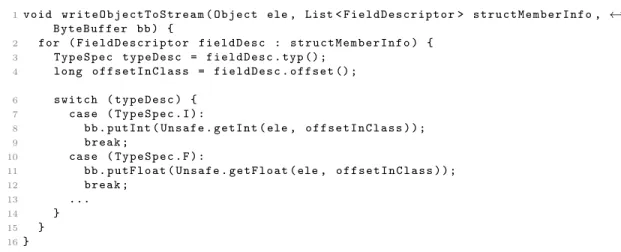
For this code snippet, the center object can be represented by a single Point struct allocated on the accelerator. The first step in creating that allocation is to serialize the JVM object to a byte bu↵er that matches the layout of the OpenCL struct. This can be done using the code template below, which takes as input the object to be transferred to the accelerator, a byte bu↵er to write the serialized object to, and a list of type descriptors and o↵sets for each field in the object being transferred. This field metadata is sorted in the same order as the fields appear in the OpenCL struct definition. The object to be transferred can be loaded by name
using Java reflection.
1 void w r i t e O b j e c t T o S t r e a m ( Object ele , List < F i e l d D e s c r i p t o r > s t r u c t M e m b e r I n f o ,
-B y t e -B u f f e r bb ) { 2 for ( F i e l d D e s c r i p t o r f i e l d D e s c : s t r u c t M e m b e r I n f o ) { 3 T y p e S p e c t y p e D e s c = f i e l d D e s c . typ () ; 4 long o f f s e t I n C l a s s = f i e l d D e s c . offset () ; 6 switch ( t y p e D e s c ) { 7 case ( T y p e S p e c . I ) :
8 bb . putInt ( Unsafe . getInt ( ele , o f f s e t I n C l a s s ) ) ;
9 break ; 10 case ( T y p e S p e c . F ) : 11 bb . p u t F l o a t ( Unsafe . g e t F l o a t ( ele , o f f s e t I n C l a s s ) ) ; 12 break ; 13 ... 14 } 15 } 16}
Figure 3.5 : Code snippet illustrating the serialization of an Object into a ByteBu↵er.
The code snippet in Figure 3.5 relies on the sun.misc.Unsafe package to fetch both the o↵set of a field inside an object as well as the value of that field. The Unsafe package is used rather than Java reflection t