1
Value proposition as a framework for value co-creation in
crowd-funding ecosystem
ABSTRACT
Purpose – The aim of the present paper is to explore whether the phenomenon of crowd funding can be considered a service ecosystem, where the constituent actors generate resources and co-create value for and within the system.
Design/Methodology/approach – A qualitative, multiple case-study approach is used to analyze the two most representative crowdfunding platforms in Spain, Verkami and Lánzanos, in terms of amounts of funds provided
Findings –The findings reveal how six categories of value propositions frame eight types of value co-creation processes when different actors interact and integrate resources at three levels: micro–meso–macro within crowdfunding service ecosystems
Research limitations/implications – Certain limitations to the study arise from the research context. We chose to analyse specific cases of crowd-funding in the arts and cultural sector through the most representative platforms in Spain. The sampling design could be improved by broadening the type of cultural projects considered and by including experiences of crowd-funding projects in other countries in the analysis. Practical implications – From the present study, we can conclude that crowd-funding in the cultural sector in Spain acts as a service ecosystem. The unique approach that links the micro-meso and macro levels with specific types of value propositions assists service managers and practitioners, co-create value propositions and value with different actors within the service ecosystem.
Originality/value – The present paper suggests that crowd-funding in the arts and cultural sector occurs within a complex service ecosystem, where six categories of value propositions frame eight value co-creation processes, namely through ideation, evaluation, design, testing, launch, financing and authorship. Managerial contributions include the development of a crowd-funding service ecosystem model for arts managers, which offers not only a method of financing or economic value, but which also offers opportunities for strengthening bonds with customers and other stakeholders. Our paper is innovative in that we integrate value propositions categories with the micro – meso and macro contexts and analyse the different kind of co-creation are framed in the crowdfunding context.
Key words: Service ecosystems, network, crowd-funding, service-dominant logic, value propositions, value co-creation.
Paper type – Research paper / 1. Introduction.
2 In the last years, several scholars have highlighted the interactive and networked nature of value creation (Gummesson, 2006a; Lusch and Vargo, 2006; Achrol and Kotler, 2012; Grönroos, 2006). Karpen et al, (2012: 21) point out that ‘A central implication of S-D logic is that the notion of superior value cocreation replaces the more prevalent one of superior value provision as the cornerstone of business strategy’. Some authors even refer to a new kind of buesiness model based on actors, interactions and networks (Gummesson 2008b,c, Laamanen and Skalen, 2014). In the present paper, we go in depth with the crowd-funding phenomenon, which we consider vey intresting as it can be considered a new kind of business model where actors are able to exchange value in a context that can be considered an example of value co-creation innovation (as new ways of value co-creation arise) and actors feel free to develop complex roles as the frontiers among buyers, sellers, investors, etc. can be developed by the same person/organization. The Eurpean Comission (2014: 3) has published a report where points out ‘Crowdfunding is a new financial system with its own particularities (...) But crowdfunding is also about atracting the emotional interest of users, setting up channels of identification with platform´s core values and purposes and exploiting the capabilities of social networks, community and proximity. This brings out new interactions between economic efficiency and democratic practices which are distinctive of the crowd-funding market’.
The active role of actors in the crowd-funding business model can be considered an example of good practice because of its capacity to create superior value co-creation in a meaningful way for all the actors and in a continous change, as all the parties feel part of the project and feel free to make new proposals to improve the model.
Although previous papers have analysed the crowd-funding phenomenon (Ordiani et al, 2011; Burtch et al, 2013; Quero and Ventura, 2015), there is scarce of information on the changing role of the actors, their capability to change and their interest on innovating on the way of co-creating value propositions.
The research propositions whose answer we address in the present paper are: P 1. Crowd-funding phenomenon can be cosidered a service (eco)system.
P 2. The 8 Co´s model integrates the eight ways value proposition is co-created among actors.
The research questions are theoretically linked to FP 7 and FP 10, whose strategic themes are related to value in context. Karpen et al. (2012: 25), alingning S-D logic with S-D orientation refer to this research area as one strategic capability, specifically they name it “Individuated interaction capability”, defined as ‘an organization´s ability to understand the resource integration processes, contexts and desired outcomes of individual customers and other value network partners’.
We interpret crowd-funding penomenon as a new generation of service (eco)system as defined by Wieland et al (2012), that has been able to adapt resource integration processes to new contexts meeting all partner´s changing desires/outcomes. In order to better understand how value is exchanged, we identify actors and ways of value co-creation, resulting on eight categories of co-creation that integrates all the possible ways value is co-created. Building on this, our purpose is to contribute to the development of a general theory SD logic, specifically on FP 7 and FP 10 by exploring:
3 - The ecosystem approach is needed to undestand new service models. - The crowd-funding platforms are an example of individuated generation
capability, where the organization have the ability to understand the resource integration process in a way that benefits all parties in the context.
- The value propositiona approach offer different interpretations for every level in the service ecosysten, where eight different ways of co-creating value take place.
The results of the present paper can also contribute to enviroments different from crowd-funding, as the new ways of value co-creation can be transformed into different way of actions that could be used by organizations to stength their relationships with actors (stakeholders).
The paper is divided into seven sections in which research questions are developed in detail. First we analyze the carowd-funding phenomenon and the actors involved on it, second, we study crowdfunding from a network, system and ecosystem perspecvtive; On the fourth section, we adapt the value proposition approach and planning framework to crowdfunding ecosystems and afterwards we connect value co-creation as the basis for valur proposition. Finally, a qualitative empirical approach, where three platform directors in Spain participated, is the baiss for creating the crowdfunding ecosystem model based on value propositions. Some discussion, limitations and directions for future research conclude are offered.
2. Crowd-funding phenomenon: concept and actors involved.
Though the literature on crowd-funded markets is quite limited, there is a growing interest on the different way on which value is exchanged among actors. Ordanini et al. (2011: 444) define crowd-funding as ‘an initiative undertaken to raise money for a new project proposed by someone, by collecting small to medium size investments from several other people (i.e. a crowd)’. In the same sense, Schwienbacher and Larralde (2010: 370) have conceptualised crowd-funding as ‘the financing of a project or a venture by a group of individuals instead of professional parties’; according to Lawton and Marom (2013), crowd-funding platforms facilitate sophisticated service ecosystems, which rely on the participation of expert actors who interact with crowd-funders in order to attain the proposed objectives. Crowd-funding platforms in the arts sector consumers and other actors to actively participate in value co-creation processes, exchanging much more than just money (Burtch et al, 2013; Alves, H., 2013; Russo-Spena and Mele, 2012; Ordanini, et al, 2011). Rather, they provide arts organisations with collaborative value co-creation spaces or service ecosystems with certain unique characteristics, which set it apart from other organisational solutions: ‘(…) crowd-funding, although sharing some characteristics of traditional resource-pooling and social-networking phenomena, has some unique elements related to creating service platforms through which individual consumers can pool monetary resources to support and sustain new projects initiated by others’ (Ordanini et al.,2011: 445).
Ramos (2014) identifies four different types of crowdfunding platforms:
- Equity-based platforms, which specialize in projects that provide investors with tangible benefits.
4 - Lending based platforms, which seek to lend capital in exchange for
interests.
- Rewards-based platforms, which provide rewards, usualy products like DVD, t-shirts, etc in exchange for user´s capital contributions.
- Donation-based platforms, whish seek to attract donations by specific project, mainly of social character, and rewards are non material (solidarity, sense of belonging, etc.).
According to data from Forbes (11/05/2012), the world crowdfunding market 2014 could be broken down as follows: donations (49 %), loans (22%), equity (18%) and rewards (11%). In Spain (where our research is framed), the structure is the same. In 2013 the crowdfunding investments increased 100% and reached the quantity of 19,1 million euros (Infocrowdsourcing, 2013).
Belleflamme, Lambert and Schwienbacher (2012) distinguish between two types of crowd-funding, depending on the actors involved. In the first type of crowd-funding project, the fundamental objective of participating actors is to raise enough money to get the project financed. In such cases, crowd funding is understood as a pre-sale mechanism, in which the financing actor adopts the role of consumer (financing consumer). Alternatively, participation in crowd-funding projects may be motivated by potential financial reward, and the role of participating actors is strictly that of an investor (investors). Ordanini et al. (2011) identify three kinds of actors in the crowd-funding contexts: actors who propose ideas and/or projects to be funded; the ‘crowd’ that decide to finally support certain projects (bearing a risk and expecting a certain payoff) and crowd-funding organizations (platforms), who bring together those who want to deliver and finance new initiatives. Furthermore, Belleflamme et al. (2012) characterises expert actors as actors who have domain expertise and a particular interest in the field or phenomenon in question. Experts often act as advisors for projects and can make informed predictions or require changes to be made in the project.
Regarding research question 2, literature identifies up to seven kind of actors in the crowd-funding context:
Table 1. Actors in the crowd-funding context literature.
Actor name Literature
A 1. Creative core Ordiani et al (2011); Belleflamme et al (2012); Burtch et al (2013); Quero and Ventura, 2015.
A.2. Platforms Ordiani et al (2011) and Quero and Ventura (2015)
A.3. Financing customer Ordiani et al (2011); Belleflamme et al (2012); Burtch et al (2013); Quero and Ventura, 2015.
A 4. Non-financing customers. Quero and Ventura (2015)
A.5. Investors Belleflame et al. (2012); Quero and Ventura (2015)
A.6. Experts Belleflame et al. (2012) and Quero and Ventura (2015)
A.7. Crowdfunding associations World Crowdfunding Federation (WCF); Asociación Española de Crowdfunding (AEC)
5 As the crowdfunding phenomenon has grown in markets. A new actor that literature didn’t include up to this paper is crowdfunding associations. Their role is increasing its importance as they exchange knowledge and experience and invest to benefit all parties in the value co-creation process. Table 1 describes the actors identified in crowd-funding context and their actions and intentions as described in the literature. As a result of the growing interest of crowdfunding, governments are starting to create new laws to regulate the process, what has given the crowdfunding associations still more importance in their role as lobbies to guarantee the benefits of all the actors.
3. Crowd-funding Network, System and (eco)systems.
The terms Network, System and (eco)system, have a common perspective on their approach to the market. Early approaches previous highlighted the importance of value creation in networks (Normann, 2001), and pioneers on this area of research like Gummesson (2006a) and Groonroos (2006) afforded the importance of introducing complexity and networks into the market system approach, like the “Many to many marketing theory” (Gummesson, 2006a), The Viable System Approach (Barile and Polese, 2010), the “context” as a ‘set of unique actors with unique reciprocal links among them’(Chandler and Vargo, 2011: 40), the Systems Thinking as a holistic market conceptualization (Mele et al, 2015) and “The Collective Consumption Network” (Närvänen et al, 2014).
Gummesson (2008b) was one of the first scholars to highlight to identify levels in market relationships (‘special’, ‘mega’ and ‘nano’ relationships). Frow et al. (2014 : 332) conceptualise service ecosystem as ‘the interdependence between actors, their adaptation and evolution’, and, in the same perspective Chandler and Vargo (2011) purpose a multi-level conceptualization of context based on three levels: (1) micro-level; (2) meso-micro-level; and (3) macro level. Above these three levels, there is a meta-layer, that frames exchange among complex networks as service ecosystem. Wieland et al. (2012:13) argue that ‘an actor-to-actor orientation is essential to the ecosystem perspective’.
Following Frow et al. (2014), three levels of relationships are identified to analyse the crowdfunding context: focal actor (micro-level), stakeholder system (meso-level) and service ecosystem (macro-level).
Adopting the service ecosystems theory perspective, actors in service ecosystems co-create value in at micro, meso and macro levels, configuring a dynamic Service Ecosystem (Frow et al. 2014; Di Maggio et al., 1983; Chandler et al., 2011).
Crowdfunding phenomenon can be considered as a way of innovation through institionalization, as platforms and platforms associations can be considered as institutions that guide forces of value determination, as described by Vargo et al. (2013). This way, platforms offer value co-creation opportunities framed on different concepts of value propositions at every stage of the ecosystem and for all the actors. 4. Value proposition and the crowd-funding ecosystem
The ecosystem approach to the crowdfunding phenomenon requires to go in depth with the concept of value propositions. Vargo and Lusch (2004, 2008a,b) have highlighted the importance of the value proposition concept as a related issue of
co-6 creation of value. Vargo (2011: 220) posit ‘S-D logic is essentialy a value co-creation model that sees all actors as resource integrators, tied together in shared systems of exchange –service ecosystems or markets-. In this way, markets are characterised by mutual value propositions and service provision, governes by socially constructed institutions’.
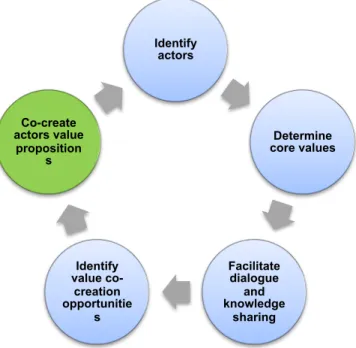
Frow and Payne (2011) propose a iterative planning framework, consisting of five steps coupling the stakeholder concept and value creation with the objetive of co-creating value propositions. We have changed thoe concept of stakeholder by “actor” (As suggested by the S-D logic literature) and adapted the plannig to the crowd-funding context as follows. See the process for value proposition planning framework on Figure 2.
Figure 2. Value proposition planning framework in crowd-funding ecosystems
Source: Adapted from Frow and Payne (2011:233). (1) Identify actors
Literature on crowdfunding identifies seven actors (described in previous sections). But the innovative and open nature of the crowdfunding phenomenon will probably regiter changes as it evolves in time. The capacity of each actor to offer and receive value propositions will determine its permanence o elimination in the process.
(2) Determine core values.
Previous research on crowdfunding (Quero and Ventura, 2015) pointed out the importance given to the system equlibrium by the actors in the decission process, what Gummesson (2008a) addresses as “balanced centricity”. In the same sense, Frow and Payne (2011:234) ‘advocate an approach aimed at increasing company value rather than profit maximization’.
(3) Facilitate dialogue and knowledge sharing.
Identify actors Determine core values Facilitate dialogue and knowledge sharing Identify value co-creation opportunitie s Co-create actors value proposition s
7 Innovative open services (Chesborough, 2003) are inherently based on communication and knowledge sharing. This capacity for dialogue and collaborative capacity is labeled by Lusch et al. (2006) as “mega-competencies”.
(4) Identify value co-creation opportnities.
The open and active nature of all the actors participating in the crowdfunding context offer a context where all agents are “active players”, in the sendse described by Prahalad and Ramashwamy (2004) and they are free to continuouly create new value co-creation opportunities (Frow and Payne, 2011).
(5) Co-create actors´ value propositions.
Finally, SD Logic literature offers different ways to co-create value depending on the context. Russo Spena and Mele purpose a 5 Co´s model in which five ways of value creation are described. Quero and Ventura (2015) describe 7 kind of value co-creation but lack to frame exchanges into a ecosystem that better describes the complex and interconected nature of the crowdfunding phenomenon. We adopt Frow et al.(2014: 340) definition of value proposition to frame our research: ‘dynamic and adjusting mechanism for negotiating how resources are shared within a service ecosystem’. Drawing on this definition, we will analyse how differnt ways of value co-creation in crowd-funding contexts allow the possibily to arise value propositions as the basis for crowd-funding ecosystem.
5. Value co-creation as the basis for value proposition.
To account for the colective dimension of value co-creation, Vargo and Lusch (2008a:5) argue: ‘while we initially fucused on exchange between two parties, we have increasingly tried to make it clear that it needs to be understood that the venue of value (co) creation is the value configurations –economic and social actors within networks interacting and exchanging across and through networks’. In this sense, crowd-funding can be seen as a collective action where the actors offer value propositions through cocreation.
Value cocreation concept has been addressed by diferent autors in service-dominant logic literature. For Karpen et al (2012, p. 15) “the notion of cocreating value refers to asisting customers in co-constructing and engaging in superior experiences”. And Laamanen and Skalén (2014:3) refer to ‘the collective dimension of prectces arguing that value is co-created when firmas and consumers enact prectices congruently’. Frow et al (2014:332) make an intresting analysis of the concept ‘value proposition’ from a service ecosystem perspective: ‘Within a service ecosystem, exchange occurs because no one actor has all the resources to operate in isolation and is therefore required to participate in resource integration practices(...)’. This perspective is in line with the context in crowd-funding ecosystems. It is very intresting how this paper identifies seven kind of value propositions which are linked to the micro-meso-macro level in the ecosystem.
Russo Spena and Mele (2012) conceptualize co-creation as a way for innovation in service and create the ‘5 Co´s Model’ where five categories of co-cretion are found: (1) co-ideation, (2) co-evaluation of ideas, (3) co-design, (4) co-test, (5) co-launch, and Quero and Ventura (2015:125) add two more categories when applying the value co-creation to crowd-funding context: (6) co-investment, (7) co-consumption. Recent literature also purposes new ways of creating value that could be added: (8) co-authorship (Kumar, 2015:55) wich refers to ‘a key mechanism that links different sets of talent to produce a research output’. Althoug their empirical approach is fron the scientific collaborations for research, it can be also applied to the cowdfunding
8 context, which is characterised by a great flexibility where actors can easily change roles.
6. Illustration of Rewards-based crowd-funding platforms in Spain.
Crowd funding is a recent phenomenon, which is transforming how value is co-created in the arts sector. Taking into account the complexity of the information relating to the relationship between actors, this study employs a qualitative methodology, based on an analysis of cases that facilitate the exploration of responses in context, and using a variety of information sources (Yin 2009; Gummesson, 2006b). Gummesson (2006b, p. 171) writes, “(…) addressing the complex reality of management issues, qualitative methodology supported by modern natural sciences is superior to quantitative methodology emanating from traditional natural sciences”. Along the same lines, other authors (Dubois and Gadde, 2002) consider qualitative methods to be the most appropriate for obtaining in-depth information on new phenomena (as is the case of crowd-funding). In designing and structuring the qualitative research in terms of case analysis, the method referred to by Yin (2009) has been used.
As the scope of the study being limited to the cultural sector, case selection was carried out according to a review of cases published on the most dynamic crowd-funding platforms in Spain in terms of proposals of a cultural nature. Following this, purposive sampling was used to select two highly known crowdfunding platforms in Spain: Verkami (http://www.verkami.com/), and Lánzanos (http://www.lanzanos.com/). Informal interviews with the managers of these three platforms allowed us to confirm that they manage around 70 % of the crowd-funding projects in Spain. They also had a common idea of each other´s positioning: Verkami only accepts arts and design projects, and Lánzanos accepts all king of projects (social cultural, technological, etc.). In the cultural context, Verkami represents 70% of the crowd-funding projects. In 2013, Verkami financed 953 projects, 61% more than 2012 and the money raised out of these projects is almost 5 millions €, 89% more than 2012 and 122.000 of financing customers (A3). Verkami has a success level of 70%. Information gathering was carried out using a variety of information sources, with the objective of achieving a more complete and complex understanding of the phenomenon (Järvensivu and Törnroos, 2010). The use of multiple data sources ensured a large number of perspectives, which were required for the qualitative methodology (Yin, 2009). The information analysed contained primary data from in-depth interviews and secondary data obtained from a netnographic study of forums and three crowd-funding platforms selected and the impact of each of the platforms and projects on social networks. The context in which the process of crowd-funding takes place is limited to the Internet and online platforms created to facilitate interaction between participants. This situation meant that a netnographic study, along the lines developed by Kozinets (2002: 62), emerged as the most suitable approach, given that, as the author indicates, ‘(…)“Netnography”, or ethnography on the Internet, is a new qualitative research methodology that adapts ethnographic research techniques to study the cultures and communities that are emerging through computer-mediated communications’. The information obtained from the Internet was coded and analysed using ATLAS.ti software.
9 7. The crowdfunding ecosystem model based on value proposition
The first question to be addressed was to confirm that the actors identified on the crowd-funding literature matched the reality of crowdfunding in Spain. Both platforms, Lánzanos and Verkami agreed to add one more actor: Public institutions. When asking about the characterisation of this relationship, Lánzanos said ‘There was a big need for regulation. I think is good for the market, not to be on an unknown terrain”. About the actions and intentions that describe each actor, the table 1 has the information for each of them, following the answers of the platforms´ leaders.
Table 2. Actors, actions and intentions in corowdfunding.
Actor name Actor actions / intentions
A 1. Creative core Propose ideas and/or projects to be funded Wants his/her project financed
A.2. Platforms Bring together those who want to deliver and finance. They get a benefit from the intermediation process.
A.3. Financing customer Pay to finance the product they want to consume
A 4. Non-financing customers. They don´t pay, but promote and help to get the project´s success
A.5. Investors Fund the project in order to get a potential financial reward. In cultural projects is very unusual, although, as Lánzanos noted “The creative core always has the possibility to decide the kind of reward. One of them can be a financial reward, as it was the case of El Cosmonauta”.
A.6. Experts Have a particular interest in in the field of the phenomenon in question.
A.7. Crowdfunding associations Represents the institutionalization of crowd-funding. They work to improve the processes creating links among actors (mainly platform).
A 8. Public institutions They have increased their presence on the markets, regulating crowd-funding phenomenon and offering a legal context.
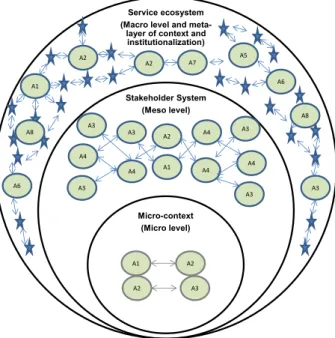
Answering the first research proposition, the results of the qualitative research showed that crowdfunding phenomenon can be considered an ecosystem (See figure 2), where different gropus of actors co-create value at a micro – meso and macro-level. When the platform directors were asked about the relationship among actors and the ecosystem concept, Lánzanos answered: ‘every actor on the crowd-funding context is equally important’ and Verkami “I agree with the idea of ecosystem, as all the actors are important”
10 Based on value proposition, which constitutes a frame where actors co-create several categories of value. The open nature of the service where crowd-funding appears make it difficult to delimitate an specific kind of value co-creation just to an actor. There is no limit for the actors, who sometimes can behave as consumers, sometimes as financers, other times as experts, etc. On the Figure 3 we can observe how the value proposition metaphors frame relationships among actors that co-create value in every level.
Figure 3. Value proposition as a framework for value co-creation in crowd-funding ecosystem
Service ecosystem (Macro level and
meta-layer of context and institutionalization) Stakeholder System (Meso level) Micro-context (Micro level) A1 A2 A2 A3 A4 A3 A4 A3 A3 A4 A3 A3 A4 A1 A4 A2 A1 A2 A2 A7 A5 A6 A3 A6 A8 A8 Service ecosystem
(Macro level and meta-layer of context and institutionalization
Actors
A1, A2, A3, A4, A5, A6, A7, A8
Value proposition ‘wild card’ and
‘journey to a destination’
Stakeholder System (Meso level)
Actors
A1, A2, A3, A4, A5, A6 Value proposition Invitation to play and bridge connectiong our worlds Micro context (Micro-‐level) Value proposition Promise Proposal Value co-‐creation Co-‐ideation, Co-‐evaluation of ideas, Co-‐design, Co-‐test,
Co-‐launch, co-‐investment, co-‐consumption, co-‐ authorship Value co-‐ creation Co-‐ideation, Co-‐evaluation of ideas, Co-‐ design, Co-‐ test, Co-‐ launch, co-‐ investment, co-‐ consumption, co-‐authorship Value co-‐creation Co-‐ideation, Co-‐ evaluation of ideas, Co-‐design, Co-‐test, Co-‐launch, co-‐ investment, co-‐ consumption, co-‐ authorship Actors
11 Following the metaphors that describe six categories of value co-creation by Frow et al. (2014) and the ecosystem levels stablished by Candler and Vargo (2011), the crowdfunding ecosystem organizes into three levels:
a. Micro-context (micro-level):
At this level, there is a direct service-for-service exchange. It is the traditional dyad that Gummesson (2008b, p. 45) called “the classic dyad”, a two-party relationship in which the direct service – for service exchange takes place (Chandler and Vargo, 2011; Madhvaram and Hunt, 2008; Barney et el., 2001).
The exchange at this level is direct: the creative core (A1) wants to get funded from (A2) or (A3) and offers different types of rewards. For example, for the project “7yaert90minutes”, that is a film that is open at Verkami,(03/2015), rewards can go from 10 euros to get a t-shirt in exchange to 800 euros and A2 would be in the credits of the film. As our empirical approach is on rewards- based crowdfunding platforms, there is a dominant use of value proposition as a “promise”, where the actor receives the product (A3 and A4) is not so active. But the system is so flexible that the actor decides in every case if his/her proposal goes beyond the rewards published on the platform. For example, on the interview developed by El Cosmonauta (the first crowdfunded fim in Spain), they received all kind of offers different form money: people who had their cameras, micropones, artists, etc. In this case actors (A3) felt free to offer ‘service’ for ‘service exchange. Although all kind of value co-creation can appear at this stage, the most common is to co-evaluate, co-test, co-investment and co-consumption. In the words of Lánzanos “This is a system of ideas validation. Around 40 to 50% of the projects are modified with respect to the original from the beginning to the end of the campaign’. Although, we can also find the value proposition as a proposal. In the opinion of Verkami “many of the projects are a proposal to involve the client, but cultural projects, that are the dominant category in our platform, don`t change so much”.
b. Stakeholder System (Meso-level):
At this level, there is an indirect service for service exchange through a triad. Apart from the direct service received, there is an interaction between actors receiving the service from the same provider (Chandler and Vargo, 2011; Gummesson, 2006a; Grönroos, 2006). At this stage is where the role of Expert (A6) appears, as relationships increase their complexity and other interest (different form the simple service for service exchange take place). In crowdfunding context, we can identify both categories of value propositions. As considered an ‘invitation to play’, projects on the platforms can be considered an exchange relationship where actors (A2 or A3) offer ideas (co-ideation) about the propcess or, for example, how a game could be developed. Heroquest 25 (Lánzanos platform) is the project with a highest income in the reward-based category in Spain (680.037 €) and one of the key elements of its developmet was “customers and other actors were collaborators”. Both categories of value proposition can take place at this stage:
- Invitation to play and bridge connecting our worlds: actors, like financing customers (A4) pay to achieve beneficial outcome (the product, a Tshirt, etc).
- Buiding bridges: refers to both sides working for the project. Not always happens, but sometimes does. In this sense, Lánzanos said “the experst are people who want to hel to the entrepreneur on its business”.
12 c. Ecosystem (macro level, meta layer of context):
The service becomes complex, as it includes direct and indirect service, creating a network (Gummesson, 2006a; 2008, 2009). In this network, actors, dyads and triads create synergy among multiple simultaneous direct and indirect service – for service exchanges (Achrol and Kotler, 1999, 2012; Kogut, 2009; White, 2002; Felzensztein et al., 2009). Different kind of actors with different interests co-create value in order to get their project delivered. New actors appear: platforms associations (A7), who work for the common benefits of all actors (the produce information, disseminate information, and, as stated by Verkami ‘act as lobby with authorities, for example when crowdfunding was to be regulated in Spain”. A second new actor appears at this stage: public institutions. In the opinion of Lánzanos ‘Their role is more and more active, not only as regulating, but also they are interested on the benefit this new way of exchange generates’.
At this stage, platforms and platforms associations, represent the institutionalization of the crowd-funding ecosystem in the sense described by Edvardsson et al (2014: 301): ‘Institutions emerge in the creation and recreation of service systems and service systems are designed to enable value co-creation’. The institutionalization of crowdfunding has brought new actors to the System: the government and other actors who think crowdfunding needs to be regulated as any other economic activity. As a result, world associations of crowdfunding have aggregated as lobbies for the sector not to be damaged. We could even refer to these relationships as a conflictual value co-creation, in the sense described by Laamanen and Skalen (2014).
Two metaphors shape the value proposition at this stage: ‘wild card’ would refer to gaining awareness of the potential of disruptive, disintermediating, playing-field altering, opportunities and threats that impact any actors (Frow et al, 2011). As Lánzanos stated ‘all actors play at the same level, there are no categories (superior/inferior) among them’. Regarding the “journey to a destination”, Both, Verkami and Lánzanos agreed on the fact that “there is an emotional link between the creative core and the consumers”. Also, there is an emotional link between the platform and their clients, as Verkami says “we have an increasing number of clients that come to the webpage just to have a look and look for interesting projects to support (…) we are entrepreneurs helping others entrepreneurs for success”.
Discussion
Based on the findings, crowd-funding can be considered a service ecosystem, where seven actors “come together” as the context offer positive synergies for all actors involved. Crowd-funding service ecosystems are complex in the sense described by Gummesson (2006a), as many different actors participate in them, and their structure and functioning include much broader functions than mere financing; they are structures which are created to enable value co-creation for all of the various actors through the application of the resources of all participants in order to create a market-oriented and relationship-based market offering. The three conditions stated by Chandler and Vargo (2011),Lusch et al. (2010) and Frow and Payne (2011) to be considered an ecosystem are present in crowd-funding context:
(a) Service offerings are co-produced. (b) There is an exchange of service offering. (c) Value is co-created.
13 As stated by Frow et al (2014:339) ‘value propositions represent a fundamental component of marketing strategy, as they determine resource commitment (…). A value proposition supports the well being of the ecosystem as it sets out the resource sharing that sustains each actor’. The present research frames value co-creation into value propositions, and value propositions into each stage of the ecosystem, offering a frame for strategic planning. Although the empirical approach has been developed in the crowdfunding context, the theoretical approach give us the possibility to apply it to other systems or (eco) systems.
Implications, limitations and directions for future research
The present paper has important implications for practitioners and scholars. With respect to managers, in the cultural milieu relationships between actors have traditionally been a determining factor in the management of cultural organisations’ (Quero and Ventura, 2009; Hume, 2008). Although relational marketing theories already contained this perspective (Frow and Payne, 2011), the “Crowd-funding ecosystem” proposed constitutes a significant contribution, because it sheds light on the ecosystem theory. It will be necessary, therefore, from a strategic planning point of view, to include the following actions when an ecosystem is identified:
a. Identification of all of the actors in an arts crowd funding service ecosystem. b. Identification of the co-creation processes between actors and specification of
the types of co-creation (the 8 Co-s model).
c. Identification of value proposition strategies that frame value co-creation. From a tactical point of view, the empirical analysis covered the processes which are carried out in each of the different types of co-creation and for each of the various actors, the context provided by social networks and the Internet means that, up to now, this field of communication is of particular relevance from the perspective of strategy planning and design.
Concerning implications for scholars, we point out that the essence of this study lies in its ability to understand the crowd-funding ecosystem providing a theoretical model which puts the concept of ecosystem based on interconnections between actors through value propositions strategies that frame different kind of valur co-creation. Crowd-funding can be considered an ecosystem, where context frames exchange. From this perspective, the interviews carried out show: that all of the agents who are part of the crowd-funding relationship network generate resources and create value for the system (FP 9). This means that, the context of value creation is a network of networks (Vargo and Lusch, 2008), and large-scale social structures and institutions evolve relative to the individual service efforts of actors, dyads, triads and complex networks (Chandler and Vargo, 2011).
The results of the present research could be used as a foundation for future studies which go into greater depth concerning the types of value created in crowd-funding, the practices which reflect such behaviour and the marked tendency towards interconnection between agents which facilitates the emergence and maintenance of ecosystems. It will be also interesting to analyse how other contexts different from
14 crowd-funding could learn from it and develop innovative strategies based on value network.
Certain limitations to the study arise from the research context. We chose to analyse specific cases of crowd-funding through the most representative platforms in Spain. The sampling design could be improved by broadening the type of cultural projects considered and by including experiences of projects in other countries in the analysis. This study gives rise to many potential channels for carrying out future research. It would be interesting to check the validity of the theoretical model developed against environments other than the cultural setting. Platforms like Verkami are increasing their demand for technological projects and enterprises. In fact, they have just launched Seedquick (https://www.seedquick.com/), where new types of crowd-funding projects (different from cultural and social ones) will be offered.
Furthermore, a more in-depth study of the different factors which underlie the emergence of sustainable ecosystems would be recommended. The crowd-funding phenomenon is just one formula which, with the context offered nowadays by new technologies and the Internet, has found a suitable environment for certain projects. However, the evolution of the world of technology and the growing interrelation between actors will continue to facilitate the development of new models, which it will be interesting to include from a theoretical and empirical point of view.
From the present research paper we can conclude that crowd-funding context in the cultural sector in Spain acts as a a servjce ecosystem, where seven kind of actors (the creative core, the platform, the financing customers, non-financing customers, investors, experts and public institutions co-create eight types of value (co ideation, valuation of ideas, design, test, launch, investment, co-consumption and co-authoring). These kind of value co-creation can be framed on six value proposition strategies. Future research will allow an increase in the value proposition strategies, knowledge about funding contexts and how crowd-funding works in other sectors different from creative industries and other countries.
References
Achrol R and Kotler P (1999) Marketing in the network economy. Journal of marketing 63 (2): 146-163.
Achrol,RS and Kotler P (2012) Frontiers of the marketing paradigm in the third millennium. Journal of the Academy of marketing Science 40 (1): 35-52.
Alves H (2013) Co-creation and innovation in public services. The Service Industries Journal 33(7-8): 671–682.
Asociación Española de Crowdfunding (2015). Available at:
http://web.spaincrowdfunding.org/ (accessed 11 January /2015).
Barile S and Polese F (2010) Linking the viable system and many-to-many network approaches to service-dominant-logic and service science. International Journal of Quality and Service Sciences 2(1): 23-42.
Barney J, Wright M and Ketchen D Jr (2001) Resource-based theories of Competitive advantage: A ten years retrospective on a resource-besed view. Journal of Management 27 (6): 643-50.
Belleflamme P Lambert T and Schwienbacher A (2012) Individual crowdfunding
15
http://creationetfinancement.files.wordpress.com/2012/12/individual-crowdfunding-practices.pdf (accessed on april 2013).
Burtch G, Ghose A and Wattal S (2013) An empirical examination of the antecedents and consequences of contribution patterns in crowd-funded markets. Information Systems Research 24(3): 449-519.
Chandler JD and Vargo SL (2011) Contextualization and value-in-context: How context frames exchange. Marketing Theory 11(1): 35-49.
Charman-Anderson S (2012) Crowdfunding raised $ 1,5bn in 2011, Set to double in
2012. Forbes 11, May, 12. Available at:
http://www.forbes.com/sites/suwcharmananderson/2012/05/11/crowdfunding-raised-1-5bn-in-2011-set-to-double-in-2012/ (accessed 04/02/2015).
Chesborough H (2003) Open Innovation: The New Imperative for for Creating and Profiting from Technology. Cambridge: Harvard Business School Press.
DiMaggio PJ and Powell WW (1983) The iron cage revisited: Institutional isomorphism and collective Rationality in Organizational Fields. American Sociological Review 48: 147-60.
Dubois A and Gadde L (2002) Systematic combining: an abductive approach to case research. Journal of Busieness Research 55(7): 553-60.
Edvardsson B, Kleinaltenkamp M, Tronvoll B, McHugh P and Windahl C (2014) Institutional logics matter when coordinating resource integration. Marketing Theory 14(3): 291-309.
Felzenstein C and Gimmon E (2009) Social networks and marketing cooperation in entrepreneurial clusters: an international comparative study. Journal of International Entrepreneurship 7(4): 281-291.
Frow P and Payne A (2011) A stakeholder perspective of the value proposition concept. European Journal of Marketing. 45(1/2): 223-240.
Frow P, McColl-Kennedy JR, Hilton T, Davidson A, Payne A and Brozovic D (2014) Value propositions: a service ecosystems perspective. Marketing Theory 14(3): 327-351.
Grönroos C (2006) What can service offer to marketing theory. In: Lush F and Vargo SL (eds.) The Service – Dominant Logic of Marketing: Dialog, Debate and Directions New York: ME Sharpe, pp. 354-364.
Gummesson E (2006a) Many to many marketing as grand theory: a Nordic School contribution. In In: Lush F and Vargo SL (eds.) The Service – Dominant Logic of Marketing: Dialog, Debate and Directions New York: ME Sharpe, pp.339-353. Gummesson E (2006b) Qualitative research in management. Management Decission
44(2): 167 – 179.
Gummesson E (2008a) Extending the service-dominant logic: from customer centricity to balanced centricity, Journal of the Academy of Marketing Science 36: 1–10.
Gummesson E (2008b) Total Relationship Marketing. Oxford: Butterworth– Heinemann.
Gummesson E (2008c) Quality, service-dominant logic and many-to-many marketing. The TQM Journal 20 (2): 143-153.
Gummesson E and Grönroos C (2012) The emergence of the new service marketing: Nordic School perspectives. Journal of Service Management 23: 479 – 497.
Gummesson E and Polesse F (2009) B2B is not an island, Journal of Business and Industrial Marketing 24(5/6): 337-50.
16 Jarvensivu T and Törnroos JA (2010) Case study research with moderate constructionism: conceptualization and practical illustration. Industrial Marketing Management 39(1): 100-8.
Karpen IO, Bove LL, and Lukas BA (2012) Linking Service Dominant Logic and Strategic Business Prectice: A conceptual Model of a Service-Dominant Orientation. Journal of Service Research 15(1): 21-38.
Kought B (2009) The network of knowledge: Generative rules and the emergende of structure. Strategic Management Journal 21:405-25.
Kozinets R (2002) The field behind the screen: using netnography for marketing research in online communities. Journal of Marketing Research 39(1): 61-72. Kumar S (2015) Co-authorship networks: a review of the literature. Aslib Journal of
Information 67(1): 55-73.
Laamanen M and Skalen P (2014) Collective-conflictual value co-creation: a strategic action field approach. Marketing Theory 14 (3): 1-20.
Lánzanos (2015) Available at: http://www.lanzanos.com/ (accessed 10 September 2014).
Lawton K and Marom D (2013) Crowd-funding Revolution, USA: Mc-Graw Hill. Leith JM (2013) What is an enterprise ecosystem Available at http://www.jackmartinleith.com/enterprise-ecosystem/(accessed 01/09/2015).
Lusch RF and Vargo SL (2006) Service-dominant logic as a foundation for a general theory. In: Lusch R and Vargo S (eds) The service dominant logic of marketing: Dialog, debate and directions. NY: ME Sharpe, pp 406-420.
Lusch RF, Vargo SL and Malter AJ (2006) Marketing as a service exchange: taking a leadership role in global marketing management. Organizational Dynamics 35(3): 264-278.
Madhavaran S and Hunt S (2008) The service dominant logic and a hierarchy of operant resources: developing masterful operant resources and implications for marketing strategy, Journal of the Academy of Marketing Science 36: 67-82. Mele C, Pels J and Storbacka K (2015) A holistic market conceptualization. Journal
of the Academy of Marketing Science. 43:100-114.
Närvänen E, Gummesson E and Kuusela H (2014) The collective consumption Network. Managing Service Quality 24(6): 545-564.
Normann R (2001) Reframing Business: when the map changes the landscape. Chichester. UK: John Wiley and Sons.
Ordiani A, Miceli L, Pizzetti M, and Parasuraman A (2011) Crowd-funding: transforming customers into investors through innovative service platforms, Journal of Service Management 22 (4): 443-470.
Prahalad CK and Ramashwamy V (2004) Co-opting customer competence. Harvard Business Review 78 (1): 79-90.
Quero MJ and Ventura R (2009) The Role of Stakeholders in the Management of Cultural Organisations. The Case of Performing Arts Organisations in Spain. Journal of Relationship Marketing 8: 19 – 37.
Quero MJ and Ventura R (2015) The role of balanced centricity in the Spanish creative industries adopting a crowd-funding organizational model. Journal of Service Theory and Prantice 25(2): 122-139.
Ramos J (2014) Crowdfunding and the role of managers in ensuring the sustainability of crowdfunding platforms. Institute for prospective technological studies. European Union.
Russo-Spena T and Mele C (2012) Five Co-s” in innovating: a practice-based view. Journal of Service Management 23(4): 527-553.
17 Schwienbacher A and Larralde B (2010) Crowdfunding of Entrepreneurial Ventures. In: Cumming D (eds) The Oxford Handbook of Entrepreneurial Finance. Oxford: Oxford University Press.
Vargo SL (2011) Market Systems, stakeholders and value propositions. Towards a service-dominant logic-based theory of the market. European Journal of Marketing 45(1/2): 217-222.
Vargo SL and Lusch RF (2008b) Why “service”? Journal of the Academy of Marketing Science 36: 25–38.
Vargo SL and Lusch RF (2004) Evolving to a new dominant logic for marketing, Journal of Marketing 68(1): 1–17.
Vargo SL and Lusch RF (2008a) Service-dominant logic: continuing the evolution, Journal of the Academy of Marketing Science 36: 1–10.
Vargo SL, Wieland H and Akaka MA (2013) Innovation through institutionalization: A service ecosystems perspective. Industrial Marketing Management 44(1): 63-72. Verkami (2015) Available at: http://www.verkami.com/ (accessed 10 September
2014).
White H (2002) Business mobilize production through markets: Parametric modeling of path-dependent outcomes in oriented network flows. Complexity, 8(1): 87-95. Wieland H, Polese F, Vargo and Lusch R (2012) Toward a service (eco)system
perspective on value creation. International Journal of Service Science, Management Engineering, and Technology 3(3): 12-25.
World Crowdfunding Federation (2015). Available al:
http://www.worldcrowdfund.org/ (accessed 11 January 2015).